
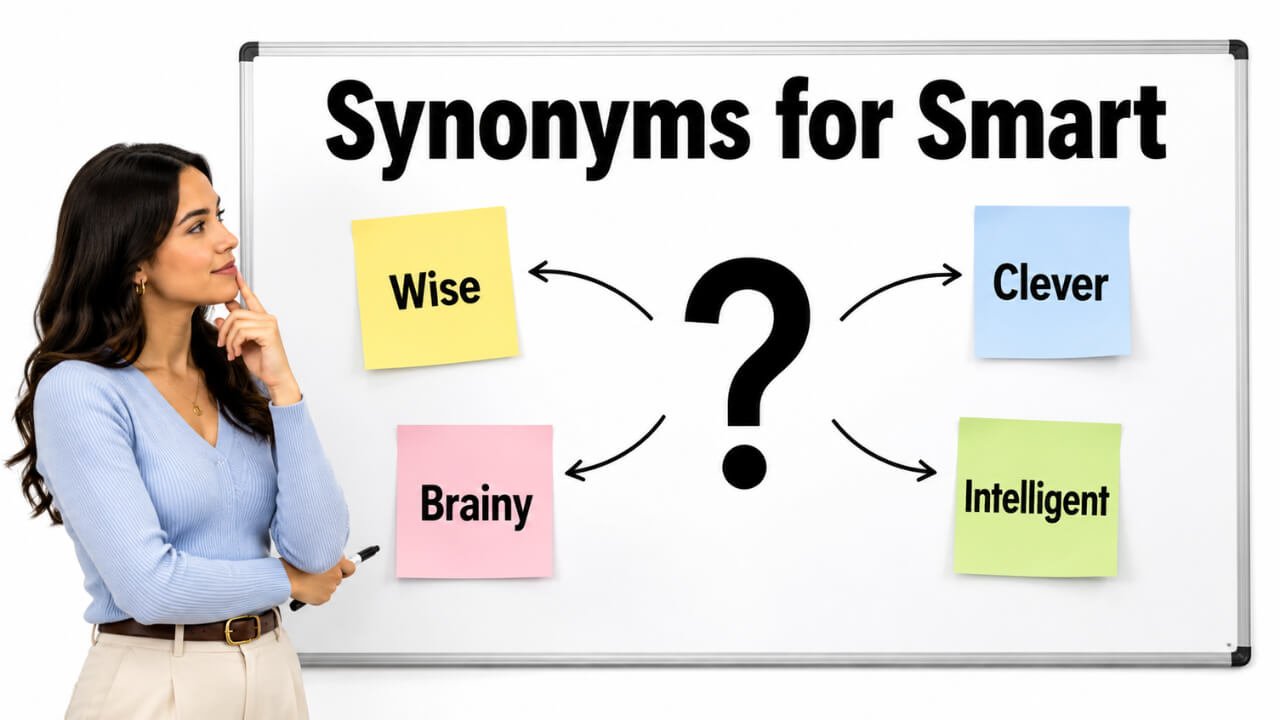
Quick Answer: The best synonyms for smart include intelligent, clever, bright, brilliant, sharp, wise, astute, savvy, knowledgeable, and stylish. Use intelligent for general mental ability, clever for quick thinking, bright for natural learning ability, brilliant for exceptional talent, astute for strong judgment, savvy for practical understanding, and stylish when “smart” means neat or fashionable.
Pronunciation and Word Details
Word: Smart.
Pronunciation: /smɑːrt/.
Part of Speech: Adjective.
Meaning: Smart means intelligent, quick thinking, well judged, stylish, or technologically advanced, depending on context.
US Pronunciation:
UK Pronunciation:
What Does “Smart” Mean?
Smart means having intelligence, good judgment, quick understanding, or a neat and stylish appearance.
The word smart is most often used as an adjective. It can describe a person, idea, decision, outfit, device, answer, strategy, or action. In grammar, it usually comes before a noun or after a linking verb.
Example: She is a smart student.
Example: That was a smart choice.
Example: He wore a smart suit.
In different sentence contexts, “smart” can mean mentally intelligent, practically wise, quick in response, polished in appearance, or advanced in function.
Meaning, Tone, and Context of “Smart”
Smart has a positive and flexible tone. It can be casual, neutral, professional, conversational, or descriptive, depending on how it is used.
Casual Tone: “Smart” is common in everyday speech when describing a person who understands things quickly.
Formal Tone: In professional or academic writing, words like intelligent, astute, capable, knowledgeable, or perceptive may sound more precise.
Positive Tone: Smart usually suggests ability, good judgment, or attractive presentation.
Style Context: Smart can describe neat clothing, polished appearance, or elegant design.
Technology Context: Smart can describe a device or system that uses advanced features or automation.
Because “smart” has several meanings, the best synonym depends on whether you are talking about intelligence, quick thinking, practical judgment, appearance, or technology.
When and How to Use “Smart”
For Intelligence: Use “smart” when someone learns quickly, understands ideas well, or solves problems effectively.
Example: She is smart enough to handle a difficult project.
For Quick Thinking: Use “smart” when someone responds fast or finds a clever solution.
Example: His smart reply helped calm the situation.
For Good Judgment: Use “smart” when a choice is sensible, practical, or well planned.
Example: Saving money early is a smart decision.
For Style: Use “smart” when clothing, appearance, or design looks neat, polished, or attractive.
Example: He looked smart in a clean black jacket.
For Technology: Use “smart” when a device, tool, or system has advanced features.
Example: The smart system adjusts the settings automatically.
For Praise: Use “smart” when you want to compliment ability, effort, or thinking.
Example: That was a smart way to explain the answer.
Best Synonyms for Smart
Synonym: Intelligent.
Meaning: Having strong mental ability and understanding.
Example: She is an intelligent learner with strong reasoning skills.
Synonym: Clever.
Meaning: Quick at solving problems or creating useful ideas.
Example: His clever plan saved time and effort.
Synonym: Bright.
Meaning: Naturally quick to learn and understand.
Example: The bright child understood the lesson quickly.
Synonym: Brilliant.
Meaning: Exceptionally intelligent, talented, or impressive.
Example: Her brilliant answer impressed the whole class.
Synonym: Sharp.
Meaning: Quick, alert, and mentally active.
Example: He has a sharp mind for details.
Synonym: Wise.
Meaning: Showing good judgment and deep understanding.
Example: It was wise to check the facts before replying.
Synonym: Astute.
Meaning: Able to understand situations and make good judgments.
Example: The manager made an astute decision during the meeting.
Synonym: Savvy.
Meaning: Having practical knowledge and real world understanding.
Example: She is savvy about money and planning.
Synonym: Knowledgeable.
Meaning: Having a lot of information or expertise about a subject.
Example: He is knowledgeable about grammar and vocabulary.
Synonym: Stylish.
Meaning: Neat, fashionable, or attractive in appearance.
Example: She wore a stylish coat to the event.
50 Synonyms for Smart with Short Meanings
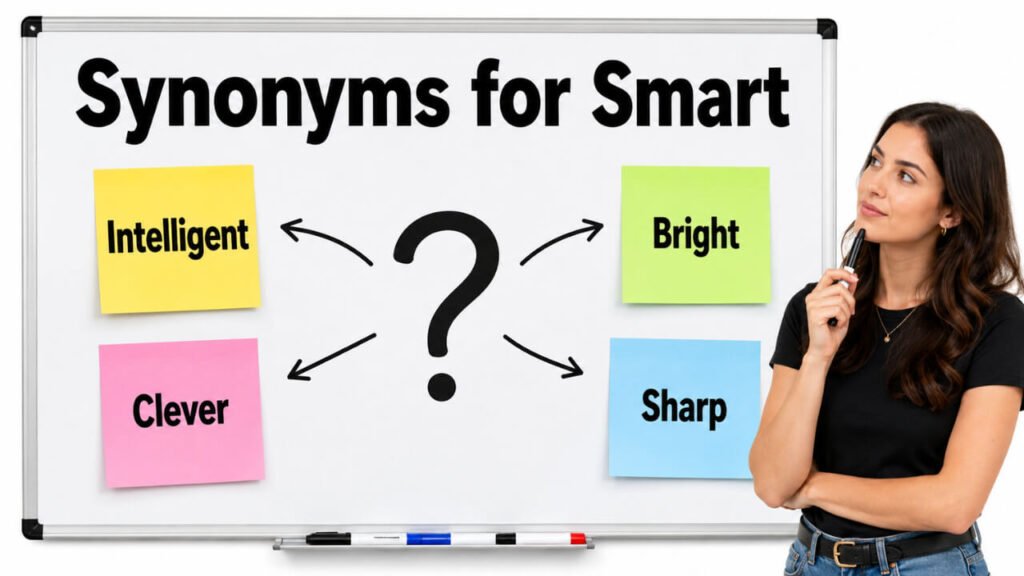
- Intelligent: Having strong mental ability.
- Clever: Quick at finding good solutions.
- Bright: Quick to learn and understand.
- Brilliant: Exceptionally intelligent or talented.
- Sharp: Mentally alert and quick.
- Wise: Showing good judgment.
- Astute: Good at understanding situations.
- Savvy: Practically knowledgeable.
- Knowledgeable: Well informed about a subject.
- Brainy: Very intelligent in a casual way.
- Gifted: Naturally talented or intelligent.
- Talented: Having strong natural ability.
- Capable: Able to do things well.
- Skilled: Having learned ability.
- Competent: Able to perform effectively.
- Insightful: Able to understand deeper meaning.
- Perceptive: Good at noticing and understanding things.
- Discerning: Able to judge carefully.
- Judicious: Showing careful and wise judgment.
- Sensible: Practical and reasonable.
- Practical: Useful and based on good judgment.
- Resourceful: Able to solve problems with available means.
- Inventive: Good at creating new ideas.
- Creative: Able to think in original ways.
- Ingenious: Very clever and original.
- Quick thinking: Able to respond fast and well.
- Alert: Mentally awake and aware.
- Witty: Quick and amusing with words.
- Articulate: Able to express ideas clearly.
- Logical: Based on clear reasoning.
- Rational: Guided by reason.
- Thoughtful: Careful and considerate in thinking.
- Reasonable: Fair and sensible.
- Prudent: Careful and wise about decisions.
- Strategic: Planned with a clear purpose.
- Shrewd: Good at judging practical matters.
- Tactful: Smart in handling sensitive situations.
- Educated: Having formal knowledge or learning.
- Learned: Having deep knowledge.
- Academic: Related to study and learning.
- Sophisticated: Advanced, refined, or worldly.
- Polished: Refined in style or behavior.
- Elegant: Graceful and stylish.
- Neat: Clean and orderly in appearance.
- Classy: Stylish and tasteful.
- Chic: Fashionable and stylish.
- Dapper: Neat and stylish in dress.
- Sleek: Smooth, modern, and stylish.
- Advanced: Highly developed or modern.
- Automated: Able to work with smart control or programmed action.
Read Also:
Synonyms for And
Synonyms for Smart by Context
When Smart Means Intelligent
Use these synonyms when “smart” describes mental ability, learning, reasoning, or understanding.
Synonyms: Intelligent, bright, brilliant, brainy, gifted, knowledgeable.
Example: She is an intelligent student who learns new concepts quickly.
Example: His brilliant explanation made the topic easier to understand.
When Smart Means Clever
Use these synonyms when “smart” means quick, inventive, or good at solving problems.
Synonyms: Clever, sharp, quick thinking, resourceful, ingenious, inventive.
Example: The clever solution fixed the issue without extra cost.
Example: Her resourceful approach helped the team finish early.
When Smart Means Wise
Use these synonyms when “smart” means sensible, careful, practical, or well judged.
Synonyms: Wise, sensible, prudent, judicious, practical, reasonable.
Example: It was wise to read the instructions before starting.
Example: Choosing a simple layout was a practical decision.
When Smart Means Perceptive
Use these synonyms when “smart” means good at understanding people, situations, or hidden details.
Synonyms: Astute, perceptive, insightful, discerning, shrewd, savvy.
Example: His astute comments showed a deep understanding of the problem.
Example: She gave an insightful answer during the discussion.
When Smart Means Stylish
Use these synonyms when “smart” describes appearance, clothing, design, or presentation.
Synonyms: Stylish, elegant, polished, neat, classy, chic, dapper, sleek.
Example: He looked polished in a clean suit and formal shoes.
Example: The room had a sleek and modern design.
When Smart Means Advanced
Use these synonyms when “smart” describes technology, systems, tools, or automatic features.
Synonyms: Advanced, automated, modern, digital, connected, responsive.
Example: The advanced system adjusts settings without manual control.
Example: The automated feature saves time during daily tasks.
Another Word for Smart
The best single replacement for “smart” is intelligent when you mean mental ability. However, the best alternative depends on context. Use clever for quick ideas, wise for good judgment, stylish for appearance, and advanced for technology.
Original: She is a smart student.
Better Option: She is an intelligent student.
Original: That was a smart answer.
Better Option: That was a clever answer.
Original: He made a smart choice.
Better Option: He made a wise choice.
Original: She wore a smart dress.
Better Option: She wore a stylish dress.
When Not to Use “Smart”
Do not use “smart” when a more exact synonym would explain your meaning better. Since “smart” has several meanings, it can sound vague if the context is not clear.
Weak: He is smart at work.
Better: He is highly capable at work.
Weak: That was a smart report.
Better: That was an insightful report.
Weak: She wore a smart outfit to the event.
Better: She wore an elegant outfit to the event.
Weak: The device is smart.
Better: The device is advanced and automated.
Weak: He gave a smart comment.
Better: He gave a perceptive comment.
Avoid “smart” when writing formal evaluations, academic work, detailed reviews, or technical descriptions where a precise word would help the reader more.
Words Commonly Confused With Smart
Smart vs Intelligent: Smart is broader and can mean intelligent, stylish, or practical. Intelligent focuses mainly on mental ability.
Smart vs Clever: Smart can describe general ability, while clever often means quick, inventive, or good at finding solutions.
Smart vs Wise: Smart may refer to quick understanding, while wise refers to good judgment and experience.
Smart vs Brilliant: Smart means intelligent or capable, while brilliant suggests exceptional intelligence or talent.
Smart vs Sharp: Smart is general, while sharp often means mentally quick, alert, and good with details.
Smart vs Stylish: Smart can mean neat and fashionable, while stylish focuses mainly on appearance.
Smart vs Savvy: Smart can be general intelligence, while savvy means practical knowledge, especially in real life situations.
Smart vs Advanced: Smart can describe technology with useful features, while advanced means highly developed or modern.
Which Synonym Should You Choose?
Choose intelligent when describing mental ability, learning, reasoning, or understanding.
Choose clever when writing about quick ideas, problem solving, or creative answers.
Choose bright when describing someone who learns quickly, especially in a positive and simple way.
Choose brilliant when the person, idea, or answer is exceptionally impressive.
Choose sharp when someone notices details quickly or thinks fast.
Choose wise when writing about good judgment, maturity, or careful decisions.
Choose astute when writing formally about strong understanding of situations.
Choose savvy when describing practical knowledge in daily life, work, or planning.
Choose knowledgeable when someone knows a lot about a subject.
Choose stylish when “smart” refers to clothing, appearance, design, or presentation.
Choose advanced when “smart” describes technology, systems, tools, or devices.
Real Life Examples of “Smart” in Sentences
Original: She is a smart student.
Better Option: She is an intelligent student.
Original: That was a smart idea.
Better Option: That was a clever idea.
Original: He made a smart decision.
Better Option: He made a wise decision.
Original: The speaker gave a smart answer.
Better Option: The speaker gave an insightful answer.
Original: She looked smart at the dinner.
Better Option: She looked elegant at the dinner.
Original: He is smart with money.
Better Option: He is savvy with money.
Original: The team used a smart strategy.
Better Option: The team used a strategic plan.
Original: The child is very smart.
Better Option: The child is very bright.
Original: The office has smart lighting.
Better Option: The office has automated lighting.
Original: His smart observation changed the discussion.
Better Option: His perceptive observation changed the discussion.
Synonym Groups and Usage Differences
Intelligence Group
This group describes mental ability, learning power, and understanding. Use it when “smart” means someone can think, learn, or reason well.
Synonyms: Intelligent, bright, brilliant, brainy, gifted, knowledgeable.
Example: The intelligent student understood the difficult concept quickly.
Cleverness Group
This group describes quick thinking, problem solving, and original ideas. Use it when “smart” means mentally quick or inventive.
Synonyms: Clever, sharp, ingenious, inventive, resourceful, quick thinking.
Example: His ingenious method solved the problem in minutes.
Judgment Group
This group describes careful choices, mature thinking, and practical decisions.
Synonyms: Wise, sensible, prudent, judicious, practical, reasonable.
Example: Taking notes before the meeting was a sensible choice.
Perception Group
This group describes the ability to notice details, understand people, or read situations well.
Synonyms: Astute, perceptive, insightful, discerning, shrewd, savvy.
Example: Her perceptive question revealed the main issue.
Style Group
This group describes clothing, appearance, design, or presentation.
Synonyms: Stylish, elegant, polished, neat, classy, chic, dapper.
Example: He arrived in a polished outfit for the interview.
Technology Group
This group describes modern systems, tools, or devices with advanced functions.
Synonyms: Advanced, automated, modern, digital, connected, responsive.
Example: The automated system reduced manual work.
Antonyms of Smart
Unintelligent: Lacking mental ability or understanding.
Foolish: Showing poor judgment.
Dull: Slow to understand or not mentally sharp.
Ignorant: Lacking knowledge or information.
Slow: Taking longer to understand or respond.
Naive: Lacking practical experience or judgment.
Unwise: Not showing good judgment.
Careless: Not thinking carefully before acting.
Clumsy: Awkward in action, expression, or judgment.
Unskilled: Lacking ability or training.
Unfashionable: Not stylish or current.
Shabby: Untidy, worn, or not smart in appearance.
Outdated: No longer modern or advanced.
Basic: Simple and not advanced.
Ordinary: Not special, sharp, or impressive.
Comparison: Smart vs Related Words
Smart vs Intelligent
Smart is broader because it can mean intelligent, stylish, practical, or advanced. Intelligent mainly describes mental ability.
Example With Smart: She is smart and learns quickly.
Example With Intelligent: She is intelligent and understands complex ideas.
Smart vs Clever
Smart can describe general ability or good judgment. Clever focuses more on quick thinking, creative solutions, or skillful ideas.
Example With Smart: That was a smart way to handle the problem.
Example With Clever: That was a clever trick to save time.
Smart vs Wise
Smart can mean quick or intelligent. Wise suggests experience, maturity, and careful judgment.
Example With Smart: He made a smart choice for the project.
Example With Wise: He made a wise choice after considering the risks.
Smart vs Bright
Smart is a general word for intelligence or ability. Bright often describes natural learning ability and quick understanding.
Example With Smart: The smart child solved the puzzle.
Example With Bright: The bright child learned the rule immediately.
Smart vs Brilliant
Smart means capable or intelligent. Brilliant means exceptionally intelligent, impressive, or outstanding.
Example With Smart: She gave a smart answer in class.
Example With Brilliant: She gave a brilliant answer that surprised everyone.
Smart vs Sharp
Smart describes intelligence or good judgment. Sharp emphasizes alertness, speed, and attention to detail.
Example With Smart: He is smart enough to manage the task.
Example With Sharp: He has a sharp eye for small mistakes.
Smart vs Stylish
Smart can describe a neat and polished appearance. Stylish focuses more directly on fashion, taste, and visual appeal.
Example With Smart: He looked smart in his formal clothes.
Example With Stylish: He looked stylish in his tailored jacket.
Common Phrases and Expressions With Smart
Smart Choice: A sensible or beneficial decision.
Smart Move: A clever or practical action.
Smart Idea: A useful or clever thought.
Smart Person: Someone intelligent or capable.
Smart Student: A learner who understands quickly.
Smart Answer: A clever, clear, or well judged reply.
Smart Casual: Neat clothing that is relaxed but still polished.
Smart Look: A clean, stylish, or polished appearance.
Smart Thinking: Good judgment or clever reasoning.
Smart Device: A modern device with advanced features.
Common Mistakes to Avoid
Mistake: Using “smart” when the meaning is too broad.
Better Choice: Use a more exact word like intelligent, clever, wise, stylish, or advanced.
Mistake: Calling every good idea “smart.”
Better Choice: Use clever for quick ideas, practical for useful ideas, and strategic for planned ideas.
Mistake: Using “smart” for clothing when the reader may think of intelligence.
Better Choice: Use stylish, polished, elegant, or neat for appearance.
Mistake: Repeating “smart” too often in one paragraph.
Better Choice: Replace repeated use with context based alternatives.
Mistake: Using “smart” when describing deep knowledge.
Better Choice: Use knowledgeable, learned, educated, or expert when the focus is subject knowledge.
Mistake: Using “smart” for technology without explaining the feature.
Better Choice: Use advanced, automated, connected, or responsive to show what the technology does.
Mistake: Confusing “smart” with “wise.”
Better Choice: Use wise when the focus is judgment, experience, and careful decision making.
Conclusion
Understanding synonyms for smart helps you choose clearer words for different meanings. Use intelligent for mental ability, clever for quick ideas, wise for good judgment, astute for strong perception, savvy for practical knowledge, and stylish for appearance. When writing about technology, advanced or automated may be more accurate. Since “smart” can describe people, choices, clothing, and devices, the best synonym always depends on context.
FAQs About Synonyms for Smart
What is the best synonym for smart?
The best synonym for smart is intelligent when you mean mental ability. For quick thinking, clever is often better.
What is a formal synonym for smart?
Formal synonyms for smart include intelligent, astute, perceptive, judicious, knowledgeable, capable, and discerning.
What is a casual synonym for smart?
Casual synonyms for smart include clever, bright, sharp, brainy, savvy, and quick thinking.
Can smart mean stylish?
Yes, smart can mean neat, polished, or stylish in appearance. For example, “a smart outfit” means a clean and attractive outfit.
What is another word for a smart person?
Another word for a smart person is intelligent person. Other options include bright person, clever person, brilliant thinker, or knowledgeable person.
What is the difference between smart and wise?
Smart often means intelligent or quick thinking. Wise means showing good judgment, maturity, and careful understanding.
What is the opposite of smart?
The opposite of smart can be unintelligent, foolish, dull, ignorant, unwise, shabby, or outdated, depending on the meaning.
