
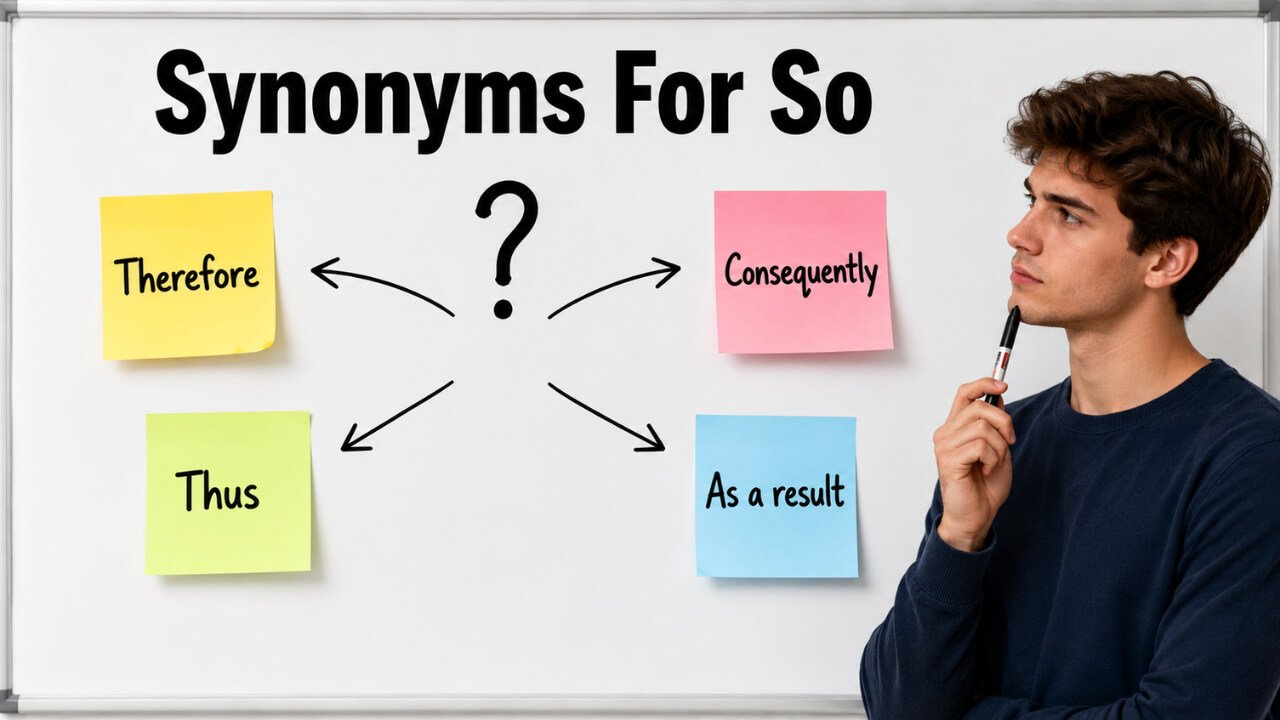
Quick Answer: Synonyms for so include therefore, thus, accordingly, consequently, hence, very, extremely, in that way, as a result, and for that reason. The best synonym depends on context. Use therefore in formal writing, so in casual speech, thus for academic tone, very or extremely for emphasis, as a result for cause and result, and in that way when describing manner or method.
Pronunciation and Word Details
Word: So.
Pronunciation: /soʊ/.
Part of Speech: Adverb, conjunction, and discourse marker.
Meaning: So can mean therefore, very, in that way, for that purpose, or as a result, depending on the sentence.
US Pronunciation:
UK Pronunciation:
What Does “So” Mean?
So means: In that way, to that degree, or as a result.
So is a flexible word in English. It can work as an adverb, conjunction, intensifier, sentence connector, or conversational marker. Its meaning changes based on sentence position and context.
So can show result.
Example: It was raining, so we stayed inside.
So can show degree or emphasis.
Example: The movie was so interesting.
So can show manner.
Example: Hold the brush so.
So can introduce a conclusion.
Example: So, what should we do next?
So can also connect ideas in speech or writing, especially when explaining cause, effect, purpose, or response.
Meaning, Tone, and Context of “So”
So is common, natural, and conversational. It is one of the most flexible words in everyday English. It can sound casual, neutral, polite, emotional, or explanatory, depending on how it is used.
In formal writing, so is sometimes replaced with therefore, thus, accordingly, or consequently. In casual speech, so often sounds more natural than formal alternatives.
Casual Tone: I was tired, so I went home early.
Formal Tone: The data was incomplete. Therefore, the results were limited.
Emotional Tone: I am so happy for you.
Academic Tone: The sample size was small. Thus, the conclusion should be limited.
Conversational Tone: So, what happened after that?
Instructional Tone: Fold the paper so it fits inside the envelope.
When and How to Use “So”
For Result: Use so to show that one action or situation caused another.
Example: The road was closed, so we took another route.
For Degree: Use so before an adjective or adverb to show intensity.
Example: The answer was so clear.
For Purpose: Use so with that to explain why something is done.
Example: She spoke slowly so that everyone could understand.
For Manner: Use so to mean in this way or in that way.
Example: Arrange the chairs so they face the front.
For Conversation Flow: Use so to begin a question, conclusion, or new point.
Example: So, what is your final decision?
For Emphasis: Use so to make an emotion or description stronger.
Example: I am so grateful for your help.
For Agreement: Use so in short responses to confirm a statement.
Example: I think so.
Best Synonyms for So
Therefore: For that reason or as a result.
Example: The request was incomplete. Therefore, it was returned.
Thus: As a result or in this way.
Example: The rule was changed, thus improving the process.
Consequently: As a result of something.
Example: The team missed the deadline. Consequently, the launch was delayed.
Accordingly: In a way that matches the situation or result.
Example: The instructions changed, and the staff acted accordingly.
Hence: For this reason or from this point.
Example: The plan was too costly, hence the need for revision.
As a result: Because of what happened before.
Example: The system failed. As a result, the report was delayed.
For that reason: Because of the stated cause.
Example: The room was full. For that reason, the meeting moved outside.
Very: To a high degree.
Example: The lesson was very helpful.
Extremely: To a very great degree.
Example: The task was extremely difficult.
In that way: By that method or manner.
Example: Explain it in that way so the idea becomes clearer.
50 Synonyms for So with Short Meanings
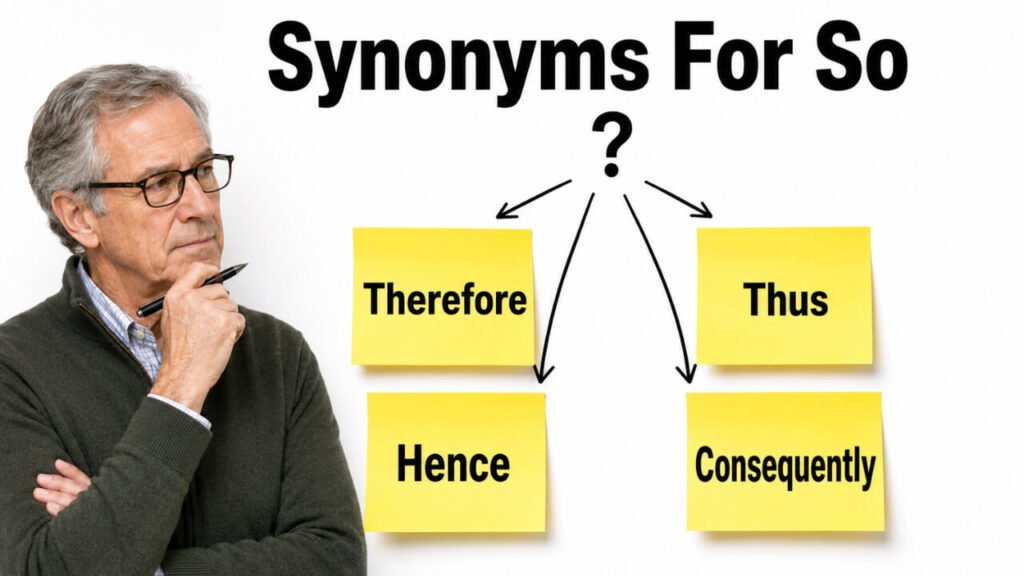
- Therefore: For that reason.
- Thus: As a result or in this way.
- Consequently: As a result of something.
- Accordingly: In a way that fits the situation.
- Hence: For this reason.
- As a result: Because of what happened.
- For that reason: Due to the stated cause.
- For this reason: Because of this fact.
- That is why: Explaining the reason something happened.
- Because of that: Due to the previous point.
- Due to this: As a result of this situation.
- In consequence: As a natural result.
- It follows that: The logical result is.
- As such: Because of that condition or role.
- Then: As a result or next in order.
- In that case: If that situation is true.
- In turn: As a following result.
- Thereby: By that action or means.
- Wherefore: For which reason, very formal.
- Ergo: Therefore, often used in logical explanation.
- Very: To a high degree.
- Extremely: To a very great degree.
- Highly: To a strong degree.
- Greatly: Very much.
- Deeply: Strongly or intensely.
- Really: Very or truly.
- Truly: Genuinely or strongly.
- Quite: Fairly, completely, or very, depending on context.
- Rather: Somewhat or fairly.
- Incredibly: To an unusually high degree.
- Remarkably: In a noticeably strong way.
- Exceptionally: More than usual.
- Particularly: Especially or specifically.
- Especially: More than usual or more than others.
- Too: More than needed or also.
- That much: To that degree.
- To such a degree: With that level of intensity.
- To that extent: To that amount or level.
- In that way: By that method or manner.
- Like that: In that manner.
- In this way: By this method.
- In such a manner: In that particular way.
- Similarly: In a similar way.
- Likewise: In the same way.
- Also: In addition.
- Indeed: Used for confirmation or emphasis.
- Well: Used to begin or continue a response.
- Now: Used to introduce a point or next step.
- Since: Because or from the time that.
- So that: In order that or for the purpose of.
Read Also:
Synonyms for Effective
Synonyms for So by Context
When So Means Therefore
Use these synonyms when so connects a cause to a result.
Therefore: The answer was incomplete. Therefore, it needed revision.
Consequently: The road was blocked. Consequently, traffic slowed down.
As a result: The file was missing. As a result, the work stopped.
For that reason: The weather was unsafe. For that reason, the trip was cancelled.
When So Means Very
Use these synonyms when so increases the strength of an adjective or adverb.
Very: The instructions were very clear.
Extremely: The room was extremely quiet.
Highly: The method was highly effective.
Really: The answer was really helpful.
When So Means In That Way
Use these synonyms when so explains manner, method, or style.
In that way: Write it in that way for better clarity.
Like that: Hold the handle like that.
In this way: In this way, the process becomes easier.
In such a manner: The message was written in such a manner that everyone understood it.
When So Means For That Purpose
Use these synonyms when so explains purpose or intention.
So that: I saved the file so that I could use it later.
In order that: She explained slowly in order that the class could follow.
For the purpose of: The notes were prepared for the purpose of review.
With the aim that: He spoke clearly with the aim that no one would misunderstand.
When So Means Also or Likewise
Use these synonyms when so shows similarity or agreement.
Also: She agreed, and I also agreed.
Likewise: He was tired, and she felt likewise.
Similarly: The first answer was correct. Similarly, the second answer was acceptable.
As well: He joined the discussion, and she joined as well.
When So Starts a Conversation
Use these synonyms when so introduces a question, conclusion, topic, or next point.
Well: Well, what should we do next?
Now: Now, let us look at the main issue.
Then: Then, what is the final answer?
In that case: In that case, we should begin again.
Another Word for So
Another word for so: Therefore is often the best single replacement for so when so means as a result. However, the best alternative depends on meaning. Use very when so shows degree, in that way when it shows manner, so that when it shows purpose, and well when it begins a conversational response.
Original: It was late, so we left.
Better Option: It was late. Therefore, we left.
Original: The answer was so simple.
Better Option: The answer was very simple.
Original: Hold the paper so.
Better Option: Hold the paper in that way.
Original: Speak clearly so everyone understands.
Better Option: Speak clearly so that everyone understands.
When Not to Use “So”
Avoid so when it makes writing too casual, repetitive, vague, or unclear. In formal writing, therefore, thus, consequently, or as a result often sound stronger.
Weak: The report was late, so the review was late, so the meeting was delayed.
Better: The report was late. As a result, the review was delayed, and the meeting had to be moved.
Weak: The topic is so important.
Better: The topic is highly important.
Weak: The evidence was missing, so the conclusion was weak.
Better: The evidence was missing. Therefore, the conclusion was weak.
Weak: She was so happy and so excited and so grateful.
Better: She was delighted, excited, and deeply grateful.
Weak: Do it so.
Better: Do it in this way.
Words Commonly Confused With So
So vs Therefore: So is more casual and conversational. Therefore is more formal and better for essays, reports, and explanations.
So vs Thus: So is common in everyday speech. Thus sounds more formal and is often used in academic or logical writing.
So vs Very: So and very can both show degree, but so often feels more emotional or conversational.
So vs Too: So means to a high degree. Too means more than needed or more than suitable.
So vs Such: So usually comes before adjectives or adverbs. Such usually comes before noun phrases.
So vs Because: So introduces a result. Because introduces a reason.
So vs Since: So can show result. Since can show reason or time.
So vs Then: So can show result or transition. Then can show time order, next step, or result.
Which Synonym Should You Choose?
Choose therefore when writing formal conclusions, essays, explanations, or logical results.
Choose thus when writing academic, technical, or structured arguments.
Choose consequently when showing a clear result from a previous action.
Choose as a result when explaining cause and effect in simple, clear language.
Choose for that reason when you want a direct and readable result phrase.
Choose very when so means to a high degree in simple writing.
Choose extremely when the degree is stronger than very.
Choose in that way when so means by that method or manner.
Choose so that when explaining purpose or intention.
Choose well when starting a casual answer or moving a conversation forward.
Real Life Examples of “So” in Sentences
Original: It was cold, so we closed the windows.
Better Option: It was cold. Therefore, we closed the windows.
Original: The test was so difficult.
Better Option: The test was extremely difficult.
Original: She studied hard, so she passed.
Better Option: She studied hard. As a result, she passed.
Original: I wrote it so everyone could understand.
Better Option: I wrote it so that everyone could understand.
Original: The answer was so clear.
Better Option: The answer was very clear.
Original: He explained it so.
Better Option: He explained it in that way.
Original: The system failed, so the data was lost.
Better Option: The system failed. Consequently, the data was lost.
Original: So, what should we do now?
Better Option: Well, what should we do now?
Original: The message was so powerful.
Better Option: The message was highly powerful.
Original: I think so.
Better Option: I believe that is correct.
Synonym Groups and Usage Differences
Result Group
This group explains cause and result. Use it when one idea happens because of another.
Synonyms: Therefore, consequently, accordingly, as a result, for that reason.
Example: The documents were missing. Therefore, the approval was delayed.
Degree Group
This group shows intensity before adjectives or adverbs.
Synonyms: Very, extremely, highly, greatly, really.
Example: The explanation was extremely useful.
Manner Group
This group explains how something is done.
Synonyms: In that way, like that, in this way, in such a manner.
Example: Arrange the parts in this way to avoid confusion.
Purpose Group
This group explains intention or reason for an action.
Synonyms: So that, in order that, for the purpose of, with the aim that.
Example: She spoke slowly so that everyone could follow.
Agreement Group
This group shows similarity, confirmation, or agreement.
Synonyms: Likewise, similarly, also, as well, indeed.
Example: He accepted the idea, and she agreed as well.
Conversation Group
This group introduces a new point, response, or conclusion.
Synonyms: Well, now, then, in that case.
Example: Well, let us begin with the main question.
Antonyms of So
Nevertheless: Shows contrast instead of result.
However: Introduces an opposite or different idea.
Yet: Shows contrast despite the previous point.
Although: Introduces a condition that contrasts with the main idea.
But: Connects a contrasting idea.
Despite that: Means something happens even with the previous fact.
Still: Shows something continues or remains true.
Not very: Opposite of so when so means very.
Slightly: To a small degree.
Barely: Almost not or only just.
Hardly: Almost not at all.
Differently: Opposite of so when so means in that way.
Comparison: So vs Related Words
So vs Therefore
Difference: So is common and conversational. Therefore is formal and better for logical conclusions.
Example With So: It was raining, so we stayed home.
Example With Therefore: It was raining. Therefore, we stayed home.
So vs Thus
Difference: So sounds natural in speech. Thus sounds more academic or formal.
Example With So: The rule changed, so the process improved.
Example With Thus: The rule changed, thus improving the process.
So vs Consequently
Difference: So is simple and broad. Consequently clearly shows a result and sounds formal.
Example With So: The file was missing, so the work stopped.
Example With Consequently: The file was missing. Consequently, the work stopped.
So vs Very
Difference: So can show strong feeling or degree. Very is more neutral and direct.
Example With So: I am so pleased with the result.
Example With Very: I am very pleased with the result.
So vs Too
Difference: So means to a high degree. Too means more than needed or more than suitable.
Example With So: The tea is so hot.
Example With Too: The tea is too hot to drink.
So vs Such
Difference: So usually modifies adjectives and adverbs. Such usually modifies noun phrases.
Example With So: It was so beautiful.
Example With Such: It was such a beautiful scene.
So vs Because
Difference: So introduces the result. Because introduces the reason.
Example With So: I was tired, so I rested.
Example With Because: I rested because I was tired.
So vs Since
Difference: So usually gives the result. Since can give the reason or show time.
Example With So: The shop was closed, so we returned home.
Example With Since: Since the shop was closed, we returned home.
Common Phrases and Expressions With So
So What: A phrase used to ask why something matters.
So Far: Up to this point.
So Much: A large amount or strong degree.
So Many: A large number.
So That: In order that or for the purpose that.
So Long: Goodbye or for such a long time, depending on context.
So Called: Used to show that a name or description may be doubtful or only claimed.
So To Speak: Used when a phrase is not literal.
I Think So: Used to show belief or mild agreement.
Even So: Despite that or nevertheless.
Common Mistakes to Avoid
A common mistake is using so too often in formal writing. Repeated so can make a paragraph sound casual or weak. Replace it with therefore, as a result, consequently, or thus when the tone needs to be more professional.
Another mistake is confusing so with because. So gives the result, while because gives the reason.
Weak: I was late because I missed the bus, so because the traffic was bad.
Better: I was late because I missed the bus. The traffic was also bad, so I arrived even later.
Writers also confuse so with too. So hot means very hot. Too hot means hotter than suitable.
Avoid vague sentence openings like So, in formal essays unless it helps the flow. Use therefore, in conclusion, or as a result when the meaning needs to be clearer.
Avoid using so before nouns when such is needed.
Weak: It was so a difficult question.
Better: It was such a difficult question.
Conclusion
Synonyms for so depend on how the word works in a sentence. Use therefore, thus, consequently, or as a result when so shows result. Use very, extremely, or highly when it shows degree. Use in that way when it shows manner, and so that when it shows purpose. Since so has many meanings, the best synonym is the one that matches the sentence context clearly.
FAQs About Synonyms for So
What is the best synonym for so?
Answer: The best synonym for so is therefore when so means as a result. When so means very, the best synonym is very or extremely.
What is a formal synonym for so?
Answer: Formal synonyms for so include therefore, thus, consequently, accordingly, and hence.
What is another word for so in essays?
Answer: In essays, use therefore, thus, as a result, consequently, or for that reason instead of casual so.
Can so mean very?
Answer: Yes. So can mean very when it comes before an adjective or adverb, as in so beautiful or so quickly.
Is so the same as therefore?
Answer: Not always. So can mean therefore, but it can also mean very, in that way, so that, or a conversational transition.
What is the opposite of so?
Answer: The opposite depends on meaning. For result, opposites include however and nevertheless. For degree, opposites include slightly, barely, and hardly.
What can I use instead of so many?
Answer: Instead of so many, you can use a large number of, numerous, many, countless, or a great number of, depending on tone.
