
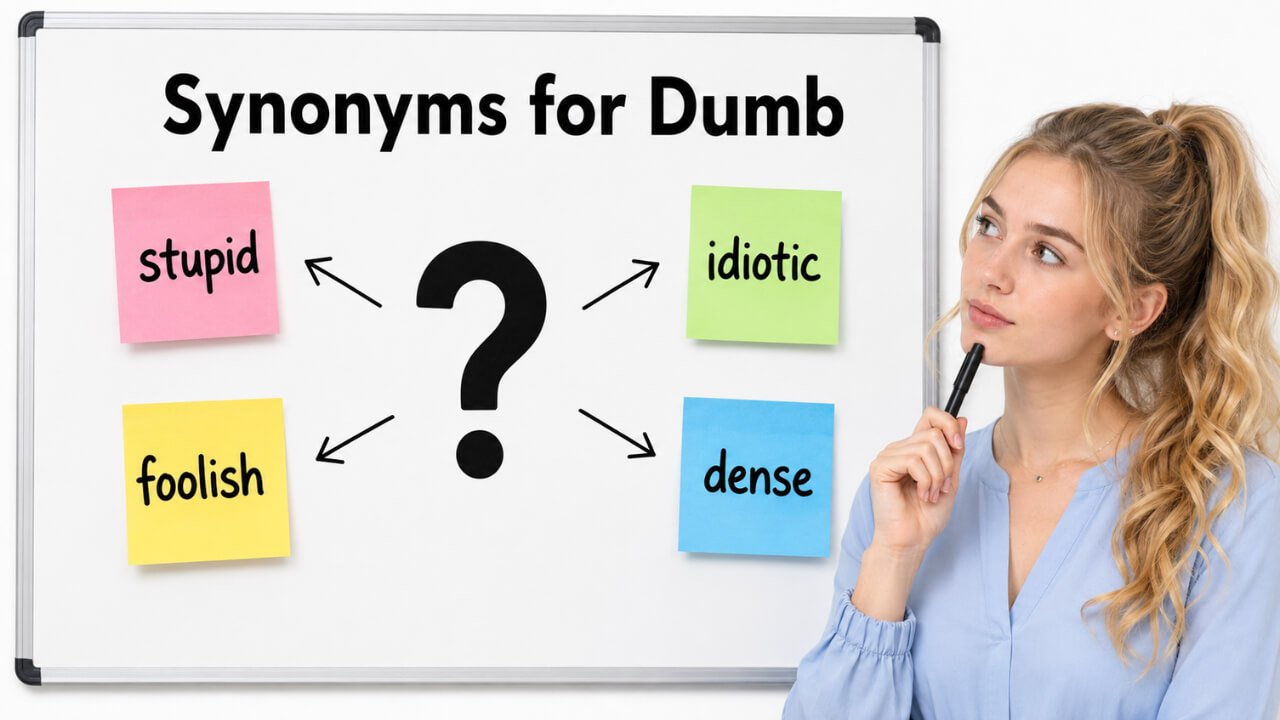
Quick Answer: Synonyms for dumb include foolish, unwise, silly, unintelligent, clueless, uninformed, illogical, irrational, speechless, and basic. Use foolish for a decision that shows poor judgment, unwise for formal advice, and silly for a harmless mistake. Uninformed and clueless describe a lack of knowledge, while illogical and irrational suit weak reasoning. Speechless relates to being unable to speak because of emotion, and basic describes technology with limited features. Avoid calling a person dumb because the word can sound rude and insulting.
Pronunciation and Word Details
Word: Dumb.
Pronunciation: /dʌm/.
Part of Speech: Adjective.
Meaning: Dumb commonly means foolish or unintelligent, but it can also describe silence or something with only basic functions.
US Pronunciation:
UK Pronunciation:
What Does “Dumb” Mean?
Dumb commonly means foolish, unintelligent, or lacking good judgment. It is an adjective used to describe a person, decision, question, mistake, idea, action, or device.
When dumb describes a decision or action, it suggests that the choice was poorly considered. When it describes an idea or argument, it may suggest that the reasoning is weak or illogical.
The word can also mean temporarily unable to speak, especially because of surprise or shock. In technology, dumb may describe a device that performs only basic functions and cannot process complex information.
Calling a person dumb can sound disrespectful. More precise words such as uninformed, confused, inexperienced, unwise, or mistaken usually communicate the intended meaning more clearly.
Meaning, Tone, and Context of “Dumb”
Dumb is a casual, direct, and usually negative word. It frequently appears in everyday conversation when someone wants to criticize an idea, action, mistake, or decision.
The tone may range from playful to strongly insulting. Saying that a small mistake was dumb may sound light or self critical. Calling another person dumb, however, can attack that person’s intelligence and sound unnecessarily harsh.
In formal, academic, and professional writing, dumb is often too vague. Words such as unwise, impractical, illogical, irrational, uninformed, or poorly considered provide a clearer meaning.
The word also appears in older expressions related to silence. However, it should not be used carelessly to describe people with speech or communication disabilities. Accurate terms such as nonspeaking, nonverbal, or unable to speak may be more respectful when they correctly fit the context.
When and How to Use “Dumb”
For Poor Judgment: Use dumb informally for a choice or action that was not sensible.
Example: Leaving the documents at home was a dumb mistake.
For a Foolish Idea: The word may describe a suggestion that appears unlikely to work.
Example: Ignoring the safety instructions would be a dumb idea.
For Weak Reasoning: Dumb can informally criticize an argument that does not follow logic.
Example: His conclusion sounded dumb because it ignored the evidence.
For Lack of Knowledge: People sometimes use dumb when they feel confused or uninformed.
Example: I felt dumb because I did not understand the instructions.
For Temporary Silence: Dumb may describe someone who cannot speak because of shock or surprise.
Example: The unexpected announcement left the audience dumb with amazement.
For Basic Technology: Dumb may describe a device with limited processing or communication abilities.
Example: The building uses a dumb sensor that only records temperature.
For Respectful Writing: Replace dumb with a word that explains the exact problem.
Example: The applicant was inexperienced with the software, not dumb.
Best Synonyms for Dumb
Foolish: Showing poor judgment or a lack of practical sense.
Example: It was foolish to ignore the warning signs.
Unwise: Not sensible or likely to produce a good result.
Example: Making a large purchase without checking the budget would be unwise.
Silly: Foolish in a harmless, playful, or unimportant way.
Example: We laughed about the silly misunderstanding.
Unintelligent: Not showing strong intellectual ability or careful thought.
Example: The proposal was based on an unintelligent assumption.
Clueless: Having little or no understanding of a situation.
Example: I was clueless about the new registration process.
Uninformed: Lacking the knowledge needed to form a reliable opinion.
Example: The criticism came from an uninformed viewpoint.
Illogical: Not following a clear or reasonable pattern of thought.
Example: The conclusion was illogical because it contradicted the facts.
Irrational: Not guided by reason or sensible judgment.
Example: His fear of the harmless object seemed irrational.
Speechless: Temporarily unable to speak because of surprise or emotion.
Example: The generous gesture left her speechless.
Basic: Having only simple functions or limited features.
Example: The basic device cannot process complex commands.
50 Synonyms for Dumb with Short Meanings
- Foolish: Showing poor judgment or little practical sense.
- Unwise: Not sensible or carefully considered.
- Silly: Foolish in a harmless or playful way.
- Senseless: Lacking meaning, reason, or purpose.
- Absurd: Completely unreasonable or difficult to believe.
- Ridiculous: Extremely unreasonable or deserving criticism.
- Irrational: Not controlled by clear reason.
- Illogical: Not following a sensible pattern of thought.
- Thoughtless: Acting without considering the effects.
- Careless: Failing to give enough attention.
- Imprudent: Failing to consider risks or consequences.
- Misguided: Based on incorrect beliefs or poor judgment.
- Nonsensical: Making no logical or practical sense.
- Preposterous: Extremely unreasonable or unbelievable.
- Ludicrous: So unreasonable that it appears laughable.
- Asinine: Extremely foolish or lacking sense.
- Idiotic: Very foolish or unreasonable.
- Unintelligent: Not showing intelligence or careful thought.
- Dim: Informally slow to understand something.
- Dense: Informally unable to understand something easily.
- Obtuse: Slow or unwilling to understand an idea.
- Witless: Lacking intelligence or good judgment.
- Mindless: Done without thought or attention.
- Brainless: Showing no careful thought or intelligence.
- Slow Witted: Taking longer to understand or respond.
- Dull Witted: Lacking quick understanding or mental sharpness.
- Simpleminded: Having limited understanding or judgment.
- Clueless: Having no useful understanding of a situation.
- Uninformed: Lacking important knowledge or information.
- Ignorant: Lacking knowledge about a particular subject.
- Unaware: Not knowing that something exists or is happening.
- Naive: Lacking experience or practical understanding.
- Inexperienced: Lacking knowledge gained through practice.
- Inept: Lacking skill or ability in a particular task.
- Incompetent: Unable to perform a task properly.
- Unskilled: Lacking the training or ability needed.
- Incapable: Unable to complete a particular action successfully.
- Speechless: Temporarily unable to speak because of emotion.
- Silent: Not speaking or making any sound.
- Wordless: Expressed without spoken or written words.
- Quiet: Making little sound or saying very little.
- Mute: Not producing speech or sound.
- Voiceless: Having no voice or opportunity to express an opinion.
- Nonspeaking: Communicating without spoken language.
- Nonverbal: Using little or no spoken language.
- Uncommunicative: Unwilling or unable to communicate openly.
- Basic: Having only simple functions or features.
- Simple: Not advanced, complex, or highly developed.
- Rudimentary: Limited to the earliest or most basic level.
- Noninteractive: Unable to respond intelligently to user input.
Read Also:
Synonyms For Control
Synonyms for Dumb by Context
When Dumb Means Foolish
Foolish, unwise, silly, careless, thoughtless, imprudent, and misguided describe decisions or actions that show poor judgment.
Foolish is the strongest general alternative. It focuses on the action rather than directly attacking someone’s intelligence. Unwise sounds more formal and works well in advice, reports, and professional communication.
Silly is more suitable for a minor or harmless mistake. Imprudent describes a decision made without properly considering possible risks.
Example: It was foolish to leave without checking the address.
Example: Approving the plan without reviewing the costs would be imprudent.
When Dumb Means Unintelligent
Unintelligent, dim, dense, obtuse, witless, mindless, and dull witted can describe weak understanding or poor thinking.
These alternatives often sound judgmental when applied directly to a person. In respectful writing, describe the specific problem instead of making a broad statement about intelligence.
For example, a person may be confused, inexperienced, distracted, or unfamiliar with a subject. None of these conditions necessarily means that the person lacks intelligence.
Example: The argument relied on an unintelligent assumption.
Example: His response seemed obtuse because it ignored the main question.
When Dumb Means Uninformed
Clueless, uninformed, ignorant, unaware, naive, and inexperienced describe missing knowledge, awareness, or experience.
Clueless is casual and often humorous. Uninformed is neutral and suitable for formal writing. Ignorant means lacking knowledge about a particular subject, not lacking intelligence in general.
Naive suggests limited experience or an overly trusting view. Inexperienced describes someone who has not yet developed knowledge through practice.
Example: I was clueless about the application process.
Example: The statement reflected an uninformed understanding of the issue.
When Dumb Means Silent
Speechless, silent, wordless, quiet, mute, voiceless, and uncommunicative relate to silence or communication.
Speechless is the best option when surprise, joy, anger, or shock temporarily prevents someone from speaking. Silent means not speaking or making sound. Wordless describes communication without words.
Mute has traditional uses related to silence, but it should be used carefully when discussing a person. Nonspeaking or nonverbal may be more accurate in certain communication contexts.
Example: The final result left everyone speechless.
Example: She remained silent throughout the discussion.
When Dumb Describes Simple Technology
Basic, simple, rudimentary, limited, and noninteractive describe technology that does not have advanced processing or communication features.
Basic is usually the clearest general alternative. Rudimentary suggests that the design is at an early or undeveloped stage. Noninteractive means that a device or program cannot respond dynamically to a user.
These alternatives provide more detail than dumb and create a more professional technical tone.
Example: The system uses a basic sensor with limited functions.
Example: The information appears on a noninteractive display.
Another Word for Dumb
Foolish is often the best single replacement for dumb when describing a mistake, idea, action, or decision. It communicates poor judgment without directly claiming that someone lacks intelligence.
However, the best alternative depends on the intended meaning. Choose unwise for formal advice, silly for a harmless mistake, illogical for weak reasoning, uninformed for missing knowledge, and basic for simple technology.
Original: That was a dumb decision.
Better Option: That was a foolish decision.
Original: It would be dumb to ignore the instructions.
Better Option: It would be unwise to ignore the instructions.
Original: His explanation sounds dumb.
Better Option: His explanation sounds illogical.
Original: This is a dumb electronic device.
Better Option: This is a basic electronic device.
When Not to Use “Dumb”
Avoid using dumb when it directly insults a person or fails to explain the real problem. The word may sound rude, childish, vague, or overly emotional.
In formal writing, dumb rarely provides enough detail. A decision may be unwise, an argument may be illogical, a person may be uninformed, and a device may be basic. Each alternative communicates a more precise meaning.
Avoid using dumb when discussing speech or communication disabilities. Choose accurate and respectful language that describes the person’s actual communication method.
Weak: The employee was dumb about the procedure.
Better: The employee was unfamiliar with the procedure.
Weak: She gave a dumb answer.
Better: She gave an inaccurate answer based on a misunderstanding.
Weak: The manager made a dumb financial choice.
Better: The manager made an imprudent financial choice.
Weak: The machine uses dumb technology.
Better: The machine uses basic technology with limited processing features.
Words Commonly Confused With Dumb
Dumb vs Foolish: Dumb may criticize intelligence, while foolish usually describes a particular action, idea, or decision that shows poor judgment.
Dumb vs Stupid: Both words can sound insulting. Stupid is often stronger, while dumb has additional meanings related to silence and simple technology.
Dumb vs Ignorant: Dumb may suggest weak intelligence or judgment. Ignorant means lacking knowledge about a particular subject.
Dumb vs Clueless: Clueless means having little understanding of a situation. It is usually more casual and less severe than dumb.
Dumb vs Unwise: Unwise describes a decision that is not sensible. It is more formal and less insulting than dumb.
Dumb vs Illogical: Illogical specifically describes reasoning that does not follow a sensible pattern. Dumb is broader and less precise.
Dumb vs Speechless: Speechless means temporarily unable to speak because of strong emotion. It does not suggest low intelligence.
Dumb vs Basic: Basic describes something with simple functions or limited development. It is clearer when discussing technology.
Which Synonym Should You Choose?
Choose foolish when describing a decision, action, mistake, or idea that shows poor judgment.
Choose unwise when giving formal advice or warning someone about a risky choice.
Choose silly when the mistake is harmless, playful, or not serious.
Choose careless when the problem occurred because someone failed to pay attention.
Choose imprudent when a decision was made without considering risks or consequences.
Choose illogical when an argument, explanation, or conclusion does not follow reason.
Choose irrational when a fear, reaction, belief, or action is not controlled by sensible thought.
Choose clueless in casual conversation when someone has no understanding of a situation.
Choose uninformed in essays, reports, emails, and professional communication when someone lacks important knowledge.
Choose ignorant when the person lacks knowledge about a specific subject, but avoid using it as a general insult.
Choose speechless when strong emotion temporarily prevents someone from speaking.
Choose silent when someone is not speaking or when a place produces no sound.
Choose basic, rudimentary, or noninteractive when describing technology without advanced features.
Real Life Examples of “Dumb” in Sentences
Original: I made a dumb mistake while completing the form.
Better Option: I made a careless mistake while completing the form.
Original: It was dumb to leave without checking the weather.
Better Option: It was foolish to leave without checking the weather.
Original: That rule seems dumb.
Better Option: That rule seems unreasonable.
Original: His argument sounded dumb.
Better Option: His argument sounded illogical.
Original: I felt dumb because I misunderstood the question.
Better Option: I felt confused because I misunderstood the question.
Original: She asked a dumb question.
Better Option: She asked a question based on incomplete information.
Original: Buying another expensive item was a dumb choice.
Better Option: Buying another expensive item was an unwise choice.
Original: The announcement left me dumb with surprise.
Better Option: The announcement left me speechless with surprise.
Original: The office still uses a dumb terminal.
Better Option: The office still uses a basic terminal.
Original: He made a dumb assumption about the results.
Better Option: He made an uninformed assumption about the results.
Synonym Groups and Usage Differences
Poor Judgment Group
Foolish, unwise, imprudent, careless, thoughtless, and misguided describe actions or decisions that fail to consider consequences.
Foolish is a broad everyday word. Unwise sounds more formal. Imprudent emphasizes ignored risks, while careless suggests insufficient attention.
Example: It was imprudent to approve the agreement without reading it carefully.
Weak Reasoning Group
Illogical, irrational, senseless, absurd, nonsensical, and ridiculous describe ideas, beliefs, or actions that do not follow clear reasoning.
Illogical works well for arguments and conclusions. Irrational often describes unreasonable fears or emotional reactions. Absurd and ridiculous express stronger criticism.
Example: The conclusion was illogical because it contradicted the available evidence.
Limited Knowledge Group
Clueless, uninformed, ignorant, unaware, naive, and inexperienced describe missing knowledge, awareness, or practical experience.
Clueless is casual. Uninformed is neutral and professional. Naive suggests limited life experience, while ignorant refers to missing knowledge about a particular topic.
Example: The recommendation was based on an uninformed view of the situation.
Silence Group
Speechless, silent, wordless, quiet, mute, voiceless, and uncommunicative relate to speaking, sound, and communication.
Speechless usually describes a temporary emotional reaction. Silent means making no sound or choosing not to speak. Wordless describes communication without words.
Example: The audience remained speechless after the unexpected announcement.
Basic Technology Group
Basic, simple, rudimentary, limited, and noninteractive describe devices or systems without advanced abilities.
Basic is the most neutral general option. Rudimentary suggests limited development, while noninteractive describes a system that cannot respond dynamically.
Example: The basic controller can receive commands but cannot analyze complex information.
Antonyms of Dumb
The opposite of dumb changes according to whether the word refers to intelligence, judgment, knowledge, speaking, or technology.
Intelligent: Able to learn, understand, and reason effectively.
Clever: Quick to understand ideas and solve problems.
Wise: Showing good judgment and experience.
Sensible: Guided by practical and reasonable thinking.
Rational: Based on clear reason and logic.
Logical: Following a consistent pattern of thought.
Thoughtful: Giving careful attention to decisions and consequences.
Informed: Having relevant and accurate knowledge.
Knowledgeable: Knowing a great deal about a subject.
Aware: Understanding what is happening.
Experienced: Having knowledge gained through practice.
Articulate: Able to express thoughts clearly.
Communicative: Willing and able to share information.
Talkative: Speaking frequently and willingly.
Interactive: Able to respond to user actions or information.
Advanced: Having highly developed features or abilities.
Comparison: Dumb vs Related Words
Dumb vs Foolish
Dumb is casual and may directly question intelligence. Foolish focuses more clearly on poor judgment in a specific action or decision.
Example With Dumb: It was dumb to ignore the warning.
Example With Foolish: It was foolish to ignore the warning.
Foolish is usually the more respectful and precise choice.
Dumb vs Unwise
Dumb sounds casual and emotional. Unwise sounds more formal and describes a choice that is unlikely to produce a good result.
Example With Dumb: Quitting without a plan would be dumb.
Example With Unwise: Quitting without a plan would be unwise.
Unwise works better in professional advice, reports, essays, and serious discussions.
Dumb vs Ignorant
Dumb may suggest a lack of intelligence. Ignorant means lacking knowledge about a specific subject.
Example With Dumb: He sounded dumb during the discussion.
Example With Ignorant: He was ignorant of the updated regulations.
A knowledgeable and intelligent person can still be ignorant about an unfamiliar topic.
Dumb vs Illogical
Dumb is broad and informal. Illogical specifically describes an argument, conclusion, or explanation that does not follow sound reasoning.
Example With Dumb: The explanation sounds dumb.
Example With Illogical: The explanation is illogical because the conclusion conflicts with the facts.
Illogical is more suitable for academic and analytical writing.
Dumb vs Speechless
Dumb has an older meaning related to an inability to speak. Speechless describes someone who temporarily cannot speak because of surprise or emotion.
Example With Dumb: The unexpected result left her dumb.
Example With Speechless: The unexpected result left her speechless.
Speechless is clearer and more natural in modern everyday language.
Dumb vs Basic
Dumb may describe technology that lacks advanced processing. Basic describes the limitation more clearly and neutrally.
Example With Dumb: The room uses a dumb temperature sensor.
Example With Basic: The room uses a basic temperature sensor.
Basic is usually preferable in general technical explanations.
Common Phrases and Expressions With Dumb
Dumb Idea: An idea considered foolish or poorly planned.
Dumb Mistake: A simple or preventable error.
Dumb Decision: A choice made without enough thought.
Dumb Question: A question considered obvious or unnecessary, although this phrase can discourage people from asking for help.
Dumb Luck: Success achieved through chance rather than skill.
Play Dumb: Pretend not to know or understand something.
Struck Dumb: Made temporarily unable to speak because of shock or surprise.
Dumb Down: Make information easier to understand, sometimes by removing important detail.
Dumb Device: A device with limited processing or communication abilities.
Dumb Move: An informal expression for a poorly judged action.
Common Mistakes to Avoid
One common mistake is using dumb as a general insult instead of explaining the actual issue. Someone may be uninformed, confused, distracted, inexperienced, or mistaken without lacking intelligence.
Another mistake is choosing a synonym that is much stronger than the intended meaning. Silly works for a harmless error, while idiotic and asinine express severe criticism and may sound offensive.
Do not confuse ignorance with low intelligence. Ignorant simply means lacking knowledge about a particular subject.
Writers should also avoid using dumb, mute, or similar language carelessly when discussing speech and communication disabilities. Choose terminology that is accurate, respectful, and relevant to the individual situation.
In technical writing, describe the actual limitation. Basic, rudimentary, limited, or noninteractive is usually more informative than dumb.
Avoid repeating dumb several times in the same paragraph. Select a precise synonym according to the meaning, tone, audience, and sentence context.
Conclusion
Synonyms for dumb include foolish, unwise, silly, unintelligent, clueless, uninformed, illogical, speechless, and basic. Foolish suits poor decisions, while unwise provides a more formal and respectful tone. Illogical describes weak reasoning, and uninformed identifies missing knowledge without attacking intelligence. Speechless relates to temporary silence, while basic works for simple technology. Because dumb can sound vague or insulting, choosing a precise alternative creates clearer, kinder, and more effective writing.
FAQs About Synonyms for Dumb
What Is the Best Synonym for Dumb?
Foolish is often the best general synonym when describing an idea, action, mistake, or decision that shows poor judgment.
What Is a Polite Word for Dumb?
Uninformed, confused, inexperienced, mistaken, unwise, or unfamiliar may be more polite, depending on the context.
Is Stupid the Same as Dumb?
The words are similar when they describe poor intelligence or judgment, but stupid is often stronger. Dumb also has meanings related to silence and basic technology.
What Is a Formal Synonym for Dumb?
Unwise, illogical, irrational, imprudent, uninformed, and unsophisticated are useful formal alternatives for different meanings.
Can Dumb Mean Silent?
Yes. Dumb traditionally referred to being unable or unwilling to speak. Speechless or silent is usually clearer in modern usage.
What Is Another Word for a Dumb Decision?
A foolish, unwise, imprudent, careless, thoughtless, or misguided decision can replace a dumb decision.
What Is the Opposite of Dumb?
Possible opposites include intelligent, wise, sensible, informed, articulate, communicative, interactive, and advanced, depending on the meaning.
