
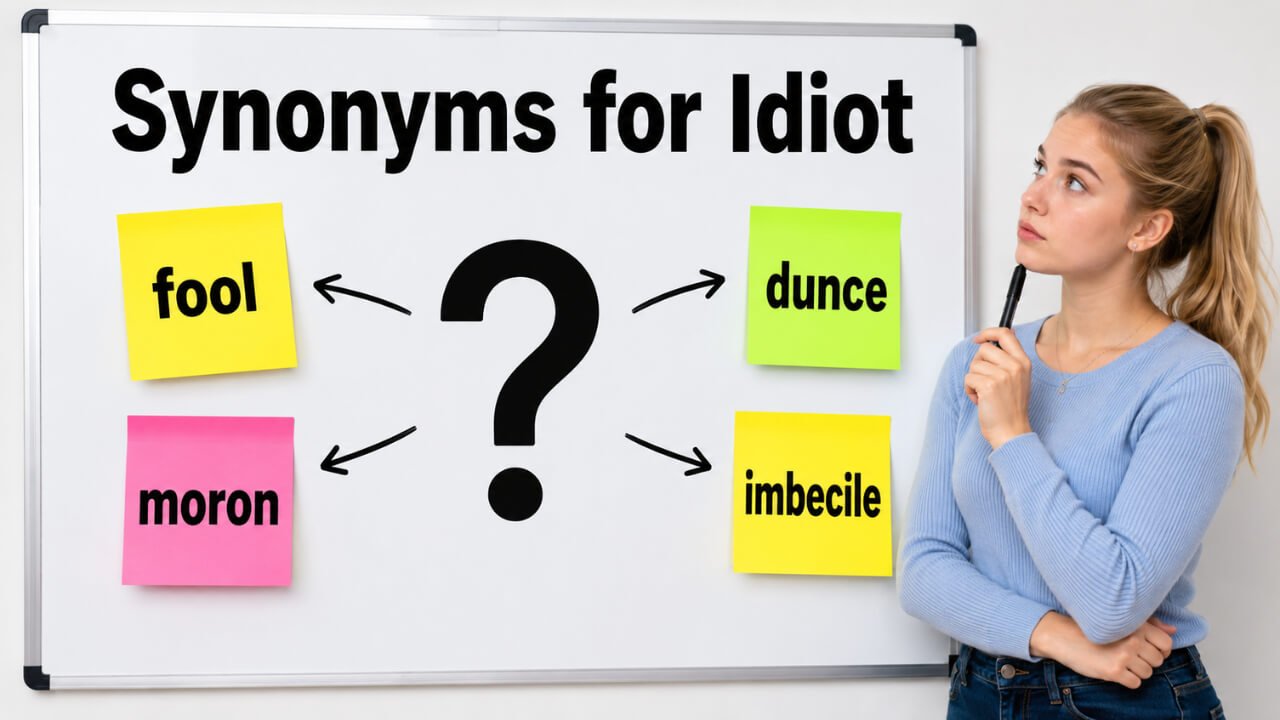
Quick Answer: The best synonyms for idiot are fool, dunce, dimwit, nitwit, blockhead, dummy, ignoramus, clown, buffoon, and foolish person. These synonyms for idiot vary in tone. Use fool for general criticism, dunce for learning or understanding, clown for silly behavior, ignoramus for lack of knowledge, and foolish person when you want a softer and more respectful option.
Pronunciation and Word Details
Word: Idiot
Pronunciation: /ˈɪdiət/
Part of Speech: Noun
Meaning: A rude word for a person who acts foolishly, shows poor judgment, or fails to understand something obvious.
US Pronunciation:
UK Pronunciation:
What Does “Idiot” Mean?
Direct Answer: Idiot means a person who behaves foolishly, makes a poor decision, or seems unable to understand something simple.
The word idiot is a noun and is usually used as an insult. It can describe someone who acts carelessly, lacks common sense, or says something unreasonable. However, it is a harsh and disrespectful word, so it should be used carefully.
Example: He felt like an idiot after forgetting the meeting time.
In modern writing, idiot is common in casual speech, criticism, fiction, dialogue, and emotional reactions. It is not suitable for polite, professional, academic, or respectful communication.
Meaning, Tone, and Context of “Idiot”
Tone: Idiot is rude, direct, emotional, and insulting.
It is not neutral or polite. The word often expresses anger, frustration, mockery, or strong disapproval. It may sound natural in casual dialogue, but it can sound offensive in serious writing.
Common Contexts: Arguments, jokes, fictional dialogue, informal speech, criticism, comedy, and emotional reactions.
Formal Use: Avoid idiot in professional writing, academic essays, workplace emails, and polite conversation. Use softer alternatives like foolish person, careless person, uninformed person, unwise person, or someone showing poor judgment.
Important Note: Some old synonyms for idiot have a history of being used in harmful ways. In respectful writing, choose words that criticize the action or decision rather than attacking the person.
When and How to Use “Idiot”
For Strong Criticism: Use idiot only when the tone is intentionally harsh or emotional.
Example: Calling someone an idiot rarely solves the problem.
For Casual Dialogue: Use idiot in fictional or informal dialogue when a character is angry, joking, or frustrated.
Example: She muttered, “I was such an idiot for leaving my keys inside.”
For Self Criticism: Idiot is often used when someone blames themselves for a mistake.
Example: I felt like an idiot after sending the wrong file.
For Humor: Use idiot carefully in jokes, because it can still sound insulting.
Example: He called himself an idiot after tripping over his own bag.
For Safer Writing: Use a softer synonym when respect matters.
Example: Instead of calling him an idiot, say he made a poor decision.
Best Synonyms for Idiot
Fool: A person who shows poor judgment or acts unwisely.
Example: Only a fool would ignore such clear instructions.
Dunce: A person who is slow to understand or learn something.
Example: He felt like a dunce during the difficult lesson.
Dimwit: A person who seems silly or not very intelligent.
Example: The character was written as a harmless dimwit.
Nitwit: A silly or foolish person.
Example: Do not act like a nitwit during the interview.
Blockhead: A stubborn or slow thinking person.
Example: He sounded like a blockhead when he ignored the warning.
Dummy: A casual word for someone who acts foolishly.
Example: I felt like a dummy for missing the obvious answer.
Ignoramus: A person who lacks knowledge, often in an annoying way.
Example: The article made him sound like an ignoramus.
Clown: A person who behaves foolishly or unseriously.
Example: Stop acting like a clown and focus on the task.
Buffoon: A ridiculous person who behaves in a foolish way.
Example: The rude guest looked like a buffoon at the dinner.
Foolish Person: A softer phrase for someone who acts without good judgment.
Example: A foolish person might ignore helpful advice.
50 Synonyms for Idiot with Short Meanings
- Fool: A person who shows poor judgment.
- Dunce: A person who learns or understands slowly.
- Dimwit: A silly or unintelligent person.
- Nitwit: A foolish or silly person.
- Blockhead: A stubborn or slow thinking person.
- Dummy: A casual word for a foolish person.
- Ignoramus: A person who lacks basic knowledge.
- Clown: A person who behaves foolishly or unseriously.
- Buffoon: A ridiculous or foolish person.
- Foolish Person: A softer phrase for someone with poor judgment.
- Silly Person: Someone acting in a childish or foolish way.
- Careless Person: Someone who acts without enough attention.
- Unwise Person: Someone who makes poor decisions.
- Thoughtless Person: Someone who acts without thinking carefully.
- Senseless Person: Someone acting without reason or judgment.
- Clueless Person: Someone who does not understand what is happening.
- Confused Person: Someone who lacks clear understanding.
- Irrational Person: Someone not guided by reason.
- Reckless Person: Someone who acts without caring about risk.
- Incompetent Person: Someone unable to do something properly.
- Simpleton: An old word for a foolish or simple minded person.
- Nincompoop: A silly, foolish, or ridiculous person.
- Dope: A casual insult for a foolish person.
- Dolt: A person who is slow to understand.
- Bonehead: A person who makes foolish mistakes.
- Airhead: A person who seems silly or forgetful.
- Numbskull: A person who acts foolishly or slowly.
- Birdbrain: A silly person who lacks judgment.
- Twit: A mildly insulting word for a foolish person.
- Halfwit: A harsh word for a person seen as foolish.
- Moron: A strong and offensive insult for a foolish person.
- Imbecile: A harsh and offensive insult for a foolish person.
- Cretin: A very offensive insult for a foolish person.
- Oaf: A clumsy or foolish person.
- Lout: A rude and foolish person.
- Bozo: A casual insult for a ridiculous person.
- Goof: A silly person or someone who makes mistakes.
- Goofball: A silly or playful person.
- Muppet: A casual insult for someone acting foolishly.
- Knucklehead: A foolish or stubborn person.
- Thickhead: A slow thinking or stubborn person.
- Dunderhead: An old fashioned word for a foolish person.
- Chump: A person easily fooled or used.
- Sap: A person who is easily tricked.
- Mug: A person who is easily fooled.
- Witless Person: Someone lacking good judgment.
- Mindless Person: Someone acting without thought.
- Absurd Person: Someone behaving in a ridiculous way.
- Poor Judge: Someone who makes bad decisions.
- Poor Thinker: Someone who reasons badly.
Read Also:
Synonyms for Implement
Synonyms for Idiot by Context
When Idiot Means Foolish Person
Use these synonyms when someone acts without good judgment.
Useful Synonyms: Fool, foolish person, unwise person, thoughtless person, senseless person.
Example: He was not an idiot, but he made a foolish decision.
Example: A thoughtless person might speak before understanding the facts.
When Idiot Means Someone Who Does Not Understand
Use these synonyms when the focus is confusion, weak understanding, or lack of awareness.
Useful Synonyms: Dunce, clueless person, confused person, ignoramus, dolt.
Example: She felt like a dunce when she could not follow the instructions.
Example: He sounded clueless during the discussion.
When Idiot Means Silly Person
Use these synonyms when the tone is lighter, humorous, or casual.
Useful Synonyms: Goof, goofball, clown, nitwit, bozo.
Example: Stop acting like a clown and listen carefully.
Example: He is a goofball, but he means well.
When Idiot Means Rude or Ridiculous Person
Use these synonyms when someone behaves badly, loudly, or embarrassingly.
Useful Synonyms: Buffoon, lout, oaf, blockhead, knucklehead.
Example: The rude guest acted like a buffoon.
Example: Only a blockhead would ignore such a clear warning.
When Idiot Needs a Polite Alternative
Use these alternatives when you want to criticize the behavior without insulting the person.
Useful Synonyms: Careless person, unwise person, uninformed person, poor judge, someone showing poor judgment.
Example: He made an unwise choice during the meeting.
Example: The report described the mistake as poor judgment.
Another Word for Idiot
Direct Answer: Another word for idiot is fool, especially when you mean someone who acts with poor judgment.
The best alternative depends on tone. Fool is strong but common. Dunce works for weak understanding. Clown fits silly behavior. Ignoramus fits lack of knowledge. For respectful writing, foolish person or someone showing poor judgment is usually better.
Original: He acted like an idiot during the meeting.
Better Option: He acted like a fool during the meeting.
Original: I felt like an idiot after making that mistake.
Better Option: I felt like a fool after making that mistake.
Original: Do not be an idiot about the instructions.
Better Option: Do not be careless with the instructions.
Original: The article called him an idiot for ignoring the facts.
Better Option: The article described him as uninformed for ignoring the facts.
When Not to Use “Idiot”
Do not use idiot when you need a respectful, professional, academic, or neutral tone. It attacks the person rather than explaining the behavior. In serious writing, it often sounds emotional and weak.
Weak: The employee was an idiot for missing the deadline.
Better: The employee showed poor planning by missing the deadline.
Weak: Only an idiot would disagree with this idea.
Better: A person may disagree with this idea for weak or unclear reasons.
Weak: The customer sounded like an idiot.
Better: The customer seemed confused about the instructions.
Weak: The student is an idiot at math.
Better: The student needs more support with math.
Weak: That was an idiot decision.
Better: That was a poor decision.
Use idiot only when the insulting tone is intentional. In most clear writing, describe the action, mistake, decision, or misunderstanding instead.
Words Commonly Confused With Idiot
Idiot vs Fool: Idiot is harsher and more insulting. Fool can mean someone who acts unwisely, and it can be softer depending on context.
Idiot vs Stupid: Idiot is a noun for a person. Stupid is usually an adjective that describes an action, idea, or person.
Idiot vs Ignorant: Idiot suggests foolishness or poor judgment. Ignorant means lacking knowledge or information.
Idiot vs Naive: Idiot is insulting. Naive means inexperienced or too trusting, often without cruel intent.
Idiot vs Silly: Idiot is rude. Silly can be light, playful, or harmless.
Idiot vs Clueless: Idiot attacks intelligence or judgment. Clueless means unaware or confused.
Idiot vs Incompetent: Idiot is a general insult. Incompetent means unable to perform a task properly.
Idiot vs Rude: Idiot focuses on foolishness. Rude focuses on bad manners or disrespect.
Which Synonym Should You Choose?
Choose fool when writing about poor judgment in a general way.
Choose dunce when the focus is weak learning, slow understanding, or classroom style language.
Choose dimwit when the tone is informal and lightly insulting.
Choose nitwit when the tone is silly, casual, or old fashioned.
Choose blockhead when someone is stubborn, slow to understand, or unwilling to listen.
Choose ignoramus when the problem is lack of knowledge, especially when the person acts confident.
Choose clown when someone behaves foolishly, unseriously, or disruptively.
Choose buffoon when someone seems ridiculous, loud, or embarrassing.
Choose careless person when the mistake came from lack of attention.
Choose someone showing poor judgment for professional, polite, academic, or neutral writing.
Real Life Examples of “Idiot” in Sentences
Original: I felt like an idiot after forgetting my password.
Better Option: I felt like a fool after forgetting my password.
Original: He looked like an idiot when he ignored the warning.
Better Option: He looked careless when he ignored the warning.
Original: Stop being an idiot and read the instructions.
Better Option: Stop being careless and read the instructions.
Original: The driver acted like an idiot in traffic.
Better Option: The driver acted recklessly in traffic.
Original: She called herself an idiot for missing the answer.
Better Option: She called herself a fool for missing the answer.
Original: Only an idiot would believe that false claim.
Better Option: Only a gullible person would believe that false claim.
Original: He sounded like an idiot during the debate.
Better Option: He sounded uninformed during the debate.
Original: Do not treat him like an idiot.
Better Option: Do not treat him like he lacks understanding.
Original: That idiot broke the rule again.
Better Option: That careless person broke the rule again.
Original: I made an idiot mistake on the form.
Better Option: I made a foolish mistake on the form.
Synonym Groups and Usage Differences
Foolishness Group
This group is best when someone makes a poor decision or acts without good judgment.
Synonyms: Fool, foolish person, unwise person, senseless person, poor judge.
Example: A foolish person might ignore clear advice.
Lack of Knowledge Group
This group fits situations where the person does not know enough or misunderstands the topic.
Synonyms: Ignoramus, clueless person, uninformed person, confused person, dunce.
Example: He sounded uninformed because he ignored the basic facts.
Silly Behavior Group
This group works when the behavior is foolish but not deeply serious.
Synonyms: Clown, goof, goofball, nitwit, bozo.
Example: He acted like a clown during the serious meeting.
Harsh Insult Group
This group includes strong words that can offend people. Use them only in dialogue, analysis, or clearly informal contexts.
Synonyms: Moron, imbecile, cretin, halfwit, numbskull.
Example: The character angrily called himself a numbskull.
Careless Action Group
This group is useful when the real issue is not intelligence but lack of attention.
Synonyms: Careless person, thoughtless person, reckless person, poor thinker, mindless person.
Example: A careless person might send the wrong message without checking it.
Polite Alternative Group
This group is best for professional or respectful writing.
Synonyms: Unwise person, uninformed person, someone showing poor judgment, someone acting carelessly.
Example: The report said the choice showed poor judgment.
Antonyms of Idiot
Genius: A person with exceptional intelligence or ability.
Expert: A person with deep knowledge or skill.
Scholar: A person who studies and understands a subject deeply.
Intellectual: A person who thinks carefully and seriously.
Wise Person: Someone with good judgment and understanding.
Sensible Person: Someone who makes practical and reasonable decisions.
Smart Person: Someone who understands things quickly.
Clever Person: Someone who solves problems skillfully.
Thinker: Someone who reflects carefully before acting.
Professional: Someone who acts with skill, care, and discipline.
Competent Person: Someone able to do a task properly.
Knowledgeable Person: Someone who has strong information or understanding.
Comparison: Idiot vs Related Words
Idiot vs Fool
Difference: Idiot is usually a stronger insult. Fool can describe someone who makes a poor decision, but it may sound less harsh.
Example With Idiot: He called himself an idiot for losing the ticket.
Example With Fool: He called himself a fool for losing the ticket.
Idiot vs Dunce
Difference: Idiot is a general insult. Dunce is more connected to slow learning or weak understanding.
Example With Idiot: I felt like an idiot after misunderstanding the question.
Example With Dunce: I felt like a dunce during the difficult lesson.
Idiot vs Ignoramus
Difference: Idiot suggests foolishness or poor judgment. Ignoramus means someone who lacks knowledge, often while acting confident.
Example With Idiot: He acted like an idiot by ignoring the facts.
Example With Ignoramus: He sounded like an ignoramus when he dismissed the facts.
Idiot vs Clown
Difference: Idiot is more directly insulting. Clown often describes someone behaving silly, unserious, or disruptive.
Example With Idiot: Stop acting like an idiot in the meeting.
Example With Clown: Stop acting like a clown in the meeting.
Idiot vs Incompetent Person
Difference: Idiot is vague and insulting. Incompetent person is more specific because it means someone cannot do a task properly.
Example With Idiot: The manager called the worker an idiot.
Example With Incompetent Person: The manager said the worker was incompetent at handling the task.
Idiot vs Careless Person
Difference: Idiot attacks the person. Careless person focuses on lack of attention or responsibility.
Example With Idiot: He was an idiot for leaving the door open.
Example With Careless Person: He was careless for leaving the door open.
Common Phrases and Expressions With Idiot
Complete Idiot: A very foolish person.
Total Idiot: A strongly foolish or unreasonable person.
Act Like an Idiot: Behave foolishly or carelessly.
Feel Like an Idiot: Feel embarrassed after a mistake.
Look Like an Idiot: Appear foolish or embarrassed.
Sound Like an Idiot: Speak in a way that seems foolish or uninformed.
Treat Someone Like an Idiot: Talk to someone as if they cannot understand.
Make an Idiot of Yourself: Do something embarrassing or foolish.
Call Someone an Idiot: Insult someone by saying they are foolish.
Idiot Move: A foolish or careless action.
Common Mistakes to Avoid
Using Idiot in Formal Writing: Avoid idiot in essays, reports, professional emails, and respectful explanations. It sounds emotional and insulting.
Weak: The policy failed because the planner was an idiot.
Better: The policy failed because the planner made poor decisions.
Attacking the Person Instead of the Action: Clear writing explains the mistake rather than insulting the person.
Weak: He is an idiot.
Better: He misunderstood the instructions.
Choosing a Synonym That Is Too Harsh: Words like moron, imbecile, and cretin are very offensive. Use them only when discussing language, tone, or fictional dialogue.
Weak: The customer was a moron.
Better: The customer was confused about the process.
Using Idiot When Ignorant Is More Accurate: If someone lacks information, ignorant or uninformed may be more precise.
Weak: He is an idiot about history.
Better: He is uninformed about history.
Repeating Idiot Too Often: Repetition makes writing sound angry and thin. Use more precise words such as careless, foolish, reckless, clueless, or uninformed.
Weak: The idiot made an idiot mistake and gave an idiot answer.
Better: The careless person made a foolish mistake and gave an uninformed answer.
Conclusion
Understanding synonyms for idiot helps you choose words with the right meaning, tone, and level of politeness. Use fool for poor judgment, dunce for weak understanding, clown for silly behavior, and ignoramus for lack of knowledge. For respectful writing, avoid direct insults and choose phrases like careless person, uninformed person, or someone showing poor judgment. The best synonym depends on whether you want to sound casual, critical, humorous, formal, or polite.
FAQs About Synonyms for Idiot
What is the best synonym for idiot?
The best synonym for idiot is fool. It is common, clear, and less extreme than many harsher insults.
What is a polite synonym for idiot?
A polite alternative is someone showing poor judgment. You can also use careless person, uninformed person, or unwise person.
Is idiot a rude word?
Yes, idiot is a rude and insulting word. It should be avoided in professional, academic, and respectful communication.
What is another word for idiot in casual speech?
Casual alternatives include dummy, goof, clown, nitwit, bonehead, and knucklehead. These still may sound insulting depending on tone.
What is the difference between idiot and fool?
Idiot is usually harsher and more insulting. Fool often means someone who acts with poor judgment and can sound slightly softer.
What is a formal way to say idiot?
A formal way to express the idea is a person showing poor judgment, an uninformed person, or someone acting carelessly.
What is the opposite of idiot?
Opposites of idiot include genius, expert, wise person, sensible person, smart person, competent person, and knowledgeable person.
