
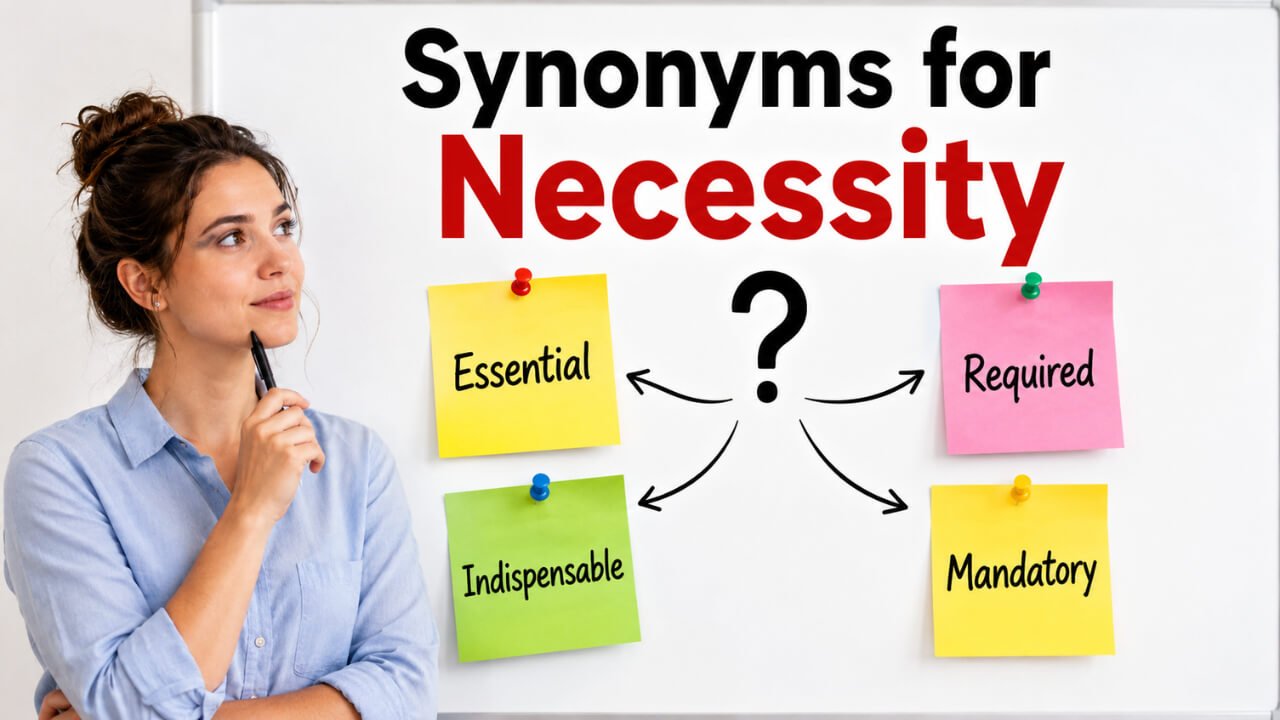
Quick Answer: Common synonyms for necessity include need, requirement, essential, obligation, prerequisite, must, demand, imperative, condition, and indispensability. The best synonyms for necessity depend on context. Use need in everyday conversation, requirement in formal rules or instructions, obligation for duties, prerequisite for something needed beforehand, imperative for an urgent or important need, and indispensability when emphasizing that something cannot reasonably be done without.
Pronunciation and Word Details
Word: Necessity.
Pronunciation: /nəˈsesəti/
Part of Speech: Noun.
Meaning: Something that is needed, required, or essential for a particular purpose, situation, or result.
US Pronunciation:
UK Pronunciation:
What Does “Necessity” Mean?
Necessity means something that is needed, required, essential, or unavoidable.
As a noun, necessity can refer to an object, condition, action, duty, or circumstance that must exist or happen. It can describe basic human needs, formal requirements, practical demands, or situations in which a person has little or no reasonable choice.
Basic Meaning: A necessity is something required for life, success, safety, comfort, or a particular purpose.
Example: Clean drinking water is a basic necessity.
The word also describes the state of being necessary.
Example: The necessity of regular maintenance became clear after the equipment failed.
Necessity may also refer to circumstances that force someone to act.
Example: Financial necessity caused him to look for additional work.
In everyday speech, need is often the simplest replacement. In rules, policies, and professional writing, requirement may be more precise. When necessity involves a moral, professional, or legal duty, obligation is often better.
Meaning, Tone, and Context of “Necessity”
Necessity has a neutral to formal tone. It is common in academic writing, professional communication, discussions about basic needs, policies, economics, law, philosophy, planning, and everyday conversation.
The word often carries a stronger sense than want or preference. If something is a necessity, it is not merely desirable. It is considered needed for a particular reason.
Neutral Context: Reliable transportation became a necessity after she changed jobs.
Formal Context: The report emphasizes the necessity of proper safety procedures.
Everyday Context: A warm coat is a necessity in very cold weather.
Academic Context: Researchers discussed the necessity of accurate data collection.
Professional Context: Clear communication is a necessity for effective teamwork.
Urgent Context: Immediate medical attention became an absolute necessity.
Necessity can also have a practical tone when discussing things required for ordinary life.
Example: Food, shelter, and clean water are fundamental necessities.
It may sound stronger and more formal than need. For casual conversation, need is usually simpler.
Formal: There is a necessity for additional training.
More Natural in Conversation: There is a need for additional training.
When and How to Use “Necessity”
For Basic Needs: Use necessity for things considered essential for everyday life, health, or safety.
Example: Safe housing is a necessity for every family.
For Formal Requirements: Use necessity when emphasizing that something must be present or completed.
Example: Accurate documentation is a necessity for the application process.
For Practical Needs: The word works well when circumstances make something important or unavoidable.
Example: Working from home made a reliable internet connection a necessity.
For Urgent Action: Necessity can describe something that must happen without unnecessary delay.
Example: Repairing the damaged roof became an immediate necessity.
For Duties: It can describe actions that circumstances require.
Example: Regular inspections are a necessity in environments where safety is critical.
For Essential Conditions: Use necessity when a condition must exist for a desired result.
Example: Consistent practice is a necessity for developing advanced skills.
For Unavoidable Circumstances: Necessity may suggest that a person acts because no practical alternative exists.
Example: She accepted additional hours out of financial necessity.
For Strong Emphasis: Phrases such as absolute necessity or practical necessity emphasize that something is especially important.
Example: Emergency preparation is an absolute necessity in high risk environments.
Best Synonyms for Necessity
Need: Something required or important for a particular purpose.
Example: There is a clear need for better communication.
Requirement: Something that must be provided, achieved, or completed.
Example: Proof of identity is a requirement for registration.
Essential: Something absolutely necessary or extremely important.
Example: Reliable information is an essential part of good decision making.
Obligation: A duty or responsibility that a person is required to fulfill.
Example: Employees have an obligation to follow safety procedures.
Prerequisite: Something that must exist or happen before something else is possible.
Example: Basic mathematics is a prerequisite for the advanced course.
Imperative: Something extremely important and requiring action.
Example: Protecting confidential information is a professional imperative.
Demand: A need or requirement created by circumstances.
Example: Growing demand for housing created a need for new development.
Must: Something regarded as essential or necessary.
Example: Comfortable shoes are a must for a long walking trip.
Condition: A requirement that must be satisfied for something else to happen.
Example: Regular attendance is a condition of participation.
Indispensability: The quality of being so important that something cannot reasonably be done without it.
Example: The crisis demonstrated the indispensability of reliable communication systems.
50 Synonyms for Necessity with Short Meanings
- Need: Something required for a purpose or situation.
- Requirement: Something that must be provided or fulfilled.
- Essential: Something absolutely necessary or highly important.
- Obligation: A duty that must be performed.
- Prerequisite: Something required before another thing can happen.
- Imperative: An urgent or extremely important necessity.
- Demand: A requirement created by circumstances or expectations.
- Must: Something considered essential or required.
- Condition: A requirement that must be satisfied.
- Indispensability: The quality of being impossible or difficult to do without.
- Needfulness: The state of being necessary or needed.
- Requirement of Circumstance: Something made necessary by a particular situation.
- Essential Requirement: Something that must be present or completed.
- Basic Need: Something necessary for ordinary life or wellbeing.
- Fundamental Need: A need that forms an essential foundation.
- Vital Need: Something necessary for survival, safety, or success.
- Pressing Need: Something requiring prompt attention.
- Urgent Need: Something that must be addressed quickly.
- Immediate Need: A requirement that exists at the present moment.
- Practical Need: Something required for practical reasons.
- Absolute Need: Something regarded as completely necessary.
- Compulsion: A strong force or circumstance that makes action necessary.
- Duty: Something a person is responsible for doing.
- Responsibility: An obligation to perform or manage something.
- Essentiality: The quality of being necessary or essential.
- Indispensable Need: Something that cannot reasonably be omitted.
- Requisite: Something needed for a particular purpose.
- Precondition: A condition that must exist beforehand.
- Qualification: A condition or standard needed for eligibility.
- Criterion: A standard that must be met in certain contexts.
- Necessitation: The condition or process of making something necessary.
- Constraint: A limitation that may require a particular course of action.
- Compelling Need: A strong necessity that demands attention.
- Critical Need: Something highly important and urgently required.
- Essential Condition: A condition without which something cannot proceed.
- Mandatory Requirement: Something that must be fulfilled.
- Necessary Condition: A condition required for a result to occur.
- Required Element: A part that must be included.
- Required Condition: A condition that must be satisfied.
- Basic Requirement: A minimum essential condition or need.
- Core Requirement: A central condition that must be met.
- Primary Need: A major or fundamental necessity.
- Essential Need: Something strongly required.
- Unavoidable Need: A necessity that cannot reasonably be ignored.
- Compelling Requirement: A strong requirement created by circumstances.
- Urgency: A condition requiring immediate attention or action.
- Exigency: An urgent need created by difficult circumstances.
- Essential Provision: Something that must be supplied or available.
- Necessary Measure: An action required to achieve a result.
- Matter of Necessity: Something done because circumstances require it.
Read Also:
Synonyms for Miracle

Synonyms for Necessity by Context
When Necessity Means a Basic Need
When necessity refers to something essential for ordinary life, strong alternatives include need, basic need, fundamental need, vital need, essential, and essential requirement.
Example With Necessity: Clean water is a necessity for every community.
Example With Basic Need: Clean water is a basic need for every community.
Example With Essential: Clean water is essential for every community.
Need is usually the most natural everyday alternative. Basic need is especially useful for food, shelter, health, safety, and other fundamental conditions.
When Necessity Means a Formal Requirement
Requirement, requisite, condition, essential condition, required condition, and mandatory requirement work well when rules or procedures are involved.
Example With Necessity: Completing the form is a necessity before registration.
Example With Requirement: Completing the form is a requirement before registration.
Requirement is more precise when a rule, policy, institution, or process formally demands something.
When Necessity Means an Urgent Need
Urgent need, pressing need, critical need, imperative, exigency, and immediate need emphasize urgency.
Example With Necessity: Finding temporary shelter became a necessity after the storm.
Example With Urgent Need: Finding temporary shelter became an urgent need after the storm.
Example With Imperative: Restoring access to clean water became an imperative.
Imperative is particularly useful in formal writing when action is both important and urgent.
When Necessity Means a Duty
Obligation, duty, responsibility, and imperative are appropriate when necessity involves something a person is expected or required to do.
Example With Necessity: Protecting confidential records is a professional necessity.
Example With Obligation: Protecting confidential records is a professional obligation.
Obligation emphasizes responsibility more strongly than necessity.
When Necessity Means Something Required Beforehand
Prerequisite, precondition, condition, qualification, and requisite work when one thing must exist before another can happen.
Example With Necessity: Prior experience is a necessity for this position.
Example With Prerequisite: Prior experience is a prerequisite for this position.
Prerequisite is more precise when describing admission, eligibility, education, training, or sequential processes.
When Necessity Means Something Unavoidable
Compulsion, unavoidable need, practical need, compelling need, and matter of necessity can express situations where circumstances leave little choice.
Example With Necessity: She moved closer to work out of necessity.
Example With Practical Need: She moved closer to work because of a practical need.
Example With Compulsion: Circumstances created a compulsion to reduce unnecessary expenses.
Compulsion is stronger and can imply pressure, so it should not replace necessity automatically.
Another Word for Necessity
Another word for necessity is need. It is the most versatile and natural replacement in many everyday sentences.
However, the best alternative depends on context. Requirement is stronger for rules, obligation is better for duties, prerequisite works when something must happen first, and imperative is useful for urgent or highly important matters.
Original: There is a necessity for additional staff.
Better Option: There is a need for additional staff.
Original: Wearing protective equipment is a necessity in this area.
Better Option: Wearing protective equipment is a requirement in this area.
Original: Regular practice is a necessity before attempting advanced techniques.
Better Option: Regular practice is a prerequisite before attempting advanced techniques.
Original: Improving public safety has become a necessity.
Better Option: Improving public safety has become an imperative.
When Not to Use “Necessity”
Necessity is useful, but it can sound unnecessarily formal in simple conversation.
Weak: I have a necessity to buy some groceries.
Better: I need to buy some groceries.
Avoid necessity when a more specific word explains exactly why something is required.
Weak: A degree is a necessity for admission to the program.
Better: A degree is a prerequisite for admission to the program.
Do not use necessity when the real meaning is obligation.
Weak: Reporting the problem is your necessity as a supervisor.
Better: Reporting the problem is your obligation as a supervisor.
Avoid treating preferences as necessities unless they truly are essential.
Weak: A larger television is a necessity for the living room.
Better: A larger television would be useful for the living room.
Repetition can also make formal writing sound heavy.
Weak: There is a necessity for planning, a necessity for communication, and a necessity for supervision.
Better: Effective planning, communication, and supervision are essential.
Use necessity when its strong meaning is justified rather than simply using it as a formal replacement for want, preference, convenience, or desire.
Words Commonly Confused With Necessity
Necessity vs Need: Necessity often sounds stronger and more formal. Need is broader and more natural in everyday language.
Necessity vs Requirement: Necessity describes something needed because of purpose or circumstances. Requirement often describes something demanded by a rule, standard, or process.
Necessity vs Essential: Necessity is a noun, while essential can function as an adjective or noun. A necessity is something needed, while essential commonly describes something as necessary.
Necessity vs Obligation: Necessity focuses on what circumstances require. Obligation emphasizes duty, responsibility, promise, law, or expectation.
Necessity vs Prerequisite: Necessity means something generally needed. Prerequisite specifically means something required before another activity, stage, or result.
Necessity vs Imperative: Necessity can describe any strong need. Imperative usually suggests something especially important, urgent, or demanding action.
Necessity vs Demand: Necessity focuses on need. Demand can refer to a requirement, strong request, or the amount of something people want.
Necessity vs Convenience: A necessity is required, while a convenience simply makes something easier or more comfortable.
Necessity vs Desire: Necessity involves something needed. Desire refers to something wanted.
Which Synonym Should You Choose?
Choose need for everyday conversation, simple explanations, and general writing.
Choose requirement when rules, applications, procedures, standards, or formal conditions are involved.
Choose essential when emphasizing that something is extremely important or cannot reasonably be omitted.
Choose obligation when discussing duties, responsibilities, promises, professional conduct, or legal expectations.
Choose prerequisite when one condition must be satisfied before another activity can begin.
Choose imperative when the situation is urgent, serious, or strategically important.
Choose demand when circumstances, work, markets, or other pressures create a need.
Choose condition when something must be satisfied before an agreement, process, or outcome can proceed.
Choose requisite in formal or academic writing when referring to something necessary for a purpose.
Choose pressing need when the matter requires attention soon.
Choose critical need when the requirement is highly important and failure to address it may cause serious problems.
Choose basic need when discussing food, shelter, health, safety, or other fundamental requirements.
Choose must in conversational or practical writing when something is strongly recommended or considered essential.
Choose indispensability when emphasizing the quality of being impossible or extremely difficult to do without.
Real Life Examples of “Necessity” in Sentences
Original: Reliable transportation became a necessity after he started working farther from home.
Better Option: Reliable transportation became a need after he started working farther from home.
Original: Completing the safety course is a necessity for all new workers.
Better Option: Completing the safety course is a requirement for all new workers.
Original: Regular exercise is a necessity for maintaining his training routine.
Better Option: Regular exercise is essential for maintaining his training routine.
Original: Reporting serious hazards is a necessity for every supervisor.
Better Option: Reporting serious hazards is an obligation for every supervisor.
Original: Basic computer skills are a necessity before taking the advanced class.
Better Option: Basic computer skills are a prerequisite for taking the advanced class.
Original: Reducing unnecessary expenses became a necessity during the difficult period.
Better Option: Reducing unnecessary expenses became an imperative during the difficult period.
Original: Access to clean water is a necessity for healthy communities.
Better Option: Access to clean water is a fundamental need for healthy communities.
Original: Immediate repairs became a necessity after the pipe began leaking.
Better Option: Immediate repairs became an urgent need after the pipe began leaking.
Original: Clear communication is a necessity for successful teamwork.
Better Option: Clear communication is an essential requirement for successful teamwork.
Original: She accepted additional work out of financial necessity.
Better Option: She accepted additional work because of financial need.
Synonym Groups and Usage Differences
Basic Need Group
Need, basic need, fundamental need, vital need, primary need, and essential need describe things required for life, wellbeing, safety, or normal functioning.
These expressions are especially useful when discussing health, housing, food, education, resources, or personal circumstances.
Example: Reliable access to food and clean water is a fundamental need.
Formal Requirement Group
Requirement, requisite, mandatory requirement, required condition, basic requirement, and core requirement are useful in professional, academic, technical, and administrative writing.
These terms suggest that a standard or condition must be satisfied.
Example: Valid identification is a requirement for completing the registration.
Duty Group
Obligation, duty, responsibility, and imperative relate to actions people are expected or required to perform.
Obligation is especially suitable when ethical, legal, professional, or personal responsibility is involved.
Example: Maintaining accurate records is a professional obligation.
Prior Condition Group
Prerequisite, precondition, qualification, condition, and necessary condition describe something that must exist before another step or outcome becomes possible.
Example: Successful completion of the introductory course is a prerequisite for enrollment.
Urgency Group
Imperative, urgent need, pressing need, critical need, immediate need, exigency, and compelling need emphasize serious or time sensitive requirements.
Example: Restoring essential services became an urgent need.
Practical Need Group
Practical need, requirement of circumstance, unavoidable need, matter of necessity, and necessary measure describe needs created by real situations rather than preference.
Example: Additional storage became a practical need as the business expanded.
Essentiality Group
Essentiality, indispensability, essential requirement, and absolute need emphasize how important something is.
Example: The experience demonstrated the indispensability of reliable communication.
Antonyms of Necessity
The opposite of necessity depends on whether the word means a requirement, essential item, unavoidable condition, or basic need.
Luxury: Something desirable or comfortable but not essential.
Option: Something that may be chosen but is not required.
Choice: Freedom to select among alternatives rather than being forced by necessity.
Preference: Something favored rather than required.
Desire: Something wanted rather than needed.
Want: A wish for something that may not be essential.
Convenience: Something that makes life easier but is not necessarily required.
Nonessential: Something that is not necessary.
Unnecessity: The state of not being necessary, though this word is uncommon in everyday use.
Voluntary Action: Something done by choice rather than requirement.
Discretion: Freedom to decide whether an action is needed.
Possibility: Something that may happen but is not required to happen.
Comparison: Necessity vs Related Words
Necessity vs Need
Necessity usually expresses a stronger or more formal kind of need. Need is more flexible and common in everyday speech.
Example With Necessity: Reliable electricity is a necessity for the laboratory.
Example With Need: There is a need for reliable electricity in the laboratory.
Necessity vs Requirement
Necessity comes from circumstances, purpose, or practical importance. Requirement often comes from rules, standards, agreements, or procedures.
Example With Necessity: Additional storage became a necessity as the collection expanded.
Example With Requirement: A completed application is a requirement for admission.
Necessity vs Essential
Necessity is primarily a noun. Essential is often an adjective that describes something as absolutely needed.
Example With Necessity: Reliable communication is a necessity during an emergency.
Example With Essential: Reliable communication is essential during an emergency.
Necessity vs Obligation
Necessity focuses on what must be done because circumstances require it. Obligation focuses on what someone has a duty or responsibility to do.
Example With Necessity: Cutting expenses became a necessity.
Example With Obligation: Managers have an obligation to protect confidential information.
Necessity vs Prerequisite
Necessity has a broad meaning. Prerequisite specifically identifies something needed before another thing can happen.
Example With Necessity: Training is a necessity for safe equipment use.
Example With Prerequisite: Safety training is a prerequisite for operating the equipment.
Necessity vs Imperative
Necessity expresses a need. Imperative adds a stronger sense of urgency, importance, or required action.
Example With Necessity: Improving communication is a necessity.
Example With Imperative: Improving communication is an organizational imperative.
Necessity vs Demand
Necessity is something required. Demand may describe a strong requirement, expectation, request, or level of need.
Example With Necessity: Rest became a necessity after several exhausting days.
Example With Demand: Increased demand for services required additional staff.
Necessity vs Luxury
Necessity describes something required, while luxury describes something desirable but not essential.
Example With Necessity: Safe drinking water is a necessity.
Example With Luxury: An expensive decorative feature may be considered a luxury.
Common Phrases and Expressions With “Necessity”
Absolute Necessity: Something considered completely essential.
Basic Necessity: Something needed for ordinary life or wellbeing.
Practical Necessity: Something required because of real circumstances.
Financial Necessity: A need created by financial circumstances.
Economic Necessity: A requirement resulting from economic conditions.
Matter of Necessity: Something that must be done because circumstances require it.
Out of Necessity: Done because there is no reasonable practical alternative.
Necessity of Life: Something essential for normal living or survival.
Necessity for Change: A situation showing that change is required.
Necessity for Action: A condition making action important or unavoidable.
Common Mistakes to Avoid
A common mistake is using necessity when need would sound more natural.
Unnatural: I have a necessity to speak with you.
Natural: I need to speak with you.
Another mistake is treating every desire as a necessity. Necessity suggests genuine importance or requirement.
Unclear: A newer phone is an absolute necessity.
Clearer: A newer phone would be useful for the work I need to do.
Do not confuse necessity with requirement. A necessity may result from circumstances, while a requirement is often formally imposed.
Avoid replacing necessity with obligation when no duty exists. If something is needed because of circumstances rather than responsibility, need or requirement may be more accurate.
Prerequisite should only be used when something must occur before another event, activity, or stage.
Do not overuse absolute necessity. Necessity already indicates something required, so absolute should be reserved for cases where strong emphasis is genuinely useful.
Avoid repeating necessity several times within one paragraph when accurate alternatives are available.
Repetitive: Training is a necessity, communication is a necessity, and planning is also a necessity.
Improved: Training is essential, clear communication is required, and careful planning is equally important.
Be cautious with highly formal alternatives such as exigency and indispensability. They can be useful, but simpler words such as urgent need and essentiality are often clearer.
Always choose a synonym because it matches the intended meaning, not simply because it looks different.
Conclusion
Synonyms for necessity include need, requirement, essential, obligation, prerequisite, imperative, demand, condition, and indispensability. Use need for everyday situations, requirement for formal rules, obligation for duties, prerequisite for conditions that must come first, and imperative for urgent priorities. Basic need works well for essential resources, while practical necessity describes something required by circumstances. Choosing the right alternative helps you express whether something is simply needed, formally required, unavoidable, urgent, or essential.
FAQs About Synonyms for Necessity
What is the best synonym for necessity?
Need is the most versatile synonym for necessity. Requirement, obligation, prerequisite, and imperative are better when the context is more specific.
What is a formal synonym for necessity?
Requirement, prerequisite, imperative, requisite, essentiality, and indispensability can work in formal writing depending on the intended meaning.
What is a simple synonym for necessity?
Need is the simplest and most natural alternative in everyday English.
What is another word for basic necessity?
Basic need, essential need, fundamental need, vital need, and essential requirement are useful alternatives.
Are necessity and requirement the same?
Not exactly. Necessity refers broadly to something needed, while requirement often means something formally demanded by a rule, standard, process, or condition.
What synonym for necessity means an urgent need?
Imperative, pressing need, critical need, urgent need, immediate need, and exigency can express an urgent necessity.
What is the opposite of necessity?
Common opposites include luxury, option, preference, choice, desire, convenience, and nonessential item. The best antonym depends on the sentence context.
