
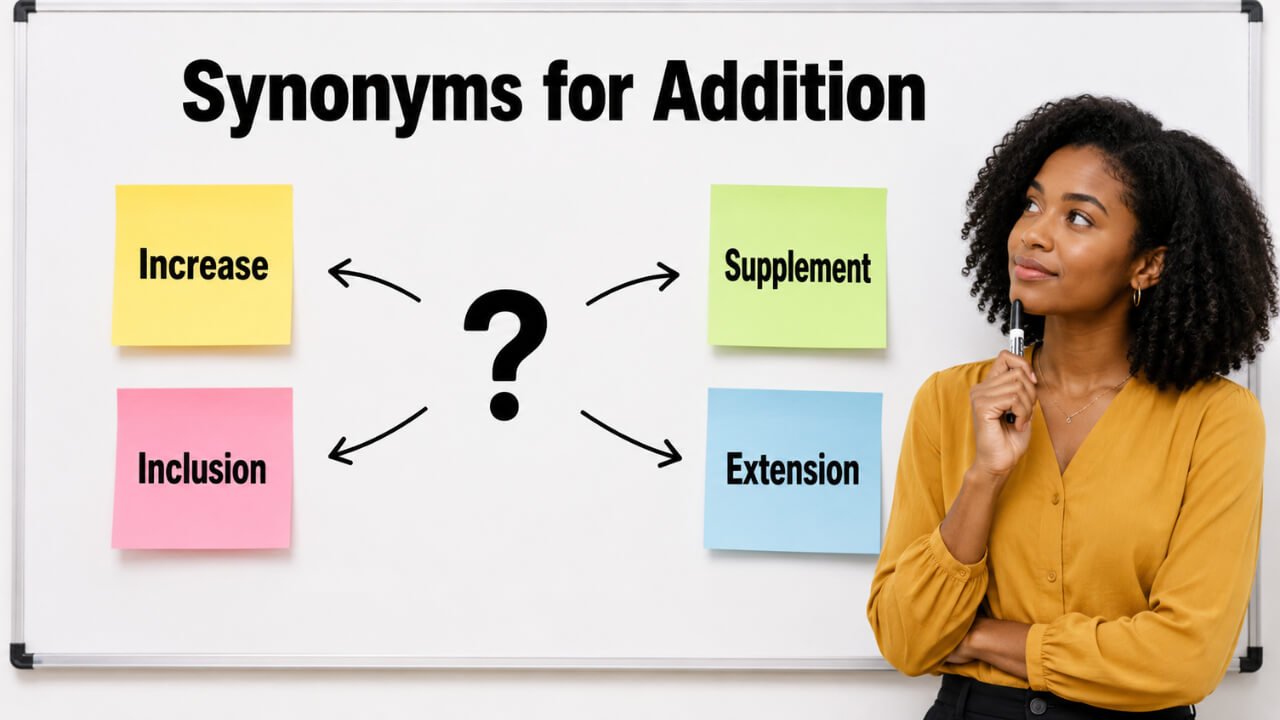
Quick Answer: Synonyms for in addition include additionally, furthermore, moreover, also, besides, plus, as well, too, along with that, and what is more. Use additionally in formal writing, also in everyday sentences, furthermore for essays and reports, moreover for strong supporting points, plus for casual speech, and as well or too for simple added information.
Pronunciation and Word Details
Word: In addition.
Pronunciation: ɪn əˈdɪʃən.
Part of Speech: Transitional phrase and adverbial phrase.
Meaning: In addition means also, furthermore, or as an extra point added to what has already been said.
US Pronunciation:
UK Pronunciation:
What Does “In Addition” Mean?
In addition means also or as something extra. It is a transitional phrase used to add more information, another point, or a supporting detail to a sentence or paragraph.
The phrase works well in formal writing, essays, reports, explanations, and professional communication. It usually connects one idea to another. For example, you might say, the plan is affordable. In addition, it is easy to manage. Here, in addition introduces another benefit.
It can appear at the beginning of a sentence, in the middle of a sentence, or before a noun phrase when followed by to.
Meaning, Tone, and Context of “In Addition”
In addition has a formal, clear, and neutral tone. It is more polished than plus and more direct than long expressions like on top of that. It is common in academic writing, business writing, reports, instructions, formal emails, and structured explanations.
In casual conversation, people often use also, too, or plus instead. In essays, in addition helps organize ideas clearly. In technical writing, it can introduce another feature, condition, step, or requirement. The phrase is useful when you want to add information without sounding emotional, dramatic, or overly casual.
When and How to Use “In Addition”
For Adding Information: Use in addition when you want to introduce another idea that supports or expands the previous one.
Example: The course teaches grammar. In addition, it improves vocabulary.
For Supporting an Argument: Use in addition when adding another reason, fact, or example to strengthen your point.
Example: The proposal saves money. In addition, it reduces waste.
For Formal Writing: Use in addition in essays, reports, and professional documents when you need a clear transition.
Example: The study includes survey data. In addition, it presents detailed interviews.
For Listing Benefits: Use in addition when naming extra advantages, features, or positive points.
Example: The software is simple to use. In addition, it is highly secure.
For Connecting Paragraphs: Use in addition at the start of a paragraph to show that the new paragraph continues the same topic.
Example: In addition, the results show a clear improvement in user satisfaction.
Best Synonyms for In Addition
Additionally: Also or as one more point.
Example: The plan is affordable. Additionally, it is easy to follow.
Furthermore: More importantly or as another supporting point.
Example: The method is practical. Furthermore, it saves time.
Moreover: Also, with stronger emphasis on the next point.
Example: The design is attractive. Moreover, it is highly functional.
Also: As well or too.
Example: She writes articles and also edits reports.
Besides: Apart from that or in addition to what was said.
Example: The hotel is close to the beach. Besides, it offers free breakfast.
Plus: Also, in a casual and simple way.
Example: The app is fast. Plus, it is easy to use.
As Well: Also, usually placed at the end of a sentence.
Example: The guide covers grammar and vocabulary as well.
Too: Also, often used in simple conversation.
Example: I want the workbook too.
Along With That: Together with the previous point.
Example: The package includes lessons. Along with that, it offers practice tests.
What Is More: Used to add a stronger or surprising extra point.
Example: The room is spacious. What is more, it has a beautiful view.
50 Synonyms for In Addition with Short Meanings
- Additionally: Also or as another point.
- Furthermore: Adds a stronger supporting idea.
- Moreover: Adds an important extra point.
- Also: Adds more information simply.
- Besides: Apart from what was already said.
- Plus: Also in a casual way.
- Too: Also, often at the end of a sentence.
- As Well: Also or in the same way.
- Likewise: In the same way or also.
- Similarly: Adds a related or matching point.
- Along With That: Together with the previous point.
- On Top of That: Adds something extra with emphasis.
- What Is More: Adds a stronger extra point.
- Not Only That: Adds another notable detail.
- Apart From That: Besides the earlier point.
- Beyond That: Adds something further.
- Added to That: Adds another connected idea.
- Together With That: Along with the previous point.
- Coupled With That: Combined with the previous idea.
- Over and Above That: More than what was already mentioned.
- In Addition to This: Adds another related point.
- Another Point Is: Introduces one more idea.
- Another Thing Is: Adds a further detail.
- As an Extra Point: Adds information beyond the main idea.
- By the Same Token: Adds a similar supporting point.
- In the Same Way: Adds a matching idea.
- Equally: Adds a point with similar importance.
- Correspondingly: Adds a related point that matches another.
- As a Further Point: Adds one more formal idea.
- To Add to This: Introduces more information.
- To Continue: Adds the next related idea.
- In Support of This: Adds information that strengthens a point.
- More Than That: Adds a stronger extra idea.
- Still More: Adds even more information.
- As Another Benefit: Adds one more advantage.
- As Another Reason: Adds one more explanation.
- As Another Example: Adds one more illustration.
- In the Bargain: As an added benefit.
- Into the Bargain: Also as an extra advantage.
- As a Bonus: Adds an extra benefit.
- To Boot: Also, often with a casual tone.
- Then Again: Adds another related thought.
- For Good Measure: Adds something extra beyond need.
- In Like Manner: In a similar way.
- With This: Along with the present point.
- Including This: Adds something as part of a group.
- Alongside This: Adds something together with another thing.
- As Well as This: Adds another related point.
- Further: Adds more information in a formal way.
- More: Adds another amount, point, or detail.
Read Also:
Synonyms for Motivation

Synonyms for In Addition by Context
When In Addition Means Also
Use these synonyms when you simply want to add one more idea without strong emphasis.
Best Synonyms: Also, too, as well, additionally, plus.
Example: The guide explains synonyms. It also gives examples.
Example: The article covers meaning and usage as well.
When In Addition Means Furthermore
Use these synonyms when adding another supporting point in an essay, report, or formal explanation.
Best Synonyms: Furthermore, moreover, additionally, further, as a further point.
Example: The policy is clear. Furthermore, it is easy to apply.
Example: The results are reliable. Moreover, they are consistent across groups.
When In Addition Means Besides
Use these synonyms when adding a separate point, extra reason, or extra benefit.
Best Synonyms: Besides, apart from that, beyond that, on top of that, what is more.
Example: The hotel is affordable. Besides, it is close to the station.
Example: The plan saves time. On top of that, it lowers costs.
When In Addition Means Along With
Use these synonyms when one thing is added together with another thing.
Best Synonyms: Along with, together with, coupled with, alongside, as well as.
Example: The report includes charts along with written analysis.
Example: Strong planning, coupled with clear communication, improved the project.
When In Addition Means Extra Benefit
Use these synonyms when adding an advantage, bonus, or helpful extra detail.
Best Synonyms: As a bonus, in the bargain, into the bargain, for good measure, to boot.
Example: The book is useful for beginners. As a bonus, it includes practice questions.
Example: The room is large and comfortable to boot.
Another Word for In Addition
Another word for in addition is additionally. It is clear, formal, and useful in many writing contexts. However, the best alternative depends on tone. Use also for simple sentences, furthermore for essays, moreover for strong emphasis, and plus for casual speech.
Original: In addition, the lesson includes practice exercises.
Better Option: Additionally, the lesson includes practice exercises.
Original: The device is lightweight. In addition, it is easy to carry.
Better Option: The device is lightweight. Also, it is easy to carry.
Original: The plan is affordable. In addition, it supports long term growth.
Better Option: The plan is affordable. Furthermore, it supports long term growth.
Original: The room is clean. In addition, it has a balcony.
Better Option: The room is clean. Plus, it has a balcony.
When Not to Use “In Addition”
Do not use in addition too often in the same paragraph. Repetition makes writing sound stiff and mechanical. Use additionally, also, furthermore, moreover, or besides to create smoother flow.
Weak: In addition, the course is useful. In addition, it is simple. In addition, it is affordable.
Better: The course is useful. It is also simple. Furthermore, it is affordable.
Do not use in addition when the ideas are not connected. It should add related information, not introduce a contrast or opposite idea.
Weak: The food was delicious. In addition, the service was slow.
Better: The food was delicious. However, the service was slow.
Do not use in addition to mean because. It adds information, but it does not show cause.
Weak: In addition, it rained, the match was canceled.
Better: Because it rained, the match was canceled.
Do not use in addition to when no object follows.
Weak: In addition to, the report includes charts.
Better: In addition, the report includes charts.
Words Commonly Confused With In Addition
In Addition vs Additionally: In addition is a phrase, while additionally is a single word. Both mean also, but additionally often sounds smoother in formal writing.
In Addition vs Furthermore: In addition adds information, while furthermore often adds a stronger supporting reason in essays or reports.
In Addition vs Moreover: In addition is neutral, while moreover gives the next point more importance or emphasis.
In Addition vs Besides: In addition is more formal and organized, while besides can sound conversational or slightly informal.
In Addition vs Also: In addition is a transition phrase, while also is shorter and fits naturally inside many sentences.
In Addition vs Plus: In addition is formal, while plus is casual and better for everyday speech.
In Addition vs In Addition To: In addition can stand alone as a transition. In addition to must be followed by a noun, pronoun, or gerund.
Which Synonym Should You Choose?
Choose additionally when you need a polished and formal replacement for in addition.
Choose furthermore when writing essays, reports, or explanations that need another supporting point.
Choose moreover when the added idea is important and strengthens the previous statement.
Choose also when you want a simple and natural word for everyday writing.
Choose too when the sentence is short, casual, and direct.
Choose as well when you want an easy phrase at the end of a sentence.
Choose besides when adding a separate reason, benefit, or extra point.
Choose plus when writing in a casual tone.
Choose along with when joining two things in the same phrase.
Choose on top of that when you want a conversational phrase with extra emphasis.
Real Life Examples of “In Addition” in Sentences
Original: In addition, the guide explains common mistakes.
Better Option: Additionally, the guide explains common mistakes.
Original: The article is clear. In addition, it is easy to read.
Better Option: The article is clear. Also, it is easy to read.
Original: The class teaches writing. In addition, it improves speaking skills.
Better Option: The class teaches writing and improves speaking skills as well.
Original: The plan is practical. In addition, it saves money.
Better Option: The plan is practical. Furthermore, it saves money.
Original: The design is attractive. In addition, it is functional.
Better Option: The design is attractive. Moreover, it is functional.
Original: The package includes lessons. In addition, it includes worksheets.
Better Option: The package includes lessons along with worksheets.
Original: The hotel is quiet. In addition, it is near the market.
Better Option: The hotel is quiet. Besides, it is near the market.
Original: The app is free. In addition, it works offline.
Better Option: The app is free. Plus, it works offline.
Original: The report explains the problem. In addition, it suggests solutions.
Better Option: The report explains the problem and suggests solutions too.
Original: The course gives examples. In addition, it includes practice tasks.
Better Option: The course gives examples. On top of that, it includes practice tasks.
Synonym Groups and Usage Differences
Formal Addition Group
This group works best in essays, reports, academic writing, business writing, and professional explanations.
Synonyms: Additionally, furthermore, moreover, further, as a further point.
Example: Furthermore, the findings support the main argument.
Casual Addition Group
This group sounds natural in everyday conversation, simple writing, and friendly explanations.
Synonyms: Also, too, plus, as well, on top of that.
Example: The bag is stylish. Plus, it has enough space for books.
Supporting Point Group
This group adds information that strengthens an argument, claim, or recommendation.
Synonyms: Furthermore, moreover, in support of this, by the same token, what is more.
Example: Moreover, the evidence matches the earlier results.
Extra Benefit Group
This group is useful when adding bonuses, advantages, or helpful details.
Synonyms: As a bonus, in the bargain, into the bargain, to boot, for good measure.
Example: The room is spacious and has a great view to boot.
Similar Idea Group
This group adds a point that matches or parallels the previous idea.
Synonyms: Likewise, similarly, in the same way, equally, correspondingly.
Example: Similarly, the second method improves accuracy.
Antonyms of In Addition
Antonyms of in addition depend on the sentence. Since in addition adds information, its opposite may introduce contrast, exclusion, limitation, or exception.
However: Shows contrast instead of addition.
But: Introduces an opposite or different point.
Nevertheless: Adds contrast despite the previous idea.
Instead: Shows replacement rather than addition.
Rather: Corrects or replaces an earlier idea.
Except: Shows exclusion from a statement.
Apart From: Can show exclusion when used in a limiting sense.
Only: Limits the idea instead of adding more.
Without: Shows absence or lack of something added.
On the Contrary: Introduces an opposite idea.
Comparison: In Addition vs Related Words
In Addition vs Additionally
In addition and additionally both add more information. Additionally is one word and often sounds smoother at the beginning of formal sentences.
Example With In Addition: In addition, the report includes survey results.
Example With Additionally: Additionally, the report includes survey results.
In Addition vs Furthermore
In addition adds another point. Furthermore often adds a stronger reason that supports an argument.
Example With In Addition: In addition, the course includes exercises.
Example With Furthermore: Furthermore, the course improves practical writing skills.
In Addition vs Moreover
In addition is neutral. Moreover adds emphasis and usually introduces a more important supporting idea.
Example With In Addition: In addition, the tool is simple to use.
Example With Moreover: Moreover, the tool reduces errors significantly.
In Addition vs Also
In addition is more formal and often begins a sentence. Also is shorter and can appear in different places.
Example With In Addition: In addition, she teaches grammar.
Example With Also: She also teaches grammar.
In Addition vs Besides
In addition sounds structured and formal. Besides can sound more conversational and may introduce another reason.
Example With In Addition: In addition, the room includes a desk.
Example With Besides: Besides, the room is close to the library.
In Addition vs Plus
In addition is better for formal writing. Plus is better for casual speech and simple explanations.
Example With In Addition: In addition, the plan improves safety.
Example With Plus: Plus, the plan saves money.
Common Phrases and Expressions With In Addition
In Addition: Also or as another point.
In Addition To: Along with or besides something.
In Addition to This: Also after what was just mentioned.
In Addition to That: Adds another related point.
In Addition to These: Adds more items to an already mentioned group.
In Addition to Being: Adds another quality or role.
In Addition to Having: Adds another feature or possession.
In Addition to Helping: Adds another action or benefit.
In Addition to the Above: Refers to extra information after earlier points.
In Addition to Other Factors: Adds one factor among several others.
Common Mistakes to Avoid
A common mistake is overusing in addition at the start of every sentence. This makes writing sound repetitive. Use additionally, also, furthermore, and moreover when variety improves flow.
Another mistake is using in addition for contrast. If the second idea disagrees with the first, choose however, but, nevertheless, or on the other hand.
Writers also confuse in addition with in addition to. In addition can stand alone as a sentence transition. In addition to must be followed by a noun, pronoun, or gerund.
Avoid using plus in formal essays when a more polished connector is needed. Additionally or furthermore usually sounds better. Also avoid stacking too many transition words together, such as also in addition. One clear connector is enough.
Conclusion
Synonyms for in addition help you add information smoothly and avoid repeated wording. Use additionally for formal writing, furthermore for supporting arguments, moreover for stronger emphasis, also for simple sentences, and plus for casual speech. Choose besides when adding another reason, as well or too for easy everyday flow, and along with when joining related things. The best synonym depends on tone, sentence position, and the kind of extra point you want to add.
FAQs About Synonyms for In Addition
What are the best synonyms for in addition?
The best synonyms for in addition are additionally, furthermore, moreover, also, besides, plus, as well, too, along with that, and what is more.
What is a formal synonym for in addition?
A formal synonym for in addition is additionally. Furthermore and moreover are also strong formal choices for essays, reports, and professional writing.
Can I use also instead of in addition?
Yes, you can use also instead of in addition when the sentence is simple or conversational. Also is shorter and more natural in everyday writing.
Is in addition the same as furthermore?
They are similar, but not always identical. In addition simply adds information, while furthermore often adds a stronger supporting point.
Is plus a good synonym for in addition?
Plus is a good synonym in casual speech or informal writing. In formal writing, additionally, furthermore, or moreover is usually better.
What is the difference between in addition and in addition to?
In addition is a transition phrase that can stand alone. In addition to must be followed by a noun, pronoun, or gerund.
What should I use instead of in addition in an essay?
Use additionally, furthermore, moreover, also, or as a further point in an essay. Choose furthermore or moreover when the next idea strengthens your argument.
