
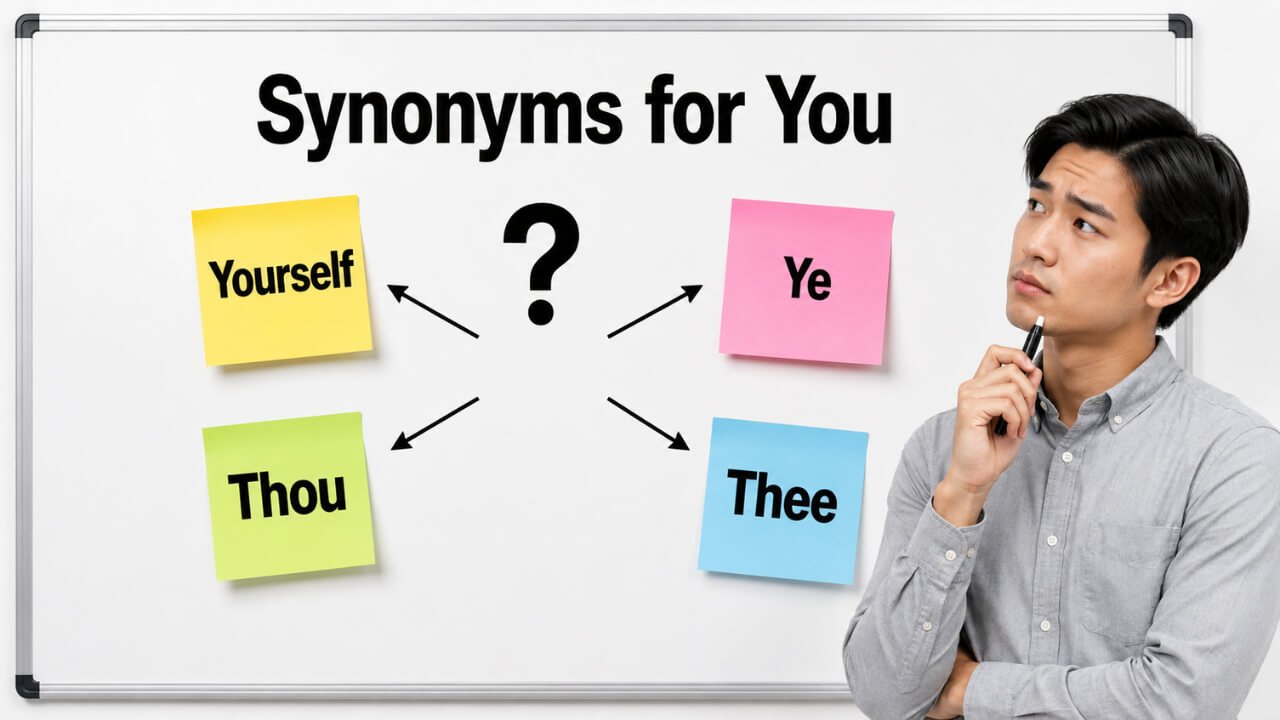
Quick Answer: The best synonyms for you include yourself, one, someone, anyone, the reader, the listener, the recipient, the audience, you all, and the person addressed. For formal writing, one is often the best choice when speaking generally. For instructions and guides, the reader or the user can be clearer. In casual speech, you all works well for a group. In personal writing, yourself is useful when the action refers back to the person being addressed.
Pronunciation and Word Details
Word: You.
Pronunciation: /juː/
Part of Speech: Pronoun.
Meaning: You refers to the person or people being spoken to, written to, or addressed.
US Pronunciation:
UK Pronunciation:
What Does “You” Mean?
You means the person or people being addressed directly. It is a pronoun used in both singular and plural contexts.
You can refer to one person, as in “You are right.” It can also refer to a group, as in “You are all welcome.” In general writing, you may refer to any person in a situation, such as “You should check the meaning before using a word.” Because you is direct, personal, and flexible, it is common in conversation, instructions, advice, questions, emails, lessons, and everyday explanations.
Meaning, Tone, and Context of “You”
You has a neutral and conversational tone. It is direct, simple, and easy to understand. It can sound friendly when used in advice, guides, and spoken language. It can also sound too direct in formal academic writing, especially when the writer should use one, people, readers, or a specific noun instead.
You is commonly used in questions, instructions, personal messages, classroom language, customer guidance, grammar examples, and everyday conversation. In business writing, you can sound polite and reader focused when used carefully. In academic writing, it may sound informal unless the context allows a direct address.
When and How to Use “You”
For Direct Address: Use you when speaking or writing to a specific person.
Example: You should save your work before closing the file.
For Questions: Use you when asking someone directly about an action, opinion, or need.
Example: Do you understand the difference between these two words?
For Instructions: Use you when guiding a reader through steps.
Example: You can replace this word with a clearer synonym.
For General Advice: Use you when the sentence applies to people in general, especially in simple writing.
Example: You learn vocabulary faster when you use words in real sentences.
For Plural Meaning: Use you when addressing more than one person, but add all or everyone when clarity is needed.
Example: You all need to submit the form today.
For Personal Emphasis: Use yourself when the action refers back to the person addressed.
Example: You should check the answer yourself.
Best Synonyms for You
Yourself: The person being addressed, used for emphasis or reflexive meaning.
Example: You can solve this yourself with careful practice.
One: A formal word meaning any person in general.
Example: One should choose words that match the tone of the sentence.
Someone: An unknown or general person.
Example: Someone may need a clearer explanation before using the term.
Anyone: Any person at all.
Example: Anyone can improve vocabulary with daily reading.
The Reader: The person reading a text, article, guide, or instruction.
Example: The reader should understand the meaning before choosing a synonym.
The Listener: The person hearing spoken words.
Example: The listener may understand the tone from the speaker’s voice.
The Recipient: The person who receives a message, email, gift, or action.
Example: The recipient should know why the message is important.
The Audience: The people being spoken to, taught, or addressed.
Example: The audience needs simple examples to understand the word.
You All: A clear plural form used for more than one person.
Example: You all should review the notes before the test.
The Person Addressed: A precise phrase for the person being spoken to or written to.
Example: The person addressed must understand the instruction clearly.
50 Synonyms for You with Short Meanings
- Yourself: The person being addressed directly.
- One: Any person in a formal or general sense.
- Someone: An unspecified person.
- Anyone: Any person without restriction.
- A Person: A general human being.
- The Reader: The person reading the text.
- The Listener: The person hearing spoken words.
- The Recipient: The person receiving something.
- The Addressee: The person a message is directed to.
- The Audience: The group or person being addressed.
- The User: The person using something.
- The Visitor: The person visiting a place or page.
- The Customer: The person buying or receiving a service.
- The Client: The person receiving professional help.
- The Student: The person learning something.
- The Learner: The person gaining knowledge or skill.
- The Applicant: The person applying for something.
- The Candidate: The person being considered for a role.
- The Employee: The person working in a job.
- The Manager: The person responsible for leading others.
- The Team Member: A person in a group or team.
- The Participant: A person taking part in an activity.
- The Guest: A person invited or welcomed somewhere.
- The Member: A person belonging to a group.
- The Buyer: A person purchasing something.
- The Viewer: A person watching something.
- The Caller: A person making a call.
- The Patient: A person receiving care or treatment.
- The Parent: A person caring for a child.
- The Child: A young person being addressed.
- The Driver: A person driving a vehicle.
- The Homeowner: A person who owns a home.
- The Individual: One person being addressed or described.
- The Person Reading: The person currently reading the words.
- The Person Listening: The person currently hearing the words.
- The Person Addressed: The person spoken to or written to.
- The Intended Person: The person meant to receive the message.
- The Other Person: A person separate from the speaker.
- Each of You: Every person in the addressed group.
- Every One of You: All people being addressed individually.
- All of You: The full group being addressed.
- You All: More than one person being addressed.
- Everyone Here: All people present in the place or situation.
- Anybody: Any person, often in casual use.
- Whoever Is Addressed: Any person the message is directed toward.
- The Target Reader: The specific reader a text is meant for.
- The Target Audience: The group a message is meant to reach.
- The Person Concerned: The person affected by the matter.
- The Responsible Person: The person expected to act.
- The Named Person: The specific person being discussed or addressed.
Read Also:
Synonyms for In Addition

Synonyms for You by Context
When You Means the Reader
Use reader based alternatives when writing articles, guides, lessons, or instructions. These choices sound clear because they identify the person reading the content.
Synonyms: The reader, the person reading, the target reader, the user.
Example: The reader should choose the synonym that matches the tone.
When You Means the Listener
Use listener based alternatives when the context involves speech, conversation, teaching, or spoken instructions.
Synonyms: The listener, the audience, the person listening, the addressee.
Example: The listener can understand meaning from tone, pause, and word choice.
When You Means Any Person
Use general alternatives when the sentence does not refer to one exact person. This is useful in formal writing and general advice.
Synonyms: One, someone, anyone, a person, an individual.
Example: One should avoid repeating the same word too often.
When You Means a Group
Use plural alternatives when you is speaking to more than one person. These options reduce confusion in instructions and announcements.
Synonyms: You all, all of you, each of you, every one of you, everyone here.
Example: All of you should review the instructions before starting.
When You Means a Role
Use role based alternatives when the context is specific. This makes the sentence clearer and more professional.
Synonyms: The customer, the student, the client, the applicant, the employee.
Example: The student should write the answer in complete sentences.
When You Means the Same Person
Use yourself when the action returns to the person being addressed. It adds emphasis or shows that the person performs the action personally.
Synonyms: Yourself, your own self, you personally.
Example: You should check the final sentence yourself.
Another Word for You
Another word for you depends on the context. In formal general writing, one is often the best replacement. In guides or articles, the reader is clearer. In plural speech, you all or all of you is more specific. In personal emphasis, yourself is the strongest option.
Original: You should choose the word carefully.
Better Option: One should choose the word carefully.
Original: You can see the difference in the examples.
Better Option: The reader can see the difference in the examples.
Original: You need to submit your answers today.
Better Option: All of you need to submit your answers today.
Original: You should test the sentence again.
Better Option: You should test the sentence yourself.
When Not to Use “You”
Do not use you when it sounds too direct, repetitive, vague, or informal for the context. In formal essays, one, people, or a specific noun may sound more suitable. In professional instructions, a role based noun may be clearer. In group messages, you can be unclear because it may refer to one person or many people.
Weak: You can see that you need to use better words when you write.
Better: Writers can improve clarity by choosing more accurate words.
Weak: You must follow the rule because you made the mistake.
Better: The student should follow the rule to avoid the mistake.
Weak: You need to arrive early.
Better: All participants need to arrive early.
Weak: You should know this already.
Better: The explanation may help clarify the point.
Words Commonly Confused With You
You vs Your: You is a pronoun, while your shows possession.
Example: You are learning a new word.
Example: Your sentence is clear.
You vs You’re: You is a pronoun, while you’re means you are.
Example: You chose the correct synonym.
Example: You’re choosing the correct synonym.
You vs Yourself: You names the person addressed, while yourself refers back to that same person for emphasis or reflexive meaning.
Example: You should review the answer.
Example: You should review the answer yourself.
You vs One: You is direct and conversational, while one is formal and general.
Example: You should write clearly.
Example: One should write clearly.
You vs They: You refers to the person being addressed, while they refers to other people.
Example: You need to check the meaning.
Example: They need to check the meaning.
You vs We: You addresses the reader or listener, while we includes the speaker or writer.
Example: You can improve with practice.
Example: We can improve with practice.
Which Synonym Should You Choose?
Choose yourself when the action refers back to the person being addressed.
Choose one when writing formally about people in general.
Choose someone when referring to an unspecified person.
Choose anyone when the meaning is open to any person.
Choose the reader when writing an article, guide, lesson, or explanation.
Choose the listener when discussing speech, conversation, or spoken instructions.
Choose the recipient when referring to a person receiving a message, gift, or document.
Choose the audience when speaking to a group or describing people receiving information.
Choose you all when casual speech needs a clear plural meaning.
Choose the student, customer, client, employee, or applicant when a role based noun is clearer than you.
Real Life Examples of “You” in Sentences
Original: You should read the full sentence before choosing a synonym.
Better Option: The reader should read the full sentence before choosing a synonym.
Original: You can use one in formal writing.
Better Option: A writer can use one in formal writing.
Original: You need to bring your documents tomorrow.
Better Option: All of you need to bring your documents tomorrow.
Original: You should check the answer again.
Better Option: You should check the answer yourself.
Original: You may receive a reply within two days.
Better Option: The recipient may receive a reply within two days.
Original: You must complete the exercise before the lesson ends.
Better Option: The student must complete the exercise before the lesson ends.
Original: You can ask a question after the presentation.
Better Option: The audience can ask a question after the presentation.
Original: You should update your information before submitting the form.
Better Option: The applicant should update the information before submitting the form.
Original: You can understand the speaker’s meaning from context.
Better Option: The listener can understand the speaker’s meaning from context.
Original: You should avoid unclear word choices.
Better Option: One should avoid unclear word choices.
Synonym Groups and Usage Differences
Direct Address Group
This group includes words and phrases used when speaking to a person or group directly. These choices keep the sentence personal and clear.
Synonyms: You, yourself, you all, all of you.
Example: All of you should read the instructions carefully.
General Person Group
This group works when the sentence applies to people in general, not one exact person. It is helpful in formal writing, advice, and explanations.
Synonyms: One, someone, anyone, a person, an individual.
Example: One should choose a synonym according to meaning and tone.
Reader Group
This group is useful in written content. It helps replace repeated uses of you in articles, guides, lessons, and grammar explanations.
Synonyms: The reader, the person reading, the target reader, the user.
Example: The reader can compare the examples to understand the difference.
Listener Group
This group fits spoken situations. It is useful when meaning depends on hearing, tone, or conversation.
Synonyms: The listener, the audience, the person listening, the addressee.
Example: The listener may notice the speaker’s polite tone.
Role Specific Group
This group gives more detail than you. It works well in professional, educational, service, and instruction based writing.
Synonyms: The student, the customer, the client, the employee, the applicant.
Example: The customer should keep the receipt for future reference.
Reflexive Group
This group shows that the person addressed performs the action personally or receives the effect of the action.
Synonyms: Yourself, your own self, you personally.
Example: You can decide for yourself after reading both examples.
Antonyms of You
You has no true antonym because it is a pronoun, not a descriptive word. However, it can be contrasted with pronouns that refer to different people or roles in a sentence.
I: The speaker or writer.
Me: The speaker or writer as the object of an action.
We: The speaker and one or more other people.
Us: The speaker’s group as the object of an action.
He: A male person being discussed.
She: A female person being discussed.
They: Other people being discussed.
Them: Other people as the object of an action.
Someone Else: A different person.
Other People: People who are not the person being addressed.
Comparison: You vs Related Words
You vs Yourself
You names the person being addressed. Yourself refers back to that same person and often adds emphasis.
Example With You: You should review the paragraph.
Example With Yourself: You should review the paragraph yourself.
You vs One
You is direct and conversational. One is formal and general.
Example With You: You should avoid unclear synonyms.
Example With One: One should avoid unclear synonyms.
You vs The Reader
You speaks directly to the person reading. The reader sounds more formal and article focused.
Example With You: You can compare the meanings below.
Example With The Reader: The reader can compare the meanings below.
You vs The Listener
You can refer to a person in any direct address. The listener specifically refers to someone hearing speech.
Example With You: You may understand the sentence from context.
Example With The Listener: The listener may understand the sentence from context.
You vs The Audience
You may be singular or plural. The audience clearly refers to a group receiving information.
Example With You: You should ask questions at the end.
Example With The Audience: The audience should ask questions at the end.
You vs The Recipient
You is general and direct. The recipient is specific to receiving a message, item, or action.
Example With You: You will receive the confirmation soon.
Example With The Recipient: The recipient will receive the confirmation soon.
Common Phrases and Expressions With You
Thank You: A polite expression of gratitude.
You Are Welcome: A polite reply after someone says thank you.
You Know: A conversational phrase used to refer to shared understanding.
You See: A phrase used to explain or clarify a point.
You All: A plural phrase for more than one person.
All of You: A phrase meaning every person being addressed.
Each of You: Every individual in a group.
Just for You: Made, chosen, or done for the person addressed.
Up to You: Your choice or responsibility.
Good for You: An expression of approval, support, or praise.
Common Mistakes to Avoid
Avoid using you too often in the same paragraph. Repetition can make writing sound basic or overly direct. Replace some uses with the reader, people, one, or a more specific noun.
Do not confuse you with your. You is a pronoun, while your shows possession.
Do not confuse you with you’re. You’re means you are.
Avoid using you in formal academic writing when one, people, researchers, writers, or students would sound more suitable.
Avoid unclear plural use. If you means more than one person, use all of you, each of you, or you all when clarity matters.
Avoid blaming language with you. A sentence like “You made this mistake” can sound harsh. A softer sentence like “This mistake can happen when the rule is unclear” may be better.
Conclusion
Synonyms for you depend strongly on context because you is a pronoun, not a descriptive word with many exact replacements. Use yourself for emphasis, one for formal general writing, the reader for articles, the listener for speech, the recipient for messages, and you all or all of you for groups. The best choice should match the sentence’s tone, audience, and purpose. Clear alternatives help reduce repetition and make writing sound more natural, specific, and professional.
FAQs About Synonyms for You
What are the best synonyms for you?
The best synonyms for you are yourself, one, someone, anyone, the reader, the listener, the recipient, the audience, you all, and the person addressed.
Is “one” a formal synonym for you?
Yes. One is a formal alternative when you means any person in general. For example, “One should write clearly” sounds more formal than “You should write clearly.”
Can “yourself” replace you?
Yourself can replace or support you when the action refers back to the same person. For example, “Check it yourself” means the person addressed should do it personally.
What is the plural synonym for you?
Useful plural alternatives include you all, all of you, each of you, every one of you, and everyone here.
Can I use “the reader” instead of you?
Yes. The reader is a strong replacement in articles, guides, lessons, and explanations. It sounds more formal and less direct than you.
Is you formal or casual?
You is neutral, but it often feels conversational. It is common in everyday speech, instructions, and helpful writing. In very formal writing, one or a specific noun may be better.
What is another word for you in professional writing?
In professional writing, use the recipient, the client, the customer, the applicant, the employee, or the reader when those words match the context.
