
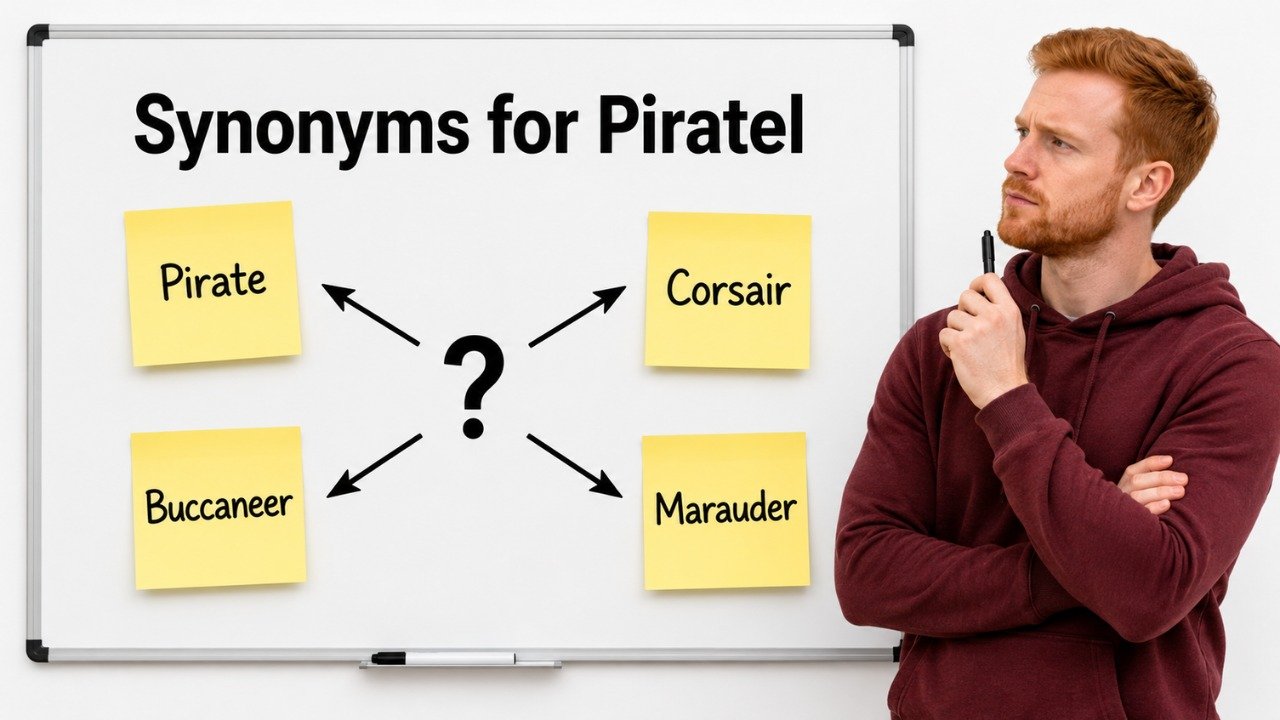
Quick Answer: The best synonyms for pirate include buccaneer, corsair, freebooter, sea robber, sea raider, marauder, plunderer, hijacker, bootlegger, and copyright infringer. Use buccaneer or corsair in historical and literary writing, sea robber in clear general explanations, and marauder or plunderer when emphasizing violent raids. Hijacker suits the unlawful seizure of a vessel. For unauthorized digital copying, bootlegger, digital pirate, software pirate, or copyright infringer provides a more specific meaning.
Pronunciation and Word Details
Word: Pirate.
Pronunciation: /ˈpaɪ.rət/
Part of Speech: Noun, verb, and adjective.
Meaning: A person who attacks or robs ships, or someone who copies, distributes, or broadcasts protected material without permission.
US Pronunciation:
UK Pronunciation:
What Does “Pirate” Mean?
A pirate is a person who attacks, boards, robs, or controls ships without lawful authority.
As a noun, pirate traditionally refers to a criminal who operates at sea. Pirates may attack vessels, steal valuable goods, take control of ships, or raid coastal communities.
The word also has a modern meaning. A pirate can be someone who copies, downloads, distributes, sells, or broadcasts protected material without permission from its legal owner.
As a verb, pirate means to copy, reproduce, distribute, or use something illegally.
Maritime Use: The pirate boarded the merchant vessel and stole its cargo.
Historical Use: The book describes a pirate who sailed through busy trade routes.
Digital Use: The software pirate distributed unauthorized copies of the program.
Broadcasting Use: The pirate transmitted programs without a legal broadcasting license.
Verb Use: The group attempted to pirate the protected recording.
Adjective Use: Authorities closed the pirate broadcasting station.
Pirate can therefore refer to a sea criminal, an unauthorized copier, an illegal broadcaster, or the act of taking and reproducing protected material without permission.
Meaning, Tone, and Context of “Pirate”
Pirate usually has a negative, criminal, adventurous, or dramatic tone. The exact tone depends on whether the word appears in historical, legal, fictional, digital, or casual writing.
Historical Tone: In historical writing, pirate describes a person who committed robbery or violence at sea. The term is usually factual and serious.
Legal Tone: In legal or formal contexts, pirate can refer to maritime crime or unauthorized copying. More precise terms such as copyright infringer or unauthorized distributor may be preferred.
Literary Tone: In novels and adventure stories, pirate often creates an exciting, dangerous, rebellious, or mysterious image.
Conversational Tone: In casual speech, pirate may describe someone who obtains or shares protected content illegally.
Technical Tone: In discussions of software, broadcasting, publishing, or digital media, pirate refers to unauthorized copying or distribution.
Emotional Tone: The word may suggest danger, lawlessness, greed, freedom, rebellion, or adventure depending on the context.
Humorous Tone: Pirate is sometimes used playfully for costumes, fictional characters, themed events, or exaggerated descriptions.
Writers should avoid romanticizing real violence or confusing historical pirates with privateers who operated under official authority.
When and How to Use “Pirate”
For Maritime Robbery
For Sea Crime: Use pirate for someone who attacks, robs, or takes control of vessels without legal authority.
Example: The pirate targeted ships carrying valuable goods.
For Historical Writing
For History: Use pirate when discussing unlawful raiders who operated along sea routes or coastal regions.
Example: The historian examined how the pirate disrupted regional trade.
For Adventure Fiction
For Fiction: Use pirate for a fictional sailor, outlaw, captain, or crew member involved in sea adventures.
Example: The young pirate searched the island for hidden treasure.
For Unauthorized Copying
For Copyright: Use pirate for someone who illegally copies or distributes protected books, films, music, software, or other material.
Example: The digital pirate shared unauthorized copies of the program.
For Illegal Broadcasting
For Broadcasting: Use pirate for a person or station that broadcasts without the required permission or license.
Example: The authorities located the pirate broadcaster outside the city.
For Unlawful Seizure
For Hijacking: Use pirate when someone unlawfully boards or takes control of a ship.
Example: The pirate attempted to seize the cargo vessel.
For Verb Usage
For Illegal Reproduction: Use pirate as a verb when someone copies, distributes, or sells protected material without authorization.
Example: It is unlawful to pirate copyrighted publications.
For Figurative Description
For Rebellion: Pirate can describe a bold, lawless, or unconventional figure in creative writing.
Example: The character lived like a pirate who refused to follow ordinary rules.
Best Synonyms for Pirate
Buccaneer
Synonym: A pirate or sea raider, especially one associated with the Caribbean during an earlier historical period.
Example: The buccaneer sailed in search of merchant vessels.
Corsair
Synonym: A pirate or private sea raider, especially in historical and literary contexts.
Example: The corsair attacked ships traveling through the narrow passage.
Freebooter
Synonym: A person who robs, plunders, or acts without legal authority.
Example: The freebooter searched the coast for valuable cargo.
Sea Robber
Synonym: A person who steals from ships or travelers at sea.
Example: The sea robber boarded the vessel under cover of darkness.
Sea Raider
Synonym: A person who attacks ships or coastal settlements.
Example: The sea raider became feared throughout the region.
Marauder
Synonym: A person who travels around stealing, attacking, or causing destruction.
Example: The marauder led a series of raids along the coast.
Plunderer
Synonym: Someone who steals goods by force during an attack.
Example: The plunderer took supplies from the captured ship.
Hijacker
Synonym: A person who unlawfully takes control of a vehicle, aircraft, or vessel.
Example: The hijacker attempted to redirect the ship.
Bootlegger
Synonym: A person who makes, sells, or distributes unauthorized goods or copies.
Example: The bootlegger sold illegal copies of the recording.
Copyright Infringer
Synonym: A person who uses, copies, or distributes protected work without legal permission.
Example: The copyright infringer reproduced the book without authorization.
50 Synonyms for Pirate with Short Meanings
The following list includes direct synonyms and useful alternatives for maritime, historical, literary, digital, and verb meanings of pirate.
- Buccaneer: A historical pirate or sea raider.
- Corsair: A pirate or armed sea raider.
- Freebooter: A lawless person who steals or plunders.
- Sea Robber: A criminal who steals from ships at sea.
- Sea Raider: A person who attacks ships or coasts.
- Maritime Robber: A thief who commits robbery on the water.
- Maritime Raider: A person who conducts unlawful attacks at sea.
- Sea Bandit: A bandit who robs ships or coastal areas.
- Sea Rover: A sailor who roams the seas and may raid vessels.
- Rover: A wandering raider or adventurer.
- Picaroon: An old term for a pirate or dishonest adventurer.
- Reaver: A raider who steals goods through force.
- Marauder: A roaming attacker who steals and destroys.
- Raider: A person who carries out a sudden attack.
- Plunderer: Someone who steals valuables during an attack.
- Pillager: A person who violently steals from a place.
- Looter: Someone who steals goods during disorder or conflict.
- Robber: A person who takes property through force or threats.
- Bandit: An outlaw who robs people or places.
- Brigand: A member of an armed group of robbers.
- Outlaw: A person who lives outside the protection of the law.
- Thief: Someone who takes property without permission.
- Hijacker: A person who unlawfully seizes a vessel or vehicle.
- Ship Hijacker: Someone who illegally takes control of a ship.
- Coastal Raider: A person who attacks communities near the sea.
- Ocean Raider: A person who attacks vessels on the open ocean.
- Swashbuckler: A bold and adventurous fighter, especially in fiction.
- Privateer: A privately owned armed sailor officially authorized to attack enemy ships.
- Pirate Captain: The leader of a pirate vessel or crew.
- Pirate Crew Member: A person serving with a pirate crew.
- Bootlegger: Someone who produces or sells unauthorized goods.
- Copyright Infringer: Someone who violates the legal rights of a creator.
- Digital Pirate: A person who illegally copies or distributes digital content.
- Software Pirate: Someone who copies or shares software without permission.
- Media Pirate: A person who distributes protected media illegally.
- Content Thief: Someone who takes and uses another person’s content without permission.
- Unauthorized Copier: A person who reproduces protected material illegally.
- Illegal Downloader: Someone who downloads protected material without permission.
- Illegal Distributor: A person who shares or sells protected work unlawfully.
- Counterfeiter: Someone who makes unauthorized imitations or copies.
- Plagiarist: A person who presents another person’s work as their own.
- Broadcast Pirate: Someone who broadcasts without legal authorization.
- Unlicensed Broadcaster: A person who transmits programs without a required license.
- Plunder: To steal valuables by force.
- Raid: To attack suddenly in order to steal or cause damage.
- Rob: To take property through force or threats.
- Loot: To steal goods during an attack or disturbance.
- Pillage: To violently steal from a place.
- Hijack: To unlawfully seize control of a vessel or vehicle.
- Steal: To take something without the owner’s permission.
Read Also:
Synonyms for Conservative
Synonyms for Pirate by Context
When Pirate Means a Sea Robber
Buccaneer, sea robber, sea raider, maritime robber, sea bandit, and ocean raider are suitable alternatives.
Example With Pirate: The pirate attacked a merchant ship near the island.
Example With Sea Robber: The sea robber attacked a merchant ship near the island.
Sea robber is the clearest general replacement. Buccaneer is more colorful and historical, while maritime robber sounds formal and descriptive.
When Pirate Means a Historical Raider
Buccaneer, corsair, freebooter, picaroon, rover, and reaver work well in historical or literary descriptions.
Example With Pirate: The pirate became known for raiding wealthy ports.
Example With Buccaneer: The buccaneer became known for raiding wealthy ports.
Buccaneer often suggests a particular period and region. Corsair may describe a pirate, but it can also refer to a sea raider who had official support.
When Pirate Means a Violent Plunderer
Marauder, plunderer, pillager, looter, raider, and brigand emphasize theft, destruction, or violent attack.
Example With Pirate: The pirate stole food and valuables from the settlement.
Example With Plunderer: The plunderer stole food and valuables from the settlement.
Plunderer emphasizes stolen goods, while marauder suggests repeated roaming attacks.
When Pirate Means a Ship Hijacker
Hijacker, ship hijacker, maritime raider, and sea raider are useful when someone unlawfully takes control of a vessel.
Example With Pirate: The pirate seized the ship and changed its course.
Example With Hijacker: The hijacker seized the ship and changed its course.
Hijacker is the most precise term when control of the vessel is the main point.
When Pirate Means a Fictional Adventurer
Swashbuckler, buccaneer, sea rover, adventurer, outlaw, and rogue may suit fictional descriptions.
Example With Pirate: The pirate crossed the ocean in search of a hidden island.
Example With Swashbuckler: The swashbuckler crossed the ocean in search of a hidden island.
Swashbuckler emphasizes bold action and dramatic adventure. It does not always imply actual piracy.
When Pirate Means an Illegal Copier
Copyright infringer, digital pirate, software pirate, media pirate, unauthorized copier, and content thief are suitable alternatives.
Example With Pirate: The pirate shared protected files without permission.
Example With Copyright Infringer: The copyright infringer shared protected files without permission.
Copyright infringer is the most precise formal term. Digital pirate is more conversational and broader.
When Pirate Means an Illegal Seller
Bootlegger, counterfeiter, illegal distributor, and unauthorized seller can describe someone who sells unlawful copies.
Example With Pirate: The pirate sold unauthorized recordings.
Example With Bootlegger: The bootlegger sold unauthorized recordings.
Bootlegger commonly refers to unauthorized products or recordings. Counterfeiter usually implies imitation goods or false copies.
When Pirate Means an Illegal Broadcaster
Broadcast pirate, unlicensed broadcaster, and unauthorized broadcaster are useful alternatives.
Example With Pirate: The pirate transmitted programs without permission.
Example With Unlicensed Broadcaster: The unlicensed broadcaster transmitted programs without permission.
Unlicensed broadcaster is direct and formal. Broadcast pirate has a stronger and more dramatic tone.
When Pirate Is Used as a Verb
Plunder, raid, rob, loot, pillage, hijack, steal, copy illegally, and distribute illegally may replace the verb pirate.
Example With Pirate: The group planned to pirate the protected publication.
Example With Copy Illegally: The group planned to copy the protected publication illegally.
The correct verb depends on whether the sentence refers to robbery, seizure, copying, selling, or distribution.
Another Word for Pirate
Buccaneer is one of the best general alternatives for pirate in historical and adventure writing. However, there is no single replacement that works in every context.
Use sea robber for maritime theft, hijacker for the seizure of a ship, copyright infringer for unauthorized copying, and bootlegger for illegal production or sales.
Original: The pirate attacked ships traveling through the channel.
Better Option: The sea raider attacked ships traveling through the channel.
Original: The pirate took control of the cargo vessel.
Better Option: The hijacker took control of the cargo vessel.
Original: The pirate distributed unauthorized copies of the software.
Better Option: The copyright infringer distributed unauthorized copies of the software.
Original: The pirate sold illegal recordings at the market.
Better Option: The bootlegger sold illegal recordings at the market.
When Not to Use “Pirate”
Pirate may sound vague, inaccurate, overly dramatic, informal, or legally imprecise in certain situations.
When Official Authorization Existed
A privateer had official permission from a government to attack enemy vessels. Calling every privateer a pirate removes an important legal distinction.
Weak: The government hired the pirate to attack enemy ships.
Better: The government authorized the privateer to attack enemy ships.
When No Robbery Occurred
A sailor, explorer, trader, smuggler, or naval officer should not automatically be called a pirate.
Weak: The pirate transported goods secretly across the border.
Better: The smuggler transported goods secretly across the border.
When Formal Legal Precision Is Needed
Copyright infringer or unauthorized distributor may be clearer in formal reports.
Weak: The court found that the pirate had copied the protected work.
Better: The court found that the copyright infringer had copied the protected work.
When Describing Plagiarism
Plagiarism involves presenting another person’s ideas or words as one’s own. Piracy usually involves unauthorized copying or distribution.
Weak: The student was a pirate who copied the essay.
Better: The student was a plagiarist who copied the essay.
When the Meaning Is Too Broad
Specify the exact type of unlawful behavior whenever possible.
Weak: Authorities arrested the pirate.
Better: Authorities arrested the ship hijacker who had seized the vessel.
When the Tone Is Too Playful
Pirate can create an adventurous or humorous image that may not suit serious discussions of violence or theft.
Weak: The cheerful pirates stole the crew’s supplies during the violent raid.
Better: The armed raiders stole the crew’s supplies during the violent attack.
When Repetition Weakens the Writing
Avoid repeating pirate in every sentence.
Weak: The pirate led the pirates to the pirate ship where the pirates stored their cargo.
Better: The pirate captain led the crew to the vessel where they stored the stolen cargo.
Words Commonly Confused With Pirate
Pirate vs Buccaneer: Pirate is a broad term for an unlawful sea robber. Buccaneer often refers to a particular type of historical sea raider and is common in adventure writing.
Pirate vs Corsair: A pirate operates without lawful authority. Corsair may describe a pirate, but historically it could also refer to an officially supported raider.
Pirate vs Privateer: A pirate acts without legal authorization. A privateer receives official permission to attack enemy ships during conflict.
Pirate vs Smuggler: A pirate attacks or robs vessels. A smuggler secretly transports prohibited or untaxed goods.
Pirate vs Bandit: A pirate traditionally commits robbery at sea. A bandit usually robs people or places on land.
Pirate vs Hijacker: A pirate may rob or attack a ship. A hijacker specifically takes unlawful control of a vessel or vehicle.
Pirate vs Bootlegger: A pirate may illegally copy or distribute protected work. A bootlegger makes, sells, or distributes unauthorized goods.
Pirate vs Plagiarist: A pirate reproduces or distributes protected material without permission. A plagiarist claims another person’s words or ideas as their own.
Pirate vs Counterfeiter: A pirate creates or shares unauthorized copies. A counterfeiter produces an imitation designed to appear genuine.
Pirate vs Swashbuckler: A pirate is an unlawful sea robber. A swashbuckler is a bold fictional adventurer and may not be a criminal.
Which Synonym Should You Choose?
Choose buccaneer for historical stories, adventure writing, and colorful descriptions of sea raiders.
Choose corsair when writing about historical maritime raiders, but verify whether the person operated independently or with official support.
Choose sea robber when you need a simple and direct explanation for general readers.
Choose maritime robber in formal reports, essays, or definitions about crime at sea.
Choose sea raider when the person attacks ships or coastal communities.
Choose marauder when emphasizing repeated attacks, destruction, and roaming violence.
Choose plunderer when the focus is on stealing valuable goods during an attack.
Choose hijacker when someone unlawfully takes control of a ship or other vehicle.
Choose privateer only when the person had official authorization from a government.
Choose swashbuckler for fictional, dramatic, or adventurous characters.
Choose bootlegger when describing the illegal production or sale of unauthorized goods.
Choose copyright infringer in formal, academic, legal, or professional writing about protected material.
Choose digital pirate or software pirate in conversational or technical writing about unauthorized digital copying.
Choose unlicensed broadcaster in formal reports about illegal transmissions.
Choose outlaw or bandit in casual conversation when the exact maritime meaning is not important.
Real Life Examples of “Pirate” in Sentences
Original: The pirate attacked a ship carrying valuable cargo.
Better Option: The sea raider attacked a ship carrying valuable cargo.
Original: The pirate became feared throughout the coastal region.
Better Option: The marauder became feared throughout the coastal region.
Original: The pirate stole supplies from the captured vessel.
Better Option: The plunderer stole supplies from the captured vessel.
Original: The pirate seized control of the passenger ship.
Better Option: The hijacker seized control of the passenger ship.
Original: The pirate sailed under official orders from the government.
Better Option: The privateer sailed under official orders from the government.
Original: The fictional pirate defeated his enemies in a dramatic duel.
Better Option: The fictional swashbuckler defeated his enemies in a dramatic duel.
Original: The pirate copied the software without permission.
Better Option: The software pirate copied the program without permission.
Original: The pirate distributed protected recordings online.
Better Option: The copyright infringer distributed protected recordings without authorization.
Original: The pirate sold illegal copies of the film.
Better Option: The bootlegger sold unauthorized copies of the film.
Original: The pirate operated a broadcasting station without a license.
Better Option: The unlicensed broadcaster operated the station without legal permission.
Synonym Groups and Usage Differences
Maritime Crime Group
Pirate, sea robber, maritime robber, sea bandit, and ocean raider describe unlawful theft or attack at sea.
Sea robber is direct and easy to understand. Maritime robber sounds more formal, while sea bandit has a vivid and dramatic tone.
Example: The maritime robber targeted ships carrying expensive cargo.
Historical Raider Group
Buccaneer, corsair, freebooter, picaroon, rover, and reaver are associated with earlier periods, sea raids, and adventure literature.
These words carry historical or literary associations and may require context.
Example: The buccaneer became famous for raiding wealthy ports.
Attack Group
Raider, marauder, plunderer, pillager, looter, and brigand emphasize sudden attacks, theft, or destruction.
Raider focuses on the attack. Plunderer focuses on stolen wealth. Marauder suggests repeated roaming attacks.
Example: The marauder led several attacks along the coast.
Seizure Group
Hijacker, ship hijacker, and maritime raider describe someone who unlawfully takes control of a vessel.
Hijacker is the most precise modern term for forced seizure.
Example: The ship hijacker ordered the crew to change direction.
Fictional Adventure Group
Swashbuckler, buccaneer, sea rover, outlaw, and rogue can describe adventurous or rebellious fictional characters.
These terms may create excitement without accurately describing real maritime crime.
Example: The swashbuckler crossed the deck with a sword in his hand.
Digital Copying Group
Digital pirate, software pirate, media pirate, copyright infringer, and unauthorized copier relate to unlawful reproduction or distribution.
Copyright infringer is the most formal and legally precise option.
Example: The copyright infringer distributed hundreds of unauthorized copies.
Illegal Sales Group
Bootlegger, counterfeiter, illegal distributor, and unauthorized seller describe people who produce or sell unlawful goods.
Bootlegger emphasizes unauthorized production or sales. Counterfeiter suggests an imitation intended to appear genuine.
Example: The bootlegger sold illegal recordings to customers.
Broadcasting Group
Broadcast pirate, unlicensed broadcaster, and unauthorized broadcaster describe people or stations that transmit without required permission.
Unlicensed broadcaster is neutral and formal. Broadcast pirate is more vivid.
Example: Officials located the unlicensed broadcaster after tracing the signal.
Theft Action Group
Plunder, raid, rob, loot, pillage, hijack, and steal describe actions associated with piracy.
These verbs are not interchangeable in every sentence. Hijack means take control, while plunder and pillage emphasize stealing during an attack.
Example: The attackers planned to raid the coastal warehouse.
Antonyms of Pirate
Pirate has no single exact antonym. The best opposite depends on whether pirate refers to maritime crime, unauthorized copying, illegal broadcasting, or unlawful behavior.
Lawful Sailor: A sailor who operates within the law.
Naval Officer: A legally appointed member of a naval force.
Coast Guard Officer: An official responsible for maritime safety and law enforcement.
Merchant Sailor: A person who works legally aboard a commercial vessel.
Authorized Privateer: A historical sea raider who acted with official permission.
Law Enforcer: A person responsible for enforcing legal rules.
Copyright Holder: A person or organization that legally owns rights to protected work.
Authorized User: Someone who has permission to access or use protected material.
Licensed Distributor: A person or business legally permitted to distribute a product.
Licensed Broadcaster: A broadcaster operating with legal authorization.
Legitimate Seller: Someone who sells lawful and authorized goods.
Original Creator: The person who produces an original work.
Comparison: Pirate vs Related Words
Pirate vs Buccaneer
Pirate is a broad term for someone who commits robbery or violence at sea. Buccaneer usually has a historical association and is common in adventure stories.
Example With Pirate: The pirate robbed a vessel near the coast.
Example With Buccaneer: The buccaneer raided ships traveling through the region.
Pirate vs Corsair
Pirate usually means an unlawful sea robber. Corsair may describe a pirate or a private raider associated with a particular region or government.
Example With Pirate: The pirate acted without legal authority.
Example With Corsair: The corsair attacked enemy ships along the trade route.
Pirate vs Privateer
A pirate acts without lawful permission. A privateer historically operated a privately owned vessel with official authorization to attack enemy ships.
Example With Pirate: The pirate attacked any ship carrying valuable cargo.
Example With Privateer: The privateer attacked vessels belonging to an enemy state.
Pirate vs Sea Raider
Pirate emphasizes maritime crime and robbery. Sea raider emphasizes sudden attacks against vessels or coastal communities.
Example With Pirate: The pirate stole the merchant’s cargo.
Example With Sea Raider: The sea raider attacked several coastal settlements.
Pirate vs Marauder
A pirate operates mainly at sea. A marauder is any roaming person who raids, steals, or destroys property.
Example With Pirate: The pirate boarded the cargo ship.
Example With Marauder: The marauder traveled from village to village stealing supplies.
Pirate vs Hijacker
A pirate may attack, rob, or seize a ship. A hijacker specifically takes unlawful control of a vessel or vehicle.
Example With Pirate: The pirate stole goods from the ship.
Example With Hijacker: The hijacker forced the captain to change course.
Pirate vs Bootlegger
A pirate may unlawfully copy or distribute protected material. A bootlegger usually produces, sells, or distributes unauthorized goods.
Example With Pirate: The digital pirate copied the protected recording.
Example With Bootlegger: The bootlegger sold unauthorized recordings.
Pirate vs Plagiarist
A pirate copies or distributes work without permission. A plagiarist presents another person’s ideas or words as original work.
Example With Pirate: The pirate shared illegal copies of the book.
Example With Plagiarist: The plagiarist submitted copied paragraphs under their own name.
Common Phrases and Expressions With “Pirate”
Pirate Ship: A vessel used by pirates for attacks, robbery, or travel.
Pirate Captain: The person who leads a pirate vessel and crew.
Pirate Crew: A group of people serving aboard a pirate ship.
Pirate Flag: A flag associated with pirates and used to identify a pirate vessel.
Pirate Treasure: Valuable goods believed to have been stolen or hidden by pirates.
Pirate Raid: A sudden attack carried out by pirates.
Pirate Copy: An unauthorized reproduction of protected material.
Software Pirate: A person who copies or distributes software without permission.
Digital Pirate: Someone who unlawfully copies or shares digital content.
Pirate Broadcasting: Radio or television transmission conducted without required authorization.
Common Mistakes to Avoid
Treating Every Sea Fighter as a Pirate
Sailors, naval officers, privateers, smugglers, and pirates have different roles. Check whether the person committed unlawful robbery at sea.
Calling a Privateer a Pirate
Privateers operated with official authority. Pirates did not have lawful permission.
Incorrect: The government issued orders to the pirate.
Better: The government issued authorization to the privateer.
Using Buccaneer for Every Pirate
Buccaneer carries historical and regional associations. Sea robber or sea raider may be more accurate in general explanations.
Confusing Piracy With Smuggling
Piracy involves robbery, attack, seizure, or unauthorized copying. Smuggling involves secretly transporting prohibited or untaxed goods.
Confusing Piracy With Plagiarism
Piracy usually means unauthorized copying or distribution. Plagiarism means claiming another person’s work as one’s own.
Using Pirate Too Vaguely
State whether the person is a sea robber, hijacker, illegal broadcaster, or copyright infringer.
Vague: The authorities investigated the pirate.
Clear: The authorities investigated the unlicensed broadcaster.
Ignoring Part of Speech
Pirate can be a noun, verb, or adjective.
Noun: The pirate boarded the vessel.
Verb: They attempted to pirate the protected recording.
Adjective: Officials closed the pirate station.
Using the Wrong Plural
The plural of pirate is pirates.
Singular: A pirate approached the ship.
Plural: Several pirates approached the ship.
Confusing Possessive Forms
Pirate’s shows possession by one pirate. Pirates’ shows possession by more than one pirate.
Singular Possessive: The pirate’s map was hidden in the cabin.
Plural Possessive: The pirates’ supplies were stored below deck.
Romanticizing Serious Crime
Pirate can sound adventurous in fiction, but real piracy involves robbery, violence, danger, and unlawful seizure. Match the tone to the subject.
Conclusion
Understanding synonyms for pirate helps you choose an accurate word for maritime crime, historical writing, adventure fiction, digital copying, or illegal broadcasting. Buccaneer and corsair suit historical contexts, while sea robber and sea raider clearly describe criminals at sea. Use hijacker for unlawful vessel seizure, plunderer for violent theft, and swashbuckler for fictional adventure. In modern contexts, copyright infringer, digital pirate, bootlegger, and unlicensed broadcaster provide more precise alternatives based on the specific offense.
FAQs About Synonyms for Pirate
What Is the Best Synonym for Pirate?
Buccaneer is a strong historical and literary synonym. Sea robber is the clearest general alternative for a criminal who steals at sea.
Is Corsair Another Word for Pirate?
Corsair can mean pirate, especially in historical writing. However, some corsairs operated with official support, so the words are not always identical.
Is a Privateer the Same as a Pirate?
No. A privateer had official permission to attack enemy vessels. A pirate operated without lawful authorization.
What Is a Modern Synonym for Pirate?
Copyright infringer, digital pirate, software pirate, bootlegger, and unauthorized distributor are useful modern alternatives.
What Is a Formal Word for Pirate?
Maritime robber is a formal term for a sea criminal. Copyright infringer is more precise for unauthorized copying.
Can Swashbuckler Replace Pirate?
Swashbuckler can replace pirate in fictional or adventurous contexts. It describes a bold fighter but does not necessarily mean a sea robber.
What Is the Opposite of Pirate?
There is no exact opposite. Lawful sailor, naval officer, authorized user, licensed distributor, and copyright holder may work in different contexts.
