
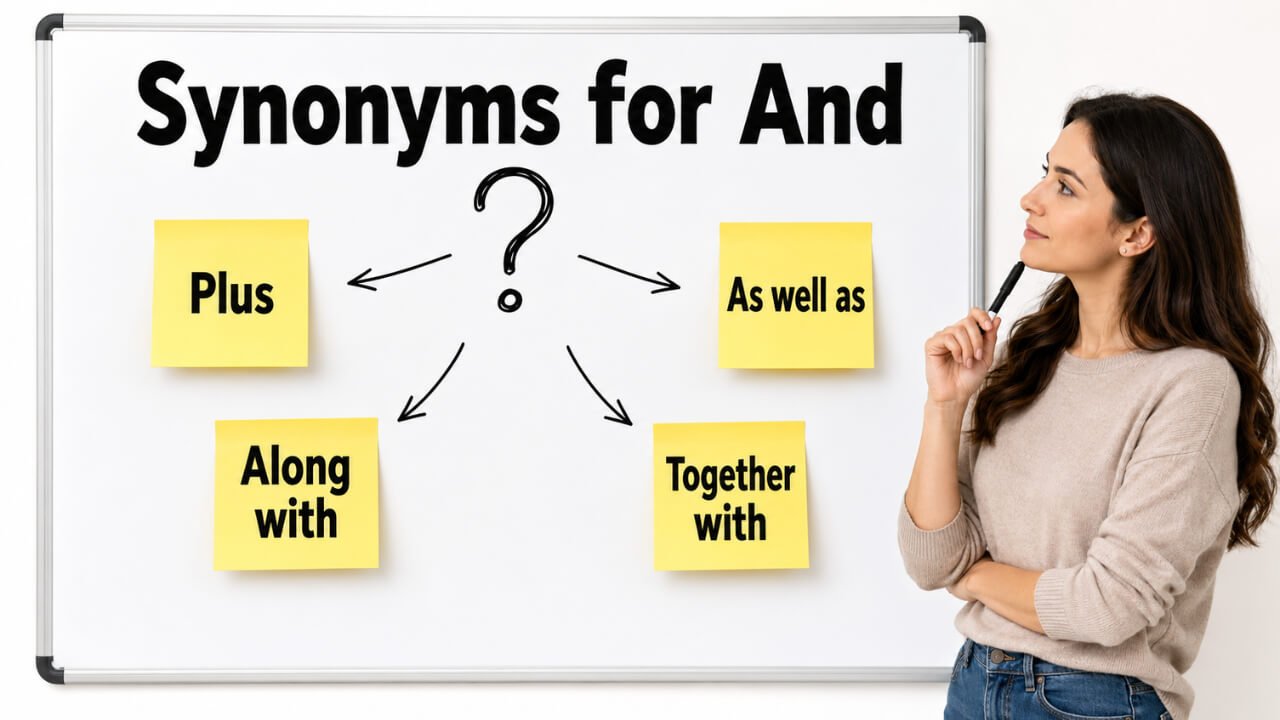
Quick Answer: The best synonyms for and include plus, also, as well as, along with, together with, in addition to, moreover, furthermore, including, and then. Use plus for simple addition, as well as for polished phrasing, in addition to for formal writing, moreover and furthermore for essays or reports, along with for connected items, and then when “and” shows sequence.
Pronunciation and Word Details
Word: And.
Pronunciation: /ænd/ or /ənd/.
Part of Speech: Coordinating conjunction.
Meaning: “And” connects words, phrases, clauses, actions, or ideas.
US Pronunciation:
UK Pronunciation:
What Does “And” Mean?
“And” means that two or more words, ideas, actions, or clauses are connected together.
It is a coordinating conjunction, which means it joins equal parts of a sentence. It can connect nouns, verbs, adjectives, phrases, or complete clauses.
Example: She bought apples and oranges.
In this sentence, “and” connects two nouns. It can also connect actions.
Example: He opened the door and walked inside.
Here, “and” connects two actions in sequence. Because “and” has many uses, the best replacement depends on whether you mean addition, connection, sequence, emphasis, or inclusion.
Meaning, Tone, and Context of “And”
“And” has a neutral tone. It is common in casual speech, formal writing, academic writing, instructions, descriptions, lists, stories, and everyday conversation.
It does not usually sound emotional or strong by itself. Its meaning depends on the words around it.
Neutral Use: “And” simply joins two items or ideas.
Formal Use: “And” can connect clauses in essays, reports, guides, and explanations.
Casual Use: “And” appears naturally in daily speech because it is simple and clear.
Sequential Use: “And” can show that one action happens after another.
Inclusive Use: “And” can show that both things are included, not just one.
Because it is so common, writers often replace “and” with more specific words when they want smoother flow, stronger emphasis, or clearer meaning.
When and How to Use “And”
For Joining Items: Use “and” when two or more items belong together in a list.
Example: The folder contains notes, charts, and examples.
For Adding Ideas: Use “and” when the second idea adds more information to the first.
Example: The guide is simple and helpful.
For Connecting Clauses: Use “and” when two complete ideas are equally important.
Example: The lesson explains the rule, and the examples make it easier to understand.
For Showing Sequence: Use “and” when one action follows another.
Example: She signed the form and submitted it.
For Pairing Equal Words: Use “and” when two words have the same grammatical role.
Example: The answer should be clear and correct.
For Combining Qualities: Use “and” when one subject has more than one quality.
Example: His response was polite and professional.
Best Synonyms for And
Synonym: Plus.
Meaning: Adds another item or idea in a simple way.
Example: We need paper plus a working printer.
Synonym: Also.
Meaning: Adds another related point.
Example: The tool is fast and also easy to use.
Synonym: As well as.
Meaning: Adds another item in a smoother or slightly more formal way.
Example: The course covers grammar as well as vocabulary.
Synonym: Along with.
Meaning: Adds something that comes together with another thing.
Example: Send the form along with your signature.
Synonym: Together with.
Meaning: Shows that two things are included or combined.
Example: The report, together with the data, supports the result.
Synonym: In addition to.
Meaning: Adds extra information in formal or careful writing.
Example: In addition to grammar, the lesson explains sentence style.
Synonym: Moreover.
Meaning: Adds a stronger supporting point.
Example: The method is clear. Moreover, it saves time.
Synonym: Furthermore.
Meaning: Adds another formal point in an argument or explanation.
Example: The rule is simple. Furthermore, it applies to many sentences.
Synonym: Including.
Meaning: Shows that something is part of a larger group.
Example: The package includes notes, examples, and practice tasks.
Synonym: Then.
Meaning: Shows the next action in a sequence.
Example: Read the sentence, then choose the best synonym.
50 Synonyms for And with Short Meanings
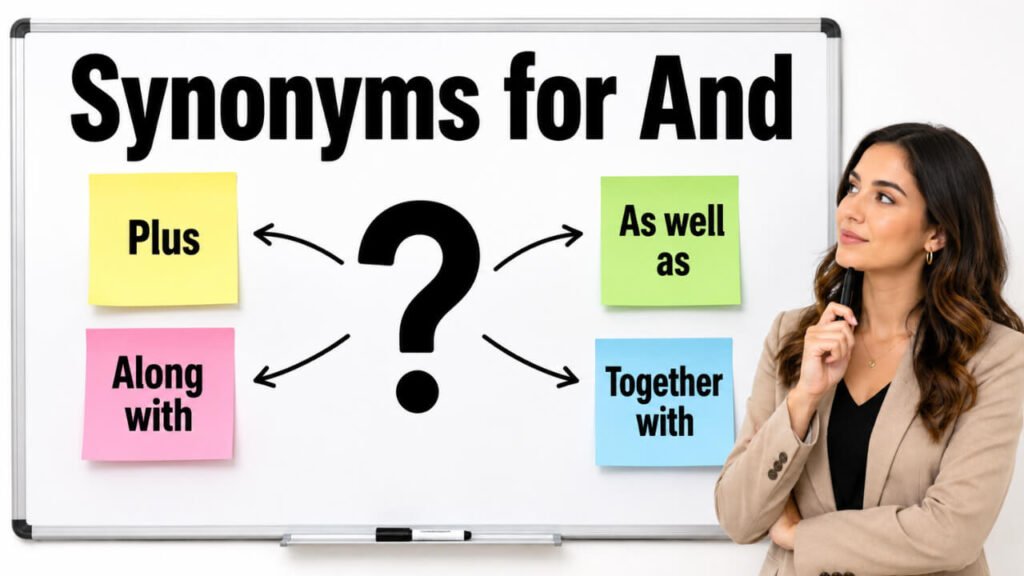
- Plus: Adds another item or idea.
- Also: Adds more information.
- Too: Means also at the end of a sentence.
- As well: Adds something in a natural way.
- As well as: Adds another item or idea smoothly.
- Along with: Shows something comes together with another thing.
- Together with: Shows combined inclusion.
- In addition to: Adds extra information formally.
- In addition: Adds another point.
- Additionally: Adds another idea in formal writing.
- Moreover: Adds a stronger supporting point.
- Furthermore: Adds another formal point.
- Besides: Adds an extra reason or item.
- Including: Shows something is part of a group.
- With: Shows connection or accompaniment.
- Alongside: Shows two things exist or happen together.
- Coupled with: Shows two things work together.
- Combined with: Shows two things are joined.
- Accompanied by: Shows one thing comes with another.
- Paired with: Shows two items are matched together.
- Added to: Shows one thing is placed with another.
- Joined with: Shows connection between two things.
- Linked with: Shows a relationship between ideas or items.
- Connected with: Shows two things are related.
- Together: Shows unity or shared action.
- Jointly with: Shows shared involvement.
- In combination with: Shows two things used together.
- What is more: Adds a stronger extra point.
- Not to mention: Adds an extra detail for emphasis.
- On top of: Adds something extra.
- Over and above: Adds beyond what is already included.
- Then: Shows the next step.
- Next: Shows the following action or point.
- Followed by: Shows order after something else.
- After that: Shows the next action in time.
- Subsequently: Shows a later action formally.
- Likewise: Adds a similar idea.
- Similarly: Adds a related or matching idea.
- Equally: Adds a point with similar importance.
- In the same way: Adds a similar action or idea.
- As another point: Adds one more idea.
- As a further point: Adds another supporting idea.
- Plus the fact that: Adds a full idea in a casual way.
- Both: Introduces two included items.
- Not only but also: Emphasizes two connected ideas.
- As a companion to: Shows one thing works with another.
- Side by side with: Shows things placed or used together.
- In association with: Shows connection or cooperation.
- In partnership with: Shows shared action or purpose.
- As part of: Shows inclusion within a larger whole.
Read Also:
Synonyms for Smart
Synonyms for And by Context
When And Means Plus
Use these alternatives when “and” simply adds one thing to another.
Synonyms: Plus, also, too, as well, in addition.
Example: She ordered tea plus a slice of cake.
Example: The lesson explains punctuation and also sentence flow.
When And Means In Addition
Use these alternatives when adding another point in formal writing, essays, reports, or explanations.
Synonyms: In addition, additionally, moreover, furthermore, besides.
Example: The plan is affordable. Furthermore, it is easy to follow.
Example: The rule is useful. Moreover, it improves sentence clarity.
When And Means Together With
Use these alternatives when two things are connected, included, paired, or used together.
Synonyms: Along with, together with, with, alongside, coupled with.
Example: Submit your application along with the required documents.
Example: The new method, coupled with careful editing, improved the article.
When And Means Then
Use these alternatives when “and” shows that one action happens after another.
Synonyms: Then, next, after that, followed by, subsequently.
Example: Review the sentence, then replace the repeated word.
Example: She finished the draft. After that, she checked the examples.
When And Means Similar Addition
Use these alternatives when the second idea is similar to the first.
Synonyms: Likewise, similarly, equally, in the same way.
Example: The first answer is clear. Similarly, the second one is direct.
Example: The guide is helpful. Likewise, the examples are easy to apply.
Another Word for And
The best single replacement for “and” is often plus when the meaning is simple addition. However, the best alternative depends on context. In formal writing, in addition to may sound better. In polished sentences, as well as can improve flow. In sequence, then is usually clearer.
Original: She bought notebooks and pens.
Better Option: She bought notebooks plus pens.
Original: The article explains meaning and examples.
Better Option: The article explains meaning as well as examples.
Original: The report includes grammar rules and usage notes.
Better Option: The report includes grammar rules in addition to usage notes.
Original: Read the paragraph and answer the question.
Better Option: Read the paragraph, then answer the question.
When Not to Use “And”
Avoid using “and” when another word gives a clearer relationship between ideas. “And” can become weak when it is repeated too often, used in long lists, or used where contrast, choice, cause, or sequence is needed.
Weak: The sentence is long and unclear and repetitive.
Better: The sentence is long, unclear, and repetitive.
Weak: You can choose tea and coffee.
Better: You can choose tea or coffee.
Weak: The answer was short and it was confusing.
Better: The answer was short, but it was confusing.
Weak: She opened the file and reviewed it and sent it.
Better: She opened the file, reviewed it, then sent it.
Weak: The report and the chart explains the issue.
Better: The report and the chart explain the issue.
Words Commonly Confused With And
And vs Or: “And” includes both items, while “or” gives a choice between items.
And vs But: “And” adds information, while “but” introduces contrast.
And vs Plus: “Plus” is a close alternative for addition, but it can sound more casual or mathematical.
And vs Also: “Also” adds information, but it usually cannot connect two equal nouns by itself.
And vs With: “With” shows accompaniment, while “and” joins equal sentence parts.
And vs As Well As: “As well as” adds related information, but it can make one item feel secondary.
And vs Then: “And” can show sequence, but “then” is clearer when order matters.
And vs Moreover: “Moreover” adds a strong supporting point, especially in formal writing.
Which Synonym Should You Choose?
Choose plus when you want a simple and direct replacement for addition.
Choose also when adding another point inside a sentence.
Choose as well as when you want a smoother phrase for connected nouns or ideas.
Choose along with when something comes together with another item.
Choose together with when you want to show combined inclusion.
Choose in addition to when writing formally in essays, reports, instructions, or explanations.
Choose moreover when the next point strengthens your argument.
Choose furthermore when adding another formal point in academic or professional writing.
Choose including when the second item is part of a larger group.
Choose then when “and” means the next step in time or order.
Real Life Examples of “And” in Sentences
Original: I need a pen and a notebook.
Better Option: I need a pen plus a notebook.
Original: The course teaches grammar and vocabulary.
Better Option: The course teaches grammar as well as vocabulary.
Original: Send your name and your email address.
Better Option: Send your name along with your email address.
Original: The answer is clear and useful.
Better Option: The answer is clear as well as useful.
Original: The guide explains rules and gives examples.
Better Option: The guide explains rules and also gives examples.
Original: Read the question and choose the answer.
Better Option: Read the question, then choose the answer.
Original: The report includes charts and tables.
Better Option: The report includes charts in addition to tables.
Original: The method is simple and effective.
Better Option: The method is simple yet effective.
Original: She checked the spelling and grammar.
Better Option: She checked the spelling as well as the grammar.
Original: The idea is practical and easy to explain.
Better Option: The idea is practical. Moreover, it is easy to explain.
Synonym Groups and Usage Differences
Addition Group
This group adds one item, detail, or idea to another. Use it when “and” means simple addition.
Synonyms: Plus, also, too, as well, in addition.
Example: The package includes lessons plus practice questions.
Formal Transition Group
This group helps connect full sentences or larger ideas in formal writing.
Synonyms: Additionally, moreover, furthermore, besides.
Example: The rule is easy to learn. Furthermore, it is useful in many sentences.
Togetherness Group
This group shows that two things are connected, included, paired, or used together.
Synonyms: Along with, together with, coupled with, combined with.
Example: Clear grammar, combined with strong vocabulary, improves writing.
Sequence Group
This group shows time order or the next action.
Synonyms: Then, next, after that, followed by, subsequently.
Example: Write the sentence, then check the punctuation.
Similarity Group
This group adds a similar or matching idea.
Synonyms: Likewise, similarly, equally, in the same way.
Example: The first example is clear. Similarly, the second example is easy to understand.
Inclusion Group
This group shows that something belongs inside a larger set.
Synonyms: Including, as part of, with, among.
Example: The lesson covers many topics, including grammar and vocabulary.
Antonyms of And
The opposite of “and” depends on the meaning. When “and” means both, the opposite may show choice, exclusion, contrast, or separation.
Or: Shows a choice instead of including both.
But: Shows contrast instead of addition.
Except: Excludes something from a group.
Without: Shows that something is not included.
Minus: Removes one thing from another.
Excluding: Leaves something out.
Apart from: Separates one thing from another.
Instead of: Replaces one thing with another.
Neither nor: Excludes both items.
Separate from: Shows that two things are not joined.
Comparison: And vs Related Words
And vs Plus
“And” is the standard conjunction for joining words, phrases, and clauses. “Plus” is a close alternative for simple addition, but it can sound more casual.
Example With And: She bought milk and bread.
Example With Plus: She bought milk plus bread.
And vs Also
“And” connects equal parts of a sentence. “Also” adds information, but it usually works as an adverb.
Example With And: The article is clear and helpful.
Example With Also: The article is clear and also helpful.
And vs As Well As
“And” gives equal weight to both items. “As well as” can sound smoother, but it may make the second item feel added rather than equal.
Example With And: The guide covers spelling and punctuation.
Example With As Well As: The guide covers spelling as well as punctuation.
And vs In Addition To
“And” is simple and direct. “In addition to” is more formal and works well when adding extra information.
Example With And: She studies grammar and vocabulary.
Example With In Addition To: She studies grammar in addition to vocabulary.
And vs Moreover
“And” can connect ideas inside one sentence. “Moreover” adds a strong supporting point between sentences.
Example With And: The method is simple and effective.
Example With Moreover: The method is simple. Moreover, it is effective.
And vs Then
“And” can show sequence, but “then” makes the order clearer.
Example With And: He saved the file and closed the program.
Example With Then: He saved the file, then closed the program.
Common Phrases and Expressions With And
And So On: Means more similar things continue.
And So Forth: Means the list continues in the same way.
And Then: Shows the next action or event.
And Yet: Adds a surprising contrast.
And More: Shows that extra items are included.
Both And: Connects two included items with equal importance.
And All: Adds a general or informal ending.
And All That: Refers vaguely to related things.
And Therefore: Connects addition with result.
And Also: Adds more information, though it can sometimes be repetitive.
Common Mistakes to Avoid
Mistake: Repeating “and” too many times in one sentence.
Better Choice: Use commas, shorter sentences, or clearer connectors.
Mistake: Using “and” when the meaning is actually choice.
Better Choice: Use “or” when only one option may be selected.
Mistake: Using “and” when the sentence needs contrast.
Better Choice: Use “but,” “yet,” or “however” when ideas conflict.
Mistake: Replacing “and” with “also” in every sentence.
Better Choice: Use “also” only when it fits naturally as an adverb.
Mistake: Using “as well as” without checking sentence grammar.
Better Choice: Make sure the main subject still controls the verb.
Mistake: Making long lists unclear.
Better Choice: Use commas, parallel structure, and a final “and” before the last item.
Mistake: Choosing a formal synonym in casual writing.
Better Choice: Use “plus” or “also” when the tone should stay simple.
Mistake: Choosing a casual synonym in formal writing.
Better Choice: Use “in addition to,” “furthermore,” or “moreover” in essays and reports.
Conclusion
Learning synonyms for and helps you write with more variety, clarity, and control. Use plus for simple addition, as well as for smoother phrasing, in addition to for formal writing, along with for connected items, and then for sequence. Words like moreover and furthermore are best when adding strong points in essays or reports. Since “and” is a basic conjunction, always choose the synonym that matches the sentence context.
FAQs About Synonyms for And
What is the best synonym for and?
The best synonym for “and” is plus when the meaning is simple addition. For formal writing, in addition to or as well as may be better.
Can I use also instead of and?
You can use also when adding information, but it does not always replace “and.” “Also” is usually an adverb, while “and” is a conjunction.
Is as well as a synonym for and?
Yes, as well as can be a synonym for “and” when adding related items or ideas. It often sounds smoother and slightly more formal.
What is a formal synonym for and?
Formal synonyms for “and” include in addition to, additionally, moreover, furthermore, together with, and coupled with.
What is a casual synonym for and?
Casual synonyms for “and” include plus, also, too, and as well.
Can and start a sentence?
Yes, “and” can start a sentence in modern writing when it creates a natural connection. In formal writing, use it carefully and avoid overusing it.
What is the difference between and and or?
“And” includes both items, while “or” gives a choice. For example, “tea and coffee” means both, while “tea or coffee” means one option.
