
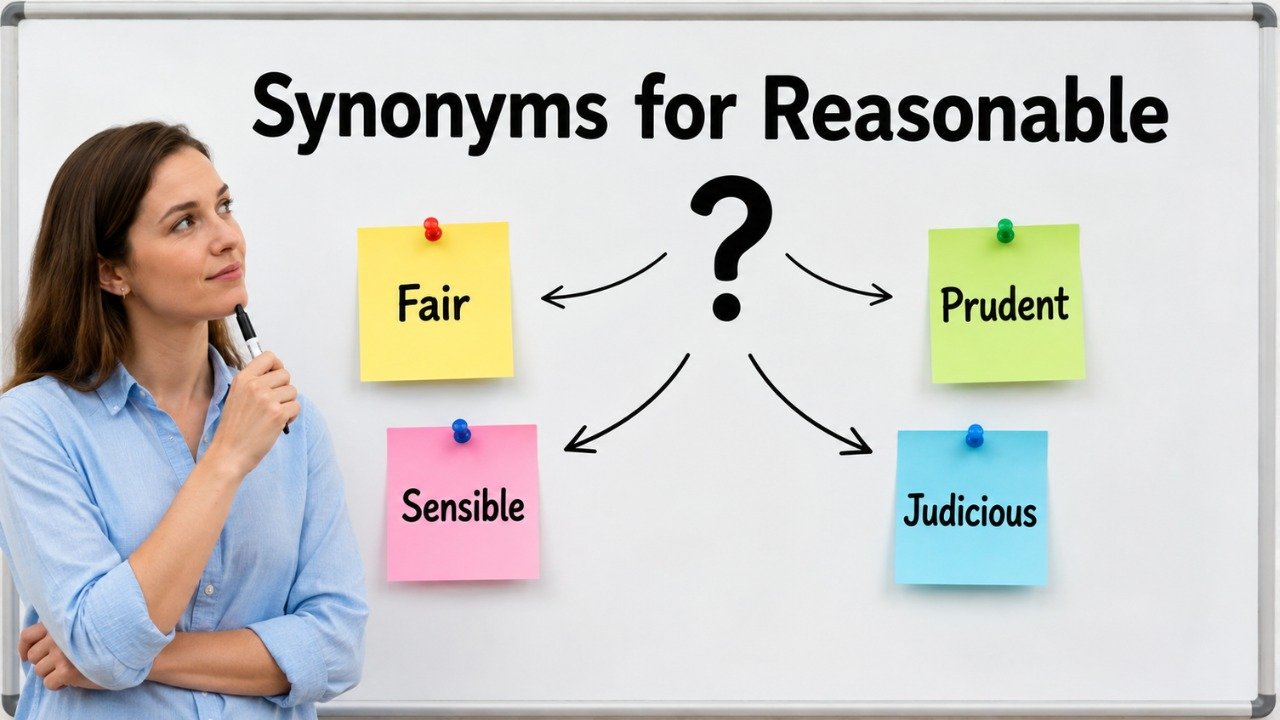
Quick Answer: The best synonyms for reasonable are sensible, fair, rational, logical, practical, realistic, moderate, acceptable, affordable, and justifiable. Use sensible or practical for everyday decisions, rational or logical for formal arguments, fair for treatment and agreements, affordable or moderate for prices, realistic for expectations, acceptable for standards, and justifiable when an action can be supported with good reasons.
Pronunciation and Word Details
Word: Reasonable.
Pronunciation: /ˈriːzənəbəl/
Part of Speech: Adjective.
Meaning: Sensible, fair, acceptable, or not greater than what is appropriate.
US Pronunciation:
UK Pronunciation:
What Does “Reasonable” Mean?
Reasonable means sensible, fair, acceptable, or based on good judgment. It is an adjective used to describe decisions, prices, expectations, requests, explanations, people, and actions.
When describing a person, reasonable suggests that the person listens to facts, thinks calmly, and is willing to consider different views.
When describing a decision, it means the choice is practical and supported by sound thinking. A reasonable decision is neither careless nor extreme.
When describing a price, reasonable means affordable or not excessively high. A reasonable price may not be cheap, but it feels fair for the value received.
When describing an explanation, reasonable means believable, logical, or possible based on the available information.
The word can also describe an acceptable degree or amount. For example, a reasonable level of effort is enough for the situation without being excessive.
Meaning, Tone, and Context of “Reasonable”
Reasonable has a neutral and generally positive tone. It suggests calm judgment, fairness, balance, and practicality.
In everyday conversation, people use reasonable to describe prices, requests, expectations, and choices. It often sounds polite because it avoids strong or emotional judgment.
In formal writing, reasonable can describe arguments, decisions, conclusions, standards, and actions. It is especially useful when the writer wants to show that something is supported by evidence or common sense.
In professional communication, reasonable often expresses cooperation and flexibility. A reasonable deadline, for example, gives someone enough time to complete a task without unnecessary pressure.
In academic writing, the word may describe an interpretation, assumption, conclusion, or explanation that is supported by evidence but is not presented as absolutely certain.
In discussions about fairness, reasonable suggests that a demand or solution respects the needs and rights of everyone involved.
When and How to Use “Reasonable”
For Sensible Decisions
Use reasonable when a decision is based on careful thought and practical judgment.
Example: Delaying the outdoor event because of heavy rain was a reasonable decision.
For Fair Treatment
Use reasonable when a rule, request, or agreement treats people fairly.
Example: The manager made a reasonable request that everyone submit the report before Friday.
For Affordable Prices
Use reasonable when a price is fair and not excessively expensive.
Example: The restaurant offers good food at reasonable prices.
For Realistic Expectations
Use reasonable when an expectation can realistically be achieved.
Example: Completing the first stage within two weeks is a reasonable goal.
For Logical Explanations
Use reasonable when an explanation appears believable and supported by facts.
Example: Her explanation for arriving late sounded reasonable.
For Moderate Amounts
Use reasonable when an amount is neither too small nor too large.
Example: Drink a reasonable amount of water throughout the day.
For Cooperative Behavior
Use reasonable when someone listens, compromises, and avoids extreme reactions.
Example: He remained reasonable during the disagreement and considered both opinions.
Best Synonyms for Reasonable
Sensible
Synonym: Sensible means showing good judgment and practical thinking.
Example: Choosing the safer route was a sensible decision.
Fair
Synonym: Fair means treating people properly and without unjust preference.
Example: Both sides agreed that the proposed arrangement was fair.
Rational
Synonym: Rational means based on reason rather than emotion.
Example: She offered a rational explanation for changing the plan.
Logical
Synonym: Logical means following a clear and correct pattern of reasoning.
Example: His conclusion was logical because it matched the evidence.
Practical
Synonym: Practical means suitable for real conditions and likely to work.
Example: Taking the train was the most practical option.
Realistic
Synonym: Realistic means based on what is actually possible.
Example: The team created a realistic schedule for completing the project.
Moderate
Synonym: Moderate means not extreme, excessive, or unusually large.
Example: The hotel charges a moderate fee for additional services.
Acceptable
Synonym: Acceptable means good enough to meet a required standard.
Example: The final result was acceptable, although it could still be improved.
Affordable
Synonym: Affordable means inexpensive enough for someone to pay.
Example: They found an affordable apartment near their workplace.
Justifiable
Synonym: Justifiable means supported by good reasons or evidence.
Example: The delay was justifiable because the road was unsafe.
50 Synonyms for Reasonable with Short Meanings
- Sensible: Showing good judgment.
- Fair: Treating people properly and equally.
- Rational: Based on reason and clear thought.
- Logical: Following sound reasoning.
- Practical: Suitable for real situations.
- Realistic: Based on what is actually possible.
- Moderate: Not excessive or extreme.
- Acceptable: Good enough for a purpose.
- Affordable: Not too expensive to purchase.
- Justifiable: Supported by good reasons.
- Sound: Based on reliable judgment.
- Wise: Showing knowledge and good judgment.
- Prudent: Careful about possible risks.
- Judicious: Showing thoughtful and balanced judgment.
- Responsible: Showing care and good decision making.
- Balanced: Considering different sides fairly.
- Equitable: Fair to everyone involved.
- Impartial: Not favoring one side unfairly.
- Proper: Correct or suitable for the situation.
- Appropriate: Right for a particular purpose.
- Suitable: Fitting the needs of the situation.
- Satisfactory: Good enough to meet expectations.
- Adequate: Sufficient for a particular need.
- Tolerable: Acceptable despite some limitations.
- Manageable: Possible to control or complete.
- Workable: Practical enough to succeed.
- Feasible: Possible to achieve successfully.
- Attainable: Capable of being reached.
- Plausible: Appearing possible or believable.
- Credible: Worthy of belief or trust.
- Believable: Easy to accept as true.
- Probable: Likely to happen or be true.
- Understandable: Easy to recognize or sympathize with.
- Defensible: Capable of being supported with reasons.
- Warranted: Justified by the circumstances.
- Valid: Supported by sound reasoning or evidence.
- Legitimate: Acceptable according to proper standards.
- Commonsensical: Based on ordinary practical judgment.
- Level headed: Calm and sensible in difficult situations.
- Temperate: Controlled and not extreme.
- Measured: Calm, careful, and controlled.
- Restrained: Kept within sensible limits.
- Modest: Limited in size, amount, or cost.
- Economical: Providing good value without unnecessary expense.
- Inexpensive: Costing relatively little.
- Cost effective: Providing useful results for a fair cost.
- Within reason: Staying inside sensible or acceptable limits.
- Agreeable: Acceptable or pleasant enough.
- Decent: Acceptable in quality, value, or behavior.
- Proportionate: Fairly matched to the situation.
Read Also:
Synonyms for Treat

Synonyms for Reasonable by Context
When Reasonable Means Sensible or Rational
Use sensible, rational, logical, sound, prudent, wise, or practical when reasonable describes thinking, judgment, or decisions.
Sensible is the most natural choice in everyday language. Rational is more formal and emphasizes reasoning rather than emotion. Logical focuses on whether ideas connect correctly. Prudent suggests careful attention to possible risks.
Example: It would be sensible to save part of your income each month.
Example: The committee reached a rational conclusion after reviewing the facts.
Example: Choosing a smaller venue was a practical solution.
When Reasonable Means Fair or Just
Use fair, equitable, impartial, balanced, proportionate, or justifiable when reasonable refers to treatment, rules, requests, or agreements.
Fair is the clearest general alternative. Equitable is more formal and focuses on fairness according to individual circumstances. Proportionate means that a response or demand is properly matched to the situation.
Example: The workers asked for a fair amount of time to complete the task.
Example: The new arrangement offers an equitable solution for both groups.
Example: The response should be proportionate to the seriousness of the mistake.
When Reasonable Means Affordable or Not Excessive
Use affordable, moderate, economical, inexpensive, modest, or cost effective when reasonable describes money, prices, fees, or expenses.
Affordable focuses on whether someone can pay the price. Moderate means the price is not unusually high. Economical suggests good value and limited waste.
Example: We found an affordable hotel close to the city center.
Example: The service is available for a moderate monthly fee.
Example: This is an economical choice for a small household.
When Reasonable Means Believable or Likely
Use plausible, credible, believable, probable, valid, or defensible when reasonable describes an explanation, assumption, conclusion, or possibility.
Plausible means something appears possible even when it has not been proven. Credible suggests that the information or person deserves trust. Probable expresses a stronger likelihood.
Example: Her explanation seemed plausible.
Example: The witness gave a credible account of the event.
Example: Based on the evidence, that outcome appears probable.
When Reasonable Means Acceptable or Adequate
Use acceptable, satisfactory, adequate, tolerable, decent, or suitable when reasonable describes quality, progress, performance, or conditions.
Acceptable means something meets the minimum required standard. Satisfactory usually suggests that the result fulfills expectations. Adequate means there is enough for the intended purpose.
Example: The first draft was acceptable, but several sections needed revision.
Example: His performance during the training period was satisfactory.
Example: The room provides adequate space for two people.
When Reasonable Describes a Person
Use sensible, level headed, balanced, fair, practical, or accommodating when reasonable describes someone who listens and responds calmly.
Level headed emphasizes calm thinking during pressure. Balanced suggests that the person considers different opinions. Accommodating describes someone willing to adjust or compromise.
Example: She is level headed and rarely makes decisions in anger.
Example: The supervisor was fair and listened to every concern.
Another Word for Reasonable
Sensible is often the best single replacement for reasonable when describing a decision, suggestion, or person. However, the best alternative depends on the intended meaning.
Use fair for treatment or agreements, affordable for prices, realistic for expectations, plausible for explanations, and acceptable for standards or results.
Original: It was reasonable to postpone the journey.
Better Option: It was sensible to postpone the journey.
Original: The landlord offered a reasonable price.
Better Option: The landlord offered an affordable price.
Original: We need to set a reasonable deadline.
Better Option: We need to set a realistic deadline.
Original: Her account of the incident sounded reasonable.
Better Option: Her account of the incident sounded plausible.
When Not to Use “Reasonable”
Do not use reasonable when a more precise word would communicate your intended meaning clearly.
When Referring Only to Price
Reasonable can describe cost, but affordable or economical may be clearer when the main issue is whether someone can pay.
Weak: The course has a reasonable fee.
Better: The course has an affordable fee.
When Describing Exact Logic
Use logical or rational when you specifically mean that an argument follows clear reasoning.
Weak: His argument was reasonable.
Better: His argument was logical and supported by evidence.
When Describing Possibility
Use plausible, credible, or probable when discussing whether an explanation or event is believable or likely.
Weak: That is a reasonable explanation.
Better: That is a plausible explanation based on the available facts.
When Describing Minimum Quality
Use acceptable, satisfactory, or adequate when discussing standards or performance.
Weak: The quality of the final report was reasonable.
Better: The quality of the final report was satisfactory.
When You Need a Strong Compliment
Reasonable often means acceptable rather than excellent. It may sound weak when strong praise is intended.
Weak: She gave a reasonable presentation.
Better: She gave an impressive and well organized presentation.
When the Standard Is Unclear
Reasonable can become vague when readers do not know what standard is being used.
Weak: Finish the work within a reasonable period.
Better: Finish the work within five working days.
Words Commonly Confused With Reasonable
Reasonable vs Rational: Reasonable can mean sensible, fair, affordable, or acceptable. Rational mainly describes thinking based on reason rather than emotion.
Reasonable vs Sensible: Reasonable has several meanings, while sensible mainly refers to practical judgment and wise decisions.
Reasonable vs Fair: Fair focuses on equal or proper treatment. Reasonable can describe fairness, but it can also describe prices, expectations, explanations, and decisions.
Reasonable vs Realistic: Realistic means based on actual conditions and what can be achieved. Reasonable may mean realistic, but it can also mean sensible or fair.
Reasonable vs Affordable: Affordable refers specifically to whether a person can pay a price. Reasonable only suggests that the price is not excessive.
Reasonable vs Plausible: Plausible describes something that appears believable or possible. Reasonable can also describe a person, request, price, amount, or decision.
Reasonable vs Acceptable: Acceptable means meeting a required standard. Reasonable may mean acceptable, but it often carries an additional idea of fairness or good judgment.
Reasonable vs Moderate: Moderate means limited and not extreme. Reasonable can describe a moderate amount, but it also includes ideas of logic, fairness, and practicality.
Which Synonym Should You Choose?
Choose sensible when describing an everyday decision, suggestion, response, or person.
Choose rational when emphasizing thought based on reason rather than emotion.
Choose logical when an argument, conclusion, or explanation follows a clear pattern of reasoning.
Choose practical when an idea can work effectively in real conditions.
Choose fair when discussing treatment, payment, rules, requests, or agreements.
Choose equitable in formal writing when fairness depends on individual needs or circumstances.
Choose realistic when describing plans, deadlines, expectations, targets, or goals.
Choose affordable when discussing prices that people can pay.
Choose moderate when an amount, fee, reaction, or demand is not extreme.
Choose plausible when an explanation, theory, or account appears believable.
Choose acceptable when something meets a required standard.
Choose justifiable when an action or decision can be defended with strong reasons.
Choose prudent when a decision involves caution, risk, or future consequences.
Choose satisfactory when describing performance or results that meet expectations.
Real Life Examples of “Reasonable” in Sentences
Original: The teacher gave us a reasonable amount of time to finish the assignment.
Better Option: The teacher gave us an adequate amount of time to finish the assignment.
Original: Her suggestion sounded reasonable to everyone in the meeting.
Better Option: Her suggestion sounded practical to everyone in the meeting.
Original: The shop sells quality furniture at reasonable prices.
Better Option: The shop sells quality furniture at affordable prices.
Original: He remained reasonable even when the discussion became tense.
Better Option: He remained level headed even when the discussion became tense.
Original: We need a reasonable explanation for the missing information.
Better Option: We need a credible explanation for the missing information.
Original: Finishing the entire project today is not a reasonable expectation.
Better Option: Finishing the entire project today is not a realistic expectation.
Original: The customer made a reasonable request for a replacement.
Better Option: The customer made a fair request for a replacement.
Original: Taking a short break after several hours of work is reasonable.
Better Option: Taking a short break after several hours of work is sensible.
Original: The committee reached a reasonable conclusion.
Better Option: The committee reached a logical conclusion.
Original: The hotel provides reasonable accommodation for the price.
Better Option: The hotel provides satisfactory accommodation for the price.
Synonym Groups and Usage Differences
Judgment Group
Sensible, rational, logical, sound, wise, prudent, and judicious describe decisions or thoughts based on good judgment.
Sensible is common in conversation. Rational and logical are more analytical. Prudent and judicious suggest careful consideration before acting.
Example: It was prudent to review the agreement before signing it.
Fairness Group
Fair, equitable, impartial, balanced, and proportionate describe treatment or decisions that avoid unfair advantage.
Fair is the broadest word. Equitable is useful when different people require different forms of support. Impartial emphasizes the absence of personal bias.
Example: The panel made an impartial decision after hearing both sides.
Practicality Group
Practical, realistic, workable, feasible, attainable, and manageable describe ideas or goals that can succeed in real conditions.
Practical focuses on usefulness. Feasible means possible to complete. Manageable suggests that the task can be controlled without excessive difficulty.
Example: Dividing the project into smaller stages made it manageable.
Cost Group
Affordable, moderate, inexpensive, economical, modest, and cost effective describe prices or spending that stay within sensible limits.
Affordable focuses on the buyer’s ability to pay. Economical focuses on avoiding waste. Cost effective means the results justify the expense.
Example: Public transport is often an economical option for regular travel.
Credibility Group
Plausible, credible, believable, probable, defensible, and valid describe ideas or explanations that can be accepted or supported.
Plausible means possible. Credible means trustworthy. Defensible suggests that an opinion can be supported when challenged.
Example: The researcher offered a defensible interpretation of the results.
Acceptability Group
Acceptable, satisfactory, adequate, tolerable, decent, proper, and suitable describe something that meets a need or standard.
Acceptable and satisfactory are neutral. Adequate often means enough but not excellent. Tolerable suggests that something can be endured despite disadvantages.
Example: The temporary arrangement was tolerable for a few days.
Moderation Group
Moderate, measured, restrained, temperate, modest, and within reason describe behavior or amounts that are controlled rather than extreme.
Measured often describes a calm response. Restrained emphasizes control. Temperate suggests avoiding excess.
Example: She gave a measured response instead of reacting angrily.
Antonyms of Reasonable
The opposite of reasonable changes according to the intended meaning. A decision can be unreasonable because it is irrational, while a price can be unreasonable because it is excessive.
Unreasonable: Not sensible, fair, or acceptable.
Irrational: Not based on clear reasoning.
Illogical: Not following a sensible pattern of thought.
Foolish: Showing poor judgment.
Reckless: Acting without considering risks.
Unfair: Not treating people properly or equally.
Biased: Unfairly favoring one side.
Excessive: Greater than what is necessary or appropriate.
Extreme: Far beyond normal or moderate limits.
Unaffordable: Too expensive for someone to pay.
Unrealistic: Not based on what is actually possible.
Implausible: Difficult to believe or accept as possible.
Unacceptable: Not meeting required standards.
Inadequate: Not sufficient for a particular need.
Arbitrary: Based on personal choice rather than clear reasons.
Indefensible: Impossible to support with convincing reasons.
Comparison: Reasonable vs Related Words
Reasonable vs Sensible
Reasonable has a wider range of meanings. It can describe a fair request, an affordable price, a believable explanation, or a sensible choice. Sensible mainly describes good judgment and practical thinking.
Example With Reasonable: The company offered a reasonable price for the equipment.
Example With Sensible: Buying only the equipment we need is a sensible decision.
Reasonable vs Rational
Reasonable may refer to fairness, price, quality, or good judgment. Rational focuses specifically on reasoning that is not controlled by emotion.
Example With Reasonable: Asking for more information was a reasonable request.
Example With Rational: She made a rational decision after comparing the risks.
Reasonable vs Logical
Reasonable suggests that something makes sense or appears acceptable. Logical means that ideas follow one another correctly.
Example With Reasonable: His explanation sounded reasonable.
Example With Logical: His explanation was logical because each point supported the next.
Reasonable vs Fair
Reasonable may describe something that is fair, but it can also describe something sensible or affordable. Fair directly emphasizes justice and proper treatment.
Example With Reasonable: The client gave us a reasonable deadline.
Example With Fair: The client gave every team member a fair opportunity to contribute.
Reasonable vs Practical
Reasonable describes a choice that makes sense. Practical emphasizes whether the choice can work effectively in real life.
Example With Reasonable: Renting a smaller office seems reasonable.
Example With Practical: A smaller office is practical because most employees work remotely.
Reasonable vs Realistic
Reasonable describes something sensible or acceptable. Realistic specifically describes something based on actual conditions and achievable possibilities.
Example With Reasonable: The team made a reasonable request for additional support.
Example With Realistic: The team created a realistic deadline based on its available resources.
Reasonable vs Affordable
Reasonable can describe a price that seems fair. Affordable means the buyer has enough money to pay it.
Example With Reasonable: The repair cost was reasonable for the amount of work required.
Example With Affordable: The monthly payment is affordable for our household.
Reasonable vs Plausible
Reasonable may describe many things, including decisions, prices, people, and expectations. Plausible is mainly used for explanations, theories, accounts, and possibilities.
Example With Reasonable: His request for an extension was reasonable.
Example With Plausible: His explanation for the delay was plausible.
Reasonable vs Acceptable
Reasonable suggests fairness, logic, or moderation. Acceptable means something reaches a required standard, even if it is not especially good.
Example With Reasonable: The proposed schedule seems reasonable.
Example With Acceptable: The quality of the revised document is acceptable.
Common Phrases and Expressions With Reasonable
Reasonable Price: A price that is fair and not excessively high.
Reasonable Request: A demand that is fair, practical, and possible to fulfill.
Reasonable Explanation: An account that appears logical or believable.
Reasonable Person: Someone who thinks calmly and considers facts.
Reasonable Amount: A quantity that is appropriate rather than excessive.
Reasonable Time: Enough time to complete something without unnecessary delay.
Reasonable Expectation: A result that can realistically be anticipated.
Reasonable Effort: A suitable amount of work for achieving a goal.
Reasonable Compromise: An agreement that fairly considers different needs.
Reasonable Doubt: A serious and sensible uncertainty based on careful thought.
Common Mistakes to Avoid
Repeating Reasonable Too Often
Using reasonable several times in one paragraph can make the writing vague and repetitive. Replace it with a more precise synonym where appropriate.
Repetitive: The plan is reasonable, the cost is reasonable, and the deadline is reasonable.
Improved: The plan is practical, the cost is affordable, and the deadline is realistic.
Using Affordable for Nonfinancial Situations
Affordable relates to cost. Do not use it as a general replacement for sensible or fair.
Incorrect: Postponing the event was an affordable decision.
Correct: Postponing the event was a sensible decision.
Confusing Rational With Fair
Rational describes thought based on reason. Fair describes proper and equal treatment.
Incorrect: The payment arrangement was rational for both workers.
Correct: The payment arrangement was fair for both workers.
Using Reasonable as Strong Praise
Reasonable often means acceptable or adequate. It does not usually mean excellent, outstanding, or exceptional.
Weak Praise: She completed a reasonable piece of work.
Stronger Praise: She completed an excellent piece of work.
Leaving the Standard Unclear
The meaning of reasonable may depend on personal judgment. Add details when clarity matters.
Vague: Please reply within a reasonable time.
Clear: Please reply within three working days.
Confusing Reasonable and Reasonably
Reasonable is an adjective that describes a noun. Reasonably is an adverb that modifies an adjective, verb, or adverb.
Adjective: The price is reasonable.
Adverb: The product is reasonably priced.
Choosing a Synonym Without Checking Context
A word may match one meaning of reasonable but not another. Plausible works for explanations, while affordable works for prices.
Incorrect: She gave an affordable explanation.
Correct: She gave a plausible explanation.
Conclusion
The best synonyms for reasonable depend on the meaning you want to express. Sensible, rational, logical, and practical work well for decisions and ideas. Fair and equitable suit treatment or agreements, while affordable and moderate describe prices. Realistic is best for goals and expectations, plausible fits explanations, and acceptable describes adequate standards. Understanding these differences helps you use synonyms for reasonable naturally, avoid vague wording, and choose a precise alternative for conversations, essays, reports, emails, and professional writing.
FAQs About Synonyms for Reasonable
What Is the Best Synonym for Reasonable?
Sensible is the best general synonym when reasonable describes a decision, suggestion, person, or action based on good judgment.
What Is a Formal Synonym for Reasonable?
Rational, justifiable, judicious, defensible, equitable, and proportionate are useful formal alternatives, depending on the context.
What Is Another Word for a Reasonable Price?
Affordable, moderate, economical, inexpensive, modest, and fair are suitable alternatives for a reasonable price.
Can Fair Replace Reasonable?
Fair can replace reasonable when discussing treatment, requests, agreements, payments, or rules. It does not work for every meaning of reasonable.
What Is the Difference Between Reasonable and Rational?
Reasonable has several meanings, including sensible, fair, affordable, and acceptable. Rational specifically describes thinking based on reason rather than emotion.
What Synonym Should I Use for a Reasonable Explanation?
Plausible is usually the best choice. Credible, believable, logical, and valid may also work depending on the strength and type of evidence.
Is Reasonable a Positive Word?
Reasonable is generally positive because it suggests fairness, good judgment, and moderation. However, when describing quality, it may simply mean acceptable rather than excellent.
