
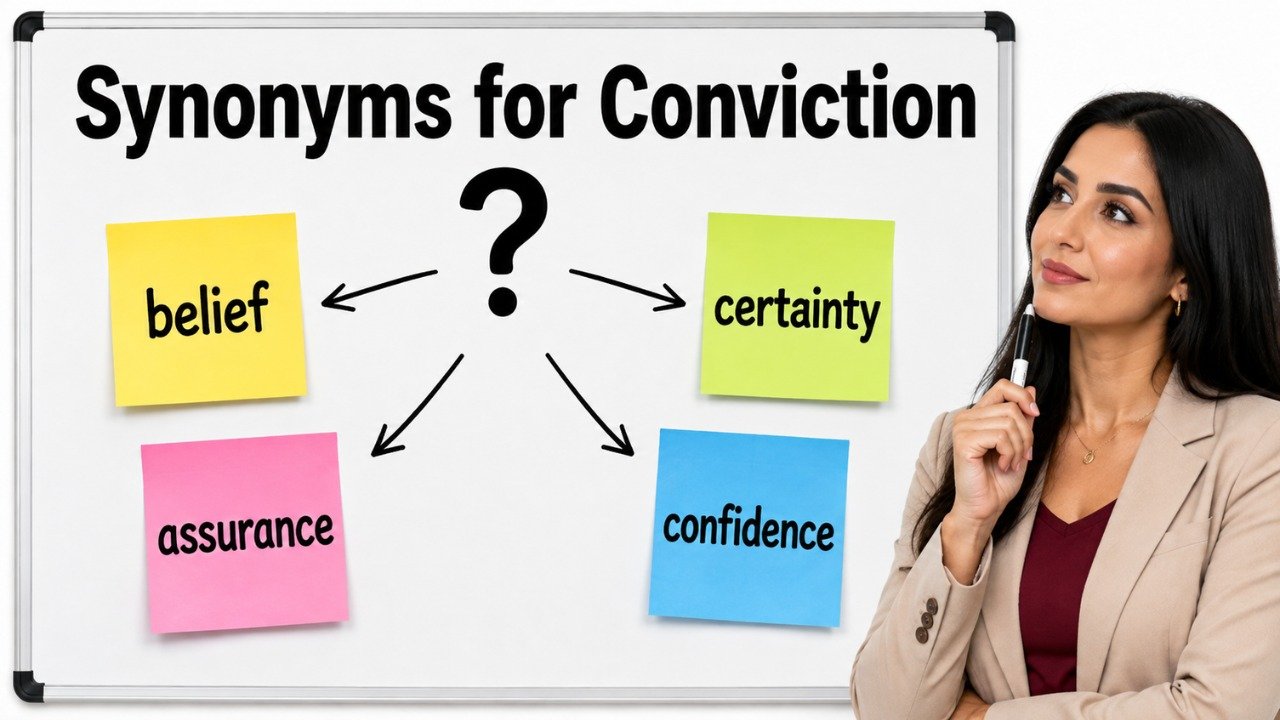
Quick Answer: The best synonyms for conviction include belief, certainty, confidence, assurance, faith, principle, persuasion, resolve, determination, and guilty verdict. Among these synonyms for conviction, belief is the broadest choice for a firmly held idea, certainty emphasizes freedom from doubt, principle suits moral or personal values, resolve and determination describe strength of purpose, while guilty verdict or finding of guilt is appropriate when conviction refers to a legal judgment that someone committed a crime.
Pronunciation and Word Details
Word: Conviction.
Pronunciation: /kənˈvɪkʃən/
Part of Speech: Noun.
Meaning: A firmly held belief or certainty, or a legal judgment that a person is guilty of a crime.
US Pronunciation:
UK Pronunciation:
What Does “Conviction” Mean?
Conviction means a strong belief that a person accepts as true or an official legal judgment that someone is guilty of an offense.
As a noun, conviction has two important meanings.
The first refers to a belief held with strong certainty.
Example: She spoke with conviction about the importance of education.
In this sense, conviction can suggest confidence, certainty, moral principle, or deep personal belief.
Example: His conviction that honesty matters guided his decisions.
The second meaning belongs to legal contexts. A conviction occurs when a person is found guilty of a crime through the legal process.
Example: The conviction followed a lengthy trial.
The word can therefore refer either to a state of strong belief or to a formal finding of guilt. Context determines which meaning is intended.
Conviction can also describe the strength and confidence with which someone expresses an idea.
Example: He delivered the argument with real conviction.
Here, confidence, assurance, firmness, or certainty may be suitable alternatives.
Meaning, Tone, and Context of “Conviction”
Conviction usually has a strong, serious, and formal tone.
When it means a firmly held belief, the word often carries a positive sense of confidence, commitment, sincerity, and principle.
Personal Use: She remained true to her convictions.
In moral or ethical discussions, conviction often refers to a deeply held principle.
Moral Use: He refused to compromise his convictions.
In speeches, essays, and professional communication, conviction may describe confidence and firmness.
Formal Use: She presented her proposal with conviction.
In academic or analytical writing, conviction can refer to the strength with which someone accepts a position or conclusion.
Academic Use: His conviction rested on years of observation and research.
In legal writing, conviction has a precise technical meaning. It refers to a formal determination of guilt.
Legal Use: The court record included a previous conviction.
Because the word has more than one sense, selecting a synonym requires attention to context. Belief and certainty suit personal ideas, resolve suits determination, and guilty verdict or finding of guilt suits legal matters.
When and How to Use “Conviction”
For Strong Beliefs
Use conviction when a person strongly believes that something is true or right.
Example: She has a deep conviction that every child deserves an education.
For Moral Principles
Conviction works well for values that guide behavior or decisions.
Example: He acted according to his personal convictions.
For Certainty
Use conviction when someone feels little or no doubt about a conclusion.
Example: She expressed her conviction that the plan would succeed.
For Confident Communication
Conviction can describe the confident and sincere way someone speaks.
Example: He spoke with conviction during the meeting.
For Determination
In some contexts, conviction suggests firmness of purpose and unwillingness to abandon a course of action.
Example: She pursued the goal with conviction despite several setbacks.
For Personal Philosophy
Use convictions when discussing deeply held ideas about morality, society, life, or behavior.
Example: His decisions reflect his strongest convictions.
For Legal Judgments
Conviction is the correct term when referring to an official finding that someone is guilty of a crime.
Example: The conviction was recorded after the trial.
For Criminal Records
The word commonly appears when discussing a person’s legal history.
Example: The form asked whether the applicant had any previous convictions.
Best Synonyms for Conviction
Belief: An idea or principle that someone accepts as true.
Example: Her belief in equal opportunity influenced her work.
Certainty: Complete confidence that something is true or correct.
Example: He spoke with certainty about the outcome.
Confidence: A strong feeling of trust in an idea, ability, or judgment.
Example: She expressed confidence in the team’s decision.
Assurance: Firm confidence or freedom from doubt.
Example: He answered the question with assurance.
Faith: Strong trust or belief, sometimes without complete proof.
Example: She maintained her faith in the project’s potential.
Principle: A firmly held rule, value, or standard that guides behavior.
Example: Fairness is one of his guiding principles.
Persuasion: A belief or opinion that someone strongly accepts.
Example: People of different political persuasions attended the discussion.
Resolve: Firm determination to do something.
Example: Her resolve remained strong despite the difficulties.
Determination: Firmness of purpose and willingness to continue.
Example: His determination helped him complete the difficult task.
Guilty Verdict: A legal decision that a person is guilty of an offense.
Example: The jury returned a guilty verdict.
50 Synonyms for Conviction with Short Meanings
- Belief: Something accepted as true.
- Certainty: Complete confidence without significant doubt.
- Confidence: Strong trust in an idea or judgment.
- Assurance: Firm confidence or certainty.
- Faith: Strong belief or trust.
- Principle: A firmly held moral or personal rule.
- Persuasion: A strongly held belief or opinion.
- Creed: A set of strongly held beliefs.
- Doctrine: A principle or body of accepted beliefs.
- Tenet: A central belief within a system of ideas.
- View: An opinion or belief about something.
- Opinion: A judgment or belief held about a subject.
- Position: A particular belief or standpoint.
- Stance: A clearly expressed position on an issue.
- Standpoint: A perspective or position from which something is judged.
- Judgment: A considered conclusion or belief.
- Conclusion: A belief reached after thought or evidence.
- Certitude: Complete certainty or confidence.
- Surety: Confidence that something is true or dependable.
- Trust: Firm belief in reliability or truth.
- Commitment: Strong dedication to a belief, purpose, or course of action.
- Resolve: Firm determination.
- Determination: Strong purpose and persistence.
- Resolution: Firmness in deciding or acting.
- Firmness: Strength and steadiness in belief or action.
- Steadfastness: Unchanging loyalty to a belief or purpose.
- Dedication: Strong commitment to a cause or principle.
- Devotion: Deep loyalty or commitment.
- Sincerity: Genuine belief and honest feeling.
- Earnestness: Serious and sincere commitment.
- Confidence of belief: Strong trust in the truth of an idea.
- Moral certainty: Strong confidence based on judgment or principle.
- Strong belief: A firmly accepted idea.
- Firm belief: An opinion held with confidence.
- Deep belief: A belief held with strong personal commitment.
- Personal principle: A belief that guides individual behavior.
- Guiding principle: A belief used to direct decisions.
- Core belief: A central and deeply held idea.
- Article of faith: A belief accepted with strong confidence.
- Point of view: A particular way of understanding an issue.
- Guilty verdict: A formal legal decision of guilt.
- Finding of guilt: An official determination that someone is guilty.
- Judgment of guilt: A formal legal conclusion of guilt.
- Adjudication of guilt: A legal determination that an offense was committed by the accused.
- Criminal judgment: A formal court judgment in a criminal matter.
- Guilty finding: A decision that a defendant is guilty.
- Condemnation: A formal judgment against someone or strong declaration of wrongdoing.
- Finding against the defendant: A legal determination unfavorable to an accused person.
- Determination of guilt: A conclusion that legal guilt has been established.
- Legal finding of guilt: A formal judgment that someone committed an offense.
Read Also:
Synonyms for Grand

Synonyms for Conviction by Context
When Conviction Means Strong Belief
When conviction means a firmly held idea, useful alternatives include belief, faith, persuasion, creed, principle, tenet, and core belief.
Example: She has a strong conviction that education can change lives.
Alternative: She has a strong belief that education can change lives.
Belief is the broadest and most natural alternative.
Example: His belief in fairness influenced every decision.
Faith often suggests strong trust even when complete proof is unavailable.
Example: She never lost faith in the possibility of improvement.
When Conviction Means Certainty
When conviction refers to being sure that something is true, certainty, assurance, confidence, certitude, and surety may work.
Example: He expressed his conviction that the strategy would succeed.
Alternative: He expressed his certainty that the strategy would succeed.
Certainty strongly emphasizes lack of doubt.
Example: She answered with complete certainty.
Assurance can describe confidence both in thought and manner.
Example: He explained the proposal with assurance.
When Conviction Means a Moral Principle
When conviction refers to values that guide behavior, principle, creed, tenet, belief, guiding principle, and core belief are useful alternatives.
Example: She refused to abandon her convictions.
Alternative: She refused to abandon her principles.
Principle is especially useful when the belief affects moral choices or conduct.
Example: Honesty remains one of his strongest principles.
When Conviction Means Determination
When conviction suggests firmness of purpose, resolve, determination, resolution, steadfastness, firmness, and commitment may be stronger choices.
Example: She approached the challenge with conviction.
Alternative: She approached the challenge with determination.
Resolve suggests a firm decision to continue despite difficulty.
Example: His resolve strengthened after the setback.
When Conviction Means Confidence in Speech
When someone speaks or acts with conviction, suitable alternatives include confidence, assurance, certainty, firmness, sincerity, and earnestness.
Example: She defended her proposal with conviction.
Alternative: She defended her proposal with confidence.
Earnestness works when sincerity and seriousness are more important than certainty.
Example: He spoke with genuine earnestness.
When Conviction Means a Legal Finding
In legal contexts, conviction refers to a formal determination of guilt. Close alternatives include guilty verdict, finding of guilt, judgment of guilt, guilty finding, and determination of guilt.
Example: The conviction came after the evidence was presented.
Alternative: The finding of guilt came after the evidence was presented.
A guilty verdict specifically refers to the formal decision that the accused is guilty.
Example: The jury returned a guilty verdict.
Another Word for Conviction
The best general replacement for conviction is belief when referring to a strongly held idea. However, certainty is better when the emphasis is confidence without doubt, principle is stronger for moral values, and guilty verdict is appropriate in a legal context.
Original: She spoke with conviction about the importance of honesty.
Better Option: She spoke with confidence about the importance of honesty.
Original: His conviction that the plan would succeed never changed.
Better Option: His belief that the plan would succeed never changed.
Original: She refused to compromise her convictions.
Better Option: She refused to compromise her principles.
Original: The conviction followed a lengthy trial.
Better Option: The guilty verdict followed a lengthy trial.
When Not to Use “Conviction”
Conviction can become unclear when the reader cannot tell whether you mean a personal belief or a legal judgment.
Weak: His conviction changed his life.
Better: His deeply held belief changed his life.
If the sentence concerns a criminal case, make the legal meaning clear.
Weak: The report discussed his conviction without explaining the context.
Better: The report discussed his criminal conviction.
Avoid using conviction when opinion is weak, temporary, or uncertain.
Weak: She had a slight conviction that the meeting might be canceled.
Better: She had a feeling that the meeting might be canceled.
Conviction usually suggests strength and confidence, so it sounds unnatural with language expressing major uncertainty.
Do not use conviction when simple preference is intended.
Weak: His conviction was to drink tea instead of coffee.
Better: His preference was to drink tea instead of coffee.
Avoid replacing legal conviction with sentence. A conviction establishes guilt, while a sentence states the legal consequence or punishment.
Weak: His conviction was three years in prison.
Better: His sentence was three years in prison.
Use precise alternatives when writing about different shades of belief.
Weak: She had a conviction in the accuracy of the measurement.
Better: She had confidence in the accuracy of the measurement.
Words Commonly Confused With Conviction
Conviction vs Belief: A belief is anything a person accepts as true. A conviction is usually stronger and more firmly held.
Conviction vs Opinion: An opinion is a view or judgment that may be tentative. A conviction usually carries greater certainty and commitment.
Conviction vs Certainty: Conviction is a firmly held belief, while certainty specifically refers to being free from doubt.
Conviction vs Confidence: Conviction concerns strong belief, while confidence may refer to trust in a person, ability, prediction, or judgment.
Conviction vs Principle: Conviction can refer to any strongly held belief. Principle usually refers to a moral rule, standard, or guiding value.
Conviction vs Faith: Both can describe strong belief, but faith often emphasizes trust that may continue without complete evidence.
Conviction vs Resolve: Conviction concerns what someone strongly believes, while resolve concerns determination to act or continue.
Conviction vs Verdict: A conviction is the legal status or result of being found guilty. A verdict is the formal decision in a case and can be either guilty or not guilty.
Conviction vs Sentence: A conviction means a person has been found guilty. A sentence is the punishment or legal consequence imposed afterward.
Which Synonym Should You Choose?
Choose belief when you need a simple and general replacement for a strongly held idea.
Choose certainty when someone feels completely sure that something is true.
Choose confidence when emphasizing trust in an argument, decision, ability, or outcome.
Choose assurance when describing calm and confident expression.
Choose faith when the belief involves deep trust or commitment.
Choose principle when referring to moral standards or values that guide behavior.
Choose persuasion when describing a particular belief or intellectual position.
Choose creed or doctrine when referring to an organized system of beliefs.
Choose resolve when conviction refers to firmness of purpose.
Choose determination when emphasizing persistence and willingness to continue.
Choose steadfastness when someone refuses to abandon a belief or purpose.
Choose sincerity when the main idea is genuine belief rather than certainty.
Choose guilty verdict when discussing the formal outcome of a criminal trial.
Choose finding of guilt in formal legal discussion when emphasizing the determination that guilt has been established.
For essays, belief, principle, certainty, stance, and persuasion are useful depending on the argument.
For reports, certainty, confidence, position, judgment, and conclusion may provide greater precision.
For professional emails, confidence and assurance often sound natural when discussing decisions or recommendations.
For everyday conversation, belief, opinion, confidence, and certainty are usually easier and more natural.
For legal writing, conviction should generally remain conviction unless a more specific term such as guilty verdict or finding of guilt is needed.
Real Life Examples of “Conviction” in Sentences
Original: She spoke with conviction during the presentation.
Better Option: She spoke with confidence during the presentation.
Original: His conviction that the project could succeed inspired the team.
Better Option: His belief that the project could succeed inspired the team.
Original: She refused to compromise her convictions.
Better Option: She refused to compromise her principles.
Original: He stated his conviction that the evidence was reliable.
Better Option: He stated his certainty that the evidence was reliable.
Original: The leader acted with conviction during the crisis.
Better Option: The leader acted with determination during the crisis.
Original: Her conviction remained strong despite criticism.
Better Option: Her resolve remained strong despite criticism.
Original: He defended his position with conviction.
Better Option: He defended his position with assurance.
Original: The court record showed an earlier conviction.
Better Option: The court record showed an earlier finding of guilt.
Original: The conviction came at the end of the trial.
Better Option: The guilty verdict came at the end of the trial.
Original: His convictions shaped his approach to public service.
Better Option: His guiding principles shaped his approach to public service.
Synonym Groups and Usage Differences
Belief Group
Belief, faith, persuasion, creed, tenet, doctrine, and core belief describe ideas that people accept as true.
Belief is broad and neutral. Faith implies trust. Creed and doctrine often refer to structured systems of ideas.
Example: Her belief in fairness influenced every decision.
Certainty Group
Certainty, confidence, assurance, certitude, surety, and trust emphasize freedom from doubt.
Certainty is the strongest general term for being sure, while assurance often describes the manner in which confidence is expressed.
Example: He answered with complete certainty.
Principle Group
Principle, guiding principle, personal principle, creed, and tenet describe beliefs that guide actions or moral decisions.
Principle is especially suitable for ethical behavior.
Example: Respect for others is one of her guiding principles.
Determination Group
Resolve, determination, resolution, firmness, steadfastness, commitment, and dedication describe strength of purpose.
These words are most useful when conviction refers to determined action rather than belief alone.
Example: She approached the challenge with determination.
Sincerity Group
Sincerity, earnestness, devotion, and dedication emphasize genuine commitment.
These choices work when someone clearly and honestly cares about a cause or belief.
Example: He spoke with unmistakable sincerity.
Legal Judgment Group
Guilty verdict, finding of guilt, judgment of guilt, adjudication of guilt, and determination of guilt relate to the legal meaning of conviction.
These expressions describe the formal conclusion that a defendant is guilty.
Example: The jury returned a guilty verdict after reviewing the evidence.
Antonyms of Conviction
The opposite of conviction depends on whether the word means certainty, belief, determination, or a legal finding.
Doubt: Uncertainty about whether something is true.
Uncertainty: Lack of confidence or certainty.
Disbelief: Refusal or inability to accept something as true.
Skepticism: A questioning attitude toward a claim or belief.
Indecision: Difficulty making a firm choice.
Hesitation: Delay caused by uncertainty or lack of confidence.
Vacillation: Repeated movement between different opinions or decisions.
Wavering: Lack of firmness in belief or purpose.
Ambivalence: Mixed or conflicting feelings about something.
Unbelief: Absence of belief.
Acquittal: A legal judgment that a defendant is not guilty.
Exoneration: The clearing of someone from blame or accusation.
Vindication: Evidence or judgment showing that someone was right or justified.
Release: Freedom from legal custody or obligation in an appropriate context.
Comparison: Conviction vs Related Words
Conviction vs Belief
Belief is broad and can range from weak to strong. Conviction normally suggests a firmly held belief with greater certainty.
Example With Conviction: She has a deep conviction that honesty matters.
Example With Belief: She has a belief that honesty encourages trust.
Conviction vs Certainty
Conviction refers to a strongly held belief, while certainty emphasizes complete freedom from doubt.
Example With Conviction: He expressed his conviction that the plan was fair.
Example With Certainty: He stated with certainty that the figures were correct.
Conviction vs Confidence
Conviction describes firm belief, while confidence can refer more broadly to trust in oneself, another person, an ability, or a result.
Example With Conviction: She defended her ideas with conviction.
Example With Confidence: She presented the findings with confidence.
Conviction vs Principle
Conviction can be any deeply held belief. Principle is usually a moral rule or standard that guides behavior.
Example With Conviction: His conviction about personal responsibility remained unchanged.
Example With Principle: He acted according to the principle of fairness.
Conviction vs Faith
Conviction usually emphasizes certainty about a belief. Faith often emphasizes trust, especially when complete proof is unavailable.
Example With Conviction: She expressed her conviction that the decision was correct.
Example With Faith: She maintained faith in the team’s ability to recover.
Conviction vs Resolve
Conviction concerns strong belief, while resolve refers to a firm determination to act.
Example With Conviction: He spoke with conviction about the need for reform.
Example With Resolve: He showed resolve by continuing despite opposition.
Conviction vs Verdict
A conviction means that a person has been formally found guilty. A verdict is the decision reached in a legal case and may be guilty or not guilty.
Example With Conviction: The conviction remained part of the official court record.
Example With Verdict: The jury returned a guilty verdict.
Conviction vs Sentence
Conviction establishes guilt. A sentence determines the legal consequence imposed after guilt has been established.
Example With Conviction: The conviction followed the criminal trial.
Example With Sentence: The sentence was imposed after the conviction.
Common Phrases and Expressions With “Conviction”
Strong Conviction: A belief held with great certainty.
Deep Conviction: A belief rooted strongly in personal values or judgment.
Personal Conviction: A firmly held individual belief or principle.
Moral Conviction: A strong belief about what is morally right or wrong.
Political Conviction: A strongly held belief about politics or government.
Religious Conviction: A deeply held belief connected with religion or faith.
Speak With Conviction: To speak confidently and sincerely.
Act With Conviction: To behave with confidence, firmness, and determination.
Firm Conviction: A belief held without significant doubt.
Criminal Conviction: A formal legal finding that someone is guilty of a criminal offense.
Common Mistakes to Avoid
One common mistake is using conviction as though it means any casual opinion.
Weak: My conviction is that this restaurant is slightly better.
Better: My opinion is that this restaurant is slightly better.
Conviction suggests a stronger and more deeply held belief than opinion.
Another mistake is confusing conviction with confidence.
Unclear: She had conviction in her ability to complete the assignment.
Better: She had confidence in her ability to complete the assignment.
Confidence is generally more natural when referring to trust in someone’s abilities.
Do not confuse conviction with determination.
Unclear: His conviction helped him finish the race despite exhaustion.
Better: His determination helped him finish the race despite exhaustion.
Conviction concerns belief, while determination describes persistence toward a goal.
Legal writers should not confuse conviction with sentence.
Incorrect: His conviction was five years in prison.
Correct: His sentence was five years in prison.
A conviction establishes guilt. A sentence specifies the punishment or consequence.
Do not assume that verdict and conviction always mean exactly the same thing.
Incorrect: Every verdict is a conviction.
Correct: A guilty verdict may result in a conviction, while a not guilty verdict does not.
Avoid unnecessary repetition.
Repetitive: She spoke with conviction about her convictions and defended those convictions with conviction.
Improved: She spoke confidently about her principles and defended them with firmness.
Choose words based on the exact meaning. Use belief for an idea, certainty for lack of doubt, principle for moral standards, resolve for determination, and conviction for a firmly held belief or legal finding of guilt.
Conclusion
The best synonyms for conviction depend on its meaning. Belief, certainty, confidence, assurance, and faith work when conviction describes a firmly held idea. Principle and tenet suit moral or guiding beliefs, while resolve and determination emphasize firmness of purpose. In legal contexts, guilty verdict, finding of guilt, and judgment of guilt are useful close alternatives. Understanding these differences makes it easier to choose synonyms for conviction that are accurate, natural, and appropriate for essays, reports, conversation, professional writing, and legal discussion.
FAQs About Synonyms for Conviction
What Is the Best Synonym for Conviction?
Belief is the best general synonym when conviction means a firmly held idea. Certainty, confidence, principle, or resolve may be better depending on context.
What Is Another Word for Strong Conviction?
Strong belief, certainty, firm belief, faith, resolve, and steadfastness are useful alternatives depending on whether you mean belief or determination.
What Is a Formal Synonym for Conviction?
Certitude, persuasion, principle, tenet, assurance, and determination can work in formal writing. In legal contexts, finding of guilt is a useful close alternative.
Is Conviction the Same as Belief?
Not exactly. A belief can be weak or tentative, while a conviction is usually held strongly and with considerable certainty.
What Is the Difference Between Conviction and Confidence?
Conviction is a firmly held belief. Confidence is trust in a person, ability, judgment, decision, or expected result.
What Does Conviction Mean in Law?
In law, conviction means a formal determination that a person is guilty of a criminal offense.
What Is the Opposite of Conviction?
For the belief meaning, common opposites include doubt, uncertainty, disbelief, skepticism, and hesitation. In a legal context, acquittal is the clearest opposite.
