
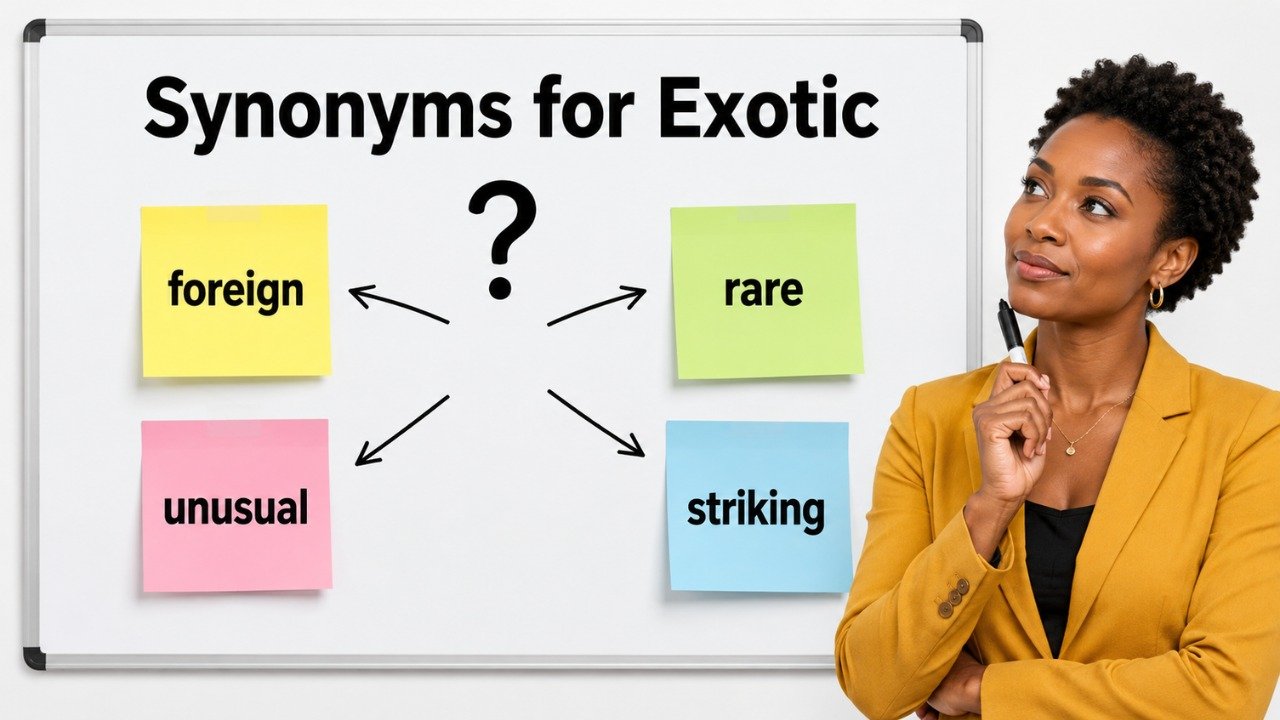
Quick Answer: The best synonyms for exotic include unusual, foreign, rare, unfamiliar, distinctive, extraordinary, striking, unusual looking, unconventional, and intriguing. Use unusual for something outside the ordinary, foreign for something originating from another country or region, rare for something uncommon, distinctive for something noticeably different, striking for strong visual impact, unconventional for something that does not follow usual patterns, and intriguing when the unusual quality creates curiosity or interest.
Pronunciation and Word Details
Word: Exotic
Pronunciation: /ɪɡˈzɒtɪk/
Part of Speech: Adjective and noun
Meaning: Unusual, unfamiliar, or originating from a distant place, especially in a way that seems interesting or distinctive.
US Pronunciation:
UK Pronunciation:
What Does “Exotic” Mean?
Exotic means unusual, unfamiliar, striking, or connected with a distant place or culture.
As an adjective, exotic can describe plants, animals, foods, locations, styles, materials, appearances, experiences, or ideas that seem uncommon or noticeably different from what is familiar.
For example, an exotic plant may come from a distant climate and be uncommon in the local environment. An exotic destination may feel far removed from everyday surroundings. An exotic flavor may combine unfamiliar ingredients or tastes.
The word can also describe something visually distinctive or unusual even when geographical origin is not the main point.
In modern writing, context matters because exotic sometimes emphasizes foreignness, rarity, novelty, beauty, or curiosity. A more specific synonym can often make the intended meaning clearer.
Meaning, Tone, and Context of “Exotic”
Exotic usually has a neutral to positive tone, but its effect depends on the subject and context.
Tone: Often curious, admiring, descriptive, or imaginative.
Formal Use: Suitable for descriptions of plants, animals, materials, locations, foods, and unfamiliar objects.
Casual Use: Common when describing unusual experiences, appearances, tastes, or places.
Academic Use: Can appear in discussions of species, geography, horticulture, biology, and cultural topics, although more precise words may be preferred when accuracy matters.
Conversational Use: Often used for something that feels unusual, interesting, glamorous, or far from ordinary experience.
Descriptive Use: Especially common in travel writing, food writing, fiction, fashion descriptions, and nature related content.
Technical Use: In biology or ecology, exotic may refer to a species introduced from another geographical region, though specialized terms can sometimes be more precise.
Writers should choose the word carefully when referring to people or cultures. Words such as unfamiliar, distinctive, foreign, regional, or specific cultural descriptions can sometimes communicate the intended meaning more accurately.
When and How to Use “Exotic”
For Something Unusual
Use exotic when something seems noticeably different from ordinary or familiar things.
Example: The shop displayed an exotic collection of handmade decorations.
For Plants and Animals
Exotic can describe species that come from distant regions or are uncommon in a particular location.
Example: The greenhouse contained several exotic plants from tropical climates.
For Food and Flavors
Use exotic when a food contains unusual, unfamiliar, or distinctive ingredients and flavors.
Example: The chef created a dish with exotic spices and tropical fruit.
For Distant Places
Exotic may describe a destination that feels unfamiliar, remote, or culturally different from the speaker’s usual surroundings.
Example: They dreamed of visiting an exotic island surrounded by clear water.
For Appearance
The word can describe a striking, unusual, or distinctive look.
Example: The bird had exotic feathers with remarkable patterns.
For Experiences
Use exotic when an activity or experience feels rare, unfamiliar, or far removed from normal routine.
Example: The tour offered visitors an exotic experience in a remote landscape.
For Design and Style
Exotic can describe unusual materials, patterns, colors, or influences.
Example: The room featured exotic fabrics and intricate decorative patterns.
Best Synonyms for Exotic
Unusual
Synonym: Unusual means different from what is common, normal, or expected.
Example: The garden contained several unusual flowers.
Foreign
Synonym: Foreign means originating from or connected with another country or region.
Example: The market offered a wide range of foreign ingredients.
Rare
Synonym: Rare means uncommon and not often seen or found.
Example: The museum displayed a rare type of mineral.
Unfamiliar
Synonym: Unfamiliar means not known, recognized, or commonly experienced.
Example: The traveler tasted several unfamiliar dishes.
Distinctive
Synonym: Distinctive means having qualities that make something noticeably different.
Example: The bird was known for its distinctive coloring.
Extraordinary
Synonym: Extraordinary means extremely unusual or remarkable.
Example: They discovered an extraordinary landscape beyond the mountains.
Striking
Synonym: Striking means attracting attention because of a strong or unusual appearance.
Example: The flower had a striking combination of colors.
Unconventional
Synonym: Unconventional means different from accepted, traditional, or usual methods and styles.
Example: The designer used an unconventional combination of materials.
Intriguing
Synonym: Intriguing means unusual or mysterious enough to create interest and curiosity.
Example: The recipe included an intriguing blend of flavors.
Remarkable
Synonym: Remarkable means unusual enough to deserve attention or admiration.
Example: The region was home to a remarkable variety of wildlife.
50 Synonyms for Exotic with Short Meanings
- Unusual: Different from what is normal or common.
- Foreign: Originating from another country or region.
- Rare: Uncommon or difficult to find.
- Unfamiliar: Not commonly known or recognized.
- Distinctive: Noticeably different because of special qualities.
- Extraordinary: Very unusual or remarkable.
- Striking: Visually impressive or attention grabbing.
- Unconventional: Different from traditional or usual practices.
- Intriguing: Interesting because it seems unusual or mysterious.
- Remarkable: Worth noticing because of unusual qualities.
- Uncommon: Not frequently encountered.
- Unique: Unlike anything else in an important way.
- Novel: New, original, or unfamiliar.
- Curious: Unusual in a way that creates interest.
- Peculiar: Noticeably strange or unusual.
- Outlandish: Extremely unusual or unconventional.
- Bizarre: Very strange or unexpected.
- Unorthodox: Different from traditional beliefs or methods.
- Exceptional: Unusually good, rare, or distinctive.
- Singular: Remarkably unusual or distinctive.
- Faraway: Located at a great distance.
- Remote: Distant from familiar or populated places.
- Distant: Far away geographically or culturally.
- Tropical: Associated with warm regions near the tropics.
- Overseas: Coming from or located in another country across the sea.
- Imported: Brought into one country or region from another.
- Alien: Originating outside a particular environment or place.
- Nonlocal: Coming from outside the immediate region.
- International: Connected with several countries or foreign regions.
- Worldly: Associated with broad experience of different places and cultures.
- Colorful: Rich in vivid or varied qualities.
- Vivid: Strong, bright, or intensely noticeable.
- Dramatic: Visually or emotionally impressive.
- Captivating: Attractive enough to hold attention.
- Fascinating: Extremely interesting or compelling.
- Alluring: Powerfully attractive or appealing.
- Enchanting: Delightfully unusual or attractive.
- Mysterious: Difficult to understand and therefore interesting.
- Distinct: Clearly different from other things.
- Original: Fresh, unusual, or independently created.
- Unordinary: Outside ordinary experience or expectation.
- Unexpected: Different from what was anticipated.
- Unprecedented: Not previously known or experienced.
- Exceptional Looking: Visually uncommon or remarkable.
- Unusual Looking: Having an appearance outside the ordinary.
- Rarely Seen: Seldom encountered or observed.
- Far Flung: Located in a distant or remote place.
- Little Known: Not widely familiar or recognized.
- Uncommon Looking: Having features that are rarely seen.
- Distinctively Foreign: Noticeably associated with another region or culture.
Read Also:
Synonyms for Refined

Synonyms for Exotic by Context
When Exotic Means Unusual
When exotic simply means outside the ordinary, useful alternatives include unusual, uncommon, extraordinary, remarkable, distinctive, peculiar, and unconventional.
Unusual Example: The artist created an unusual sculpture from recycled materials.
Distinctive Example: The building had a distinctive curved roof.
Remarkable Example: The valley contained a remarkable variety of plants.
When Exotic Means Foreign
When exotic refers to something from another region or country, foreign, imported, overseas, nonlocal, and international may be clearer.
Foreign Example: The store specializes in foreign spices.
Imported Example: The restaurant uses imported ingredients.
Overseas Example: The collection included fabrics produced overseas.
When Exotic Means Rare
Rare, uncommon, exceptional, singular, and rarely seen work well when scarcity is the main idea.
Rare Example: The forest is home to several rare species.
Uncommon Example: The mineral has an uncommon crystal structure.
Exceptional Example: Researchers observed an exceptional form of the plant.
When Exotic Means Visually Striking
Use striking, vivid, colorful, dramatic, distinctive, or captivating when appearance is more important than origin.
Striking Example: The butterfly had striking blue markings.
Vivid Example: The plant produced vivid purple flowers.
Captivating Example: The room featured a captivating combination of patterns.
When Exotic Means Interesting or Mysterious
Intriguing, fascinating, mysterious, enchanting, and alluring work when something attracts attention because it feels unfamiliar.
Intriguing Example: The dish had an intriguing combination of sweet and savory flavors.
Fascinating Example: The region has a fascinating variety of wildlife.
Mysterious Example: The cave contained mysterious markings on its walls.
When Exotic Means Distant
Remote, distant, faraway, and far flung are stronger when geographical distance is the main meaning.
Remote Example: They traveled to a remote village surrounded by mountains.
Faraway Example: The story takes place on a faraway island.
Distant Example: The seeds came from a distant region.
Another Word for Exotic
The best general replacement for exotic is often unusual because it clearly communicates that something is different from what is ordinary or familiar.
However, context determines the strongest alternative. Foreign is better for geographical origin, rare for scarcity, striking for appearance, and intriguing for something that creates curiosity.
Original: The garden contained several exotic flowers.
Better Option: The garden contained several unusual flowers.
Original: The restaurant served exotic ingredients from distant regions.
Better Option: The restaurant served imported ingredients from distant regions.
Original: The bird had exotic markings.
Better Option: The bird had striking markings.
Original: The collection included several exotic objects that visitors had never seen before.
Better Option: The collection included several intriguing objects that visitors had never seen before.
When Not to Use “Exotic”
Exotic can be effective, but it may become vague when the writer actually means foreign, rare, unusual, tropical, distant, or visually striking.
When Geographical Origin Matters
If something simply comes from another country, foreign or imported may be more precise.
Weak: The store sells exotic vegetables from several countries.
Better: The store sells imported vegetables from several countries.
When Something Is Simply Rare
Use rare when scarcity is the main point.
Weak: Researchers discovered an exotic species found in only a few locations.
Better: Researchers discovered a rare species found in only a few locations.
When Appearance Is the Main Focus
Striking or distinctive can create a clearer image.
Weak: The bird had an exotic pattern on its wings.
Better: The bird had a striking pattern on its wings.
When Something Is Unfamiliar
Unfamiliar may be more neutral and exact.
Weak: She struggled to understand the exotic terminology.
Better: She struggled to understand the unfamiliar terminology.
When Describing People
Exotic can sound vague or objectifying when applied to a person’s appearance or cultural identity. A precise description of the relevant feature is usually clearer.
Weak: He had an exotic appearance.
Better: He had distinctive dark curls and sharply defined features.
When Repetition Weakens the Writing
Repeated use can make descriptions sound general.
Weak: The market had exotic foods, exotic fabrics, exotic decorations, and exotic spices.
Better: The market had unfamiliar foods, colorful fabrics, intricate decorations, and imported spices.
Words Commonly Confused With Exotic
Exotic vs Unusual: Exotic often suggests unfamiliarity, distant origin, or distinctive appeal, while unusual simply means outside what is normal.
Exotic vs Foreign: Foreign specifically refers to something from another country or region. Exotic may also suggest rarity, novelty, or striking qualities.
Exotic vs Rare: Rare means uncommon or scarce. Something can be rare without being foreign or visually unusual.
Exotic vs Tropical: Tropical refers specifically to climates, plants, animals, or environments associated with warm tropical regions. Exotic is broader.
Exotic vs Unique: Unique means one of a kind or unlike anything else. Exotic does not necessarily mean unique.
Exotic vs Unfamiliar: Unfamiliar means not recognized or known by someone. Exotic may carry an additional sense of fascination or distinctiveness.
Exotic vs Bizarre: Bizarre suggests something very strange or unexpected. Exotic is usually less negative and often more appealing.
Exotic vs Intriguing: Intriguing emphasizes curiosity and interest, while exotic emphasizes unfamiliarity, foreignness, or unusual qualities.
Which Synonym Should You Choose?
Choose unusual when you simply mean something different from the ordinary.
Choose foreign when geographical origin is important.
Choose imported when an item has been brought from another country or region.
Choose rare when something is difficult to find or seldom seen.
Choose unfamiliar when the reader or speaker does not recognize something.
Choose distinctive when something has recognizable qualities that separate it from others.
Choose striking when appearance creates a strong visual impression.
Choose intriguing when something unusual creates curiosity.
Choose unconventional when an idea, style, or method breaks from traditional expectations.
Choose remote or faraway when distance is the key idea.
Choose tropical when discussing environments, plants, foods, or species specifically associated with tropical climates.
For essays and reports, unusual, foreign, distinctive, uncommon, rare, and nonlocal are usually precise choices.
For descriptive writing, striking, vivid, captivating, fascinating, and enchanting can add stronger imagery.
For everyday conversation, unusual, different, rare, interesting, and unfamiliar often sound natural.
Real Life Examples of “Exotic” in Sentences
Original: The garden was filled with exotic flowers.
Better Option: The garden was filled with unusual tropical flowers.
Original: The chef added exotic spices to the dish.
Better Option: The chef added unfamiliar imported spices to the dish.
Original: The traveler wanted to visit an exotic destination.
Better Option: The traveler wanted to visit a remote and unfamiliar destination.
Original: The bird had exotic coloring.
Better Option: The bird had striking coloring.
Original: They collected exotic objects from distant regions.
Better Option: They collected distinctive objects from distant regions.
Original: The recipe had an exotic flavor.
Better Option: The recipe had an intriguing flavor.
Original: The greenhouse contained exotic plants.
Better Option: The greenhouse contained rare tropical plants.
Original: The designer chose an exotic pattern for the fabric.
Better Option: The designer chose an unconventional pattern for the fabric.
Original: The region is known for exotic wildlife.
Better Option: The region is known for unusual and rarely seen wildlife.
Original: She was fascinated by the exotic landscape.
Better Option: She was fascinated by the extraordinary landscape.
Synonym Groups and Usage Differences
Unusualness Group
Unusual, uncommon, peculiar, extraordinary, singular, and unconventional emphasize how far something differs from ordinary experience.
Example: The house had an unusual circular design.
Foreign Origin Group
Foreign, imported, overseas, nonlocal, international, and distant emphasize geographical origin rather than appearance.
Example: The market sells imported spices from several regions.
Rarity Group
Rare, exceptional, uncommon, singular, and rarely seen focus on scarcity.
Example: The conservation area protects several rare plant species.
Visual Impact Group
Striking, vivid, dramatic, colorful, distinctive, and captivating emphasize appearance.
Example: The fish had striking orange and blue markings.
Curiosity Group
Intriguing, fascinating, mysterious, alluring, and enchanting emphasize interest and emotional appeal.
Example: The old building had an intriguing architectural style.
Distance Group
Remote, distant, faraway, and far flung focus on geographical separation.
Example: They traveled to a remote island in search of unusual wildlife.
Antonyms of Exotic
The opposite of exotic depends on whether exotic means unusual, foreign, rare, distant, or striking.
Antonym: Common. Frequently found or experienced.
Antonym: Ordinary. Normal and not unusual.
Antonym: Familiar. Well known or easily recognized.
Antonym: Local. Originating from the immediate area.
Antonym: Native. Naturally belonging to a particular region.
Antonym: Domestic. Connected with one’s own country or local setting.
Antonym: Conventional. Following familiar or traditional patterns.
Antonym: Typical. Having the usual qualities of a particular type.
Antonym: Everyday. Normal and regularly experienced.
Antonym: Plain. Lacking unusual or striking qualities.
Comparison: Exotic vs Related Words
Exotic vs Unusual
Exotic often suggests unfamiliarity, distant origin, or distinctive appeal. Unusual simply means uncommon or different from normal expectations.
Example With Exotic: The market displayed exotic fruits from distant regions.
Example With Unusual: The tree produced an unusual shape of fruit.
Exotic vs Foreign
Exotic can imply fascination or rarity, while foreign simply indicates another country or region.
Example With Exotic: The garden contained exotic flowers that attracted many visitors.
Example With Foreign: The garden contained several foreign plant species.
Exotic vs Rare
Exotic emphasizes unfamiliarity or distant origin, while rare focuses on scarcity.
Example With Exotic: The restaurant served exotic ingredients.
Example With Rare: The forest contained a rare species of orchid.
Exotic vs Tropical
Exotic is broad and may refer to anything unusual or unfamiliar. Tropical specifically refers to warm regions near the tropics.
Example With Exotic: The greenhouse displayed several exotic species.
Example With Tropical: The greenhouse maintained warm conditions for tropical plants.
Exotic vs Unique
Exotic means unusual or foreign, but unique means truly one of a kind or distinctly unlike everything else.
Example With Exotic: They purchased an exotic decorative object.
Example With Unique: The sculpture had a unique shape that appeared nowhere else in the collection.
Exotic vs Distinctive
Exotic often suggests novelty or foreignness. Distinctive emphasizes recognizable qualities that make something stand apart.
Example With Exotic: The bird had exotic plumage.
Example With Distinctive: The bird had distinctive white markings around its eyes.
Exotic vs Bizarre
Exotic can sound positive or appealing. Bizarre usually suggests something extremely strange or difficult to understand.
Example With Exotic: The menu included several exotic dishes.
Example With Bizarre: The dish had a bizarre combination of ingredients that surprised everyone.
Common Phrases and Expressions With Exotic
Exotic Animals: Animals considered unusual or originating from distant regions.
Exotic Plants: Plants that are unfamiliar, uncommon, or introduced from another region.
Exotic Fruits: Fruits that are unusual or not commonly available in a particular place.
Exotic Food: Food featuring unfamiliar ingredients, flavors, or culinary traditions.
Exotic Destination: A place perceived as distant, unusual, or unlike familiar surroundings.
Exotic Species: A species originating outside a particular geographical area.
Exotic Beauty: An unusual or striking type of visual attractiveness.
Exotic Flavor: A taste that feels unfamiliar, distinctive, or unusually complex.
Exotic Location: A distant or unfamiliar place with distinctive qualities.
Exotic Appearance: An unusual or visually striking look, though more specific descriptive wording is often preferable.
Common Mistakes to Avoid
Using Exotic When Foreign Is More Precise
If location or origin is the only important detail, foreign is usually clearer.
Weak: The document discussed exotic products imported from abroad.
Better: The document discussed foreign products imported from abroad.
Treating Exotic and Rare as Identical
An exotic object may be common in its place of origin. Rare means scarce, not merely foreign or unfamiliar.
Weak: Mangoes are exotic because they are always rare.
Better: Some fruits may seem exotic in one region even if they are common elsewhere.
Using Exotic for Every Unusual Thing
Exotic can become vague if unusual, distinctive, remote, rare, or striking would communicate the meaning better.
Weak: The building had exotic windows.
Better: The building had distinctive arched windows.
Confusing Exotic With Tropical
Not everything exotic is tropical, and not everything tropical is exotic.
Weak: Every exotic plant grows in a tropical climate.
Better: Some exotic plants come from tropical regions, while others originate in different climates.
Overusing the Word in Descriptive Writing
Repeating exotic can reduce precision and make several descriptions sound identical.
Weak: They saw exotic birds, exotic trees, exotic flowers, and exotic landscapes.
Better: They saw rare birds, unfamiliar trees, vivid flowers, and dramatic landscapes.
Using Exotic Vaguely for People
When describing a person’s appearance, background, or culture, exotic may be too broad and may reduce a person to unfamiliarity. Specific description is usually more respectful and informative.
Weak: She had an exotic look.
Better: She had distinctive features and an elegant personal style.
Choosing Strong Synonyms Without Considering Tone
Words such as bizarre and outlandish can sound negative or mocking. They should not automatically replace exotic.
Weak: The garden contained bizarre flowers.
Better: The garden contained unusual flowers.
Conclusion
The best synonyms for exotic depend on whether you mean unusual, foreign, rare, distant, visually striking, or intriguing. Use unusual for general difference, foreign or imported for geographical origin, rare for scarcity, distinctive or striking for appearance, and intriguing for something that creates curiosity. Remote and faraway work better for distant locations, while tropical is appropriate for specific climates. Choosing a precise alternative helps your writing sound clearer, more natural, and better suited to the intended context.
FAQs About Synonyms for Exotic
What Is the Best Synonym for Exotic?
Unusual is the best general synonym because it works when something is different from what is ordinary or familiar. Other strong choices include rare, foreign, distinctive, striking, and intriguing.
What Is Another Word for Exotic in Formal Writing?
Useful formal alternatives include unusual, distinctive, foreign, uncommon, nonlocal, imported, and exceptional. The best choice depends on the exact meaning.
What Is a Synonym for Exotic When Describing a Place?
Remote, faraway, unfamiliar, distinctive, and distant can work well. Choose remote or faraway when distance is important and unfamiliar when novelty is the main idea.
Is Rare a Synonym for Exotic?
Sometimes. Rare is appropriate when exotic means uncommon, but it does not communicate foreign origin or unusual appearance by itself.
Is Foreign the Same as Exotic?
No. Foreign simply means originating from another country or region. Exotic may also suggest novelty, rarity, unusual appearance, or fascination.
What Is a Better Word Than Exotic for Appearance?
Striking, distinctive, unusual, vivid, and remarkable are clearer choices when appearance is the main focus.
What Are Good Synonyms for Exotic Food?
Unusual, unfamiliar, foreign, distinctive, imported, intriguing, and uncommon can work depending on whether you are describing the ingredients, origin, or flavor.
