
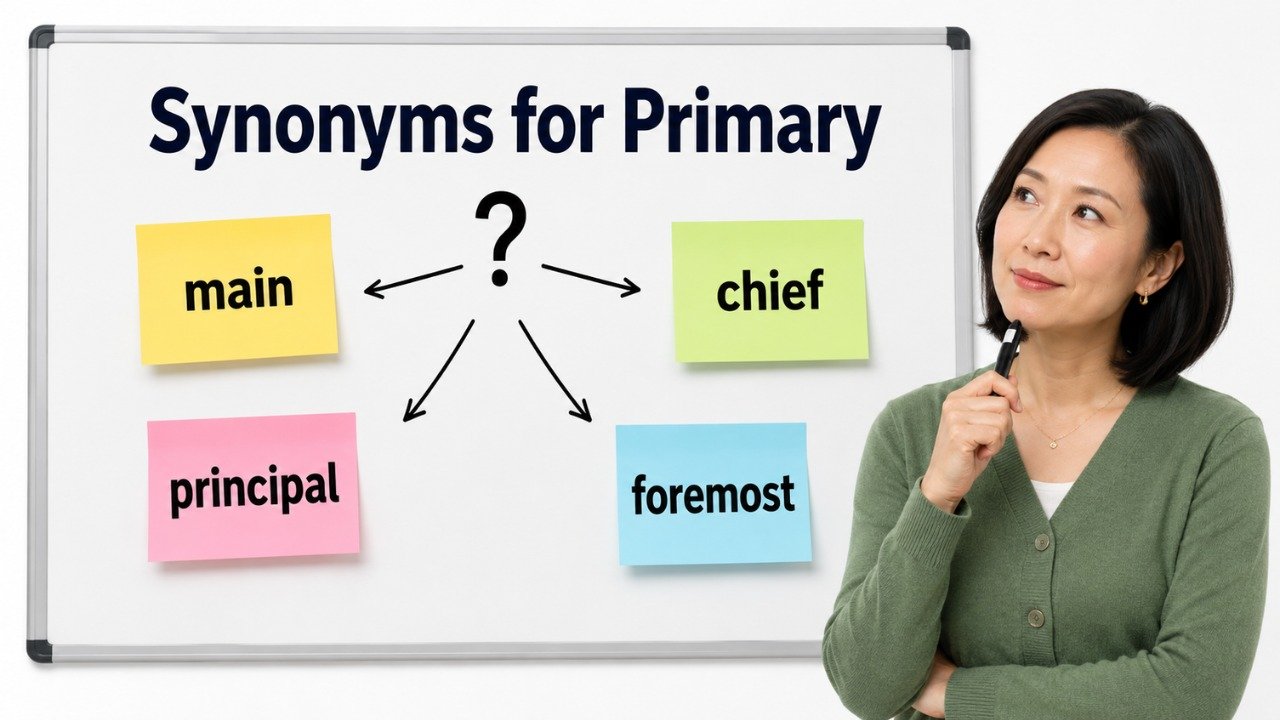
Quick Answer: The best synonyms for primary include main, chief, principal, foremost, leading, central, key, major, fundamental, and essential. Use main for the most important person, purpose, or thing, principal in formal writing, chief for a leading concern or responsibility, foremost for highest importance or rank, central for something at the heart of an issue, fundamental for basic principles, and initial or first when primary refers to something that comes before others in time or order.
Pronunciation and Word Details
Word: Primary.
Pronunciation: /ˈpraɪmeri/
Part of Speech: Adjective and noun.
Meaning: Most important, first in order, fundamental, or directly connected with the beginning or main purpose of something.
US Pronunciation:
UK Pronunciation:
What Does “Primary” Mean?
Primary means most important, first in order, basic, original, or directly connected with the beginning of something.
As an adjective, primary commonly describes the person, reason, goal, concern, source, responsibility, or factor that has the greatest importance.
Example: Safety is our primary concern.
Primary can also mean first in a sequence or process.
Example: The primary stage of the project focuses on planning.
In education, primary can describe the earliest formal stage of schooling.
Example: She teaches children at the primary level.
In research and information, primary can describe an original or direct source rather than an interpretation produced later.
Example: The researcher examined primary documents from the period.
In technical and academic contexts, primary may also mean basic, fundamental, or serving as the starting point from which other things develop.
The word is therefore broad. Its best synonym depends on whether the intended meaning is most important, first, basic, original, direct, or central.
Meaning, Tone, and Context of “Primary”
Primary is generally neutral and slightly formal. It appears naturally in everyday conversation, academic writing, professional communication, reports, education, research, science, business, and technical descriptions.
When primary means most important, it has a clear and objective tone.
Example: The primary reason for the change was increased demand.
In formal writing, primary is often preferred because it sounds precise without being overly dramatic.
Example: The primary objective of the study was to identify the main causes of the problem.
In casual conversation, main often sounds more natural.
Formal: The primary concern is cost.
Casual: The main concern is cost.
When primary means basic or fundamental, it is especially common in academic and technical language.
Example: Trust is a primary requirement for effective cooperation.
When primary means first, words such as initial, earliest, or first may communicate the sequence more clearly.
Example: The initial stage involved gathering information.
Primary is not strongly emotional. It usually communicates importance, priority, sequence, or foundational status in a direct and professional way.
When and How to Use “Primary”
For the Most Important Thing
Use primary when one person, goal, reason, concern, or issue has greater importance than the others.
Example: Customer safety remains the primary concern.
For a Main Purpose
Primary works well when describing the central purpose or objective of an activity.
Example: The primary purpose of the meeting is to review progress.
For a Main Reason
Use primary when identifying the strongest or most important cause.
Example: Limited funding was the primary reason for the delay.
For the First Stage
Primary can refer to something that comes first in a sequence, process, or development.
Example: The primary phase involves collecting the required information.
For Fundamental Principles
Use primary when describing something basic or essential to a larger idea or system.
Example: Clear communication is a primary element of successful teamwork.
For Original Information
Primary can describe material obtained directly from an original event, record, person, or source.
Example: The historian examined primary records before writing the report.
For Central Importance
Primary can describe something that occupies a central position in a discussion, strategy, or decision.
Example: Cost became a primary consideration during planning.
For Education
Primary commonly describes the first major stage of formal education.
Example: Reading skills develop rapidly during primary education.
For Priority
Primary can indicate that something should receive attention before secondary concerns.
Example: Protecting essential services is the primary priority during an emergency.
Best Synonyms for Primary
Main: Most important or most noticeable among several things.
Example: The main reason for the change was improved efficiency.
Chief: Most important among a group of concerns, causes, or responsibilities.
Example: Her chief concern was the safety of the staff.
Principal: First in importance, rank, or influence.
Example: The principal objective is to reduce unnecessary costs.
Foremost: Most important, respected, or prominent.
Example: Quality remains their foremost consideration.
Leading: Having an important, prominent, or influential position.
Example: Cost was a leading factor in the final decision.
Central: Located at the heart of an issue, system, or discussion.
Example: Communication plays a central role in successful teamwork.
Key: Extremely important to achieving a particular result.
Example: Preparation is a key part of the process.
Major: Important, considerable, or having a strong effect.
Example: Lack of funding was a major obstacle.
Fundamental: Basic and necessary to the nature or structure of something.
Example: Trust is fundamental to a productive relationship.
Essential: Completely necessary or extremely important.
Example: Clear instructions are essential for accurate results.
50 Synonyms for Primary with Short Meanings
- Main: Most important among several things.
- Chief: Highest in importance or concern.
- Principal: First in importance, rank, or influence.
- Foremost: Most important or prominent.
- Leading: Occupying an important or influential position.
- Central: At the heart of an issue or system.
- Key: Particularly important to an outcome.
- Major: Important or significant in effect.
- Dominant: Having the greatest influence or power.
- Prime: Of first importance or quality.
- Paramount: More important than anything else.
- Preeminent: Outstanding in importance or position.
- Predominant: Having the greatest influence or presence.
- Cardinal: Fundamentally important.
- Essential: Absolutely necessary or highly important.
- Fundamental: Basic and necessary.
- Basic: Forming the simplest or most necessary level.
- Core: Forming the central or most important part.
- Crucial: Extremely important to an outcome.
- Vital: Necessary for success or continued functioning.
- Critical: Having decisive importance.
- Significant: Important enough to deserve attention.
- Important: Having considerable value or influence.
- First: Coming before all others.
- Initial: Occurring at the beginning.
- Earliest: Coming before others in time.
- Opening: Occurring at the beginning of a process.
- Beginning: Connected with the first stage.
- Original: Existing from the beginning or source.
- Direct: Coming immediately from the source.
- Firsthand: Obtained directly rather than through another person.
- Immediate: Direct and without an intermediate step.
- Elementary: Basic or belonging to an early level.
- Foundational: Providing a base for later development.
- Underlying: Forming the basic cause or structure.
- Root: Existing at the basic or original level.
- Base: Forming the supporting or starting level.
- Supreme: Highest in rank or importance.
- Top: Highest or most important.
- Priority: Deserving attention before other matters.
- Prominent: Important and easily recognized.
- Notable: Important or worthy of attention.
- Decisive: Having enough importance to determine an outcome.
- Determining: Strongly influencing the final result.
- Pivotal: Having a central influence on what happens.
- Indispensable: So important that it cannot reasonably be omitted.
- Necessary: Required for a particular purpose.
- Primarymost: Holding the first position in importance.
- Predominating: Having greater influence than competing factors.
- Prior: Coming earlier or receiving earlier consideration.
Read Also:
Synonyms for Exotic

Synonyms for Primary by Context
When Primary Means Main or Most Important
When primary describes the most important reason, purpose, concern, responsibility, or factor, useful alternatives include main, chief, principal, foremost, key, major, paramount, and central.
Main: The most natural general alternative.
Example: The main reason for moving the deadline was insufficient preparation.
Chief: Useful when one concern or responsibility is more important than the rest.
Example: Her chief responsibility is maintaining quality standards.
Principal: Formal and precise, especially in reports and academic writing.
Example: The principal objective is to increase efficiency.
Foremost: Stronger than main and useful when emphasizing highest importance.
Example: Public safety should remain the foremost concern.
Paramount: Appropriate when something is more important than every competing consideration.
Example: Accuracy is paramount when interpreting the results.
When Primary Means Central
Primary may describe something that plays a central role in an idea, system, problem, or decision.
Useful alternatives include central, core, key, pivotal, and dominant.
Central: Best when something lies at the heart of an issue.
Example: Trust is central to effective cooperation.
Core: Best for the essential inner part of something.
Example: Reliability is a core requirement of the system.
Key: Natural in professional and everyday writing.
Example: Experience is a key factor when selecting candidates.
Pivotal: Suitable when something strongly affects what happens next.
Example: The final meeting played a pivotal role in reaching an agreement.
When Primary Means Fundamental
When primary refers to something basic or necessary to a larger structure, useful synonyms include fundamental, basic, essential, foundational, core, and cardinal.
Fundamental: Best for principles, conditions, concepts, and requirements.
Example: Respect is fundamental to productive communication.
Foundational: Appropriate when something supports later development.
Example: Early reading skills are foundational to later learning.
Essential: Best when something is necessary rather than simply important.
Example: Accurate information is essential for good decisions.
Basic: Useful for the simplest or most necessary level of something.
Example: The course introduces the basic principles of writing.
When Primary Means First
When primary refers to sequence or time, choose first, initial, earliest, opening, beginning, or prior.
First: The clearest alternative in ordinary language.
Example: The first stage focuses on collecting information.
Initial: More formal and useful for processes, plans, and assessments.
Example: The initial review identified several concerns.
Earliest: Best when specifically referring to time.
Example: The earliest records provide valuable historical information.
Opening: Useful for the first section or stage of an activity.
Example: The opening phase introduces the basic concepts.
When Primary Means Original or Direct
In research, evidence, and information, primary may mean original, direct, or firsthand.
Useful alternatives include original, firsthand, direct, immediate, and source based.
Original: Best for records, documents, evidence, and material created at the time.
Example: The researcher reviewed the original documents.
Firsthand: Best for information obtained directly through personal experience or observation.
Example: The witness provided firsthand information about the event.
Direct: Useful when information comes straight from its source.
Example: The report contains direct evidence from participants.
When Primary Means Dominant
Primary can sometimes describe the strongest or most influential force among several possibilities.
Useful alternatives include dominant, predominant, leading, determining, and decisive.
Dominant: Best when one factor clearly has more influence than others.
Example: Cost remained the dominant concern.
Predominant: More formal and useful when something is the most common or influential element.
Example: Economic factors were the predominant influence on the decision.
Determining: Best when something largely decides the result.
Example: Availability became the determining factor.
Decisive: Suitable when something ultimately settles an issue.
Example: Experience proved decisive in the selection process.
Another Word for Primary
The best single replacement for primary is often main because it works naturally when primary means most important. However, the best alternative depends on context. Use principal in formal writing, fundamental when discussing basic principles, initial for the first stage, and original when discussing direct sources or evidence.
Original: The primary reason for the delay was limited funding.
Better Option: The main reason for the delay was limited funding.
Original: The primary objective of the study was to measure improvement.
Better Option: The principal objective of the study was to measure improvement.
Original: Communication is a primary requirement for successful teamwork.
Better Option: Communication is a fundamental requirement for successful teamwork.
Original: The primary stage involved reviewing the available information.
Better Option: The initial stage involved reviewing the available information.
When Not to Use “Primary”
Primary is useful, but another word may be more accurate when the exact meaning is already clear.
When You Simply Mean Main
In ordinary conversation, primary can sound slightly formal when main expresses the same idea naturally.
Weak: My primary concern is whether we have enough time.
Better: My main concern is whether we have enough time.
When You Mean First in Time
Primary may be unclear when the sentence is specifically describing sequence.
Weak: During the primary stage, the team gathered information.
Better: During the initial stage, the team gathered information.
When You Mean Essential
Primary suggests importance, but it does not always mean something is absolutely necessary.
Weak: Reliable data is a primary requirement for the analysis.
Better: Reliable data is an essential requirement for the analysis.
When You Mean Original Evidence
For research and historical writing, original or firsthand may communicate the type of evidence more clearly.
Weak: She relied on primary information from the witness.
Better: She relied on firsthand information from the witness.
When You Mean the Strongest Influence
Dominant may be more precise when discussing competing forces or influences.
Weak: Cost was the primary influence on consumer behavior.
Better: Cost was the dominant influence on consumer behavior.
When Repetition Makes Writing Mechanical
Repeating primary several times in a paragraph can make the writing sound rigid.
Weak: The primary purpose was to identify the primary issue and develop a primary solution.
Better: The main purpose was to identify the central issue and develop the most important solution.
Words Commonly Confused With Primary
Primary vs Main: Both can mean most important. Main is more common in everyday language, while primary often sounds more formal or analytical.
Primary vs Principal: Both can mean first in importance. Principal is especially common when discussing objectives, reasons, roles, and responsibilities in formal writing.
Primary vs Prime: Prime can mean first in importance or excellent in quality. Primary more often describes the main member, reason, purpose, stage, or source.
Primary vs Fundamental: Primary emphasizes importance or order. Fundamental emphasizes that something forms an essential foundation.
Primary vs Essential: Primary means most important among several things. Essential means necessary and difficult or impossible to do without.
Primary vs Initial: Primary can mean main or first. Initial specifically means occurring at the beginning.
Primary vs Original: Primary may describe an original source, but original emphasizes that something comes from the beginning or has not been copied or derived from something else.
Primary vs Central: Primary emphasizes rank or importance. Central emphasizes position at the heart of an issue, activity, or system.
Primary vs Dominant: Primary means most important or first. Dominant emphasizes greater power, influence, quantity, or presence.
Primary vs Principal: Primary can have several meanings, including first, fundamental, or original. Principal mainly emphasizes first importance or rank.
Which Synonym Should You Choose?
Choose main for everyday writing and conversation when you simply mean most important.
Choose chief when describing the most important concern, reason, responsibility, or difficulty.
Choose principal for formal reports, essays, studies, objectives, reasons, and responsibilities.
Choose foremost when you want to emphasize that something ranks above all other considerations.
Choose central when something lies at the heart of a discussion, system, problem, or argument.
Choose key for concise professional writing when something strongly affects success or results.
Choose major when something is important but not necessarily the single most important factor.
Choose paramount when one concern is more important than every other consideration.
Choose fundamental when discussing principles, rights, concepts, structures, or necessary conditions.
Choose essential when something is necessary rather than merely important.
Choose initial when referring specifically to the first stage of a process.
Choose first in simple conversation when describing order or sequence.
Choose original when discussing documents, records, evidence, or material from the source.
Choose firsthand when information comes directly from personal observation or experience.
Choose dominant when one force, factor, or influence is stronger than the others.
Choose determining when one factor has a major effect on the final outcome.
For essays and reports, principal, central, fundamental, dominant, and determining often provide greater precision.
For professional emails, main, key, major, and principal usually sound natural.
For casual conversation, main and first are often clearer than primary.
Real Life Examples of “Primary” in Sentences
Original: The primary reason for changing the plan was cost.
Better Option: The main reason for changing the plan was cost.
Original: Safety is the primary concern during construction.
Better Option: Safety is the foremost concern during construction.
Original: The primary objective is to improve response times.
Better Option: The principal objective is to improve response times.
Original: Communication is a primary part of successful teamwork.
Better Option: Communication is a fundamental part of successful teamwork.
Original: The primary stage of the project involves planning.
Better Option: The initial stage of the project involves planning.
Original: The researcher relied on primary documents.
Better Option: The researcher relied on original documents.
Original: Price was the primary factor in the decision.
Better Option: Price was the determining factor in the decision.
Original: Education remains a primary issue for the community.
Better Option: Education remains a central issue for the community.
Original: The primary influence on the result was experience.
Better Option: The dominant influence on the result was experience.
Original: Their primary goal is to reduce unnecessary waste.
Better Option: Their chief goal is to reduce unnecessary waste.
Synonym Groups and Usage Differences
Importance Group
This group includes main, chief, principal, foremost, prime, paramount, and preeminent.
These words describe something that has a high position in importance or priority.
Main is general and natural. Principal is more formal. Foremost and paramount provide stronger emphasis.
Example: Protecting essential services remained the foremost concern.
Centrality Group
This group includes central, core, key, pivotal, and crucial.
These words describe something that sits at the heart of a system, issue, strategy, or outcome.
Central and core focus on position or structure. Key, crucial, and pivotal focus more strongly on importance to a result.
Example: Reliable communication is a key element of successful coordination.
Foundation Group
This group includes fundamental, basic, foundational, underlying, cardinal, and essential.
These words are useful when primary describes something necessary to a larger concept or structure.
Fundamental and foundational suggest a base. Essential emphasizes necessity.
Example: Trust is a fundamental requirement for effective cooperation.
Sequence Group
This group includes first, initial, earliest, opening, beginning, and prior.
These alternatives describe order and time rather than importance.
Initial is especially common in professional writing, while first is simpler and more conversational.
Example: The initial assessment revealed several areas for improvement.
Source Group
This group includes original, direct, firsthand, immediate, and source based.
These words apply when primary describes information, evidence, documents, research material, or experience obtained directly from the original source.
Example: The report includes firsthand accounts from people who witnessed the event.
Influence Group
This group includes dominant, predominant, determining, decisive, and leading.
These words describe factors or forces that strongly shape an outcome.
Dominant focuses on strength. Determining and decisive focus on influence over the final result.
Example: Availability became the determining consideration.
Antonyms of Primary
The opposite of primary changes according to whether primary means most important, first, basic, or original.
Secondary: Less important or occurring after the first level.
Minor: Less important, serious, or influential.
Subsidiary: Supporting or less important than the main element.
Peripheral: Away from the central or most important part.
Marginal: Having relatively little importance or influence.
Lesser: Lower in importance, degree, or value.
Subordinate: Lower in rank or importance.
Additional: Added to something more important or already existing.
Supplementary: Providing extra support rather than forming the main part.
Optional: Not essential or required.
Advanced: Beyond the basic or introductory level.
Final: Coming at the end rather than the beginning.
Later: Occurring after an earlier stage.
Derived: Obtained from another source rather than original.
Indirect: Reaching something through an intermediate source or step.
Comparison: Primary vs Related Words
Primary vs Main
Primary and main often mean the same thing when referring to importance. Main is more conversational, while primary tends to sound more formal or analytical.
Example With Primary: The primary reason for the change was cost.
Example With Main: The main reason for the change was cost.
Both are correct, but main sounds slightly more natural in everyday communication.
Primary vs Principal
Both words can mean most important, but principal is often especially suitable for formal objectives, causes, people, and responsibilities.
Example With Primary: The primary objective is to improve efficiency.
Example With Principal: The principal objective is to improve efficiency.
Principal can create a more formal tone in this context.
Primary vs Chief
Primary is neutral and flexible. Chief strongly emphasizes that something ranks above other concerns or responsibilities.
Example With Primary: Her primary concern was safety.
Example With Chief: Her chief concern was safety.
Primary vs Fundamental
Primary emphasizes importance or position. Fundamental emphasizes the basic foundation on which something depends.
Example With Primary: Trust is a primary requirement for cooperation.
Example With Fundamental: Trust is a fundamental requirement for cooperation.
Fundamental better emphasizes that cooperation depends on trust.
Primary vs Essential
Primary means most important or first. Essential means completely necessary.
Example With Primary: Communication is a primary skill for managers.
Example With Essential: Communication is an essential skill for managers.
The second sentence emphasizes necessity more strongly.
Primary vs Initial
Primary has several meanings, while initial specifically refers to the beginning.
Example With Primary: The primary phase involved planning.
Example With Initial: The initial phase involved planning.
Initial is clearer when the sentence focuses on sequence.
Primary vs Central
Primary emphasizes priority. Central emphasizes being at the heart of an issue or system.
Example With Primary: Cost is a primary concern.
Example With Central: Cost is a central concern.
Both work, but central suggests that cost is deeply connected with the entire issue.
Primary vs Dominant
Primary suggests first importance. Dominant suggests the strongest influence, power, or presence.
Example With Primary: Price was the primary consideration.
Example With Dominant: Price was the dominant consideration.
Dominant places more emphasis on strength relative to competing factors.
Primary vs Original
Primary can mean original when discussing sources, but the two words are not interchangeable in every context.
Example With Primary: The researcher examined primary documents.
Example With Original: The researcher examined original documents.
Original directly emphasizes that the documents came from the source or period being studied.
Common Phrases and Expressions With Primary
Primary Concern: The most important issue requiring attention.
Primary Goal: The main result someone wants to achieve.
Primary Purpose: The chief reason something exists or is done.
Primary Objective: The most important planned outcome.
Primary Reason: The main explanation or cause.
Primary Source: Original or direct material used as evidence or information.
Primary Responsibility: The most important duty assigned to someone.
Primary Focus: The main subject receiving attention.
Primary Factor: The most important influence on an outcome.
Primary Role: The main function performed by a person, object, or system.
Common Mistakes to Avoid
Using Primary and Main Repeatedly Without Purpose
Primary and main often have similar meanings. Using both unnecessarily can make a sentence repetitive.
Weak: The primary main reason was poor communication.
Better: The primary reason was poor communication.
Using Primary When Initial Is Clearer
If you are discussing sequence rather than importance, initial may be more precise.
Weak: The primary step is to gather the required documents.
Better: The initial step is to gather the required documents.
Assuming Primary Always Means Essential
Something can be primary because it has the greatest importance without being absolutely necessary.
Weak: Water is a primary need for survival.
Better: Water is an essential need for survival.
Use essential when necessity is the central meaning.
Confusing Principal and Principle
Principal can mean most important, while principle refers to a rule, belief, or fundamental idea.
Incorrect: The principle objective is to reduce waste.
Correct: The principal objective is to reduce waste.
Using Primary for Every Important Idea
Overusing primary can make writing repetitive and vague.
Repetitive: The primary issue affected the primary goal because of a primary concern.
Better: The central issue affected the main goal because of a major concern.
Choosing a Stronger Synonym Without Checking Tone
Paramount, preeminent, crucial, and vital can sound stronger than primary.
Advice: Use these alternatives only when the importance is genuinely strong enough to justify them.
Confusing First in Importance With First in Time
Primary can mean either, so context matters.
Example: The primary concern refers to importance.
Example: The initial stage refers to time or sequence.
Using Major When Only One Thing Is Clearly Most Important
Major means important, but it does not necessarily mean the single most important.
Less Precise: Safety is a major concern above all others.
Better: Safety is the primary concern above all others.
Using Original for Every Primary Source
A primary source is often original material, but original can have broader meanings.
Advice: Choose the word based on whether you want to emphasize direct evidence, firsthand information, or originality.
Conclusion
Understanding synonyms for primary makes it easier to express importance, sequence, foundation, and originality with greater precision. Use main for everyday situations, principal for formal objectives, foremost for highest importance, central for something at the heart of an issue, and fundamental for basic principles. Choose initial when primary means first in a process, original for source material, and dominant for the strongest influence. The best choice always depends on the exact meaning and tone of your sentence.
FAQs About Synonyms for Primary
What Is the Best Synonym for Primary?
The best general synonym is main when primary means most important. Principal, chief, foremost, central, and fundamental may be better in more specific contexts.
What Is Another Word for Primary in Formal Writing?
Principal is an excellent formal alternative. Depending on context, foremost, central, fundamental, paramount, or predominant may also work.
What Is a Synonym for Primary When It Means First?
Use first, initial, earliest, opening, or beginning. Initial is especially useful for formal descriptions of stages and processes.
What Is a Synonym for Primary When It Means Most Important?
Main, chief, principal, foremost, paramount, key, and central can all express this meaning.
Are Primary and Main the Same?
They often overlap. Main is more conversational, while primary can sound more formal and may also mean first, basic, or original.
What Is the Difference Between Primary and Fundamental?
Primary emphasizes first importance or priority. Fundamental describes something basic and necessary to the structure or nature of something.
What Is the Opposite of Primary?
Common antonyms include secondary, minor, subordinate, peripheral, supplementary, and indirect. The best opposite depends on the meaning of primary in the sentence.
