
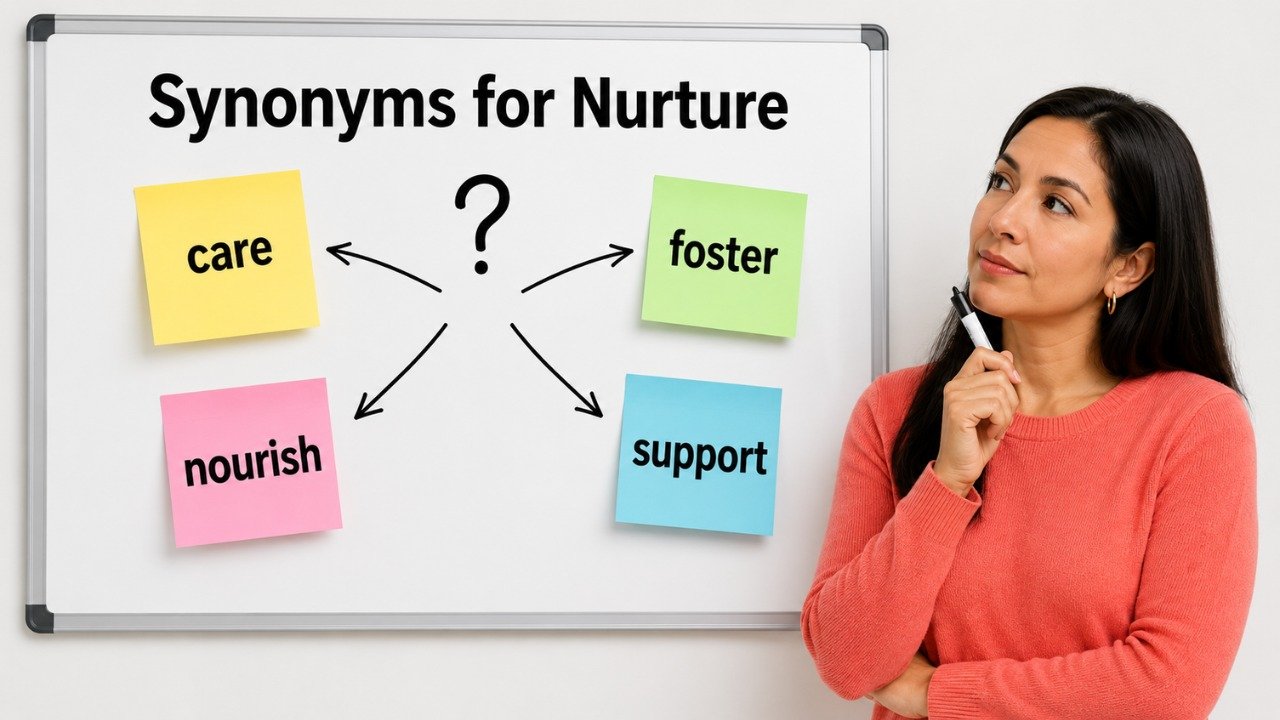
Quick Answer: The best synonyms for nurture include foster, cultivate, nourish, support, encourage, develop, care for, strengthen, cherish, and promote. Use foster for encouraging growth or development, cultivate for skills, relationships, and qualities, nourish for physical or emotional support, care for when looking after a person or living thing, develop for abilities and ideas, and encourage when helping confidence, effort, or progress grow.
Pronunciation and Word Details
Word: Nurture
Pronunciation: /ˈnɜːrtʃər/
Part of Speech: Verb and noun
Meaning: To care for, support, encourage, or help someone or something grow and develop.
US Pronunciation:
UK Pronunciation:
What Does “Nurture” Mean?
Nurture means to care for, support, encourage, or help someone or something develop over time. As a verb, it describes actions that promote physical, emotional, intellectual, personal, or practical growth.
The word can refer to caring for children, developing talent, strengthening relationships, encouraging ideas, supporting confidence, or helping plants and organizations grow.
Personal Growth: Parents can nurture a child’s confidence.
Skills: Regular practice nurtures creative ability.
Relationships: Honest communication can nurture trust.
Ideas: A supportive environment can nurture new ideas.
Plants: Gardeners nurture young plants until they become established.
As a noun, nurture refers to care, encouragement, education, or environmental influences that affect development.
Example: Both natural ability and nurture can influence how a skill develops.
Meaning, Tone, and Context of “Nurture”
Nurture has a positive, supportive, and caring tone. It often suggests patience, attention, encouragement, and gradual development rather than immediate change.
The word is common in personal, educational, professional, psychological, agricultural, and relationship contexts.
In emotional writing, nurture often expresses warmth and care.
Example: She nurtured her child’s confidence through patience and encouragement.
In professional writing, nurture may describe talent, leadership, partnerships, ideas, or organizational growth.
Example: The program was designed to nurture emerging talent.
In educational contexts, nurture often refers to helping abilities, curiosity, confidence, or learning develop.
Example: Good teaching can nurture curiosity in young learners.
In gardening and agriculture, nurture can describe caring for plants or living things.
Example: Careful watering helped nurture the young seedlings.
The word is generally neutral to positive. It can sound slightly more thoughtful and intentional than simpler alternatives such as help or care for.
When and How to Use “Nurture”
For Personal Growth
Use nurture when someone helps another person develop confidence, resilience, abilities, or positive qualities.
Example: A supportive teacher can nurture a student’s confidence.
For Children
Nurture is appropriate when discussing emotional, physical, educational, or social care for children.
Example: Parents should nurture curiosity as children grow.
For Skills and Talent
Use nurture when an ability is developed through guidance, practice, and encouragement.
Example: The instructor helped nurture her musical talent.
For Relationships
Nurture works well when describing actions that strengthen trust, respect, affection, or cooperation.
Example: Honest communication can nurture a healthy relationship.
For Ideas
Use nurture when an idea needs time, attention, resources, or encouragement to develop.
Example: The team nurtured the idea until it became a practical proposal.
For Emotional Well Being
Nurture can describe providing reassurance, kindness, attention, and emotional support.
Example: Supportive friendships can nurture emotional well being.
For Plants and Living Things
Use nurture when caring for something living so it can grow successfully.
Example: She nurtured the plants with regular watering and careful attention.
For Professional Development
Nurture can describe supporting employees, leaders, partnerships, or business opportunities.
Example: The organization works to nurture future leaders.
Best Synonyms for Nurture
Foster
Synonym: Foster means to encourage the growth or development of something.
Example: The classroom environment fosters creativity.
Cultivate
Synonym: Cultivate means to develop a quality, skill, relationship, or habit through continued effort.
Example: She worked to cultivate stronger communication skills.
Nourish
Synonym: Nourish means to provide what is needed for physical, emotional, or intellectual growth.
Example: Reading can nourish a child’s imagination.
Support
Synonym: Support means to provide help, encouragement, resources, or stability.
Example: Her family supported her artistic development.
Encourage
Synonym: Encourage means to give someone confidence, motivation, or support.
Example: The teacher encouraged students to explore new ideas.
Develop
Synonym: Develop means to help something grow, improve, or become more advanced.
Example: The course develops practical communication skills.
Care For
Synonym: Care for means to look after someone or something attentively.
Example: Volunteers care for injured animals.
Strengthen
Synonym: Strengthen means to make something more effective, stable, or resilient.
Example: Regular communication strengthens relationships.
Cherish
Synonym: Cherish means to care deeply for someone or something and treat it as valuable.
Example: She cherished the friendship they had built.
Promote
Synonym: Promote means to encourage the development, growth, or acceptance of something.
Example: The program promotes healthy learning habits.
50 Synonyms for Nurture with Short Meanings
- Foster: To encourage growth or development.
- Cultivate: To develop something through care and effort.
- Nourish: To provide what is needed for growth.
- Support: To give help, stability, or encouragement.
- Encourage: To inspire confidence or continued effort.
- Develop: To help something grow or improve.
- Care For: To look after attentively.
- Raise: To care for someone while they grow.
- Tend: To look after something carefully.
- Cherish: To care deeply for something valued.
- Protect: To keep someone or something safe.
- Promote: To encourage progress or development.
- Strengthen: To make something stronger or more resilient.
- Sustain: To help something continue successfully.
- Feed: To provide nourishment for growth.
- Rear: To bring up and care for a child or young animal.
- Educate: To develop knowledge and understanding.
- Guide: To provide direction and assistance.
- Mentor: To advise and support development.
- Train: To develop skills through practice and instruction.
- Coach: To help someone improve ability or performance.
- Inspire: To encourage ideas, confidence, or motivation.
- Stimulate: To encourage activity, thought, or growth.
- Advance: To help something move forward.
- Improve: To make something better.
- Build: To gradually develop or strengthen something.
- Grow: To help increase or develop.
- Enrich: To improve quality or add value.
- Empower: To give confidence, ability, or authority.
- Assist: To help someone make progress.
- Help: To make growth or progress easier.
- Uphold: To support or maintain something important.
- Preserve: To protect something so it continues.
- Maintain: To keep something in a healthy or effective condition.
- Safeguard: To protect from harm or loss.
- Bolster: To provide extra support or strength.
- Reinforce: To make an ability, belief, or condition stronger.
- Motivate: To encourage action or continued effort.
- Teach: To help someone gain knowledge or skills.
- Instruct: To provide guidance or knowledge.
- Prepare: To help someone become ready for future development.
- Shape: To influence how something develops.
- Mature: To help or allow something to become fully developed.
- Refine: To improve something through careful development.
- Deepen: To make a relationship, understanding, or quality stronger.
- Encourage Growth: To actively support development.
- Provide For: To supply needs required for care and growth.
- Look After: To take responsibility for someone’s care.
- Bring Up: To care for and educate a child as they grow.
- Attend To: To give careful attention to someone’s needs.
Read Also:
Synonyms for Primary

Synonyms for Nurture by Context
When Nurture Means Encourage Growth
Foster, cultivate, develop, promote, stimulate, and encourage are strong choices when nurture refers to helping something grow.
Foster: Best for creating conditions that encourage progress.
Example: The program fosters independent thinking.
Cultivate: Best for abilities, qualities, relationships, or habits that develop gradually.
Example: She cultivated greater patience through experience.
Develop: Best when something becomes more advanced over time.
Example: The training developed his leadership abilities.
When Nurture Means Care For Someone
Care for, tend, look after, raise, rear, protect, and provide for work well when nurture refers to personal or physical care.
Care For: A direct and natural replacement for looking after someone.
Example: She cared for her elderly relative.
Raise: Best when discussing children over an extended period.
Example: They raised their children in a supportive home.
Tend: Useful when caring for people, animals, or plants that need regular attention.
Example: The gardener tended the young plants carefully.
When Nurture Means Support Talent
Develop, mentor, coach, train, encourage, guide, and cultivate are useful for skills and abilities.
Mentor: Best when an experienced person advises someone less experienced.
Example: Senior employees mentor younger colleagues.
Coach: Best for improving performance through practical guidance.
Example: She coached the group to improve their presentation skills.
Cultivate: Useful when talent grows gradually through practice and support.
Example: The school cultivates artistic talent.
When Nurture Means Strengthen a Relationship
Cultivate, strengthen, deepen, cherish, maintain, support, and foster are effective alternatives.
Strengthen: Best when making a relationship more stable.
Example: Regular communication strengthens trust.
Deepen: Best when increasing emotional closeness or understanding.
Example: Shared experiences deepened their friendship.
Cherish: Best when emphasizing affection and emotional value.
Example: He cherished his relationship with his grandparents.
When Nurture Means Encourage an Idea
Develop, foster, cultivate, shape, stimulate, support, and refine can replace nurture when discussing ideas.
Develop: Best when an idea becomes more complete.
Example: They developed the concept into a workable plan.
Refine: Best when improving an existing idea.
Example: The group refined the proposal after receiving feedback.
Foster: Best when creating an environment where ideas can emerge.
Example: Open discussion fosters creative thinking.
When Nurture Means Support Emotional Growth
Support, encourage, empower, strengthen, reassure, and guide can express emotional development.
Support: A broad and natural choice.
Example: Her family supported her through a difficult period.
Empower: Best when someone gains confidence or independence.
Example: The course empowered participants to trust their abilities.
Encourage: Best when giving someone motivation or confidence.
Example: His teacher encouraged him to keep improving.
Another Word for Nurture
The best general replacement for nurture is often foster because it naturally describes encouraging growth, development, talent, relationships, ideas, and positive qualities. However, the best alternative always depends on what is being nurtured.
Original: The program aims to nurture creativity.
Better Option: The program aims to foster creativity.
Original: She nurtured her son’s musical ability.
Better Option: She developed her son’s musical ability.
Original: They worked hard to nurture their friendship.
Better Option: They worked hard to strengthen their friendship.
Original: The gardener nurtured the seedlings carefully.
Better Option: The gardener tended the seedlings carefully.
When Not to Use “Nurture”
Nurture can sound vague when a more specific verb explains the action better.
Weak: The teacher nurtured the student.
Better: The teacher encouraged the student’s confidence and guided her learning.
Avoid nurture when you specifically mean feeding someone.
Weak: She nurtured the baby before bedtime.
Better: She fed the baby before bedtime.
Do not use nurture when you mean simple physical protection.
Weak: The equipment nurtures workers from danger.
Better: The equipment protects workers from danger.
Nurture may sound unnecessarily formal in casual conversation.
Weak: Can you nurture my plants while I am away?
Better: Can you look after my plants while I am away?
Avoid repeated use of nurture when different actions are involved.
Weak: The school nurtures talent, nurtures confidence, and nurtures discipline.
Better: The school develops talent, builds confidence, and encourages discipline.
Use raise rather than nurture when the sentence specifically describes bringing up children.
Weak: They nurtured three children in a small town.
Better: They raised three children in a small town.
Words Commonly Confused With Nurture
Nurture vs Foster: Nurture emphasizes care, support, and gradual development. Foster emphasizes encouraging development or creating conditions where growth can occur.
Nurture vs Nourish: Nurture is broader and can include emotional, intellectual, social, and physical development. Nourish often focuses on supplying what is needed for growth, either physically or figuratively.
Nurture vs Cultivate: Nurture emphasizes care and support. Cultivate emphasizes deliberate effort to develop a skill, relationship, habit, quality, or idea.
Nurture vs Support: Support means providing help or assistance. Nurture usually suggests continued support that promotes development.
Nurture vs Raise: Raise is commonly used for bringing up children or young animals. Nurture describes the care and encouragement that contribute to their development.
Nurture vs Develop: Develop focuses on growth or improvement. Nurture emphasizes the care, guidance, and conditions that help that development happen.
Nurture vs Cherish: Nurture involves helping something develop. Cherish emphasizes valuing, loving, or protecting someone or something deeply.
Nurture vs Encourage: Encourage usually involves motivation or confidence. Nurture can include encouragement but also involves ongoing care, support, and development.
Which Synonym Should You Choose?
Choose foster when discussing creativity, cooperation, learning, trust, or positive development in formal writing.
Choose cultivate when describing skills, qualities, habits, relationships, knowledge, or attitudes that develop gradually.
Choose nourish when emphasizing emotional, intellectual, creative, or physical nourishment.
Choose support when the main idea is providing help, resources, or stability.
Choose encourage when someone needs confidence, motivation, or reassurance.
Choose develop when discussing abilities, plans, ideas, systems, or professional skills.
Choose care for in everyday conversation when referring to people, animals, or living things.
Choose raise when specifically discussing bringing up children.
Choose mentor when an experienced person guides another person’s professional or personal growth.
Choose strengthen when discussing relationships, confidence, abilities, or structures that already exist.
For essays and reports, foster, cultivate, develop, promote, and support usually provide a precise professional tone.
For emails, encourage, support, develop, and strengthen often sound natural and clear.
For casual conversation, care for, help, look after, raise, and support are usually more direct.
Real Life Examples of “Nurture” in Sentences
Original: The teacher worked hard to nurture her students’ confidence.
Better Option: The teacher worked hard to build her students’ confidence.
Original: Good communication helps nurture strong relationships.
Better Option: Good communication helps strengthen relationships.
Original: The program nurtures young artistic talent.
Better Option: The program develops young artistic talent.
Original: Parents can nurture curiosity by answering questions patiently.
Better Option: Parents can encourage curiosity by answering questions patiently.
Original: She nurtured the plants throughout the summer.
Better Option: She tended the plants throughout the summer.
Original: The organization nurtures future leaders.
Better Option: The organization develops future leaders.
Original: A positive environment can nurture creativity.
Better Option: A positive environment can foster creativity.
Original: They nurtured the idea for several months.
Better Option: They developed the idea for several months.
Original: Regular conversations helped nurture trust between them.
Better Option: Regular conversations helped cultivate trust between them.
Original: The coach nurtured the athlete’s natural ability.
Better Option: The coach refined the athlete’s natural ability.
Synonym Groups and Usage Differences
Care Group
Care for, tend, look after, provide for, protect, and raise focus on meeting someone’s physical or practical needs.
Example: She cared for the young animals until they were healthy.
These words are especially useful when nurture refers to children, animals, plants, or people requiring attention.
Growth Group
Foster, cultivate, develop, grow, advance, and promote describe progress or development.
Example: The organization fosters professional growth.
Foster emphasizes creating helpful conditions, while cultivate suggests deliberate and continuing effort.
Emotional Support Group
Support, encourage, cherish, empower, and strengthen describe emotional care and confidence building.
Example: Her encouragement strengthened his confidence.
These words work well when nurture refers to emotional security, motivation, or personal development.
Learning Group
Educate, teach, guide, mentor, train, and coach focus on developing knowledge or ability.
Example: Experienced professionals mentor new employees.
Mentor often involves ongoing personal guidance, while train focuses more directly on developing particular skills.
Relationship Group
Cultivate, strengthen, deepen, cherish, foster, and maintain describe relationships that require continued attention.
Example: Honest communication can deepen mutual trust.
Cultivate suggests intentional effort, while deepen emphasizes increasing closeness or understanding.
Idea and Creativity Group
Develop, foster, inspire, stimulate, shape, refine, and cultivate describe creative or intellectual growth.
Example: Open discussion stimulates new ideas.
Inspire emphasizes creative motivation, while refine describes improving an idea that already exists.
Antonyms of Nurture
The opposite of nurture depends on whether the word refers to care, growth, encouragement, development, or protection.
Neglect: To fail to provide proper care or attention.
Ignore: To give no attention to someone or something.
Abandon: To leave someone or something without needed care.
Discourage: To reduce confidence, motivation, or enthusiasm.
Hinder: To make development or progress more difficult.
Suppress: To prevent growth, expression, or development.
Damage: To harm someone or something physically or emotionally.
Weaken: To make something less strong or effective.
Undermine: To gradually reduce strength, confidence, or stability.
Stifle: To prevent an idea, ability, feeling, or activity from developing.
Comparison: Nurture vs Related Words
Nurture vs Foster
Nurture emphasizes attentive care and continued support. Foster focuses more on encouraging development or creating favorable conditions.
Example With Nurture: Parents can nurture a child’s confidence.
Example With Foster: Supportive classrooms foster curiosity.
Nurture vs Cultivate
Cultivate often involves deliberate effort to develop something over time. Nurture includes both care and encouragement.
Example With Nurture: She nurtured her daughter’s artistic ability.
Example With Cultivate: She cultivated a strong interest in art.
Nurture vs Nourish
Nourish focuses on supplying what is needed to grow or remain healthy. Nurture includes a wider range of care, guidance, protection, and encouragement.
Example With Nurture: The teacher nurtured his interest in science.
Example With Nourish: Reading nourished his imagination.
Nurture vs Support
Support means providing assistance or stability. Nurture usually implies that the support helps continued development.
Example With Nurture: The program nurtures young writers.
Example With Support: The program supports young writers with training and resources.
Nurture vs Encourage
Encourage usually means giving confidence or motivation. Nurture suggests longer and more continuous care.
Example With Nurture: Her parents nurtured her interest in music for years.
Example With Encourage: Her parents encouraged her to perform at the concert.
Nurture vs Develop
Develop focuses on the growth or improvement itself. Nurture focuses more on the support that helps growth happen.
Example With Nurture: The school nurtures leadership potential.
Example With Develop: The course develops leadership skills.
Nurture vs Raise
Raise is more specific when referring to bringing up children or young animals.
Example With Nurture: They nurtured their child’s creativity.
Example With Raise: They raised their child in a supportive household.
Nurture vs Cherish
Cherish means to value or love deeply. Nurture means to actively support development.
Example With Nurture: She nurtured their friendship through regular communication.
Example With Cherish: She cherished their friendship for many years.
Common Phrases and Expressions With Nurture
Nurture Talent: To help an ability develop through encouragement and practice.
Nurture Creativity: To encourage creative thinking and expression.
Nurture Growth: To support continued development or improvement.
Nurture Relationships: To give relationships the care and attention they need.
Nurture Confidence: To help someone become more secure in their abilities.
Nurture an Idea: To develop an idea carefully over time.
Nurture Potential: To help natural ability become stronger or more useful.
Nurture Trust: To gradually strengthen confidence between people.
Nurture Curiosity: To encourage interest, questioning, and learning.
Nurture a Child: To provide care, guidance, protection, and encouragement during development.
Common Mistakes to Avoid
A common mistake is treating every synonym for nurture as interchangeable. Foster, nourish, cultivate, support, and raise have related meanings, but each emphasizes a different type of care or development.
Unnatural: The gardener mentored the flowers.
Better: The gardener tended the flowers.
Use raise rather than nurture when the main idea is bringing up children.
Less Precise: They nurtured four children.
Better: They raised four children.
Avoid using cultivate for immediate emotional reassurance.
Unnatural: She cultivated him after the disappointing result.
Better: She encouraged him after the disappointing result.
Do not use nourish when you mean professional instruction alone.
Unclear: The instructor nourished the employees in technical procedures.
Better: The instructor trained the employees in technical procedures.
Repetition can also make writing sound mechanical.
Repetitive: Good leaders nurture trust, nurture talent, and nurture communication.
Better: Good leaders cultivate trust, develop talent, and encourage communication.
Avoid vague statements when a more specific verb tells readers what actually happened.
Vague: The program nurtured participants.
Better: The program mentored participants and developed their professional skills.
Grammar also matters. Nurture is usually followed by the person, quality, idea, relationship, or ability receiving support.
Natural: The teacher nurtured the student’s confidence.
Unnatural: The teacher nurtured toward the student’s confidence.
Choose a synonym according to the exact action. Care for expresses attention, foster expresses encouragement, cultivate expresses gradual development, and strengthen emphasizes making something already present more secure.
Conclusion
Understanding synonyms for nurture makes it easier to express different kinds of care, encouragement, and development accurately. Use foster for positive growth, cultivate for skills and relationships, nourish for emotional or intellectual support, develop for abilities and ideas, care for when looking after someone, and strengthen for relationships or confidence. The best choice depends on whether you are describing care, learning, personal growth, creativity, emotional support, or gradual development.
FAQs About Synonyms for Nurture
What Is the Best Synonym for Nurture?
Answer: Foster is one of the best general synonyms because it means to encourage growth or development. The best choice still depends on context.
What Is Another Word for Nurture a Child?
Answer: Raise, care for, look after, support, and provide for are natural alternatives. Raise is best when referring to bringing up a child over many years.
What Is Another Word for Nurture Talent?
Answer: Develop, cultivate, foster, mentor, train, and encourage are useful choices. Develop is especially natural for abilities and professional skills.
What Is a Formal Synonym for Nurture?
Answer: Foster, cultivate, promote, develop, sustain, and strengthen work well in formal or professional writing.
Is Nurture the Same as Nourish?
Answer: Not exactly. Nourish means to provide what is needed for growth, while nurture is broader and can include care, guidance, encouragement, protection, and emotional support.
What Is Another Word for Nurture a Relationship?
Answer: Cultivate, strengthen, deepen, maintain, foster, and cherish are useful alternatives. Strengthen is a clear choice when improving an existing relationship.
What Is the Opposite of Nurture?
Answer: Common antonyms include neglect, abandon, discourage, suppress, hinder, weaken, and stifle. The best opposite depends on the particular meaning of nurture.
