
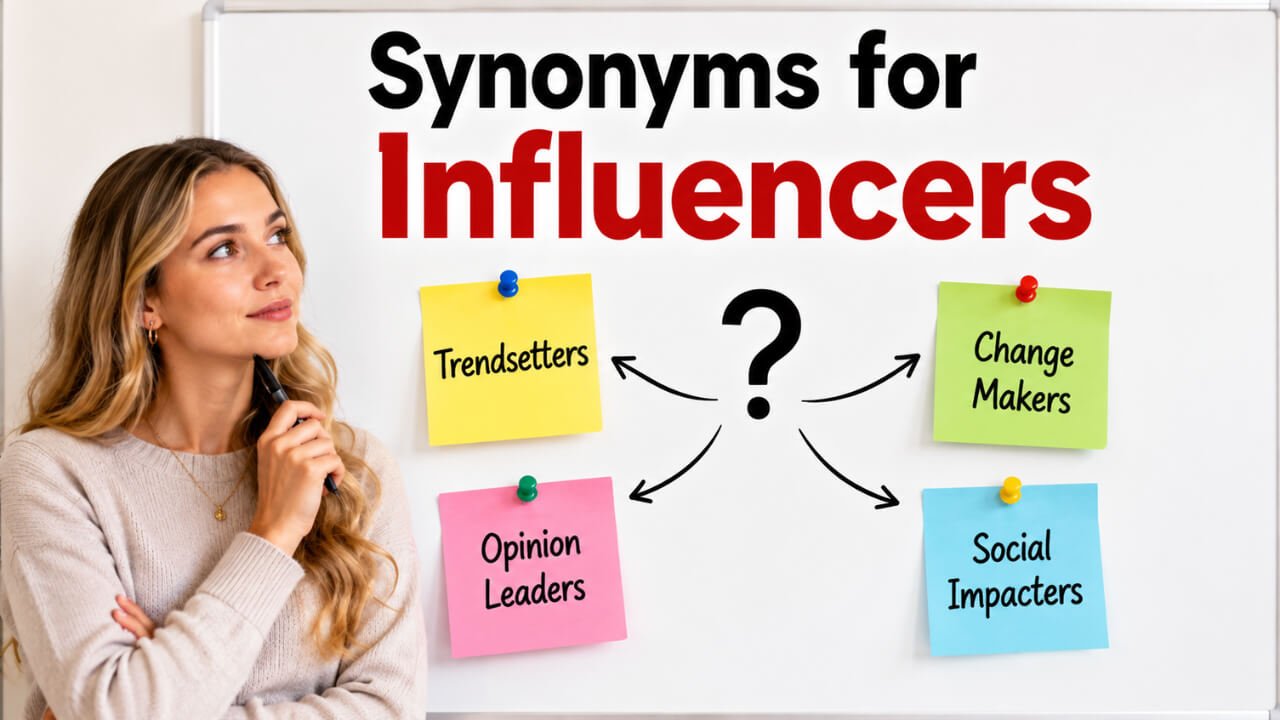
Quick Answer: Common synonyms for influencers include opinion leaders, trendsetters, tastemakers, persuaders, advocates, promoters, mentors, role models, thought leaders, and key figures. The best choice depends on context. Use opinion leaders or thought leaders in formal and professional writing. Use trendsetters or tastemakers for fashion, culture, style, and consumer preferences. Use persuaders when emphasizing the ability to change decisions. Use advocates for people who actively support a cause, while mentors and role models work better when influence comes through guidance or example.
Pronunciation and Word Details
Word: Influencers.
Pronunciation: /ˈɪnfluənsərz/
Part of Speech: Plural noun.
Meaning: People who affect the opinions, behavior, choices, attitudes, or actions of other people.
US Pronunciation:
UK Pronunciation:
What Does “Influencers” Mean?
Influencers are people who have the ability to affect what others think, believe, choose, discuss, or do.
The word is a plural noun. The singular form is influencer. An influencer may shape opinions through expertise, reputation, leadership, personal example, communication, popularity, authority, or a trusted relationship with other people.
Influencers can exist in many areas. A respected expert may influence professional decisions. A trendsetter may shape clothing or design preferences. A mentor may influence someone’s career direction. An advocate may influence public attitudes toward an issue.
The word does not always describe people who actively try to persuade others. Sometimes a person becomes influential simply because others admire, trust, follow, or learn from that person.
General Context: Influencers are people who shape opinions or behavior.
Professional Context: Influencers may be experts, leaders, advisors, decision makers, or respected voices.
Cultural Context: Influencers may be trendsetters, tastemakers, icons, or style leaders.
Personal Context: Influencers may include mentors, teachers, role models, advisors, or guides.
Persuasive Context: Influencers may be advocates, promoters, campaigners, or persuaders.
Meaning, Tone, and Context of “Influencers”
Influencers is generally a neutral and widely understood word. Its tone changes depending on the context in which it appears.
In everyday conversation, influencers often describes people whose opinions or recommendations attract attention and affect the choices of others.
In business or professional writing, the term can refer to people who influence decisions even when they do not have formal authority. Such people may be advisors, specialists, senior employees, respected colleagues, or industry experts.
In academic or analytical writing, more precise alternatives such as opinion leaders, thought leaders, key figures, advocates, or influential individuals may sound more appropriate.
In cultural discussions, trendsetters and tastemakers are useful when the influence involves style, entertainment, design, food, fashion, or popular preferences.
In personal development, mentor, guide, and role model are better when the influence is based on advice, experience, example, or encouragement.
Tone: Usually neutral, but the surrounding context can make it positive, critical, professional, or promotional.
Formality: Suitable for general communication, although more specific synonyms may improve formal writing.
Common Use: Communication, leadership, culture, business, marketing, education, public discussion, personal development, and consumer behavior.
Main Idea: An influencer affects the thinking, preferences, or actions of other people.
When and How to Use “Influencers”
Use influencers when you want to describe people who have noticeable power to shape opinions, preferences, behavior, or decisions.
For Public Opinion: Use influencers when certain people affect what large groups think or discuss.
Example: Community influencers helped residents understand the importance of the new initiative.
For Consumer Choices: Use the word when people can affect purchasing preferences or product awareness.
Example: Industry influencers can strongly affect how customers view emerging products.
For Cultural Trends: Use influencers when people help introduce, spread, or popularize styles and ideas.
Example: Several cultural influencers helped make the artistic style more widely recognized.
For Professional Decisions: Use influencers for people who affect workplace or industry decisions without necessarily having final authority.
Example: Senior advisors and technical specialists were important influencers in the final decision.
For Personal Development: Use the word when someone’s ideas, example, or guidance shapes another person’s growth.
Example: Her teachers were major influencers during the early stages of her career.
For Leadership: Use influencers when respected individuals motivate others to support a direction or idea.
Example: Effective influencers within the organization encouraged employees to accept the proposed changes.
Best Synonyms for Influencers
Opinion Leaders
Synonym: Opinion leaders are respected people whose views affect how others think about topics, issues, or decisions.
Example: Local opinion leaders helped shape public understanding of the proposal.
Trendsetters
Synonym: Trendsetters are people who introduce or popularize new styles, habits, ideas, or preferences.
Example: Young designers became trendsetters in contemporary interior style.
Tastemakers
Synonym: Tastemakers are people whose preferences influence what others consider attractive, fashionable, desirable, or culturally important.
Example: Several respected tastemakers brought attention to the emerging artistic movement.
Persuaders
Synonym: Persuaders are people who successfully encourage others to change opinions, choices, or actions.
Example: Skilled persuaders can make complicated ideas easier for audiences to accept.
Advocates
Synonym: Advocates are people who publicly support or defend a cause, policy, idea, or group.
Example: Education advocates encouraged greater investment in local schools.
Promoters
Synonym: Promoters are people who actively encourage interest in an idea, activity, product, event, or cause.
Example: The promoters helped increase awareness of the community project.
Mentors
Synonym: Mentors are experienced people who influence others through advice, support, knowledge, and guidance.
Example: Experienced mentors helped the new employees develop stronger professional skills.
Role Models
Synonym: Role models are people whose behavior, qualities, or achievements encourage others to follow their example.
Example: Successful graduates often become role models for younger students.
Thought Leaders
Synonym: Thought leaders are respected experts whose ideas influence professional or intellectual discussion.
Example: Several thought leaders introduced new approaches to workplace learning.
Key Figures
Synonym: Key figures are important people who have significant influence within a group, field, movement, or situation.
Example: The report examined several key figures who shaped the development of the industry.
50 Synonyms for Influencers with Short Meanings
- Opinion Leaders: People whose views strongly affect the opinions of others.
- Trendsetters: People who introduce or popularize new trends.
- Tastemakers: People who shape cultural, artistic, or consumer preferences.
- Persuaders: People skilled at changing opinions or encouraging action.
- Advocates: People who actively support a cause, idea, or position.
- Promoters: People who encourage interest in something.
- Mentors: Experienced people who influence others through guidance.
- Role Models: People whose behavior encourages others to imitate them.
- Thought Leaders: Experts whose ideas influence professional or intellectual discussion.
- Key Figures: Important people with significant influence in a situation or field.
- Leaders: People who guide, direct, or inspire others.
- Guides: People who influence others by providing direction or advice.
- Advisors: People who affect decisions through recommendations and expertise.
- Authorities: Recognized experts whose knowledge gives their opinions influence.
- Experts: Highly knowledgeable people whose views can shape decisions.
- Spokespeople: People who communicate ideas or positions for a group.
- Champions: Strong supporters who actively encourage acceptance of an idea or cause.
- Campaigners: People who work actively to influence support for a particular objective.
- Supporters: People who encourage or endorse an idea, person, or cause.
- Endorsers: People whose approval can affect how others view something.
- Ambassadors: Representatives who create positive awareness and understanding.
- Motivators: People who encourage others to take action or improve.
- Inspirers: People who stimulate ideas, ambition, confidence, or action.
- Catalysts: People who help cause or accelerate change.
- Change Makers: People who actively create or encourage meaningful change.
- Movers: People who have enough influence to make important things happen.
- Power Brokers: People who influence important decisions through relationships or authority.
- Decision Makers: People with the authority to determine outcomes.
- Opinion Shapers: People who help form or alter the opinions of others.
- Culture Shapers: People who affect cultural attitudes, habits, or preferences.
- Style Leaders: People whose choices influence fashion or visual preferences.
- Pacesetters: People who establish standards or directions that others follow.
- Pathfinders: People who introduce new approaches that others later adopt.
- Pioneers: People who introduce new ideas, methods, or directions.
- Forerunners: People who appear early in a movement or development and influence what follows.
- Authorities in the Field: Recognized specialists whose views carry professional weight.
- Trusted Voices: People whose opinions are accepted because others consider them reliable.
- Respected Voices: People whose statements receive attention because of reputation or experience.
- Public Figures: Widely recognized people whose actions or opinions may influence others.
- Leading Voices: Prominent people who strongly represent or shape discussion.
- Key Players: Important participants who affect decisions or outcomes.
- Major Figures: Prominent individuals with substantial importance or influence.
- Opinion Makers: People who contribute strongly to forming public or group opinion.
- Image Makers: People who help shape how individuals, ideas, or organizations are perceived.
- Communicators: People who influence others by presenting ideas effectively.
- Educators: People who shape knowledge, attitudes, and understanding through teaching.
- Teachers: People who influence learning, thinking, behavior, and development.
- Counselors: People who influence choices by providing advice and support.
- Strategists: People whose planning and advice can shape decisions and direction.
- Persuasive Voices: People whose communication strongly affects opinions or choices.
Read Also:
Synonyms for Necessity

Synonyms for Influencers by Context
When Influencers Means People Who Shape Opinions
Opinion leaders, opinion shapers, opinion makers, trusted voices, respected voices, leading voices, and thought leaders work well when the focus is on ideas and beliefs.
Example: Respected opinion leaders helped people understand the issue from several perspectives.
These alternatives are especially useful in reports, essays, professional communication, and discussions about public attitudes.
When Influencers Means People Who Create Trends
Trendsetters, tastemakers, style leaders, pacesetters, culture shapers, pioneers, and forerunners are useful when someone affects fashion, design, culture, habits, or popular preferences.
Example: The young artists quickly became tastemakers in contemporary design.
Trendsetter emphasizes being among the first to establish a trend. Tastemaker focuses more on influencing what other people consider desirable or stylish.
When Influencers Means People Who Persuade Others
Persuaders, advocates, promoters, campaigners, champions, endorsers, and persuasive voices work when deliberate persuasion is the main idea.
Example: Skilled advocates persuaded local residents to support the environmental initiative.
Persuader is general. Advocate usually involves support for an issue or cause. Promoter emphasizes increasing attention or interest.
When Influencers Means Professional Experts
Thought leaders, experts, authorities, advisors, strategists, authorities in the field, and leading voices fit professional or academic settings.
Example: Industry thought leaders discussed how new methods could improve productivity.
These choices often sound more precise than influencers in reports, essays, research discussions, and professional communication.
When Influencers Means People Who Guide Others
Mentors, role models, guides, teachers, educators, counselors, motivators, and inspirers are better when influence happens through learning, personal example, encouragement, or advice.
Example: Her mentors influenced the way she approached leadership and teamwork.
Mentor suggests direct guidance, while role model suggests influence through behavior or achievement.
When Influencers Means Powerful People
Leaders, key figures, major figures, power brokers, decision makers, key players, and movers are useful when influence is connected with authority, status, networks, or control.
Example: Several key figures influenced the direction of the negotiations.
These terms are especially useful when describing organizations, industries, institutions, or important decisions.
Another Word for Influencers
Another word for influencers is opinion leaders, especially when describing people who shape how others think about an issue, idea, product, or trend.
However, no single synonym works perfectly in every context. Trendsetters is better for style and culture. Thought leaders is stronger for professional expertise. Mentors is more accurate for personal guidance. Advocates works when people actively support a cause.
Original: Influencers helped shape public attitudes toward the program.
Better Option: Opinion leaders helped shape public attitudes toward the program.
Original: Influencers introduced several new design ideas.
Better Option: Trendsetters introduced several new design ideas.
Original: The conference included respected influencers from the field.
Better Option: The conference included respected thought leaders from the field.
Original: Several influencers helped younger employees develop confidence.
Better Option: Several mentors helped younger employees develop confidence.
When Not to Use “Influencers”
Influencers is useful, but it can sometimes be too broad. Avoid it when a more specific word clearly explains how a person has influence.
If someone has formal authority, leader or decision maker may be clearer. If someone influences others through expertise, expert or thought leader may be more accurate. If the influence comes from personal guidance, mentor is stronger.
The word may also sound repetitive when used several times in the same paragraph.
Weak: The influencers spoke with other influencers about how influencers could influence customer preferences.
Better: The opinion leaders spoke with industry experts about how trusted voices could shape customer preferences.
Avoid influencers when you actually mean celebrities, leaders, advisors, experts, or promoters and those distinctions matter.
Weak: The company consulted several influencers before changing its technical process.
Better: The company consulted several technical experts before changing its process.
The second sentence explains why these people mattered.
Weak: Her father was one of the strongest influencers in her personal development.
Better: Her father was one of the strongest role models in her personal development.
Role model gives the reader a clearer picture of the relationship.
Words Commonly Confused With Influencers
Influencers vs Leaders: Influencers shape attitudes or behavior, while leaders usually have responsibility for guiding or directing people. A leader can be an influencer, but an influencer does not need an official leadership position.
Influencers vs Celebrities: Celebrities are widely recognized people. Influencers are defined by their ability to affect opinions or behavior. A famous person may have influence, but fame and influence are not identical.
Influencers vs Advocates: Influencers may affect many kinds of choices, while advocates actively support a specific cause, policy, person, or position.
Influencers vs Promoters: Influencers affect attitudes or preferences. Promoters deliberately increase awareness or interest in something.
Influencers vs Thought Leaders: Influencers is a broad term. Thought leaders usually influence people through expertise, ideas, research, professional knowledge, or intellectual authority.
Influencers vs Trendsetters: Influencers may shape many kinds of decisions. Trendsetters specifically influence new styles, behaviors, cultural preferences, or emerging trends.
Influencers vs Mentors: Influencers can affect people from a distance. Mentors normally have a more direct relationship involving advice, guidance, and development.
Which Synonym Should You Choose?
Choose opinion leaders when describing people who shape beliefs, attitudes, or public discussion.
Choose thought leaders for experts whose ideas influence professional, academic, or industry conversations.
Choose trendsetters when discussing people who introduce or popularize styles, habits, preferences, or cultural trends.
Choose tastemakers when the influence involves taste, design, fashion, entertainment, art, food, or cultural preferences.
Choose persuaders when the person’s main role is convincing others to change their opinions or actions.
Choose advocates when people actively support an issue, cause, policy, or community.
Choose promoters when someone actively creates interest, awareness, or attention.
Choose mentors when people influence others through personal guidance and experience.
Choose role models when influence comes from behavior, achievements, character, or example.
Choose key figures when writing formally about important people within an organization, movement, industry, or historical situation.
Choose decision makers when the people actually have authority to approve or reject something.
Choose experts when knowledge and professional credibility are the reason their opinions matter.
For essays and reports, thought leaders, opinion leaders, experts, key figures, and advocates are often precise choices.
For everyday conversation, leaders, trendsetters, mentors, role models, and influential people usually sound natural.
Real Life Examples of “Influencers” in Sentences
Original: Several influencers encouraged people to support the community project.
Better Option: Several advocates encouraged people to support the community project.
Original: Influencers introduced new ideas that changed interior design preferences.
Better Option: Trendsetters introduced new ideas that changed interior design preferences.
Original: The organization invited influencers to discuss emerging industry practices.
Better Option: The organization invited thought leaders to discuss emerging industry practices.
Original: Teachers are important influencers in a child’s early development.
Better Option: Teachers are important role models in a child’s early development.
Original: Local influencers helped residents understand the proposal.
Better Option: Local opinion leaders helped residents understand the proposal.
Original: The manager identified several influencers who could help employees accept the changes.
Better Option: The manager identified several key figures who could help employees accept the changes.
Original: Influencers helped younger workers develop stronger professional habits.
Better Option: Mentors helped younger workers develop stronger professional habits.
Original: Cultural influencers shaped what audiences considered fashionable.
Better Option: Tastemakers shaped what audiences considered fashionable.
Original: Influencers played an important role in changing public attitudes.
Better Option: Opinion shapers played an important role in changing public attitudes.
Original: The researchers interviewed influencers from several professional fields.
Better Option: The researchers interviewed leading voices from several professional fields.
Synonym Groups and Usage Differences
Opinion and Public Discussion Group
Opinion leaders, opinion shapers, opinion makers, trusted voices, respected voices, and leading voices belong to this group.
These terms describe people whose views affect the way others understand an issue or form opinions.
Example: Trusted voices helped explain the policy in language that local residents could understand.
Opinion leader is usually the strongest general alternative when the focus is influence over beliefs or attitudes.
Trend and Culture Group
Trendsetters, tastemakers, culture shapers, style leaders, pacesetters, pioneers, and forerunners belong to this group.
They describe people who influence what becomes popular, fashionable, accepted, or culturally important.
Example: The designers became tastemakers whose preferences influenced an entire generation of artists.
Trendsetter emphasizes starting trends, while tastemaker emphasizes influencing preferences.
Persuasion Group
Persuaders, advocates, promoters, campaigners, champions, endorsers, and persuasive voices belong to this group.
These words focus on encouraging people to support, accept, purchase, consider, or participate in something.
Example: Community advocates persuaded officials to consider the concerns of residents.
Advocate is usually connected to active support, while persuader focuses directly on changing someone’s mind.
Expertise Group
Thought leaders, experts, authorities, advisors, strategists, and authorities in the field belong to this group.
They influence other people because their knowledge, experience, or professional judgment is respected.
Example: Technical experts helped shape the organization’s long term strategy.
Thought leader emphasizes ideas, while expert emphasizes specialized knowledge.
Guidance Group
Mentors, role models, teachers, educators, guides, counselors, motivators, and inspirers belong to this group.
These people influence others through advice, example, encouragement, education, or personal development.
Example: Experienced mentors helped new employees build confidence and professional judgment.
Mentor normally suggests a direct developmental relationship.
Power and Decision Group
Leaders, key figures, key players, major figures, power brokers, decision makers, and movers belong to this group.
These words emphasize influence through authority, position, connections, reputation, or control over important decisions.
Example: Key decision makers met to determine the future direction of the project.
Decision maker is the most precise term when a person has actual authority over an outcome.
Antonyms of Influencers
There is no single exact antonym for influencers because influence can involve authority, persuasion, popularity, expertise, or personal example. However, several words express contrasting roles.
Antonym: Followers. People who accept or follow the direction, ideas, or example of others.
Antonym: Observers. People who watch events without actively shaping them.
Antonym: Spectators. People who witness an activity rather than affecting its direction.
Antonym: Bystanders. People who are present but do not actively participate or influence events.
Antonym: Outsiders. People who are not closely involved in a group or decision process.
Antonym: Nonparticipants. People who do not take part in an activity or process.
Antonym: Unknowns. People who have little public recognition or established influence.
Antonym: Subordinates. People who hold lower positions and may have less formal decision authority.
The best opposite depends on context. Followers contrasts with influencers when discussing leadership or trends, while observers or bystanders works better when discussing participation.
Comparison: Influencers vs Related Words
Influencers vs Opinion Leaders
Influencers is broader. Opinion leaders specifically shape what other people think or believe.
Example With Influencers: Several influencers affected customer preferences during the campaign.
Example With Opinion Leaders: Several opinion leaders changed how residents viewed the proposed policy.
Influencers vs Thought Leaders
Influencers may gain attention through reputation, popularity, personality, expertise, or relationships. Thought leaders primarily influence people through knowledge and original ideas.
Example With Influencers: The event attracted influencers from several industries.
Example With Thought Leaders: The event attracted thought leaders known for developing new management ideas.
Influencers vs Trendsetters
Influencers can affect opinions or actions in almost any area. Trendsetters specifically lead emerging trends.
Example With Influencers: Influencers helped change consumer attitudes.
Example With Trendsetters: Trendsetters introduced styles that quickly became popular.
Influencers vs Tastemakers
Influencers is general, while tastemakers are especially associated with preferences, style, art, design, entertainment, food, and culture.
Example With Influencers: Influencers affected what audiences discussed.
Example With Tastemakers: Tastemakers influenced which artistic styles gained attention.
Influencers vs Advocates
Influencers may or may not deliberately support a specific position. Advocates intentionally speak or act in support of something.
Example With Influencers: Influencers affected opinions about the initiative.
Example With Advocates: Advocates publicly defended the initiative and encouraged others to support it.
Influencers vs Mentors
Influencers can affect people without having a personal relationship with them. Mentors usually provide direct advice, guidance, and support.
Example With Influencers: Several writers became important influencers in his thinking.
Example With Mentors: His mentors helped him develop practical leadership skills.
Influencers vs Role Models
Influencers shape choices or opinions. Role models influence through behavior, achievements, or personal qualities that others admire.
Example With Influencers: Influencers affected her interest in entrepreneurship.
Example With Role Models: Successful entrepreneurs became role models for younger professionals.
Common Phrases and Expressions With Influencers
Key Influencers: People who have particularly strong influence over opinions or decisions.
Industry Influencers: People who have significant influence within a particular professional field.
Local Influencers: People who shape attitudes or behavior within a local community.
Cultural Influencers: People who help shape cultural preferences, ideas, values, or trends.
Major Influencers: People whose influence is especially significant.
Powerful Influencers: People who can strongly affect decisions, opinions, or behavior.
Trusted Influencers: People whose influence comes from credibility and trust.
Leading Influencers: Prominent people who have strong influence within a specific area.
Key Decision Influencers: People who affect an important decision even if they do not make the final choice.
Positive Influencers: People who encourage constructive behavior, attitudes, or decisions.
Common Mistakes to Avoid
One common mistake is using influencers for every person who is popular or visible. Popularity does not automatically mean that a person meaningfully affects the opinions or behavior of others.
Another mistake is using influencers when a more precise role is known. If someone provides professional expertise, expert may be stronger. If the person guides someone personally, mentor is clearer. If the person introduces cultural trends, trendsetter may communicate the idea more accurately.
Avoid repeating influencers several times within a short paragraph. Replace repeated uses with appropriate synonyms when the meaning remains clear.
Repetitive: The influencers met other influencers to discuss how influencers affect public opinion.
Improved: The opinion leaders met industry experts to discuss how influential voices affect public opinion.
Do not assume all synonyms are interchangeable. Advocate suggests active support. Trendsetter suggests introducing trends. Thought leader implies intellectual or professional authority. Role model focuses on influence through example.
Be careful with decision maker. An influencer may affect a decision without having final authority, while a decision maker normally has direct power to determine the outcome.
Also avoid vague phrases when the type of influence is important.
Vague: Several influencers were involved in the project.
Clearer: Several technical advisors and community leaders were involved in the project.
Choosing a specific synonym usually makes writing clearer, more informative, and more professional.
Conclusion
Synonyms for influencers include opinion leaders, trendsetters, tastemakers, thought leaders, advocates, persuaders, mentors, role models, promoters, and key figures. The strongest replacement depends on the type of influence being described. Use opinion leaders for shaping beliefs, trendsetters for emerging styles, thought leaders for professional expertise, advocates for active support, and mentors for personal guidance. Choosing a precise alternative instead of repeatedly using influencers makes sentences clearer and helps readers understand exactly how a person affects opinions, behavior, decisions, or trends.
FAQs About Synonyms for Influencers
What are the best synonyms for influencers?
The best synonyms include opinion leaders, trendsetters, tastemakers, thought leaders, persuaders, advocates, mentors, role models, promoters, and key figures. The best choice depends on how the person creates influence.
What is another word for influencers in formal writing?
Opinion leaders, thought leaders, key figures, leading voices, and influential individuals are strong choices for formal writing. Thought leaders works especially well when the influence comes from professional expertise.
What is another word for influencers in business?
Useful business alternatives include thought leaders, industry experts, key players, decision influencers, advisors, authorities, and strategists. Choose the term that accurately describes the person’s role.
Is trendsetter a synonym for influencer?
Yes, but only in certain contexts. A trendsetter influences emerging styles, habits, or cultural preferences, while influencer has a much broader meaning.
Is opinion leader the same as influencer?
The meanings overlap, but opinion leader is more specific. An opinion leader primarily influences beliefs or attitudes, while an influencer may affect opinions, behavior, purchasing choices, trends, or decisions.
Can mentor be used instead of influencer?
Yes, when the influence comes through direct advice, guidance, experience, or personal development. Mentor is usually more precise than influencer in educational and career contexts.
What is the opposite of influencers?
Followers, observers, spectators, bystanders, and nonparticipants can function as opposites depending on context. Followers is the strongest contrast when discussing leadership, trends, or social influence.
