
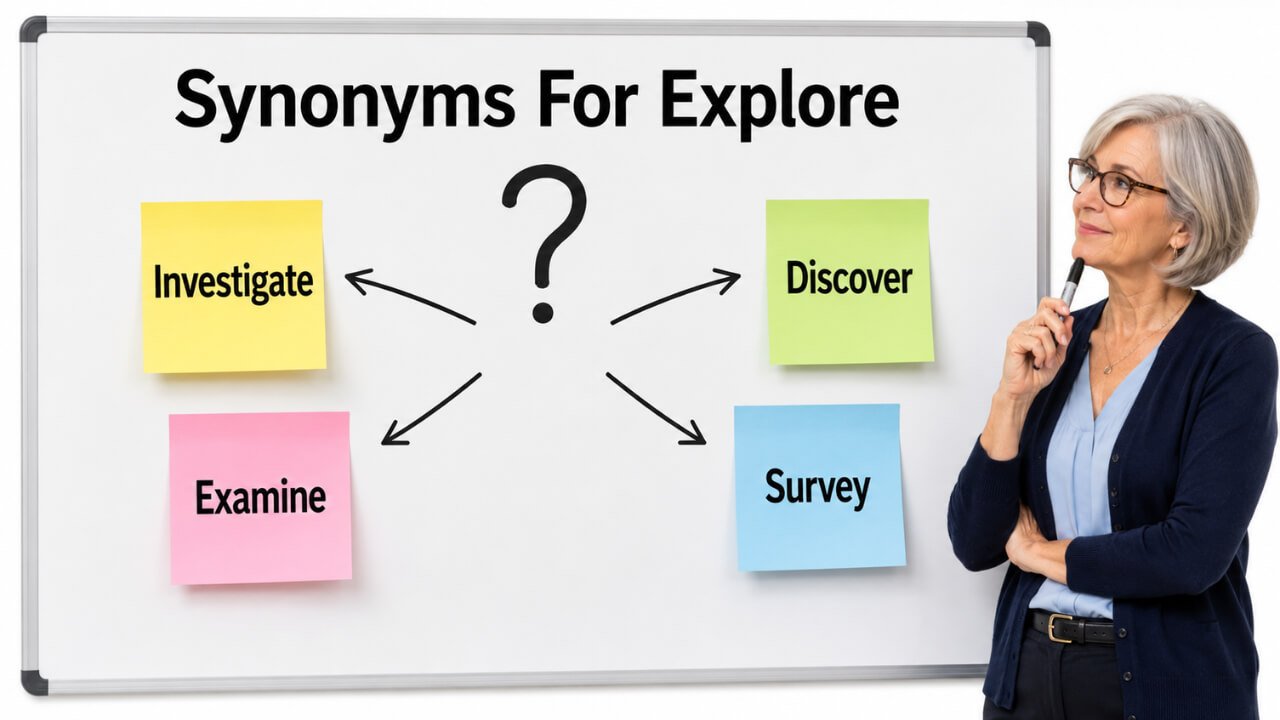
Quick Answer: The best synonyms for explore include investigate, examine, research, study, inspect, survey, discover, probe, look into, and delve into. Use investigate for facts or problems, research for academic or informational work, examine for careful observation, survey for places or broad reviews, discover for finding something new, and delve into when you want a deeper or more thoughtful tone.
Pronunciation and Word Details
Word: Explore.
Pronunciation: /ɪkˈsplɔːr/.
Part of Speech: Verb.
Meaning: To examine, search, travel through, or study something in order to learn more about it.
US Pronunciation:
UK Pronunciation:
What Does “Explore” Mean?
Explore means to look into something carefully, travel through a place, or study a subject to learn more about it. It is mainly used as a verb.
You can explore a city, an idea, a question, a career path, a problem, a theory, or a possibility. In writing, the word often suggests curiosity, learning, discovery, and open investigation.
Explore can describe physical movement, such as visiting an unknown area. It can also describe mental activity, such as thinking deeply about a topic or examining different choices.
Meaning, Tone, and Context of “Explore”
Explore has a neutral and positive tone. It sounds thoughtful, curious, and open minded. It is not too formal, but it also works well in professional, academic, and everyday writing.
In conversation, people use explore when talking about places, choices, ideas, emotions, and opportunities. In academic writing, it often means to examine a subject in detail. In business or planning contexts, it can mean to consider options before making a decision.
The word is common in travel, education, research, personal growth, science, problem solving, and creative work.
When and How to Use “Explore”
For Travel: Use explore when someone visits a place to see, learn, or experience more.
Example: We spent the afternoon exploring the old town.
For Research: Use explore when studying a topic, question, or idea.
Example: The essay explores the causes of language change.
For Options: Use explore when considering different choices before deciding.
Example: She wants to explore new career opportunities.
For Ideas: Use explore when thinking about a concept in a deeper way.
Example: The discussion explored the meaning of personal success.
For Problems: Use explore when examining a problem to understand its causes or solutions.
Example: The team explored several ways to improve the process.
For Feelings: Use explore when reflecting on emotions, thoughts, or personal experiences.
Example: He began to explore why he felt nervous before speaking.
Best Synonyms for Explore
Investigate: To search for facts, causes, or explanations.
Example: The committee will investigate the issue carefully.
Examine: To look at something closely and thoughtfully.
Example: The doctor examined the results before giving advice.
Research: To study a topic using information, evidence, and careful reading.
Example: Students researched the history of the language.
Study: To learn about a subject through focused attention.
Example: She studied the poem to understand its deeper meaning.
Inspect: To check something closely, often for quality, safety, or detail.
Example: The manager inspected the room before the guests arrived.
Survey: To look over an area, subject, or group in a broad way.
Example: The report surveyed common problems in modern writing.
Probe: To investigate deeply, especially when trying to uncover hidden facts.
Example: The questions probed the cause of the mistake.
Discover: To find or learn something new.
Example: They discovered a better method during the project.
Look into: To check or investigate something.
Example: I will look into the problem and respond soon.
Delve into: To examine a topic deeply and carefully.
Example: The article delves into the meaning of the word.
50 Synonyms for Explore with Short Meanings
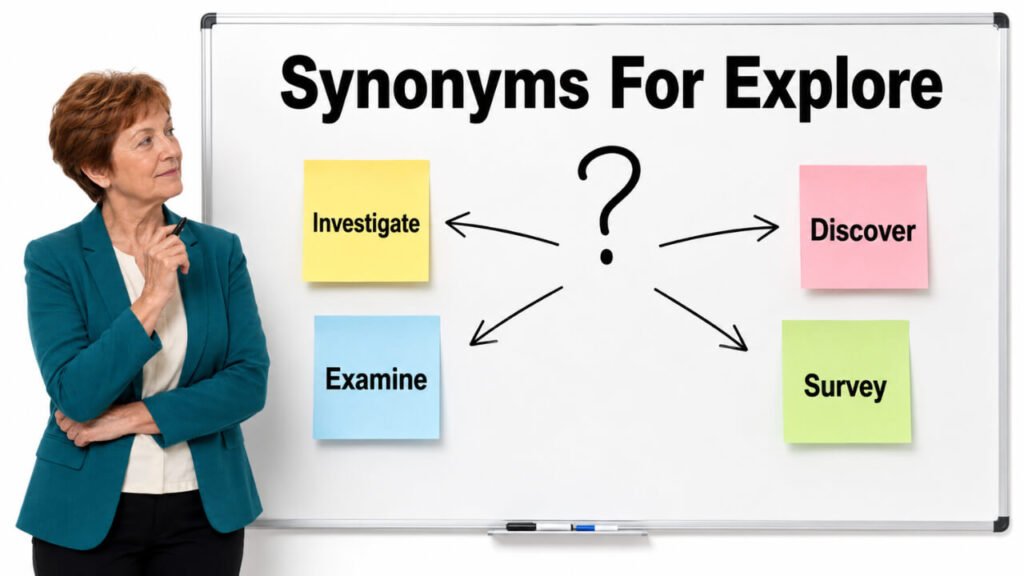
- Investigate: To search for facts or causes.
- Examine: To look at something carefully.
- Research: To study a subject using information.
- Study: To learn about something with attention.
- Inspect: To check something closely.
- Survey: To review broadly or look over.
- Probe: To investigate deeply.
- Discover: To find something new.
- Search: To look for something.
- Seek: To try to find or learn.
- Look into: To investigate or check.
- Delve into: To study deeply.
- Dig into: To examine with effort.
- Analyze: To study parts and details.
- Review: To examine again or assess.
- Assess: To judge or evaluate carefully.
- Evaluate: To decide value, quality, or importance.
- Consider: To think about carefully.
- Test: To try something to learn results.
- Try: To attempt or experience something.
- Experiment with: To test a method or idea.
- Inquire into: To ask questions about something.
- Question: To examine through asking.
- Scrutinize: To inspect very closely.
- Scout: To search an area for information.
- Tour: To travel through a place.
- Visit: To go to a place.
- Roam: To move around freely.
- Wander: To move around without a fixed path.
- Travel through: To pass across or around a place.
- Traverse: To move across an area.
- Navigate: To move through or find a way.
- Map: To record or understand an area.
- Chart: To plan, record, or trace.
- Uncover: To reveal something hidden.
- Find out: To learn information.
- Learn about: To gain knowledge of something.
- Look around: To view a place casually.
- Check out: To examine or visit casually.
- Go over: To review carefully.
- Think through: To consider fully.
- Reflect on: To think deeply about.
- Pursue: To follow an idea, path, or goal.
- Investigate further: To continue examining.
- Open up: To make an idea or possibility available.
- Trace: To follow the history or path of something.
- Follow: To track or examine a path.
- Review in detail: To examine carefully.
- Explore further: To continue learning more.
- Study closely: To examine with focused attention.
Read Also:
Synonyms for So

Synonyms for Explore by Context
When Explore Means Investigate
Use these synonyms when explore means to search for facts, causes, reasons, or evidence.
Investigate: The editor investigated the source of the error.
Probe: The questions probed the reason behind the delay.
Look into: We need to look into the complaint before deciding.
Inquire into: The report inquired into the cause of the problem.
When Explore Means Examine Carefully
Use these words when explore means to look closely at details, structure, meaning, or quality.
Examine: The teacher examined the sentence structure.
Analyze: The article analyzed the main themes of the story.
Scrutinize: The reviewer scrutinized every detail of the document.
Inspect: The worker inspected the equipment before use.
When Explore Means Research
Use these synonyms when explore means to study a subject for knowledge, evidence, or understanding.
Research: The class researched different writing styles.
Study: She studied the topic before writing her answer.
Review: The writer reviewed several arguments before forming a conclusion.
Delve into: The book delves into the development of modern grammar.
When Explore Means Travel
Use these words when explore means to move through a place to experience or learn about it.
Tour: They toured the old buildings in the city.
Roam: The children roamed through the garden.
Traverse: The hikers traversed the valley before sunset.
Navigate: He learned to navigate the narrow streets.
When Explore Means Consider Options
Use these synonyms when explore means to think about choices, possibilities, plans, or solutions.
Consider: We should consider other ways to solve the issue.
Evaluate: The team evaluated several possible approaches.
Assess: She assessed the risks before making a decision.
Think through: He thought through each option carefully.
Another Word for Explore
Investigate is often the best single replacement for explore when you mean to examine facts, causes, or details. However, the best alternative depends on context. Use research for academic study, examine for close observation, tour for travel, and consider for options or possibilities.
Original: The article explores the effect of word choice on meaning.
Better Option: The article examines the effect of word choice on meaning.
Original: We explored several solutions during the meeting.
Better Option: We considered several solutions during the meeting.
Original: They explored the city after breakfast.
Better Option: They toured the city after breakfast.
Original: She explored the topic before writing her essay.
Better Option: She researched the topic before writing her essay.
When Not to Use “Explore”
Do not use explore when a more exact word would make your meaning clearer. It can sound too broad if you are talking about strict research, physical inspection, legal investigation, or exact data analysis.
Avoid repeating explore many times in the same paragraph. Use a stronger synonym when the sentence needs more precision.
Weak: The report explores the problem and explores the causes.
Better: The report examines the problem and investigates the causes.
Weak: The mechanic explored the engine.
Better: The mechanic inspected the engine.
Weak: The student explored facts for the assignment.
Better: The student researched facts for the assignment.
Weak: We explored the numbers in the table.
Better: We analyzed the numbers in the table.
Words Commonly Confused With Explore
Explore vs Discover: Explore means to search, examine, or travel in order to learn. Discover means to find something new or previously unknown.
Explore vs Investigate: Explore is broader and can be curious or open ended. Investigate is more focused on facts, causes, evidence, or problems.
Explore vs Research: Explore can mean study, travel, or consider. Research means to study a topic carefully using information and evidence.
Explore vs Examine: Explore suggests learning through searching or considering. Examine suggests looking closely at details.
Explore vs Search: Search means to look for something specific. Explore can mean to look around, study broadly, or consider possibilities.
Explore vs Analyze: Explore means to look into a topic or possibility. Analyze means to break something into parts and study how those parts work.
Which Synonym Should You Choose?
Choose investigate when writing about facts, causes, problems, complaints, or evidence.
Choose examine when writing about close observation, details, meaning, structure, or condition.
Choose research when writing about study, essays, reports, academic topics, or information gathering.
Choose analyze when writing about data, results, patterns, arguments, or complex details.
Choose survey when writing about a broad view of a topic, place, group, or area.
Choose tour when writing about visiting a place for experience or learning.
Choose consider when writing about choices, plans, possibilities, or decisions.
Choose delve into when you want a deeper, more thoughtful, or more detailed tone.
Choose look into for casual or everyday writing about checking an issue.
Choose probe when the sentence needs a stronger sense of deep questioning or investigation.
Real Life Examples of “Explore” in Sentences
Original: We explored the old market during our trip.
Better Option: We toured the old market during our trip.
Original: The essay explores the role of memory in storytelling.
Better Option: The essay examines the role of memory in storytelling.
Original: The team explored why the project was delayed.
Better Option: The team investigated why the project was delayed.
Original: She wants to explore new career paths.
Better Option: She wants to consider new career paths.
Original: The class explored the meaning of the poem.
Better Option: The class analyzed the meaning of the poem.
Original: We explored several ways to reduce errors.
Better Option: We evaluated several ways to reduce errors.
Original: The guide helped visitors explore the museum.
Better Option: The guide helped visitors tour the museum.
Original: The report explores customer feedback.
Better Option: The report reviews customer feedback.
Original: He explored the idea before sharing his opinion.
Better Option: He thought through the idea before sharing his opinion.
Original: Scientists explored the possible causes of the change.
Better Option: Scientists researched the possible causes of the change.
Synonym Groups and Usage Differences
Research Group
This group includes research, study, review, and delve into. Use these words when the focus is learning, reading, or gaining knowledge.
Example: The writer researched the topic before forming an argument.
Investigation Group
This group includes investigate, probe, look into, and inquire into. Use these words when the focus is finding facts, causes, or explanations.
Example: The manager investigated the reason for the mistake.
Examination Group
This group includes examine, inspect, scrutinize, and analyze. Use these words when the focus is careful attention to detail.
Example: The editor scrutinized the paragraph for unclear wording.
Travel Group
This group includes tour, roam, wander, traverse, and navigate. Use these words when the focus is moving through a place.
Example: The travelers roamed through the village in the evening.
Possibility Group
This group includes consider, evaluate, assess, and think through. Use these words when the focus is choices, plans, or future action.
Example: The group evaluated several ideas before choosing one.
Antonyms of Explore
Ignore: To pay no attention to something.
Avoid: To stay away from something.
Neglect: To fail to give attention or care.
Overlook: To miss or fail to notice something.
Disregard: To treat something as unimportant.
Dismiss: To reject without much thought.
Abandon: To stop following or considering something.
Leave: To go away from a place or stop dealing with something.
Hide: To keep something from being seen or found.
Conceal: To keep information or details secret.
Comparison: Explore vs Related Words
Explore vs Investigate
Explore is broad and can mean to study, travel, or consider. Investigate is more focused and usually means to search for facts, causes, or proof.
Example With Explore: The article explores different reasons for the change.
Example With Investigate: The article investigates the main cause of the change.
Explore vs Examine
Explore suggests a process of learning or discovery. Examine means to look closely at something.
Example With Explore: The course explores modern grammar patterns.
Example With Examine: The course examines modern grammar patterns in detail.
Explore vs Research
Explore can be general, creative, or open ended. Research is more formal and usually involves collecting information.
Example With Explore: She explored the topic before choosing a title.
Example With Research: She researched the topic before writing the report.
Explore vs Discover
Explore is the action of searching or learning. Discover is the result of finding something.
Example With Explore: They explored the forest trail.
Example With Discover: They discovered a quiet lake near the trail.
Explore vs Search
Explore can mean to look around broadly. Search usually means to look for something specific.
Example With Explore: We explored the area after lunch.
Example With Search: We searched the area for the missing keys.
Explore vs Analyze
Explore means to look into a topic, idea, or place. Analyze means to study parts, patterns, causes, or results.
Example With Explore: The speaker explored the problem in simple terms.
Example With Analyze: The speaker analyzed the problem using clear evidence.
Common Phrases and Expressions With Explore
Explore Options: To consider different choices.
Explore Ideas: To think about possible concepts or plans.
Explore a Topic: To study or discuss a subject.
Explore Further: To continue learning or investigating.
Explore in Detail: To examine something carefully.
Explore Possibilities: To consider what could happen or be done.
Explore a Place: To visit and learn about an area.
Explore the Evidence: To examine facts or proof.
Explore New Ways: To consider fresh methods or approaches.
Explore the Meaning: To study what something means.
Common Mistakes to Avoid
One common mistake is using explore when the sentence needs a more exact word. For example, use inspect for checking physical condition, analyze for data, and research for study.
Another mistake is repeating explore too often. Repetition can make writing sound flat. Replace repeated uses with examine, investigate, consider, or delve into when they fit.
Writers also confuse explore with discover. Exploring is the process. Discovering is the result.
Avoid using casual phrases such as check out in formal writing when examine, review, or investigate would sound more precise.
Also avoid vague phrasing. Instead of saying someone explored something, explain whether they studied it, traveled through it, tested it, reviewed it, or considered it.
Conclusion
The keyword synonyms for explore covers many useful alternatives because explore can mean to travel, study, examine, investigate, or consider. The best synonym depends on context. Use research for study, investigate for facts, examine for details, tour for travel, analyze for data, and consider for choices. Strong synonym choice makes your writing clearer, more natural, and more accurate for readers.
FAQs About Synonyms for Explore
What is the best synonym for explore?
The best synonym for explore is often investigate when you mean to look into facts or causes. For study, use research. For travel, use tour.
What is another word for explore in an essay?
In an essay, good alternatives include examine, analyze, research, study, and discuss. Choose the word that matches your exact purpose.
What is a formal synonym for explore?
Formal synonyms for explore include investigate, examine, analyze, research, evaluate, and inquire into.
What is a casual synonym for explore?
Casual alternatives include look into, check out, look around, and dig into. These work well in everyday speech.
Is discover the same as explore?
No. Explore means to search, study, or travel to learn more. Discover means to find something new as a result.
Can explore mean consider?
Yes. Explore can mean consider when talking about options, possibilities, plans, or ideas.
What is the opposite of explore?
Common opposites of explore include ignore, avoid, neglect, overlook, dismiss, and disregard.
