
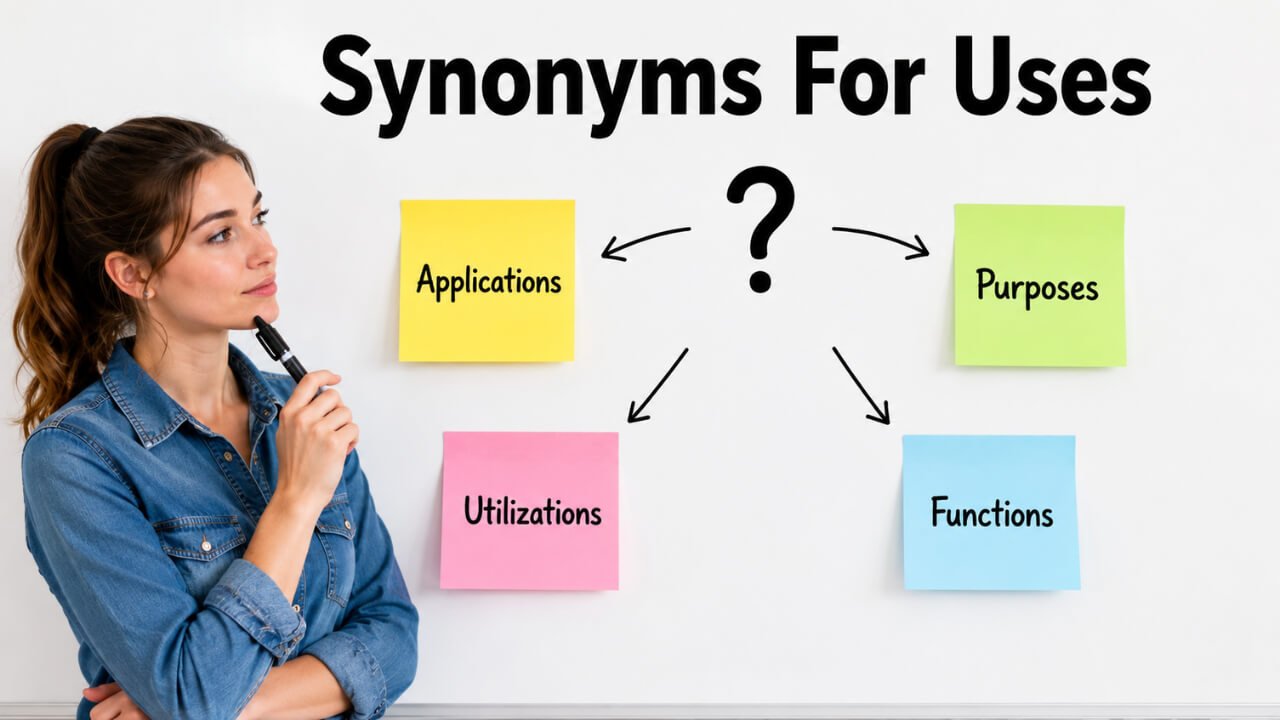
Quick Answer: The best synonyms for uses include applications, functions, purposes, roles, employs, utilizes, applies, operates, benefits, and advantages. Use applications for practical purposes, functions for how something works, purposes for reasons, employs or utilizes for formal writing, applies for methods or rules, and benefits when uses means helpful results.
Pronunciation and Word Details
Word: Uses.
Pronunciation: /ˈjuːsɪz/ as a noun and /ˈjuːzɪz/ as a verb.
Part of Speech: Plural noun and verb.
Meaning: Uses means purposes, functions, or ways something is used, and it can also mean employs or applies something.
US Pronunciation:
UK Pronunciation:
What Does “Uses” Mean?
Uses means the purposes, functions, or practical ways something can be used. It can work as a plural noun, as in “the uses of water,” or as a verb, as in “she uses a dictionary.”
As a noun, uses refers to applications, purposes, benefits, roles, or functions. As a verb, uses means employs, applies, utilizes, operates, or takes advantage of something.
The meaning depends on sentence context. In grammar, vocabulary, science, education, daily life, and instructions, uses often explains what something is for or how someone applies it.
Meaning, Tone, and Context of “Uses”
Uses is a neutral and common word. It works well in casual speech, school writing, professional explanations, technical content, and simple instructions.
The tone is direct and practical. It does not sound emotional or dramatic. It is usually clear, but it can become too general if the sentence needs a more specific word like applications, functions, benefits, purposes, employs, or utilizes.
In academic and informational writing, uses often appears when explaining the value, purpose, function, or method of something. In everyday conversation, it simply tells what someone does with an object, tool, idea, method, or resource.
When and How to Use “Uses”
For Practical Purpose: Use uses when explaining what something is for.
Example: This guide explains the common uses of punctuation.
For Function: Use uses when describing how something works or what role it performs.
Example: The device has several uses in home safety.
For Method: Use uses when someone applies a tool, system, or process.
Example: The teacher uses examples to explain grammar.
For Benefits: Use uses when talking about helpful results or value.
Example: The article describes the uses of reading aloud.
For Formal Explanation: Use uses when presenting clear information in lessons, reports, or guides.
Example: The report lists the main uses of renewable energy.
For Daily Action: Use uses when describing what a person does with something.
Example: He uses a notebook to organize his ideas.
Best Synonyms for Uses
Applications: Practical ways something can be used.
Example: The lesson explains the applications of active voice.
Functions: The jobs or roles something performs.
Example: The chart shows the functions of each sentence part.
Purposes: The reasons something exists or is done.
Example: The paragraph explains the purposes of formal writing.
Roles: The parts played by someone or something.
Example: The article discusses the roles of context in meaning.
Employs: Uses something for a purpose.
Example: The writer employs clear examples to support the point.
Utilizes: Uses something effectively, often in formal writing.
Example: The method utilizes simple steps for better learning.
Applies: Puts a rule, method, or idea into action.
Example: The student applies grammar rules in each sentence.
Operates: Uses or controls a machine, tool, or system.
Example: The technician operates the equipment carefully.
Benefits: Helpful results or advantages of something.
Example: The section explains the benefits of daily practice.
Advantages: Positive uses, strengths, or helpful features.
Example: The guide describes the advantages of clear word choice.
50 Synonyms for Uses with Short Meanings
- Applications: Practical ways something is used.
- Functions: Jobs or roles something performs.
- Purposes: Reasons for using or doing something.
- Roles: Parts or duties something has.
- Employs: Uses something for a purpose.
- Utilizes: Uses something effectively.
- Applies: Puts something into action.
- Operates: Controls or works with a tool or system.
- Benefits: Helpful results or values.
- Advantages: Positive points or useful qualities.
- Functions of: Working roles of something.
- Purposes of: Reasons something is used.
- Uses for: Practical things something can do.
- Practical uses: Real life applications.
- Common uses: Regular or frequent applications.
- Main uses: Most important applications.
- Possible uses: Ways something may be used.
- Potential uses: Future or possible applications.
- Everyday uses: Ordinary daily applications.
- Uses up: Consumes or finishes something.
- Consumes: Uses resources, time, or energy.
- Spends: Uses money, time, or effort.
- Exploits: Uses something for advantage.
- Takes advantage of: Uses an opportunity or resource.
- Makes use of: Uses something available.
- Puts to use: Applies something practically.
- Handles: Uses or manages something.
- Works with: Uses something while doing a task.
- Practices: Uses a method regularly.
- Exercises: Uses a right, power, or skill.
- Implements: Uses a plan, system, or method.
- Adopts: Begins to use a method or idea.
- Follows: Uses a rule, method, or process.
- Performs with: Uses something to complete an action.
- Relies on: Uses as support or help.
- Depends on: Uses or needs for support.
- Draws on: Uses knowledge, experience, or resources.
- Refers to: Uses information for help.
- Consults: Uses a source for guidance.
- Employments: Ways something is employed.
- Utilities: Practical usefulness or services.
- Services: Useful actions or functions.
- Values: Helpful qualities or importance.
- Usefulness: The quality of being helpful.
- Relevance: Practical connection or importance.
- Importance: Value or need in a situation.
- Effects: Results of using something.
- Outcomes: Results produced by use.
- Functions as: Works in the role of something.
- Serves as: Acts as or is used as something.
Read Also:
Synonyms for Explore
Synonyms for Uses by Context
When Uses Means Applications
Use these synonyms when uses means practical ways something can be used.
Applications: The article explains the applications of strong vocabulary.
Practical Uses: The guide lists practical uses of grammar examples.
Common Uses: The lesson covers common uses of the comma.
Possible Uses: The teacher discussed possible uses of the new method.
When Uses Means Functions
Use these words when uses means what something does or how it works.
Functions: The table shows the functions of each word form.
Roles: Context has many roles in sentence meaning.
Services: The system provides several services for users.
Utilities: The tool has helpful utilities for editing text.
When Uses Means Purposes
Use these synonyms when uses means reasons, aims, or intended results.
Purposes: The paragraph explains the purposes of transition words.
Reasons: The lesson gives reasons for using active voice.
Aims: The activity has several learning aims.
Goals: The exercise has clear grammar goals.
When Uses Means Employs
Use these words when uses is a verb meaning someone applies or makes use of something.
Employs: The writer employs examples to clarify the idea.
Utilizes: The lesson utilizes simple comparisons.
Applies: The student applies the rule correctly.
Makes Use Of: The speaker makes use of short sentences for clarity.
When Uses Means Benefits
Use these synonyms when uses means helpful value, positive effects, or advantages.
Benefits: The section explains the benefits of daily reading.
Advantages: Clear grammar has many advantages in communication.
Value: The value of examples is easy to understand.
Usefulness: The usefulness of the method depends on the goal.
Another Word for Uses
Applications is often the best single replacement for uses when talking about the practical ways something can be used. However, the best choice depends on context. Use functions for how something works, purposes for reasons, employs for formal verb use, and benefits when the meaning is about helpful results.
Original: The article explains the uses of clear punctuation.
Better Option: The article explains the applications of clear punctuation.
Original: The tool has many uses in writing.
Better Option: The tool has many functions in writing.
Original: She uses examples to explain the rule.
Better Option: She employs examples to explain the rule.
Original: The guide describes the uses of daily practice.
Better Option: The guide describes the benefits of daily practice.
When Not to Use “Uses”
Do not use uses when the sentence needs a more exact word. It can sound broad when you mean applications, functions, purposes, benefits, employs, applies, or consumes.
Avoid repeating uses too often in the same paragraph. Repetition can make writing sound simple, flat, or unclear.
Weak: The article explains the uses of grammar and the uses of examples.
Better: The article explains the functions of grammar and the benefits of examples.
Weak: The machine uses a lot of power and has many uses.
Better: The machine consumes a lot of power and has many practical applications.
Weak: The writer uses a formal tone and uses strong evidence.
Better: The writer employs a formal tone and supports the argument with strong evidence.
Weak: The lesson shows the uses of the method.
Better: The lesson shows the applications of the method.
Words Commonly Confused With Uses
Uses vs Applications: Uses is general, while applications often sounds more formal and practical. Applications usually refers to real ways something can be put into action.
Uses vs Functions: Uses can mean purposes or actions, while functions means what something does or how it works.
Uses vs Purposes: Uses describes practical ways something is used, while purposes describes the reasons something exists or is done.
Uses vs Benefits: Uses means ways something can be used, while benefits means the helpful results of using it.
Uses vs Employs: Uses can be a noun or verb, while employs is a more formal verb meaning uses.
Uses vs Utilizes: Uses is simple and natural, while utilizes is more formal and can sound unnecessary if the sentence is simple.
Uses vs Consumes: Uses can mean applies or employs, while consumes means uses up resources, time, energy, or materials.
Which Synonym Should You Choose?
Choose applications when writing about practical ways something can be used.
Choose functions when explaining how something works or what job it performs.
Choose purposes when describing reasons, aims, or intended results.
Choose employs when writing formally about how a person or writer uses a method, tool, or style.
Choose utilizes when you need a formal tone, especially in reports or technical explanations.
Choose applies when writing about rules, methods, skills, or ideas being put into action.
Choose benefits when the meaning is about helpful results or positive effects.
Choose advantages when comparing positive points or strengths.
Choose consumes when talking about using up energy, time, money, space, or resources.
Choose makes use of when you want a natural phrase for using something available.
Real Life Examples of “Uses” in Sentences
Original: The article explains the uses of strong verbs.
Better Option: The article explains the applications of strong verbs.
Original: This tool has several uses for students.
Better Option: This tool has several functions for students.
Original: She uses simple examples in her lesson.
Better Option: She employs simple examples in her lesson.
Original: The device uses too much energy.
Better Option: The device consumes too much energy.
Original: The guide describes the uses of active voice.
Better Option: The guide describes the benefits of active voice.
Original: He uses the same method every time.
Better Option: He applies the same method every time.
Original: The report lists the uses of the new system.
Better Option: The report lists the applications of the new system.
Original: The speaker uses stories to explain the point.
Better Option: The speaker makes use of stories to explain the point.
Original: The machine uses water during the process.
Better Option: The machine consumes water during the process.
Original: The lesson covers the uses of each tense.
Better Option: The lesson covers the functions of each tense.
Synonym Groups and Usage Differences
Application Group
This group includes applications, practical uses, common uses, and possible uses. Use these words when explaining how something can be used in real situations.
Example: The guide explains the practical uses of sentence examples.
Function Group
This group includes functions, roles, services, and utilities. Use these words when describing what something does or how it works.
Example: The chart explains the functions of different word classes.
Purpose Group
This group includes purposes, aims, goals, and reasons. Use these words when explaining why something is used or why it exists.
Example: The paragraph describes the purposes of formal language.
Formal Verb Group
This group includes employs, utilizes, applies, and implements. Use these words when uses is a verb in formal, academic, or professional writing.
Example: The writer employs clear examples to support the explanation.
Resource Group
This group includes consumes, spends, uses up, and draws on. Use these words when describing the use of time, money, energy, materials, or knowledge.
Example: The process consumes less time than the older method.
Antonyms of Uses
Misuses: Uses something in the wrong way.
Wastes: Uses carelessly or without good result.
Ignores: Does not use or pay attention to something.
Avoids: Stays away from using something.
Rejects: Refuses to use or accept something.
Discards: Throws away or stops using something.
Abandons: Stops using or following something.
Neglects: Fails to use, care for, or consider properly.
Saves: Keeps something instead of using it.
Preserves: Protects something from being used up or damaged.
Comparison: Uses vs Related Words
Uses vs Applications
Uses is a general word for ways something is used. Applications sounds more specific and often refers to practical or real life use.
Example With Uses: The lesson explains the uses of examples in writing.
Example With Applications: The lesson explains the applications of examples in writing.
Uses vs Functions
Uses can mean practical purposes. Functions means the jobs or roles something performs.
Example With Uses: The tool has many uses in editing.
Example With Functions: The tool has many functions in editing.
Uses vs Purposes
Uses describes what something can be used for. Purposes explains why something is used or why it exists.
Example With Uses: The article lists the uses of punctuation.
Example With Purposes: The article explains the purposes of punctuation.
Uses vs Benefits
Uses means ways something can be applied. Benefits means the helpful results that come from using it.
Example With Uses: The guide describes the uses of reading practice.
Example With Benefits: The guide describes the benefits of reading practice.
Uses vs Employs
Uses is simple and common. Employs is more formal and usually describes a person, writer, method, or system using something intentionally.
Example With Uses: The writer uses short sentences.
Example With Employs: The writer employs short sentences.
Uses vs Utilizes
Uses is usually clearer in simple sentences. Utilizes sounds formal and should be used when the sentence needs a professional tone.
Example With Uses: The program uses a simple process.
Example With Utilizes: The program utilizes a simple process.
Uses vs Consumes
Uses can mean employs or applies. Consumes means uses up something such as energy, time, money, or materials.
Example With Uses: The machine uses electricity.
Example With Consumes: The machine consumes electricity.
Common Phrases and Expressions With Uses
Common Uses: Regular or frequent ways something is used.
Practical Uses: Real life applications of something.
Main Uses: The most important ways something is used.
Everyday Uses: Ordinary daily applications.
Possible Uses: Ways something may be used.
Multiple Uses: Several different applications.
Uses Of: The purposes or functions of something.
Uses For: Practical things something can be used for.
Makes Use Of: Uses something available.
Uses Up: Finishes or consumes a resource.
Common Mistakes to Avoid
A common mistake is using uses too generally when a more exact word would improve clarity. If you mean practical purposes, choose applications. If you mean how something works, choose functions. If you mean helpful results, choose benefits.
Another mistake is using utilizes too often as a formal replacement. In many simple sentences, uses sounds clearer and more natural.
Writers also confuse uses and benefits. Uses are ways to apply something. Benefits are positive results.
Avoid repeating uses in one paragraph. Replace it with applications, functions, purposes, employs, applies, or consumes when needed.
Also be careful with verb meaning and noun meaning. In “she uses a pen,” uses is a verb. In “the uses of a pen,” uses is a plural noun.
Conclusion
The keyword synonyms for uses includes many helpful alternatives because uses can work as both a noun and a verb. Choose applications for practical ways, functions for roles, purposes for reasons, employs for formal verb use, applies for methods, and benefits for helpful results. Strong word choice makes your writing clearer, more accurate, and more natural for readers.
FAQs About Synonyms for Uses
What is the best synonym for uses?
The best synonym for uses is applications when talking about practical ways something is used. As a verb, employs is often a strong formal choice.
What is another word for uses in writing?
Good alternatives include applications, functions, purposes, employs, utilizes, applies, benefits, and advantages.
Is uses a noun or a verb?
Uses can be both. It is a plural noun in “the uses of grammar” and a verb in “she uses grammar correctly.”
What is a formal synonym for uses?
Formal synonyms include applications, functions, employs, utilizes, applies, implements, and exercises.
What is a simple synonym for uses?
Simple synonyms include uses for, ways, purposes, functions, applies, and makes use of.
What is the difference between uses and benefits?
Uses means the ways something can be applied. Benefits means the good results or advantages of using it.
What is the opposite of uses?
Opposites include misuses, wastes, ignores, avoids, rejects, discards, and abandons.
