
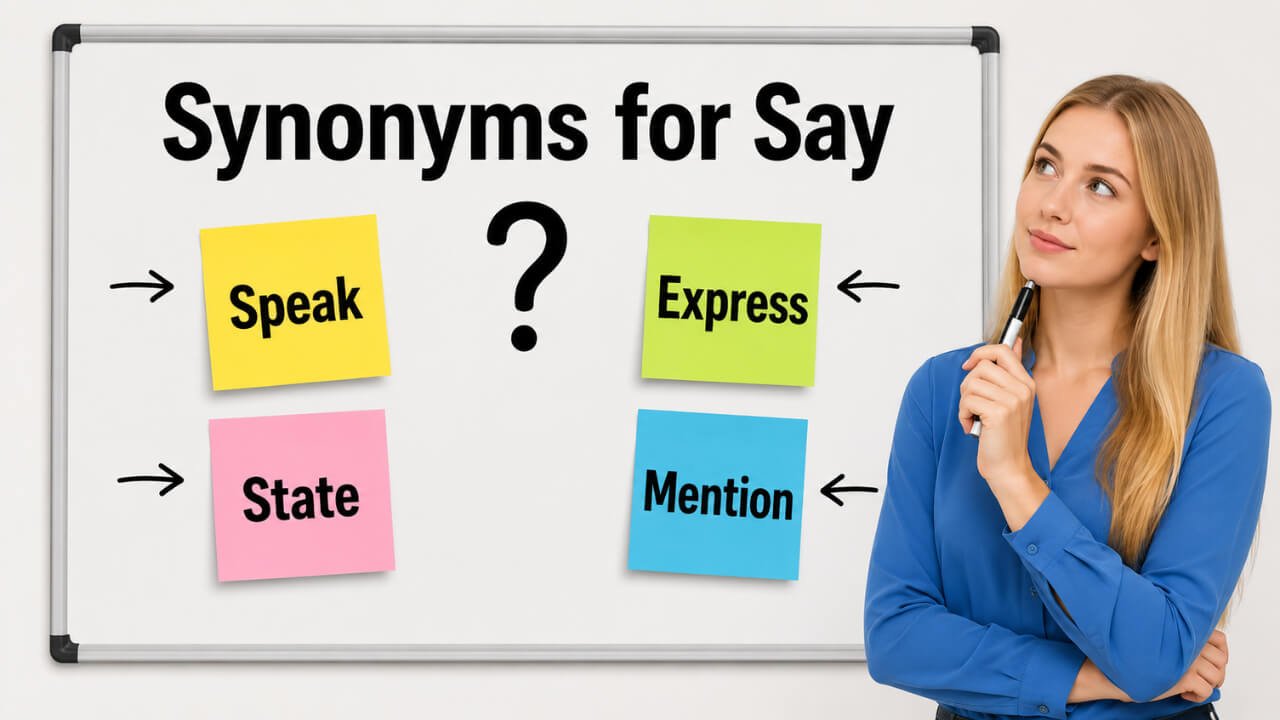
Quick Answer: The best synonyms for say include state, tell, mention, express, speak, utter, remark, declare, announce, and explain. Use state for formal writing, tell when giving information to someone, mention for brief comments, express for feelings or opinions, declare for strong official statements, and explain when making an idea clear.
Pronunciation and Word Details
Word: Say.
Pronunciation: /seɪ/
Part of Speech: Verb.
Meaning: To speak words, express an idea, give information, or communicate something.
US Pronunciation:
UK Pronunciation:
What Does “Say” Mean?
Say means to speak, express, or communicate something using words. It is mainly used as a verb and can describe spoken words, written statements, opinions, instructions, questions, or reported speech.
The word say is common in everyday communication. You can use it when someone speaks directly, gives an opinion, repeats information, or communicates a message.
Example: She said the meeting would start at noon.
In writing, say can also introduce speech or ideas.
Example: The report says the results improved this year.
Meaning, Tone, and Context of “Say”
Say is a neutral and highly common word. It works in casual speech, formal writing, stories, reports, instructions, and conversations. It is not emotional by itself, but the sentence around it can make it sound polite, serious, firm, friendly, or dramatic.
In everyday speech, say is simple and natural.
Example: What did he say?
In formal writing, stronger alternatives like state, report, declare, or explain may sound clearer.
Example: The researcher stated the conclusion clearly.
In creative writing, alternatives like whispered, muttered, shouted, or remarked can show tone, mood, and emotion more clearly than said.
When and How to Use “Say”
For Spoken Words: Use say when someone speaks aloud.
Example: He said he would call later.
For Opinions: Use say when sharing what someone thinks or believes.
Example: Many people say kindness matters in daily life.
For Written Information: Use say when a document, sign, article, or message gives information.
Example: The note says the office is closed today.
For Reported Speech: Use say when repeating someone’s words indirectly.
Example: She said that she was ready.
For Questions in Conversation: Use say when asking about someone’s exact words.
Example: What did the teacher say about the assignment?
For General Communication: Use say when the exact speaking style is not important.
Example: I just wanted to say thank you.
Best Synonyms for Say
State: To say something clearly, often in a formal or direct way.
Example: The manager stated the new rule during the meeting.
Tell: To give information to another person.
Example: Please tell me what happened.
Mention: To say something briefly without giving many details.
Example: She mentioned the deadline during lunch.
Express: To communicate a feeling, thought, or opinion.
Example: He expressed his concern about the delay.
Speak: To use words aloud.
Example: The guest will speak after dinner.
Utter: To say a word or sound, often with emotion or seriousness.
Example: She did not utter a single word.
Remark: To say something as a comment.
Example: He remarked that the room looked brighter.
Declare: To say something strongly, clearly, or officially.
Example: The judge declared the decision final.
Announce: To say something publicly or formally.
Example: They announced the winner at the event.
Explain: To say something in a way that makes it clear.
Example: The guide explained the safety rules.
50 Synonyms for Say with Short Meanings
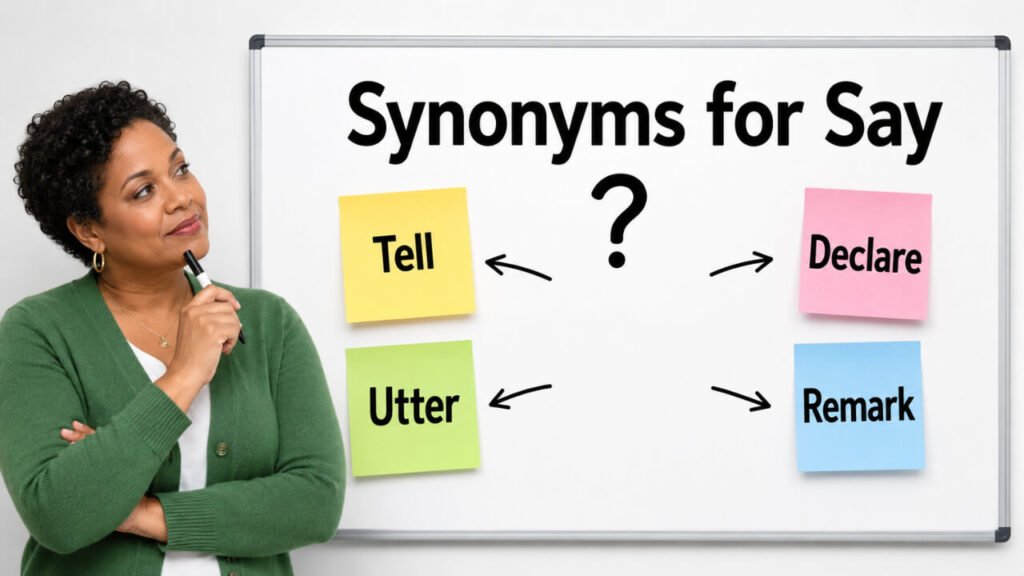
- State: To say something clearly or formally.
- Tell: To give information to someone.
- Mention: To say something briefly.
- Express: To communicate thoughts or feelings.
- Speak: To use words aloud.
- Utter: To say a word or sound.
- Remark: To make a comment.
- Declare: To say something strongly or officially.
- Announce: To make something known publicly.
- Explain: To make something clear with words.
- Report: To give information about an event or fact.
- Reply: To say something in response.
- Answer: To respond to a question.
- Respond: To speak or write back.
- Comment: To give an opinion or reaction.
- Observe: To make a thoughtful comment.
- Note: To point something out briefly.
- Add: To say something extra.
- Continue: To keep speaking after a pause.
- Whisper: To say something very quietly.
- Shout: To say something loudly.
- Yell: To speak loudly with force or emotion.
- Mutter: To speak quietly and unclearly.
- Murmur: To say something softly.
- Ask: To say a question.
- Inquire: To ask in a formal way.
- Pronounce: To say a word in a particular way.
- Voice: To express an opinion or feeling.
- Articulate: To express an idea clearly.
- Communicate: To share information or meaning.
- Convey: To communicate an idea or feeling.
- Reveal: To say information that was hidden.
- Disclose: To share private or important information.
- Claim: To say something is true.
- Assert: To say something with confidence.
- Insist: To say something firmly.
- Suggest: To say an idea for consideration.
- Propose: To suggest a plan or idea.
- Advise: To say what someone should do.
- Warn: To say something about possible danger.
- Promise: To say that you will do something.
- Admit: To say something true, often unwillingly.
- Confess: To admit something serious or personal.
- Repeat: To say something again.
- Recite: To say something from memory.
- Quote: To repeat someone’s exact words.
- Narrate: To tell a story or describe events.
- Describe: To say what something is like.
- Discuss: To talk about a topic in detail.
- Address: To speak to a person or group.
Read Also:
Synonyms For Death

Synonyms for Say by Context
When Say Means Speak Words
Use these synonyms when the focus is on spoken language.
Speak: She will speak at the ceremony.
Utter: He could barely utter a sentence.
Whisper: She whispered the secret softly.
Shout: The coach shouted instructions from the sideline.
When Say Means Give Information
Use these alternatives when someone shares facts, updates, or details.
Tell: Please tell me the truth.
Report: The witness reported what happened.
Inform: The officer informed the group about the rule.
Explain: She explained the process step by step.
When Say Means Express an Opinion
Use these choices when someone shares thoughts, feelings, or beliefs.
Express: He expressed his doubts about the plan.
Comment: She commented on the recent changes.
Remark: He remarked that the idea was useful.
Observe: The editor observed that the paragraph needed clarity.
When Say Means State Formally
Use these synonyms in academic, official, professional, or serious writing.
State: The document states the main condition.
Declare: The leader declared the result final.
Announce: The school announced the new schedule.
Assert: The writer asserted that the evidence was strong.
When Say Means Answer or Respond
Use these words when someone speaks after a question, message, or statement.
Reply: He replied with a simple yes.
Answer: She answered the question calmly.
Respond: They responded to the request quickly.
Add: He added that the work was almost finished.
When Say Means Reveal or Admit
Use these alternatives when someone shares hidden, private, or difficult information.
Reveal: She revealed the reason for leaving.
Disclose: The form disclosed the important details.
Admit: He admitted his mistake.
Confess: She confessed that she had forgotten the appointment.
Another Word for Say
Another word for say is state. It is one of the best single replacements because it works well in formal writing, essays, reports, and clear explanations. However, the best alternative depends on context. Use tell for giving information, mention for brief comments, express for feelings, and declare for strong statements.
Original: She said the answer was correct.
Better Option: She stated that the answer was correct.
Original: He said his opinion during the meeting.
Better Option: He expressed his opinion during the meeting.
Original: Please say the rules again.
Better Option: Please explain the rules again.
Original: They said the date publicly.
Better Option: They announced the date publicly.
When Not to Use “Say”
Do not use say when a more specific verb would make the sentence clearer. While say is useful, it can sound weak or repetitive if used too often in writing.
Weak: She said the instructions to the class.
Better: She explained the instructions to the class.
Weak: He said the news to everyone.
Better: He announced the news to everyone.
Weak: The report says the numbers changed.
Better: The report states that the numbers changed.
Weak: I said my feelings clearly.
Better: I expressed my feelings clearly.
Avoid say when the tone matters. Words like whisper, shout, mutter, or declare give the reader a clearer picture.
Words Commonly Confused With Say
Say vs Tell: Say focuses on the words spoken, while tell focuses on giving information to a person.
Example: She said hello. She told me the truth.
Say vs Speak: Say usually needs words or a message, while speak focuses on the act of talking.
Example: He said something kind. He can speak clearly.
Say vs State: Say is general and neutral, while state is more formal and direct.
Example: The note says the room is closed. The policy states the rule clearly.
Say vs Mention: Say can include a full message, while mention means to say something briefly.
Example: She said she was busy. She mentioned the meeting once.
Say vs Express: Say communicates words, while express communicates feelings, thoughts, or opinions.
Example: He said the sentence aloud. He expressed his gratitude.
Say vs Declare: Say is general, while declare sounds stronger, official, or public.
Example: She said she was ready. The captain declared the team ready.
Which Synonym Should You Choose?
Choose state when writing formal sentences, reports, essays, instructions, or official explanations.
Choose tell when giving information directly to another person.
Choose mention when the information is brief, minor, or not the main point.
Choose express when writing about emotions, opinions, concerns, gratitude, or personal thoughts.
Choose declare when the statement is strong, public, official, or final.
Choose announce when information is shared with a group or made public.
Choose explain when the purpose is to make an idea clear.
Choose reply, answer, or respond when someone speaks after a question or message.
Choose whisper, shout, mutter, or murmur when the speaking style matters.
Choose assert or claim when someone says something strongly, especially when the truth may need support.
Real Life Examples of “Say” in Sentences
Original: She said the answer was wrong.
Better Option: She stated that the answer was wrong.
Original: He said the story to the children.
Better Option: He told the story to the children.
Original: The teacher said the rule again.
Better Option: The teacher explained the rule again.
Original: They said the winner’s name.
Better Option: They announced the winner’s name.
Original: He said his worries during the meeting.
Better Option: He expressed his worries during the meeting.
Original: She said something about the deadline.
Better Option: She mentioned the deadline.
Original: The witness said what happened.
Better Option: The witness reported what happened.
Original: He said no after the question.
Better Option: He replied no after the question.
Original: The child said the poem from memory.
Better Option: The child recited the poem from memory.
Original: She said the same sentence again.
Better Option: She repeated the same sentence.
Synonym Groups and Usage Differences
Speaking Group
This group includes words that describe the act or style of speaking. Use these when sound, volume, or delivery matters.
Synonyms: Speak, utter, whisper, shout, yell, mutter, murmur.
Example: She whispered the answer so no one else could hear it.
Information Group
This group works when someone gives facts, updates, instructions, or details.
Synonyms: Tell, inform, report, explain, describe, communicate.
Example: The guide explained the route before the trip began.
Opinion Group
This group is useful when someone shares a view, feeling, or reaction.
Synonyms: Express, comment, remark, observe, suggest.
Example: He expressed his opinion with confidence.
Formal Statement Group
This group fits official, academic, legal, or professional writing.
Synonyms: State, declare, announce, assert, disclose.
Example: The agreement states the payment terms clearly.
Response Group
This group fits questions, replies, and conversation turns.
Synonyms: Reply, answer, respond, add, continue.
Example: She answered the question without hesitation.
Admission Group
This group works when someone reveals truth, accepts fault, or shares hidden information.
Synonyms: Admit, confess, reveal, disclose.
Example: He admitted that he had misunderstood the instruction.
Antonyms of Say
Antonyms of say depend on the meaning. If say means speak, the opposite may be stay silent. If it means reveal, the opposite may be hide or conceal.
Stay Silent: To not speak.
Remain Quiet: To avoid saying anything.
Listen: To receive words instead of speaking them.
Hear: To receive sound or spoken words.
Conceal: To keep information hidden.
Hide: To keep something from being known.
Withhold: To choose not to share information.
Deny: To say that something is not true.
Suppress: To prevent something from being expressed.
Retract: To take back something already said.
Comparison: Say vs Related Words
Say vs State
Say is general and can be casual or formal. State is clearer and more formal.
Example With Say: The sign says the gate is closed.
Example With State: The notice states that the gate is closed.
Say vs Tell
Say focuses on the words. Tell focuses on giving information to someone.
Example With Say: She said the answer.
Example With Tell: She told me the answer.
Say vs Speak
Say usually connects to a specific message. Speak focuses on talking or using language.
Example With Say: He said a few kind words.
Example With Speak: He spoke clearly during the meeting.
Say vs Mention
Say can refer to a full message. Mention means to refer to something briefly.
Example With Say: She said she needed help.
Example With Mention: She mentioned that she needed help.
Say vs Express
Say gives words. Express gives feelings, thoughts, opinions, or emotions.
Example With Say: He said he was thankful.
Example With Express: He expressed his thanks sincerely.
Say vs Announce
Say is broad. Announce means to say something publicly or officially.
Example With Say: They said the date yesterday.
Example With Announce: They announced the date yesterday.
Common Phrases and Expressions With Say
Say Hello: To greet someone.
Say Goodbye: To express farewell.
Say Thank You: To show gratitude.
Say Sorry: To apologize.
Say Yes: To agree or accept.
Say No: To refuse or disagree.
Say Something: To speak or share a thought.
Needless to Say: Something is obvious and does not need explanation.
That Is to Say: Used before explaining something more clearly.
Say the Word: To give permission or signal readiness.
Common Mistakes to Avoid
One common mistake is using say too many times in the same paragraph. Repetition can make writing sound plain.
Weak: She said the rule, then said the reason, and then said the answer.
Better: She explained the rule, gave the reason, and stated the answer.
Another mistake is using say when tell is needed. Use tell when there is a person receiving information.
Weak: He said me the truth.
Better: He told me the truth.
Avoid choosing a synonym that changes the meaning. Declare sounds stronger than say, while mention sounds shorter and lighter.
Weak: She declared that she liked tea.
Better: She said that she liked tea.
Do not use emotional speech verbs unless the sentence supports that emotion.
Weak: He shouted the answer quietly.
Better: He whispered the answer quietly.
Use specific synonyms when clarity matters. Explain, announce, report, and express often give more useful meaning than say.
Conclusion
The keyword synonyms for say includes many useful alternatives, but the best choice depends on meaning and context. Use state for formal writing, tell for giving information, mention for brief comments, express for feelings, announce for public news, and explain for clarity. In stories or conversations, words like whisper, shout, reply, and remark can show tone and action. Choosing the right synonym helps your writing sound clearer, more natural, and more precise.
FAQs About Synonyms for Say
What are the best synonyms for say?
The best synonyms for say are state, tell, mention, express, speak, remark, declare, announce, reply, and explain.
What is another word for say in formal writing?
A good formal word for say is state. You can also use declare, report, assert, or explain, depending on the sentence.
What is another word for say in casual speech?
In casual speech, use tell, mention, talk, speak, reply, or answer. These words sound natural in everyday conversation.
What is the difference between say and tell?
Say focuses on the words spoken. Tell focuses on giving information to a person. For example, say “She said hello,” but say “She told me the truth.”
Can I use express instead of say?
Yes, use express instead of say when the sentence is about feelings, opinions, thoughts, concerns, gratitude, or emotions.
What is a stronger word than say?
Stronger words than say include declare, assert, insist, announce, and proclaim. These words sound more confident, official, or forceful.
What is the simplest synonym for say?
The simplest synonym for say is tell when giving information to someone. For formal writing, state is often the clearest simple replacement.
