
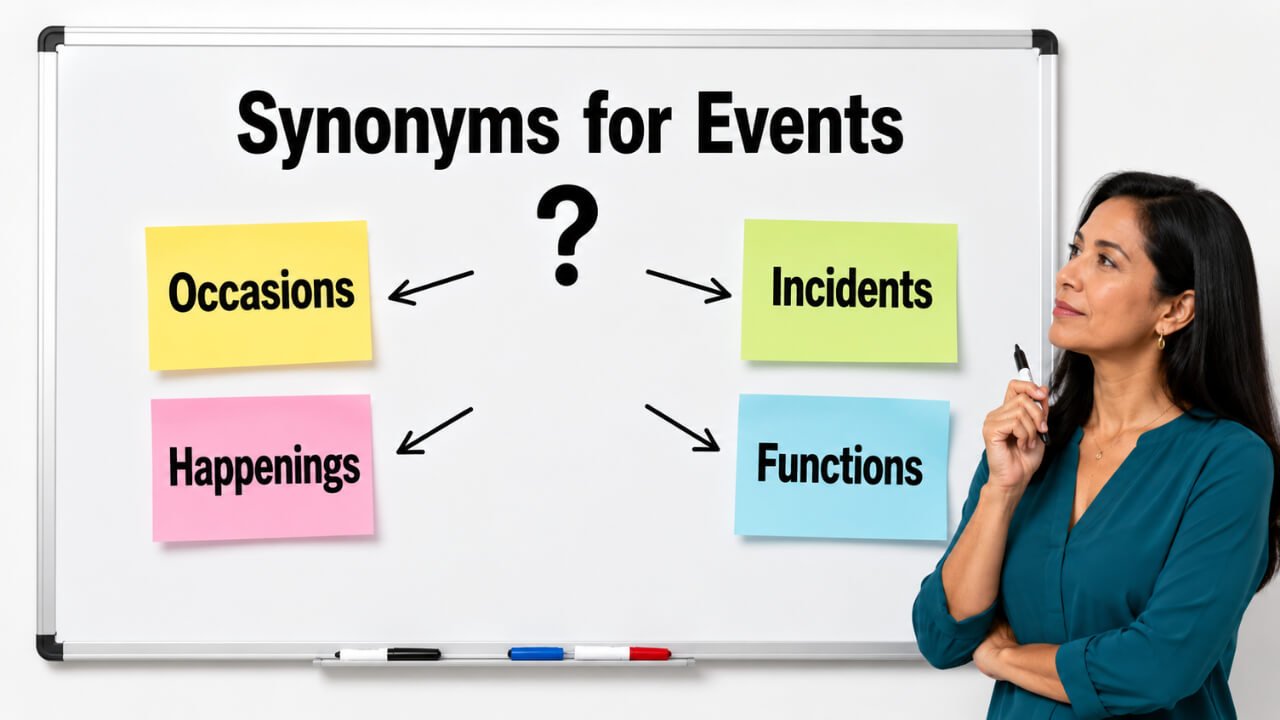
Quick Answer: Synonyms for events include occasions, happenings, incidents, activities, gatherings, functions, ceremonies, affairs, experiences, and milestones. Use occasions for special or planned moments, happenings for general situations, incidents for unexpected events, gatherings for social events, functions for formal programs, ceremonies for official or meaningful events, and milestones for important life or progress moments.
Pronunciation and Word Details
Word: Events
Pronunciation: /ɪˈvents/
Part of Speech: Plural noun
Meaning: Things that happen, especially planned activities, important occasions, or notable situations.
US Pronunciation:
UK Pronunciation:
What Does “Events” Mean?
Events means things that happen, especially occasions, activities, incidents, or situations that are noticed, planned, or remembered. It is a plural noun. The singular form is event.
The word events can describe planned programs, public activities, private celebrations, historical moments, unexpected incidents, sports competitions, business functions, or important experiences in life. It can work as the subject, object, or part of a phrase.
Example: Several events took place during the weekend.
Example: The school planned events for the students.
Example: Historical events can change the future of a country.
Meaning, Tone, and Context of “Events”
Events is a neutral and widely used word. It works in formal, casual, academic, business, social, historical, and technical contexts. The tone depends on the situation. A wedding event feels joyful, a tragic event feels serious, and a business event sounds professional.
In everyday speech, events can mean parties, programs, meetings, or activities. In history, it means important happenings from the past. In business, it often means conferences, meetings, launches, or formal functions. In personal writing, it can refer to meaningful life moments.
Formal Context: Events can refer to official programs, ceremonies, meetings, or public occasions.
Casual Context: Events can mean parties, get togethers, outings, or activities.
Academic Context: Events can describe historical happenings, scientific observations, or important developments.
Emotional Context: Events can describe life moments, memories, achievements, or difficult experiences.
When and How to Use “Events”
For Planned Activities: Use events when talking about organized programs, meetings, shows, or celebrations.
Example: The committee arranged three events for the festival.
For Social Occasions: Use events when describing parties, dinners, gatherings, or community activities.
Example: Family events bring everyone together.
For Historical Happenings: Use events when writing about important moments in history.
Example: These events shaped the direction of the nation.
For Unexpected Situations: Use events when discussing things that happened suddenly or without planning.
Example: The events of that night were difficult to explain.
For Business Programs: Use events when referring to official meetings, functions, workshops, or launches.
Example: The company hosted several professional events this year.
For Life Moments: Use events when describing meaningful personal experiences.
Example: Graduation and marriage are major events in many lives.
Best Synonyms for Events
Occasions: Special or notable times when something happens.
Example: Weddings and birthdays are joyful occasions.
Happenings: Things that take place, often in a general or casual sense.
Example: The town was full of exciting happenings during the fair.
Incidents: Specific events, often unexpected or unusual.
Example: The report explained the incidents that occurred at the station.
Activities: Things people do, often planned for a purpose.
Example: The school organized activities for the children.
Gatherings: Events where people come together.
Example: The family gathering lasted the whole afternoon.
Functions: Formal or organized social or professional events.
Example: The hotel hosted several business functions.
Ceremonies: Formal events held for a special purpose or tradition.
Example: The award ceremony honored the winners.
Affairs: Events, matters, or social occasions.
Example: The dinner was a private affair.
Experiences: Events someone lives through or personally feels.
Example: Traveling alone can create meaningful experiences.
Milestones: Important events that mark progress or achievement.
Example: Buying a first home is a major milestone.
50 Synonyms for Events with Short Meanings
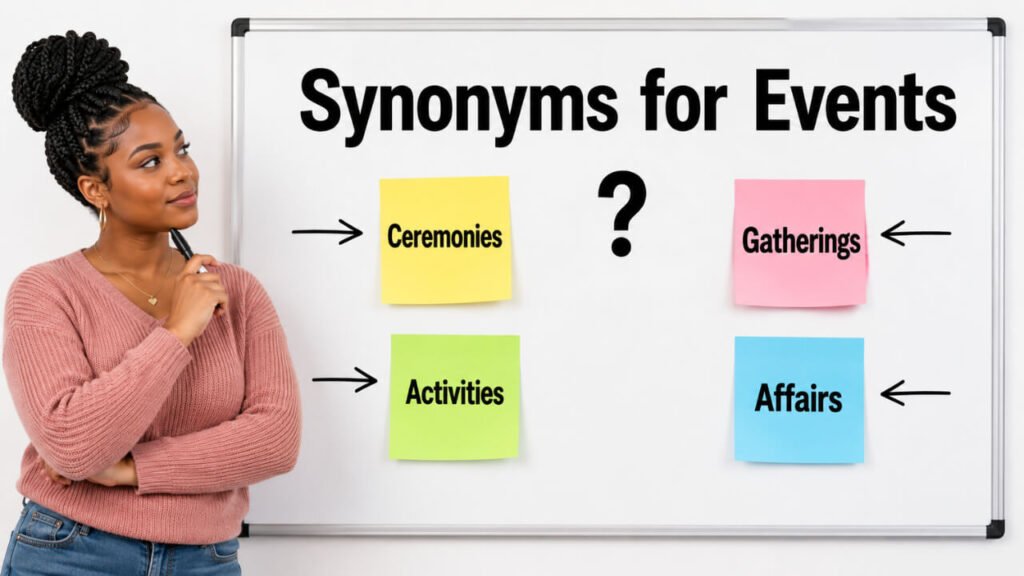
- Occasions: Special times when something happens.
- Happenings: Things that take place.
- Incidents: Specific or unusual events.
- Activities: Planned things people do.
- Gatherings: Events where people meet.
- Functions: Formal or organized events.
- Ceremonies: Formal events with meaning or tradition.
- Affairs: Social events or matters.
- Experiences: Things someone lives through.
- Milestones: Important moments of progress.
- Occurrences: Things that happen.
- Episodes: Separate events in a longer situation.
- Developments: New events or changes in a situation.
- Situations: Conditions or sets of events.
- Moments: Short points in time with meaning.
- Incidences: Instances of something happening.
- Meetings: Events where people come together to talk.
- Conferences: Formal meetings for discussion or learning.
- Programs: Planned events or organized activities.
- Festivals: Celebratory events with activities.
- Celebrations: Happy events honoring something.
- Parties: Social events for enjoyment.
- Receptions: Formal social gatherings.
- Assemblies: Groups gathered for a purpose.
- Conventions: Large formal meetings or events.
- Seminars: Educational events with discussion.
- Workshops: Practical learning events.
- Sessions: Parts of an event or meeting.
- Competitions: Events where people compete.
- Matches: Sports or contest events.
- Tournaments: Series of competitive events.
- Performances: Events where people present art or entertainment.
- Shows: Public entertainment or display events.
- Exhibitions: Events where items or work are displayed.
- Displays: Public presentations or showings.
- Fairs: Public events with stalls, activities, or displays.
- Rallies: Large public gatherings for support or action.
- Campaigns: Planned series of activities or events.
- Commemorations: Events held to remember something.
- Observances: Events that honor a day, custom, or tradition.
- Rituals: Repeated events with symbolic meaning.
- Traditions: Repeated customs or meaningful events.
- Proceedings: Formal events or activities in order.
- Circumstances: Conditions surrounding an event.
- Episodes: Separate parts of a larger story or situation.
- Cases: Specific examples or instances of events.
- Matters: Situations, events, or concerns.
- Scenes: Events or situations in a place.
- Turns: Changes or events in a situation.
- Experiences: Personal events someone goes through.
Read Also:
Synonyms for Skills
Synonyms for Events by Context
When Events Means Planned Occasions
Use these synonyms when events are arranged, scheduled, or organized for a purpose.
Useful Synonyms: Occasions, activities, functions, programs, ceremonies.
Example: The college planned several events for new students.
Better Option: The college planned several activities for new students.
When Events Means Things That Happen
Use these synonyms when speaking generally about things that occur.
Useful Synonyms: Happenings, occurrences, incidents, episodes, developments.
Example: The events of the day surprised everyone.
Better Option: The happenings of the day surprised everyone.
When Events Means Social Gatherings
Use these words when people meet for celebration, discussion, or shared activity.
Useful Synonyms: Gatherings, parties, receptions, assemblies, celebrations.
Example: Family events are important to her.
Better Option: Family gatherings are important to her.
When Events Means Formal Programs
Use formal synonyms when talking about official, public, professional, or ceremonial programs.
Useful Synonyms: Functions, ceremonies, conferences, conventions, proceedings.
Example: The organization hosted three events this month.
Better Option: The organization hosted three formal functions this month.
When Events Means Historical Moments
Use these synonyms when discussing past moments, major changes, or important developments.
Useful Synonyms: Occurrences, developments, milestones, episodes, circumstances.
Example: These events changed the course of history.
Better Option: These developments changed the course of history.
When Events Means Personal Life Moments
Use these synonyms when describing meaningful personal experiences or achievements.
Useful Synonyms: Experiences, milestones, moments, occasions, memories.
Example: Graduation is one of the most important events in her life.
Better Option: Graduation is one of the most important milestones in her life.
Another Word for Events
Another word for events is occasions. It is one of the best general replacements when talking about planned, special, social, or meaningful happenings. However, the best alternative depends on context. Use happenings for general situations, incidents for unexpected events, functions for formal programs, and milestones for important life moments.
Original: The school arranged several events this week.
Better Option: The school arranged several activities this week.
Original: The wedding was one of the biggest events of the year.
Better Option: The wedding was one of the biggest occasions of the year.
Original: The report described the events of the evening.
Better Option: The report described the incidents of the evening.
Original: Graduation is an important event in life.
Better Option: Graduation is an important milestone in life.
When Not to Use “Events”
Do not use events when a more specific word would make the sentence clearer. Events can sound too broad if the reader needs to know whether you mean parties, accidents, meetings, ceremonies, activities, historical changes, or personal moments.
Weak: Many events happened at the office.
Better: Many incidents happened at the office.
Weak: The company held a nice event.
Better: The company held a formal function.
Weak: The children enjoyed the events.
Better: The children enjoyed the activities.
Weak: The police studied the events.
Better: The police studied the incidents.
Weak: The event in her life was meaningful.
Better: The milestone in her life was meaningful.
Words Commonly Confused With Events
Events vs Occasions: Events is a broad word for things that happen. Occasions usually suggests special, planned, or meaningful events.
Events vs Incidents: Events can be planned or unplanned, while incidents often means unexpected, unusual, or sometimes negative happenings.
Events vs Activities: Events are often larger or more organized. Activities are things people do within an event or as part of a plan.
Events vs Functions: Events is general, while functions usually sounds more formal, social, or professional.
Events vs Ceremonies: Events can be any happenings, while ceremonies are formal events with tradition, meaning, or official purpose.
Events vs Happenings: Events sounds more neutral and standard. Happenings sounds more casual and general.
Events vs Milestones: Events can be ordinary or important. Milestones are important events that mark progress, achievement, or change.
Which Synonym Should You Choose?
Choose occasions when writing about special, meaningful, or planned events.
Choose happenings when speaking casually about things that took place.
Choose incidents when writing about unusual, unexpected, or serious events.
Choose activities when focusing on things people do during a program or gathering.
Choose gatherings when people come together socially or formally.
Choose functions when writing about formal, business, or organized social events.
Choose ceremonies when the event has tradition, honor, or official meaning.
Choose milestones when writing about important life moments or progress.
Choose developments when writing about changes in news, history, reports, or ongoing situations.
Choose experiences when focusing on what someone personally went through.
Real Life Examples of “Events” in Sentences
Original: The school planned fun events for the students.
Better Option: The school planned fun activities for the students.
Original: The wedding was a beautiful event.
Better Option: The wedding was a beautiful occasion.
Original: Several events happened during the meeting.
Better Option: Several incidents happened during the meeting.
Original: The city hosted cultural events all summer.
Better Option: The city hosted cultural festivals all summer.
Original: The company organized a formal event.
Better Option: The company organized a formal function.
Original: These events changed his life.
Better Option: These experiences changed his life.
Original: The award event was held in the evening.
Better Option: The award ceremony was held in the evening.
Original: Historical events shaped the nation.
Better Option: Historical developments shaped the nation.
Original: The family event was full of joy.
Better Option: The family gathering was full of joy.
Original: Starting a business was an important event for her.
Better Option: Starting a business was an important milestone for her.
Synonym Groups and Usage Differences
Planned Event Group
This group includes words for organized, scheduled, or arranged events. These synonyms are useful for schools, workplaces, communities, and public programs.
Synonyms: Activities, programs, functions, ceremonies, conferences.
Example: The organization announced new programs for the public.
Social Event Group
This group focuses on people coming together for enjoyment, celebration, or connection.
Synonyms: Gatherings, parties, receptions, celebrations, assemblies.
Example: The evening gathering was warm and memorable.
Unexpected Event Group
This group fits things that happen suddenly, unusually, or without planning.
Synonyms: Incidents, occurrences, episodes, situations, developments.
Example: The report explained the incident clearly.
Formal Event Group
This group is useful for official, professional, ceremonial, or structured events.
Synonyms: Functions, ceremonies, conventions, seminars, proceedings.
Example: The opening ceremony began at noon.
Historical Event Group
This group describes important past happenings, changes, or turning points.
Synonyms: Developments, milestones, episodes, circumstances, occurrences.
Example: The development marked a turning point in history.
Personal Event Group
This group describes meaningful life moments, memories, and personal experiences.
Synonyms: Milestones, experiences, moments, occasions, memories.
Example: Her graduation was a proud milestone.
Antonyms of Events
Events can have different opposites depending on meaning. If events means happenings, the opposite may be inactivity or nothingness. If events means organized programs, the opposite may be cancellation or absence.
Inactivity: A state where nothing is happening.
Stillness: Lack of movement or action.
Calm: A peaceful state without major happenings.
Quiet: Lack of activity, noise, or public action.
Routine: Regular activity without a special event.
Nonoccurrence: The fact that something does not happen.
Cancellation: The stopping of a planned event.
Absence: Lack of an expected event or presence.
Pause: A temporary stop in activity.
Standstill: A state where activity or progress stops.
Comparison: Events vs Related Words
Events vs Occasions
Events is broad and can mean any notable happening. Occasions usually suggests a special or meaningful time.
Example With Events: Several events were planned for the weekend.
Example With Occasions: Birthdays are joyful occasions.
Events vs Incidents
Events may be planned, neutral, happy, serious, or historical. Incidents are usually specific, unexpected, unusual, or sometimes negative.
Example With Events: The festival included many events.
Example With Incidents: The manager recorded all safety incidents.
Events vs Activities
Events are often larger organized happenings. Activities are actions people do, often inside an event.
Example With Events: The school hosted three events.
Example With Activities: The children enjoyed painting and reading activities.
Events vs Functions
Events is more general. Functions usually refers to formal, organized, social, or professional occasions.
Example With Events: The hotel hosted many events.
Example With Functions: The hotel hosted several business functions.
Events vs Ceremonies
Events can be any planned or notable happenings. Ceremonies are formal events with tradition, honor, or official purpose.
Example With Events: The event started at ten o’clock.
Example With Ceremonies: The graduation ceremony started at ten o’clock.
Events vs Happenings
Events sounds more standard and neutral. Happenings sounds more casual and sometimes more lively.
Example With Events: The article described recent events.
Example With Happenings: The article described recent happenings in the town.
Events vs Milestones
Events can be ordinary or major. Milestones are important events that show progress, achievement, or change.
Example With Events: Many events happened during the year.
Example With Milestones: The first sale was a major milestone for the business.
Common Phrases and Expressions With Events
Current Events: Important things happening now.
Historical Events: Important happenings from the past.
Special Events: Planned occasions that are different from regular activities.
Major Events: Important or large scale happenings.
Upcoming Events: Events that will happen soon.
Public Events: Events open to people in a community or area.
Private Events: Events limited to selected people or guests.
Life Events: Important personal moments or changes.
Charity Events: Events organized to support a cause.
Sports Events: Competitions, matches, or athletic activities.
Common Mistakes to Avoid
Using events too generally can make writing unclear. It is better to choose a more specific word when the meaning is obvious.
Weak: The office had many events yesterday.
Better: The office had many meetings yesterday.
Repeating events too often can make a paragraph sound plain. Replace it with occasions, activities, functions, ceremonies, incidents, or developments when they fit.
Weak: The event included several events for guests.
Better: The program included several activities for guests.
Do not use incidents for happy planned events. Incidents often suggests something unusual, unexpected, or negative.
Weak: The wedding incident was beautiful.
Better: The wedding occasion was beautiful.
Do not use ceremonies for general events unless there is a formal or symbolic purpose.
Weak: We had a lunch ceremony at noon.
Better: We had a lunch gathering at noon.
Do not use milestones for ordinary daily happenings. Milestones should mark important progress or achievement.
Weak: Drinking tea was a milestone in my day.
Better: Drinking tea was a pleasant moment in my day.
Conclusion
Synonyms for events help you describe happenings with better accuracy and style. Use occasions for special moments, activities for planned things people do, incidents for unexpected situations, functions for formal programs, ceremonies for official or meaningful events, and milestones for important life achievements. The word events is useful, but it can sound broad when used too often. Choosing the right synonym makes your writing clearer, more natural, and more specific for readers.
FAQs About Synonyms for Events
What is the best synonym for events?
The best general synonym for events is occasions. It works well for special, planned, or meaningful happenings.
What are formal synonyms for events?
Formal synonyms for events include functions, ceremonies, conferences, proceedings, conventions, and programs.
What is another word for social events?
Another word for social events is gatherings. You can also use parties, receptions, celebrations, or get togethers.
What is a synonym for unexpected events?
A good synonym for unexpected events is incidents. Other options include occurrences, episodes, situations, and developments.
Are events and activities the same?
Events and activities are related, but not always the same. An event is often a larger organized happening, while activities are things people do during it.
What is a synonym for important life events?
A strong synonym for important life events is milestones. It describes major moments of progress, achievement, or change.
What are antonyms of events?
Antonyms of events include inactivity, stillness, calm, routine, nonoccurrence, cancellation, absence, and standstill.
