
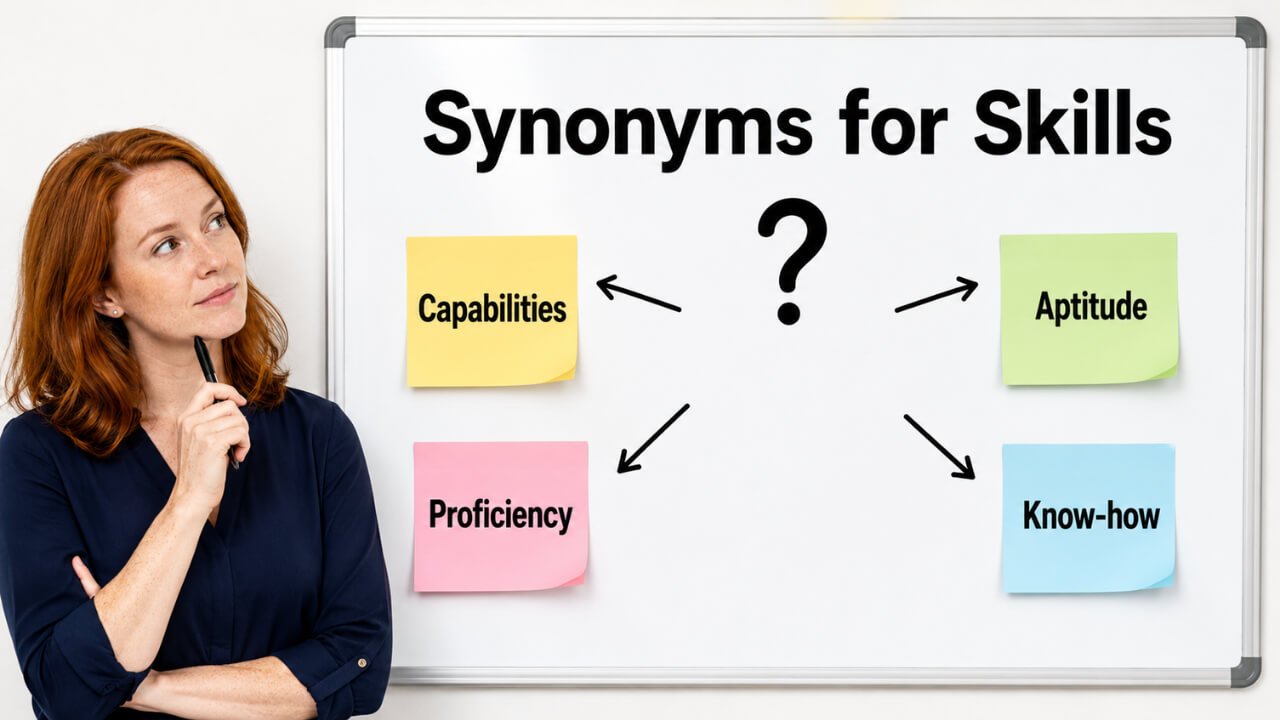
Quick Answer: Synonyms for skills include abilities, talents, expertise, competence, proficiency, capabilities, knowledge, techniques, qualifications, and know how. The best synonym depends on context. Use abilities for general strengths, expertise for advanced professional knowledge, proficiency for practiced ability, talents for natural gifts, and qualifications for job, study, or career situations.
Pronunciation and Word Details
Word: Skills
Pronunciation: /skɪlz/
Part of Speech: Plural noun
Meaning: Learned or natural abilities that help someone perform tasks well.
US Pronunciation:
UK Pronunciation:
What Does “Skills” Mean?
Skills means the abilities, knowledge, techniques, or talents a person uses to do something well. It is a plural noun, and the singular form is skill. The word can describe practical ability, creative talent, technical knowledge, professional strength, social ability, or learned competence.
Skills can appear before another noun, after an adjective, or as the main object of a sentence.
Example: She has strong writing skills.
Example: The job requires advanced computer skills.
Example: Good listening skills make communication easier.
Meaning, Tone, and Context of “Skills”
Skills is a neutral, common, and useful word. It is not too formal or too casual, so it works in everyday speech, school writing, job applications, workplace communication, training guides, and professional documents.
The word can sound broad when used alone. For clearer writing, it is often better to name the exact type of skill, such as communication skills, leadership skills, technical skills, writing skills, or problem solving skills.
Formal Context: Skills can describe professional abilities, training, and qualifications.
Casual Context: Skills can describe anything someone does well.
Academic Context: Skills can describe learning, research, writing, reading, analysis, and study ability.
Technical Context: Skills can describe knowledge of tools, systems, methods, or processes.
When and How to Use “Skills”
For Work Ability: Use skills when describing what someone can do in a job or career.
Example: Her management skills helped the team finish the project.
For Learning: Use skills when talking about abilities developed through study, practice, or training.
Example: The course helps students improve their reading skills.
For Technical Ability: Use skills when referring to tools, systems, software, machines, or specialized methods.
Example: The role requires strong data analysis skills.
For Communication: Use skills when describing speaking, writing, listening, or explaining ideas.
Example: Clear communication skills are important in every workplace.
For Creative Work: Use skills when talking about art, writing, music, design, or performance.
Example: His drawing skills improved after regular practice.
For Practical Tasks: Use skills when describing hands on ability in real life tasks.
Example: Cooking, repairing, and organizing are useful practical skills.
Best Synonyms for Skills
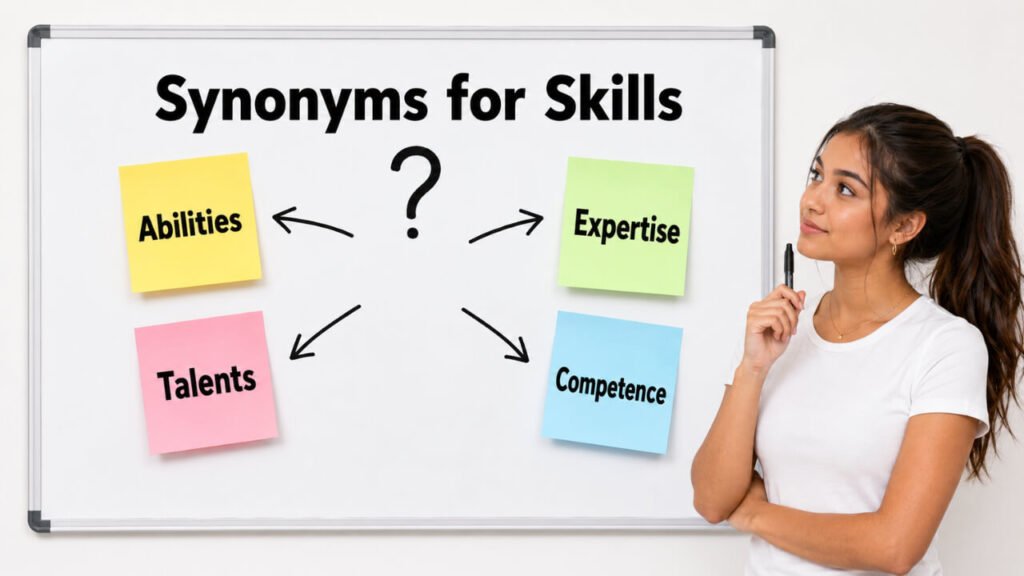
Abilities: Natural or learned powers that help someone do something well.
Example: Her abilities make her a strong candidate for the role.
Talents: Natural or developed gifts in a specific area.
Example: His talents include writing, music, and public speaking.
Expertise: Advanced knowledge or high level skill in a subject.
Example: The project needs someone with financial expertise.
Competence: Reliable ability to do something properly.
Example: Her competence made the team trust her decisions.
Proficiency: A strong level of practiced ability.
Example: He showed proficiency in computer programming.
Capabilities: The qualities, knowledge, or skills needed to do something.
Example: The team has the capabilities to complete the task.
Knowledge: Information and understanding gained through learning or experience.
Example: Her knowledge of grammar helps her write clearly.
Techniques: Specific methods used to perform a task well.
Example: The coach taught breathing techniques to the runners.
Qualifications: Skills, education, training, or experience that make someone suitable.
Example: His qualifications match the job requirements.
Know How: Practical knowledge about how to do something.
Example: She has the know how to solve the problem quickly.
50 Synonyms for Skills with Short Meanings
- Abilities: Powers that help someone do something.
- Talents: Natural or developed gifts.
- Expertise: Advanced knowledge or skill.
- Competence: Reliable ability to perform well.
- Proficiency: Strong practiced ability.
- Capabilities: Qualities or powers needed to do something.
- Knowledge: Understanding gained through learning or experience.
- Techniques: Methods used to complete a task.
- Qualifications: Skills, training, or education for a role.
- Know How: Practical understanding of how to do something.
- Aptitude: Natural ability to learn or perform.
- Mastery: Complete control or high level skill.
- Experience: Knowledge gained by doing something over time.
- Training: Preparation gained through learning and practice.
- Capacity: Ability or potential to do something.
- Facility: Ease and skill in doing something.
- Dexterity: Skillful use of the hands or body.
- Craftsmanship: Skill in making things carefully.
- Artistry: Creative skill and imagination.
- Command: Strong control or knowledge of a subject.
- Efficiency: Ability to work well with little waste.
- Effectiveness: Ability to produce good results.
- Strengths: Areas where someone performs well.
- Gifts: Natural abilities or special talents.
- Acumen: Sharp practical intelligence.
- Flair: Natural style or ability.
- Skillfulness: Quality of being skilled.
- Practical Ability: Skill used in real tasks.
- Technical Ability: Skill with tools, systems, or methods.
- Professional Ability: Skill used in work or career settings.
- Creative Ability: Skill in producing original work or ideas.
- Interpersonal Ability: Skill in dealing with people.
- Communication Ability: Skill in sharing ideas clearly.
- Leadership Ability: Skill in guiding or managing others.
- Analytical Ability: Skill in studying details and solving issues.
- Problem Solving Ability: Skill in finding answers and fixing problems.
- Judgement: Ability to make sensible decisions.
- Resourcefulness: Ability to handle problems effectively.
- Versatility: Ability to do many things well.
- Craft: Skill in an art, trade, or practical activity.
- Workmanship: Skill shown in completed work.
- Finesse: Careful and skillful handling.
- Precision: Ability to do something accurately.
- Savvy: Practical understanding and smart ability.
- Insight: Deep understanding of a subject or situation.
- Understanding: Knowledge of how something works.
- Credentials: Proof of training, ability, or qualification.
- Specialization: Skill in one particular field.
- Specialty: A subject or activity someone does especially well.
- Discipline: Trained ability in a field, subject, or practice.
Read Also:
Synonyms for Created
Synonyms for Skills by Context
When Skills Means General Ability
Use general synonyms when you want to describe what a person can do without naming a specific field.
Useful Synonyms: Abilities, capabilities, strengths, capacity, aptitude.
Example: She has many skills that help the team.
Better Option: She has many abilities that help the team.
When Skills Means Professional Expertise
Use professional synonyms when writing about jobs, work, careers, training, or formal qualifications.
Useful Synonyms: Expertise, competence, proficiency, qualifications, credentials.
Example: His skills in management are valuable.
Better Option: His management expertise is valuable.
When Skills Means Natural Talent
Use talent focused synonyms when the ability feels natural, creative, or personally gifted.
Useful Synonyms: Talents, gifts, flair, artistry, aptitude.
Example: Her skills in music are impressive.
Better Option: Her musical talent is impressive.
When Skills Means Practical Know How
Use practical synonyms when the focus is doing real tasks, using tools, fixing issues, or applying experience.
Useful Synonyms: Know how, techniques, practical ability, experience, dexterity.
Example: The task requires strong skills with tools.
Better Option: The task requires strong practical ability with tools.
When Skills Means Technical Ability
Use technical synonyms when the ability involves systems, tools, data, machines, software, or specialized work.
Useful Synonyms: Technical ability, proficiency, command, expertise, knowledge.
Example: The role needs strong skills in data analysis.
Better Option: The role needs strong proficiency in data analysis.
When Skills Means Social Ability
Use social synonyms when talking about communication, teamwork, leadership, listening, or dealing with people.
Useful Synonyms: Interpersonal ability, communication ability, leadership ability, judgement, strengths.
Example: Good skills help him work with clients.
Better Option: Good interpersonal ability helps him work with clients.
Another Word for Skills
Another word for skills is abilities. It is the best single replacement because it works in many situations and can describe natural strengths, learned powers, practical knowledge, and professional qualities. Still, the best alternative depends on context. Use expertise for advanced knowledge, qualifications for job readiness, talents for natural gifts, and techniques for specific methods.
Original: She has excellent skills in writing.
Better Option: She has excellent writing abilities.
Original: The team needs someone with strong skills in finance.
Better Option: The team needs someone with strong financial expertise.
Original: His skills helped him get the job.
Better Option: His qualifications helped him get the job.
Original: The artist showed great skills.
Better Option: The artist showed great talent.
When Not to Use “Skills”
Do not use skills when a more exact word would make the meaning clearer. Skills can sound too broad if the reader needs to know whether you mean knowledge, talent, training, qualifications, experience, or technique.
Weak: She has good skills.
Better: She has strong writing and communication abilities.
Weak: He has skills in the subject.
Better: He has deep knowledge of the subject.
Weak: The applicant has many skills.
Better: The applicant has strong qualifications and practical experience.
Weak: The dancer has nice skills.
Better: The dancer has impressive technique and artistry.
Weak: We need skills for this project.
Better: We need technical expertise and problem solving ability for this project.
Words Commonly Confused With Skills
Skills vs Abilities: Skills are often learned through practice, while abilities can be natural, learned, or both.
Skills vs Talents: Talents usually suggest natural gifts, while skills can be developed through training and repetition.
Skills vs Expertise: Skills can be basic or advanced, while expertise means deep knowledge or a high level of ability.
Skills vs Qualifications: Skills describe what someone can do, while qualifications include education, training, experience, and proof of suitability.
Skills vs Knowledge: Knowledge is what someone understands, while skills show how well someone can apply that understanding.
Skills vs Techniques: Skills are broader abilities, while techniques are specific methods used to perform a task.
Skills vs Experience: Experience is gained by doing something over time, while skills are the abilities developed or used during that experience.
Which Synonym Should You Choose?
Choose abilities when you need a broad and natural replacement for skills.
Choose talents when talking about natural gifts, creativity, or personal strengths.
Choose expertise when writing about advanced knowledge in a subject or profession.
Choose competence when describing reliable and proper performance.
Choose proficiency when showing a strong and practiced level of ability.
Choose qualifications when writing about jobs, applications, study, or role requirements.
Choose knowledge when the focus is understanding facts, ideas, or information.
Choose techniques when the focus is a specific method or way of doing something.
Choose know how when the meaning is practical experience and real world ability.
Choose mastery when someone has reached an excellent or advanced level.
Real Life Examples of “Skills” in Sentences
Original: She has strong skills in customer service.
Better Option: She has strong communication abilities in customer service.
Original: His skills helped the team finish the work.
Better Option: His expertise helped the team finish the work.
Original: The course improves writing skills.
Better Option: The course improves writing proficiency.
Original: We need someone with computer skills.
Better Option: We need someone with technical ability.
Original: Her skills in design are impressive.
Better Option: Her creative ability in design is impressive.
Original: He has good skills with numbers.
Better Option: He has strong analytical ability.
Original: The manager has excellent people skills.
Better Option: The manager has excellent interpersonal ability.
Original: Practice helped him build new skills.
Better Option: Practice helped him build new techniques.
Original: The job requires many skills.
Better Option: The job requires strong qualifications and experience.
Original: Her skills make her a good teacher.
Better Option: Her knowledge and communication ability make her a good teacher.
Synonym Groups and Usage Differences
Ability Group
This group includes broad words that describe what someone can do. These synonyms work well when you do not need to name a specific field.
Synonyms: Abilities, capabilities, capacity, strengths.
Example: Her abilities make her a valuable team member.
Knowledge Group
This group focuses on understanding, information, and subject awareness. Use these words when the ability is based on learning or study.
Synonyms: Knowledge, understanding, insight, command.
Example: His command of grammar makes his writing clear.
Professional Group
This group is best for career, work, training, and formal writing. These words sound polished and specific.
Synonyms: Expertise, competence, proficiency, qualifications, credentials.
Example: Her qualifications match the role well.
Creative Group
This group fits art, writing, design, performance, music, and other creative activities.
Synonyms: Talents, artistry, flair, craft, craftsmanship.
Example: His flair for storytelling keeps readers interested.
Practical Group
This group focuses on doing real tasks, using tools, applying methods, and solving everyday problems.
Synonyms: Know how, techniques, experience, practical ability, dexterity.
Example: The work requires practical ability and careful technique.
Thinking Group
This group describes mental ability, decision making, analysis, and problem solving.
Synonyms: Acumen, judgement, analytical ability, problem solving ability, resourcefulness.
Example: Her judgement helped the team avoid a costly mistake.
Antonyms of Skills
Skills can have different opposites depending on the meaning. If skills means ability, the opposite may be inability. If it means expertise, the opposite may be inexperience or incompetence.
Inability: Lack of power or ability to do something.
Incompetence: Lack of proper skill or ability.
Weakness: An area where someone does not perform well.
Clumsiness: Lack of physical skill or coordination.
Ignorance: Lack of knowledge or understanding.
Inexperience: Lack of practice or real world exposure.
Inefficiency: Poor ability to complete work well.
Unpreparedness: Lack of training or readiness.
Limitation: Something that reduces ability or performance.
Helplessness: Lack of ability to manage or solve something.
Comparison: Skills vs Related Words
Skills vs Abilities
Skills usually suggest learned or practiced ability. Abilities can be natural, learned, or both.
Example With Skills: She improved her writing skills through practice.
Example With Abilities: She has strong abilities in writing and editing.
Skills vs Talents
Talents often sound natural or gifted. Skills often sound developed through effort, training, and practice.
Example With Skills: His cooking skills improved after training.
Example With Talents: His talent for cooking was clear from a young age.
Skills vs Expertise
Skills can describe any level of ability. Expertise means advanced knowledge and strong command of a subject.
Example With Skills: She has strong teaching skills.
Example With Expertise: She has expertise in early childhood education.
Skills vs Competence
Skills describe abilities. Competence describes the ability to do something correctly, reliably, and responsibly.
Example With Skills: The assistant has strong office skills.
Example With Competence: The assistant showed competence in handling office tasks.
Skills vs Proficiency
Skills is general. Proficiency means a confident, practiced, and higher level of skill.
Example With Skills: He has language skills.
Example With Proficiency: He has proficiency in English.
Skills vs Qualifications
Skills describe what someone can do. Qualifications include skills, education, training, and experience that make someone suitable.
Example With Skills: Her skills fit the role.
Example With Qualifications: Her qualifications fit the role.
Skills vs Techniques
Skills are broad abilities. Techniques are exact methods used to perform a task.
Example With Skills: The player has strong football skills.
Example With Techniques: The player uses advanced passing techniques.
Common Phrases and Expressions With Skills
Communication Skills: Ability to share ideas clearly.
Leadership Skills: Ability to guide, organize, and influence others.
Technical Skills: Ability to use tools, systems, or specialized methods.
Writing Skills: Ability to write clearly and effectively.
Listening Skills: Ability to understand what others say.
Problem Solving Skills: Ability to find answers and fix issues.
People Skills: Ability to interact well with others.
Practical Skills: Ability to do useful real life tasks.
Transferable Skills: Abilities that can be used in different roles or situations.
Soft Skills: Personal qualities such as teamwork, patience, and communication.
Common Mistakes to Avoid
Using skills too generally can make writing weak. Instead of saying someone has good skills, name the exact type of skill.
Weak: She has good skills.
Better: She has strong writing and communication skills.
Repeating skills too many times can make a sentence sound flat. Use abilities, expertise, knowledge, qualifications, or talents when they fit the meaning.
Weak: His skills include design skills and writing skills.
Better: His abilities include design, writing, and creative planning.
Do not use talent when the meaning is training. Talent suggests natural ability, while expertise and proficiency suggest learned strength.
Weak: Her talent in accounting came from years of study.
Better: Her expertise in accounting came from years of study.
Do not use knowledge when the meaning is practical performance. Knowledge is understanding, while skill is the ability to apply that understanding.
Weak: He has knowledge in public speaking.
Better: He has strong public speaking skills.
Do not use qualifications for simple everyday ability. Qualifications sounds more formal and fits jobs, education, or role requirements.
Weak: My qualification is cooking dinner quickly.
Better: My skill is cooking dinner quickly.
Conclusion
Synonyms for skills help you choose clearer and more accurate words for different situations. Use abilities as the best general replacement, expertise for advanced knowledge, proficiency for practiced ability, talents for natural gifts, and qualifications for professional or academic contexts. When writing, avoid using skills too broadly. Choose a synonym that shows whether you mean knowledge, technique, training, experience, creativity, or personal strength. This makes your writing more specific, polished, and useful.
FAQs About Synonyms for Skills
What is the best synonym for skills?
The best general synonym for skills is abilities. It works in many contexts and can describe both natural and learned strengths.
What are professional synonyms for skills?
Professional synonyms for skills include expertise, competence, proficiency, qualifications, capabilities, and credentials.
What is another word for skills on a resume?
Another word for skills on a resume is qualifications. You can also use expertise, abilities, strengths, or competencies depending on the section.
Are skills and abilities the same?
Skills and abilities are closely related, but they are not always the same. Skills are often learned through practice, while abilities can be natural or learned.
What is a synonym for technical skills?
A synonym for technical skills is technical ability. Other useful options include technical expertise, proficiency, knowledge, and command.
What is a better word than skills?
A better word depends on context. Use expertise for advanced knowledge, talent for natural ability, proficiency for practiced skill, and qualifications for job related ability.
What are antonyms of skills?
Antonyms of skills include inability, incompetence, weakness, clumsiness, ignorance, inexperience, and inefficiency.
