
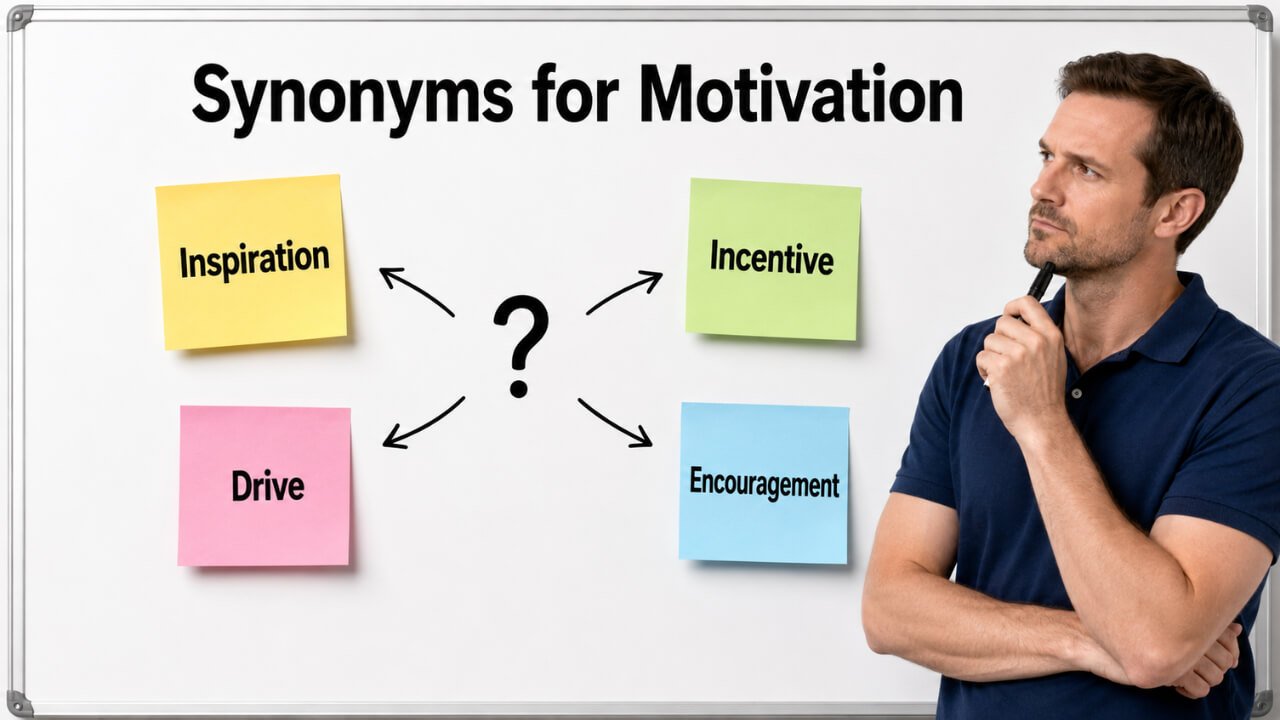
Quick Answer: Synonyms for motivation include inspiration, drive, encouragement, ambition, purpose, incentive, reason, motive, desire, and determination. Use inspiration for emotional energy, drive for inner force, encouragement for support, ambition for goals, purpose for deeper meaning, incentive for rewards, reason or motive for cause, and determination for continued effort.
Pronunciation and Word Details
Word: Motivation
Pronunciation: /ˌmoʊtɪˈveɪʃən/
Part of Speech: Noun
Meaning: Motivation means the reason, desire, energy, or inner force that makes someone want to act, work, improve, or continue.
US Pronunciation:
UK Pronunciation:
What Does “Motivation” Mean?
Motivation means the reason or inner desire that pushes someone to do something. It is a noun used to describe purpose, energy, ambition, interest, encouragement, or the cause behind an action.
Motivation can come from inside a person, such as goals, passion, confidence, discipline, or personal values. It can also come from outside, such as rewards, support, praise, pressure, or opportunity. In sentences, motivation often explains why someone studies, works, improves, competes, creates, or keeps going after difficulty.
Example: Her motivation to succeed came from her family.
Example: The coach gave the team extra motivation.
Example: Money was not his only motivation for working hard.
Meaning, Tone, and Context of “Motivation”
Motivation is a neutral and useful word. It can sound emotional, professional, academic, personal, or conversational depending on how it is used. In everyday speech, motivation often means energy or desire to do something. In formal writing, it can mean reason, motive, purpose, or incentive.
The word is common in writing about goals, habits, learning, success, leadership, fitness, career growth, performance, discipline, and personal development. Motivation is usually positive, but it can also describe selfish, hidden, or unclear reasons for action.
Example: Her motivation was honest.
Example: His motivation was difficult to understand.
When and How to Use “Motivation”
For Inner Drive: Use motivation when talking about personal energy that makes someone keep going.
Example: His motivation helped him finish the course.
For Purpose: Use motivation when explaining the deeper reason behind an action.
Example: Her motivation for teaching was to help young students grow.
For Encouragement: Use motivation when someone receives support that makes them feel ready to act.
Example: The teacher’s kind words gave students motivation.
For Goals: Use motivation when describing ambition, progress, or the desire to improve.
Example: Career growth became his main motivation.
For Rewards: Use motivation when a benefit, prize, or result pushes someone to act.
Example: The bonus was a strong motivation for the team.
Best Synonyms for Motivation
Inspiration: A feeling, idea, or experience that makes someone want to act, create, or improve.
Example: Her speech gave me inspiration to start again.
Drive: Strong inner energy that pushes a person toward a goal.
Example: His drive helped him build a better career.
Encouragement: Support that gives someone confidence, hope, or energy.
Example: Her encouragement helped him keep studying.
Ambition: A strong desire to achieve success or reach a goal.
Example: His ambition led him to work harder.
Purpose: A meaningful reason for doing something.
Example: She found purpose in helping others.
Incentive: A reward or benefit that encourages action.
Example: The prize gave students an incentive to participate.
Reason: The cause or explanation behind an action.
Example: His reason for leaving was personal growth.
Motive: A specific reason behind a decision, action, or behavior.
Example: The manager questioned his motive for changing the plan.
Desire: A strong wish or want.
Example: Her desire to improve kept her focused.
Determination: Firm commitment to continue despite difficulty.
Example: His determination helped him overcome failure.
50 Synonyms for Motivation with Short Meanings
- Inspiration: Emotional energy that encourages action.
- Drive: Strong inner push toward a goal.
- Encouragement: Support that builds confidence.
- Ambition: Desire to achieve success.
- Purpose: Meaningful reason for action.
- Incentive: Reward that encourages effort.
- Reason: Cause behind an action.
- Motive: Specific reason for doing something.
- Desire: Strong wish to act or achieve.
- Determination: Firm decision to continue.
- Enthusiasm: Excited interest and energy.
- Passion: Strong emotional interest.
- Willpower: Mental strength to keep going.
- Discipline: Controlled effort toward a goal.
- Commitment: Serious dedication to something.
- Dedication: Strong focus on a purpose.
- Devotion: Deep care and commitment.
- Aspiration: Hope or goal for the future.
- Aim: Intended goal or purpose.
- Goal: Desired result or target.
- Objective: Planned aim or result.
- Intention: Plan or purpose in the mind.
- Intent: Purpose behind an action.
- Cause: Reason something happens.
- Impulse: Sudden urge to act.
- Urge: Strong feeling to do something.
- Stimulus: Something that causes a response.
- Spur: Something that pushes action.
- Push: Force or encouragement to act.
- Prompting: Gentle reason or signal to act.
- Influence: Power that affects behavior.
- Inducement: Something offered to encourage action.
- Impetus: Force that starts or increases action.
- Catalyst: Something that causes change or action.
- Rationale: Reasoned explanation for action.
- Basis: Main reason or foundation.
- Grounds: Reasons used to support action.
- Interest: Attention and desire to learn more.
- Curiosity: Desire to know or explore.
- Eagerness: Strong willingness to begin.
- Zeal: Great energy and eagerness.
- Energy: Strength and readiness to act.
- Morale: Confidence and spirit in a group.
- Confidence: Belief in ability.
- Hope: Belief that improvement is possible.
- Mission: Strong purpose or duty.
- Calling: Deep sense of personal purpose.
- Hunger: Strong desire for achievement.
- Self discipline: Personal control and steady effort.
- Inner fire: Strong personal passion and drive.
Read Also:
Synonyms for Serious

Synonyms for Motivation by Context
When Motivation Means Inner Drive
Use these synonyms when motivation means personal energy, self control, and the will to continue.
Useful Synonyms: Drive, determination, willpower, discipline, commitment, dedication, inner fire.
Example: His motivation helped him train every morning.
Better Option: His discipline helped him train every morning.
When Motivation Means Inspiration
Use these words when motivation comes from a feeling, idea, person, story, or meaningful experience.
Useful Synonyms: Inspiration, encouragement, enthusiasm, hope, passion, support.
Example: Her words gave me motivation.
Better Option: Her words gave me inspiration.
When Motivation Means Reason
Use these synonyms when motivation means the cause, purpose, or explanation behind an action.
Useful Synonyms: Reason, motive, purpose, cause, intention, intent, rationale.
Example: His motivation for moving was a better future.
Better Option: His reason for moving was a better future.
When Motivation Means Reward
Use these words when motivation comes from a prize, benefit, payment, result, or advantage.
Useful Synonyms: Incentive, inducement, stimulus, spur, push, benefit.
Example: The scholarship was strong motivation for students.
Better Option: The scholarship was a strong incentive for students.
When Motivation Means Ambition
Use these synonyms when motivation is connected to success, goals, achievement, or personal growth.
Useful Synonyms: Ambition, aspiration, goal, objective, desire, hunger, mission.
Example: Her motivation to become a doctor was strong.
Better Option: Her ambition to become a doctor was strong.
Another Word for Motivation
Another word for motivation is drive when you mean the inner force that pushes someone to act. However, the best alternative depends on context. Use inspiration for emotional energy, incentive for rewards, purpose for meaning, and reason or motive for explanation.
Original: His motivation helped him finish the project.
Better Option: His drive helped him finish the project.
Original: The teacher gave the class motivation.
Better Option: The teacher gave the class encouragement.
Original: Money was her motivation for working overtime.
Better Option: Money was her incentive for working overtime.
Original: His motivation for helping was kindness.
Better Option: His reason for helping was kindness.
When Not to Use “Motivation”
Do not use motivation when a more exact word would make the meaning clearer. Motivation can sound broad if you are talking about rewards, emotional support, personal ambition, purpose, hidden reasons, or steady effort.
Weak: The gift was his motivation.
Better: The gift was his incentive.
Weak: Her motivation was to become a leader.
Better: Her ambition was to become a leader.
Weak: His motivation for the decision was unclear.
Better: His motive for the decision was unclear.
Weak: The speech gave us motivation.
Better: The speech gave us inspiration.
Weak: His motivation stayed strong during the challenge.
Better: His determination stayed strong during the challenge.
Words Commonly Confused With Motivation
Motivation vs Inspiration: Motivation is the reason or force that pushes action. Inspiration is an emotional spark that makes someone feel hopeful, creative, or ready to begin.
Motivation vs Motive: Motivation is broader and can describe desire, energy, or reason. Motive usually means the specific reason behind one action or decision.
Motivation vs Incentive: Motivation can be internal or external. Incentive is usually an external reward or benefit that encourages action.
Motivation vs Ambition: Motivation is the force behind action. Ambition is a strong desire to succeed or reach a high goal.
Motivation vs Discipline: Motivation is the desire to act. Discipline is the ability to act consistently even when desire is low.
Motivation vs Purpose: Motivation pushes action. Purpose gives deeper meaning to action.
Which Synonym Should You Choose?
Choose inspiration when writing about emotional energy, creativity, hope, or a powerful idea.
Choose drive when describing strong inner force, effort, ambition, or personal energy.
Choose encouragement when someone receives support, praise, guidance, or confidence from others.
Choose ambition when the focus is success, achievement, career growth, or a high goal.
Choose purpose when the meaning behind action is deep, personal, or connected to values.
Choose incentive when a reward, benefit, prize, or result encourages action.
Choose reason when explaining why someone does something in a clear and simple way.
Choose motive when discussing the specific reason behind a decision or behavior.
Choose determination when the person continues despite difficulty.
Choose enthusiasm when the tone is positive, energetic, and excited.
Real Life Examples of “Motivation” in Sentences
Original: His motivation helped him wake up early.
Better Option: His discipline helped him wake up early.
Original: She found motivation in her teacher’s advice.
Better Option: She found inspiration in her teacher’s advice.
Original: The prize gave students motivation to join.
Better Option: The prize gave students an incentive to join.
Original: His motivation for studying was a better career.
Better Option: His reason for studying was a better career.
Original: Her motivation to succeed was clear.
Better Option: Her ambition to succeed was clear.
Original: The team needed motivation after the loss.
Better Option: The team needed encouragement after the loss.
Original: My motivation is to help my family.
Better Option: My purpose is to help my family.
Original: His motivation stayed strong through failure.
Better Option: His determination stayed strong through failure.
Original: The coach gave the players motivation.
Better Option: The coach gave the players confidence.
Original: Her motivation came from a love of learning.
Better Option: Her passion came from a love of learning.
Synonym Groups and Usage Differences
Inner Drive Group
This group includes drive, determination, willpower, discipline, commitment, dedication, and inner fire. Use these words when motivation comes from personal strength and continued effort.
Example: Her determination helped her complete the training.
Inspiration Group
This group includes inspiration, encouragement, enthusiasm, hope, support, and passion. Use these words when motivation comes from emotion, guidance, or positive energy.
Example: His story gave the audience inspiration.
Reason Group
This group includes reason, motive, purpose, cause, intention, intent, rationale, basis, and grounds. Use these words when motivation explains why someone acts.
Example: Her purpose was to create a safer place for children.
Reward Group
This group includes incentive, inducement, stimulus, spur, push, and benefit. Use these words when motivation comes from something gained.
Example: The bonus became a strong incentive for better performance.
Goal Group
This group includes ambition, aspiration, goal, objective, mission, hunger, and aim. Use these words when motivation is connected to achievement and future success.
Example: His ambition pushed him to keep improving.
Antonyms of Motivation
Discouragement: Loss of confidence or desire to continue.
Apathy: Lack of interest, care, or energy.
Laziness: Unwillingness to make effort.
Indifference: Lack of concern or interest.
Disinterest: Absence of attention or personal involvement.
Hopelessness: Feeling that success or improvement is impossible.
Doubt: Lack of belief or confidence.
Resistance: Refusal or unwillingness to act.
Inertia: Lack of movement, effort, or progress.
Demotivation: Loss of motivation or desire to act.
Comparison: Motivation vs Related Words
Motivation vs Inspiration
Motivation is the reason or force that makes someone act. Inspiration is a feeling or idea that creates excitement, hope, or creativity.
Example With Motivation: Her motivation was to build a better life.
Example With Inspiration: Her grandmother’s story was her inspiration.
Motivation vs Motive
Motivation is broader and can describe desire, energy, or reason. Motive is usually a specific reason behind one action.
Example With Motivation: His motivation improved after he set clear goals.
Example With Motive: His motive for leaving was personal growth.
Motivation vs Incentive
Motivation can come from inside or outside a person. Incentive usually means an external reward or benefit.
Example With Motivation: Her motivation came from personal pride.
Example With Incentive: The certificate was an incentive to finish the course.
Motivation vs Ambition
Motivation is the push to act. Ambition is the desire to reach success, status, or a major goal.
Example With Motivation: His motivation helped him study daily.
Example With Ambition: His ambition was to become a respected writer.
Motivation vs Discipline
Motivation is the desire to begin or continue. Discipline is the habit of doing the work even when motivation is low.
Example With Motivation: Motivation helped her start exercising.
Example With Discipline: Discipline helped her exercise every week.
Common Phrases and Expressions With Motivation
Strong Motivation: A powerful reason or desire to act.
Lack of Motivation: Little or no desire to do something.
Personal Motivation: Inner reason connected to one’s own goals.
Inner Motivation: Motivation that comes from inside a person.
External Motivation: Motivation that comes from rewards or outside pressure.
Motivation to Succeed: Desire to achieve a goal.
Source of Motivation: Person, idea, goal, or reason that encourages action.
Boost Motivation: Increase energy, interest, or desire to act.
Motivation Level: The amount of desire or energy someone has.
Main Motivation: The most important reason behind an action.
Common Mistakes to Avoid
A common mistake is using motivation when motive is more accurate. Motivation can describe general desire, energy, or reason, but motive usually means the specific reason behind one action.
Another mistake is using motivation and inspiration as if they always mean the same thing. Inspiration often starts a feeling, while motivation pushes action. Also avoid using motivation too often in one paragraph. Replace it with drive, purpose, reason, incentive, ambition, encouragement, or determination when the meaning is clear.
Use incentive for rewards, discipline for steady effort, ambition for success goals, and purpose for deeper meaning. Choosing the right synonym makes your writing more precise and natural.
Conclusion
Synonyms for motivation help you explain why people act, continue, improve, or pursue goals. Use drive for inner force, inspiration for emotional energy, encouragement for support, ambition for success, purpose for deeper meaning, incentive for rewards, and determination for effort through difficulty. The best choice depends on whether you mean a reason, feeling, goal, reward, or personal commitment. Clear synonym choice makes your writing stronger, more natural, and easier to understand.
FAQs About Synonyms for Motivation
What are the best synonyms for motivation?
The best synonyms for motivation are inspiration, drive, encouragement, ambition, purpose, incentive, reason, motive, desire, and determination.
What is another word for motivation in formal writing?
In formal writing, use incentive, purpose, reason, motive, objective, aspiration, or determination depending on the sentence.
What is another word for motivation in everyday speech?
In everyday speech, use drive, push, encouragement, energy, reason, or inspiration.
What is the difference between motivation and inspiration?
Motivation is the reason or force that makes someone act. Inspiration is an emotional feeling or idea that makes someone feel ready to act.
What is a strong synonym for motivation?
Drive, determination, ambition, purpose, willpower, and passion are strong synonyms for motivation.
Is incentive the same as motivation?
Not exactly. Incentive is usually an external reward, while motivation can be internal, external, emotional, practical, or personal.
What is the opposite of motivation?
The opposite of motivation can be discouragement, apathy, laziness, indifference, hopelessness, inertia, or demotivation.
