
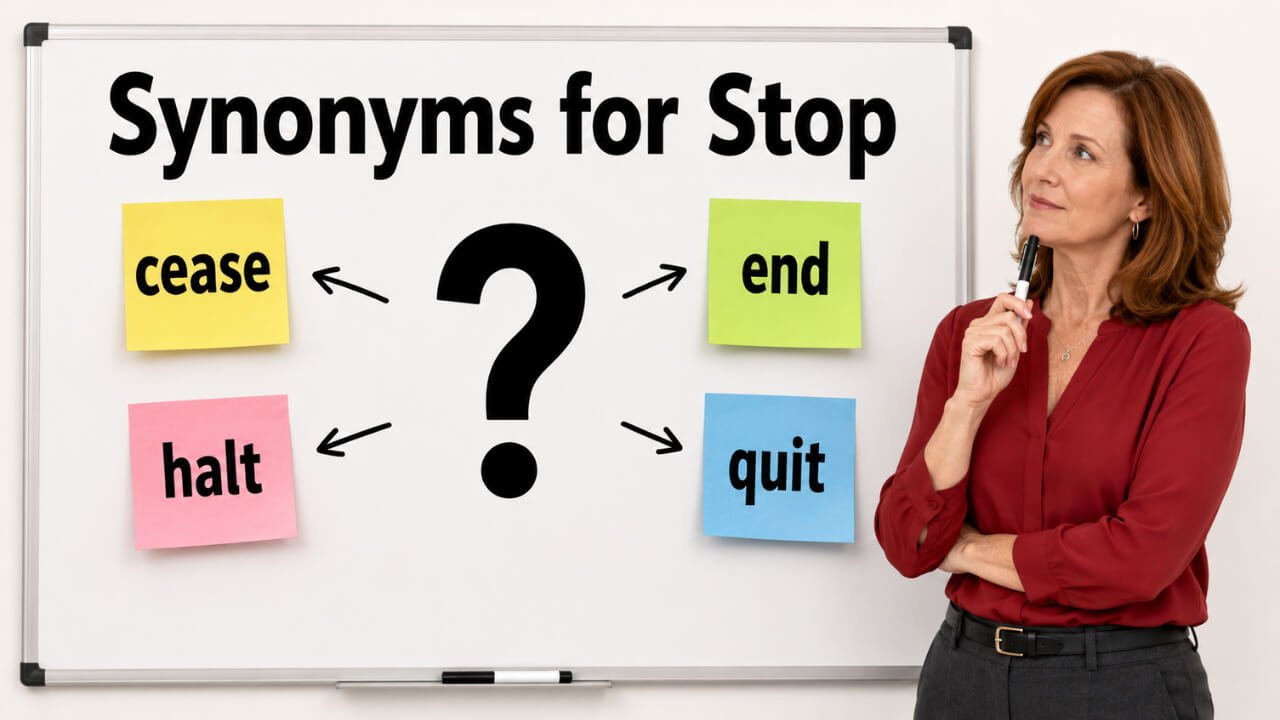
Quick Answer: Synonyms for stop include halt, cease, end, discontinue, pause, suspend, quit, finish, terminate, and prevent. Use halt for movement, cease for formal writing, end for something coming to a close, pause for a temporary break, discontinue for products or habits, terminate for formal closure, and prevent when stop means to keep something from happening.
Pronunciation and Word Details
Word: Stop
Pronunciation: /stɑːp/ or /stɒp/
Part of Speech: Verb and noun
Meaning: Stop means to end an action, movement, process, habit, event, or condition, or to prevent something from continuing or happening.
US Pronunciation:
UK Pronunciation:
What Does “Stop” Mean?
Stop means to bring something to an end, make movement finish, or prevent an action from continuing. It can work as a verb or a noun.
As a verb, stop can mean to quit doing something, make someone quit, end movement, block progress, or prevent an event. For example, a car can stop, a person can stop talking, a rule can stop confusion, and medicine can stop pain.
As a noun, stop can mean a pause, a place where a vehicle halts, or an act of ending something. For example, a bus stop is a place where buses halt, and a full stop marks the end of a sentence.
Meaning, Tone, and Context of “Stop”
Stop is a common, clear, and neutral word. It works in casual speech, formal writing, instructions, grammar, road signs, safety rules, school writing, workplace messages, and daily conversation.
The tone of stop depends on context. It can sound direct in commands, serious in warnings, gentle in advice, technical in instructions, or formal when used in reports. For example, stop shouting sounds direct, while discontinue use sounds more formal.
Stop is commonly used with actions, movement, habits, behavior, machines, conversations, pain, noise, danger, work, travel, and processes. Because it has many meanings, choosing the right synonym depends on whether you mean end, pause, quit, prevent, block, or interrupt.
When and How to Use “Stop”
For Ending an Action: Use stop when someone no longer continues an activity.
Example: Please stop talking during the test.
For Movement: Use stop when a person, vehicle, or object no longer moves.
Example: The train will stop at the next station.
For Temporary Breaks: Use stop when an action pauses for a short time.
Example: We stopped to rest after the long walk.
For Prevention: Use stop when something keeps an event, problem, or result from happening.
Example: Careful planning can stop mistakes before they happen.
For Habits: Use stop when someone quits a repeated action or behavior.
Example: He wants to stop drinking soda every day.
For Formal Closure: Use stop when a service, product, process, or agreement ends.
Example: The company decided to stop the old service.
Best Synonyms for Stop
Halt: To make movement, action, or progress come to an end.
Example: The guard asked the driver to halt at the gate.
Cease: To stop formally or completely.
Example: The noise ceased after midnight.
End: To bring something to a close.
Example: The meeting ended at five.
Discontinue: To stop doing, using, making, or offering something.
Example: The store will discontinue that product next month.
Pause: To stop briefly before continuing.
Example: She paused before answering the question.
Suspend: To stop something temporarily.
Example: The school suspended classes during the storm.
Quit: To stop doing something, especially a job, habit, or activity.
Example: He decided to quit smoking.
Finish: To complete something and stop working on it.
Example: She finished the report before lunch.
Terminate: To formally end something.
Example: The contract was terminated by agreement.
Prevent: To stop something from happening.
Example: Good planning can prevent delays.
50 Synonyms for Stop with Short Meanings
- Halt: To stop movement or progress.
- Cease: To stop completely or formally.
- End: To bring something to a close.
- Discontinue: To stop using, making, or doing something.
- Pause: To stop for a short time.
- Suspend: To stop something temporarily.
- Quit: To stop doing a habit, job, or activity.
- Finish: To complete and stop working on something.
- Terminate: To end something formally.
- Prevent: To stop something from happening.
- Block: To stop movement, access, or progress.
- Interrupt: To stop something briefly by breaking into it.
- Break off: To stop suddenly or end a connection.
- Cut off: To stop supply, speech, contact, or movement.
- Shut down: To stop a machine, system, or operation.
- Close: To stop being open or active.
- Cancel: To stop a planned event or arrangement.
- Abort: To stop a process before it is completed.
- Check: To stop or slow progress.
- Restrain: To stop someone from acting freely.
- Hold back: To stop or delay movement, action, or emotion.
- Keep from: To stop someone or something from doing something.
- Deter: To stop someone by making an action seem unwise.
- Discourage: To stop someone by reducing desire or confidence.
- Forbid: To officially stop someone from doing something.
- Prohibit: To stop something by rule or law.
- Ban: To officially stop an action, item, or practice.
- Inhibit: To slow down or stop a process or action.
- Suppress: To stop, control, or hold back something.
- Quell: To stop unrest, fear, anger, or disorder.
- Stall: To stop or delay progress.
- Delay: To make something happen later.
- Postpone: To stop something from happening until a later time.
- Freeze: To stop movement, change, or activity.
- Arrest: To stop development, progress, or movement.
- Curtail: To reduce or stop part of an activity.
- Eliminate: To remove something completely.
- Remove: To take something away so it no longer affects a situation.
- Abolish: To officially end a system, rule, or practice.
- Drop: To stop doing, using, or discussing something.
- Give up: To stop trying or stop doing something.
- Leave off: To stop doing something.
- Desist: To stop doing something, often by request or order.
- Refrain: To choose not to do something.
- Abstain: To avoid doing or using something by choice.
- Wind up: To bring something to an end.
- Conclude: To finish or bring to a close.
- Come to a standstill: To stop moving or progressing.
- Grind to a halt: To stop slowly or with difficulty.
- Bring to an end: To cause something to finish.
Read Also:
Synonyms for Healthy
Synonyms for Stop by Context
When Stop Means Halt Movement
Use these synonyms when stop means to make a person, vehicle, object, or process no longer move.
Halt: The officer told the truck to halt.
Come to a standstill: Traffic came to a standstill after the crash.
Freeze: Everyone froze when the alarm sounded.
Pull up: The driver pulled up near the entrance.
When Stop Means End an Action
Use these synonyms when stop means to no longer continue an activity, habit, behavior, or task.
Cease: The workers ceased activity after the warning.
Quit: She quit drinking coffee at night.
Leave off: He left off working when it became dark.
Give up: They gave up the old method.
When Stop Means Pause Temporarily
Use these synonyms when the action stops for a short time and may continue later.
Pause: The speaker paused for a moment.
Suspend: The project was suspended until approval arrived.
Delay: The rain delayed the match.
Postpone: The class was postponed until Friday.
When Stop Means Prevent
Use these synonyms when stop means to keep something from happening.
Prevent: A fence can prevent animals from entering.
Block: The filter blocked unwanted messages.
Deter: Strong rules can deter careless behavior.
Keep from: His advice kept me from making a mistake.
When Stop Means Officially End
Use these synonyms when stop means to formally close, cancel, or end something.
Terminate: They terminated the agreement.
Cancel: The event was canceled because of heavy rain.
Abolish: The rule was abolished after many complaints.
Discontinue: The service was discontinued last year.
Another Word for Stop
Another word for stop is halt when the meaning is to end movement or progress. It is a strong, clear replacement in both formal and practical writing. However, the best alternative depends on context. Use pause for a short break, cease for formal writing, quit for habits, and prevent when stop means to keep something from happening.
Original: The car stopped at the red light.
Better Option: The car halted at the red light.
Original: Please stop talking for a moment.
Better Option: Please pause for a moment.
Original: He wants to stop smoking.
Better Option: He wants to quit smoking.
Original: Good rules can stop confusion.
Better Option: Good rules can prevent confusion.
When Not to Use “Stop”
Do not use stop when a more specific word would make the meaning clearer. Stop is useful, but it can sound too basic when writing about formal closure, prevention, delay, temporary breaks, or quitting a habit.
Weak: The company stopped the service.
Better: The company discontinued the service.
Weak: The meeting stopped at noon.
Better: The meeting ended at noon.
Weak: She stopped before answering.
Better: She paused before answering.
Weak: Rules stopped the problem.
Better: Rules prevented the problem.
Weak: He stopped his job last week.
Better: He quit his job last week.
Avoid using stop repeatedly in one paragraph. Replace it with halt, cease, end, pause, prevent, discontinue, terminate, or quit when the sentence needs a sharper meaning.
Words Commonly Confused With Stop
Stop vs Halt: Stop is general and common, while halt often sounds stronger or more formal, especially for movement, progress, or official orders.
Stop vs Cease: Stop works in everyday speech, while cease sounds more formal and often means to stop completely.
Stop vs Pause: Stop can be permanent or temporary, while pause means a short break before continuing.
Stop vs End: Stop focuses on the action of no longer continuing, while end focuses on the final point or close of something.
Stop vs Prevent: Stop can mean to end something already happening, while prevent means to keep something from happening at all.
Stop vs Quit: Stop is general, while quit usually means to stop a habit, job, activity, or repeated behavior by choice.
Stop vs Discontinue: Stop is simple and broad, while discontinue is more formal and often used for products, services, habits, medicines, or official actions.
Which Synonym Should You Choose?
Choose halt when writing about movement, traffic, progress, or sudden stopping.
Choose cease when you need a formal word for something ending completely.
Choose end when writing about meetings, events, stories, periods, or situations that come to a close.
Choose pause when the stopping is temporary and the action may continue.
Choose suspend when a process, service, class, rule, or activity stops for a limited time.
Choose quit when writing about a habit, job, course, activity, or repeated action.
Choose discontinue when writing about products, services, treatments, practices, or official decisions.
Choose terminate when writing about contracts, agreements, employment, or formal closure.
Choose prevent when the meaning is to stop something before it happens.
Choose block when something stops access, movement, progress, or entry.
Real Life Examples of “Stop” in Sentences
Original: The bus stopped near the school.
Better Option: The bus halted near the school.
Original: She stopped speaking when the phone rang.
Better Option: She paused when the phone rang.
Original: The company stopped selling that item.
Better Option: The company discontinued that item.
Original: He stopped smoking last year.
Better Option: He quit smoking last year.
Original: The rain stopped the match.
Better Option: The rain delayed the match.
Original: Good instructions stop mistakes.
Better Option: Good instructions prevent mistakes.
Original: The machine stopped suddenly.
Better Option: The machine shut down suddenly.
Original: The meeting stopped at three.
Better Option: The meeting ended at three.
Original: The rule stops unsafe behavior.
Better Option: The rule prohibits unsafe behavior.
Original: She stopped the argument before it grew worse.
Better Option: She ended the argument before it grew worse.
Synonym Groups and Usage Differences
Movement Group
Words like halt, freeze, come to a standstill, and grind to a halt describe movement that stops. Use them for cars, traffic, machines, people, and progress.
Example: Traffic came to a standstill after the road closed.
Ending Group
Words like end, cease, finish, conclude, and wind up describe something coming to a close. Use them for meetings, events, actions, tasks, and periods of time.
Example: The program concluded after the final speech.
Temporary Break Group
Words like pause, suspend, delay, and postpone describe stopping for a while. Use them when the action may continue later.
Example: The school suspended outdoor activities because of the storm.
Prevention Group
Words like prevent, block, deter, restrain, and keep from show that something is stopped before it happens or before it continues.
Example: Safety rules prevent many accidents.
Official Closure Group
Words like terminate, cancel, discontinue, abolish, and prohibit fit formal, legal, business, or official contexts.
Example: The old policy was abolished after review.
Habit and Choice Group
Words like quit, give up, refrain, abstain, and desist focus on personal choice, behavior, or repeated action.
Example: He refrained from commenting during the discussion.
Antonyms of Stop
Stop has different opposites depending on context. If stop means end an action, the opposite may be start or continue. If stop means prevent, the opposite may be allow or permit. If stop means pause movement, the opposite may be move or proceed.
Start: To begin an action, process, or movement.
Begin: To do the first part of something.
Continue: To keep doing something.
Proceed: To move forward or continue.
Resume: To start again after a pause.
Go: To move or continue.
Advance: To move forward.
Allow: To let something happen.
Permit: To officially allow something.
Encourage: To support or make something more likely.
Enable: To make something possible.
Keep going: To continue without stopping.
Carry on: To continue doing something.
Restart: To begin again after stopping.
Open: To make available or active again.
Comparison: Stop vs Related Words
Stop vs Halt
Stop is the general word for ending movement or action. Halt is stronger and often used for movement, commands, traffic, or progress.
Example With Stop: The car stopped at the gate.
Example With Halt: The car halted at the security gate.
Stop vs Cease
Stop is common in everyday writing. Cease is more formal and often suggests a complete ending.
Example With Stop: The noise stopped after midnight.
Example With Cease: The noise ceased after midnight.
Stop vs Pause
Stop can be permanent or temporary. Pause means to stop briefly and usually continue later.
Example With Stop: She stopped reading the book.
Example With Pause: She paused reading to answer the door.
Stop vs End
Stop focuses on the action of no longer continuing. End focuses on the final point or conclusion.
Example With Stop: They stopped the game because of rain.
Example With End: The game ended because of rain.
Stop vs Prevent
Stop can mean ending something already happening. Prevent means stopping something before it happens.
Example With Stop: The teacher stopped the argument.
Example With Prevent: Clear rules prevented the argument.
Stop vs Quit
Stop is broader. Quit often means to leave a job, habit, course, or activity by choice.
Example With Stop: He stopped working at six.
Example With Quit: He quit his job last month.
Common Phrases and Expressions With Stop
Stop Talking: To no longer speak.
Stop Working: To no longer function or continue working.
Stop Moving: To become still.
Stop By: To visit briefly.
Stop Over: To stay somewhere briefly during travel.
Full Stop: A punctuation mark that ends a sentence.
Bus Stop: A place where buses halt for passengers.
Stop Sign: A road sign that tells drivers to halt.
Stop at Nothing: To do anything necessary to reach a goal.
Put a Stop To: To end or prevent something.
Common Mistakes to Avoid
A common mistake is using stop when the sentence needs a more exact synonym. Use pause when the action is temporary, quit for habits or jobs, prevent for something that has not happened yet, and terminate for formal endings.
Another mistake is confusing stop and end. You can stop an action, but an event ends. For example, the speaker stopped talking is natural, and the speech ended is more natural than the speech stopped in formal writing.
Avoid vague phrases like stop the thing or stop the problem. Write end the argument, prevent the error, block access, or discontinue the service. Clear synonym choice makes writing stronger and easier to understand.
Conclusion
Synonyms for stop help you describe ending, pausing, preventing, blocking, quitting, and formal closure with better accuracy. Use halt for movement, cease for formal endings, pause for temporary breaks, quit for habits, discontinue for products or services, and prevent when something is stopped before it happens. The best synonym depends on whether the action is ending completely, stopping briefly, being blocked, or being avoided.
FAQs About Synonyms for Stop
What are the best synonyms for stop?
The best synonyms for stop are halt, cease, end, discontinue, pause, suspend, quit, finish, terminate, and prevent.
What is another word for stop in formal writing?
In formal writing, use cease, terminate, discontinue, suspend, prohibit, or conclude, depending on the sentence.
What is another word for stop temporarily?
Another word for stop temporarily is pause. You can also use suspend, delay, or postpone when the action may continue later.
What is another word for stop moving?
Another word for stop moving is halt. You can also use come to a standstill, freeze, or pull up, depending on the situation.
What is another word for stop doing something?
Another word for stop doing something is quit. You can also use cease, give up, leave off, desist, or refrain.
Is prevent the same as stop?
Prevent is related to stop, but it means to stop something before it happens. Stop can mean ending something that is already happening.
What is the opposite of stop?
The opposite of stop can be start, begin, continue, proceed, resume, allow, or permit, depending on the meaning.
