
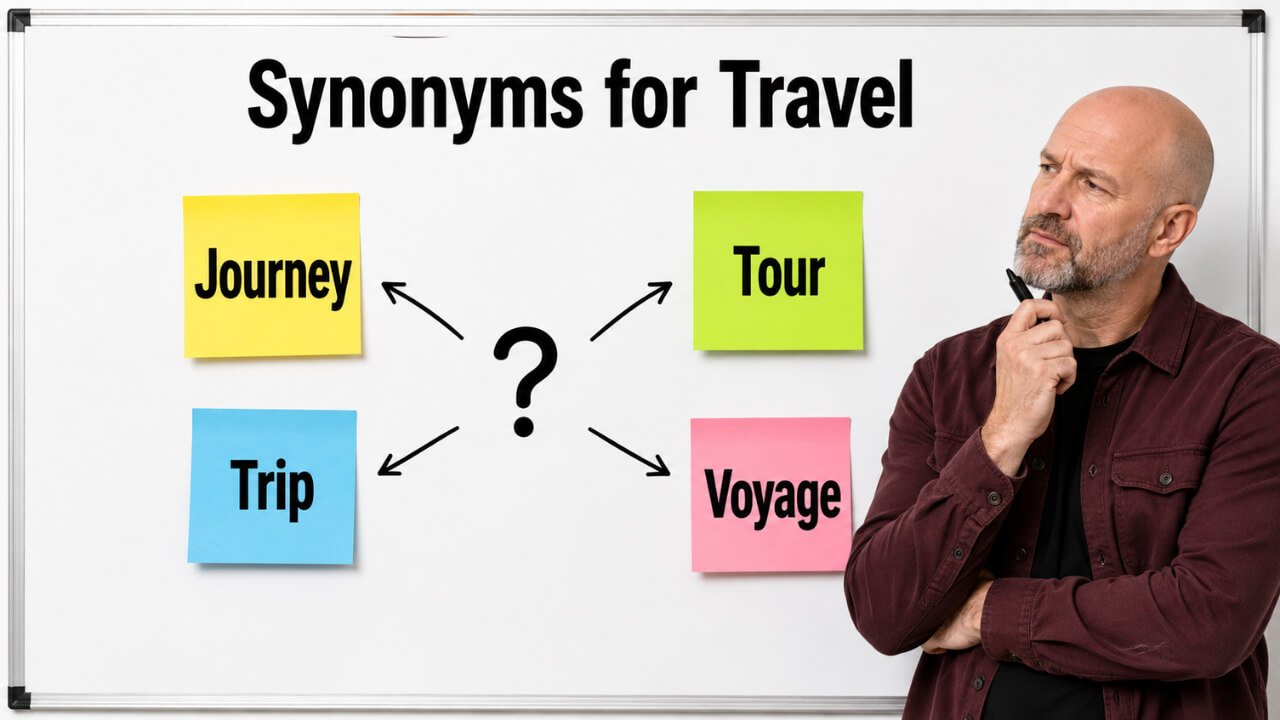
Quick Answer: The best synonyms for travel include journey, trip, tour, voyage, excursion, expedition, commute, trek, roam, and migrate. The keyword synonyms for travel helps readers choose a more exact word for going from one place to another. Use journey for meaningful or long movement, trip for casual speech, tour for sightseeing, voyage for sea or space movement, commute for daily work travel, expedition for planned exploration, and migrate for movement to another region.
Pronunciation and Word Details
Word: Travel
Pronunciation: /ˈtrævəl/
Part of Speech: Noun and verb
Meaning: Travel means to go from one place to another, especially over a distance.
US Pronunciation:
UK Pronunciation:
What Does “Travel” Mean?
Travel means to move from one place to another. It can work as a verb, as in “They travel every summer,” or as a noun, as in “Travel teaches patience and planning.” The word is used for vacations, business trips, tourism, daily movement, transportation, adventure, migration, and exploration. In different sentence contexts, travel can describe the action of going somewhere, the habit of visiting places, the experience of movement, or the general activity of moving across distance.
Meaning, Tone, and Context of “Travel”
Travel has a neutral, clear, and flexible tone. It is common in casual speech, formal writing, tourism writing, business communication, school essays, reports, and everyday conversation. The word is not strongly emotional by itself, but the context can make it sound exciting, practical, personal, or serious. In formal writing, journey, transit, transportation, or migration may be more exact. In casual speech, trip, visit, ride, or drive often sounds more natural. In descriptive writing, voyage, trek, roam, or expedition can add stronger detail.
When and How to Use “Travel”
For General Movement: Use travel when someone goes from one place to another and the exact method is not the main focus.
Example: Many families travel during the summer break.
For Tourism: Use travel when someone visits places for pleasure, culture, rest, or learning.
Example: She loves to travel and learn about local traditions.
For Work: Use travel when movement is connected to a job, meeting, project, or professional duty.
Example: His new position requires him to travel every month.
For Distance: Use travel when the movement covers a noticeable distance.
Example: They traveled across the country by train.
For Method: Use a more specific synonym when the way of moving matters.
Example: We flew to the city and then drove to the village.
For Life Experience: Use travel when movement also suggests growth, memory, discovery, or learning.
Example: Travel helped her understand different cultures and lifestyles.
Best Synonyms for Travel
Journey: A long or meaningful act of going from one place to another.
Example: Their journey through the mountains lasted five days.
Trip: A visit or movement to a place, usually for a short time.
Example: We planned a weekend trip to the lake.
Tour: A planned visit to several places, often for sightseeing or learning.
Example: The visitors took a tour of the old city.
Voyage: A long journey, especially by sea, air, or space.
Example: The ship began its voyage before sunrise.
Excursion: A short journey made for pleasure, study, or a special purpose.
Example: The class went on an excursion to the museum.
Expedition: A planned journey for adventure, research, or exploration.
Example: The team prepared for an expedition into the desert.
Commute: Regular travel between home and work, school, or another repeated place.
Example: Her daily commute takes almost one hour.
Trek: A long and difficult journey, often on foot.
Example: They made a tiring trek through the forest.
Roam: To travel freely without a fixed route or clear destination.
Example: The writer liked to roam through quiet villages.
Migrate: To move from one region to another for living, work, climate, or survival.
Example: Many birds migrate when the weather changes.
50 Synonyms for Travel with Short Meanings
- Journey: A trip from one place to another, often long or meaningful.
- Trip: A short or planned visit to a place.
- Tour: Travel through several places, usually for sightseeing.
- Voyage: A long journey by sea, air, or space.
- Excursion: A short journey for pleasure, study, or a special event.
- Expedition: A planned journey for exploration, research, or adventure.
- Commute: Regular travel between home and work or school.
- Trek: A long and difficult journey, usually on foot.
- Pilgrimage: A journey to a sacred or deeply meaningful place.
- Odyssey: A long journey full of events, difficulty, or discovery.
- Cruise: Travel by ship for pleasure.
- Flight: Travel by airplane.
- Ride: Travel in or on a vehicle, animal, or bicycle.
- Drive: Travel by car or another road vehicle.
- Walk: Travel on foot.
- Hike: Travel on foot, often in nature or on trails.
- Sail: Travel by boat or ship.
- Roam: Travel freely without a fixed plan.
- Wander: Move from place to place without a clear direction.
- Migrate: Move from one region to another for living or survival.
- Move: Change location from one place to another.
- Transit: Travel through a route, system, or place.
- Transportation: Movement of people or goods from one place to another.
- Passage: A journey through, across, or beyond a place.
- Crossing: Travel from one side to another.
- Touring: Traveling around a place to see it.
- Journeying: The act of making a journey.
- Voyaging: Traveling on a long journey, often across water.
- Cruising: Traveling smoothly by ship, car, or airplane.
- Flying: Traveling through the air by airplane.
- Driving: Traveling by operating a vehicle.
- Riding: Traveling as a passenger or on a bike, horse, or vehicle.
- Sailing: Traveling across water by boat or ship.
- Walking: Traveling by foot at a normal pace.
- Hiking: Walking a long distance, especially outdoors.
- Trekking: Making a long and challenging journey.
- Roving: Moving from place to place without staying long.
- Rambling: Walking or traveling in a relaxed, unplanned way.
- Globetrotting: Traveling widely around the world.
- Sightseeing: Traveling to see interesting places.
- Exploring: Traveling to learn about a place.
- Going: Moving toward a place.
- Relocating: Moving to a new place to live or work.
- Proceeding: Moving forward or continuing on a route.
- Passing: Moving through or by a place.
- Traversing: Traveling across or through an area.
- Wayfaring: Traveling on foot from place to place.
- Adventuring: Traveling with excitement, risk, or discovery.
- Peregrination: A formal word for a long journey or wandering.
- Tourism: Travel for pleasure, culture, or recreation.
Read Also:
Synonyms for Culture

Synonyms for Travel by Context
When Travel Means a General Trip
Use trip, journey, visit, tour, or outing when travel means going somewhere for a specific reason. Trip is the most natural choice in casual speech, while journey can sound longer or more meaningful.
Example: We took a short trip to the coast.
Example: Her journey across the country changed her outlook.
When Travel Means a Long Distance Journey
Use journey, voyage, expedition, trek, or odyssey when travel is long, distant, difficult, or important. These words add more weight and detail than the general word travel.
Example: The explorers began a dangerous expedition.
Example: His odyssey through several countries became a powerful story.
When Travel Means Daily Movement
Use commute, transit, ride, drive, or transportation when travel is regular, practical, or connected to work and school.
Example: My commute is easier by train.
Example: Public transit helps many workers reach the city.
When Travel Means Pleasure or Tourism
Use tour, excursion, cruise, sightseeing, or tourism when travel is for enjoyment, rest, learning, or culture.
Example: The family enjoyed a sightseeing tour.
Example: They booked a cruise for their vacation.
When Travel Means Free Movement
Use roam, wander, rove, ramble, or explore when travel has no strict route, schedule, or destination.
Example: He liked to wander through quiet streets.
Example: They roamed the countryside for hours.
When Travel Means Moving to Another Region
Use migrate, relocate, move, or resettle when travel involves a longer change of place. These words are useful for people, animals, work, climate, safety, and settlement.
Example: Some families relocate for better work opportunities.
Example: Birds migrate to warmer regions in winter.
Another Word for Travel
Another word for travel is journey. It is often the best single replacement because it can describe movement, distance, and experience. However, the best alternative depends on context. Use trip for casual plans, commute for regular work movement, voyage for sea or space movement, and tour for visiting several places.
Original: We will travel to the mountains tomorrow.
Better Option: We will journey to the mountains tomorrow.
Original: She travels to work by bus.
Better Option: She commutes to work by bus.
Original: They traveled around the old city.
Better Option: They toured the old city.
Original: The ship traveled across the ocean.
Better Option: The ship voyaged across the ocean.
When Not to Use “Travel”
Do not use travel when a more specific word would make the meaning clearer. Travel can sound weak, repetitive, or unclear if you mean a short vacation, daily work movement, walking, flying, touring, or moving permanently. It may also sound too general in essays, reports, travel writing, or storytelling. Choose a sharper synonym when the purpose, distance, method, or mood matters.
Weak: I travel to work every morning.
Better: I commute to work every morning.
Weak: We traveled around the museum.
Better: We toured the museum.
Weak: They traveled through the forest on foot.
Better: They trekked through the forest on foot.
Weak: The birds travel south every winter.
Better: The birds migrate south every winter.
Words Commonly Confused With Travel
Travel vs Trip: Travel is the general act of going from one place to another, while trip means one specific visit or journey.
Travel vs Journey: Travel is broad and neutral, while journey often sounds longer, deeper, or more meaningful.
Travel vs Tour: Travel can mean any movement, while tour means visiting several places, usually with a plan or purpose.
Travel vs Voyage: Travel is general, while voyage usually means a long journey by sea, air, or space.
Travel vs Commute: Travel can happen for many reasons, while commute means regular movement between home and work or school.
Travel vs Migration: Travel may be temporary, while migration usually means movement to another region for living, work, climate, or survival.
Travel vs Transportation: Travel focuses on the act or experience of moving, while transportation often refers to systems, vehicles, or the movement of people and goods.
Which Synonym Should You Choose?
Choose journey when writing about a long, meaningful, personal, or emotional experience.
Choose trip when writing about a short visit, casual plan, vacation, or simple movement.
Choose tour when writing about sightseeing, organized visits, or movement through several places.
Choose voyage when writing about long travel by sea, air, or space.
Choose commute when writing about daily movement to work, school, or a regular destination.
Choose trek when writing about a difficult journey, especially on foot or through rough places.
Choose excursion when writing about a short outing for pleasure, learning, or a group activity.
Choose expedition when writing about planned exploration, research, adventure, or fieldwork.
Choose roam when writing about free movement without a fixed route.
Choose migrate when writing about people, animals, or birds moving to another region for living or survival.
Real Life Examples of “Travel” in Sentences
Original: We travel to the beach every summer.
Better Option: We take a trip to the beach every summer.
Original: She travels to work by train.
Better Option: She commutes to work by train.
Original: The scientists traveled into the rainforest.
Better Option: The scientists went on an expedition into the rainforest.
Original: They traveled across the ocean.
Better Option: They voyaged across the ocean.
Original: He traveled through the hills on foot.
Better Option: He trekked through the hills on foot.
Original: The tourists traveled around the city.
Better Option: The tourists toured the city.
Original: The children traveled to the zoo for the day.
Better Option: The children went on an excursion to the zoo for the day.
Original: Some animals travel to warmer places in winter.
Better Option: Some animals migrate to warmer places in winter.
Original: She likes to travel without a fixed plan.
Better Option: She likes to roam without a fixed plan.
Original: His dream is to travel around the world.
Better Option: His dream is to go globetrotting around the world.
Synonym Groups and Usage Differences
General Movement Group
Words like journey, trip, go, move, and proceed describe basic movement from one place to another. These words are useful when the route, method, or purpose is not the main focus.
Example: We will journey north before sunset.
Tourism Group
Words like tour, sightseeing, excursion, cruise, and tourism are best for leisure, culture, learning, and vacation related writing. They suggest planned visits, enjoyment, or discovery.
Example: The visitors enjoyed a tour of the historic district.
Work and Routine Group
Words like commute, transit, transportation, drive, and ride fit regular or practical movement. These choices are useful in everyday, business, school, and city related contexts.
Example: Her commute became shorter after she moved closer to the office.
Adventure Group
Words like expedition, trek, hike, odyssey, and adventuring suggest challenge, discovery, or risk. They are stronger than travel and often create a more vivid image.
Example: The group began a trek across the rocky trail.
Free Movement Group
Words like roam, wander, rove, ramble, and explore suggest loose movement without a strict plan. These words fit creative, casual, and descriptive writing.
Example: They wandered through the market after lunch.
Relocation and Migration Group
Words like migrate, relocate, move, and resettle refer to changing location for a longer purpose. These words are useful for people, animals, jobs, climate, and settlement.
Example: Many birds migrate when temperatures drop.
Antonyms of Travel
Stay: To remain in one place.
Remain: To continue being in the same location.
Settle: To make a long term home in one place.
Stop: To end movement.
Halt: To pause or bring movement to an end.
Rest: To stop moving and relax.
Wait: To stay in a place until something happens.
Reside: To live in a place.
Dwell: To live or stay in a location.
Remain Still: To avoid movement.
Comparison of Travel and Related Words
Travel vs Journey
Travel is broad and can describe any movement from one place to another. Journey often suggests a longer trip or a meaningful experience.
Example With Travel: They travel to different cities for work.
Example With Journey: Their journey through the desert took two weeks.
Travel vs Trip
Travel can describe the general activity of going places. Trip usually means one specific visit, vacation, or planned movement.
Example With Travel: Travel helps people learn about new cultures.
Example With Trip: Our trip to the mountains was peaceful.
Travel vs Tour
Travel means going from one place to another. Tour means visiting places in an organized or sightseeing focused way.
Example With Travel: We travel whenever we get time.
Example With Tour: We toured the old palace in the afternoon.
Travel vs Voyage
Travel is common and general. Voyage is more formal and usually refers to a long journey by sea, air, or space.
Example With Travel: The team traveled across the ocean.
Example With Voyage: The sailors began their voyage before dawn.
Travel vs Commute
Travel can happen for any reason. Commute means regular travel between home and work, school, or another repeated destination.
Example With Travel: He travels often for meetings.
Example With Commute: He commutes by bus every morning.
Travel vs Migrate
Travel may be temporary or short term. Migrate usually means moving to another region for living, climate, work, or survival.
Example With Travel: The family traveled to another country for a holiday.
Example With Migrate: Many birds migrate south in winter.
Common Phrases and Expressions With Travel
Travel Light: To travel with few bags or belongings.
Travel Abroad: To go to another country.
Travel Around: To visit different places.
Travel Far: To go a long distance.
Travel Safely: To move from place to place without danger.
Travel Plans: Arrangements for a trip or journey.
Travel Time: The amount of time needed to reach a place.
Travel Route: The path used to reach a destination.
Travel Experience: Knowledge, memory, or understanding gained from traveling.
Travel Companion: A person who travels with someone.
Common Mistakes to Avoid
Using Travel Too Often: Repeating travel in every sentence can make writing sound flat. Use trip, journey, tour, commute, or voyage when they fit better.
Choosing a Synonym Without Context: Do not use voyage for a short car ride or commute for a vacation. Each synonym has a specific meaning.
Confusing Travel and Trip: Travel is a general activity, while trip is one specific visit or journey.
Using Journey for Every Situation: Journey sounds meaningful or long. It may feel too dramatic for a simple visit to a nearby store.
Ignoring Method of Movement: Use fly, drive, walk, ride, or sail when the method matters.
Using Migration for Temporary Travel: Migration usually means moving to another region for a longer reason, not taking a short holiday.
Making Sentences Too Vague: Instead of saying someone traveled, explain whether they toured, trekked, commuted, explored, or relocated.
Conclusion
Synonyms for travel help you describe movement with better accuracy, variety, and style. Use trip for casual visits, journey for meaningful movement, tour for sightseeing, voyage for long sea or space travel, commute for regular work movement, and expedition for planned exploration. Words like roam, wander, trek, and migrate add more detail when the purpose or style of movement matters. The best choice depends on distance, method, mood, and reason for going.
FAQs About Synonyms for Travel
What are the best synonyms for travel?
The best synonyms for travel are journey, trip, tour, voyage, excursion, expedition, commute, trek, roam, and migrate.
What is another word for travel?
Another word for travel is journey. It works well when you mean going from one place to another, especially over a distance.
What is a formal synonym for travel?
A formal synonym for travel is journey. Other formal options include voyage, expedition, transit, transportation, and migration.
What is a casual synonym for travel?
A casual synonym for travel is trip. You can also use go, visit, drive, ride, or walk, depending on the sentence.
What is the difference between travel and journey?
Travel is a general word for movement from one place to another. Journey often suggests a longer, more meaningful, or more difficult experience.
What is the best synonym for travel in business writing?
Commute, transit, business trip, transportation, and travel are useful in business writing. Choose commute for daily work movement and business trip for work related visits.
Can travel be used as both a noun and a verb?
Yes. Travel can be a verb, as in “They travel often,” and a noun, as in “Travel can be expensive.”
