
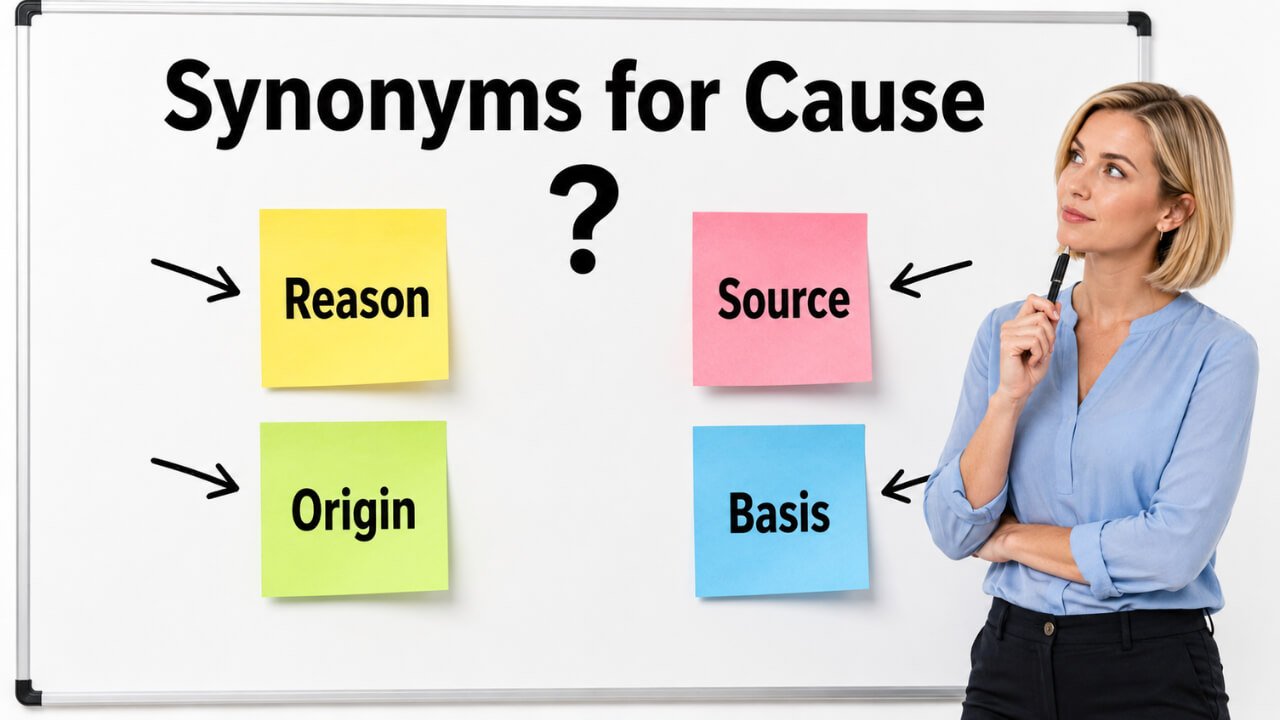
Quick Answer: Synonyms for cause include reason, source, origin, factor, trigger, motive, basis, ground, purpose, and lead to. Use reason for everyday explanations, source for where something begins, origin for the starting point, factor for one part of a result, trigger for something that starts a reaction, motive for why someone acts, basis for support or foundation, ground for formal justification, purpose for intention, and lead to when cause is used as a verb.
Pronunciation and Word Details
Word: Cause
Pronunciation: /kɔːz/
Part of Speech: Noun and verb
Meaning: A cause is the reason something happens, and to cause means to make something happen.
US Pronunciation:
UK Pronunciation:
What Does “Cause” Mean?
Cause means the reason, source, or action that makes something happen. As a noun, it refers to the reason behind an event, problem, result, feeling, or situation. As a verb, it means to create, produce, bring about, or make something happen.
Cause is used in everyday speech, academic writing, reports, essays, health discussions, problem solving, legal writing, and social topics. In one sentence, cause may mean a reason, such as the cause of stress. In another sentence, it may mean an action, such as heavy rain caused flooding. It can also mean a belief or purpose that people support, such as a noble cause.
Meaning, Tone, and Context of “Cause”
Cause is a neutral word. It can sound simple in conversation, serious in reports, and analytical in academic writing. It is common when explaining why something happened or what produced a result.
In formal writing, cause often appears in cause and effect discussions, research, analysis, and problem statements. In casual speech, people use it to explain everyday situations, such as the cause of a delay or the cause of a mistake. In emotional or social writing, cause can also mean a purpose, mission, or public issue that people care about.
The tone depends on context. Cause can be technical when used in science or research, serious when discussing harm or problems, and positive when describing a meaningful purpose.
When and How to Use “Cause”
For Explaining a Reason: Use cause when you want to identify why something happened.
Example: The main cause of the delay was heavy traffic.
For Showing an Effect: Use cause as a verb when one action creates a result.
Example: Lack of sleep can cause poor concentration.
For Problem Analysis: Use cause when discussing the root of a problem, mistake, failure, or issue.
Example: The team investigated the cause of the system error.
For Academic Writing: Use cause in essays, research, and reports to explain relationships between events.
Example: The study examined the causes of stress among students.
For Social Purpose: Use cause when referring to a mission, belief, or public issue people support.
Example: Many volunteers worked together for a good cause.
For Legal or Formal Context: Use cause when discussing grounds, justification, or a reason for action.
Example: The complaint gave the court cause to review the case.
Best Synonyms for Cause
Reason: The explanation for why something happens.
Example: The reason for the delay was a power failure.
Source: The place, person, or thing something comes from.
Example: The source of the noise was a broken fan.
Origin: The beginning or starting point of something.
Example: Researchers studied the origin of the disease.
Factor: One thing that helps produce a result.
Example: Poor planning was a major factor in the failure.
Trigger: Something that starts a reaction or event.
Example: A sudden sound can trigger fear in some people.
Motive: The reason behind a person’s action or decision.
Example: The police searched for a motive behind the crime.
Basis: The foundation or main support for an idea, belief, or decision.
Example: The report became the basis for the new policy.
Ground: A formal reason or justification for an action.
Example: There were clear grounds for concern.
Purpose: The aim, intention, or reason for doing something.
Example: The purpose of the meeting was to solve the issue.
Lead to: To cause a result or make something happen.
Example: Poor communication can lead to serious mistakes.
50 Synonyms for Cause with Short Meanings
- Reason: An explanation for why something happens.
- Source: The place or thing something comes from.
- Origin: The beginning or starting point.
- Factor: One part that helps create a result.
- Trigger: Something that starts a reaction.
- Motive: The reason behind an action.
- Basis: The foundation for a decision or idea.
- Ground: A formal reason or justification.
- Purpose: The intention behind an action.
- Root: The deepest or main cause.
- Root Cause: The basic reason behind a problem.
- Explanation: A statement that makes the reason clear.
- Justification: A reason used to support an action.
- Rationale: A logical reason for a decision.
- Incentive: A reason that encourages action.
- Influence: Something that affects a result.
- Driver: A strong force behind change or action.
- Determinant: A factor that strongly shapes an outcome.
- Contributor: Something that helps produce a result.
- Catalyst: Something that starts or speeds up change.
- Stimulus: Something that causes a response.
- Impulse: A sudden reason or urge to act.
- Provocation: Something that causes a reaction, often anger.
- Agent: Something that produces an effect.
- Force: Power that causes change or movement.
- Condition: A situation that helps something happen.
- Circumstance: A fact or condition connected to an event.
- Background: Earlier conditions that explain a situation.
- Foundation: The base on which something depends.
- Premise: An idea or fact used as a starting point.
- Case: A reason or argument for something.
- Issue: A matter or problem that creates concern.
- Mission: A purpose or important goal.
- Aim: A goal or intended result.
- Objective: A planned goal or purpose.
- Principle: A belief that supports action.
- Belief: An idea that guides a person or group.
- Campaign: Organized action for a purpose.
- Movement: A group effort for a shared cause.
- Interest: A concern or goal someone supports.
- Produce: To make something happen or exist.
- Create: To bring something into existence.
- Generate: To produce a result, feeling, or effect.
- Bring About: To make something happen.
- Lead To: To result in something.
- Result In: To have a particular outcome.
- Give Rise To: To cause something to begin.
- Spark: To start something suddenly.
- Provoke: To cause a strong reaction.
- Prompt: To cause or encourage an action.
Read Also:
Synonyms for Travel

Synonyms for Cause by Context
When Cause Means Reason
Use reason when you want a simple, clear word for why something happened. It is natural in everyday speech and writing.
Synonyms: Reason, explanation, rationale, justification, ground.
Example: The reason for her absence was a family emergency.
When Cause Means Source
Use source when you mean the place, person, thing, or condition something comes from. It is useful for problems, sounds, data, emotions, and events.
Synonyms: Source, origin, root, foundation, background.
Example: The source of the problem was a missing file.
When Cause Means Factor
Use factor when one thing contributes to a larger result. This word works well in reports, analysis, research, and essays.
Synonyms: Factor, contributor, influence, determinant, condition.
Example: Weather was an important factor in the accident.
When Cause Means Trigger
Use trigger when something starts a reaction, event, feeling, or chain of events. It often suggests a sudden beginning.
Synonyms: Trigger, catalyst, stimulus, spark, provocation.
Example: One small error triggered a larger problem.
When Cause Means Motive
Use motive when discussing the reason behind a person’s behavior, decision, or action.
Synonyms: Motive, purpose, aim, objective, incentive.
Example: The investigator wanted to understand the motive behind the act.
When Cause Means Public Purpose
Use cause when talking about a mission, belief, charity, movement, or social goal.
Synonyms: Mission, movement, campaign, principle, interest.
Example: They raised money for an important cause.
When Cause Means Make Happen
Use lead to, produce, create, generate, or bring about when cause is used as a verb.
Synonyms: Lead to, produce, create, generate, bring about.
Example: Poor planning can lead to costly delays.
Another Word for Cause
Another word for cause is reason when you mean why something happened. However, the best alternative depends on context. Use source for the starting point, factor for one part of a result, trigger for something that starts a reaction, and lead to when cause is used as a verb.
Original: The cause of the noise was unclear.
Better Option: The source of the noise was unclear.
Original: Stress can cause headaches.
Better Option: Stress can lead to headaches.
Original: The main cause of the mistake was poor communication.
Better Option: The main reason for the mistake was poor communication.
Original: Several causes helped create the problem.
Better Option: Several factors helped create the problem.
When Not to Use “Cause”
Do not use cause when a more specific word would explain the idea better. Cause can sound too general in academic writing, reports, medical explanations, and problem analysis. If you mean the exact starting point, use source or origin. If you mean one part of a result, use factor. If you mean an intention, use motive or purpose.
Weak: The cause of the change was money.
Better: The main factor behind the change was money.
Weak: The cause of his decision was unclear.
Better: The motive behind his decision was unclear.
Weak: The cause of the smell was the kitchen.
Better: The source of the smell was the kitchen.
Weak: The new rule caused many discussions.
Better: The new rule prompted many discussions.
Weak: The illness was caused by several causes.
Better: The illness resulted from several factors.
Words Commonly Confused With Cause
Cause vs Reason: Cause can mean the thing that makes something happen, while reason usually means the explanation for why something happened.
Cause vs Source: Cause explains why something happens, while source points to where something begins or comes from.
Cause vs Origin: Cause explains the reason behind an event, while origin means the starting point or beginning.
Cause vs Factor: Cause may be the main reason, while factor is one part that helps create a result.
Cause vs Trigger: Cause can be general, while trigger means something that starts a reaction or event suddenly.
Cause vs Motive: Cause can apply to events and results, while motive applies mainly to human action and intention.
Cause vs Purpose: Cause explains why something happens, while purpose explains why someone does something.
Cause vs Effect: Cause is the reason something happens, while effect is the result that happens afterward.
Which Synonym Should You Choose?
Choose reason when you need a simple and natural explanation for why something happened.
Choose source when you want to show where a problem, sound, idea, feeling, or event began.
Choose origin when writing about the beginning or historical starting point of something.
Choose factor when discussing one part of a larger result in essays, reports, or analysis.
Choose trigger when something starts a reaction, emotion, event, or chain of events.
Choose motive when explaining why a person acted in a certain way.
Choose basis when describing the foundation for an idea, decision, belief, or argument.
Choose ground when you need a formal reason or legal justification.
Choose purpose when explaining intention, goal, or aim.
Choose lead to when cause is used as a verb and you want to show a result.
Real Life Examples of “Cause” in Sentences
Original: The cause of the fire is still unknown.
Better Option: The source of the fire is still unknown.
Original: Poor sleep can cause low energy.
Better Option: Poor sleep can lead to low energy.
Original: The main cause of the argument was a misunderstanding.
Better Option: The main reason for the argument was a misunderstanding.
Original: Several causes affected the final result.
Better Option: Several factors affected the final result.
Original: The loud noise caused panic in the room.
Better Option: The loud noise triggered panic in the room.
Original: The cause of his actions was not clear.
Better Option: The motive behind his actions was not clear.
Original: Heavy rain caused flooding in the streets.
Better Option: Heavy rain produced flooding in the streets.
Original: The new policy caused confusion among employees.
Better Option: The new policy generated confusion among employees.
Original: They worked hard for a cause they believed in.
Better Option: They worked hard for a mission they believed in.
Original: The report explains the cause of the problem.
Better Option: The report explains the root cause of the problem.
Synonym Groups and Usage Differences
Reason Group
This group includes words that explain why something happened. Reason, explanation, rationale, and justification are useful when you need clarity and logic.
Example: The report gave a clear explanation for the delay.
Source Group
This group points to where something begins. Source, origin, root, and foundation are helpful when finding the starting point of an issue.
Example: The engineer found the source of the leak.
Factor Group
This group is useful when more than one thing helps create a result. Factor, contributor, influence, and determinant are common in analysis and research.
Example: Lack of training was a major contributor to the mistake.
Trigger Group
This group is used for sudden reactions or events. Trigger, spark, catalyst, stimulus, and provocation show what starts something.
Example: The announcement sparked a strong public response.
Motive Group
This group explains human intention. Motive, purpose, aim, objective, and incentive work well when discussing actions and decisions.
Example: Her main motive was to protect her family.
Result Group
This group is for cause as a verb. Lead to, result in, produce, generate, and bring about show that one thing creates another.
Example: Better planning can lead to better results.
Public Purpose Group
This group relates to social, moral, or charitable goals. Mission, movement, campaign, principle, and belief are useful alternatives.
Example: The volunteers supported a meaningful mission.
Antonyms of Cause
Effect: The result created by a cause.
Result: What happens because of an action or condition.
Outcome: The final effect of a situation or process.
Consequence: A result, often one that follows an action.
Response: A reaction to something that happened.
Solution: Something that fixes a problem instead of creating it.
Prevention: Action that stops something from happening.
Cure: Something that removes or treats a problem.
Remedy: A way to correct or improve a problem.
End: The point where something stops rather than begins.
Comparison: Cause vs Related Words
Cause vs Reason
Cause is the thing that makes something happen. Reason is the explanation that helps people understand why it happened.
Example With Cause: The cause of the accident was poor visibility.
Example With Reason: The reason for the accident was poor visibility.
Cause vs Source
Cause explains why something happens. Source identifies where something comes from or begins.
Example With Cause: The cause of the illness was unclear.
Example With Source: The source of the illness was unclear.
Cause vs Origin
Cause focuses on why an event or result happened. Origin focuses on the beginning or early history of something.
Example With Cause: The cause of the conflict was a broken agreement.
Example With Origin: The origin of the conflict goes back many years.
Cause vs Factor
Cause can refer to the main reason. Factor usually means one part of a larger situation.
Example With Cause: The cause of the delay was a damaged road.
Example With Factor: Weather was one factor in the delay.
Cause vs Trigger
Cause can be broad and general. Trigger means something that starts a reaction, often quickly or suddenly.
Example With Cause: The cause of her stress was heavy work.
Example With Trigger: The sudden message triggered her stress.
Cause vs Motive
Cause can describe events, actions, or conditions. Motive describes the reason behind a person’s action.
Example With Cause: The cause of the damage was strong wind.
Example With Motive: His motive for leaving was personal safety.
Cause vs Purpose
Cause explains why something happens. Purpose explains what someone wants to achieve.
Example With Cause: The cause of the meeting was a serious complaint.
Example With Purpose: The purpose of the meeting was to solve the complaint.
Common Phrases and Expressions With Cause
Cause and Effect: The relationship between why something happens and what happens after it.
Root Cause: The deepest or basic reason behind a problem.
Main Cause: The most important reason for something.
Possible Cause: A reason that may explain something.
Common Cause: A reason that often leads to a result.
Cause Concern: To create worry or fear.
Cause Problems: To create difficulties.
Cause Damage: To harm something or make it worse.
Cause Confusion: To make something unclear or difficult to understand.
Good Cause: A helpful, moral, or meaningful purpose.
Common Mistakes to Avoid
A common mistake is using cause too many times in one paragraph. Repeating the word can make writing sound plain. Use reason, source, factor, trigger, or result in when the meaning is more specific.
Another mistake is confusing cause with effect. The cause is why something happens. The effect is what happens after it. For example, heavy rain is the cause, while flooding is the effect.
Avoid using cause when motive is more accurate. Motive refers to a person’s reason for acting. Also avoid using cause when purpose is better, because purpose means the goal someone wants to achieve. Clear word choice helps readers understand whether you mean a reason, starting point, intention, or result.
Conclusion
Synonyms for cause help you explain reasons, sources, factors, motives, triggers, and results with better accuracy. Cause is useful in everyday writing, but words like reason, source, origin, factor, trigger, motive, basis, ground, purpose, and lead to often make sentences clearer. Choose reason for simple explanations, source for beginnings, factor for analysis, trigger for reactions, and motive for human intention. A precise synonym makes your writing stronger, more natural, and easier to understand.
FAQs About Synonyms for Cause
What are the best synonyms for cause?
The best synonyms for cause are reason, source, origin, factor, trigger, motive, basis, ground, purpose, and lead to. The right choice depends on the sentence.
What is another word for cause in writing?
Reason is the most common replacement for cause. In formal writing, you can also use source, factor, basis, rationale, or ground.
What is a synonym for cause as a verb?
Good synonyms for cause as a verb include lead to, produce, create, generate, bring about, result in, prompt, and trigger.
What is a synonym for the main cause?
Root cause is a strong phrase for the main or deepest cause. You can also use primary reason, main factor, or source.
What is the difference between cause and reason?
Cause is the thing that makes something happen. Reason is the explanation that tells why it happened. In many everyday sentences, they can overlap.
What is a formal synonym for cause?
Formal synonyms for cause include factor, basis, rationale, ground, determinant, source, and origin. Use them in reports, essays, and analysis.
What is the opposite of cause?
The opposite of cause depends on meaning. Effect, result, outcome, and consequence are opposites because they describe what happens after a cause.
