
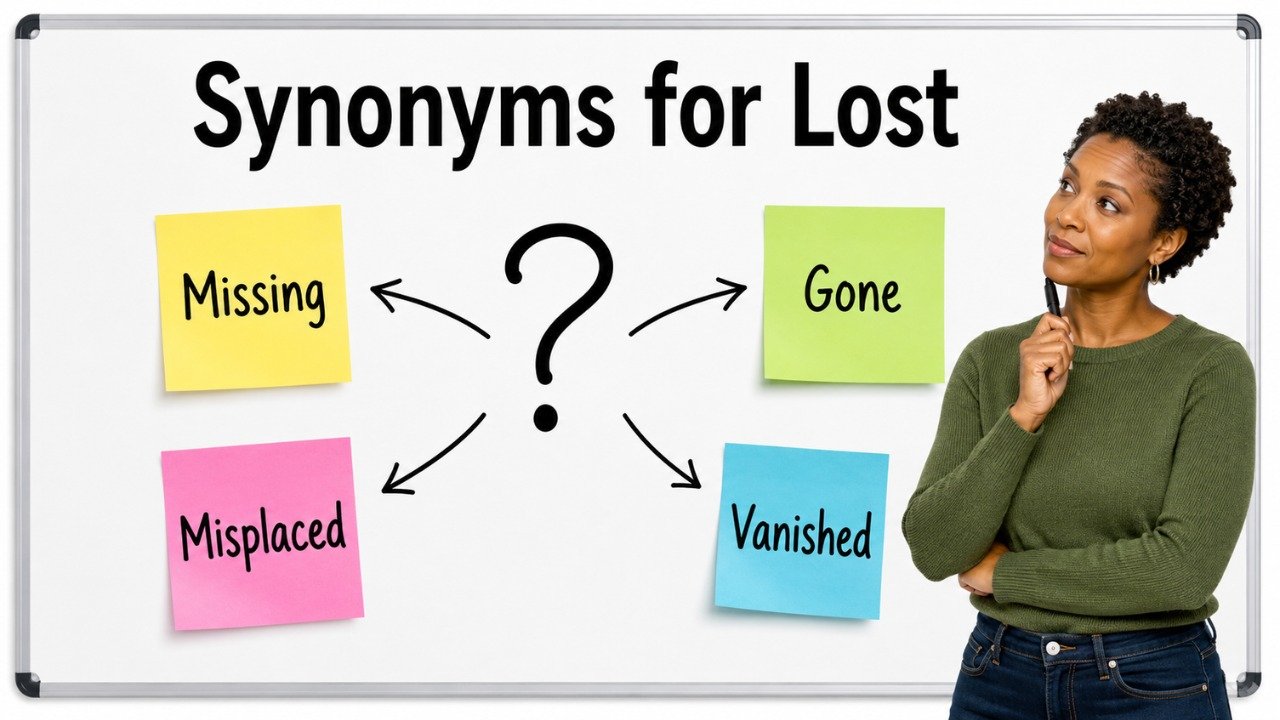
Quick Answer: The best synonyms for lost include missing, misplaced, gone, vanished, absent, astray, confused, disoriented, defeated, and wasted. For synonyms for lost in formal writing, missing, absent, misplaced, and unaccounted for are often best. In casual speech, gone and missing sound natural. Use astray or disoriented when someone does not know where they are, confused when someone does not understand something, defeated when lost means failed in a contest, and wasted when lost means time, money, or opportunity was not used well.
Pronunciation and Word Details
Word: Lost
Pronunciation: /lɔːst/
Part of Speech: Adjective, past tense verb, and past participle of lose
Meaning: Lost means unable to be found, no longer possessed, unsure of direction, confused, defeated, or wasted.
US Pronunciation:
UK Pronunciation:
What Does “Lost” Mean?
Lost means not found, no longer available, unsure where to go, confused, defeated, or wasted. It can work as an adjective, as in a lost phone, or as the past tense of the verb lose, as in she lost her keys. The word changes meaning based on context. A lost child is missing or separated. A lost game means defeat. A lost chance means a missed opportunity. A lost person can also be emotionally confused, mentally unsure, or physically unable to find the right direction.
Meaning, Tone, and Context of “Lost”
Lost is a common, neutral, and flexible word. It works in casual speech, formal writing, storytelling, reports, and emotional language. The tone depends on the meaning. Lost keys sounds ordinary and practical. A lost child sounds serious. A lost dream feels emotional. A lost match sounds factual. A lost opportunity sounds regretful. In academic or professional writing, more precise synonyms like misplaced, missing, absent, forfeited, wasted, or defeated may sound stronger. In conversation, lost is natural because it is simple, clear, and easy to understand.
When and How to Use “Lost”
For Missing Objects: Use lost when something cannot be found.
Example: I lost my wallet on the way home.
For Direction: Use lost when someone does not know where they are or where to go.
Example: We got lost in the old part of the city.
For Confusion: Use lost when someone cannot understand an idea, explanation, or situation.
Example: I felt lost during the final part of the lesson.
For Defeat: Use lost when someone did not win a game, contest, argument, or battle.
Example: The team lost the match by two points.
For Missed Opportunities: Use lost when something valuable was not used, gained, or kept.
Example: It was a lost chance to improve the project.
For Emotion: Use lost when someone feels unsure, alone, or without purpose.
Example: After graduation, he felt lost about his future.
Best Synonyms for Lost
Missing: Not able to be found or not present.
Example: The missing file was later found in another folder.
Misplaced: Put in the wrong place and temporarily not found.
Example: She misplaced her notebook before class.
Gone: No longer present, available, or existing.
Example: The old building is gone now.
Vanished: Disappeared suddenly or completely.
Example: The sound vanished as the door closed.
Astray: Away from the correct path, direction, or purpose.
Example: The hikers went astray after missing the trail sign.
Disoriented: Confused about place, direction, time, or situation.
Example: He felt disoriented after waking up in an unfamiliar room.
Confused: Unable to understand something clearly.
Example: The long instructions left me confused.
Defeated: Beaten in a contest, argument, or struggle.
Example: The defeated team accepted the result with respect.
Wasted: Used badly or not used in a valuable way.
Example: The delayed meeting felt like wasted time.
Forfeited: Given up, lost, or surrendered because of a rule, choice, or failure.
Example: They forfeited their chance by missing the deadline.
50 Synonyms for Lost with Short Meanings
- Missing: Not found or not present.
- Misplaced: Put somewhere wrong and not found right away.
- Mislaid: Temporarily placed somewhere and forgotten.
- Gone: No longer there.
- Absent: Not present where expected.
- Vanished: Disappeared completely or suddenly.
- Disappeared: No longer visible or available.
- Unrecovered: Not found or restored after being lost.
- Unaccounted for: Not located or not explained.
- Out of sight: Not visible or no longer seen.
- Astray: Away from the correct path or purpose.
- Stray: Separated from the right place or group.
- Wandering: Moving without a clear direction.
- Adrift: Without direction, control, or purpose.
- Off course: Away from the correct route.
- Disoriented: Confused about direction, place, or situation.
- Confused: Unable to understand clearly.
- Bewildered: Extremely confused or uncertain.
- Perplexed: Puzzled by something difficult to understand.
- Puzzled: Unsure because something is unclear.
- Baffled: Completely confused by something.
- Dazed: Mentally unclear or stunned.
- Unsure: Not certain about what to do.
- Uncertain: Lacking clear knowledge or confidence.
- Directionless: Having no clear path or goal.
- Aimless: Without purpose or direction.
- Absorbed: Deeply focused on something else.
- Engrossed: Fully interested or involved in something.
- Preoccupied: Mentally busy with other thoughts.
- Defeated: Beaten in a competition or struggle.
- Beaten: Overcome by an opponent or difficulty.
- Overcome: Defeated or strongly affected.
- Unsuccessful: Not achieving the desired result.
- Failed: Did not succeed.
- Forfeited: Given up or lost because of a rule or choice.
- Wasted: Used badly or without benefit.
- Squandered: Carelessly wasted or thrown away.
- Missed: Not taken, reached, or used.
- Sacrificed: Given up for another purpose.
- Relinquished: Voluntarily given up.
- Irretrievable: Impossible to get back.
- Unrecoverable: Unable to be recovered or restored.
- Destroyed: Damaged completely or ruined.
- Ruined: Spoiled or made useless.
- Forgotten: No longer remembered.
- Neglected: Not cared for or not kept alive.
- Departed: Gone away or passed from life.
- Deceased: No longer living.
- Hopeless: Having no chance of success or recovery.
- Beyond reach: Impossible to get, find, or recover.
Read Also:
Synonyms for Loyalty

Synonyms for Lost by Context
When Lost Means Missing
Lost often means something cannot be found. In this context, the best synonyms are missing, misplaced, mislaid, absent, gone, unaccounted for, and unrecovered.
Example: My lost passport caused a delay.
Better Option: My missing passport caused a delay.
Example: The lost receipt was inside the bag.
Better Option: The misplaced receipt was inside the bag.
When Lost Means Gone or Disappeared
Lost can mean something has disappeared or is no longer present. Strong synonyms include gone, vanished, disappeared, out of sight, departed, and unrecovered.
Example: The old village road is lost under the new highway.
Better Option: The old village road has disappeared under the new highway.
Example: The sound was lost in the storm.
Better Option: The sound vanished in the storm.
When Lost Means Confused
Lost can describe a person who does not understand something. Useful synonyms include confused, puzzled, perplexed, baffled, bewildered, unsure, and uncertain.
Example: I was lost during the explanation.
Better Option: I was confused during the explanation.
Example: She looked lost after hearing the new instructions.
Better Option: She looked bewildered after hearing the new instructions.
When Lost Means Without Direction
Lost can describe someone who does not know the route, purpose, or next step. Good synonyms include astray, disoriented, adrift, wandering, directionless, aimless, and off course.
Example: We were lost in the forest.
Better Option: We were disoriented in the forest.
Example: He felt lost after leaving his old job.
Better Option: He felt directionless after leaving his old job.
When Lost Means Defeated
Lost can mean someone did not win. In this context, use defeated, beaten, overcome, unsuccessful, or failed.
Example: The team lost the final match.
Better Option: The team was defeated in the final match.
Example: She lost the debate.
Better Option: She was beaten in the debate.
When Lost Means Wasted
Lost can mean time, money, effort, or opportunity was not used well. Strong synonyms include wasted, squandered, missed, forfeited, sacrificed, and relinquished.
Example: We lost valuable time during the delay.
Better Option: We wasted valuable time during the delay.
Example: He lost his chance to apply.
Better Option: He forfeited his chance to apply.
Another Word for Lost
Another word for lost is missing when you mean something cannot be found. However, the best replacement depends on context. Use misplaced for an object put in the wrong place, confused for unclear understanding, disoriented for lack of direction, defeated for losing a contest, and wasted for time or opportunity.
Original: I lost my keys again.
Better Option: I misplaced my keys again.
Original: The child was lost in the market.
Better Option: The child was missing in the market.
Original: I felt lost during the meeting.
Better Option: I felt confused during the meeting.
Original: They lost the final game.
Better Option: They were defeated in the final game.
When Not to Use “Lost”
Do not use lost when a more exact word would make the meaning clearer. Lost can sound too general in formal writing, reports, essays, and professional messages. If you mean an object is not present, use missing. If you mean someone is mentally unclear, use confused. If you mean a game result, use defeated. If you mean time was not used well, use wasted.
Weak: The report says three documents are lost.
Better: The report says three documents are missing.
Weak: I was lost by the teacher’s explanation.
Better: I was confused by the teacher’s explanation.
Weak: The company lost many hours because of the error.
Better: The company wasted many hours because of the error.
Weak: Our side lost the argument.
Better: Our side was defeated in the argument.
Words Commonly Confused With Lost
Lost vs Missing: Lost often means something cannot be found, while missing means something is not where it should be. Missing is usually more formal and exact.
Lost vs Misplaced: Lost can mean the item may be gone, while misplaced means the item was likely put in the wrong place temporarily.
Lost vs Gone: Lost suggests something cannot be found or recovered, while gone simply means it is no longer present.
Lost vs Confused: Lost can describe confusion in a broad way, while confused directly means a person does not understand something.
Lost vs Disoriented: Lost can mean physically unsure of location, while disoriented strongly means confused about direction, place, time, or surroundings.
Lost vs Defeated: Lost can describe the result of a contest, while defeated is more direct and formal.
Lost vs Wasted: Lost can describe time or opportunity that was not used, while wasted clearly means used badly or without benefit.
Which Synonym Should You Choose?
Choose missing when something is not found or not present.
Choose misplaced when an object was put in the wrong place and may still be nearby.
Choose gone when something is no longer present in a simple, casual way.
Choose vanished when something disappeared suddenly or completely.
Choose astray when someone or something moved away from the correct path.
Choose disoriented when someone does not understand where they are or what is happening around them.
Choose confused when someone does not understand an idea, message, or situation.
Choose defeated when someone did not win a game, contest, argument, or battle.
Choose wasted when time, money, effort, or opportunity was used poorly.
Choose forfeited when someone lost a right, chance, or position because of a rule, choice, or failure.
Choose irretrievable when something cannot be recovered.
Choose forgotten when an idea, memory, custom, or skill is no longer remembered.
Real Life Examples of “Lost” in Sentences
Original: I lost my phone at school.
Better Option: I misplaced my phone at school.
Original: The lost child was found near the entrance.
Better Option: The missing child was found near the entrance.
Original: We got lost on the way to the hotel.
Better Option: We got disoriented on the way to the hotel.
Original: I felt lost after reading the instructions.
Better Option: I felt confused after reading the instructions.
Original: The team lost the championship game.
Better Option: The team was defeated in the championship game.
Original: She lost her chance to join the program.
Better Option: She forfeited her chance to join the program.
Original: The lost hours affected our schedule.
Better Option: The wasted hours affected our schedule.
Original: His lost confidence slowly returned.
Better Option: His shaken confidence slowly returned.
Original: The old tradition was lost over time.
Better Option: The old tradition was forgotten over time.
Original: The signal was lost during the storm.
Better Option: The signal disappeared during the storm.
Synonym Groups and Usage Differences
Missing Object Group
This group includes missing, misplaced, mislaid, absent, gone, and unaccounted for. Use these words when something cannot be found or is not where it should be.
Example: The misplaced folder was on the wrong shelf.
Direction and Place Group
This group includes astray, disoriented, adrift, wandering, off course, and directionless. Use these words when someone does not know the correct route, place, or path.
Example: The hikers became disoriented after sunset.
Confusion Group
This group includes confused, bewildered, perplexed, puzzled, baffled, dazed, unsure, and uncertain. Use these words when lost means mentally unclear.
Example: The complex chart left the students puzzled.
Defeat Group
This group includes defeated, beaten, overcome, unsuccessful, and failed. Use these words when lost refers to a contest, argument, battle, or effort.
Example: The beaten team still played with discipline.
Waste and Opportunity Group
This group includes wasted, squandered, missed, forfeited, sacrificed, and relinquished. Use these words when lost means something valuable was not used, kept, or gained.
Example: The missed opportunity could have changed the result.
Permanent Loss Group
This group includes irretrievable, unrecoverable, beyond reach, destroyed, ruined, departed, and deceased. Use these words when something cannot be brought back, restored, or recovered.
Example: The damaged data was unrecoverable.
Antonyms of Lost
Antonyms of lost depend on the meaning. If lost means missing, the opposite is found. If lost means confused, the opposite is clear or certain. If lost means defeated, the opposite is victorious. If lost means wasted, the opposite is saved or used well.
Found: Located after being lost or missing.
Located: Identified or discovered in a specific place.
Present: Available or in the expected place.
Recovered: Found, restored, or gained back.
Returned: Brought or sent back.
Clear: Easy to understand or mentally certain.
Certain: Sure and confident.
Oriented: Aware of direction, place, or situation.
Victorious: Having won a contest or struggle.
Successful: Achieving the desired result.
Saved: Kept from being wasted or lost.
Preserved: Protected from damage, loss, or disappearance.
Comparison: Lost vs Related Words
Lost vs Missing
Lost is broader than missing. Lost can mean not found, confused, defeated, or wasted. Missing mainly means not present or not found.
Example With Lost: I lost my bag yesterday.
Example With Missing: My bag is missing from the classroom.
Lost vs Misplaced
Lost may suggest something is difficult to find or possibly gone. Misplaced suggests it was put somewhere wrong and may be found again.
Example With Lost: He lost his watch during the trip.
Example With Misplaced: He misplaced his watch in the hotel room.
Lost vs Gone
Lost often includes the idea of searching or not being able to recover something. Gone simply means something is no longer there.
Example With Lost: The file was lost after the computer crashed.
Example With Gone: The file is gone from the desktop.
Lost vs Confused
Lost can describe confusion in a general or emotional way. Confused is more direct when someone does not understand something.
Example With Lost: I felt lost during the lecture.
Example With Confused: I felt confused during the lecture.
Lost vs Disoriented
Lost can mean not knowing where to go. Disoriented means someone is confused about location, direction, time, or surroundings.
Example With Lost: We were lost in the city.
Example With Disoriented: We were disoriented after walking through several narrow streets.
Lost vs Defeated
Lost is a simple verb for not winning. Defeated is a stronger adjective or verb form that clearly shows failure in competition or conflict.
Example With Lost: They lost the match.
Example With Defeated: They were defeated in the match.
Lost vs Wasted
Lost can describe a missed or unused chance. Wasted clearly means something was used badly or without value.
Example With Lost: We lost three hours in traffic.
Example With Wasted: We wasted three hours in traffic.
Common Phrases and Expressions With Lost
Lost and Found: A place where missing items are kept until owners collect them.
Get Lost: Become unable to find the way.
Lost Cause: A person, plan, or situation with little chance of success.
Lost Time: Time that was wasted, missed, or cannot be recovered.
Lost Opportunity: A chance that was missed or not used.
Lost in Thought: Deeply thinking and unaware of surroundings.
Lost for Words: Unable to speak because of surprise, emotion, or shock.
Lost Track: Forgot the progress, order, time, or details of something.
Lost Touch: No longer in contact or no longer skilled at something.
Lost Confidence: A state of no longer feeling sure or capable.
Common Mistakes to Avoid
Avoid using lost too often when a clearer synonym would help. Repetition can make writing sound plain and less precise. In formal writing, missing may be better than lost for documents, records, and objects. Misplaced is better when something is probably nearby. Confused is better when the meaning is about understanding. Defeated is better for contests. Wasted is better for time, money, and effort.
Do not use lost when the sentence needs a specific cause. For example, lost money can mean money was misplaced, spent badly, stolen, or not earned. Choose wasted, stolen, misplaced, or forfeited if the exact meaning matters. Also avoid unnatural phrases such as I am losted. The correct form is I am lost, I lost it, or I have lost it.
Conclusion
Synonyms for lost depend on the exact meaning you want to express. Use missing, misplaced, or mislaid for objects. Use astray, disoriented, or off course for direction. Use confused, puzzled, or bewildered for understanding. Use defeated or beaten for contests, and wasted, missed, or forfeited for time, money, and opportunity. Lost is useful and natural, but a more specific synonym often makes your writing clearer, stronger, and more professional.
FAQs About Synonyms for Lost
What is the best synonym for lost?
The best synonym for lost is missing when something cannot be found. For other meanings, use confused, disoriented, defeated, or wasted.
What is a formal synonym for lost?
A formal synonym for lost is missing, absent, misplaced, unaccounted for, forfeited, or unrecovered. The best choice depends on the sentence.
What is another word for lost in direction?
Another word for lost in direction is disoriented, astray, adrift, wandering, or off course. These words describe someone who does not know the correct route.
What is another word for lost in confusion?
Another word for lost in confusion is confused, puzzled, perplexed, baffled, bewildered, or unsure. Use confused for simple writing and bewildered for stronger emotion.
What is another word for lost a game?
Another word for lost a game is defeated or beaten. You can also use unsuccessful if you want a softer or more general word.
What is another word for lost time?
Another word for lost time is wasted time. You can also use missed time, squandered time, or unrecoverable time depending on the meaning.
Is misplaced the same as lost?
Misplaced is close to lost, but it usually means something was put in the wrong place temporarily. Lost can mean something is harder to find or may be gone completely.
