
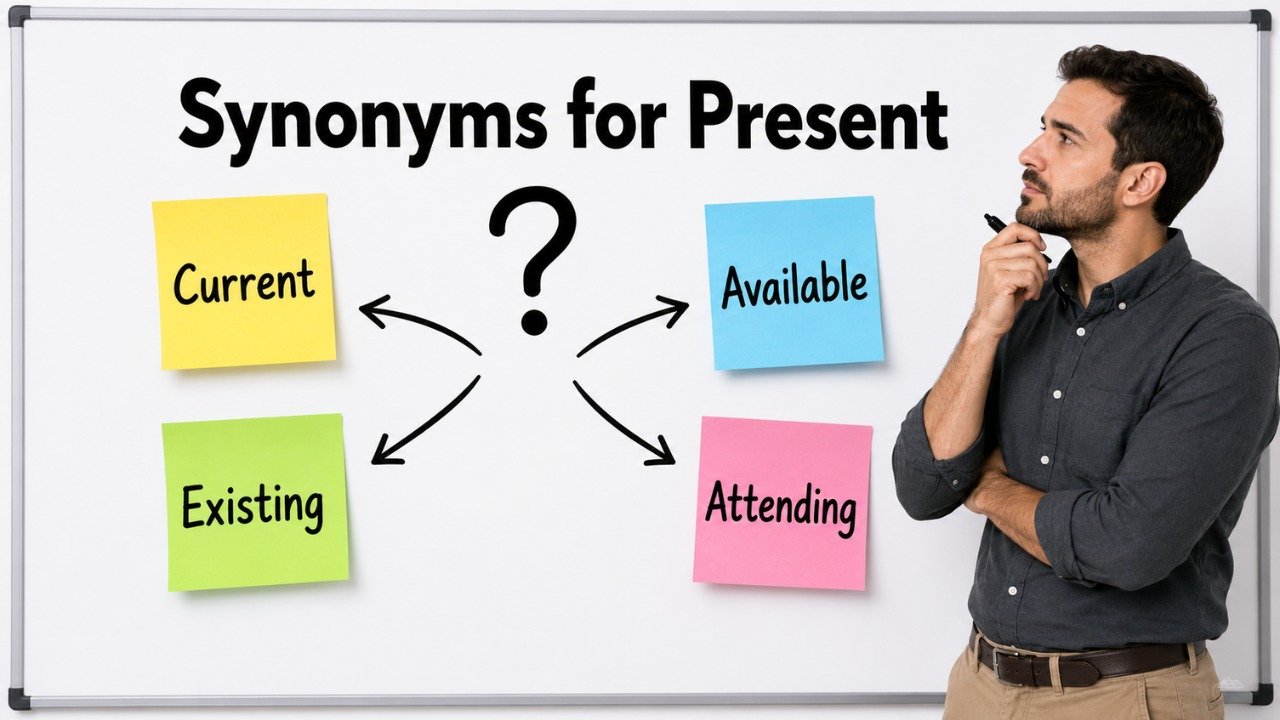
Quick Answer: The best synonyms for present include current, existing, available, attending, give, offer, introduce, display, deliver, and gift. Use current when describing something happening now, attending when someone is at an event, give when transferring something to another person, introduce when bringing someone before an audience, display when showing an object, and gift when present refers to something given for a special occasion. The correct choice among synonyms for present depends on whether the word functions as an adjective, verb, or noun.
Pronunciation and Word Details
Word: Present
Pronunciation: /ˈprez.ənt/ as an adjective or noun and /prɪˈzent/ as a verb
Part of Speech: Adjective, noun, and verb
Meaning: Existing now, being in a particular place, showing or giving something, or an item given to someone.
US Pronunciation:
UK Pronunciation:
What Does “Present” Mean?
Present means existing or happening now, being in a particular place, showing something to others, giving something, or an item offered as a gift.
As an adjective, present describes something that exists now or someone who is attending an event. In “the present situation,” it refers to current conditions. In “all members were present,” it means that everyone was there.
As a verb, present can mean to give, introduce, display, explain, or formally submit something. A person may present an award, present a report, or present a guest to an audience.
As a noun, present commonly means a gift. It can also refer to the current period of time, as in “focus on the present.”
Because the word has several meanings, the most accurate synonym depends on how it works in the sentence.
Meaning, Tone, and Context of “Present”
Present is generally a neutral and flexible word. It appears naturally in formal writing, academic work, professional communication, reports, ceremonies, and everyday conversation.
When present means current, it has a neutral or slightly formal tone. Words such as current, existing, and ongoing may communicate the meaning more precisely.
When it means being in a place, present is common in classrooms, meetings, official records, and events. Here, attending, available, and in attendance are useful alternatives.
As a verb meaning to show or explain, present often has a professional or academic tone. Speakers present ideas, researchers present findings, and employees present reports.
When it means to give something formally, present sounds more ceremonial than give. A host may present an award, while a friend is more likely to give a gift.
As a noun meaning gift, present is conversational and widely understood.
When and How to Use “Present”
For Current Time: Use present when referring to something that exists, happens, or remains true now.
Example: The present policy will remain in effect until August.
For Attendance: Use present when confirming that someone is physically or virtually attending an event.
Example: Every committee member was present at the meeting.
For Giving Something: Use present when something is given formally, publicly, or ceremonially.
Example: The principal will present the award to the winning student.
For Showing Information: Use present when explaining facts, arguments, findings, or ideas to an audience.
Example: The research team will present its findings tomorrow.
For Introducing Someone: Use present when formally introducing a person to an audience or group.
Example: The host was pleased to present the evening’s guest speaker.
For Submitting Something: Use present when providing evidence, a proposal, or a document for consideration.
Example: The lawyer presented new evidence to the court.
For a Gift: Use present as a noun for an item given to someone on a special occasion.
Example: She opened her birthday present after dinner.
For the Current Moment: Use the present as a noun when discussing the time happening now.
Example: Try to focus on the present instead of worrying about the future.
Best Synonyms for Present
Current
Meaning: Existing, happening, or being used now.
Example: The current schedule may change next month.
Existing
Meaning: Already present or in operation at this time.
Example: The company plans to improve the existing system.
Available
Meaning: Ready to be used, contacted, or involved.
Example: A qualified adviser was available to answer questions.
Attending
Meaning: Being at a meeting, event, class, or ceremony.
Example: More than fifty guests were attending the event.
Give
Meaning: To transfer something to another person.
Example: They will give the certificate to the winner.
Offer
Meaning: To make something available for someone to accept.
Example: The organization will offer assistance to local families.
Introduce
Meaning: To formally bring a person, idea, or subject before others.
Example: The host will introduce the speaker at noon.
Display
Meaning: To place something where people can see it.
Example: The gallery will display the paintings near the entrance.
Deliver
Meaning: To communicate a speech, report, message, or presentation.
Example: She will deliver the opening address.
Gift
Meaning: An item given freely to another person.
Example: The book was a thoughtful gift from her teacher.
50 Synonyms for Present with Short Meanings
- Current: Existing or happening now.
- Existing: Already in use or in operation.
- Contemporary: Belonging to the current period.
- Present day: Related to modern times.
- Modern: Connected with recent or current times.
- Ongoing: Continuing at the present time.
- Immediate: Existing or requiring attention now.
- Prevailing: Common or influential at the current time.
- Active: Currently operating, working, or involved.
- Available: Ready for use or participation.
- Here: In this place or position.
- Attending: Being at a particular event.
- In attendance: Officially present at an event.
- On hand: Present and ready to help or be used.
- Participating: Taking part in an activity or event.
- Accounted for: Confirmed as present or located.
- Give: To transfer something to someone.
- Offer: To make something available for acceptance.
- Provide: To supply something needed or useful.
- Hand over: To give control or possession to someone.
- Award: To officially give a prize or honor.
- Bestow: To give something valuable or honorable.
- Donate: To give something for a helpful purpose.
- Confer: To formally grant an honor, title, or benefit.
- Grant: To officially give permission, rights, or resources.
- Supply: To provide something that is required.
- Introduce: To formally bring someone or something before others.
- Announce: To make information publicly known.
- Display: To place something where it can be seen.
- Show: To make something visible or understandable.
- Exhibit: To display something publicly.
- Demonstrate: To show clearly through evidence or action.
- Reveal: To make previously hidden information known.
- Explain: To make an idea or subject understandable.
- Describe: To communicate the qualities or details of something.
- Express: To communicate an idea, feeling, or opinion.
- State: To communicate something clearly and directly.
- Submit: To formally provide something for consideration.
- Deliver: To communicate a speech, report, or message.
- Propose: To formally put forward an idea or plan.
- Report: To provide information about an event or finding.
- Portray: To represent someone or something in a particular way.
- Represent: To stand for or describe something.
- Depict: To show something through words or images.
- Perform: To present entertainment or an artistic work.
- Gift: Something given freely to another person.
- Offering: Something made available or given.
- Token: A small item given as a sign of appreciation.
- Keepsake: An item kept because of personal memories.
- Memento: An object that reminds someone of a person or event.
Read Also:
Synonyms for Lost

Synonyms for Present by Context
When Present Means Current
When present describes something existing or happening now, the strongest synonyms are current, existing, contemporary, ongoing, modern, and prevailing.
Current is usually the clearest general replacement. Existing emphasizes that something is already in place. Ongoing describes something that continues over time. Contemporary is useful for culture, art, ideas, and modern society.
Present: We must respond to the present situation.
Current: We must respond to the current situation.
Present: The present system needs improvement.
Existing: The existing system needs improvement.
When Present Means In Attendance
When present describes someone who is at a place or event, use here, attending, available, on hand, participating, or in attendance.
Attending focuses on participation in an organized event. Here is more natural in casual speech. In attendance sounds formal and is common in reports, ceremonies, and official records.
Present: All department leaders were present.
In Attendance: All department leaders were in attendance.
Present: Is the manager present today?
Available: Is the manager available today?
When Present Means Give
When present means to give something, useful alternatives include give, offer, award, bestow, grant, donate, and hand over.
Give is the most natural general replacement. Award is appropriate for prizes and honors. Bestow has a formal or ceremonial tone. Grant is used for permission, rights, funding, and official benefits.
Present: The committee will present her with a certificate.
Award: The committee will award her a certificate.
Present: He presented the flowers to his mother.
Gave: He gave the flowers to his mother.
When Present Means Show or Explain
When present refers to communicating information, choose show, explain, demonstrate, display, deliver, report, submit, or reveal.
Explain focuses on making information understandable. Demonstrate shows how something works. Deliver is commonly used for speeches and formal talks. Submit is best for reports, proposals, applications, and documents.
Present: She will present the results to the team.
Explain: She will explain the results to the team.
Present: He presented a detailed proposal.
Submitted: He submitted a detailed proposal.
When Present Means a Gift
When present is a noun for something given to another person, the closest synonym is gift. Other options include offering, token, keepsake, and memento.
Gift is the most direct alternative. Token usually describes a small expression of thanks or affection. Keepsake and memento emphasize emotional or personal value.
Present: They bought her a graduation present.
Gift: They bought her a graduation gift.
Present: Please accept this present as a sign of our thanks.
Token: Please accept this token as a sign of our thanks.
Another Word for Present
The best single replacement for present is often current when the word describes time or existing conditions. However, the correct alternative depends on the intended meaning.
Use attending for someone at an event, give for transferring an object, introduce for bringing someone before an audience, display for showing something visually, and gift for an item given to someone.
Original: We need to consider the present economic conditions.
Better Option: We need to consider the current economic conditions.
Original: Every employee was present during the discussion.
Better Option: Every employee attended the discussion.
Original: She will present the report to the directors.
Better Option: She will deliver the report to the directors.
Original: He bought a present for his sister.
Better Option: He bought a gift for his sister.
When Not to Use “Present”
Avoid present when its meaning could be unclear. Because the word can refer to current time, attendance, giving, showing, or a gift, readers may need additional context to understand the intended meaning.
Use a more precise synonym when discussing technical information, formal findings, official documents, or specific actions.
Weak: The team will present the material.
Better: The team will demonstrate the process.
The weak sentence does not explain whether the team will display, explain, submit, or deliver the material.
Avoid repeating present several times in one paragraph.
Weak: The present manager will present the present plan to everyone present.
Better: The current manager will explain the new plan to everyone attending.
Present can also sound unnecessarily formal when give or show communicates the idea more naturally.
Weak: Please present me with the document.
Better: Please give me the document.
Do not use present as a replacement for attend when the sentence requires an action verb.
Weak: She will present the meeting tomorrow.
Better: She will attend the meeting tomorrow.
Words Commonly Confused With Present
Present vs Current: Present and current can both describe something existing now. Current is usually clearer for policies, events, conditions, information, and trends. Present can also refer to attendance, giving, showing, or a gift.
Present vs Gift: Present and gift both describe something given to another person. Gift is slightly broader and can refer to an object, ability, donation, or generous act. Present usually refers to a physical item given on an occasion.
Present vs Introduce: Present can mean to introduce someone formally, but introduce is clearer in everyday and professional communication. Present often sounds more ceremonial.
Present vs Attend: Present describes a person’s state of being at an event. Attend describes the action of going to or taking part in that event.
Present vs Provide: Present means to show, give, or submit something. Provide means to supply something needed or useful.
Present vs Represent: Present means to show or explain something. Represent means to stand for, act for, or symbolize someone or something.
Present vs Display: Present can involve explaining information as well as showing it. Display mainly focuses on making something visible.
Which Synonym Should You Choose?
Choose current when describing information, policies, conditions, events, or situations that exist now.
Choose existing when referring to something that is already established, available, or in operation.
Choose attending when describing someone who is taking part in a meeting, class, event, or ceremony.
Choose available when someone is present and ready to speak, work, or help.
Choose give in casual conversation when transferring an object to another person.
Choose award when a prize, certificate, title, or honor is officially given.
Choose bestow in formal or ceremonial writing about honors, rights, or recognition.
Choose introduce when bringing a person, topic, or idea before an audience.
Choose explain when the main purpose is to make information clear.
Choose demonstrate when showing how a process, system, or method works.
Choose deliver for speeches, talks, reports, and formal messages.
Choose submit for documents, applications, evidence, proposals, and written work.
Choose display when an object or piece of information is made visible.
Choose gift when present refers to an item given on a birthday, holiday, celebration, or special occasion.
Choose token when describing a small item given as a sign of gratitude or affection.
Real Life Examples of “Present” in Sentences
Original: The present schedule gives us little time to prepare.
Better Option: The current schedule gives us little time to prepare.
Original: All students were present for the final lesson.
Better Option: All students attended the final lesson.
Original: The manager will present the new policy this afternoon.
Better Option: The manager will explain the new policy this afternoon.
Original: She presented the award to the winning athlete.
Better Option: She awarded the prize to the winning athlete.
Original: The designer presented several ideas to the client.
Better Option: The designer proposed several ideas to the client.
Original: The witness presented new evidence.
Better Option: The witness submitted new evidence.
Original: He presented the process through a live example.
Better Option: He demonstrated the process through a live example.
Original: The museum will present the historic documents next week.
Better Option: The museum will display the historic documents next week.
Original: I received a thoughtful present from my neighbor.
Better Option: I received a thoughtful gift from my neighbor.
Original: We should focus on the present.
Better Option: We should focus on the current moment.
Synonym Groups and Usage Differences
Current Time Group
This group includes current, existing, contemporary, modern, ongoing, prevailing, and present day. These words refer to things happening or existing now.
Current is the most flexible choice. Existing emphasizes something already established. Ongoing describes an action or situation that has not finished.
Example: The current guidelines apply to all new applications.
Attendance Group
This group includes here, attending, in attendance, available, participating, on hand, and accounted for. These words describe someone being in a place or taking part in an activity.
Here sounds conversational. In attendance is formal. Participating suggests active involvement rather than simple physical presence.
Example: Every invited member was in attendance.
Giving Group
This group includes give, offer, provide, award, bestow, donate, confer, grant, supply, and hand over.
Give is neutral and widely useful. Bestow and confer are formal. Donate is used when something is given to support a person or cause. Grant often refers to permission, funding, or rights.
Example: The panel will grant funding to three applicants.
Communication Group
This group includes introduce, explain, describe, express, state, announce, deliver, report, propose, and submit.
Introduce begins a topic or brings someone before an audience. Explain makes information clear. Deliver is suitable for formal speeches. Submit means to provide something for official review.
Example: The researcher will report the final results next week.
Visual Showing Group
This group includes show, display, exhibit, demonstrate, reveal, portray, represent, and depict.
Show is the broadest choice. Display and exhibit emphasize visibility. Demonstrate explains through action or evidence. Portray and depict describe representation through words, images, or performance.
Example: The diagram demonstrates how the system operates.
Gift Group
This group includes gift, offering, token, keepsake, and memento.
Gift is the closest general synonym for present. Token is usually small and symbolic. Keepsake and memento are kept because they carry memories or emotional meaning.
Example: The photograph became a treasured keepsake.
Antonyms of Present
The opposite of present changes according to the intended meaning.
Past: A time that has already happened.
Future: A time that has not yet arrived.
Absent: Not in a place where someone is expected.
Missing: Not present or unable to be found.
Unavailable: Not ready, accessible, or able to participate.
Withdraw: To remove something previously offered or submitted.
Withhold: To refuse to give or provide something.
Conceal: To keep information or an object hidden.
Hide: To prevent something from being seen.
Remove: To take something away from a place or position.
Receive: To accept something that another person gives.
Take: To move something into one’s possession rather than give it.
Comparison: Present vs Related Words
Present vs Current
Present and current can both mean existing now. Current is usually more precise when discussing news, policies, trends, information, or conditions. Present has more meanings and may refer to location, communication, giving, or a gift.
Example With Present: The present arrangement is temporary.
Example With Current: The current arrangement is temporary.
Present vs Existing
Present emphasizes what is true or happening now. Existing emphasizes something that has already been created, established, or put into operation.
Example With Present: The present situation requires immediate action.
Example With Existing: The existing system requires several improvements.
Present vs Give
Present often describes formal or ceremonial giving. Give is more natural in ordinary conversation and general writing.
Example With Present: The chairperson will present the trophy.
Example With Give: Please give the document to Maria.
Present vs Show
Present may involve showing, explaining, discussing, or formally introducing information. Show focuses more directly on making something visible or understandable.
Example With Present: She will present the project results.
Example With Show: She will show the audience the final design.
Present vs Introduce
Present can mean to bring a person before an audience in a formal way. Introduce is more common and direct in most situations.
Example With Present: It is my pleasure to present our guest speaker.
Example With Introduce: Let me introduce our new team member.
Present vs Deliver
Present focuses on explaining or showing content. Deliver emphasizes performing or communicating a prepared speech, message, or report.
Example With Present: He will present the research findings.
Example With Deliver: He will deliver the closing speech.
Present vs Gift
As nouns, present and gift often have the same meaning. Gift is broader and may also describe a natural ability, generous act, or donation.
Example With Present: She received a present on her birthday.
Example With Gift: Her ability to explain complex ideas is a gift.
Common Phrases and Expressions With Present
At Present: At the current time.
The Present Time: The period happening now.
The Present Moment: The exact time occurring now.
Present Day: Connected with modern or current times.
Present Situation: The conditions that exist now.
Present Company: The people currently gathered in a place.
Present a Case: To explain facts or arguments in support of a position.
Present Evidence: To formally provide facts or proof.
Present an Award: To officially give someone a prize or honor.
Present a Report: To explain or deliver information from a report.
Present an Opportunity: To create or offer a useful possibility.
Birthday Present: A gift given to someone on their birthday.
Common Mistakes to Avoid
One common mistake is using a synonym without identifying which meaning of present is intended. Current cannot replace present when the word means gift, and gift cannot replace present when it means attending.
Another mistake is using present repeatedly in the same sentence or paragraph. Replacing repeated uses with current, attending, explain, give, or gift can make the writing clearer.
Writers should also remember that present has two common pronunciations. As an adjective or noun, the stress falls on the first syllable. As a verb, the stress falls on the second syllable.
Avoid using present when a more specific action is available. Instead of saying someone presented information, explain whether the person displayed, explained, demonstrated, delivered, or submitted it.
Do not confuse present with presently. Presently may mean now, but it can also mean soon in some contexts. Use currently when you need a clear reference to the current time.
Be careful with attend and present. A person attends an event, but is present at an event.
Incorrect: She presented at the meeting as a guest.
Correct: She was present at the meeting as a guest.
The incorrect sentence could be correct only when she gave a speech or presentation.
Conclusion
The most useful synonyms for present depend on the word’s role and meaning. Use current or existing for something happening now, attending or available for someone at an event, give or award for transferring something, and explain, display, or deliver for sharing information. When present means an item given to someone, gift is usually the clearest replacement. Understanding these different meanings makes it easier to select accurate synonyms for present and write sentences that sound clear, natural, and appropriate for the context.
FAQs About Synonyms for Present
What Are the Best Synonyms for Present?
The best options include current, existing, available, attending, give, offer, introduce, display, deliver, and gift. The correct word depends on the intended meaning.
What Is Another Word for Present Meaning Current?
Current is the strongest general replacement. Existing, contemporary, ongoing, modern, and prevailing may also work in specific contexts.
What Is Another Word for Present Meaning Attending?
Attending, here, available, participating, on hand, and in attendance can describe someone who is present at an event or place.
What Is a Synonym for Present Meaning Give?
Give is the most natural option. Offer, award, bestow, grant, provide, and donate are useful alternatives for more specific situations.
What Is a Synonym for Present Information?
Use explain, show, demonstrate, display, report, deliver, or communicate. Choose the word that describes how the information is being shared.
Is Present a Noun, Verb, or Adjective?
Present can be all three. It is an adjective in “the present situation,” a verb in “present the results,” and a noun in “a birthday present.”
What Is the Opposite of Present?
Absent is the opposite when present describes attendance. Past or future may be opposites when it refers to time. Withhold, conceal, or withdraw may work when present means give or show.
