
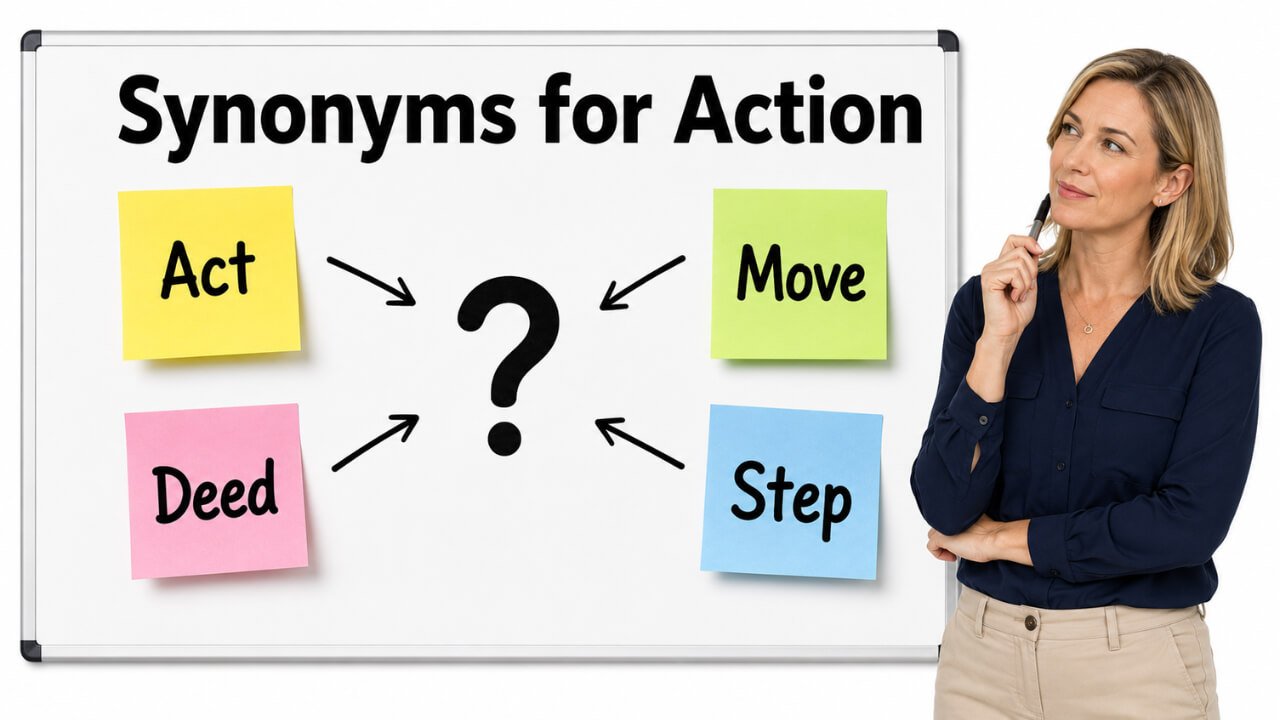
Quick Answer: The best synonyms for action include act, deed, activity, measure, step, effort, initiative, movement, operation, and response. Use act or deed for something a person does, activity for ongoing work, measure for an official decision, and step for one part of a process. Initiative is best for independent effort, movement describes physical motion, operation suits organized or technical work, and response refers to action taken after an event. The right alternative depends on whether action means behavior, effort, motion, performance, legal proceedings, or a planned solution.
Pronunciation and Word Details
Word: Action
Pronunciation: /ˈæk.ʃən/
Part of Speech: Noun
Meaning: Something that a person or group does to produce a result, respond to a situation, or create change.
US Pronunciation:
UK Pronunciation:
What Does “Action” Mean?
Action means something that a person, organization, machine, or force does. It often refers to a deed, movement, decision, effort, or process intended to create a particular result.
As a noun, action can describe a single deed. In the sentence, “Her action prevented an accident,” it refers to something she did.
Action can also describe organized steps taken to solve a problem. In “The committee took action to improve safety,” the word means measures or practical efforts.
In physical contexts, action can mean movement. A camera may capture a person in action, while a machine may depend on the action of its moving parts.
The word is also used in legal, dramatic, technical, medical, military, and professional contexts. Legal action means formal proceedings through the law. In a story or performance, action refers to events and exciting developments. The intended meaning becomes clear through the surrounding sentence.
Meaning, Tone, and Context of “Action”
Action is a neutral but often strong word. It suggests movement, purpose, energy, and practical effort. It can sound formal in reports, policies, legal writing, and professional communication, but it is also common in everyday conversation.
In formal writing, action often refers to an official measure, decision, or response. A report may recommend immediate action, corrective action, or further action.
In casual speech, action commonly means doing something instead of waiting. A person may say, “It is time for action,” to encourage effort or progress.
The word can carry a positive tone when it describes courage, initiative, achievement, or helpful intervention. It may carry a negative tone when it refers to harmful conduct, punishment, conflict, or legal proceedings.
In technical writing, action may describe the way a substance, machine, medicine, or system operates. In stories and performances, action refers to movement, events, and dramatic developments.
Because action has several meanings, a precise synonym can make writing clearer and more informative.
When and How to Use “Action”
For a Deed: Use action when referring to something a person has done.
Example: Her thoughtful action made the new student feel welcome.
For Problem Solving: Use action when practical steps are taken to improve a situation.
Example: Immediate action is needed to repair the damaged bridge.
For an Official Measure: Use action when an authority, group, or leader makes a formal decision.
Example: The committee approved action to strengthen the safety rules.
For Physical Movement: Use action when describing motion by a person, animal, machine, or object.
Example: The photograph captured the athlete in action.
For Personal Initiative: Use action when someone begins working without unnecessary delay.
Example: His willingness to take action helped the project succeed.
For a Response: Use action when someone reacts to an event, warning, request, or problem.
Example: The manager’s action followed several customer complaints.
For Legal Proceedings: Use action when a dispute is formally taken through the legal process.
Example: The property owner considered legal action after the agreement was broken.
For Dramatic Events: Use action when discussing movement and important events in a story.
Example: The final chapter contains most of the action.
For Technical Operation: Use action when explaining how a machine, substance, or process works.
Example: The action of the valve controls the flow of water.
For Encouragement: Use action when emphasizing the need to do something rather than only discuss it.
Example: Good intentions become valuable when they lead to action.
Best Synonyms for Action
Act: A particular thing that someone does.
Example: Returning the lost wallet was an honest act.
Deed: An intentional action, often judged as good, brave, or harmful.
Example: The rescue was a courageous deed.
Activity: Work, movement, or behavior occurring over a period of time.
Example: Construction activity increased during the summer.
Measure: An official action taken to solve or prevent a problem.
Example: The new safety measure reduced workplace accidents.
Step: One action in a process or plan.
Example: The first step is to identify the cause of the problem.
Effort: Physical or mental action used to achieve something.
Example: Her effort helped the team finish the assignment early.
Initiative: Independent action taken without being told.
Example: He showed initiative by creating a practical solution.
Movement: A change in physical position or direction.
Example: The sudden movement attracted everyone’s attention.
Operation: An organized, technical, medical, or planned activity.
Example: The rescue operation continued throughout the night.
Response: An action taken because of an event, request, or situation.
Example: The policy change was a response to public concern.
50 Synonyms for Action with Short Meanings
- Act: A particular thing that someone does.
- Deed: An intentional action that may be good or bad.
- Activity: Work, behavior, or movement taking place.
- Measure: An official action intended to produce a result.
- Step: One action within a larger process.
- Effort: Energy used to complete or achieve something.
- Initiative: Independent action taken without instruction.
- Movement: A change in position, place, or direction.
- Motion: The state or process of moving.
- Operation: An organized or technical activity.
- Response: An action caused by an event or request.
- Reaction: An action or feeling produced by something else.
- Behavior: The way a person or animal acts.
- Conduct: A person’s manner of acting, especially in formal situations.
- Performance: The act of completing a task or presenting something.
- Execution: The act of carrying out a plan or duty.
- Implementation: The process of putting a plan into effect.
- Intervention: Action taken to change or improve a situation.
- Procedure: An established series of actions.
- Process: A connected sequence of actions or changes.
- Practice: A customary or repeated way of acting.
- Undertaking: A task or project that requires effort.
- Enterprise: An organized and often ambitious activity.
- Pursuit: An activity carried out to achieve a goal.
- Endeavor: A serious and determined effort.
- Attempt: An action intended to achieve something.
- Move: An action taken to create progress or advantage.
- Maneuver: A planned movement or strategic action.
- Tactic: A specific action used to achieve an objective.
- Strategy: A planned series of actions for reaching a goal.
- Course: A chosen series or direction of actions.
- Proceeding: An organized action, event, or legal process.
- Campaign: A connected series of actions supporting a goal.
- Mission: An important task or organized operation.
- Task: A specific piece of work that must be completed.
- Work: Physical or mental activity used to achieve a result.
- Labor: Sustained physical or mental effort.
- Service: Helpful action performed for another person or group.
- Participation: The action of taking part in something.
- Involvement: Active participation in an activity or situation.
- Engagement: Active attention, participation, or involvement.
- Gesture: An action used to express an idea, feeling, or intention.
- Feat: An impressive action requiring skill or courage.
- Achievement: A successful action or result gained through effort.
- Accomplishment: Something completed successfully.
- Exploit: A bold, difficult, or impressive deed.
- Incident: An action or event, often unusual or important.
- Event: Something that happens or takes place.
- Occurrence: Something that happens, especially at a particular time.
- Development: An event or action that changes a situation.
Read Also:
Synonyms for Way
Synonyms for Action by Context
When Action Means a Deed
When action refers to something a person has done, act, deed, gesture, feat, exploit, and accomplishment are useful alternatives.
Act is the most general choice for a single action. Deed often carries moral meaning and may describe something brave, kind, harmful, or dishonest. Gesture usually communicates an emotion or intention. Feat and exploit describe impressive actions.
Example With Act: Helping the injured traveler was a generous act.
Example With Deed: The firefighter was honored for a courageous deed.
Example With Gesture: Her handwritten message was a thoughtful gesture.
Example With Feat: Completing the difficult climb was an impressive feat.
When Action Means a Practical Step
When action refers to something done to solve a problem or reach a goal, use step, measure, move, initiative, attempt, intervention, or response.
Step describes one part of a process. Measure is common in official and professional writing. Initiative suggests independent effort. Intervention describes action taken to prevent harm or improve a situation.
Example With Step: The first step is to review the available evidence.
Example With Measure: The school introduced a measure to improve student safety.
Example With Initiative: Her initiative helped resolve the issue quickly.
Example With Intervention: Early intervention prevented the disagreement from becoming worse.
When Action Means Physical Movement
When action refers to bodily or mechanical movement, movement, motion, maneuver, operation, and activity are suitable alternatives.
Movement describes a change in position. Motion is slightly more technical and often refers to continuous movement. Maneuver means a controlled or planned movement.
Example With Movement: A slight movement behind the curtain caught his attention.
Example With Motion: The machine converts circular motion into forward movement.
Example With Maneuver: The driver completed the difficult maneuver safely.
When Action Means Effort
When action refers to work directed toward a result, effort, endeavor, attempt, work, labor, and undertaking are effective replacements.
Effort emphasizes energy. Endeavor suggests serious and determined work. Attempt describes an effort that may or may not succeed. Undertaking refers to a demanding task or project.
Example With Effort: The group made a strong effort to complete the work on time.
Example With Endeavor: The research was a major scientific endeavor.
Example With Attempt: His first attempt did not produce the expected result.
Example With Undertaking: Restoring the old building was a difficult undertaking.
When Action Means Organized Work
When action refers to a structured activity, use operation, procedure, process, campaign, mission, enterprise, or project.
Operation is useful for organized, medical, technical, or emergency activity. Procedure describes required steps. Process emphasizes connected stages. Campaign refers to a sustained series of actions.
Example With Operation: The emergency operation rescued several families.
Example With Procedure: The technician followed the correct procedure.
Example With Process: The approval process may take several days.
Example With Campaign: The awareness campaign encouraged safer behavior.
When Action Means Behavior
When action describes how a person behaves, behavior, conduct, practice, performance, and manner are appropriate choices.
Behavior is the broadest alternative. Conduct sounds more formal and often concerns acceptable or unacceptable behavior. Practice may describe repeated or customary action.
Example With Behavior: His calm behavior helped reassure the children.
Example With Conduct: Professional conduct is expected during the hearing.
Example With Practice: Regular hand washing is a healthy practice.
When Action Means a Response
When action happens because of another event, response, reaction, reply, intervention, or countermeasure may fit the context.
Response usually suggests a considered action. Reaction may be immediate, emotional, physical, or automatic. Intervention is deliberate action intended to change the situation.
Example With Response: The new schedule was a response to employee feedback.
Example With Reaction: Her immediate reaction was surprise.
Example With Intervention: The teacher’s intervention ended the argument.
When Action Means Legal Proceedings
When action refers to the law, proceeding, case, claim, prosecution, or litigation may be more precise.
Proceeding describes an official legal process. Case refers to a dispute examined by a court. Claim is a formal demand for compensation or recognition of a right.
Example With Proceeding: The legal proceeding continued for several months.
Example With Case: The court reviewed the evidence presented in the case.
Example With Claim: The customer filed a claim for the damaged property.
When Action Means Events in a Story
When action describes what happens in a story, event, incident, development, scene, activity, or occurrence can be used.
Event is a major happening. Incident is usually a specific event. Development refers to something that changes the direction of the story.
Example With Event: The unexpected event changes the main character’s plans.
Example With Incident: The opening incident introduces the central conflict.
Example With Development: This development makes the final chapter more intense.
Another Word for Action
Act is often the best single replacement for action when referring to one specific thing that a person does. However, the strongest choice depends on context. Measure is better for an official decision, step for part of a plan, movement for physical motion, and response for something done after an event.
Original: Her action saved the child from danger.
Better Option: Her act saved the child from danger.
Original: The council approved action to reduce traffic.
Better Option: The council approved measures to reduce traffic.
Original: The next action is to examine the results.
Better Option: The next step is to examine the results.
Original: His action followed the warning.
Better Option: His response followed the warning.
When Not to Use “Action”
Action can sound vague when the reader needs to know exactly what was done. Words such as measure, procedure, response, movement, decision, and effort often provide clearer information.
Avoid repeating action several times in the same paragraph. Repetition can make professional writing sound general and mechanical.
The phrase “do an action” is often unnatural. Use take action, perform an action, complete a task, make a move, or choose a more specific verb.
Action may also be too strong when describing a small or ordinary activity. A simple word such as step, task, act, or gesture may sound more natural.
Weak: The organization took action by creating an action for improving safety.
Better: The organization introduced a measure to improve safety.
Weak: The employee did an action to correct the mistake.
Better: The employee took steps to correct the mistake.
Weak: Her action showed that she was thankful.
Better: Her gesture showed that she was thankful.
Weak: The machine completed an action.
Better: The machine completed its programmed operation.
Weak: Further action was taken about the problem.
Better: The manager introduced a new reporting procedure to address the problem.
Words Commonly Confused With Action
Action vs Act: Action is a broad word that may refer to movement, effort, behavior, or organized steps. Act usually describes one specific thing that someone does.
Action vs Activity: Action may be a single deed or practical measure. Activity usually describes ongoing work, movement, or behavior over time.
Action vs Reaction: Action can begin a situation, while reaction is caused by something that has already happened.
Action vs Behavior: Action refers to something done. Behavior describes a person’s general or repeated way of acting.
Action vs Movement: Action has many meanings, including effort and decision. Movement refers specifically to a change in physical position or direction.
Action vs Measure: Action is general. Measure usually means an official or planned step intended to solve or prevent a problem.
Action vs Operation: Action may be simple or informal. Operation refers to organized, technical, medical, or carefully planned activity.
Action vs Process: Action may be one deed or step. Process is a connected series of stages or actions leading to a result.
Action vs Initiative: Action may be requested or required. Initiative is action taken independently without waiting for instructions.
Which Synonym Should You Choose?
Choose act when referring to one specific thing a person does.
Choose deed when the action has a clear moral quality, such as bravery, kindness, dishonesty, or harm.
Choose activity when describing ongoing work, movement, or participation.
Choose measure for formal reports, policies, rules, safety decisions, and official responses.
Choose step when discussing one part of a plan, method, or process.
Choose effort when emphasizing the energy used to achieve a result.
Choose initiative when someone acts independently without waiting for instructions.
Choose movement or motion when discussing physical position, machinery, exercise, or scientific observation.
Choose operation when describing organized, medical, technical, emergency, or military work.
Choose response when an action occurs because of feedback, a request, an emergency, or another event.
Choose reaction for an immediate emotional, physical, or automatic result.
Choose intervention when someone enters a situation to prevent harm or create improvement.
Choose procedure when describing formal instructions or a required sequence.
Choose process when explaining connected stages that produce a result.
Choose strategy for a complete plan and tactic for one specific action within that plan.
Choose proceeding, case, or claim in legal writing, depending on the exact legal meaning.
Choose gesture in conversation when an action expresses kindness, respect, gratitude, or emotion.
Choose performance when discussing how well a person, team, machine, or system completes a task.
In essays and reports, measure, response, implementation, procedure, and intervention are often more precise than action. In casual conversation, act, move, step, and effort usually sound natural.
Real Life Examples of “Action” in Sentences
Original: The manager took action after receiving the complaint.
Better Option: The manager responded after receiving the complaint.
Original: Her action showed genuine kindness.
Better Option: Her gesture showed genuine kindness.
Original: The government announced action to improve road safety.
Better Option: The authorities announced measures to improve road safety.
Original: Quick action prevented further damage.
Better Option: Quick intervention prevented further damage.
Original: The machine’s action was difficult to observe.
Better Option: The machine’s motion was difficult to observe.
Original: We need action rather than another discussion.
Better Option: We need practical steps rather than another discussion.
Original: His action surprised everyone in the room.
Better Option: His unexpected act surprised everyone in the room.
Original: The action of the medicine begins within an hour.
Better Option: The effect of the medicine begins within an hour.
Original: The team planned its next action carefully.
Better Option: The team planned its next move carefully.
Original: The action in the final scene is exciting.
Better Option: The events in the final scene are exciting.
Synonym Groups and Usage Differences
Deed Group
Act, deed, gesture, feat, exploit, and accomplishment refer to things a person does. Act is general, deed often has moral meaning, gesture communicates feeling, and feat describes an impressive achievement.
Example: Donating the supplies was a generous act.
Practical Step Group
Step, measure, move, initiative, response, and intervention describe actions intended to create change. Step is part of a process, while measure is often official and intervention is usually corrective.
Example: The new safety measure reduced the risk of injury.
Effort Group
Effort, endeavor, attempt, pursuit, labor, and undertaking focus on energy and purpose. Effort is general, endeavor sounds formal, and attempt may describe work that does not succeed.
Example: Her determined effort produced excellent results.
Movement Group
Movement, motion, maneuver, and operation describe physical or mechanical action. Movement is general, motion is often technical, and maneuver suggests careful control.
Example: The sensor detected movement near the entrance.
Behavior Group
Behavior, conduct, practice, and performance describe how someone acts. Behavior is broad, conduct sounds formal, and practice refers to repeated or accepted action.
Example: Respectful conduct creates a more productive workplace.
Planning Group
Strategy, tactic, course, plan, and campaign describe organized action. Strategy is the complete plan, while a tactic is one method used within it.
Example: The team changed its strategy after reviewing the results.
Organized Work Group
Operation, procedure, process, enterprise, mission, and campaign describe structured activity. Operation emphasizes organization, while procedure describes required steps.
Example: The rescue operation was completed successfully.
Response Group
Response, reaction, intervention, and countermeasure describe action caused by a previous event. Response is usually considered, while reaction may be immediate or automatic.
Example: The policy was introduced in response to safety concerns.
Antonyms of Action
Action has several meanings, so its opposite depends on the context. When action means effort or movement, its opposites include inaction, inactivity, stillness, and passivity. When it means a practical response, delay, hesitation, and neglect may act as opposites.
Inaction: The absence of effort or practical steps.
Inactivity: A state in which little or nothing is happening.
Passivity: Acceptance of events without taking action.
Stillness: A complete absence of physical movement.
Immobility: The inability or failure to move.
Idleness: A state of not working or being active.
Rest: A period without effort or activity.
Delay: A failure to act at the expected time.
Hesitation: A pause caused by uncertainty or doubt.
Omission: The failure to do something that should be done.
Neglect: A failure to provide necessary attention or action.
Stagnation: A lack of growth, movement, or development.
Indifference: A lack of concern that may prevent action.
Withdrawal: The act of moving away from involvement or activity.
Comparison: Action vs Related Words
Action vs Act
Action is broad and may describe effort, movement, behavior, or an organized response. Act usually refers to one particular deed.
Example With Action: Immediate action is required to protect the building.
Example With Act: Reporting the danger was a responsible act.
Action vs Activity
Action may refer to one event or a deliberate step. Activity describes something happening over a period of time.
Example With Action: The director approved action to resolve the problem.
Example With Activity: Building activity continued throughout the morning.
Action vs Movement
Action can mean a decision, effort, or deed. Movement refers to a physical change in position.
Example With Action: The committee’s action improved the policy.
Example With Movement: The camera detected movement near the door.
Action vs Measure
Action is a broad term for something done. Measure is a planned or official step taken to achieve a result.
Example With Action: The school took action to improve attendance.
Example With Measure: The school introduced a new attendance measure.
Action vs Response
Action may begin a process or occur independently. Response is action taken because something else has happened.
Example With Action: The team began action before the deadline.
Example With Response: The schedule change was a response to employee requests.
Action vs Reaction
Action can be planned and deliberate. Reaction is produced by an event, substance, statement, or experience.
Example With Action: Her action was based on careful planning.
Example With Reaction: His first reaction was complete surprise.
Action vs Behavior
Action is a particular thing that someone does. Behavior is a broader pattern of actions over time.
Example With Action: His action prevented a serious mistake.
Example With Behavior: His professional behavior earned the group’s respect.
Action vs Initiative
Action can be ordered, expected, or automatic. Initiative is independent action taken without being asked.
Example With Action: The supervisor requested immediate action.
Example With Initiative: She showed initiative by repairing the error before the meeting.
Action vs Operation
Action is general and can describe almost any deed or movement. Operation refers to organized, technical, medical, or planned activity.
Example With Action: Their action protected the surrounding homes.
Example With Operation: The rescue operation lasted several hours.
Common Phrases and Expressions With “Action”
Take Action: Begin doing something to solve a problem or create change.
Course of Action: A planned series of steps or decisions.
Call to Action: A statement that encourages people to do something.
Action Plan: A detailed plan describing tasks, responsibilities, and goals.
Action Step: One specific task within a larger plan.
Put Into Action: Begin using or carrying out a plan or idea.
Spring Into Action: Begin moving or working quickly.
In Action: Actively working, moving, or performing.
Out of Action: Unable to work, move, or participate.
Corrective Action: A step taken to fix a problem or prevent it from happening again.
Legal Action: Formal proceedings used to resolve a dispute through the law.
Immediate Action: A step taken without unnecessary delay.
Further Action: Additional steps taken after an earlier response.
Action Speaks Louder Than Words: What a person does is more meaningful than what the person says.
Common Mistakes to Avoid
A common mistake is using action without explaining what happened. “The organization took action” may be too vague unless the next sentence identifies the exact measure, decision, or response.
Writers also repeat action when more precise words would improve the paragraph. Use act, step, measure, response, intervention, movement, or procedure according to the intended meaning.
Avoid using “do an action” in natural English. Say take action, perform an action, make a move, complete a task, or use a specific verb.
Do not confuse action with activity. Action can describe one deliberate deed, while activity usually refers to continuing work or movement.
Be careful when replacing action with reaction. A reaction is caused by something, but an action may be independent or planned.
Legal action should not be replaced casually with act or activity. Terms such as proceeding, case, claim, and prosecution carry more specific meanings.
Avoid choosing dramatic words such as exploit or feat for ordinary actions. These words suggest difficulty, courage, or impressive achievement.
In formal writing, replace vague phrases such as “some action” with the exact step taken. Precise vocabulary improves clarity, authority, and reader understanding.
Conclusion
Understanding synonyms for action helps you describe deeds, movement, effort, behavior, and practical decisions more precisely. Act and deed work well for individual conduct, while step and measure suit plans and official responses. Choose initiative for independent effort, movement for physical motion, operation for organized work, and response for action caused by an event. The best alternative always depends on context, tone, and purpose. A precise word makes every sentence clearer, stronger, and more useful.
FAQs About Synonyms for Action
What is the best synonym for action?
Act is the best general synonym for a particular thing someone does. Step, measure, effort, movement, or response may be more accurate in specific contexts.
What is another word for taking action?
Useful alternatives include acting, responding, intervening, proceeding, taking steps, making a move, and beginning work.
What is a formal synonym for action?
Measure, implementation, intervention, procedure, operation, and proceeding are strong formal alternatives, depending on the context.
What is a synonym for immediate action?
Quick response, prompt intervention, urgent measure, immediate step, and rapid action are suitable choices.
What is the difference between action and activity?
Action may describe one deliberate deed or decision. Activity usually refers to ongoing movement, work, or behavior over a period of time.
Can deed replace action?
Deed can replace action when referring to a particular act, especially one judged as kind, brave, harmful, or dishonest. It does not fit every meaning of action.
Which synonym should be used for official action?
Measure is usually the strongest choice for an official step. Proceeding suits legal contexts, while implementation works when a policy or plan is being put into practice.
