
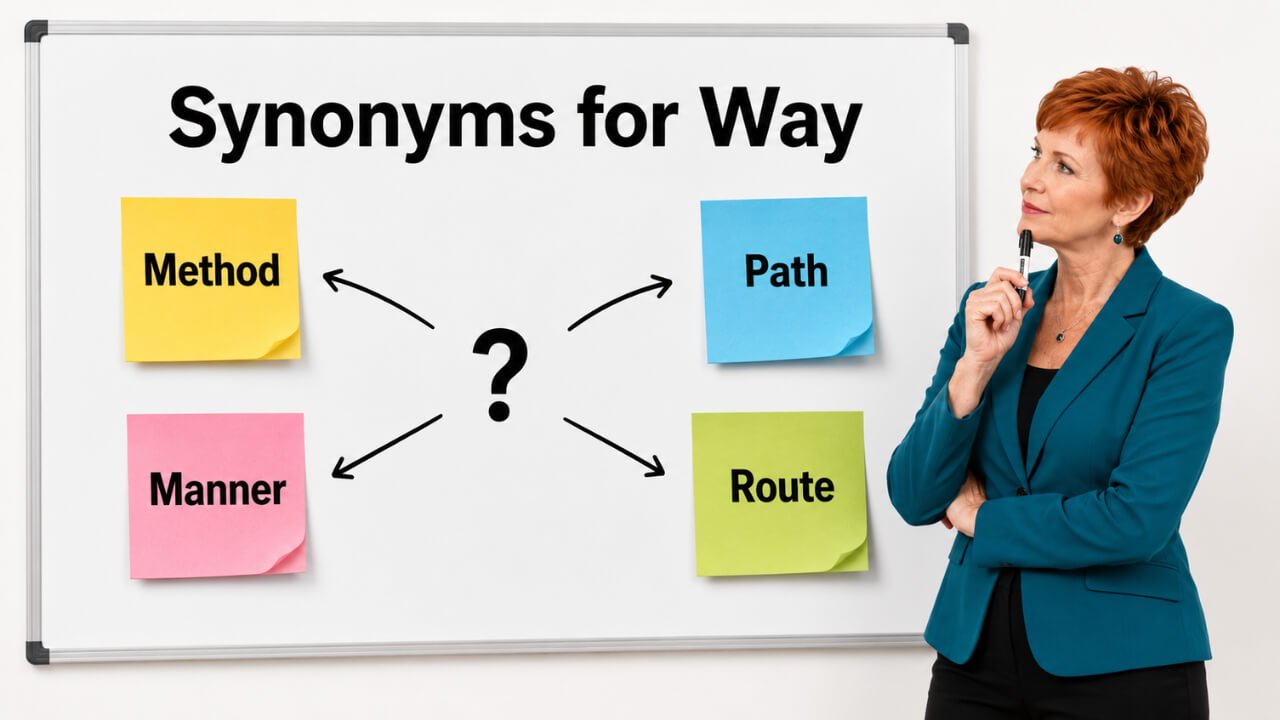
Quick Answer: The best synonyms for way include method, manner, approach, means, route, path, direction, style, technique, and course. Use method when explaining how something is done, manner for behavior or presentation, approach for a planned method, route for travel, path for movement or progress, means for a resource that makes something possible, and direction for orientation. Style works well for personal expression, while technique suits a learned skill. The correct choice depends on whether way refers to a method, behavior, route, direction, distance, or degree.
Pronunciation and Word Details
Word: Way
Pronunciation: /weɪ/
Part of Speech: Noun and adverb
Meaning: A method, manner, route, direction, means, distance, or particular course used to do or reach something.
US Pronunciation:
UK Pronunciation:
What Does “Way” Mean?
Way means a method of doing something, a route to a place, or a particular manner in which an action happens. It is most commonly used as a noun, although it can also work as an informal adverb that adds emphasis.
When way refers to a method, it explains how something is done. In the sentence, “This is the best way to solve the problem,” way means method or approach.
When it refers to travel, way means route, path, or direction. In “Do you know the way to the station?” the word describes the route someone should follow.
Way can also describe behavior or style. In “I admire the way she speaks,” it means manner. It may express distance in “The village is a long way from here” or add informal emphasis in “This version is way better.”
Because way has several meanings, the most suitable synonym depends on the sentence and intended message.
Meaning, Tone, and Context of “Way”
Way is a common, neutral, and highly flexible word. It appears naturally in casual conversation, professional communication, instructions, descriptions, stories, and general writing. Its tone usually depends on the surrounding words rather than the word itself.
In everyday speech, way often sounds simple and conversational. Expressions such as “find a way,” “on the way,” and “by the way” are familiar and natural. In formal writing, more precise alternatives such as method, procedure, approach, route, or means may communicate the intended meaning more clearly.
Way can also carry emotional force. “There is no way” may express disbelief, refusal, or impossibility. “She went out of her way to help” communicates special effort and kindness.
As an informal intensifier, way means much or considerably. For example, “The second task was way easier.” This use is common in conversation but may sound too casual in academic reports, formal essays, and professional documents.
When and How to Use “Way”
For a Method: Use way when describing how a task can be completed or a result can be achieved.
Example: We need a better way to organize these files.
For a Manner: Use way to describe how someone behaves, speaks, moves, or performs an action.
Example: I appreciate the respectful way he answered the question.
For a Route: Use way when discussing the road, path, or course that leads to a destination.
Example: Can you show me the way to the library?
For a Direction: Use way to indicate where someone or something should move.
Example: The guide pointed the way toward the exit.
For a Means: Use way when referring to something that makes an action or result possible.
Example: Online study provides a convenient way to develop new skills.
For Personal Style: Use way when describing an individual method of expression or action.
Example: Every artist has a different way of presenting an idea.
For Distance: Use way to describe how far one place or point is from another.
Example: Their house is a long way from the town center.
For Progress: Use way when discussing advancement toward a goal.
Example: The research has come a long way in recent years.
For Informal Emphasis: Use way before a comparative adjective to mean much or considerably.
Example: This explanation is way clearer than the previous one.
Best Synonyms for Way
Method: An organized or practical way of doing something.
Example: This method makes the calculation easier to understand.
Manner: The particular way in which someone acts or something happens.
Example: She handled the complaint in a calm manner.
Approach: A planned way of dealing with a task, subject, or problem.
Example: The teacher used a creative approach to explain the lesson.
Means: A resource, action, or method that makes something possible.
Example: Reading is an effective means of expanding your vocabulary.
Route: A particular road or course used to travel somewhere.
Example: We selected the shortest route through the city.
Path: A track, direction, or course leading toward a place or goal.
Example: Education opened a new path toward professional growth.
Direction: The course along which someone or something moves.
Example: The sign showed the correct direction to the entrance.
Style: A distinctive way of acting, writing, designing, or expressing something.
Example: Her writing style is clear and engaging.
Technique: A learned or practiced way of performing a particular activity.
Example: The musician practiced a new breathing technique.
Course: A direction, route, or planned series of actions.
Example: The committee decided on a different course of action.
50 Synonyms for Way with Short Meanings
- Method: A planned or organized means of doing something.
- Manner: The way an action is performed.
- Approach: A method of handling a task or problem.
- Means: Something used to achieve a result.
- Mode: A particular form or manner of operation.
- Style: A distinctive form of expression or behavior.
- Technique: A learned method used to perform a skill.
- Procedure: An established series of actions.
- Process: A sequence of steps leading to a result.
- Practice: A usual or accepted method of doing something.
- System: An organized set of methods or principles.
- Strategy: A carefully developed plan for reaching a goal.
- Plan: A proposed method for completing an action.
- Course: A chosen direction or series of actions.
- Path: A route or course toward a destination or goal.
- Route: A road or course used to reach a place.
- Road: A physical or figurative route toward something.
- Track: A marked course or direction of movement.
- Trail: A path through an area or toward a goal.
- Passage: A route through or between places.
- Direction: The course toward which something moves.
- Bearing: A position or direction in relation to a place.
- Line: A particular direction, course, or method.
- Avenue: A possible method or route toward a result.
- Channel: A means through which something is communicated or achieved.
- Medium: A method or form used to express or communicate something.
- Mechanism: A process or system that produces a result.
- Instrument: Something used as a means to achieve a purpose.
- Resource: Something available for solving a problem or meeting a need.
- Solution: A successful way of dealing with a difficulty.
- Option: One possible way of acting or choosing.
- Choice: A selected possibility or course of action.
- Possibility: A potential method, route, or outcome.
- Custom: A traditional or commonly followed way of behaving.
- Fashion: A particular manner of doing or presenting something.
- Form: A particular type, shape, or mode.
- Pattern: A repeated or recognizable way of acting.
- Habit: A usual way of behaving or doing something.
- Behavior: The way a person or thing acts.
- Conduct: A person’s manner of behaving.
- Access: A way of entering, reaching, or using something.
- Entrance: A way into a place.
- Exit: A way out of a place.
- Journey: The act or course of traveling from one point to another.
- Pass: A route through a difficult area.
- Distance: The amount of space between two points.
- Extent: The degree, range, or distance of something.
- Far: At or across a great distance.
- Considerably: By a large amount or degree.
- Significantly: To an important or noticeable degree.
Read Also:
Synonyms for Participate

Synonyms for Way by Context
When Way Means a Method
When way explains how something is done, method, approach, technique, procedure, process, and system are strong alternatives.
Method is a general and precise replacement. Approach focuses on how someone begins or handles a situation. Technique usually involves skill or practice. Procedure refers to an established sequence of actions.
Example With Method: We discovered a reliable method for checking the results.
Example With Approach: Her thoughtful approach prevented unnecessary conflict.
Example With Technique: This breathing technique can improve concentration.
Example With Procedure: Follow the safety procedure before starting the machine.
When Way Means a Manner
When way describes how someone behaves, speaks, writes, or performs an action, use manner, style, fashion, mode, conduct, or behavior.
Manner is usually neutral and suitable for both formal and general writing. Style emphasizes distinctive personal expression. Conduct and behavior focus more directly on actions.
Example With Manner: He explained the decision in a polite manner.
Example With Style: The author presents complex ideas in a simple style.
Example With Behavior: Her respectful behavior impressed the entire group.
When Way Means a Route
When way refers to travel or movement, route, path, road, track, trail, passage, and course are useful alternatives.
Route is best for a planned journey. Path may describe a physical track or a figurative journey. Road normally refers to a surface used by vehicles. Trail often describes a route through a natural area.
Example With Route: This route avoids the busiest streets.
Example With Path: A narrow path led through the garden.
Example With Road: The main road continues toward the village.
Example With Trail: We followed the trail to the top of the hill.
When Way Means a Means of Achieving Something
When way describes something that makes a result possible, use means, avenue, channel, mechanism, instrument, or resource.
Means is the broadest alternative. Avenue suggests an available possibility. Channel often relates to communication, distribution, or action. Mechanism describes how a process produces a result.
Example With Means: Education can be a means of personal advancement.
Example With Avenue: The meeting created an avenue for further discussion.
Example With Channel: The organization opened a new channel for feedback.
Example With Mechanism: The agreement provides a mechanism for resolving disputes.
When Way Means a Direction
When way indicates where something should move, direction, bearing, course, and line are suitable choices.
Direction is the clearest general replacement. Bearing is more technical and often relates to navigation. Course describes a continuing direction of travel or action.
Example With Direction: The arrow indicates the correct direction.
Example With Bearing: The navigator checked the boat’s bearing.
Example With Course: The storm forced the ship to change course.
When Way Means Distance
In expressions such as “a long way” or “some way away,” the closest alternatives include distance, far, extent, and space.
These alternatives often require the sentence to be rewritten because way does not always have a direct replacement in distance expressions.
Example With Distance: There is a considerable distance between the two villages.
Example With Far: The nearest hospital is far from here.
Example With Extent: We did not realize the full extent of the journey.
When Way Adds Informal Emphasis
When way means much or considerably, use far, considerably, significantly, greatly, or much.
Far works naturally before comparative adjectives. Considerably and significantly sound more formal and are often better for essays, reports, and professional writing.
Example With Far: The revised plan is far more practical.
Example With Considerably: Attendance was considerably higher this month.
Example With Significantly: The new process is significantly faster.
Another Word for Way
Method is often the best single replacement for way when the sentence explains how something is done. However, the best alternative depends on the intended meaning. Route works better for travel, manner for behavior, means for achieving a result, and direction for orientation.
Original: We need a new way to manage customer requests.
Better Option: We need a new method for managing customer requests.
Original: She disliked the way he spoke to the visitors.
Better Option: She disliked the manner in which he spoke to the visitors.
Original: Is this the fastest way to the museum?
Better Option: Is this the fastest route to the museum?
Original: Education is one way to create better opportunities.
Better Option: Education is one means of creating better opportunities.
When Not to Use “Way”
Way can become weak when it is repeated too often or used without enough detail. A more specific synonym can make a sentence clearer and more professional.
Avoid way when readers need to understand the exact method, route, process, or behavior being discussed. In formal documents, expressions such as “a way to,” “in a way,” and “the way that” may sound vague if the writer does not explain what they mean.
The informal intensifier way may also be unsuitable in academic or professional writing. Use far, considerably, or significantly instead.
Weak: The team found a way to improve the way information was recorded.
Better: The team developed a method for improving the process used to record information.
Weak: We need a way to complete the inspection.
Better: We need a clear procedure for completing the inspection.
Weak: This route is way more efficient.
Better: This route is considerably more efficient.
Weak: He acted in a strange way during the meeting.
Better: He behaved strangely during the meeting.
Weak: The report explains the way the system works.
Better: The report explains the process through which the system operates.
Words Commonly Confused With Way
Way vs Method: Way is broad and conversational, while method refers more precisely to an organized manner of completing a task.
Way vs Manner: Way can describe methods, routes, and behavior. Manner mainly describes how an action is performed or how someone behaves.
Way vs Approach: Way is a general term. Approach usually refers to a planned attitude or method used to handle a problem, subject, or situation.
Way vs Means: Way can describe how something happens. Means focuses on the resource, action, or method that makes a result possible.
Way vs Route: Way may refer to any direction or course. Route describes a more specific road or planned course between locations.
Way vs Path: Way is broader. Path often refers to a track, personal journey, development, or course toward a goal.
Way vs Direction: Way can mean method or route, while direction specifically identifies the course toward which someone or something moves.
Way vs Style: Way can describe any manner of action. Style emphasizes distinctive expression, presentation, design, or personal character.
Which Synonym Should You Choose?
Choose method when explaining an organized or practical way to complete a task.
Choose manner when describing how a person speaks, behaves, responds, or performs an action.
Choose approach when discussing a planned method of handling a problem, topic, project, or relationship.
Choose technique when the action requires learned ability, training, practice, or physical skill.
Choose procedure when describing official instructions or a fixed sequence of steps.
Choose process when focusing on the stages through which something develops or is completed.
Choose route when describing travel between two physical locations.
Choose path when discussing physical movement, personal development, or progress toward a goal.
Choose means when explaining what makes an action, achievement, or result possible.
Choose direction when indicating where someone or something should move.
Choose style when discussing writing, clothing, design, communication, or personal expression.
Choose course when describing a continuing direction, plan, or series of actions.
Choose far, considerably, or significantly when way is being used informally to add emphasis.
For formal essays and reports, method, approach, procedure, means, and process are usually more precise than way. For casual conversation, way often remains the most natural choice.
Real Life Examples of “Way” in Sentences
Original: Is there another way to solve this equation?
Better Option: Is there another method for solving this equation?
Original: I like the way she explains difficult ideas.
Better Option: I like the manner in which she explains difficult ideas.
Original: This is the quickest way to the airport.
Better Option: This is the quickest route to the airport.
Original: We must find a way to reduce unnecessary costs.
Better Option: We must develop a strategy for reducing unnecessary costs.
Original: He has a unique way of telling stories.
Better Option: He has a unique storytelling style.
Original: The sign showed us the way to the main entrance.
Better Option: The sign showed us the direction of the main entrance.
Original: Regular practice is one way to improve your pronunciation.
Better Option: Regular practice is one means of improving your pronunciation.
Original: The new office is a long way from my home.
Better Option: The new office is far from my home.
Original: This explanation is way easier to follow.
Better Option: This explanation is considerably easier to follow.
Original: Her way of managing the project kept everyone organized.
Better Option: Her approach to managing the project kept everyone organized.
Synonym Groups and Usage Differences
Method Group
Method, procedure, technique, process, system, and practice describe how something is done. Method is general, procedure follows fixed steps, technique involves skill, and process focuses on development through stages.
Example: The laboratory introduced a safer testing procedure.
Approach Group
Approach, strategy, plan, course, solution, and option describe ways of handling a problem or pursuing a goal. Approach emphasizes perspective and action, while strategy usually involves careful planning.
Example: A cooperative approach helped the group reach an agreement.
Manner Group
Manner, style, fashion, mode, behavior, and conduct describe how someone acts or how something appears. Manner is neutral, style is distinctive, and conduct often relates to standards of behavior.
Example: She responded to the criticism in a professional manner.
Route Group
Route, path, road, trail, track, passage, and course describe movement from one point to another. Route is planned, path is general, and trail is commonly associated with walking through natural surroundings.
Example: The hikers selected a shorter trail through the valley.
Means Group
Means, avenue, channel, mechanism, instrument, and resource describe something that enables action or achievement. Means is broad, while mechanism focuses on how a result is produced.
Example: The program provides an avenue for professional development.
Direction Group
Direction, bearing, course, and line refer to orientation or movement. Direction is the most common choice, while bearing is more precise in navigation.
Example: The vehicle continued in a northern direction.
Emphasis Group
Far, much, considerably, significantly, and greatly replace way when it intensifies a comparison. Far works in both general and formal writing, while considerably and significantly sound more analytical.
Example: The final result was significantly better than expected.
Antonyms of Way
Way has no single opposite because it carries several meanings. Its antonyms change according to whether it means a method, route, possibility, direction, or means of access.
Barrier: Something that prevents movement or progress.
Obstacle: A difficulty that blocks a method or course of action.
Blockage: Something that closes or prevents passage.
Dead End: A route or plan that cannot continue.
Misdirection: Guidance that points toward the wrong place or conclusion.
Aimlessness: A lack of clear purpose, course, or direction.
Impossibility: A situation in which no workable means exists.
Prevention: The act of stopping an action or result.
Restriction: A rule or condition that limits available options.
Confusion: A lack of clarity about the correct method or direction.
Disorder: The absence of an organized method or system.
Closure: The act of blocking or ending access to a route.
Comparison: Way vs Related Words
Way vs Method
Way is broad, familiar, and conversational. Method is more precise and describes an organized form of completing a task.
Example With Way: We need a better way to record attendance.
Example With Method: We need a more reliable method for recording attendance.
Way vs Manner
Way may refer to a method, route, behavior, or style. Manner mainly describes how someone performs an action or behaves.
Example With Way: I was surprised by the way she responded.
Example With Manner: I was surprised by her calm manner of responding.
Way vs Approach
Way is a general term for how something is done. Approach describes the attitude, plan, or method used to begin and manage a situation.
Example With Way: That is one way to handle the disagreement.
Example With Approach: A patient approach may resolve the disagreement.
Way vs Route
Way can indicate a general direction or course. Route refers to a specific road or planned journey between places.
Example With Way: Do you know the way to the park?
Example With Route: We planned a route that avoids heavy traffic.
Way vs Path
Way is more flexible and can describe methods or routes. Path usually refers to a physical track or a figurative course of growth and progress.
Example With Way: She found a way to achieve her goal.
Example With Path: Education created a path toward a rewarding career.
Way vs Means
Way explains how something may be done. Means refers to the method, resource, or instrument that makes it possible.
Example With Way: Exercise is one way to improve physical health.
Example With Means: Exercise is an effective means of improving physical health.
Way vs Direction
Way may mean route, manner, or method. Direction specifically refers to the course toward which something moves or faces.
Example With Way: Which way should we go?
Example With Direction: Which direction should we follow?
Way vs Style
Way is general, while style highlights a recognizable or personal form of expression.
Example With Way: I like the way he writes.
Example With Style: I like his clear and descriptive writing style.
Common Phrases and Expressions With “Way”
By the Way: Used to introduce an additional or slightly different topic.
In a Way: To some degree or from a particular point of view.
No Way: An expression of disbelief, refusal, or impossibility.
On the Way: Traveling toward a place or developing toward a result.
All the Way: Throughout the entire distance, process, or experience.
A Long Way: A great distance or a large amount of progress.
Find a Way: Discover a possible method or solution.
Make Way: Move aside or create space for someone or something.
Go Out of Your Way: Make a special effort beyond what is normally expected.
One Way or Another: By some method, regardless of which one is used.
Way of Life: A typical pattern of living, thinking, and behaving.
Lead the Way: Be the first to act, guide others, or demonstrate progress.
Common Mistakes to Avoid
One common mistake is repeating way several times in the same paragraph. Replace some uses with method, approach, route, manner, means, or direction to improve clarity and variety.
Another mistake is selecting a synonym without considering the intended meaning. Route cannot replace way when the sentence refers to behavior, and manner cannot replace it when discussing travel.
Avoid using way as an informal intensifier in highly formal writing. “Way more effective” may sound natural in conversation, but “considerably more effective” or “significantly more effective” is more suitable in reports and essays.
Writers also use “in a way” when they are unsure how to express an idea. This phrase may make a statement sound hesitant or vague. Explain the exact relationship whenever possible.
Do not automatically replace every instance of way. Familiar expressions such as “by the way,” “on the way,” and “go out of your way” may sound unnatural when rewritten.
Check whether the sentence describes a method, manner, route, means, direction, distance, or degree before choosing a replacement.
Conclusion
Understanding synonyms for way helps you express methods, routes, behavior, direction, and progress with greater precision. Method is ideal for explaining how a task is completed, while manner describes behavior and approach presents a planned response. Choose route or path for travel, means for achieving a result, and direction for movement. In formal writing, replace informal emphasis with far, considerably, or significantly. The best synonym always depends on the exact meaning of way in the sentence.
FAQs About Synonyms for Way
What is the best synonym for way?
Method is the best general synonym when way describes how something is done. Manner, route, means, and direction may be more accurate in other contexts.
What is another word for way in formal writing?
Method, approach, procedure, process, means, and manner are suitable formal alternatives. The correct choice depends on the intended meaning.
What is a synonym for way when discussing travel?
Route, path, road, course, track, and trail can replace way when discussing travel or movement toward a destination.
Can manner always replace way?
No. Manner replaces way only when describing behavior or how an action occurs. It cannot normally replace way when referring to a route, direction, or method.
What can replace “way better” in formal writing?
Use far better, considerably better, significantly better, or much better. These choices sound more polished in reports and essays.
Is approach the same as way?
Approach is a type of way, but it usually describes a planned method or attitude used to handle a task, subject, or problem.
How can I choose the correct synonym for way?
Identify whether way means method, manner, route, means, direction, distance, or emphasis. Then select the alternative that expresses that specific meaning most clearly.
