
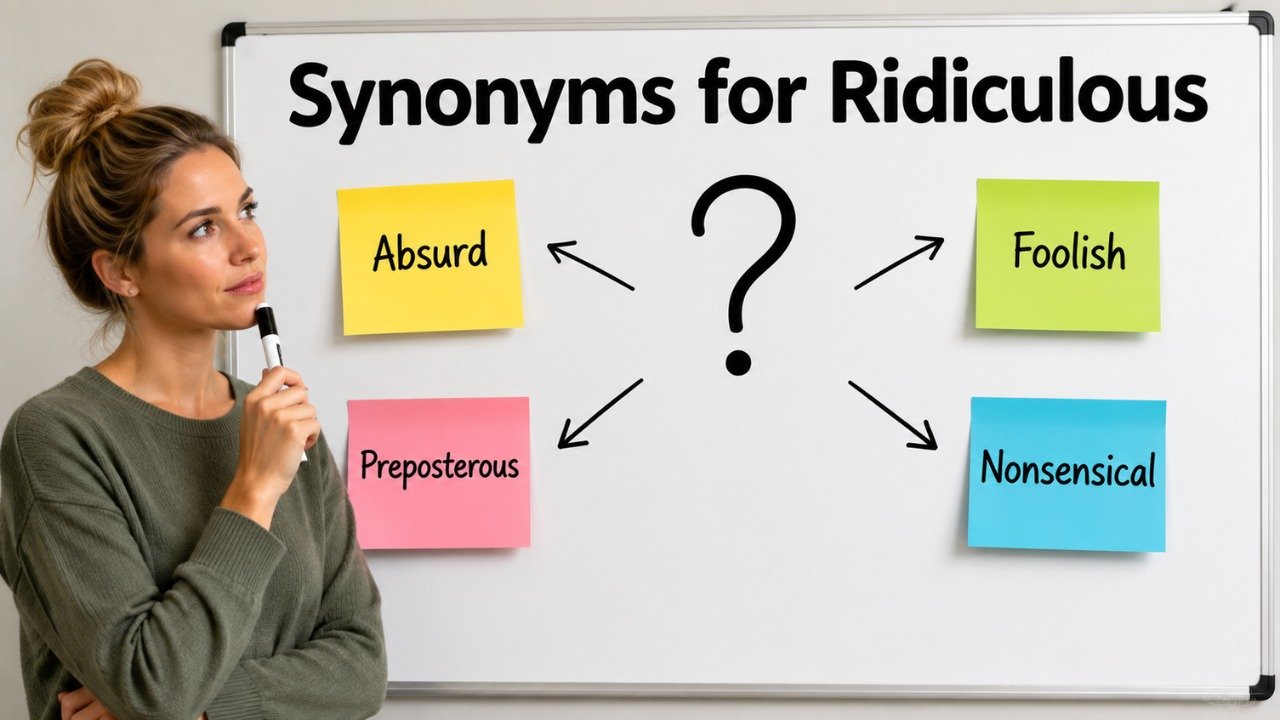
Quick Answer: Common synonyms for ridiculous include absurd, ludicrous, preposterous, foolish, laughable, nonsensical, outrageous, unreasonable, silly, and farcical. Absurd is the best neutral choice for something that makes no logical sense. Ludicrous and laughable emphasize that an idea deserves mockery. Preposterous works well in formal criticism, while silly suits casual conversation. Use outrageous for behavior, prices, or demands that are shockingly unreasonable, and use nonsensical for statements or arguments that lack clear meaning.
Pronunciation and Word Details
Word: Ridiculous.
Pronunciation: /rɪˈdɪkjələs/.
Part of Speech: Adjective.
Meaning: Extremely unreasonable, foolish, absurd, or deserving of laughter.
US Pronunciation:
UK Pronunciation:
What Does “Ridiculous” Mean?
Ridiculous means extremely foolish, unreasonable, absurd, or difficult to take seriously.
Ridiculous is an adjective. It describes a person, idea, statement, action, appearance, price, situation, rule, or amount that seems unreasonable or worthy of mockery.
The word can describe something that lacks logic.
Example: His explanation was ridiculous because it contradicted every known fact.
It can also describe something excessively high, low, large, or extreme.
Example: The restaurant charged a ridiculous price for a small meal.
Ridiculous may describe behavior that appears foolish or embarrassing.
Example: They looked ridiculous trying to carry the enormous box together.
It can also express disbelief or strong disagreement.
Example: The suggestion that nobody noticed the error is ridiculous.
The exact meaning depends on context. In some sentences, ridiculous means absurd. In others, it means excessive, embarrassing, laughable, or shockingly unreasonable.
Meaning, Tone, and Context of “Ridiculous”
Ridiculous is a strong and usually negative adjective. It often communicates criticism, disbelief, irritation, amusement, or disapproval.
The word is common in both casual conversation and formal writing. However, its emotional strength can make it sound less objective than alternatives such as unreasonable, illogical, or implausible.
Casual Tone: That hat looks ridiculous.
Critical Tone: The new rule is ridiculous and difficult to follow.
Amused Tone: The entire situation was so ridiculous that everyone started laughing.
Formal Tone: The claim appears implausible and unsupported.
Ridiculous can sound humorous when it describes an amusing situation. It can sound insulting when directed at a person, appearance, opinion, or ability.
Calling an idea ridiculous criticizes the idea. Calling a person ridiculous criticizes the person more directly and may sound rude.
Less Personal: That argument is ridiculous.
More Personal: You are ridiculous.
In academic, professional, or diplomatic writing, a precise alternative may communicate the criticism more clearly. Words such as illogical, unsupported, unreasonable, excessive, or impractical often sound more measured.
Ridiculous is commonly used when discussing unreasonable demands, unbelievable explanations, foolish behavior, excessive prices, strange clothing, impossible plans, and absurd situations.
When and How to Use “Ridiculous”
For an Absurd Idea
Use ridiculous when an idea appears completely unreasonable or impossible to accept.
Example: The idea that one person could finish the entire project in an hour is ridiculous.
For Foolish Behavior
Use ridiculous to describe behavior that seems silly, embarrassing, or lacking in good judgment.
Example: His ridiculous attempt to impress everyone caused more problems.
For an Unreasonable Demand
Use ridiculous when a request, expectation, or condition is far beyond what is fair or practical.
Example: Expecting employees to answer messages throughout the night is ridiculous.
For an Excessive Price
Use ridiculous for a price or cost that seems shockingly high.
Example: The repair shop demanded a ridiculous amount for a simple replacement.
For an Unbelievable Claim
Use ridiculous when a statement appears impossible, unsupported, or clearly false.
Example: Her claim that the missing documents disappeared by themselves sounded ridiculous.
For a Comical Appearance
Use ridiculous when someone or something looks amusing in an awkward or exaggerated way.
Example: The oversized costume made him look ridiculous.
For a Nonsensical Argument
Use ridiculous when an explanation or argument lacks logic.
Example: The conclusion is ridiculous because it is based on unrelated information.
For Strong Disagreement
Use ridiculous to reject an idea strongly in conversation.
Example: That is ridiculous. We cannot cancel the entire event because of one small mistake.
For an Extreme Amount
Use ridiculous informally when an amount, number, speed, or level is surprisingly large.
Example: The machine produces a ridiculous amount of heat.
Best Synonyms for Ridiculous
Absurd: Completely unreasonable, illogical, or impossible to take seriously.
Example: The accusation was absurd and unsupported by evidence.
Ludicrous: So unreasonable or foolish that it deserves laughter.
Example: The proposed deadline was ludicrous.
Preposterous: Contrary to reason, common sense, or probability.
Example: His preposterous explanation convinced nobody.
Laughable: So weak, foolish, or unreasonable that it invites laughter.
Example: Their attempt to hide the mistake was laughable.
Foolish: Showing poor judgment or a lack of wisdom.
Example: Ignoring the warning signs was a foolish decision.
Silly: Lacking seriousness, good sense, or mature judgment.
Example: They had a silly argument over where to sit.
Nonsensical: Lacking clear meaning, reason, or logical connection.
Example: The instructions were confusing and nonsensical.
Outrageous: Shockingly unreasonable, excessive, offensive, or improper.
Example: The company demanded an outrageous fee.
Unreasonable: Not fair, sensible, practical, or based on sound judgment.
Example: The manager placed unreasonable expectations on the team.
Farcical: Resembling an absurd comedy because of disorder or incompetence.
Example: The investigation became a farcical display of confusion.
50 Synonyms for Ridiculous with Short Meanings
- Absurd: Completely unreasonable or illogical.
- Ludicrous: So foolish that it invites laughter.
- Preposterous: Completely contrary to reason or common sense.
- Laughable: Too foolish or weak to be taken seriously.
- Foolish: Showing poor judgment or little wisdom.
- Silly: Lacking seriousness or good sense.
- Nonsensical: Without clear meaning or logical sense.
- Outrageous: Shockingly unreasonable, extreme, or offensive.
- Unreasonable: Not fair, sensible, or practical.
- Farcical: Absurdly disorganized or comical.
- Comical: Amusing because of an awkward or absurd quality.
- Bizarre: Extremely strange or unusual.
- Unbelievable: Very difficult to accept as true.
- Irrational: Not based on reason or logical thought.
- Illogical: Not following a sensible pattern of reasoning.
- Senseless: Lacking meaning, purpose, or good judgment.
- Inane: Extremely foolish, empty, or meaningless.
- Asinine: Extremely stupid or foolish.
- Idiotic: Showing an extreme lack of good judgment.
- Stupid: Lacking intelligence, thought, or common sense.
- Daft: Foolish or unreasonable in an informal way.
- Impractical: Not suitable or realistic for actual use.
- Impossible: Unable to happen, exist, or be achieved.
- Excessive: Greater than what is reasonable or necessary.
- Extreme: Far beyond an ordinary or acceptable level.
- Exaggerated: Made to appear larger or more serious than it is.
- Overblown: Presented with too much importance or intensity.
- Outlandish: Extremely unusual, strange, or unbelievable.
- Implausible: Difficult to believe because it seems unlikely.
- Incredible: So unusual that it is difficult to believe.
- Untenable: Impossible to defend or continue reasonably.
- Indefensible: Unable to be supported with a reasonable argument.
- Unjustifiable: Lacking an acceptable reason or explanation.
- Unacceptable: Too poor, improper, or unreasonable to approve.
- Pathetic: So weak or poor that it inspires contempt or pity.
- Pitiful: Extremely poor, weak, or inadequate.
- Risible: Deserving laughter or mockery.
- Clownish: Foolishly comical in behavior or appearance.
- Buffoonish: Acting in a foolish and exaggerated manner.
- Zany: Amusingly strange, energetic, or unconventional.
- Wacky: Very strange, foolish, or amusing.
- Harebrained: Extremely foolish and poorly planned.
- Cockamamie: Absurd, unbelievable, or badly considered.
- Bonkers: Extremely unreasonable or strange.
- Nutty: Odd, foolish, or unreasonable.
- Wild: Extremely unusual, unreasonable, or uncontrolled.
- Crazy: Extremely unreasonable, surprising, or excessive.
- Grotesque: Extremely distorted, inappropriate, or absurd.
- Foolhardy: Recklessly foolish despite an obvious risk.
- Madcap: Wildly foolish, energetic, or disorderly.
Read Also:
Synonyms for It
Synonyms for Ridiculous by Context
When Ridiculous Means Absurd
Absurd, preposterous, ludicrous, and nonsensical describe ideas or claims that do not make logical sense.
Absurd: Best for a neutral but strong criticism of an unreasonable idea.
Example: It is absurd to blame the entire team for one minor error.
Preposterous: Best when a claim strongly contradicts common sense.
Example: The suggestion that the damage repaired itself is preposterous.
Ludicrous: Best when an idea is so unreasonable that it appears amusing.
Example: The proposed schedule was ludicrous.
Nonsensical: Best when a statement lacks meaning or logical connection.
Example: His response was nonsensical and unrelated to the question.
When Ridiculous Means Foolish
Foolish, silly, inane, idiotic, daft, and asinine describe poor judgment or a lack of seriousness.
Foolish: Suitable for unwise choices and actions.
Example: Leaving without checking the weather was foolish.
Silly: Softer and more casual than ridiculous.
Example: We had a silly disagreement about the seating plan.
Inane: Useful for empty, pointless, or foolish comments.
Example: The discussion became filled with inane remarks.
Idiotic: A very strong and potentially insulting word.
Example: Disabling the safety system was an idiotic decision.
Daft: An informal word for something foolish or unreasonable.
Example: It was a daft idea, but everyone found it amusing.
When Ridiculous Means Excessive
Outrageous, excessive, extreme, overblown, and exaggerated describe something beyond a reasonable amount or level.
Outrageous: Best for prices, demands, conduct, or fees that seem shocking.
Example: The landlord requested an outrageous increase in rent.
Excessive: A more formal and neutral choice for amounts or behavior.
Example: The report criticized the excessive use of unnecessary materials.
Extreme: Describes something far beyond the normal range.
Example: The region experienced extreme temperatures.
Overblown: Describes something presented with more importance or drama than necessary.
Example: The reaction to the minor mistake was overblown.
Exaggerated: Describes something made to seem greater than it really is.
Example: His description of the danger was exaggerated.
When Ridiculous Means Unbelievable
Implausible, unbelievable, incredible, bizarre, and outlandish describe something difficult to accept as true.
Implausible: Best for formal analysis of an unlikely explanation.
Example: The witness gave an implausible account of the event.
Unbelievable: A common choice for something difficult to accept.
Example: The excuse sounded unbelievable.
Bizarre: Best for something unusually strange.
Example: The meeting ended with a bizarre announcement.
Outlandish: Describes a claim, outfit, idea, or plan that appears extremely unusual.
Example: They presented an outlandish plan for completing the work overnight.
When Ridiculous Means Comical
Laughable, comical, farcical, clownish, and buffoonish emphasize amusement, mockery, or exaggerated foolishness.
Laughable: Best for a weak excuse, attempt, or claim that deserves mockery.
Example: Their attempt to deny the obvious mistake was laughable.
Comical: Often less harsh and more genuinely amusing.
Example: The dog’s comical expression made everyone smile.
Farcical: Suitable for a serious process that has become absurdly disorganized.
Example: The selection process became farcical.
Clownish: Describes exaggerated and foolish behavior.
Example: His clownish performance distracted everyone.
When Ridiculous Means Unreasonable
Unreasonable, irrational, illogical, impractical, and untenable suit situations involving weak judgment or poor reasoning.
Unreasonable: Best for demands, expectations, rules, and decisions.
Example: The deadline was unreasonable.
Irrational: Best for beliefs, fears, reactions, and decisions not based on reason.
Example: Her fear of the harmless insect was irrational.
Illogical: Best for arguments and conclusions with faulty reasoning.
Example: The argument is illogical because the evidence does not support it.
Impractical: Best for plans that cannot work effectively.
Example: The design is attractive but impractical.
Untenable: Best for positions or arguments that cannot be defended.
Example: His explanation became untenable after the new evidence appeared.
Another Word for Ridiculous
Absurd is usually the best single replacement for ridiculous. It is clear, widely understood, and suitable for both formal and casual writing.
However, the strongest alternative depends on the intended meaning. Use ludicrous for something worthy of mockery, unreasonable for an unfair demand, outrageous for an excessive price, and nonsensical for an argument that lacks logic.
Original: The new rule is ridiculous.
Better Option: The new rule is unreasonable.
Original: His explanation sounded ridiculous.
Better Option: His explanation sounded implausible.
Original: They charged a ridiculous price for the repair.
Better Option: They charged an outrageous price for the repair.
Original: The entire process became ridiculous.
Better Option: The entire process became farcical.
When Not to Use “Ridiculous”
Do not use ridiculous when you need a neutral, precise, or diplomatic tone. The word expresses strong judgment and may make professional writing sound emotional.
When Discussing Evidence
Weak: The conclusion is ridiculous.
Better: The conclusion is unsupported by the available evidence.
The better sentence explains why the conclusion is weak.
When Giving Professional Feedback
Weak: Your proposal is ridiculous.
Better: Your proposal may be impractical under the current budget.
The revised sentence criticizes the proposal without insulting its writer.
When Describing a Minor Mistake
Ridiculous may sound too strong for an ordinary error.
Weak: That spelling mistake is ridiculous.
Better: That spelling mistake is easy to correct.
When the Intended Meaning Is Unclear
Ridiculous can mean foolish, excessive, strange, amusing, or unreasonable. A more specific synonym may communicate the meaning better.
Weak: The price was ridiculous.
Better: The price was excessively high.
When Speaking About a Person
Calling a person ridiculous may sound insulting or dismissive.
Weak: She is ridiculous.
Better: Her reaction seemed unnecessarily extreme.
When the Word Becomes Repetitive
Repeated use weakens its impact.
Weak: The ridiculous rule created a ridiculous delay and a ridiculous amount of confusion.
Better: The unreasonable rule caused a serious delay and widespread confusion.
Words Commonly Confused With Ridiculous
Ridiculous vs Absurd: Ridiculous often suggests that something deserves laughter or mockery. Absurd focuses more directly on a lack of logic or reason.
Ridiculous vs Ludicrous: Both words describe something extremely foolish. Ludicrous places stronger emphasis on how laughable the situation appears.
Ridiculous vs Silly: Silly is usually softer, more casual, and less critical. Ridiculous expresses stronger disapproval or disbelief.
Ridiculous vs Funny: Funny means amusing or causing laughter. Ridiculous may cause laughter, but it often includes criticism.
Ridiculous vs Outrageous: Ridiculous describes something foolish or unreasonable. Outrageous often suggests shock, anger, excess, or offensiveness.
Ridiculous vs Nonsensical: Ridiculous has a broad meaning. Nonsensical specifically describes language, reasoning, or ideas that lack sense.
Ridiculous vs Irrational: Irrational describes a lack of reason, especially in thoughts, emotions, or decisions. Ridiculous adds a stronger sense of mockery or disbelief.
Ridiculous vs Bizarre: Bizarre means extremely strange. Something bizarre is not always foolish, while something ridiculous usually deserves criticism or laughter.
Ridiculous vs Preposterous: Preposterous is stronger and often more formal. It describes a claim or idea that is completely contrary to reason.
Which Synonym Should You Choose?
Choose absurd when an idea, claim, or situation makes no logical sense.
Choose ludicrous when something is so unreasonable that it appears laughable.
Choose preposterous for strong formal criticism of an unbelievable claim.
Choose foolish when describing poor judgment without focusing on comedy.
Choose silly for light criticism in casual speech.
Choose nonsensical when an argument, statement, or instruction lacks meaning.
Choose unreasonable for unfair demands, expectations, rules, or decisions.
Choose outrageous for shocking prices, fees, behavior, or treatment.
Choose implausible when discussing an unlikely explanation in reports, essays, or formal analysis.
Choose excessive for amounts, costs, punishments, or actions beyond an acceptable limit.
Choose farcical for a serious event or process that has become absurdly disorganized.
Choose laughable when an excuse, attempt, claim, or result is too weak to deserve respect.
Choose illogical when evaluating faulty reasoning in essays, reports, or debates.
Choose impractical when a plan cannot work effectively in real conditions.
Choose comical when the situation is amusing rather than offensive or harmful.
In professional emails, use unreasonable, impractical, excessive, or unsupported instead of ridiculous when you need to sound respectful.
In academic writing, use illogical, implausible, unjustifiable, or untenable to explain the exact weakness.
In everyday conversation, silly, absurd, wild, bonkers, and ridiculous often sound natural.
Real Life Examples of “Ridiculous” in Sentences
Original: The hotel charged a ridiculous amount for breakfast.
Better Option: The hotel charged an outrageous amount for breakfast.
Original: His excuse for arriving late was ridiculous.
Better Option: His excuse for arriving late was implausible.
Original: The new deadline is ridiculous.
Better Option: The new deadline is unreasonable.
Original: She wore a ridiculous costume to the party.
Better Option: She wore an outlandish costume to the party.
Original: The instructions were ridiculous and difficult to follow.
Better Option: The instructions were nonsensical and difficult to follow.
Original: Their plan to finish the building in two days was ridiculous.
Better Option: Their plan to finish the building in two days was impractical.
Original: The argument became more ridiculous with every new claim.
Better Option: The argument became more illogical with every new claim.
Original: The meeting turned into a ridiculous display of confusion.
Better Option: The meeting turned into a farcical display of confusion.
Original: He looked ridiculous in shoes that were several sizes too large.
Better Option: He looked comical in shoes that were several sizes too large.
Original: The punishment was ridiculous for such a minor mistake.
Better Option: The punishment was excessive for such a minor mistake.
Synonym Groups and Usage Differences
Absurdity Group
Absurd, ludicrous, preposterous, nonsensical, and inane describe things that lack reason or common sense.
Absurd is the broadest choice. Preposterous is stronger and more formal. Ludicrous suggests mockery, while nonsensical focuses on a lack of meaning.
Example: The claim was preposterous because it contradicted every known fact.
Foolishness Group
Foolish, silly, idiotic, asinine, daft, and harebrained describe poor judgment or a lack of intelligence.
Silly is relatively mild. Foolish is neutral and useful in many contexts. Idiotic and asinine are harsh and may sound insulting.
Example: Ignoring the safety instructions was a foolish decision.
Excess Group
Outrageous, excessive, extreme, exaggerated, and overblown describe something beyond a reasonable limit.
Outrageous often expresses anger or shock. Excessive is more neutral and formal. Overblown commonly describes reactions, claims, descriptions, and publicity.
Example: The response to the minor problem was overblown.
Unbelievability Group
Implausible, unbelievable, incredible, bizarre, and outlandish describe things that are difficult to accept.
Implausible is useful in formal analysis. Bizarre focuses on strangeness. Outlandish often describes unusual claims, clothing, behavior, or plans.
Example: The witness offered an implausible explanation.
Comedy Group
Laughable, comical, farcical, clownish, buffoonish, and risible connect ridiculousness with laughter or mockery.
Comical can be gentle and amusing. Laughable is more critical. Risible is formal and less common in everyday conversation.
Example: The effort to conceal the obvious problem was laughable.
Unreasonableness Group
Unreasonable, irrational, illogical, impractical, untenable, and unjustifiable describe weak judgment, reasoning, or decisions.
Unreasonable suits demands and rules. Illogical suits arguments. Impractical suits plans. Untenable describes a position that cannot be defended.
Example: The proposed policy is impractical and difficult to enforce.
Antonyms of Ridiculous
The opposite of ridiculous depends on whether the intended meaning is sensible, believable, serious, moderate, or respectable.
Reasonable: Based on fair and sensible judgment.
Sensible: Showing practical wisdom and good judgment.
Logical: Following a clear and valid pattern of reasoning.
Rational: Based on reason rather than emotion or impulse.
Believable: Easy or possible to accept as true.
Plausible: Appearing reasonable or likely to be true.
Practical: Suitable for real conditions and actual use.
Serious: Deserving careful thought rather than laughter.
Dignified: Calm, respectable, and worthy of honor.
Appropriate: Suitable for the particular situation.
Acceptable: Good enough to be approved or allowed.
Justifiable: Supported by a valid reason.
Moderate: Remaining within reasonable limits.
Credible: Convincing and worthy of belief.
Respectable: Worthy of approval or respect.
Comparison Ridiculous vs Related Words
Ridiculous vs Absurd
Ridiculous often suggests that something appears foolish enough to deserve laughter. Absurd focuses mainly on a complete lack of logic or reason.
Example With Ridiculous: The amount of paperwork required for one request is ridiculous.
Example With Absurd: It is absurd to claim that the paperwork completed itself.
Ridiculous vs Ludicrous
Ridiculous and ludicrous are close synonyms. Ludicrous more strongly suggests that something is laughably unreasonable.
Example With Ridiculous: The proposed price is ridiculous.
Example With Ludicrous: Their claim that the damaged item was still new was ludicrous.
Ridiculous vs Preposterous
Preposterous is stronger and more formal than ridiculous. It commonly describes claims, ideas, excuses, and accusations that strongly oppose common sense.
Example With Ridiculous: His excuse sounded ridiculous.
Example With Preposterous: His claim that he completed the entire report in five minutes was preposterous.
Ridiculous vs Silly
Silly is softer and may sound affectionate or harmless. Ridiculous expresses stronger criticism.
Example With Ridiculous: Cancelling the event over one complaint would be ridiculous.
Example With Silly: We made silly faces for the photograph.
Ridiculous vs Outrageous
Ridiculous focuses on foolishness or unreasonableness. Outrageous emphasizes shock, anger, offensiveness, or excess.
Example With Ridiculous: The requirement is ridiculous.
Example With Outrageous: The store charged an outrageous fee for delivery.
Ridiculous vs Nonsensical
Nonsensical describes ideas, words, or arguments that lack meaning or logical connection. Ridiculous has a wider range of uses.
Example With Ridiculous: The situation became ridiculous.
Example With Nonsensical: The final paragraph was grammatically correct but nonsensical.
Ridiculous vs Unreasonable
Unreasonable is more neutral and professional. Ridiculous is stronger, more emotional, and sometimes mocking.
Example With Ridiculous: Their demands were ridiculous.
Example With Unreasonable: Their demands were unreasonable given the available resources.
Ridiculous vs Comical
Comical emphasizes amusement. Ridiculous may be amusing, but it can also express anger, disbelief, or criticism.
Example With Ridiculous: The rule is ridiculous and unfair.
Example With Comical: His surprised expression was comical.
Common Phrases and Expressions With Ridiculous
Absolutely Ridiculous: Completely unreasonable or absurd.
Example: The waiting time was absolutely ridiculous.
Completely Ridiculous: Foolish or unreasonable in every respect.
Example: The accusation was completely ridiculous.
Sound Ridiculous: Appear foolish when spoken or explained.
Example: I know the idea may sound ridiculous at first.
Look Ridiculous: Appear foolish, strange, or comical.
Example: The oversized glasses made him look ridiculous.
Seem Ridiculous: Give the impression of being unreasonable or absurd.
Example: The rule may seem ridiculous to new employees.
A Ridiculous Amount: An extremely large or excessive quantity.
Example: The task required a ridiculous amount of paperwork.
A Ridiculous Price: A price considered excessively high or unreasonable.
Example: They asked a ridiculous price for the damaged chair.
A Ridiculous Idea: A plan or suggestion that seems foolish or impossible.
Example: Driving through the storm was a ridiculous idea.
A Ridiculous Situation: A set of circumstances that appears absurd or unreasonable.
Example: A simple mistake created a ridiculous situation.
Beyond Ridiculous: More unreasonable or absurd than expected.
Example: The repeated delays were beyond ridiculous.
Common Mistakes to Avoid
Using Ridiculous as a Neutral Description
Ridiculous is strongly judgmental. It should not replace neutral words such as unusual, uncommon, unexpected, or surprising.
Incorrect: The researcher observed a ridiculous result.
Better: The researcher observed an unexpected result.
Confusing Ridiculous With Funny
Something funny causes amusement. Something ridiculous may be amusing, but it is usually also foolish, unreasonable, or absurd.
Incorrect: The comedian told a ridiculous joke.
Better: The comedian told a funny joke.
Use ridiculous only when the joke itself is foolish, absurd, or poorly constructed.
Choosing a Synonym With the Wrong Strength
Silly is milder than preposterous, idiotic, or asinine. Match the word to the seriousness of the situation.
Too Strong: She made an idiotic typing error.
Better: She made a silly typing error.
Insulting the Person Instead of Criticizing the Idea
Focus criticism on the action, statement, or decision whenever possible.
Harsh: You are ridiculous.
Better: That conclusion seems unreasonable.
Repeating Ridiculous Too Often
Frequent repetition makes writing sound emotional and imprecise.
Repetitive: The ridiculous rule caused ridiculous costs and ridiculous delays.
Improved: The unreasonable rule caused excessive costs and unnecessary delays.
Using Casual Words in Formal Writing
Words such as bonkers, wacky, nutty, and cockamamie may sound too informal for reports, essays, or professional messages.
Informal: The proposal is completely bonkers.
Formal: The proposal is financially impractical.
Using Ridiculous Without Explaining Why
A strong claim becomes more useful when supported by a reason.
Vague: The policy is ridiculous.
Clear: The policy is unreasonable because it cannot be enforced consistently.
Confusing Improbable With Absurd
An event may be unlikely without being ridiculous. Use improbable or unlikely when something has a small chance of happening but remains possible.
Incorrect: Winning the prize is ridiculous.
Better: Winning the prize is unlikely.
Conclusion
The best synonyms for ridiculous depend on the exact type of criticism you want to express. Use absurd for something illogical, ludicrous for something laughably unreasonable, and preposterous for an unbelievable claim. Unreasonable suits unfair demands, while outrageous describes shocking prices or behavior. Choose silly for mild casual criticism and nonsensical for meaningless statements. Understanding these synonyms for ridiculous helps you write with greater precision, avoid unnecessary repetition, and match the tone of conversations, essays, reports, and professional communication.
FAQs About Synonyms for Ridiculous
What Is the Best Synonym for Ridiculous?
Absurd is the best general synonym. It describes something completely unreasonable, illogical, or difficult to take seriously.
What Is a Formal Synonym for Ridiculous?
Preposterous, implausible, illogical, untenable, and unjustifiable are useful formal alternatives. The best choice depends on why the subject is unreasonable.
What Is a Polite Synonym for Ridiculous?
Unreasonable, impractical, unlikely, or difficult to justify usually sound more polite than ridiculous.
Is Ludicrous Stronger Than Ridiculous?
Ludicrous often sounds slightly stronger because it suggests that something is so foolish that it deserves laughter or mockery.
Can Silly Replace Ridiculous?
Silly can replace ridiculous in mild or casual situations. It is usually softer and less critical.
What Is Another Word for a Ridiculous Price?
Outrageous, excessive, unreasonable, or inflated can describe a price that is much higher than expected.
Is Ridiculous Always Negative?
Ridiculous is usually negative, but it can sometimes express amused surprise. A phrase such as ridiculously talented may even emphasize an unusually high positive quality.
