
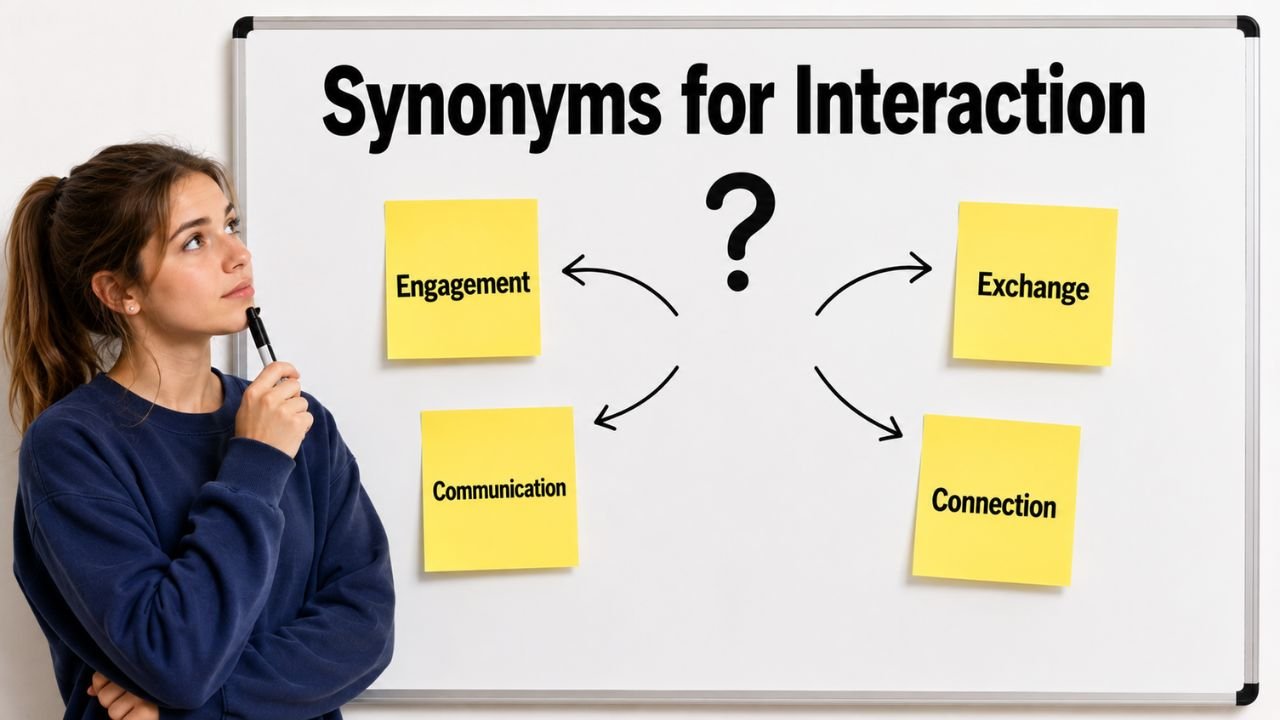
Quick Answer: The best synonyms for interaction include communication, exchange, engagement, contact, connection, dialogue, interplay, collaboration, encounter, and interface. Use communication when people share information, dialogue for a focused conversation, and engagement for active participation. Exchange fits the mutual sharing of ideas, while contact describes direct or brief communication. Choose collaboration when people work together, interplay when two forces affect each other, encounter for a meeting, and interface for communication between people, systems, or devices.
Pronunciation and Word Details
Word: Interaction.
Pronunciation: /ˌɪn.təˈræk.ʃən/.
Part of Speech: Noun.
Meaning: Interaction is communication, contact, or mutual action between two or more people, objects, systems, or forces.
US Pronunciation:
UK Pronunciation:
What Does “Interaction” Mean?
Interaction means a situation in which two or more people, things, systems, or forces communicate with or affect one another. It is a noun formed from the verb interact.
The word often describes communication between people.
Example: Regular interaction helped the new team members feel comfortable.
Interaction can also refer to social contact.
Example: The activity encourages interaction among students.
In professional settings, it may describe discussions, meetings, feedback, or cooperation.
Example: Her interaction with the client remained polite and productive.
In scientific writing, interaction describes the way two substances, forces, organisms, or variables affect one another.
Example: Researchers examined the interaction between light and the material.
In technology, interaction can refer to the way a person communicates with a device, program, or system.
Example: The controls allow smooth interaction between the user and the system.
Interaction may be brief or extended, positive or negative, direct or indirect. The exact meaning depends on what is interacting and how the exchange takes place.
Meaning, Tone, and Context of “Interaction”
Interaction has a neutral and flexible tone. It can appear in casual conversation, formal reports, academic writing, scientific explanations, professional communication, and technical instructions.
In everyday language, interaction usually describes communication or contact between people.
Example: The event gave neighbors more opportunities for interaction.
In professional writing, interaction often refers to communication between employees, clients, managers, or groups. It sounds neutral and appropriate for reports, emails, and workplace discussions.
Example: Positive interaction between departments improved the project.
In education, interaction may describe participation between teachers and students or among classmates.
Example: Group work increases classroom interaction.
In academic and scientific contexts, interaction has a more technical meaning. It describes mutual effects between variables, organisms, chemicals, medicines, or physical forces.
Example: The study examined the interaction between temperature and pressure.
In technology, interaction refers to communication between a person and a system or between separate systems.
Example: Voice controls create a simpler form of interaction.
Interaction is not usually emotional by itself. Words such as positive, negative, meaningful, respectful, limited, or direct often clarify its tone.
When and How to Use “Interaction”
Use interaction when two or more participants communicate, respond, cooperate, or affect one another.
For Communication: Use interaction when people exchange information, ideas, feelings, or responses.
Example: Clear interaction between the speakers prevented confusion.
For Social Contact: Use it when describing meetings, conversations, or shared activities.
Example: The club provides opportunities for social interaction.
For Active Participation: Use interaction when people take part rather than simply observe.
Example: The lesson includes questions that encourage student interaction.
For Cooperation: Use interaction when individuals or groups work together toward a shared result.
Example: Frequent interaction helped the departments coordinate their work.
For Mutual Influence: Use the word when two factors affect each other.
Example: The report explains the interaction between income and spending habits.
For Scientific Processes: Use interaction when substances, organisms, medicines, particles, or forces produce effects on one another.
Example: The scientist studied the interaction between the two compounds.
For Technical Communication: Use interaction when a person works with a device, program, or digital system.
Example: The simple menu improves user interaction with the device.
For Customer Communication: Use interaction when describing conversations, assistance, feedback, or service experiences.
Example: Every customer interaction should remain respectful and helpful.
For Brief Meetings: Use interaction when describing a short exchange that may still have an effect.
Example: Their brief interaction changed her opinion of the proposal.
Best Synonyms for Interaction
The strongest synonym depends on whether interaction refers to communication, social contact, cooperation, mutual influence, or a technical connection.
- Communication: The sharing of information, thoughts, or feelings.
Example: Clear communication reduced misunderstandings within the group. - Exchange: A mutual sharing of ideas, information, or responses.
Example: The meeting included a useful exchange of opinions. - Engagement: Active involvement or participation.
Example: The activity increased engagement among the students. - Contact: Communication or connection between people or groups.
Example: She remained in regular contact with the project leader. - Connection: A relationship or link between people, ideas, or systems.
Example: The discussion created a stronger connection between the teams. - Dialogue: A conversation intended to exchange ideas or solve a problem.
Example: Open dialogue helped both sides understand the issue. - Interplay: The way two or more factors affect one another.
Example: The article explores the interplay between memory and emotion. - Collaboration: The act of working together toward a shared goal.
Example: Successful collaboration produced a stronger final design. - Encounter: A meeting or experience involving another person or thing.
Example: Their first encounter was brief but memorable. - Interface: A point where people, systems, or devices communicate.
Example: The interface supports easy communication between the two systems.
50 Synonyms for Interaction with Short Meanings
- Communication: The sharing of information, thoughts, or feelings.
- Exchange: Mutual sharing between people or groups.
- Engagement: Active attention, interest, or participation.
- Contact: Direct or indirect communication with someone.
- Connection: A link between people, ideas, or systems.
- Dialogue: A focused conversation between two or more sides.
- Conversation: Informal spoken communication.
- Discussion: Detailed communication about a subject.
- Interchange: A mutual exchange of ideas or information.
- Interplay: Mutual influence between different factors.
- Involvement: Active participation in an activity or situation.
- Participation: The act of taking part.
- Encounter: A meeting or experience with someone or something.
- Meeting: An occasion when people come together.
- Association: A connection between people, groups, or ideas.
- Relationship: An ongoing connection between people or things.
- Relations: The way people or groups communicate and behave toward each other.
- Dealings: Communication or business activity between people.
- Liaison: Communication that connects separate people or groups.
- Correspondence: Communication through written messages.
- Consultation: A discussion held to obtain advice or information.
- Cooperation: The act of working together willingly.
- Collaboration: Joint work toward a shared result.
- Coordination: Organized cooperation between people or activities.
- Teamwork: Cooperative work performed by a group.
- Partnership: A relationship based on shared effort or responsibility.
- Networking: Building and maintaining useful connections.
- Socializing: Spending time communicating with other people.
- Mingling: Moving among and speaking with different people.
- Talk: Spoken communication about a subject.
- Chat: A friendly and informal conversation.
- Discourse: Formal or extended communication about ideas.
- Negotiation: Discussion intended to reach an agreement.
- Debate: A structured exchange of opposing views.
- Deliberation: Careful discussion before making a decision.
- Feedback: Information given in response to an action or idea.
- Response: An answer or reaction to communication.
- Reaction: An action or feeling caused by something else.
- Reciprocity: Mutual exchange or equal response.
- Mutuality: A condition in which both sides share or participate.
- Interrelation: A connection in which separate things affect each other.
- Interconnection: A link between multiple people, ideas, or systems.
- Interface: A point where separate systems or participants communicate.
- Transaction: An exchange involving information, services, or value.
- Communication Process: The steps through which information is shared.
- Exchange of Ideas: Mutual sharing of opinions or thoughts.
- Exchange of Information: Sharing facts, details, or knowledge.
- Two Way Communication: Communication in which both sides respond.
- Joint Activity: An action completed by people working together.
- Reciprocal Action: Action in which each side affects the other.
Read Also:
Synonyms for Force

Synonyms for Interaction by Context
The best synonym for interaction changes according to whether the sentence describes communication, social contact, cooperation, mutual influence, or technical connection.
When Interaction Means Communication
Use these alternatives when people share information, ideas, questions, or feelings.
Communication: The broadest word for sharing information.
Example: Effective communication helped the team solve the problem.
Dialogue: A purposeful conversation between people or groups.
Example: Honest dialogue improved understanding between both sides.
Conversation: A natural and often informal spoken exchange.
Example: Their conversation continued for more than an hour.
Discussion: A detailed exchange about a specific subject.
Example: The discussion focused on improving safety.
Interchange: A mutual exchange of thoughts or information.
Example: The conference encouraged an open interchange of ideas.
When Interaction Means Social Contact
Use these words when people meet, communicate, or spend time together.
Contact: Direct or indirect communication with another person.
Example: Regular contact helped them maintain their friendship.
Encounter: A meeting that may be planned or unexpected.
Example: Her encounter with the author inspired her to begin writing.
Meeting: An occasion when people gather for a purpose.
Example: The first meeting allowed everyone to introduce themselves.
Socializing: Friendly communication in a social setting.
Example: The event gave employees time for socializing.
Mingling: Speaking with several people while moving through a group.
Example: Guests spent the evening mingling and sharing stories.
When Interaction Means Active Participation
Use these alternatives when people take part, respond, or become involved.
Engagement: Active interest and participation.
Example: The questions increased audience engagement.
Participation: The act of joining an activity.
Example: Class participation improved during the group exercise.
Involvement: Personal or active connection with an activity.
Example: Community involvement strengthened the project.
Joint Activity: Work or action completed together.
Example: The workshop included a joint activity for all participants.
Contribution: Something added to a discussion or shared effort.
Example: Her contribution improved the final proposal.
When Interaction Means Cooperation
Use these synonyms when people or groups work together.
Collaboration: Joint work toward a shared outcome.
Example: Collaboration between the writers produced a clearer report.
Cooperation: Willing support and shared effort.
Example: The project succeeded because of close cooperation.
Coordination: Organizing separate actions so they work together.
Example: Better coordination prevented unnecessary delays.
Teamwork: Group effort toward a common goal.
Example: Strong teamwork helped the group finish early.
Partnership: An ongoing relationship based on shared responsibilities.
Example: The partnership allowed both groups to share resources.
When Interaction Means Mutual Influence
Use these alternatives when people, ideas, forces, or variables affect one another.
Interplay: The way different factors influence each other.
Example: The book examines the interplay between culture and language.
Interrelation: A relationship involving mutual effects.
Example: The report shows the interrelation between health and sleep.
Interconnection: A link among several related parts.
Example: The diagram explains the interconnection between the systems.
Reciprocity: Mutual action or exchange.
Example: Trust often develops through reciprocity.
Mutuality: Shared participation or benefit between both sides.
Example: The relationship was based on respect and mutuality.
When Interaction Means Technical Connection
Use these words when people, devices, programs, or systems communicate.
Interface: The point where separate systems or users connect.
Example: The interface makes the controls easier to understand.
Connection: A link that allows communication or operation.
Example: A secure connection allows the devices to exchange information.
Communication Process: The method through which information moves.
Example: The system improves the communication process between departments.
Transaction: A structured exchange of information, services, or value.
Example: Each transaction creates a record in the system.
Exchange of Information: The movement of facts or data between participants.
Example: The network supports a rapid exchange of information.
Another Word for Interaction
Exchange is one of the best general replacements for interaction because it suggests that two or more sides participate and respond. However, the most accurate alternative depends on the sentence.
Use communication for sharing information, engagement for active participation, collaboration for joint work, and interplay for mutual influence between factors.
Original: The meeting encouraged interaction between the departments.
Better Option: The meeting encouraged communication between the departments.
Original: The lesson requires regular interaction from students.
Better Option: The lesson requires active participation from students.
Original: The project depends on interaction between the two teams.
Better Option: The project depends on collaboration between the two teams.
Original: The study examined the interaction between stress and sleep.
Better Option: The study examined the interplay between stress and sleep.
When Not to Use “Interaction”
Interaction is a useful word, but it can sound vague when a more specific term would explain what actually happened.
When You Mean a Conversation
Use conversation, dialogue, or discussion when people are specifically speaking to one another.
Weak: We had an interaction about the new schedule.
Better: We had a discussion about the new schedule.
When You Mean Cooperation
Interaction only shows that people communicated or affected one another. It does not always mean that they worked together successfully.
Weak: The project required interaction between the designers.
Better: The project required collaboration between the designers.
When You Mean a Brief Meeting
Encounter may be clearer when the contact was short or unexpected.
Weak: She described her interaction with the visitor at the station.
Better: She described her brief encounter with the visitor at the station.
When You Mean a Long Term Relationship
Interaction refers to individual exchanges, while relationship describes an ongoing connection.
Weak: Their interaction developed over many years.
Better: Their relationship developed over many years.
When Describing a Specific Response
Use reaction, response, or feedback when one person or thing responds to another.
Weak: The audience interaction was positive after the announcement.
Better: The audience response was positive after the announcement.
When Writing Technical Instructions
Interface or connection may be more precise when describing how systems or devices communicate.
Weak: The interaction between the device and the control panel failed.
Better: The connection between the device and the control panel failed.
When the Meaning Is Too General
Interaction can hide useful details about the type, purpose, or result of communication.
Weak: The workshop improved interaction.
Better: The workshop improved communication and cooperation among employees.
Words Commonly Confused With Interaction
Interaction vs Communication: Interaction includes mutual action or influence, while communication specifically involves sharing information, ideas, or feelings.
Interaction vs Engagement: Interaction means contact or mutual action. Engagement emphasizes active interest, attention, or participation.
Interaction vs Relationship: Interaction may be a single exchange. A relationship is a continuing connection that develops over time.
Interaction vs Collaboration: Interaction can include any contact or response. Collaboration specifically means working together toward a shared goal.
Interaction vs Contact: Contact may involve only one brief connection. Interaction usually suggests that both sides act or respond.
Interaction vs Encounter: An encounter is a meeting or experience. Interaction focuses on what happens between the participants during that meeting.
Interaction vs Interface: Interaction is the process of mutual action. An interface is the point or system through which that action takes place.
Interaction vs Transaction: Interaction can be social, scientific, or technical. A transaction is usually a structured exchange involving information, services, duties, or value.
Interaction vs Reaction: Interaction involves two way influence. A reaction is the response produced by one event, action, or substance.
Interaction vs Interplay: Interaction is a broad term. Interplay usually describes a complex way in which several factors continuously affect one another.
Which Synonym Should You Choose?
Choose communication when people share information, instructions, opinions, or feelings.
Choose exchange when both sides give and receive ideas, information, or responses.
Choose dialogue when two people or groups discuss an issue openly and purposefully.
Choose conversation for casual speech and everyday communication.
Choose discussion when a subject is examined in detail.
Choose engagement when you want to emphasize active attention or participation.
Choose contact when communication is brief, direct, or occasional.
Choose encounter when describing a meeting, especially one that is brief or unexpected.
Choose collaboration when people work together to produce a shared result.
Choose cooperation when people willingly support one another or follow a shared plan.
Choose coordination when separate people, teams, or activities must be organized.
Choose interplay in reports, essays, and academic writing when two or more factors affect each other.
Choose interrelation when explaining how separate ideas, conditions, or variables are connected.
Choose interface in technical writing when describing the point where a person and system or two systems communicate.
Choose transaction for a structured business, service, or information exchange.
Choose feedback when someone provides comments, evaluation, or guidance in response to work.
Choose response when describing the direct result of a message, question, or action.
Choose networking when people build professional or useful connections.
Choose socializing or chatting in casual conversation when people communicate informally.
Real Life Examples of “Interaction” in Sentences
Original: Regular interaction helped the new employees understand their roles.
Better Option: Regular communication helped the new employees understand their roles.
Original: The teacher encouraged interaction during the lesson.
Better Option: The teacher encouraged participation during the lesson.
Original: Their interaction focused on resolving the disagreement.
Better Option: Their dialogue focused on resolving the disagreement.
Original: The project improved interaction between the two departments.
Better Option: The project improved collaboration between the two departments.
Original: She remembered her interaction with the speaker.
Better Option: She remembered her encounter with the speaker.
Original: The study examined the interaction between diet and energy levels.
Better Option: The study examined the interplay between diet and energy levels.
Original: The device allows easy interaction with the control system.
Better Option: The device provides an easy interface with the control system.
Original: Customer interaction remained polite throughout the conversation.
Better Option: Customer communication remained polite throughout the conversation.
Original: The event created more interaction among local residents.
Better Option: The event created more social contact among local residents.
Original: Their interaction resulted in several useful suggestions.
Better Option: Their exchange resulted in several useful suggestions.
Synonym Groups and Usage Differences
Synonyms for interaction belong to several meaning groups. Choosing from the correct group makes a sentence more accurate and natural.
Communication Group
Communication, dialogue, conversation, discussion, talk, chat, discourse, correspondence, and interchange describe the sharing of information or ideas.
Conversation and chat are usually casual. Dialogue and discussion are more purposeful. Discourse often sounds formal or academic.
Example: The discussion allowed both sides to explain their concerns.
Social Contact Group
Contact, encounter, meeting, socializing, mingling, networking, association, and relations describe people meeting or maintaining connections.
Encounter often refers to one meeting. Contact may be brief or continuing. Networking focuses on building useful professional connections.
Example: The event gave participants time for networking.
Participation Group
Engagement, involvement, participation, contribution, and joint activity emphasize active attention or action.
Engagement highlights interest, while participation means taking part. Involvement can suggest a deeper or continuing role.
Example: Audience participation made the session more energetic.
Cooperation Group
Collaboration, cooperation, coordination, teamwork, and partnership describe shared effort.
Collaboration usually involves creating or completing something together. Coordination focuses on organizing actions, while partnership suggests a continuing arrangement.
Example: Close coordination helped the teams avoid duplicated work.
Mutual Influence Group
Interplay, interrelation, interconnection, reciprocity, mutuality, reaction, and reciprocal action describe the way people, ideas, systems, or forces affect one another.
Interplay is useful for complex influences. Reciprocity describes an equal or mutual exchange.
Example: The study explored the interplay between confidence and performance.
Professional Exchange Group
Consultation, negotiation, deliberation, debate, feedback, dealings, liaison, and transaction describe structured communication in professional or formal settings.
Consultation seeks advice. Negotiation seeks agreement. Deliberation involves careful thought before a decision.
Example: The final decision followed several days of deliberation.
Technical Connection Group
Interface, connection, interconnection, communication process, exchange of information, and transaction describe communication between systems, devices, or users.
Interface refers to the point through which communication occurs. Connection refers to the link that makes communication possible.
Example: A clear interface improves the user’s experience with the system.
Antonyms of Interaction
The opposite of interaction depends on whether the word means communication, contact, participation, cooperation, or mutual influence.
Isolation: Separation from other people or groups.
Separation: The state of being kept apart.
Disconnection: The absence or loss of a link.
Detachment: Emotional or practical distance from others.
Withdrawal: The act of moving away from participation or contact.
Avoidance: The deliberate prevention of contact or communication.
Silence: The absence of spoken communication.
Inactivity: A lack of action or participation.
Nonparticipation: The state of not taking part.
Disengagement: The act of ending involvement or attention.
Alienation: A feeling of separation from people or a group.
Independence: Action without relying on mutual cooperation.
Nonresponse: The absence of an answer or reaction.
Segregation: The separation of people or groups.
Solitude: The condition of being alone.
Comparison: Interaction vs Related Words
Interaction vs Communication
Interaction includes mutual action, response, or influence. Communication specifically focuses on sharing information, ideas, or feelings.
Example With Interaction: The activity increased interaction among the participants.
Example With Communication: Clear communication helped participants understand the instructions.
Interaction vs Engagement
Interaction describes contact or mutual action. Engagement emphasizes interest, attention, and active participation.
Example With Interaction: The speaker invited interaction from the audience.
Example With Engagement: The questions increased audience engagement.
Interaction vs Collaboration
Interaction can be any form of communication or mutual effect. Collaboration means working together toward a shared outcome.
Example With Interaction: There was regular interaction between the writers.
Example With Collaboration: Their collaboration produced a complete report.
Interaction vs Relationship
Interaction may refer to one conversation or exchange. A relationship is a continuing connection that develops through repeated interactions.
Example With Interaction: Their first interaction was polite.
Example With Relationship: Their professional relationship lasted several years.
Interaction vs Contact
Contact means communication or connection. Interaction usually suggests that both sides actively respond or influence one another.
Example With Interaction: The lesson involved direct interaction between the teacher and students.
Example With Contact: She remained in contact with her former classmates.
Interaction vs Encounter
Interaction focuses on what happens between participants. Encounter refers to the meeting itself.
Example With Interaction: Their interaction included a short discussion.
Example With Encounter: Their unexpected encounter occurred at the library.
Interaction vs Interplay
Interaction is a general word for mutual action. Interplay describes a more complex or continuing pattern of mutual influence.
Example With Interaction: The experiment measured the interaction between the substances.
Example With Interplay: The report examined the interplay between stress, sleep, and concentration.
Interaction vs Interface
Interaction is the action or communication taking place. Interface is the point or method through which the communication occurs.
Example With Interaction: The system records every user interaction.
Example With Interface: The interface provides simple controls for the user.
Interaction vs Transaction
Interaction can be social, personal, scientific, or technical. A transaction is a structured exchange, often involving information, duties, services, or value.
Example With Interaction: The assistant made the interaction easy and respectful.
Example With Transaction: The transaction was completed after the details were confirmed.
Common Phrases and Expressions With “Interaction”
Social Interaction: Communication and shared activity between people.
Example: Regular social interaction can help people feel connected.
Human Interaction: Communication or mutual action involving people.
Example: The role requires frequent human interaction.
Direct Interaction: Communication that occurs without an intermediary.
Example: Students benefit from direct interaction with the instructor.
Face to Face Interaction: Communication between people who are physically present.
Example: The workshop allows face to face interaction among participants.
Meaningful Interaction: Communication that has value, purpose, or emotional importance.
Example: The activity encouraged meaningful interaction between family members.
Positive Interaction: Communication that is respectful, helpful, or pleasant.
Example: Positive interaction improved the atmosphere in the group.
Regular Interaction: Communication that happens repeatedly.
Example: Regular interaction helped the teams build trust.
Group Interaction: Communication among several people working or speaking together.
Example: The task was designed to improve group interaction.
Customer Interaction: Communication between a customer and a service representative.
Example: Every customer interaction should be clear and respectful.
User Interaction: Communication between a person and a device or system.
Example: The controls simplify user interaction with the program.
Common Mistakes to Avoid
Using Interaction as a Vague Replacement
Interaction can be too general when the sentence should identify a conversation, meeting, response, or collaboration.
Vague: The interaction was useful.
Clear: The discussion produced several useful ideas.
Confusing Interaction With Communication
Communication is one type of interaction, but interaction can also include actions, reactions, and mutual influence.
Incorrect: The chemical communication produced heat.
Better: The chemical interaction produced heat.
Using Interaction When You Mean Relationship
One interaction can happen once, while a relationship usually continues over time.
Incorrect: They built an interaction that lasted ten years.
Better: They built a relationship that lasted ten years.
Using Interaction When You Mean Collaboration
People may interact without working toward the same goal.
Weak: Completing the report required interaction.
Better: Completing the report required collaboration.
Using an Unnatural Verb
Do not usually say do an interaction when referring to communication between people.
Unnatural: The manager did an interaction with the team.
Natural: The manager interacted with the team.
Natural: The manager had a discussion with the team.
Choosing the Wrong Preposition
Use interaction with when one person or thing communicates with another.
Correct: Her interaction with the client was professional.
Use interaction between when referring to two people, groups, variables, or systems.
Correct: The study examined the interaction between exercise and sleep.
Use interaction among when referring to three or more participants.
Correct: The activity encouraged interaction among the students.
Using the Singular Form Incorrectly
Interaction can be countable or uncountable. Use an interaction for one specific exchange and interaction for the general activity.
Specific: We had an interesting interaction after the meeting.
General: Social interaction is important in group learning.
Repeating Interaction Too Often
Frequent repetition can make a paragraph sound mechanical.
Repetitive: The activity increased interaction, and the interaction led to better interaction between groups.
Improved: The activity encouraged communication and strengthened cooperation between groups.
Using Mutual Interaction Unnecessarily
Interaction already suggests action between two or more sides. Mutual interaction may be unnecessary unless the writer needs special emphasis.
Wordy: The process depends on mutual interaction between both systems.
Better: The process depends on interaction between the systems.
Confusing Reaction With Interaction
A reaction may occur in one direction. Interaction usually involves mutual effects.
Incorrect: Her surprise was an interaction to the announcement.
Correct: Her surprise was a reaction to the announcement.
Conclusion
The most useful synonyms for interaction depend on what takes place between the participants. Use communication, dialogue, or conversation for sharing information, engagement for active participation, and contact or encounter for social meetings. Collaboration, cooperation, and coordination suit shared work, while interplay and interrelation describe mutual influence. Interface is more precise for technical systems. Understanding these differences makes synonyms for interaction easier to use naturally and helps writers choose language that clearly expresses the type, purpose, and result of each exchange.
FAQs About Synonyms for Interaction
What Is the Best Synonym for Interaction?
Exchange is a strong general synonym. Communication is often better when people share information, while interplay works for mutual influence.
What Is a Formal Synonym for Interaction?
Interchange, discourse, consultation, engagement, interrelation, and collaboration are useful formal alternatives, depending on the context.
Is Communication a Synonym for Interaction?
Yes. Communication is a synonym when interaction involves sharing information, ideas, or feelings between people or groups.
What Is Another Word for Social Interaction?
Contact, conversation, engagement, socializing, mingling, networking, and association can describe different forms of social interaction.
What Is Another Word for Interaction in Academic Writing?
Interplay, interrelation, engagement, exchange, association, collaboration, and mutual influence are suitable choices for academic writing.
What Is the Difference Between Interaction and Engagement?
Interaction means contact or mutual action. Engagement emphasizes active interest, attention, or participation.
Can Interaction Refer to Things Other Than People?
Yes. Interaction can describe mutual effects between chemicals, medicines, organisms, variables, forces, devices, or computer systems.
