
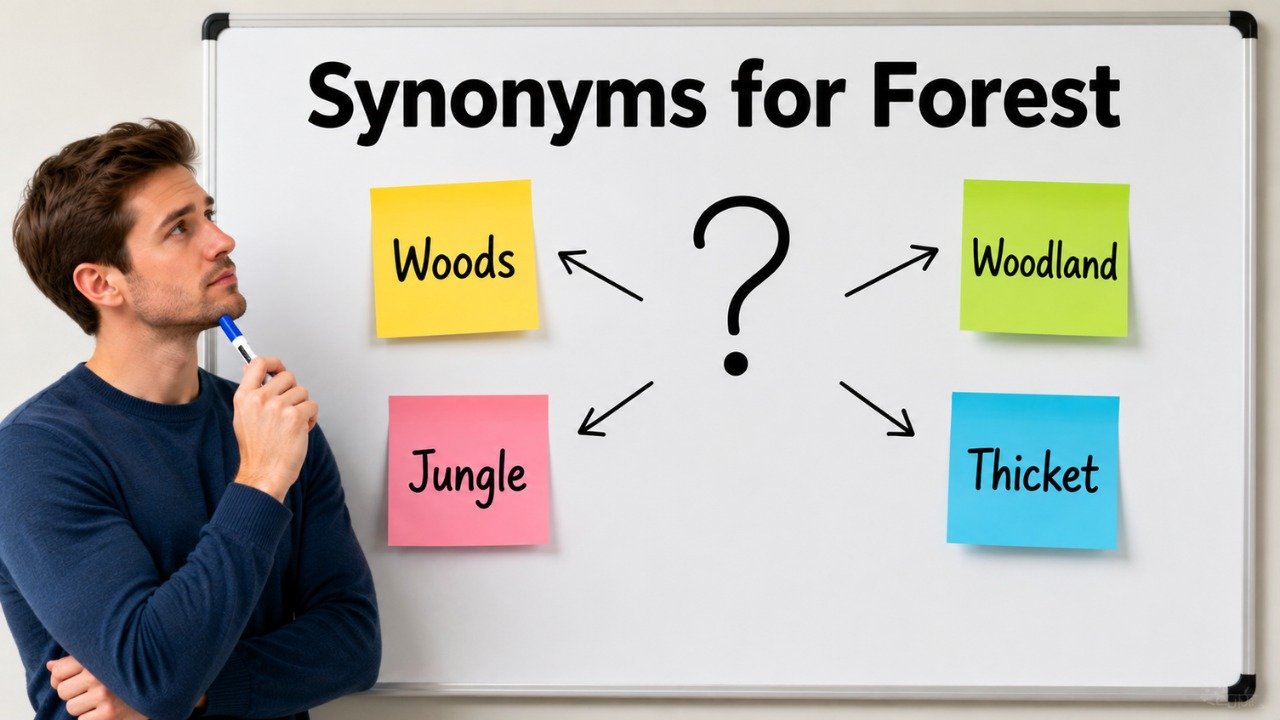
Quick Answer: The best synonyms for forest include woodland, woods, timberland, forestland, wildwood, grove, copse, jungle, rainforest, and woodlot. Among these synonyms for forest, woodland is the strongest general replacement for a large area covered with trees. Woods works naturally in casual speech, timberland suits commercial or land use contexts, rainforest describes a wet tropical forest, and grove or copse refers to a much smaller group of trees.
Pronunciation and Word Details
Word: Forest.
Pronunciation: /ˈfɔːrɪst/.
Part of Speech: Noun and verb.
Meaning: A large area of land covered mainly with trees and other vegetation.
US Pronunciation:
UK Pronunciation:
What Does “Forest” Mean?
Forest means a large area of land where trees grow closely together. It is most commonly used as a noun, but it can also function as a verb meaning to plant trees across an area.
As a noun, forest can describe a natural ecosystem, a protected landscape, a commercial timber area, or any broad region dominated by trees.
Natural Context: A forest may contain trees, shrubs, plants, fungi, animals, streams, and soil organisms.
Geographical Context: The word identifies a large wooded region on a map or within a country.
Environmental Context: Forest can refer to an ecosystem that supports wildlife, stores water, protects soil, and contains many forms of plant life.
Figurative Context: Forest may describe a large, crowded collection of similar objects.
Example: A forest of television antennas covered the rooftops.
As a verb, forest means to establish trees on land.
Example: The organization plans to forest the damaged hillside with native trees.
Meaning, Tone, and Context of “Forest”
Forest is a neutral and widely understood word. It works in everyday conversation, formal writing, geography, ecology, environmental studies, literature, tourism, and land management.
In casual speech, people may use woods instead of forest. In scientific or academic writing, terms such as forest ecosystem, boreal forest, temperate forest, or primary forest provide greater precision.
Forest can also create an emotional or descriptive tone. In literature, it may suggest beauty, mystery, isolation, danger, peace, or adventure.
Neutral Tone: The road passes through a large forest.
Scientific Tone: The forest ecosystem supports several native species.
Literary Tone: Moonlight entered the silent forest through gaps in the canopy.
Environmental Tone: Protecting the forest helps preserve wildlife habitats.
Commercial Tone: The company manages the timberland for wood production.
The meaning becomes more specific when an adjective appears before forest. Rainforest identifies a wet forest, coniferous forest identifies land dominated by cone bearing trees, and old growth forest describes a mature forest that has developed over a long period.
When and How to Use “Forest”
For Large Natural Areas
Use forest when describing an extensive area covered mainly by trees.
Example: The hikers spent three days crossing the forest.
For Environmental Writing
Use forest when discussing ecosystems, wildlife habitats, conservation, climate, soil, or water.
Example: The forest provides shelter for birds, mammals, and insects.
For Geographic Description
Use forest to identify a wooded region, landscape, or natural feature.
Example: A dense forest separates the village from the mountains.
For Protected Land
Use forest when describing land preserved or managed for environmental purposes.
Example: Hunting is restricted in this protected forest.
For Commercial Tree Land
Use forest when discussing wood production, forestry, or managed tree resources. Timberland may be more precise in commercial contexts.
Example: The forest is managed for sustainable timber production.
For Literary Description
Use forest when you want to create a sense of scale, mystery, beauty, or wilderness.
Example: The ancient forest seemed endless beneath the evening sky.
For Figurative Language
Use forest to describe a large number of tall or closely packed objects.
Example: A forest of microphones surrounded the speaker.
For Smaller Groups of Trees
Avoid forest when only a small collection of trees is present. Grove, copse, spinney, or stand of trees may be more accurate.
Example: A small grove of olive trees stood behind the house.
Best Synonyms for Forest
Woodland
Synonym: Land covered with trees and natural vegetation.
Example: Deer moved quietly through the woodland.
Woods
Synonym: A tree covered area, often smaller or less formal than a forest.
Example: The children followed a path through the woods.
Timberland
Synonym: Forested land that can be used for producing timber.
Example: The family owns several acres of timberland.
Forestland
Synonym: Land classified or used as forest.
Example: New rules protect the region’s remaining forestland.
Wildwood
Synonym: A natural, uncultivated forest, especially in literary writing.
Example: The travelers disappeared into the wildwood.
Grove
Synonym: A small group of trees growing together.
Example: We rested beneath a grove of oak trees.
Copse
Synonym: A small and fairly dense group of trees or bushes.
Example: A fox vanished into the nearby copse.
Jungle
Synonym: Dense tropical vegetation, often with thick undergrowth.
Example: The explorers moved slowly through the jungle.
Rainforest
Synonym: A dense forest in a region with high rainfall.
Example: Brightly colored birds lived in the rainforest canopy.
Woodlot
Synonym: A small area of trees managed or owned as a separate piece of land.
Example: The farmer collected firewood from the woodlot.
50 Synonyms for Forest with Short Meanings
- Woodland: An area of land covered with trees.
- Woods: A natural tree covered area, often smaller than a forest.
- Wood: A wooded area, especially in traditional or literary usage.
- Timberland: Forested land managed or valued for timber.
- Forestland: Land officially classified or used as forest.
- Wildwood: A wild and uncultivated forest.
- Greenwood: A living green forest, especially in literary language.
- Woodlot: A small, separately managed area of trees.
- Grove: A small group of trees growing together.
- Copse: A small and dense collection of trees or bushes.
- Spinney: A small wooded area, especially in British usage.
- Holt: A small wood or wooded hill in literary or regional language.
- Shaw: A narrow wood or small group of trees.
- Thicket: A dense growth of shrubs, bushes, and small trees.
- Brushwood: Land covered with bushes and small trees.
- Bushland: Open land covered with shrubs, bushes, and scattered trees.
- Backwoods: A remote and sparsely populated wooded region.
- Jungle: Dense tropical vegetation with heavy undergrowth.
- Rainforest: A thick forest found in a region with high rainfall.
- Cloud Forest: A humid mountain forest frequently covered by mist.
- Tropical Forest: A forest located in a warm tropical climate.
- Temperate Forest: A forest growing in a region with moderate temperatures.
- Boreal Forest: A northern forest dominated mainly by coniferous trees.
- Taiga: The broad northern zone of boreal forest.
- Coniferous Forest: A forest dominated by cone bearing trees.
- Deciduous Forest: A forest containing trees that seasonally lose their leaves.
- Evergreen Forest: A forest dominated by trees that remain green throughout the year.
- Mixed Forest: A forest containing both coniferous and broadleaf trees.
- Old Growth Forest: A mature forest that has developed over a long period.
- Primeval Forest: An ancient forest that remains largely undisturbed.
- Primary Forest: A naturally developed forest with little major human disturbance.
- Natural Forest: A forest that developed mainly through natural processes.
- Ancient Woodland: Wooded land that has remained continuously covered by trees for a long time.
- Native Woodland: Woodland dominated by tree species native to the region.
- Secondary Forest: A forest that has regrown after major disturbance.
- Plantation: An area where trees are deliberately planted and managed.
- Tree Plantation: Land planted with trees for production, restoration, or protection.
- Forest Preserve: A wooded area legally protected from harmful development.
- Forest Reserve: Forested land protected or managed by an authority.
- Wooded Area: Any place containing a noticeable concentration of trees.
- Wooded Land: Land that is mainly covered by trees.
- Wooded Region: A broad geographical area containing extensive tree cover.
- Wooded Tract: A defined piece of land covered with trees.
- Wooded Expanse: A large and continuous area of tree covered land.
- Wooded Country: A landscape or region containing many forests and trees.
- Forest Belt: A long or broad strip of forested land.
- Forest Tract: A specific section or parcel of forest.
- Woodland Tract: A defined area containing trees and natural vegetation.
- Stand of Trees: A group of trees growing together in one area.
- Wooded Wilderness: A remote natural region dominated by trees.
Read Also:
Synonyms for Ridiculous
Synonyms for Forest by Context
When Forest Means a Large Wooded Area
Woodland, woods, forestland, wooded region, and wooded expanse can describe land covered extensively with trees.
Woodland is the best general alternative because it sounds natural in both formal and descriptive writing.
Example: The railway passes through miles of peaceful woodland.
Woods is more conversational and may suggest a smaller area.
Example: We walked through the woods behind the farm.
Forestland is useful in legal, geographical, and land management contexts.
Example: The policy limits construction on protected forestland.
When Forest Means a Small Wooded Area
Grove, copse, spinney, woodlot, and stand of trees describe smaller collections of trees.
A grove is usually open, attractive, and made up of similar trees.
Example: A grove of citrus trees surrounded the house.
A copse is small but often denser.
Example: The birds nested in a copse near the river.
A woodlot is usually a defined piece of privately owned or managed land.
Example: The woodlot provides timber and firewood for the farm.
When Forest Means Dense Tropical Growth
Jungle, rainforest, tropical forest, and cloud forest are useful when climate and vegetation are important.
Jungle emphasizes tangled vegetation and thick undergrowth.
Example: Progress through the jungle was slow and difficult.
Rainforest emphasizes heavy rainfall, dense tree cover, and rich biodiversity.
Example: The rainforest contains thousands of plant species.
Cloud forest refers specifically to a humid mountain forest affected by frequent mist.
Example: Moss covered the trees throughout the cloud forest.
When Forest Means a Wild or Ancient Place
Wildwood, old growth forest, primeval forest, ancient woodland, and wooded wilderness create a sense of age, remoteness, or limited human disturbance.
Wildwood is especially effective in poetry, fantasy, and literary description.
Example: Legends told of a hidden village beyond the wildwood.
Primeval forest suggests an ancient and largely untouched natural environment.
Example: Massive trees towered above the primeval forest floor.
When Forest Means Managed Tree Land
Timberland, plantation, tree plantation, timber tract, and woodlot are suitable for commercial or managed land.
Timberland focuses on land used or valued for wood production.
Example: The timberland is inspected regularly for tree health.
Plantation describes trees deliberately planted in organized areas.
Example: The tree plantation produces wood for local construction.
When Forest Means Protected Land
Forest preserve, forest reserve, protected woodland, and conservation forest describe areas managed for environmental protection.
Example: Rare birds breed inside the forest reserve.
These terms are not always interchangeable. Preserve usually emphasizes protection, while reserve may allow controlled recreation or resource management.
Another Word for Forest
Woodland is usually the best single replacement for forest. It is clear, natural, and suitable for geographical, environmental, and descriptive writing. However, the best alternative depends on the size, climate, density, and purpose of the wooded area.
Original: The cabin stood beside a quiet forest.
Better Option: The cabin stood beside a quiet woodland.
Original: Workers collected timber from the commercial forest.
Better Option: Workers collected timber from the commercial timberland.
Original: We rested in a small forest of olive trees.
Better Option: We rested in a grove of olive trees.
Original: The researchers studied animals in the wet tropical forest.
Better Option: The researchers studied animals in the rainforest.
When Not to Use “Forest”
Do not use forest when another term gives the reader a more accurate picture of the location.
When the Area Is Very Small
Forest may exaggerate the size of a small group of trees.
Weak: A forest of six apple trees grew beside the cottage.
Better: A small grove of apple trees grew beside the cottage.
When You Mean Dense Tropical Undergrowth
Forest does not always communicate thick vines, bushes, and tangled tropical growth.
Weak: The travelers struggled through the tropical forest growth.
Better: The travelers struggled through the jungle.
When the Land Is Used Commercially
Timberland may be more precise when the main topic is wood production or land value.
Weak: The investor purchased forest for timber production.
Better: The investor purchased timberland for timber production.
When Describing a Defined Small Property
Woodlot is more accurate for a small piece of managed wooded land.
Weak: The farmer owns a small forest behind the barn.
Better: The farmer owns a woodlot behind the barn.
When Forest Becomes Repetitive
Repeating forest in every sentence can make a paragraph sound mechanical.
Weak: The forest was dark. The forest was wet. Animals moved through the forest.
Better: The forest was dark and wet, while animals moved quietly through the woodland.
Words Commonly Confused With Forest
Forest vs Woods: A forest is generally larger and may be discussed as an ecosystem or geographical region. Woods is more conversational and often describes a smaller wooded area.
Forest vs Woodland: Woodland is a broad alternative for tree covered land. It may describe land with a more open tree canopy than a dense forest.
Forest vs Jungle: A forest is any large tree dominated area. A jungle usually has dense tropical vegetation and heavy undergrowth.
Forest vs Grove: A forest covers a broad area, while a grove is a small group of trees, often of one type.
Forest vs Copse: A forest is extensive, while a copse is a small and usually dense patch of trees.
Forest vs Rainforest: Forest is the general category. Rainforest is a specific forest type found in regions with frequent or heavy rainfall.
Forest vs Thicket: A forest is dominated by trees. A thicket is dominated by dense bushes, shrubs, and small trees.
Forest vs Plantation: A forest may develop naturally, while a plantation is deliberately planted and managed.
Which Synonym Should You Choose?
Choose woodland when you need a natural and flexible alternative for tree covered land.
Choose woods in everyday conversation or when describing a familiar local area.
Choose timberland when discussing forestry, land ownership, timber production, or commercial value.
Choose forestland for legal classifications, land use reports, maps, and environmental policies.
Choose grove when describing a small and attractive group of trees.
Choose copse or spinney for a small, dense wooded area.
Choose woodlot when referring to a small parcel of managed or privately owned trees.
Choose jungle when dense tropical undergrowth is the main feature.
Choose rainforest when the climate has high rainfall and the forest supports rich plant and animal life.
Choose taiga or boreal forest when discussing northern coniferous regions.
Choose wildwood or primeval forest for literary descriptions involving mystery, age, or wilderness.
Choose old growth forest when maturity, ecological development, and long term continuity are important.
Choose forest reserve or forest preserve when protection and conservation are the main topics.
Choose forest ecosystem in scientific reports, environmental essays, and ecological discussions.
Real Life Examples of “Forest” in Sentences
Original: The family went walking in the forest after lunch.
Better Option: The family went walking in the woods after lunch.
Original: The hotel overlooks a peaceful forest.
Better Option: The hotel overlooks a peaceful woodland.
Original: The company purchased a forest for wood production.
Better Option: The company purchased timberland for wood production.
Original: A small forest of lemon trees grew near the house.
Better Option: A grove of lemon trees grew near the house.
Original: The rabbit disappeared into the forest beside the field.
Better Option: The rabbit disappeared into the copse beside the field.
Original: Researchers recorded rainfall throughout the tropical forest.
Better Option: Researchers recorded rainfall throughout the rainforest.
Original: The farmer manages a small forest behind the property.
Better Option: The farmer manages a woodlot behind the property.
Original: The explorers entered a forest filled with vines and dense bushes.
Better Option: The explorers entered a jungle filled with vines and dense bushes.
Original: The story describes a magical forest beyond the mountains.
Better Option: The story describes a magical wildwood beyond the mountains.
Original: The government protected the forest from development.
Better Option: The government protected the forest reserve from development.
Synonym Groups and Usage Differences
General Wooded Land Group
This group includes woodland, woods, forestland, wooded area, wooded region, and wooded tract.
These terms describe land containing many trees without necessarily identifying a particular climate or forest type. Woodland is suitable for most formal and descriptive contexts, while woods sounds more conversational.
Example: A narrow road crossed the wooded region.
Small Wooded Area Group
This group includes grove, copse, spinney, woodlot, shaw, holt, and stand of trees.
These words describe limited groups or patches of trees. Grove often sounds pleasant and open, while copse and spinney suggest denser growth.
Example: A small copse provided shelter from the wind.
Tropical Growth Group
This group includes jungle, rainforest, tropical forest, and cloud forest.
Use these words when temperature, moisture, undergrowth, or tropical biodiversity matters.
Example: Mist remained among the trees of the cloud forest.
Northern Forest Group
This group includes boreal forest, taiga, coniferous forest, and evergreen forest.
These terms describe cold climate forests that commonly contain spruce, pine, fir, and other evergreen trees.
Example: Winters are long and cold throughout the boreal forest.
Ancient and Wild Group
This group includes wildwood, greenwood, primeval forest, old growth forest, primary forest, and ancient woodland.
These alternatives emphasize age, natural development, wilderness, or minimal disturbance.
Example: Fallen logs created habitats throughout the old growth forest.
Managed Land Group
This group includes timberland, plantation, tree plantation, woodlot, and timber tract.
These words focus on ownership, planting, harvesting, or commercial management.
Example: The timberland is divided into carefully managed sections.
Protected Land Group
This group includes forest preserve, forest reserve, and protected woodland.
These terms describe land managed to protect natural habitats, wildlife, water, or scenery.
Example: Visitors must remain on marked paths inside the forest preserve.
Antonyms of Forest
The opposite of forest depends on whether the contrast involves tree cover, climate, vegetation, or openness.
Clearing: An open space within or beside a wooded area.
Grassland: Land dominated by grasses rather than trees.
Meadow: Open land covered mainly with grass and flowering plants.
Plain: A broad and mostly flat area with few trees.
Desert: Dry land with very limited vegetation.
Tundra: Cold, largely treeless land with low growing vegetation.
Steppe: A broad grassland region with few or no trees.
Open Country: Land with wide views and little tree cover.
Barren Land: Ground with little or no vegetation.
Treeless Area: Land where trees are absent.
Scrubland: Land dominated by shrubs rather than a continuous tree canopy.
Cleared Land: An area where most trees have been removed.
Comparison: Forest vs Related Words
Forest vs Woods
Forest often refers to a larger area and can carry geographical, ecological, or official meaning. Woods is more informal and may describe a smaller local area.
Example With Forest: The forest supports several endangered species.
Example With Woods: We gathered berries in the woods behind the house.
Forest vs Woodland
Forest usually suggests denser or more extensive tree cover. Woodland may include more open spaces between trees and is a flexible alternative in descriptive writing.
Example With Forest: A dense forest covered the mountain slopes.
Example With Woodland: Butterflies moved through the open woodland.
Forest vs Jungle
Forest is the general term for a large tree covered ecosystem. Jungle refers more specifically to dense tropical growth with tangled plants and heavy undergrowth.
Example With Forest: Wolves live in the northern forest.
Example With Jungle: Thick vines made the jungle difficult to cross.
Forest vs Grove
Forest describes a large wooded area. Grove describes a small collection of trees, often arranged naturally or planted together.
Example With Forest: The river flows through the forest.
Example With Grove: The ceremony took place in an olive grove.
Forest vs Copse
Forest suggests extensive tree cover. Copse describes a small and compact patch of trees.
Example With Forest: The road continues for miles through the forest.
Example With Copse: A deer stood beside the copse.
Forest vs Rainforest
Forest is a broad category. Rainforest identifies a forest with frequent rainfall, dense vegetation, and high moisture.
Example With Forest: The national park contains a large forest.
Example With Rainforest: Warm rain falls throughout much of the rainforest.
Forest vs Timberland
Forest emphasizes the natural landscape or ecosystem. Timberland emphasizes land suitable for producing timber.
Example With Forest: The forest provides nesting sites for birds.
Example With Timberland: The timberland is managed for responsible harvesting.
Common Phrases and Expressions With Forest
Forest Floor: The ground beneath the trees, usually covered with leaves, plants, soil, and fallen branches.
Forest Canopy: The upper layer formed by the branches and leaves of trees.
Forest Edge: The boundary where a forest meets open land or another habitat.
Forest Path: A trail or route passing through a forest.
Forest Cover: The amount or percentage of land covered by forests.
Forest Ecosystem: A biological community made up of trees, plants, animals, fungi, soil, and water.
Forest Reserve: A wooded area protected or managed by an authority.
Forest Conservation: The protection and responsible management of forests.
Forest Management: The planned care, use, and protection of forested land.
Forest Restoration: The process of helping a damaged or cleared forest recover.
Forest Fire: A fire that spreads through trees and vegetation in a forested area.
Dense Forest: A forest where trees and vegetation grow closely together.
Common Mistakes to Avoid
Using Jungle for Every Forest
Jungle is not a general replacement for every forest. It normally suggests tropical vegetation with thick undergrowth.
Incorrect: The snowy mountains were covered by jungle.
Correct: The snowy mountains were covered by coniferous forest.
Calling a Small Grove a Forest
Forest can make a small group of trees sound much larger than it is.
Incorrect: A forest of eight palm trees surrounded the pool.
Correct: A grove of eight palm trees surrounded the pool.
Treating Rainforest and Forest as Identical
Every rainforest is a forest, but not every forest is a rainforest. Use rainforest only when rainfall and a wet climate are relevant.
Using Timberland in Wildlife Descriptions
Timberland emphasizes commercial or productive value. Forest or woodland usually sounds more natural when discussing wildlife and habitats.
Less Natural: Owls nested throughout the timberland ecosystem.
Better: Owls nested throughout the forest ecosystem.
Confusing Thicket With Forest
A thicket contains dense shrubs, bushes, and small trees. It is usually smaller and lower than a forest.
Repeating Forest Too Often
Use suitable alternatives to improve flow, but do not replace forest with a word that changes the meaning.
Repetitive: The forest path crossed the forest before reaching the edge of the forest.
Improved: The forest path crossed the woodland before reaching the tree line.
Ignoring Differences in Size
Grove, copse, spinney, woodlot, woodland, and forest do not describe exactly the same scale. Choose a term that matches the actual area.
Using Rare Literary Words Without Context
Words such as holt, shaw, greenwood, and wildwood can sound poetic, regional, or old fashioned. They may not suit reports, instructions, or simple factual writing.
Conclusion
The most useful synonyms for forest include woodland, woods, timberland, forestland, grove, copse, jungle, rainforest, and wildwood. Woodland is the best general alternative, while woods suits casual conversation. Use grove or copse for smaller tree groups, timberland for commercial land, rainforest for wet tropical regions, and wildwood for literary descriptions. Choosing the right word depends on the area’s size, climate, density, purpose, and tone. A precise synonym makes descriptions clearer and helps readers picture the landscape accurately.
FAQs About Synonyms for Forest
What Is the Best Synonym for Forest?
Woodland is usually the best general synonym for forest. It works naturally in geographical, environmental, and descriptive writing.
Are Woods and Forest the Same?
They are similar, but woods often refers to a smaller or more familiar area. Forest can describe a larger region or a complete ecosystem.
Can Jungle Be Used as a Synonym for Forest?
Jungle can be a synonym in tropical contexts, especially when the area has dense undergrowth. It should not replace forest in cold, dry, or open wooded landscapes.
What Word Describes a Small Forest?
Grove, copse, spinney, woodlot, and stand of trees can describe a small forest or wooded patch. The best choice depends on density, ownership, and appearance.
What Is a Literary Synonym for Forest?
Wildwood and greenwood are effective literary synonyms. They can create a sense of mystery, nature, age, or adventure.
Which Forest Synonym Is Best for Formal Writing?
Woodland, forestland, wooded region, and forest tract are suitable for formal writing. Forest ecosystem is appropriate in scientific or environmental discussions.
What Is the Difference Between Forest and Rainforest?
Forest is a general term for a large tree covered area. Rainforest is a specific type of forest found in a wet climate with frequent or heavy rainfall.
