
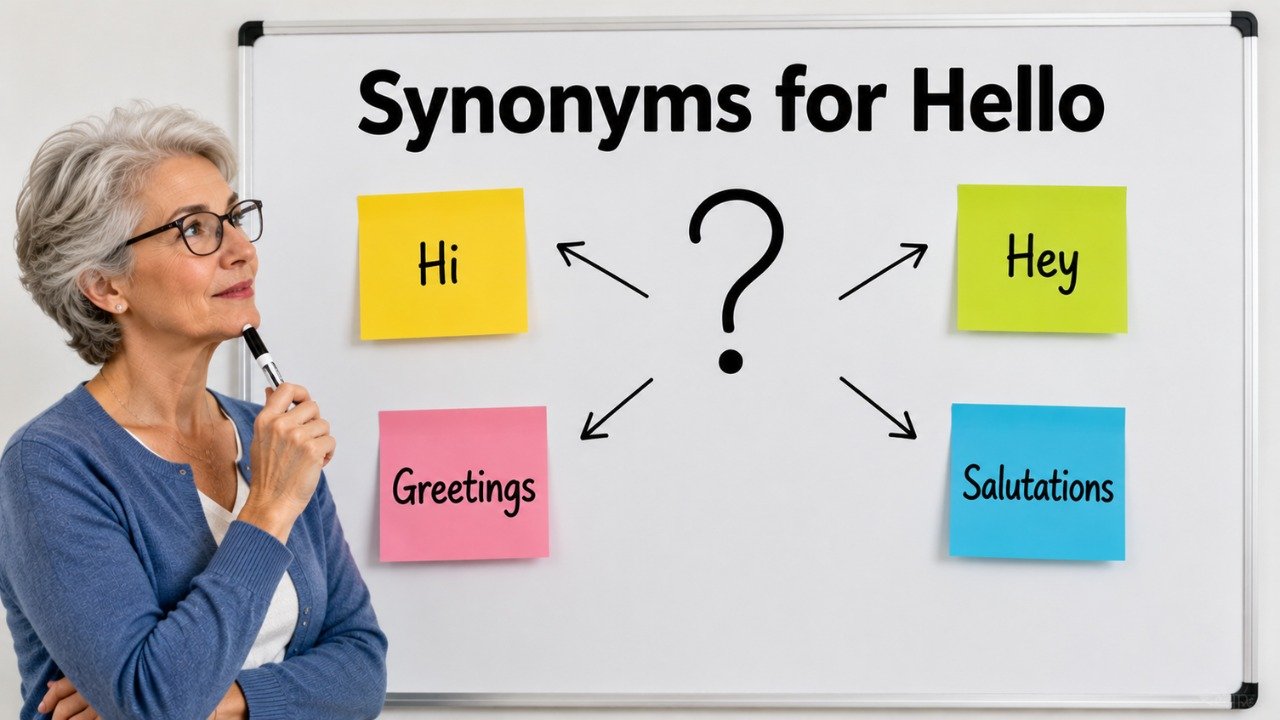
Quick Answer: The best synonyms for hello include hi, hey, greetings, welcome, good morning, good afternoon, good evening, howdy, salutations, and nice to meet you. Among these synonyms for hello, hi is the most natural choice for everyday conversation, while greetings and salutations suit formal writing. Hey sounds friendly and casual, welcome is best when receiving someone, and good morning, good afternoon, or good evening works when the time of day matters.
Pronunciation and Word Details
Word: Hello.
Pronunciation: /həˈloʊ/.
Part of Speech: Interjection, noun, and verb.
Meaning: A word used to greet someone, attract attention, or begin a conversation.
US Pronunciation:
UK Pronunciation:
What Does “Hello” Mean?
Hello is a common greeting used when meeting someone, beginning a conversation, answering a call, or attracting attention.
It most often functions as an interjection.
Example: Hello, it is lovely to see you.
Hello can also function as a noun when it refers to the greeting itself.
Example: She gave everyone a cheerful hello.
Less commonly, hello can work as a verb meaning to greet someone by saying hello.
Example: He helloed his neighbors as he passed their house.
The word is suitable for many situations because it is polite, neutral, familiar, and widely understood. It can begin a conversation with a friend, stranger, customer, teacher, coworker, or family member.
The emotion behind hello depends on the speaker’s voice and context. It can sound cheerful, surprised, cautious, formal, warm, or even impatient.
Friendly Context: Hello, I am glad you came.
Professional Context: Hello, thank you for contacting our office.
Surprised Context: Hello, what are you doing here?
Attention Seeking Context: Hello, can anyone hear me?
Meaning, Tone, and Context of “Hello”
Hello has a neutral and polite tone. It is neither extremely formal nor strongly casual, which makes it useful in many conversations.
In relaxed speech, people often replace hello with hi or hey. Hi is friendly and broadly acceptable, while hey is more casual and familiar.
In formal writing or ceremonial speech, greetings and salutations may sound more appropriate. Salutations is especially formal and may sound traditional in ordinary conversation.
Time specific greetings such as good morning, good afternoon, and good evening can sound more thoughtful or professional because they recognize the time of day.
Hello can also express emotion depending on how it appears in a sentence.
Warm Tone: Hello, my dear friend.
Neutral Tone: Hello, I have an appointment at ten.
Formal Tone: Greetings, respected guests.
Casual Tone: Hey, are you free this evening?
Enthusiastic Tone: Hello, everyone. It is wonderful to be here.
Cautious Tone: Hello, is someone in the room?
The word commonly appears in spoken conversations, written messages, letters, presentations, meetings, calls, introductions, and customer communication.
When and How to Use “Hello”
For Everyday Greetings
Use hello when beginning a polite conversation with almost anyone.
Example: Hello, how are you feeling today?
For Casual Conversation
Use hi or hey when speaking with friends, relatives, or familiar coworkers.
Example: Hi, are you ready to leave?
For Formal Introductions
Use greetings, good morning, or good afternoon when addressing a professional group or unfamiliar person.
Example: Good morning, thank you for joining the meeting.
For Welcoming Someone
Use welcome when receiving a guest, visitor, new employee, or participant.
Example: Welcome, we are pleased to have you here.
For Meeting Someone for the First Time
Use nice to meet you or pleased to meet you after an introduction.
Example: Nice to meet you, Maria.
For Written Communication
Hello is a safe opening for a polite message when the relationship is neutral or friendly.
Example: Hello, I am writing to ask about the available course.
For Time Specific Greetings
Use good morning, good afternoon, or good evening when the time of day is relevant.
Example: Good evening, everyone. Thank you for attending.
For Attracting Attention
Hello can be used when checking whether someone is listening or present.
Example: Hello, is anybody there?
For Answering a Call
Hello is the standard neutral greeting when beginning a telephone conversation.
Example: Hello, this is Daniel speaking.
For Friendly Regional Speech
Use howdy in relaxed settings where a cheerful regional style feels natural.
Example: Howdy, neighbor. How have you been?
Best Synonyms for Hello
Hi
Synonym: A short, friendly, and widely used greeting.
Example: Hi, it is good to see you again.
Hey
Synonym: A very casual greeting used with familiar people.
Example: Hey, do you want to join us?
Greetings
Synonym: A polite or formal expression used to welcome or address someone.
Example: Greetings, everyone. Thank you for coming.
Welcome
Synonym: A warm greeting offered when receiving someone.
Example: Welcome, please make yourself comfortable.
Good Morning
Synonym: A polite greeting used during the morning.
Example: Good morning, I hope you are doing well.
Good Afternoon
Synonym: A polite greeting used after midday and before evening.
Example: Good afternoon, may I help you?
Good Evening
Synonym: A polite greeting used later in the day.
Example: Good evening, ladies and gentlemen.
Howdy
Synonym: A cheerful and informal greeting with a regional tone.
Example: Howdy, it has been a long time.
Salutations
Synonym: A highly formal or traditional greeting.
Example: Salutations to all our honored guests.
Nice to Meet You
Synonym: A polite greeting used after meeting someone for the first time.
Example: Nice to meet you, I have heard wonderful things about your work.
50 Synonyms for Hello with Short Meanings
- Hi: A short and friendly everyday greeting.
- Hey: A casual greeting for familiar people.
- Greetings: A polite or formal way to address someone.
- Welcome: A warm greeting offered to someone arriving.
- Howdy: A cheerful and informal regional greeting.
- Salutations: A traditional and highly formal greeting.
- Good Morning: A polite greeting used in the morning.
- Good Afternoon: A polite greeting used after midday.
- Good Evening: A polite greeting used later in the day.
- Morning: A shortened casual form of good morning.
- Afternoon: A shortened greeting used during the afternoon.
- Evening: A shortened greeting used during the evening.
- Hello There: A friendly and slightly more expressive greeting.
- Hi There: A warm and informal greeting.
- Hey There: A cheerful greeting for casual situations.
- Greetings to You: A polite and slightly formal welcome.
- A Warm Welcome: An enthusiastic greeting for an arriving person.
- Welcome Aboard: A greeting for someone joining a team or group.
- Welcome Back: A greeting for someone who has returned.
- Nice to Meet You: A polite phrase used during a first introduction.
- Pleased to Meet You: A formal phrase used when first meeting someone.
- Good to Meet You: A friendly response during an introduction.
- It Is Nice to Meet You: A complete and courteous introduction greeting.
- How Are You: A greeting that also asks about someone’s condition.
- How Are Things: A casual greeting asking about life in general.
- How Is It Going: A relaxed greeting asking how someone is doing.
- How Have You Been: A greeting used after not seeing someone for some time.
- What Is New: A casual greeting that invites an update.
- What Is Happening: A relaxed greeting among familiar people.
- What Is Going On: An informal greeting that asks about current events.
- Good Day: A polite greeting suitable for daytime.
- A Very Good Day to You: A warm and traditional daytime greeting.
- Good to See You: A friendly greeting for someone already known.
- Great to See You: An enthusiastic greeting for a familiar person.
- Lovely to See You: A warm greeting expressing affection or pleasure.
- Nice Seeing You: A friendly expression used when meeting someone familiar.
- It Is Good to See You: A complete and polite greeting for a known person.
- Long Time No See: An informal greeting after a long separation.
- Hello Again: A greeting used when meeting or contacting someone again.
- Hi Again: A casual greeting used during renewed contact.
- Hey Again: A relaxed greeting used when returning to a conversation.
- Good to Have You Here: A welcoming greeting for a guest or participant.
- Glad You Are Here: A warm greeting expressing pleasure at someone’s arrival.
- Happy to See You: A friendly greeting showing happiness.
- Pleasure to Meet You: A courteous first meeting greeting.
- My Regards: A formal expression of greeting or respect.
- Kind Regards: A polite written greeting or expression of goodwill.
- Well Met: A traditional or literary greeting.
- Hail: An old or ceremonial greeting.
- Peace to You: A respectful greeting expressing goodwill and peace.
Read Also:
Synonyms for Forest

Synonyms for Hello by Context
When Hello Means a Casual Greeting
Hi, hey, hi there, hey there, and how is it going are useful in relaxed conversations.
Hi is the safest casual alternative because it sounds friendly without being overly familiar.
Example: Hi, can I sit beside you?
Hey is more informal and is usually better for friends, relatives, or familiar coworkers.
Example: Hey, are we still meeting later?
Hi there sounds friendly and welcoming, especially when speaking with someone you do not know well.
Example: Hi there, how may I help you?
When Hello Means a Formal Greeting
Greetings, salutations, good morning, good afternoon, and good evening work well in formal situations.
Greetings is suitable for announcements, presentations, letters, or group communication.
Example: Greetings, respected guests. We are honored by your presence.
Salutations has a traditional and ceremonial tone. It may sound unnatural in ordinary conversation.
Example: Salutations to everyone gathered here.
Good morning and good afternoon are polite choices for professional meetings and conversations.
Example: Good afternoon, thank you for taking the time to speak with me.
When Hello Means a Warm Welcome
Welcome, a warm welcome, glad you are here, and good to have you here express hospitality.
Welcome is appropriate when someone enters a place, joins a group, or begins a new experience.
Example: Welcome, we hope you enjoy your visit.
Glad you are here feels personal and sincere.
Example: Glad you are here. We have been looking forward to seeing you.
Welcome aboard is useful when someone joins a team, organization, class, or project.
Example: Welcome aboard, we are excited to work with you.
When Hello Begins an Introduction
Nice to meet you, pleased to meet you, pleasure to meet you, and good to meet you follow a first introduction.
Nice to meet you is neutral, polite, and widely appropriate.
Example: Nice to meet you, I am Olivia.
Pleased to meet you sounds slightly more formal.
Example: Pleased to meet you, Professor Clark.
Good to meet you is warm but less formal.
Example: Good to meet you, James. I have heard a lot about your work.
When Hello Greets Someone Familiar
Good to see you, great to see you, lovely to see you, and how have you been suit people who already know each other.
Good to see you is friendly and flexible.
Example: Good to see you again after so many months.
Great to see you expresses stronger enthusiasm.
Example: Great to see you. You look wonderful.
How have you been invites the other person to share an update.
Example: How have you been since your move?
When Hello Is Used After a Long Absence
Long time no see, welcome back, how have you been, and it has been a while are useful after a period without contact.
Long time no see is casual and conversational.
Example: Long time no see. Where have you been?
Welcome back is suitable when someone returns to a workplace, school, home, or group.
Example: Welcome back, we missed having you here.
When Hello Is Used in Written Communication
Hello, hi, greetings, good morning, and good afternoon can begin written messages.
Hello is neutral and dependable.
Example: Hello, I am contacting you about my appointment.
Hi is slightly more relaxed.
Example: Hi, thank you for your helpful response.
Greetings sounds more formal and may suit communication directed to a group.
Example: Greetings, everyone. Please review the information below.
Another Word for Hello
Hi is usually the best single replacement for hello. It is short, natural, friendly, and suitable for most everyday conversations. However, the best alternative depends on your relationship with the listener, the level of formality, and the purpose of the greeting.
Original: Hello, can you help me find this address?
Better Option: Hi, can you help me find this address?
Original: Hello, everyone. Thank you for attending the ceremony.
Better Option: Greetings, everyone. Thank you for attending the ceremony.
Original: Hello, I am pleased to meet you.
Better Option: Good afternoon, I am pleased to meet you.
Original: Hello, we are happy that you joined our team.
Better Option: Welcome aboard, we are happy that you joined our team.
When Not to Use “Hello”
Hello works in many settings, but another greeting may sometimes communicate your meaning more clearly.
When the Situation Is Highly Formal
Hello may sound too ordinary during a formal ceremony, official address, or traditional event.
Weak: Hello, honored guests and respected leaders.
Better: Greetings, honored guests and respected leaders.
When Welcoming Someone
Hello acknowledges a person, but welcome more clearly expresses hospitality.
Weak: Hello to our new team members.
Better: Welcome to our new team members.
When Meeting Someone for the First Time
Hello alone may sound incomplete after a formal introduction.
Weak: Hello, Mr. Adams.
Better: Pleased to meet you, Mr. Adams.
When Speaking to a Close Friend
Hello can sometimes sound distant or unusually formal between close friends.
Weak: Hello, Emma. Are you coming with us?
Better: Hey, Emma. Are you coming with us?
When the Time of Day Matters
A time specific greeting may sound more thoughtful in professional communication.
Weak: Hello, thank you for joining this morning’s meeting.
Better: Good morning, thank you for joining the meeting.
When Hello Becomes Repetitive
Repeating hello several times in the same paragraph or conversation can sound mechanical.
Weak: Hello, everyone. Hello to our guests, and hello to our new members.
Better: Hello, everyone. A warm welcome to our guests and new members.
When Attracting Attention Politely
Repeatedly saying hello may sound impatient. Excuse me is often more respectful when approaching someone who is busy.
Weak: Hello, can you answer my question?
Better: Excuse me, could you answer my question?
Words Commonly Confused With Hello
Hello vs Hi: Hello is neutral and slightly more formal. Hi is shorter, friendlier, and common in everyday conversation.
Hello vs Hey: Hello is appropriate for strangers and professional contacts. Hey is more casual and usually suits familiar people.
Hello vs Welcome: Hello acknowledges someone’s presence. Welcome expresses pleasure that someone has arrived or joined.
Hello vs Greetings: Hello is natural in speech and writing. Greetings has a more formal, traditional, or group focused tone.
Hello vs Good Morning: Hello can be used at any time. Good morning is specifically used during the morning.
Hello vs Nice to Meet You: Hello begins contact, while nice to meet you usually follows an introduction to a new person.
Hello vs Excuse Me: Hello is a greeting. Excuse me is used to attract attention politely, interrupt someone, or apologize for a minor disturbance.
Hello vs Goodbye: Hello begins an interaction, while goodbye ends it.
Hello vs How Are You: Hello simply greets someone. How are you combines a greeting with a question about the person’s condition.
Which Synonym Should You Choose?
Choose hi for everyday conversation, friendly messages, and relaxed communication.
Choose hey when speaking casually with friends, relatives, or people you know well.
Choose hello when you need a neutral greeting that works with both familiar and unfamiliar people.
Choose greetings for formal announcements, presentations, group messages, or ceremonial writing.
Choose salutations when you want a traditional, formal, or literary tone.
Choose good morning for professional or polite communication during the morning.
Choose good afternoon for meetings, customer conversations, or formal messages after midday.
Choose good evening when greeting people later in the day or at an evening event.
Choose welcome when receiving a guest, visitor, new member, customer, or participant.
Choose welcome aboard when someone joins a team, project, class, or organization.
Choose nice to meet you during a first introduction in neutral situations.
Choose pleased to meet you when the first meeting is formal or professional.
Choose good to see you when greeting someone you already know.
Choose long time no see in relaxed conversation after a long period without contact.
Choose how have you been when you want the other person to provide a personal update.
Choose howdy when a cheerful, informal, and regional tone feels suitable.
Choose excuse me instead of hello when your main purpose is to attract attention politely.
Real Life Examples of “Hello” in Sentences
Original: Hello, Sarah. Are you free for lunch?
Better Option: Hi, Sarah. Are you free for lunch?
Original: Hello, everyone. Thank you for attending our presentation.
Better Option: Greetings, everyone. Thank you for attending our presentation.
Original: Hello, I am Daniel. I recently joined the department.
Better Option: Good morning, I am Daniel. I recently joined the department.
Original: Hello, our new volunteers.
Better Option: Welcome, our new volunteers.
Original: Hello, Mr. Lewis. I have heard a great deal about you.
Better Option: Pleased to meet you, Mr. Lewis. I have heard a great deal about you.
Original: Hello, Anna. I have not seen you in years.
Better Option: Long time no see, Anna. I have not seen you in years.
Original: Hello, it is wonderful that you returned.
Better Option: Welcome back, it is wonderful that you returned.
Original: Hello, Mark. How is your family?
Better Option: Good to see you, Mark. How is your family?
Original: Hello, can you please tell me where the library is?
Better Option: Excuse me, can you please tell me where the library is?
Original: Hello, we are pleased that you joined the project.
Better Option: Welcome aboard, we are pleased that you joined the project.
Synonym Groups and Usage Differences
Casual Greeting Group
This group includes hi, hey, hi there, hey there, howdy, and what is new.
These expressions work best in relaxed conversation. Hi is the most flexible choice, while hey and what is new sound more familiar.
Example: Hey, what are you doing this weekend?
Formal Greeting Group
This group includes greetings, salutations, good morning, good afternoon, and good evening.
These alternatives suit meetings, speeches, formal messages, customer communication, and professional introductions.
Example: Good afternoon, thank you for meeting with me.
Welcome Group
This group includes welcome, a warm welcome, welcome aboard, welcome back, and glad you are here.
These expressions do more than acknowledge someone. They communicate pleasure about the person’s arrival, return, or participation.
Example: Welcome aboard. We are delighted to have you on the team.
First Meeting Group
This group includes nice to meet you, pleased to meet you, pleasure to meet you, and good to meet you.
Use these expressions after learning someone’s name or being formally introduced.
Example: Nice to meet you, Ms. Carter.
Familiar Person Group
This group includes good to see you, great to see you, lovely to see you, and happy to see you.
These greetings indicate that the speakers already know each other.
Example: Great to see you after such a long time.
Conversation Starter Group
This group includes how are you, how are things, how is it going, what is new, and how have you been.
These phrases greet someone and invite a response.
Example: How have you been since you changed jobs?
Traditional and Literary Group
This group includes hail, well met, salutations, and peace to you.
These expressions may sound ceremonial, historic, literary, or culturally respectful. They are less common in ordinary modern conversation.
Example: Well met, fellow travelers.
Time Specific Group
This group includes good morning, morning, good afternoon, afternoon, good evening, and evening.
These expressions identify the time of day and often sound polite or professional.
Example: Good evening, and welcome to the event.
Antonyms of Hello
Hello does not have one perfect opposite in every context. Its closest opposites are words and phrases used when ending contact, leaving, or refusing to acknowledge someone.
Goodbye: A common expression used when leaving or ending a conversation.
Farewell: A formal or emotional expression used when parting.
Bye: A short and casual expression used when leaving.
Good Night: A parting expression commonly used late in the evening.
See You Later: An informal phrase suggesting another future meeting.
Take Care: A warm parting phrase expressing concern for someone’s wellbeing.
Until Next Time: A phrase used when ending contact with the expectation of meeting again.
Silence: The absence of a spoken greeting or response.
Ignoring: Deliberately refusing to acknowledge someone.
Dismissal: An unfriendly act of sending someone away or refusing engagement.
Departure: The act of leaving rather than arriving and greeting.
Parting: The act of ending a meeting or conversation.
Comparison: Hello vs Related Words
Hello vs Hi
Hello is neutral and can be used in casual or professional situations. Hi is shorter, warmer, and slightly more informal.
Example With Hello: Hello, I am calling about my appointment.
Example With Hi: Hi, are you joining us for dinner?
Hello vs Hey
Hello is polite and suitable for strangers. Hey is casual and works best with familiar people.
Example With Hello: Hello, may I ask you a question?
Example With Hey: Hey, can you send me the notes?
Hello vs Greetings
Hello sounds natural in ordinary conversation. Greetings sounds more formal, traditional, or ceremonial.
Example With Hello: Hello, everyone. Let us begin.
Example With Greetings: Greetings, distinguished guests. Thank you for attending.
Hello vs Welcome
Hello acknowledges a person. Welcome expresses pleasure about the person’s arrival or participation.
Example With Hello: Hello, it is nice to see you.
Example With Welcome: Welcome, please come inside.
Hello vs Good Morning
Hello works at any time of day. Good morning is limited to morning hours and often sounds more professional.
Example With Hello: Hello, I would like to speak with the manager.
Example With Good Morning: Good morning, I would like to speak with the manager.
Hello vs Nice to Meet You
Hello can begin any interaction. Nice to meet you is specifically used during a first introduction.
Example With Hello: Hello, my name is Thomas.
Example With Nice to Meet You: Nice to meet you, Thomas.
Hello vs How Are You
Hello is a simple greeting. How are you is both a greeting and a question.
Example With Hello: Hello, Mrs. Brown.
Example With How Are You: How are you, Mrs. Brown?
Hello vs Excuse Me
Hello greets someone. Excuse me politely attracts attention or introduces a request.
Example With Hello: Hello, I am your new neighbor.
Example With Excuse Me: Excuse me, could you move your bag?
Common Phrases and Expressions With Hello
Say Hello: To greet someone verbally.
Example: Please say hello to your parents for me.
Hello There: A friendly greeting that sounds slightly more expressive than hello.
Example: Hello there, how can I help you?
Hello Again: A greeting used when reconnecting with someone.
Example: Hello again, thank you for returning.
Hello Everyone: A greeting directed toward a group.
Example: Hello, everyone. I hope you are having a pleasant day.
A Quick Hello: A brief greeting or short visit.
Example: I stopped by to say a quick hello.
A Warm Hello: A greeting expressed with kindness and enthusiasm.
Example: She offered every guest a warm hello.
Hello and Welcome: A phrase used to greet and receive an audience.
Example: Hello and welcome to our annual gathering.
Wave Hello: To greet someone with a movement of the hand.
Example: The children waved hello from the window.
Hello Stranger: A playful greeting for someone not seen recently.
Example: Hello, stranger. Where have you been?
Say Hello to Someone: To pass a greeting to another person.
Example: Say hello to your brother when you see him.
Common Mistakes to Avoid
Using Hey in Highly Formal Situations
Hey may sound too casual when addressing a senior professional, unfamiliar customer, or formal audience.
Less Suitable: Hey, I would like to discuss the contract.
Better: Good morning, I would like to discuss the contract.
Using Salutations in Casual Conversation
Salutations can sound overly formal, theatrical, or old fashioned when speaking with friends.
Unnatural: Salutations, Ben. Do you want some coffee?
Natural: Hi, Ben. Do you want some coffee?
Confusing Hello With Welcome
Hello greets someone, while welcome expresses hospitality or acceptance.
Incorrect: Hello to your new position.
Correct: Welcome to your new position.
Using Nice to Meet You With Familiar People
Nice to meet you normally refers to a first meeting. Use good to see you for someone you already know.
Incorrect: Nice to meet you again, Emily.
Better: Good to see you again, Emily.
Using Good Night as an Arrival Greeting
Good night normally ends an evening conversation. Good evening is used when greeting someone.
Incorrect: Good night, everyone. Welcome to the dinner.
Correct: Good evening, everyone. Welcome to the dinner.
Repeating Hello Too Often
Too much repetition can make dialogue or written communication sound unnatural.
Repetitive: Hello, John. Hello, Maria. Hello to everyone else.
Improved: Hello, John and Maria. A warm welcome to everyone else.
Choosing a Greeting That Does Not Match the Relationship
Hey may feel too familiar with a stranger, while salutations may feel too distant with a close friend. Consider the relationship before choosing a greeting.
Ignoring the Time of Day
Good morning, good afternoon, and good evening should match the actual time. When unsure, hello or greetings is safer.
Using Hello When Excuse Me Is Needed
Use excuse me when interrupting, requesting attention, or approaching a busy person.
Less Polite: Hello, move your chair, please.
Better: Excuse me, could you move your chair, please?
Adding Unnecessary Punctuation
One exclamation mark is enough for an enthusiastic greeting. Several marks can make professional writing appear careless.
Excessive: Hello!!!!
Better: Hello!
Conclusion
The most useful synonyms for hello include hi, hey, greetings, welcome, good morning, good afternoon, good evening, howdy, and nice to meet you. Hi is best for friendly everyday speech, while greetings suits formal communication. Choose welcome when receiving someone, pleased to meet you during a formal introduction, and good to see you for a familiar person. Understanding the tone and purpose of each greeting helps you begin conversations naturally, politely, and confidently.
FAQs About Synonyms for Hello
What Is the Best Synonym for Hello?
Hi is the best general synonym for hello in casual and friendly communication. It is short, natural, and widely understood.
What Is a Formal Synonym for Hello?
Greetings is a strong formal alternative. Good morning, good afternoon, and good evening are also polite professional choices.
What Is a Casual Way to Say Hello?
Hi, hey, hi there, hey there, and how is it going are common casual greetings.
What Can I Say Instead of Hello in a Message?
You can use hi, good morning, good afternoon, greetings, or the person’s name followed by a polite opening.
Is Welcome a Synonym for Hello?
Welcome can replace hello when receiving a guest, visitor, new member, or participant. It expresses hospitality rather than simply acknowledging someone.
What Should I Say When Meeting Someone for the First Time?
Nice to meet you is the most common choice. Pleased to meet you is more formal, while good to meet you sounds friendly and relaxed.
What Is the Difference Between Hello and Hey?
Hello is neutral and appropriate for most people. Hey is more casual and usually works best with friends or familiar contacts.
