
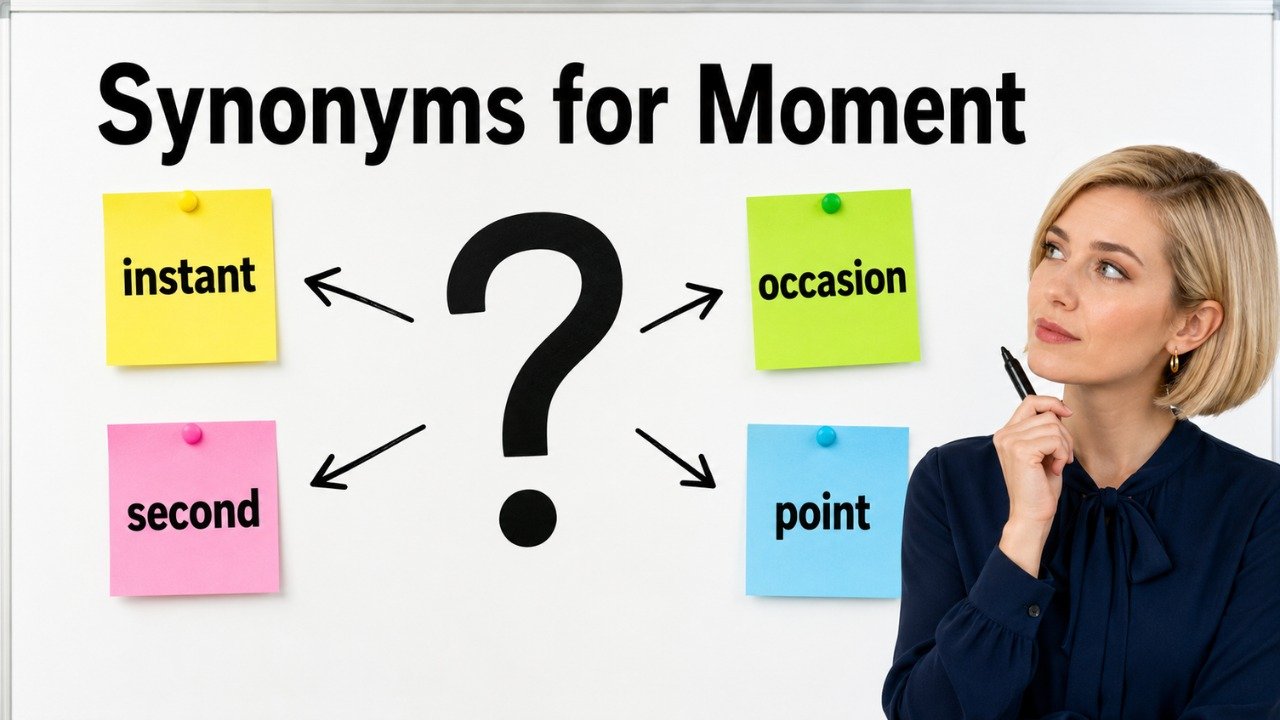
Quick Answer: The best synonyms for moment include instant, second, minute, while, occasion, point, time, opportunity, juncture, and interval. Use instant when describing an extremely brief period, second or minute in casual speech, and occasion for a particular event. Point works well for a specific stage in time, while juncture suits formal writing about an important decision or change. Opportunity is best when moment refers to a favorable chance, and interval describes a period between two events.
Pronunciation and Word Details
Word: Moment.
Pronunciation: /ˈmoʊmənt/.
Part of Speech: Noun.
Meaning: A moment is a very short period of time, a particular point in time, or an important occasion.
US Pronunciation:
UK Pronunciation:
What Does “Moment” Mean?
Moment means a very short period of time or a particular point when something happens. It is a countable noun and can describe time, an event, an opportunity, an emotional experience, or an important stage.
In its most common use, moment refers to a brief amount of time.
Example: Please wait for a moment.
It can also identify a specific point in the past, present, or future.
Example: That was the moment she understood the truth.
Moment may describe an important or memorable event.
Example: Winning the award was a proud moment for the entire family.
In some sentences, moment means a suitable opportunity to act or speak.
Example: He waited for the right moment to ask the question.
It can also refer to the present time.
Example: At the moment, the office is closed.
The meaning of moment therefore depends on whether the sentence emphasizes short duration, precise timing, emotional importance, opportunity, or the present situation.
Meaning, Tone, and Context of “Moment”
Moment is a neutral and widely used word. It appears naturally in casual conversation, formal writing, storytelling, speeches, instructions, and emotional descriptions.
In everyday speech, moment often means a short wait.
Example: I will be ready in a moment.
In emotional writing, moment can describe a meaningful, joyful, painful, or unforgettable experience.
Example: Their reunion was a deeply moving moment.
In formal writing, moment may refer to a significant stage or turning point.
Example: The decision marked an important moment in the organization’s development.
In storytelling, moment helps identify the exact time when an action or realization occurs.
Example: At that moment, the lights suddenly went out.
The word can sound polite when asking someone to wait.
Example: Could you give me a moment?
Moment can also sound dramatic when connected to danger, discovery, success, or change.
Example: It was the moment that changed everything.
Although moment is flexible, more precise synonyms such as instant, occasion, opportunity, interval, or juncture can make the intended meaning clearer.
When and How to Use “Moment”
For a Short Time: Use moment when referring to a brief period that may last only a few seconds or minutes.
Example: She paused for a moment before answering.
For a Specific Time: Use moment when identifying the exact point at which something happened.
Example: He remembered the moment the announcement was made.
For the Present Time: Use moment in expressions that describe what is happening now.
Example: At the moment, we are reviewing the application.
For an Important Event: Use moment when describing an occasion with emotional, personal, or historical importance.
Example: Graduation was a proud moment for her parents.
For an Opportunity: Use moment when referring to a suitable chance to act, speak, or decide.
Example: She chose the perfect moment to introduce her proposal.
For a Pause: Use moment when asking for a short delay or break.
Example: Please give me a moment to collect my thoughts.
For Emotional Emphasis: Use moment to highlight a meaningful experience or reaction.
Example: It was a beautiful moment of friendship and understanding.
For a Turning Point: Use moment when a situation begins to change in an important way.
Example: The discovery became a defining moment in his career.
Best Synonyms for Moment
Instant: An extremely short period of time.
Example: For an instant, the room became completely silent.
Second: A very short period, especially in casual speech.
Example: Give me a second to finish this sentence.
Minute: A short period that may be literal or informal.
Example: Can we talk for a minute?
While: A period of time, usually longer than an instant.
Example: She rested for a while after the journey.
Occasion: A particular event or special time.
Example: The ceremony was a joyful occasion.
Point: A specific stage or position in time.
Example: At that point, everyone understood the problem.
Time: A particular period or occasion.
Example: It was a difficult time for the whole community.
Opportunity: A favorable moment to do something.
Example: This is a good opportunity to discuss the plan.
Juncture: An important point when a decision or change occurs.
Example: The team reached a critical juncture in the project.
Interval: A period of time between two events or activities.
Example: There was a short interval between the two performances.
50 Synonyms for Moment with Short Meanings
- Instant: An extremely brief period of time.
- Second: A very short amount of time.
- Minute: A short period in everyday speech.
- While: A period of unspecified length.
- Time: A particular point or period.
- Point: A specific position in time.
- Occasion: A particular or special event.
- Opportunity: A suitable chance to act.
- Juncture: An important stage or decision point.
- Interval: A period between two events.
- Pause: A brief stop in action or speech.
- Beat: A very short pause or unit of time.
- Tick: A brief instant, often linked with a clock.
- Flash: An extremely quick moment.
- Split Second: A very small part of a second.
- Heartbeat: A very brief period.
- Twinkling: An extremely short time.
- Breath: A short period lasting about one breath.
- Spell: A limited period of time.
- Period: A length of time with a beginning and end.
- Phase: A stage in a process or development.
- Stage: A particular point in progress.
- Episode: A distinct event or period.
- Event: Something that happens at a particular time.
- Occurrence: An incident or happening.
- Instance: A particular example or occasion.
- Experience: A meaningful event someone goes through.
- Interlude: A short period between activities.
- Break: A short pause from activity.
- Respite: A brief period of rest or relief.
- Lull: A temporary quiet or inactive period.
- Delay: A period before something continues.
- Turn: A particular stage or opportunity.
- Opening: A suitable chance to act.
- Chance: An opportunity for something to happen.
- Window: A limited period when action is possible.
- Opening Moment: The first brief period of an event.
- Turning Point: A moment when major change begins.
- Milestone: An important point in development.
- Highlight: A particularly memorable moment.
- Peak: The most intense or successful point.
- Climax: The most important or exciting point.
- Crisis: A critical moment requiring action.
- Crossroads: A stage requiring an important decision.
- Now: The present moment.
- Present: The current period of time.
- Meanwhile: The time during which something else happens.
- Intermission: A scheduled break between parts of an event.
- Passage: A period or movement of time.
- Term: A fixed or limited period.
Read Also:
Synonyms for Adorable
Synonyms for Moment by Context
When Moment Means a Very Short Time
Instant, second, minute, beat, tick, flash, split second, heartbeat, twinkling, and breath can all describe a brief period.
Instant is the clearest choice for something that happens almost immediately.
Example: For an instant, she thought she had lost her keys.
Second is common in casual requests.
Example: Wait a second while I check the address.
Beat is often used in storytelling to describe a short dramatic pause.
Example: He remained silent for a beat before replying.
Split second emphasizes that something happened extremely quickly.
Example: She made the decision in a split second.
When Moment Means a Particular Point in Time
Point, time, stage, phase, juncture, and instance describe a specific place within a sequence of events.
Point is neutral and useful in both conversation and formal writing.
Example: At that point, the discussion became more serious.
Juncture is more formal and often refers to an important decision or change.
Example: At this juncture, the committee must choose a direction.
Stage describes a step in a process.
Example: The project is at an early stage.
Instance refers to a particular occurrence or example.
Example: In that instance, immediate action was necessary.
When Moment Means an Important Occasion
Occasion, event, milestone, highlight, turning point, climax, and peak describe memorable or significant moments.
Occasion works well for celebrations, ceremonies, and special gatherings.
Example: The wedding was a joyful occasion.
Milestone describes an important achievement or stage of progress.
Example: Completing the first year was a major milestone.
Turning point describes a moment that changes what happens next.
Example: The conversation became a turning point in their relationship.
Highlight refers to one of the most enjoyable or memorable parts of an experience.
Example: The final performance was the highlight of the evening.
When Moment Means an Opportunity
Opportunity, chance, opening, window, and turn describe a suitable time to act.
Opportunity is the strongest neutral choice.
Example: The meeting provided an opportunity to explain the proposal.
Chance is natural in casual conversation.
Example: This may be our last chance to solve the issue.
Opening suggests that circumstances have created a possibility.
Example: The change in leadership created an opening for new ideas.
Window describes a limited amount of time during which something can be done.
Example: We have a narrow window to complete the repairs.
When Moment Means a Pause or Break
Pause, interval, break, interlude, intermission, respite, and lull describe a temporary stop.
Pause is the broadest alternative for a short stop.
Example: After a brief pause, the speaker continued.
Interval often describes the time between two events.
Example: There was a ten minute interval between the sessions.
Respite emphasizes relief from something difficult or tiring.
Example: The quiet afternoon offered a welcome respite from work.
Lull describes a temporary decrease in activity, noise, or difficulty.
Example: During a lull in the storm, they checked the roof.
When Moment Means the Present Time
Now, present, current time, and this point can replace moment in expressions about what is happening presently.
Now is the most direct and conversational alternative.
Example: The office is closed now.
Present is more formal and often appears in written explanations.
Example: At present, no further information is available.
This point is useful when describing the current stage of a process.
Example: At this point, the team needs additional data.
Another Word for Moment
The best single replacement for moment is often instant when the sentence refers to a very short period. However, the best alternative depends on the intended meaning. Occasion is better for a special event, opportunity for a favorable chance, point for a specific time, and pause for a temporary stop.
Original: She hesitated for a moment before opening the door.
Better Option: She hesitated for an instant before opening the door.
Original: It was a proud moment for the entire family.
Better Option: It was a proud occasion for the entire family.
Original: He waited for the right moment to speak.
Better Option: He waited for the right opportunity to speak.
Original: At that moment, the alarm began to ring.
Better Option: At that point, the alarm began to ring.
When Not to Use “Moment”
Moment can sound vague when the sentence requires an exact amount of time.
Weak: The meeting will begin in a moment.
Better: The meeting will begin in five minutes.
Avoid moment when the intended meaning is a long period.
Weak: She lived abroad for a moment.
Better: She lived abroad for several years.
Moment may sound repetitive when used several times in the same paragraph.
Weak: At that moment, he remembered a moment from childhood that had been an important moment in his life.
Better: At that point, he remembered a childhood experience that had become an important milestone in his life.
Do not use moment when occasion, opportunity, or event gives a more precise meaning.
Weak: The ceremony was a wonderful moment.
Better: The ceremony was a wonderful occasion.
Moment may also sound too casual in formal instructions that require precise timing.
Weak: Hold the button for a moment.
Better: Hold the button for three seconds.
Avoid replacing every use of moment with instant. Instant is suitable only when the period is extremely brief.
Weak: The summer holiday was a relaxing instant.
Better: The summer holiday was a relaxing period.
Words Commonly Confused With Moment
Moment vs Instant: Moment can refer to a short period, an event, or an important point in time. Instant specifically emphasizes an extremely brief period.
Moment vs Minute: Moment is an unspecified short time. Minute is an exact unit of sixty seconds, although it is also used informally to mean a short while.
Moment vs Occasion: Moment often emphasizes a point in time. Occasion refers more clearly to an event, ceremony, celebration, or special situation.
Moment vs Opportunity: Moment may describe a suitable time, while opportunity emphasizes the chance or possibility to act.
Moment vs Time: Moment usually refers to a shorter or more specific point. Time is broader and can describe any duration, period, or occasion.
Moment vs Period: Moment usually suggests brevity. Period describes a measurable or extended amount of time.
Moment vs Interval: Moment is a general point or brief duration. Interval specifically refers to time between two events.
Moment vs Instance: Moment focuses on time, while instance often means a particular example or occurrence.
Moment vs Event: Moment can be a small part of an event. Event is the complete happening or occasion.
Moment vs Milestone: Moment may be ordinary or important. Milestone always suggests significant progress or achievement.
Which Synonym Should You Choose?
Choose instant when describing something that happens extremely quickly.
Choose second in casual speech when asking someone to wait briefly.
Choose minute when referring to a short conversational pause or an exact unit of time.
Choose point when identifying a specific stage in an event, process, or discussion.
Choose occasion when writing about a ceremony, celebration, or special event.
Choose opportunity when moment means a favorable chance to act or speak.
Choose juncture in formal writing about an important decision, transition, or stage.
Choose interval when describing time between two activities or events.
Choose pause when an action, conversation, or performance stops briefly.
Choose milestone when writing about an important achievement or stage of development.
Choose turning point when a particular moment changes the future direction of a situation.
Choose window when the opportunity is available for only a limited period.
Choose highlight when describing the most enjoyable or memorable part of an experience.
Choose present or now when referring to the current time.
Real Life Examples of “Moment” in Sentences
Original: Please wait for a moment while I find the document.
Better Option: Please wait for a second while I find the document.
Original: For a moment, she believed the door was locked.
Better Option: For an instant, she believed the door was locked.
Original: That was the moment everything changed.
Better Option: That was the turning point when everything changed.
Original: Graduation was a special moment for the students.
Better Option: Graduation was a special occasion for the students.
Original: He chose the right moment to raise the issue.
Better Option: He chose the right opportunity to raise the issue.
Original: At that moment, the machine stopped working.
Better Option: At that point, the machine stopped working.
Original: The announcement was the proudest moment of her career.
Better Option: The announcement was the proudest milestone of her career.
Original: There was a moment of silence before the answer.
Better Option: There was a brief pause before the answer.
Original: At the moment, the road remains closed.
Better Option: At present, the road remains closed.
Original: The final song was the best moment of the concert.
Better Option: The final song was the highlight of the concert.
Synonym Groups and Usage Differences
Brief Time Group
Instant, second, minute, beat, tick, flash, split second, and heartbeat all refer to short amounts of time.
Instant and split second emphasize extreme brevity. Second and minute sound natural in everyday requests. Beat is especially useful in storytelling.
Example: For a split second, the driver lost sight of the road.
Specific Time Group
Point, time, stage, phase, juncture, and instance identify a particular place in a sequence or process.
Point is flexible, while juncture is more formal. Stage and phase describe development or progress.
Example: At this stage, the plan requires further testing.
Important Event Group
Occasion, event, milestone, turning point, highlight, climax, and peak describe meaningful or memorable experiences.
Occasion is suitable for special events. Milestone indicates progress, and turning point signals major change.
Example: Receiving the certificate was an important milestone.
Opportunity Group
Opportunity, chance, opening, window, and turn refer to a suitable time for action.
Opportunity is neutral and formal enough for professional writing. Chance is more conversational, while window emphasizes limited availability.
Example: The discussion gave everyone an opportunity to share ideas.
Pause Group
Pause, break, interval, interlude, intermission, respite, and lull describe a temporary stop.
Pause is general, interval and intermission are structured, and respite suggests relief from difficulty.
Example: The workers took a short break before continuing.
Present Time Group
Now, present, current time, and this point describe what is happening at the moment of speaking or writing.
Now is direct and conversational. Present is more formal.
Example: At present, the application is still under review.
Development Group
Stage, phase, milestone, crossroads, juncture, and turning point describe progress or change.
Stage and phase are neutral. Crossroads and turning point suggest an important decision or transformation.
Example: The business had reached a critical crossroads.
Antonyms of Moment
The opposite of moment depends on whether moment means a short time, an opportunity, an important event, or a specific point.
Eternity: An endless or seemingly endless period.
Permanence: The state of lasting indefinitely.
Duration: The full length of time something continues.
Age: A very long period.
Era: A long and distinct historical period.
Epoch: A major period in history or development.
Lifetime: The entire period of a person’s life.
Continuity: Uninterrupted continuation over time.
Endlessness: The condition of having no end.
Delay: A period of waiting before action occurs.
Stagnation: A long period without movement or progress.
Routine: A repeated pattern rather than a unique occasion.
Ordinariness: The quality of not being special or memorable.
Missed Chance: An opportunity that was not used.
Inaction: Failure to act when an opportunity appears.
Continuation: The act of carrying on without stopping.
Permanency: Lasting existence rather than brief duration.
Past: Time that has already happened.
Future: Time that has not yet arrived.
Whole Period: The complete duration rather than one particular point.
Comparison: Moment vs Related Words
Moment vs Instant
Moment can describe a short period, a meaningful experience, or a particular point in time. Instant specifically refers to an extremely brief period.
Example With Moment: She stopped for a moment to read the sign.
Example With Instant: For an instant, she thought she recognized him.
Moment vs Second
Moment is an unspecified short period. Second is an exact unit of time, although it is often used casually.
Example With Moment: Give me a moment to organize these papers.
Example With Second: Give me a second to answer the message.
Moment vs Minute
Moment usually suggests a brief and undefined period. Minute can mean exactly sixty seconds or an informal short time.
Example With Moment: He paused for a moment before continuing.
Example With Minute: Can we speak for a minute?
Moment vs Occasion
Moment emphasizes a point or brief experience. Occasion describes a particular event, ceremony, or special situation.
Example With Moment: It was a touching moment for everyone present.
Example With Occasion: The anniversary was a joyful occasion.
Moment vs Opportunity
Moment identifies a time. Opportunity emphasizes that the time offers a useful chance to act.
Example With Moment: She waited for the right moment to speak.
Example With Opportunity: The meeting gave her an opportunity to present the idea.
Moment vs Point
Moment often carries a sense of short duration or emotional importance. Point identifies a precise stage in time or development.
Example With Moment: At that moment, everyone began to applaud.
Example With Point: At that point, the discussion moved to the final issue.
Moment vs Interval
Moment is a general short time or specific point. Interval is the period between two events.
Example With Moment: He looked away for a moment.
Example With Interval: There was a brief interval between the performances.
Moment vs Milestone
Moment may be important or ordinary. Milestone always refers to significant progress, achievement, or development.
Example With Moment: Signing the document was an exciting moment.
Example With Milestone: Opening the new office was a major milestone.
Common Phrases and Expressions With “Moment”
At the Moment: At the present time.
For a Moment: For a short period.
In a Moment: Very soon or after a short wait.
The Right Moment: The most suitable time to act.
A Brief Moment: A very short period.
A Quiet Moment: A short period without noise or activity.
A Proud Moment: An occasion that creates pride.
A Special Moment: A meaningful or memorable experience.
A Defining Moment: An event that strongly influences future identity or direction.
A Turning Moment: A point when an important change begins.
A Moment of Truth: A time when reality becomes clear or a decision must be made.
A Moment of Silence: A brief quiet period used to show respect.
At Any Moment: Very soon or without warning.
From That Moment On: Beginning at that particular time.
Never a Dull Moment: An expression meaning that activity or excitement is constant.
Common Mistakes to Avoid
One common mistake is treating moment as an exact measurement.
Unclear: The medicine will work in a moment.
Better: The medicine should begin working within twenty minutes.
Another mistake is using moment for a long period.
Incorrect: He studied in another country for a moment.
Better: He studied in another country for a year.
Writers sometimes use moment repeatedly when more precise nouns would improve clarity.
Repetitive: It was an important moment, and at that moment she remembered another special moment.
Improved: It was an important occasion, and at that point she remembered another meaningful experience.
Do not confuse moment with opportunity. A moment is a time, while an opportunity is a favorable chance.
Less Precise: The interview gave him a moment to discuss his experience.
Better: The interview gave him an opportunity to discuss his experience.
Avoid using instant for events that last a significant amount of time.
Incorrect: The conference was an educational instant.
Better: The conference was an educational experience.
Do not confuse moment with occasion when describing a complete ceremony or celebration.
Less Natural: The wedding was a formal moment.
Better: The wedding was a formal occasion.
Use at the moment for the present time, not in the moment, unless you mean being fully focused on the current experience.
Present Time: At the moment, she is working from home.
Current Experience: She tried to remain calm and live in the moment.
Conclusion
The best synonyms for moment include instant, second, minute, point, occasion, opportunity, juncture, interval, and pause. Instant suits an extremely brief period, while point identifies a specific stage in time. Occasion works well for special events, and opportunity is best when the sentence describes a favorable chance. Juncture adds formality to important decisions, while pause and interval describe temporary stops. Choosing the right synonyms for moment helps readers understand whether you mean short time, present time, opportunity, importance, or change.
FAQs About Synonyms for Moment
What Is the Best Synonym for Moment?
Instant is the best synonym when moment means a very short time. Point, occasion, and opportunity are better for other meanings.
What Is a Casual Synonym for Moment?
Second and minute are natural casual alternatives. For example, “Wait a second” is more conversational than “Wait for a moment.”
What Is a Formal Synonym for Moment?
Juncture, interval, occasion, and instance are useful formal alternatives. The correct choice depends on the sentence.
What Is Another Word for a Special Moment?
Occasion, milestone, highlight, event, and experience can describe a special or memorable moment.
What Is Another Word for the Right Moment?
Opportunity, chance, opening, and window can replace the right moment when describing a suitable time to act.
What Is the Difference Between Moment and Instant?
Moment can describe a brief time, event, or important point. Instant refers specifically to an extremely short period.
Can Moment Mean Opportunity?
Yes. Moment can mean a suitable time to act, as in “She waited for the right moment to speak.” Opportunity is usually the clearest replacement.
