
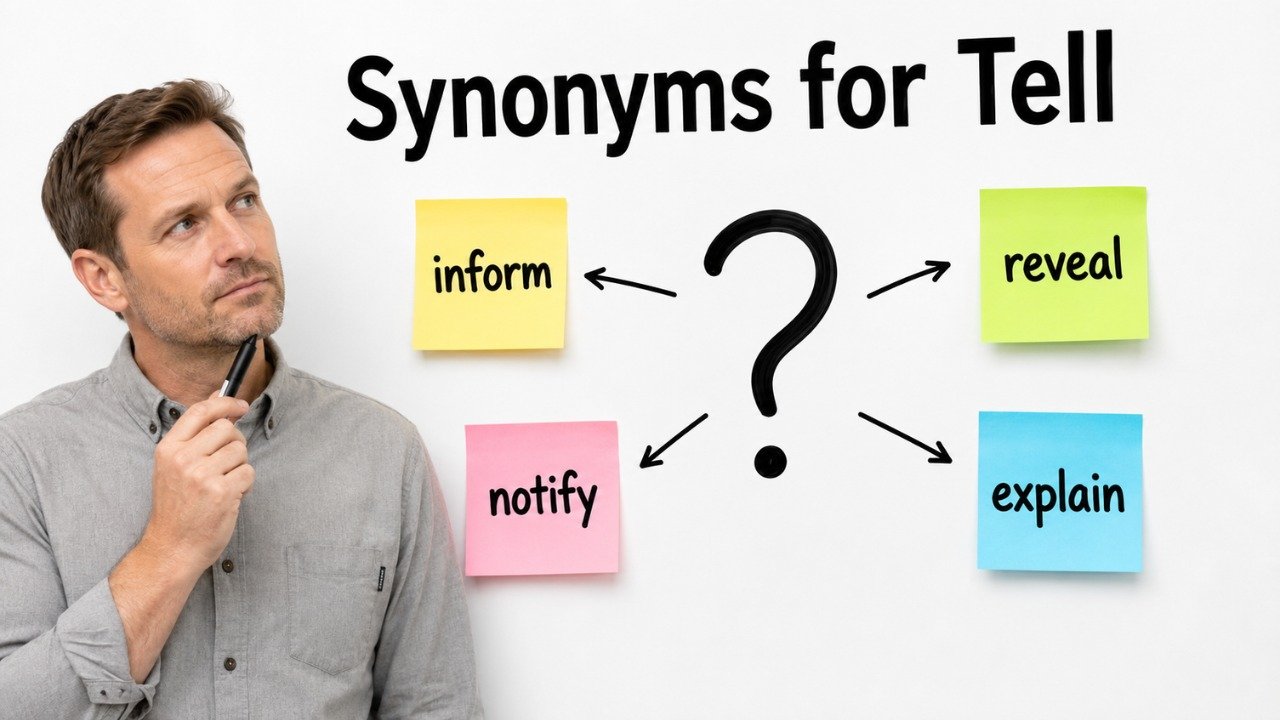
Quick Answer: The best synonyms for tell include say, inform, explain, notify, reveal, describe, instruct, recount, report, and indicate. Use say for general spoken words, inform and notify for sharing important information, explain for making something easier to understand, and reveal for previously hidden facts. Choose instruct when giving directions, recount when describing past events, report in formal or professional writing, and indicate when evidence or behavior communicates something indirectly.
Pronunciation and Word Details
Word: Tell.
Pronunciation: /tel/.
Part of Speech: Verb.
Meaning: To communicate information, give an instruction, describe something, or recognize a difference.
US Pronunciation:
UK Pronunciation:
What Does “Tell” Mean?
Tell means to communicate information, facts, instructions, stories, or personal thoughts to another person. It is mainly used as a verb.
One of its most common meanings is to give someone information.
Example: Please tell me what happened.
Tell can also mean to give an order or instruction.
Example: The teacher told the students to open their books.
It may describe the act of sharing a story or explaining an event.
Example: My grandfather told us a story about his childhood.
Tell can also mean to recognize, notice, or distinguish something.
Example: I can tell that she is worried.
Example: Can you tell the twins apart?
The meaning of tell therefore depends on the sentence. It may refer to speaking, informing, revealing, instructing, narrating, identifying, or recognizing.
Meaning, Tone, and Context of “Tell”
Tell is a common, neutral, and conversational verb. It appears naturally in everyday speech, emails, stories, instructions, essays, reports, and professional communication.
In casual conversation, tell often means to give someone information.
Example: Tell me where you left the keys.
In formal writing, inform, report, indicate, disclose, or notify may be more precise.
Example: The results indicate that the new method was effective.
Tell can have a direct or commanding tone when it introduces an instruction.
Example: She told him to leave the room.
The tone becomes softer when words such as please, could, or would are added.
Example: Could you please tell me how this works?
Tell may also carry an emotional tone when someone shares a secret, admits a mistake, or expresses personal feelings.
Example: He finally told his family the truth.
In storytelling, tell is neutral and useful, although recount, narrate, relate, and describe can provide more detail about how the information is presented.
When and How to Use “Tell”
For Sharing Information: Use tell when one person gives facts or information to another person.
Example: Please tell me the meeting time.
For Giving Instructions: Tell can introduce an action that someone is expected to perform.
Example: The doctor told him to rest for several days.
For Telling Stories: Use tell when someone shares a story, joke, experience, or sequence of events.
Example: She told the children a story before bedtime.
For Revealing Information: Tell may describe sharing something that was private, secret, or previously unknown.
Example: He refused to tell anyone the password.
For Expressing the Truth: Tell commonly appears when discussing honesty or accurate information.
Example: You should always tell the truth.
For Recognizing Feelings: Use tell when someone notices another person’s emotional state.
Example: I could tell that he was disappointed.
For Identifying Differences: Tell can mean to distinguish between two similar people, objects, sounds, or ideas.
Example: It is difficult to tell the two colors apart.
For Reporting a Problem: Use tell when informing someone about an issue or concern.
Example: Tell the manager if the machine stops working.
For Giving an Opinion: Tell may introduce someone’s judgment, advice, or personal view.
Example: Tell me what you think of the proposal.
Best Synonyms for Tell
Say: To speak or express words.
Example: She said that the office would close early.
Inform: To give someone facts or important information.
Example: Please inform the staff about the schedule change.
Explain: To make an idea, process, or situation easier to understand.
Example: The instructor explained how the machine worked.
Notify: To officially or formally make someone aware of something.
Example: The school notified parents about the closure.
Reveal: To make hidden, secret, or unknown information known.
Example: The witness revealed an important detail.
Describe: To explain what someone or something is like.
Example: He described the house in great detail.
Instruct: To tell someone what to do or how to do something.
Example: The guide instructed the visitors to remain together.
Recount: To tell a past event or experience in an organized way.
Example: She recounted what happened during the journey.
Report: To give formal information about an event, condition, or result.
Example: The researcher reported the final results.
Indicate: To show, suggest, or communicate something indirectly.
Example: His expression indicated that he was confused.
50 Synonyms for Tell with Short Meanings
- Say: To express something using spoken or written words.
- Inform: To give someone useful or important information.
- Notify: To officially make someone aware of something.
- Advise: To give information, guidance, or a recommendation.
- Explain: To make something clear or understandable.
- Describe: To give details about someone or something.
- Relate: To tell an event, experience, or story.
- Recount: To describe past events in sequence.
- Narrate: To tell a story or describe events.
- Report: To provide formal information about something.
- Announce: To make information publicly known.
- Declare: To state something clearly and firmly.
- State: To express information directly and clearly.
- Mention: To refer to something briefly.
- Reveal: To make hidden information known.
- Disclose: To provide information that was private or secret.
- Divulge: To reveal confidential or personal information.
- Confess: To admit something private, wrong, or embarrassing.
- Admit: To acknowledge that something is true.
- Communicate: To share information, thoughts, or feelings.
- Convey: To communicate an idea, feeling, or message.
- Express: To communicate a thought, opinion, or emotion.
- Share: To give information or experiences to others.
- Clarify: To make information easier to understand.
- Specify: To state something clearly and precisely.
- Instruct: To tell someone how to do something.
- Direct: To tell someone where to go or what to do.
- Order: To tell someone firmly to perform an action.
- Command: To give an authoritative instruction.
- Warn: To tell someone about possible danger or trouble.
- Remind: To tell someone about something they may have forgotten.
- Assure: To tell someone something confidently to remove doubt.
- Let Know: To give someone information.
- Make Known: To communicate information that was not previously known.
- Point Out: To direct attention to a fact or detail.
- Indicate: To show or suggest something.
- Show: To make information or evidence clear.
- Signal: To communicate through a sign, action, or movement.
- Identify: To recognize and name someone or something.
- Recognize: To know someone or something from previous knowledge.
- Distinguish: To notice the difference between similar things.
- Determine: To discover or decide something after examination.
- Detect: To notice something that is not obvious.
- Discern: To recognize or understand something with careful thought.
- Perceive: To notice or understand something through the senses or mind.
- Confide: To tell someone private information with trust.
- Proclaim: To announce something publicly and confidently.
- Articulate: To express an idea clearly and effectively.
- Voice: To express an opinion, concern, or feeling.
- Utter: To produce or speak words or sounds.
Read Also:
Synonyms for Moment

Synonyms for Tell by Context
When Tell Means Say Something
Say, state, mention, express, voice, utter, and articulate work when tell refers to spoken or written words.
Say is the broadest alternative. State is more direct and formal. Mention means to refer to something briefly, while articulate emphasizes clear expression.
Example: She stated that the information was correct.
Example: He mentioned the problem during the meeting.
Example: The student articulated her ideas clearly.
When Tell Means Give Information
Inform, notify, advise, let know, make known, communicate, and report work when someone receives information.
Inform is neutral and slightly formal. Notify is often used for official information. Report suits organized facts, results, incidents, or observations.
Example: Please inform us of any changes.
Example: The office notified employees about the new schedule.
Example: The technician reported the problem immediately.
When Tell Means Explain
Explain, clarify, describe, specify, show, and point out work when the purpose is to improve understanding.
Explain focuses on how or why something happens. Clarify removes confusion. Specify gives exact details, while describe tells what something is like.
Example: Could you explain this rule?
Example: She clarified the final step of the process.
Example: The form specifies which documents are required.
When Tell Means Reveal
Reveal, disclose, divulge, confess, admit, confide, and share work when information was private, hidden, or difficult to discuss.
Reveal is the broadest choice. Disclose often appears in formal writing. Confide suggests trust, while confess and admit usually involve accepting responsibility or acknowledging a fact.
Example: He revealed the reason for his decision.
Example: The applicant disclosed all relevant information.
Example: She confided her concerns to a close friend.
When Tell Means Give an Instruction
Instruct, direct, order, command, advise, remind, and warn work when tell introduces guidance or an expected action.
Instruct is useful for procedures or teaching. Direct focuses on what someone should do. Order and command are stronger and more authoritative.
Example: The coach instructed the players to remain focused.
Example: The guard directed visitors toward the main entrance.
Example: The officer ordered everyone to leave the area.
When Tell Means Narrate
Narrate, recount, relate, describe, report, and share work when someone communicates a story or past experience.
Narrate is common in literary and academic discussions. Recount emphasizes a sequence of past events. Relate can sound slightly formal.
Example: The traveler recounted her experiences abroad.
Example: The narrator related the events from his own perspective.
Example: He shared a funny story about his first job.
When Tell Means Recognize
Recognize, identify, detect, discern, perceive, determine, and distinguish work when tell means to notice, know, or discover something.
Recognize means to know something from previous experience. Detect means to notice something difficult to see. Distinguish focuses on differences.
Example: I recognized his voice immediately.
Example: The test detected a small error.
Example: She could distinguish the original painting from the copy.
Another Word for Tell
Say is the most common general replacement for tell when referring to spoken or written words. However, tell and say follow different grammar patterns, and the best alternative changes with the meaning.
Use inform for important information, explain for understanding, reveal for secrets, instruct for directions, and distinguish when identifying differences.
Original: Tell me what happened at the meeting.
Better Option: Explain what happened at the meeting.
Original: The office told employees about the change.
Better Option: The office notified employees about the change.
Original: She told the secret to her friend.
Better Option: She revealed the secret to her friend.
Original: I can tell the two materials apart.
Better Option: I can distinguish between the two materials.
When Not to Use “Tell”
Tell may sound repetitive, vague, too direct, or less precise than another verb. Choose a synonym that shows exactly how the information is communicated.
Avoid repeating tell several times in the same paragraph.
Weak: She told me the news and then told me what I should tell the others.
Better: She shared the news and then explained what I should report to the others.
Do not use tell when the communication is official and notify is more suitable.
Weak: The office told applicants that the date had changed.
Better: The office notified applicants that the date had changed.
Avoid tell when the sentence requires a more specific storytelling verb.
Weak: He told the events of the journey in detail.
Better: He recounted the events of the journey in detail.
Do not use tell when evidence communicates something without speaking.
Weak: The figures tell that sales increased.
Better: The figures indicate that sales increased.
Avoid tell when the intended meaning is to make something understandable.
Weak: The teacher told the difficult concept.
Better: The teacher explained the difficult concept.
Be careful when tell sounds too commanding in a polite request.
Weak: Tell me your available meeting times.
Better: Please let me know your available meeting times.
Words Commonly Confused With Tell
Tell vs Say: Tell usually names the person receiving the information. Say focuses on the words and does not normally take a person directly.
Example With Tell: She told me the answer.
Example With Say: She said the answer aloud.
Tell vs Speak: Tell communicates particular information to someone. Speak refers more generally to producing words or using a language.
Example With Tell: Tell me your reason.
Example With Speak: She speaks clearly during presentations.
Tell vs Talk: Tell usually delivers information in one direction. Talk often describes a conversation involving two or more people.
Example With Tell: He told us about the problem.
Example With Talk: We talked about the problem.
Tell vs Inform: Tell is neutral and conversational. Inform is more formal and is often used for important or official information.
Example With Tell: Tell me when you arrive.
Example With Inform: Please inform the manager when you arrive.
Tell vs Explain: Tell gives information, while explain makes a subject easier to understand by providing reasons or details.
Example With Tell: Tell me the rule.
Example With Explain: Explain why the rule is necessary.
Tell vs Ask: Tell gives information or an instruction. Ask requests information, permission, or action.
Example With Tell: Tell him to wait outside.
Example With Ask: Ask him whether he can wait outside.
Tell vs Describe: Tell is broad, while describe focuses on the qualities, appearance, or features of something.
Example With Tell: Tell me about the room.
Example With Describe: Describe the room in detail.
Which Synonym Should You Choose?
Choose say when referring generally to spoken or written words.
Choose inform when giving important information in formal writing, reports, emails, or professional communication.
Choose notify when the message is official, required, or related to a change, decision, deadline, or event.
Choose explain when helping someone understand a rule, idea, process, reason, or problem.
Choose describe when discussing appearance, features, qualities, places, people, or experiences.
Choose reveal when making hidden or previously unknown information available.
Choose disclose when sharing private information in formal, professional, financial, or legal contexts.
Choose confess when someone admits wrongdoing, guilt, or a private truth.
Choose instruct when giving practical directions or teaching someone how to complete a task.
Choose order or command when the instruction is authoritative and must be followed.
Choose recount or narrate in essays, stories, biographies, and descriptions of past events.
Choose report when presenting facts, incidents, observations, findings, or results.
Choose indicate when evidence, behavior, signs, or data communicate information indirectly.
Choose distinguish when identifying differences between similar people, objects, ideas, sounds, or results.
Choose confide when sharing private information with a trusted person.
Choose articulate when someone expresses a complex idea clearly and effectively.
Real Life Examples of “Tell” in Sentences
Original: Please tell everyone that the meeting has moved.
Better Option: Please notify everyone that the meeting has moved.
Original: Can you tell this process to the new employee?
Better Option: Can you explain this process to the new employee?
Original: She told us about her journey across the country.
Better Option: She recounted her journey across the country.
Original: The report tells that customer satisfaction improved.
Better Option: The report indicates that customer satisfaction improved.
Original: He told his friend the private information.
Better Option: He confided the private information to his friend.
Original: The manager told the staff to complete the forms.
Better Option: The manager instructed the staff to complete the forms.
Original: The witness told what she had seen.
Better Option: The witness reported what she had seen.
Original: I can tell the difference between the two sounds.
Better Option: I can distinguish between the two sounds.
Original: She told that she had made a mistake.
Better Option: She admitted that she had made a mistake.
Original: The guide told the main features of the building.
Better Option: The guide described the main features of the building.
Synonym Groups and Usage Differences
Speaking Group
Say, state, mention, utter, voice, express, and articulate describe the production or communication of words.
Say is general. State is direct and formal. Mention is brief, while articulate emphasizes clear and effective expression.
Example: She articulated her concerns during the discussion.
Information Group
Inform, notify, report, communicate, advise, and let know focus on giving information.
Inform and notify suit professional communication. Report usually presents organized facts, while let know is friendly and conversational.
Example: Please let me know when the documents arrive.
Explanation Group
Explain, clarify, describe, specify, point out, and show help another person understand something.
Explain gives reasons or details. Clarify removes confusion. Specify identifies exact requirements or features.
Example: The instructions specify the correct order of the steps.
Revelation Group
Reveal, disclose, divulge, admit, confess, and confide involve information that was hidden, personal, or difficult to share.
Disclose sounds formal. Divulge often refers to confidential details. Confide suggests trust between people.
Example: She confided her worries to her sister.
Instruction Group
Instruct, direct, order, command, advise, remind, and warn communicate guidance or expected action.
Advise offers guidance, while order and command require obedience. Warn communicates possible danger or harm.
Example: The sign warned visitors not to enter the restricted area.
Storytelling Group
Narrate, recount, relate, describe, and share communicate stories, memories, or events.
Narrate is structured and often literary. Recount focuses on events that already happened.
Example: He narrated the story from the main character’s perspective.
Recognition Group
Recognize, identify, distinguish, detect, discern, perceive, and determine describe knowing or discovering something.
Detect and discern often involve careful observation. Determine usually follows examination or analysis.
Example: The technician determined the cause of the failure.
Antonyms of Tell
The opposite of tell changes according to whether tell means communicate, reveal, instruct, or recognize.
Conceal: To keep information hidden.
Hide: To prevent something from being seen or known.
Withhold: To deliberately avoid giving information.
Suppress: To prevent information from being expressed or published.
Keep Secret: To avoid sharing private information.
Deny: To state that something is not true.
Remain Silent: To avoid speaking or communicating.
Mislead: To cause someone to believe something incorrect.
Confuse: To make information difficult to understand.
Ignore: To give no attention or response.
Obey: To follow an instruction rather than give one.
Misidentify: To recognize or name someone or something incorrectly.
Comparison: Tell vs Related Words
Tell vs Say
Tell normally identifies the listener, while say focuses on the actual words.
Example With Tell: She told her brother the news.
Example With Say: She said that the results were ready.
Tell vs Inform
Tell is common in conversation. Inform sounds more formal and deliberate.
Example With Tell: Tell me when you are ready.
Example With Inform: Please inform the office when you are ready.
Tell vs Explain
Tell gives information. Explain adds reasons, steps, or details to improve understanding.
Example With Tell: Tell me what the rule says.
Example With Explain: Explain how the rule applies.
Tell vs Describe
Tell is broad. Describe focuses on qualities, appearance, conditions, or features.
Example With Tell: Tell us about the garden.
Example With Describe: Describe the garden’s main features.
Tell vs Reveal
Tell can involve ordinary information. Reveal introduces information that was hidden or unknown.
Example With Tell: She told us the meeting time.
Example With Reveal: She revealed the reason for the private meeting.
Tell vs Report
Tell is conversational, while report is more organized and formal.
Example With Tell: He told me about the accident.
Example With Report: He reported the accident to the supervisor.
Tell vs Instruct
Tell can give any information or command. Instruct specifically provides directions or teaches a procedure.
Example With Tell: She told him to check the door.
Example With Instruct: She instructed him to inspect every door carefully.
Tell vs Indicate
Tell normally involves direct communication. Indicate means that signs, behavior, evidence, or data suggest something.
Example With Tell: She told us that she was tired.
Example With Indicate: Her expression indicated that she was tired.
Tell vs Distinguish
Tell can mean to notice a difference, but distinguish is more precise in formal writing.
Example With Tell: I cannot tell the two voices apart.
Example With Distinguish: I cannot distinguish between the two voices.
Common Phrases and Expressions With Tell
Tell the Truth: To give honest and accurate information.
Tell a Story: To describe fictional or real events.
Tell a Joke: To share a humorous story or comment.
Tell Someone About Something: To give a person information about a subject.
Tell the Difference: To recognize how two things are not the same.
Tell Apart: To distinguish between similar people or things.
Tell By: To recognize something through a sign, detail, or clue.
Tell On Someone: To report another person’s wrongdoing or behavior.
Tell Someone Off: To speak angrily to someone because of unacceptable behavior.
Tell Someone to Do Something: To give an instruction, direction, or order.
Common Mistakes to Avoid
Using Tell Without a Listener: Tell usually needs a person or group receiving the information.
Incorrect: She told that the office was closed.
Correct: She told us that the office was closed.
Correct: She said that the office was closed.
Using Tell To Before a Person: Do not normally place to between tell and the listener.
Incorrect: He told to me the answer.
Correct: He told me the answer.
Confusing Tell and Say: Use tell before a listener and say before words or a statement.
Incorrect: She said me the truth.
Correct: She told me the truth.
Correct: She said that the information was true.
Using Tell Instead of Explain: Tell does not always mean to make something understandable.
Weak: Please tell this calculation.
Better: Please explain this calculation.
Choosing a Formal Synonym in Casual Speech: Notify or disclose may sound unnecessarily formal in an ordinary conversation.
Unnatural: Notify me when dinner is ready.
Natural: Tell me when dinner is ready.
Using Tell Repeatedly: Too much repetition can make writing vague. Choose report, explain, reveal, describe, or instruct according to the exact meaning.
Weak: He told the manager what the customer had told him.
Better: He reported what the customer had explained to him.
Ignoring the Meaning of Recognition: Tell can also mean recognize or distinguish.
Example: I could tell from her voice that she was upset.
Using Tell With Incorrect Verb Structure: When tell introduces an instruction, use an object followed by the infinitive form.
Incorrect: She told to wait outside.
Correct: She told him to wait outside.
Conclusion
The best synonyms for tell depend on what is being communicated. Use say for general words, inform or notify for important information, and explain for greater clarity. Reveal and disclose suit hidden facts, while instruct and direct introduce guidance. Recount and narrate work well for stories, and indicate describes indirect evidence. When tell means recognizing a difference, choose distinguish or identify. Understanding these uses makes synonyms for tell easier to select in conversation, essays, reports, emails, and descriptive writing.
FAQs About Synonyms for Tell
What Is the Best Synonym for Tell?
Say is the most common general synonym. Inform, explain, reveal, instruct, and report are more precise in specific contexts.
What Is a Formal Synonym for Tell?
Inform, notify, report, state, disclose, and communicate are useful formal alternatives.
What Is the Difference Between Tell and Say?
Tell usually names the listener, as in “tell me.” Say focuses on the words, as in “say something.”
What Word Can Replace Tell in an Essay?
Use state, explain, report, indicate, describe, reveal, or argue, depending on the sentence’s meaning.
What Is Another Word for Telling a Story?
Narrate, recount, relate, describe, and share can replace tell when discussing a story or past event.
What Is Another Word for Telling Someone What to Do?
Instruct, direct, order, command, advise, and remind can describe giving directions or guidance.
Can Tell Mean Recognize?
Yes. Tell can mean to notice, identify, or distinguish something, as in “I can tell the difference.”
