
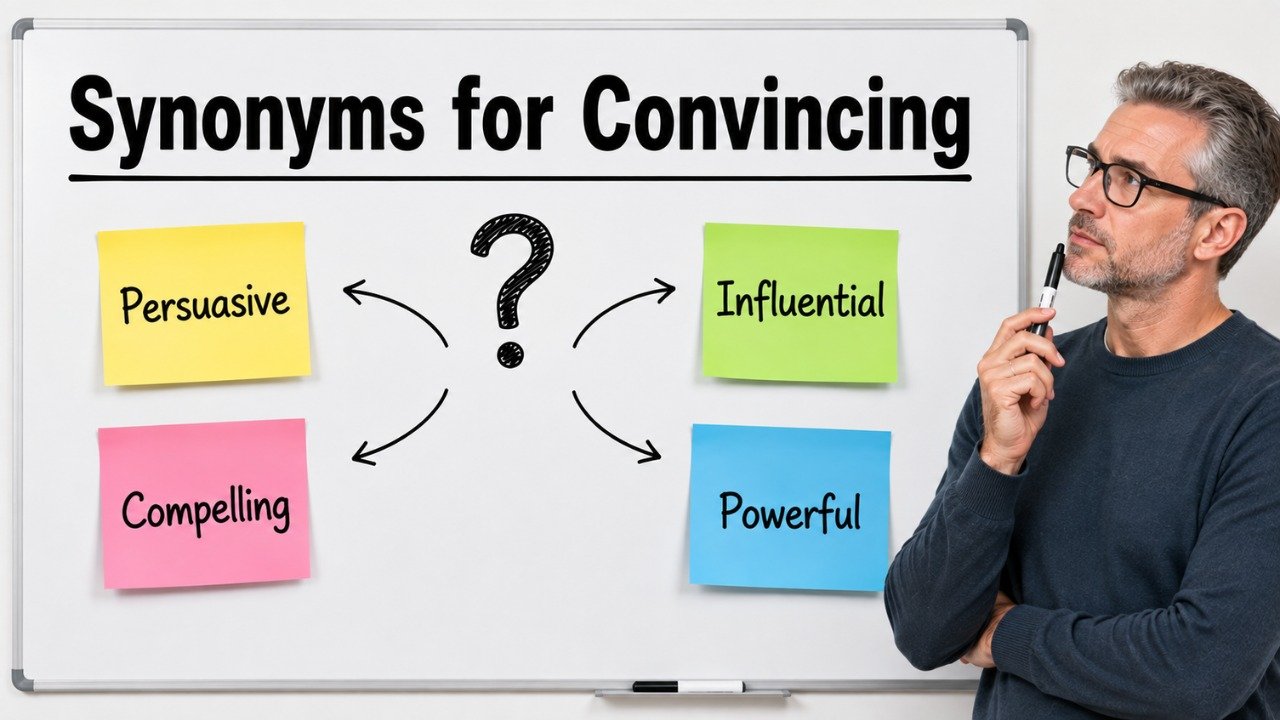
Quick Answer: The best synonyms for convincing are persuasive, compelling, credible, believable, plausible, cogent, conclusive, sound, forceful, and realistic. Use persuasive for arguments, speeches, requests, and opinions that influence people. Compelling suits ideas or evidence that are difficult to ignore, while credible and believable describe claims that appear true. Cogent and sound are strong choices for logical reasoning. Conclusive works when evidence settles a question, and realistic is best for performances, stories, or descriptions that seem genuine.
Pronunciation and Word Details
Word: Convincing.
Pronunciation: /kənˈvɪnsɪŋ/.
Part of Speech: Adjective and present participle of the verb convince.
Meaning: Able to make someone believe that something is true, reasonable, or worthy of acceptance.
US Pronunciation:
UK Pronunciation:
What Does “Convincing” Mean?
Convincing means able to make someone believe, agree with, or accept something.
As an adjective, convincing describes an argument, explanation, claim, performance, reason, or piece of evidence that appears believable and strong.
Example: She gave a convincing explanation for her decision.
The word can describe something that influences an opinion.
Example: His argument was convincing enough to change their minds.
It can also describe a performance, story, or appearance that seems real.
Example: The actor gave a convincing performance as an exhausted traveler.
Convincing is also the present participle of convince.
Example: She is convincing the committee to reconsider the proposal.
In this sentence, convincing describes the action of causing someone to believe or agree. When used as an adjective, it describes the quality of an argument, explanation, performance, or claim.
Meaning, Tone, and Context of “Convincing”
Convincing is a neutral and generally positive word. It suggests that something has enough logic, credibility, detail, or emotional power to influence a person’s judgment.
The word is common in formal writing, academic essays, reports, professional communication, everyday conversation, debates, reviews, and storytelling.
In formal or academic contexts, convincing often describes arguments and evidence.
Example: The essay presents a convincing argument for changing the policy.
In professional communication, it can describe a proposal, explanation, presentation, or reason.
Example: The team prepared a convincing case for extending the project.
In casual conversation, convincing may describe something that seems believable.
Example: His excuse did not sound very convincing.
In creative writing, theater, or film discussion, convincing usually means realistic or authentic.
Example: Her emotional reaction was completely convincing.
The word can be strong without sounding exaggerated. However, it does not always mean that something is certainly true. A statement can sound convincing while still being incorrect. The word mainly describes its effect on the listener or reader.
When and How to Use “Convincing”
For Persuasive Arguments: Use convincing when an argument successfully influences someone’s opinion.
Example: The speaker offered a convincing argument for protecting the historic building.
For Strong Evidence: Use convincing when facts or proof make a conclusion appear reliable.
Example: Investigators found convincing evidence that the records had been altered.
For Believable Explanations: Use convincing when an explanation sounds reasonable and likely to be true.
Example: She gave a convincing account of what happened.
For Effective Proposals: Use convincing when a plan or request is presented strongly enough to gain support.
Example: The students created a convincing proposal for improving the library.
For Realistic Performances: Use convincing when acting, dialogue, or behavior appears natural and genuine.
Example: His convincing performance made the character feel real.
For Credible Descriptions: Use convincing when details create a believable picture of an event, place, or person.
Example: The writer gives a convincing description of life in a remote village.
For Decisive Results: Use convincing when a result clearly demonstrates strength or superiority.
Example: The team earned a convincing victory in the final match.
Best Synonyms for Convincing
Persuasive: Able to influence someone’s beliefs, choices, or actions.
Example: She wrote a persuasive letter requesting additional funding.
Compelling: So powerful, interesting, or believable that it is difficult to ignore.
Example: The witness provided a compelling account of the incident.
Credible: Deserving belief because it appears reliable and trustworthy.
Example: The researcher offered a credible explanation for the unexpected result.
Believable: Seeming true, possible, or realistic.
Example: The character’s reaction was believable and emotionally natural.
Plausible: Appearing reasonable or possible, although not certainly true.
Example: His explanation sounded plausible at first.
Cogent: Clearly expressed, logical, and strongly persuasive.
Example: The article presents a cogent argument for reform.
Conclusive: Strong enough to settle a question or prove a point.
Example: The test results provided conclusive evidence.
Sound: Based on reliable facts, sensible reasoning, or good judgment.
Example: Her conclusion was supported by sound reasoning.
Forceful: Expressed with strength, confidence, and persuasive power.
Example: He delivered a forceful defense of the decision.
Realistic: Closely resembling real life and therefore easy to believe.
Example: The story contains realistic dialogue and convincing characters.
50 Synonyms for Convincing with Short Meanings
- Persuasive: Able to influence beliefs or decisions.
- Compelling: Powerful enough to demand attention or belief.
- Credible: Appearing reliable and worthy of trust.
- Believable: Seeming true or possible.
- Plausible: Appearing reasonable despite lacking certainty.
- Cogent: Clear, logical, and persuasive.
- Conclusive: Strong enough to settle a question.
- Sound: Based on reliable reasoning or evidence.
- Forceful: Expressed with confidence and power.
- Effective: Successful in producing the intended response.
- Powerful: Having a strong effect on thought or emotion.
- Influential: Able to affect opinions or decisions.
- Impressive: Creating a strong and favorable effect.
- Authoritative: Confident, reliable, and deserving acceptance.
- Logical: Based on clear and sensible reasoning.
- Reasonable: Fair, sensible, and easy to accept.
- Rational: Supported by logic rather than emotion alone.
- Well Founded: Based on reliable facts or reasons.
- Well Reasoned: Developed through careful and logical thought.
- Solid: Strong, dependable, and difficult to challenge.
- Valid: Logically acceptable or properly supported.
- Trustworthy: Deserving confidence or belief.
- Authentic: Appearing genuine rather than artificial.
- Realistic: Closely matching real life or actual conditions.
- Probable: Likely to be true or happen.
- Likely: Having a strong possibility of being true.
- Reassuring: Making someone feel more confident or less doubtful.
- Decisive: Producing a clear and definite conclusion.
- Definitive: Considered complete, final, or authoritative.
- Undeniable: Too clear or strong to reject.
- Irrefutable: Impossible to disprove successfully.
- Indisputable: Not reasonably open to disagreement.
- Incontrovertible: Impossible to deny or challenge with evidence.
- Unanswerable: Too strong to be successfully argued against.
- Probative: Providing evidence that helps prove something.
- Telling: Revealing something important or persuasive.
- Substantiated: Supported by facts or evidence.
- Supported: Strengthened by reasons, examples, or proof.
- Verified: Confirmed as true or accurate.
- Grounded: Based on reality, evidence, or practical reasoning.
- Evidence Based: Supported by observable facts or research.
- Fact Based: Built on facts rather than unsupported opinion.
- Well Supported: Backed by several strong reasons or facts.
- Well Substantiated: Thoroughly supported with reliable evidence.
- Persuasively Argued: Presented in a way that encourages agreement.
- Winning: Attractive or persuasive enough to gain approval.
- Engaging: Holding attention and encouraging interest.
- Appealing: Attractive or acceptable to the mind or emotions.
- True To Life: Closely resembling real experience.
- Lifelike: Appearing highly realistic and natural.
Read Also:
Synonyms for Driven

Synonyms for Convincing by Context
When Convincing Means Persuasive
Persuasive, compelling, forceful, influential, powerful, and effective describe communication that changes opinions or encourages action.
Persuasive Example: Her persuasive speech encouraged residents to support the project.
Compelling Example: He presented a compelling reason for delaying the decision.
Forceful Example: The lawyer made a forceful argument in defense of the client.
Influential Example: The report became influential in shaping public policy.
When Convincing Means Believable
Credible, believable, plausible, trustworthy, probable, and likely describe something that appears true or possible.
Credible Example: The witness gave a credible description of the vehicle.
Believable Example: Her explanation was simple but believable.
Plausible Example: There is a plausible reason for the delay.
Trustworthy Example: The information came from a trustworthy expert.
When Convincing Means Logical
Cogent, sound, logical, rational, reasonable, well founded, and well reasoned describe arguments built on clear thinking.
Cogent Example: The student wrote a cogent response to the question.
Sound Example: The recommendation is based on sound financial reasoning.
Logical Example: His conclusion follows a logical sequence.
Well Reasoned Example: The committee accepted her well reasoned proposal.
When Convincing Means Proven by Evidence
Conclusive, irrefutable, indisputable, substantiated, verified, probative, and well supported describe claims strengthened by evidence.
Conclusive Example: The examination produced conclusive results.
Irrefutable Example: The recording provided irrefutable proof.
Substantiated Example: Every major claim was substantiated with evidence.
Verified Example: The figures were verified before publication.
When Convincing Means Realistic
Realistic, authentic, believable, lifelike, and true to life describe performances, stories, images, or characters that resemble reality.
Realistic Example: The novel contains realistic conversations between family members.
Authentic Example: Her authentic performance captured the character’s grief.
Lifelike Example: The artist created a lifelike portrait.
True To Life Example: The story offers a true to life picture of childhood friendship.
When Convincing Means Decisive
Decisive, definitive, undeniable, incontrovertible, and unanswerable describe evidence, arguments, or results that leave little room for doubt.
Decisive Example: The final experiment produced decisive evidence.
Definitive Example: The report gives a definitive answer to the question.
Undeniable Example: Her improvement was undeniable.
Unanswerable Example: He presented an unanswerable case for immediate action.
Another Word for Convincing
Persuasive is often the best single replacement for convincing when discussing an argument, speech, request, or piece of writing. However, the best alternative depends on what makes something convincing. Credible suits reliable claims, compelling emphasizes emotional or intellectual power, and realistic describes believable performances or stories.
Original: She made a convincing argument for changing the schedule.
Better Option: She made a persuasive argument for changing the schedule.
Original: The witness gave a convincing explanation.
Better Option: The witness gave a credible explanation.
Original: The report presented convincing evidence.
Better Option: The report presented compelling evidence.
Original: His performance as the injured traveler was convincing.
Better Option: His performance as the injured traveler was realistic.
When Not to Use “Convincing”
Do not use convincing when you need to identify exactly why something is effective. A more precise synonym may communicate logic, credibility, evidence, or realism more clearly.
Weak: The essay was convincing.
Better: The essay was persuasive because each claim was supported by relevant evidence.
Avoid convincing when you only mean interesting. Something may attract attention without changing anyone’s opinion.
Weak: The documentary was convincing from beginning to end.
Better: The documentary was engaging from beginning to end.
Do not use convincing when evidence fully proves a conclusion. Conclusive or irrefutable may be more accurate.
Weak: The laboratory results were convincing.
Better: The laboratory results were conclusive.
Avoid convincing for statements that merely seem possible.
Weak: His theory is convincing, but there is little evidence for it.
Better: His theory is plausible, but there is little evidence for it.
Do not describe a person as convincing when you actually mean convinced.
Weak: I am convincing that this plan will work.
Better: I am convinced that this plan will work.
Avoid repeating convincing several times in one paragraph.
Weak: She gave a convincing speech with convincing evidence and a convincing conclusion.
Better: She gave a persuasive speech supported by compelling evidence and a logical conclusion.
Words Commonly Confused With Convincing
Convincing vs Convinced: Convincing describes something that causes belief. Convinced describes a person who has accepted something as true.
Convincing Example: Her explanation was convincing.
Convinced Example: I am convinced that her explanation is accurate.
Convincing vs Persuasive: Convincing means successful in causing belief or agreement. Persuasive focuses more directly on the ability to influence an opinion or action.
Convincing vs Compelling: Convincing causes belief, while compelling suggests such strong power or interest that something is difficult to resist or ignore.
Convincing vs Credible: Convincing describes the overall effect on an audience. Credible means worthy of belief because the source or claim appears reliable.
Convincing vs Plausible: Convincing suggests strong belief. Plausible means merely reasonable or possible, even when proof is incomplete.
Convincing vs Conclusive: Convincing may strongly influence belief without settling the matter. Conclusive evidence completely resolves a question.
Convincing vs Realistic: Convincing can describe arguments, evidence, explanations, and performances. Realistic mainly describes something that closely resembles real life.
Convincing vs Effective: Convincing specifically relates to belief or agreement. Effective means successful in achieving any intended result.
Which Synonym Should You Choose?
Choose persuasive when writing about arguments, speeches, essays, requests, or proposals intended to influence people.
Choose compelling when an idea, story, reason, or piece of evidence is especially powerful and difficult to ignore.
Choose credible when a person, explanation, report, or claim appears trustworthy.
Choose believable when describing a story, excuse, character, or account that seems true.
Choose plausible when an explanation seems possible but has not been fully proven.
Choose cogent in formal writing when an argument is clear, logical, and carefully organized.
Choose sound when reasoning, advice, judgment, or a conclusion is sensible and dependable.
Choose conclusive when evidence settles a question and leaves little uncertainty.
Choose irrefutable when evidence or reasoning cannot be successfully disproved.
Choose realistic when discussing acting, dialogue, characters, descriptions, or stories that resemble real life.
Choose forceful when a person communicates with strength, confidence, and emphasis.
Choose well supported in essays and reports when claims are backed by evidence, examples, or reliable facts.
Choose reassuring in emails or conversations when words reduce uncertainty and build confidence.
Choose decisive when a result, victory, or piece of evidence creates a clear outcome.
Real Life Examples of “Convincing” in Sentences
Original: The lawyer presented a convincing argument.
Better Option: The lawyer presented a cogent argument.
Original: She gave a convincing reason for arriving late.
Better Option: She gave a plausible reason for arriving late.
Original: The report contains convincing evidence of improvement.
Better Option: The report contains compelling evidence of improvement.
Original: His explanation sounded convincing.
Better Option: His explanation sounded credible.
Original: The actor gave a convincing performance.
Better Option: The actor gave an authentic performance.
Original: The essay offers a convincing analysis of the issue.
Better Option: The essay offers a well reasoned analysis of the issue.
Original: The experiment produced convincing results.
Better Option: The experiment produced conclusive results.
Original: Her proposal was convincing enough to gain approval.
Better Option: Her proposal was persuasive enough to gain approval.
Original: The character’s fear was convincing.
Better Option: The character’s fear was believable.
Original: The team achieved a convincing victory.
Better Option: The team achieved a decisive victory.
Synonym Groups and Usage Differences
Persuasion Group
Persuasive, compelling, forceful, powerful, influential, and effective describe the ability to change opinions or encourage action.
Persuasive is the most direct alternative. Compelling adds greater emotional or intellectual force, while forceful emphasizes confident expression.
Example: Her compelling presentation persuaded the committee to approve the plan.
Credibility Group
Credible, believable, plausible, trustworthy, probable, and likely describe ideas or claims that appear true.
Credible often refers to reliability. Believable is common in everyday language, while plausible describes something that is possible but not proven.
Example: The witness gave a credible account supported by several details.
Logic Group
Cogent, logical, rational, sound, reasonable, well founded, and well reasoned describe careful thinking.
Cogent is formal and strongly positive. Sound emphasizes reliability, while rational contrasts logical thought with unsupported emotion.
Example: The author develops a sound argument based on clear facts.
Evidence Group
Conclusive, irrefutable, indisputable, incontrovertible, substantiated, verified, and well supported describe claims backed by proof.
Conclusive evidence settles a question. Irrefutable and incontrovertible suggest that the evidence cannot be denied successfully.
Example: The verified records provided conclusive evidence of the payment.
Realism Group
Realistic, authentic, lifelike, believable, and true to life describe something that resembles reality.
Authentic emphasizes genuineness. Lifelike is often used for visual representations, while true to life suits stories and descriptions.
Example: The writer created authentic characters with realistic emotions.
Decisive Impact Group
Decisive, definitive, undeniable, unanswerable, and powerful describe something that produces a clear or strong effect.
Decisive often refers to results. Definitive suggests a final or authoritative answer, while undeniable means too obvious to reject.
Example: The final test provided a definitive answer.
Antonyms of Convincing
The opposite of convincing may describe something that lacks credibility, logic, evidence, realism, or persuasive power.
Unconvincing: Not able to cause belief or agreement.
Unpersuasive: Failing to influence an opinion or decision.
Implausible: Unlikely or difficult to believe.
Unbelievable: Too unlikely, unrealistic, or surprising to accept as true.
Doubtful: Not certain or worthy of complete belief.
Dubious: Questionable in truth, quality, or reliability.
Questionable: Open to doubt or criticism.
Weak: Lacking persuasive force or adequate support.
Unsound: Based on faulty reasoning or unreliable information.
Illogical: Not following clear or sensible reasoning.
Baseless: Lacking facts, reasons, or evidence.
Unsupported: Not backed by proof or reliable information.
Inconclusive: Unable to settle a question or produce a definite answer.
Unrealistic: Not accurately representing real life or likely conditions.
Ineffective: Failing to produce the intended result.
Artificial: Appearing false, forced, or unnatural.
Comparison: Convincing vs Related Words
Convincing vs Persuasive
Convincing describes something that successfully causes belief or agreement. Persuasive emphasizes the methods or qualities used to influence someone.
Example With Convincing: The evidence was convincing enough to change her opinion.
Example With Persuasive: He used persuasive language to gain their support.
Convincing vs Compelling
Convincing causes people to believe or agree. Compelling is stronger and suggests that an argument, reason, or story is difficult to resist or ignore.
Example With Convincing: She offered a convincing explanation for the mistake.
Example With Compelling: She offered a compelling reason to reconsider the decision.
Convincing vs Credible
Convincing describes the effect of a statement or argument. Credible describes whether a source or claim deserves belief.
Example With Convincing: His detailed explanation was convincing.
Example With Credible: He was considered a credible witness.
Convincing vs Plausible
Convincing suggests that something inspires fairly strong belief. Plausible means it appears possible or reasonable, but it may still lack proof.
Example With Convincing: The explanation was convincing because several facts supported it.
Example With Plausible: The explanation was plausible, but investigators needed more evidence.
Convincing vs Conclusive
Convincing evidence strongly encourages belief. Conclusive evidence settles the matter and leaves no important question unresolved.
Example With Convincing: The first test provided convincing evidence.
Example With Conclusive: The final test provided conclusive evidence.
Convincing vs Cogent
Convincing is a broad word for something believable or persuasive. Cogent specifically describes an argument that is clear, logical, and well organized.
Example With Convincing: Her presentation was convincing.
Example With Cogent: Her presentation contained a cogent analysis of the problem.
Convincing vs Realistic
Convincing can apply to reasoning, evidence, explanations, and performances. Realistic mainly applies to things that resemble actual life or likely conditions.
Example With Convincing: The speaker made a convincing case for change.
Example With Realistic: The writer created a realistic picture of rural life.
Common Phrases and Expressions With Convincing
Convincing Argument: A line of reasoning that successfully encourages agreement.
Convincing Evidence: Facts or information strong enough to support belief.
Convincing Explanation: An account that appears reasonable and truthful.
Convincing Case: A collection of arguments and evidence supporting a position.
Convincing Performance: Acting or behavior that appears natural and believable.
Convincing Reason: A strong and acceptable explanation for an action or belief.
Convincing Proof: Evidence that strongly demonstrates a claim.
Convincing Account: A believable description of an event or experience.
Convincing Demonstration: A clear display showing that an idea or method works.
Convincing Victory: A decisive result that clearly shows superiority.
Common Mistakes to Avoid
Mistake One: Confusing convincing with convinced.
Convincing describes the thing that causes belief. Convinced describes the person who believes.
Incorrect: I am convincing that the plan is safe.
Correct: I am convinced that the plan is safe.
Mistake Two: Using convincing when plausible is more accurate.
A plausible claim seems possible. A convincing claim has enough strength to inspire belief.
Mistake Three: Calling all evidence convincing.
Evidence may be weak, limited, suggestive, compelling, or conclusive. Choose the word that reflects its actual strength.
Mistake Four: Using convincing as a general compliment.
Convincing should relate to belief, agreement, credibility, or realism. Use interesting, engaging, impressive, or effective when persuasion is not involved.
Mistake Five: Repeating the word too often.
Replace repeated uses with persuasive, credible, believable, compelling, sound, or realistic according to context.
Mistake Six: Choosing an overly strong synonym.
Do not use irrefutable, incontrovertible, or conclusive unless the evidence truly leaves no reasonable doubt.
Mistake Seven: Ignoring the noun being described.
A convincing argument may be persuasive, a convincing witness may be credible, a convincing performance may be realistic, and convincing evidence may be compelling or conclusive.
Mistake Eight: Using vague praise without explanation.
Instead of simply writing that an argument is convincing, explain whether it is logical, well supported, credible, or emotionally powerful.
Conclusion
Understanding synonyms for convincing helps you express persuasion, credibility, logic, evidence, and realism more accurately. Persuasive is the best general choice for arguments and requests, while compelling adds greater power. Credible and believable suit reliable claims, and plausible describes something merely possible. Cogent and sound work well for logical reasoning. Conclusive and irrefutable describe especially strong evidence, while realistic and authentic fit performances or stories. Choosing the right alternative makes your writing clearer, more precise, and more persuasive.
FAQs About Synonyms for Convincing
What Is the Best Synonym for Convincing?
Persuasive is the best general synonym when something influences belief or action. Credible, compelling, or realistic may be better in specific contexts.
What Is a Formal Synonym for Convincing?
Cogent, compelling, credible, conclusive, well founded, and well reasoned are useful formal alternatives.
What Is the Difference Between Convincing and Convinced?
Convincing describes something that causes belief. Convinced describes someone who has accepted an idea as true.
Can Compelling Replace Convincing?
Yes, especially when an argument, reason, story, or piece of evidence is extremely powerful and difficult to ignore.
Is Plausible the Same as Convincing?
No. Plausible means possible or reasonable. Convincing suggests stronger support and a greater ability to inspire belief.
What Is a Synonym for a Convincing Argument?
Persuasive, cogent, sound, well reasoned, compelling, and forceful are strong choices for a convincing argument.
What Is the Opposite of Convincing?
Unconvincing, implausible, doubtful, weak, unsupported, illogical, and unbelievable are common opposites.
