
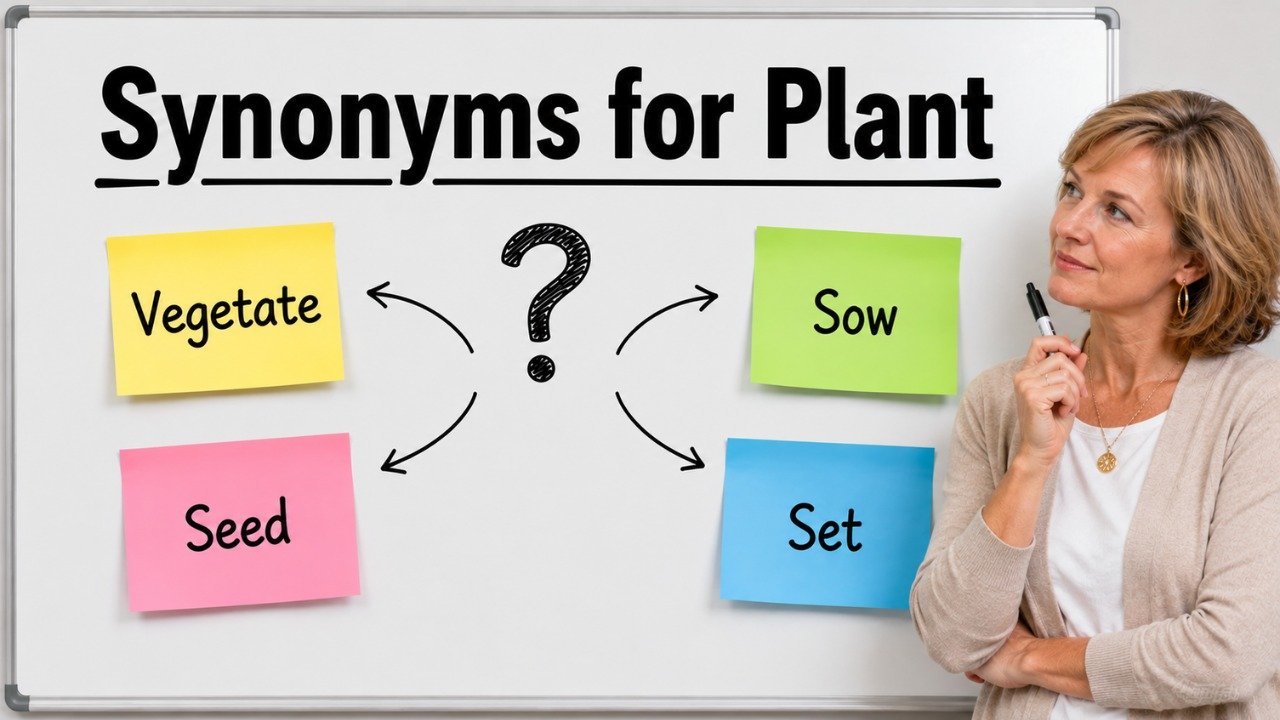
Quick Answer: The best synonyms for plant are flora, vegetation, greenery, factory, facility, sow, cultivate, place, install, and establish. Use flora or vegetation when referring to plant life. Choose factory or facility for an industrial plant. Use sow for putting seeds into soil, cultivate for caring for growing crops, and place or insert for positioning an object. Install works for machinery or equipment, while establish is best when plant means creating an organization, operation, or idea in a particular location.
Pronunciation and Word Details
Word: Plant.
Pronunciation: /plænt/.
Part of Speech: Noun and verb.
Meaning: A plant is a living organism that grows in soil or water, while the verb plant means to place, grow, install, conceal, or establish something.
US Pronunciation:
UK Pronunciation:
What Does “Plant” Mean?
Plant can mean a living organism, an industrial facility, or the act of putting something in a particular place.
As a noun, plant most commonly refers to a living organism that usually has roots, stems, and leaves. Plants include trees, flowers, shrubs, herbs, grasses, and crops.
Example: She placed a small plant beside the window.
Plant can also mean a factory or industrial facility where goods, energy, chemicals, or materials are produced.
Example: The company opened a new manufacturing plant outside the city.
As a verb, plant can mean putting seeds, bulbs, or young plants into the ground so they can grow.
Example: We will plant tomatoes in the garden.
It can also mean placing, fixing, or installing something firmly.
Example: He planted the sign beside the entrance.
Plant may describe secretly placing an object, idea, person, or piece of information somewhere.
Example: Someone planted false evidence at the scene.
The word can also mean establishing something in a place.
Example: The organization planted a new office in the region.
Because plant has several meanings, the correct synonym depends heavily on the sentence.
Meaning, Tone, and Context of “Plant”
Plant is a common, neutral, and versatile word. It appears in everyday conversation, gardening instructions, science, agriculture, industry, engineering, business, law, and creative writing.
When plant refers to a living organism, the tone is usually neutral and conversational.
Example: This plant needs more sunlight.
In scientific or academic writing, more precise terms such as flora, vegetation, species, seedling, shrub, or crop may be more useful.
Example: The study examined native vegetation in the region.
When plant refers to a factory, it has a professional, industrial, or technical tone.
Example: The processing plant operates throughout the week.
As a verb, plant can sound literal, figurative, or secretive depending on the context.
Literal Use: They planted flowers along the path.
Figurative Use: The teacher planted an idea in the student’s mind.
Secretive Use: The object had been planted in the room.
Plant is neither strongly emotional nor especially formal. However, certain meanings can carry serious or negative associations. Planting evidence, planting a device, or planting false information suggests secrecy or deception.
When and How to Use “Plant”
For a Living Organism
Use plant when referring generally to an organism that grows in soil, water, or another suitable environment.
Example: The plant produced several new leaves.
For Plant Life in an Area
Use plant when discussing individual examples, but choose flora or vegetation when referring collectively to plant life.
Example: The region supports a wide variety of plant life.
For Gardening
Use plant as a verb when putting seeds, bulbs, seedlings, flowers, vegetables, shrubs, or trees into the ground.
Example: They plan to plant roses near the fence.
For Agriculture
Use plant when placing crops or seeds in prepared soil.
Example: Farmers plant wheat during the cooler season.
For an Industrial Facility
Use plant as a noun for a factory or facility where products, electricity, fuel, or materials are produced.
Example: The power plant supplies electricity to nearby communities.
For Positioning an Object
Use plant when placing an object firmly or deliberately in one position.
Example: She planted the umbrella in the sand.
For Installing Equipment
Use plant when machinery or equipment is positioned at a particular site, although install is often more precise.
Example: The crew planted the support posts firmly in the ground.
For Concealing Something
Use plant when someone secretly places an object, device, or piece of evidence somewhere.
Example: The investigators believed someone had planted the document.
For Introducing an Idea
Use plant figuratively when an idea, doubt, hope, or suspicion is introduced into someone’s mind.
Example: His question planted doubt in her mind.
For Establishing Something
Use plant when creating or placing an operation, community, organization, or influence in a new location.
Example: The group planted a small training center in the town.
Best Synonyms for Plant
Flora
Synonym: The plants of a particular place, period, or environment.
Example: The island has a rich variety of native flora.
Vegetation
Synonym: Plants considered collectively, especially those growing naturally in an area.
Example: Thick vegetation covered the hillside.
Greenery
Synonym: Green plants, leaves, and foliage used collectively.
Example: The room felt peaceful because of the surrounding greenery.
Factory
Synonym: A building or group of buildings where goods are manufactured.
Example: The factory produces household equipment.
Facility
Synonym: A building or site designed for a particular industrial or operational purpose.
Example: The new facility processes recycled materials.
Sow
Synonym: To put seeds into soil so they can grow.
Example: Farmers sow the seeds in carefully prepared fields.
Cultivate
Synonym: To prepare land and care for plants or crops as they grow.
Example: The family cultivates vegetables behind the house.
Place
Synonym: To put someone or something in a particular position.
Example: She placed the vase in the center of the table.
Install
Synonym: To position equipment or a system so it is ready for use.
Example: Workers installed the new pump near the water tank.
Establish
Synonym: To create something on a firm or lasting basis.
Example: The organization established a new branch in the area.
50 Synonyms for Plant with Short Meanings
- Flora: The plant life of a place or period.
- Vegetation: Plants growing collectively in an area.
- Greenery: Green leaves and plants considered together.
- Botanical: A plant or plant related specimen in certain contexts.
- Organism: A living thing, including a plant.
- Seedling: A young plant that has recently begun growing.
- Sapling: A young tree.
- Shrub: A small woody plant with several stems.
- Herb: A small plant often used in cooking or medicine.
- Flower: A flowering plant or its bloom.
- Tree: A tall woody plant with a trunk.
- Crop: A plant grown for food, materials, or sale.
- Weed: A plant growing where it is not wanted.
- Houseplant: A plant grown indoors.
- Factory: A building where goods are manufactured.
- Mill: A facility where materials are processed or products are made.
- Works: An industrial site where manufacturing takes place.
- Facility: A site designed for a particular operation.
- Refinery: A plant where raw materials are purified or processed.
- Workshop: A place where products are made or repaired.
- Industrial Site: An area used for manufacturing or processing.
- Production Center: A place where goods or materials are produced.
- Manufacturing Unit: A section or facility used to make products.
- Power Station: A facility where electricity is generated.
- Machinery: Machines used together in industrial production.
- Equipment: Tools or machines used for a particular operation.
- Apparatus: A set of devices used for a specific purpose.
- Sow: To place seeds in soil.
- Seed: To scatter or place seeds for growing.
- Cultivate: To prepare land and care for growing plants.
- Grow: To raise or develop plants.
- Transplant: To move a growing plant to another place.
- Place: To put something in a particular position.
- Put: To move something into a chosen location.
- Set: To place something carefully or firmly.
- Position: To arrange something in a specific location.
- Insert: To put something inside another object or space.
- Embed: To fix something deeply within a surface or structure.
- Implant: To place something firmly inside a person, object, or idea.
- Install: To position equipment so it is ready for use.
- Situate: To place something in a particular location.
- Conceal: To place something where it cannot easily be seen.
- Hide: To put something out of sight.
- Stash: To store or hide something secretly.
- Deposit: To place or leave something in a location.
- Station: To place a person or object at a particular point.
- Establish: To create something on a lasting basis.
- Found: To create an organization, settlement, or institution.
- Introduce: To bring an idea, object, or element into a situation.
- Fix: To secure something firmly in position.
Read Also:
Synonyms for Convincing
Synonyms for Plant by Context
When Plant Means a Living Organism
Flora, vegetation, greenery, organism, botanical, seedling, sapling, shrub, herb, flower, tree, and crop can replace plant in different biological or descriptive contexts.
Flora is usually collective. It refers to all plant life within a particular region or period.
Example: The desert supports surprisingly diverse flora.
Vegetation also refers to plants collectively, especially those growing across land.
Example: Dense vegetation surrounded the river.
Greenery emphasizes fresh green leaves and attractive plant growth.
Example: The balcony was filled with greenery.
Seedling is suitable for a very young plant.
Example: The gardener protected each seedling from strong sunlight.
Sapling refers specifically to a young tree.
Example: They planted a sapling near the gate.
Shrub describes a woody plant that is usually smaller than a tree.
Example: A flowering shrub grew beside the wall.
Crop refers to plants grown for food, materials, or commercial purposes.
Example: Rice is an important crop in many regions.
When Plant Means a Factory
Factory, mill, works, facility, refinery, industrial site, production center, manufacturing unit, and power station are useful alternatives.
Factory is the most direct replacement when goods are manufactured.
Example: The factory produces furniture.
Facility is broader and may refer to manufacturing, processing, research, storage, or energy production.
Example: The facility processes agricultural products.
Mill often describes a place where grain, wood, metal, paper, or fabric is processed.
Example: The paper mill employs many local workers.
Refinery is used when oil, sugar, metal, or another raw material is purified.
Example: The refinery processes crude material into usable fuel.
Power station refers specifically to a facility that generates electricity.
Example: The power station supplies energy to the surrounding district.
When Plant Means Put in the Ground
Sow, seed, cultivate, grow, and transplant relate to gardening and agriculture.
Sow is most accurate when placing seeds into soil.
Example: They sow vegetable seeds in early spring.
Seed can also function as a verb meaning to scatter or place seeds.
Example: The workers seeded the field before the rain arrived.
Cultivate includes preparing the soil and caring for the crop.
Example: Local farmers cultivate beans and corn.
Grow focuses on raising and maintaining a plant until it develops.
Example: She grows herbs near the kitchen window.
Transplant means moving an existing plant from one place to another.
Example: The gardener transplanted the rose into a larger container.
When Plant Means Place Firmly
Place, put, set, position, situate, insert, embed, implant, deposit, station, and fix describe putting something in a particular location.
Place is the broadest and most neutral choice.
Example: Please place the box near the door.
Position emphasizes careful or strategic arrangement.
Example: The photographer positioned the light above the table.
Insert means putting something inside an opening or space.
Example: Insert the card into the slot.
Embed suggests fixing something deeply within a material, system, or idea.
Example: The stones were embedded in the path.
Fix emphasizes making something secure and stable.
Example: They fixed the post firmly in the ground.
When Plant Means Install Equipment
Install, position, fix, situate, station, and embed are useful alternatives when machinery, devices, supports, or systems are placed for use.
Install is usually the clearest professional choice.
Example: The technicians installed the equipment yesterday.
Position is suitable when exact location matters.
Example: They positioned the sensor near the entrance.
Station works when a person, guard, vehicle, or object is assigned to a location.
Example: A guard was stationed outside the building.
When Plant Means Hide Something Secretly
Conceal, hide, stash, deposit, embed, and place secretly can replace plant when an item is put somewhere without others knowing.
Conceal is formal and emphasizes keeping something from discovery.
Example: The object had been concealed behind the panel.
Hide is common and direct.
Example: Someone hid the key under the stone.
Stash is casual and suggests storing something secretly for later use.
Example: He stashed the documents inside a drawer.
Deposit is more neutral and can describe leaving something in a specific place.
Example: The package was deposited beside the rear entrance.
When Plant Means Introduce an Idea
Introduce, implant, embed, establish, inspire, suggest, and instill can replace plant when an idea, belief, suspicion, or feeling is placed in someone’s mind.
Introduce is neutral.
Example: The discussion introduced a new possibility.
Implant suggests placing an idea deeply in someone’s mind.
Example: The story implanted a lasting fear in him.
Instill is useful for gradually developing a value, habit, or feeling.
Example: Her parents instilled a strong sense of responsibility in her.
Suggest is more subtle and does not imply that the idea has become firmly established.
Example: His comment suggested another explanation.
When Plant Means Establish Something
Establish, found, create, set up, situate, station, and introduce can replace plant when an operation, organization, or influence is started in a new place.
Establish is the strongest formal alternative.
Example: The group established a regional office.
Found is used for creating an institution, organization, or settlement.
Example: They founded a school for local children.
Set up is more conversational.
Example: The team set up a small office near the market.
Another Word for Plant
The best single replacement for plant depends on its meaning. Flora is a strong alternative when plant refers to plant life, while place is the broadest substitute when plant is used as a verb. Factory is the clearest replacement for an industrial plant, and sow is best when seeds are being put into soil.
Original: The region contains many rare plants.
Better Option: The region contains many rare examples of flora.
Original: They will plant seeds after the rain.
Better Option: They will sow seeds after the rain.
Original: The workers planted the pole beside the road.
Better Option: The workers positioned the pole beside the road.
Original: The business opened a new plant.
Better Option: The business opened a new factory.
When Not to Use “Plant”
Plant is a broad word, so it can sound vague when a more precise term would explain the meaning better.
When Referring to a Specific Type of Plant
Use the exact name or category when readers need detail.
Weak: A plant blocked the path.
Better: A thorny shrub blocked the path.
When Discussing Plant Life Collectively
Plant may sound awkward when referring to all vegetation in a region.
Weak: The mountain has a wide variety of plant.
Better: The mountain has a wide variety of vegetation.
When Referring to a Factory
Use factory, refinery, mill, or power station when the type of industrial facility matters.
Weak: Smoke rose from the plant.
Better: Smoke rose from the processing factory.
When Talking About Seeds
Plant is correct, but sow may be more precise when only seeds are involved.
Weak: Farmers plant thousands of seeds across the field.
Better: Farmers sow thousands of seeds across the field.
When Describing General Placement
Plant can suggest force, firmness, or deliberate positioning. Use place or put for ordinary movement.
Weak: She planted her phone on the table.
Better: She placed her phone on the table.
When Describing Professional Installation
Use install for equipment, software, machinery, or systems.
Weak: The technicians planted a new cooling system.
Better: The technicians installed a new cooling system.
When the Meaning Could Sound Suspicious
Plant can imply deception when used with evidence, documents, devices, or information.
Weak: She planted the report on his desk.
Better: She placed the report on his desk.
The second sentence avoids suggesting that the report was left there secretly.
Words Commonly Confused With Plant
Plant vs Flora: Plant can refer to one living organism. Flora refers collectively to the plant life of a particular place or period.
Plant vs Vegetation: A plant may be an individual organism. Vegetation means plants growing collectively across an area.
Plant vs Flower: A plant is the entire organism. A flower may refer to the reproductive bloom or to a flowering plant in everyday speech.
Plant vs Tree: A tree is a type of plant with a woody trunk. Not every plant is a tree.
Plant vs Crop: A crop is a plant grown deliberately for food, materials, or sale. Many plants are not crops.
Plant vs Factory: Plant can mean an industrial production site. Factory is clearer when goods are manufactured.
Plant vs Facility: Plant usually suggests industrial production or processing. Facility is broader and may include research, storage, treatment, or training operations.
Plant vs Sow: Plant can describe placing seeds, bulbs, or young plants in soil. Sow usually refers specifically to seeds.
Plant vs Grow: Plant describes putting something into soil. Grow describes caring for it as it develops.
Plant vs Transplant: Plant means placing something in soil. Transplant means moving an existing plant from one location to another.
Plant vs Place: Plant often suggests deliberate, firm, or secret placement. Place is neutral and suitable for most ordinary situations.
Plant vs Install: Plant may describe positioning something, but install is more precise for equipment, systems, or machinery.
Plant vs Implant: Plant is broad. Implant usually means placing something deeply inside a body, object, system, or mind.
Which Synonym Should You Choose?
Choose flora when writing formally about the plant life of a region, habitat, or historical period.
Choose vegetation when describing plants growing collectively across land.
Choose greenery in casual or descriptive writing about attractive green leaves and plants.
Choose seedling for a young plant that has recently begun growing.
Choose sapling when referring to a young tree.
Choose shrub for a short woody plant with several stems.
Choose crop when discussing plants grown for food, materials, or commercial sale.
Choose factory when plant means a building where products are manufactured.
Choose refinery when raw materials are purified or processed.
Choose mill for facilities that process grain, wood, paper, metal, or fabric.
Choose facility in formal reports when the site serves a broader operational purpose.
Choose power station when the plant generates electricity.
Choose sow when putting seeds into soil.
Choose cultivate when discussing land preparation and ongoing crop care.
Choose grow when focusing on raising and maintaining plants.
Choose transplant when moving a living plant to another location.
Choose place in casual conversation when something is simply put somewhere.
Choose position when exact arrangement or location matters.
Choose insert when something is placed inside an opening.
Choose embed when something is fixed deeply within a surface, structure, or system.
Choose install in technical writing when equipment or machinery is made ready for use.
Choose conceal or hide when an item is placed out of sight.
Choose establish in reports, essays, and professional emails when an organization or operation is created in a new location.
Choose plant when the general meaning is already clear and no more precise alternative is needed.
Real Life Examples of “Plant” in Sentences
Original: She placed the plant near the window.
Better Option: She placed the houseplant near the window.
Original: Thick plants covered the hillside.
Better Option: Thick vegetation covered the hillside.
Original: The area is known for its unusual plants.
Better Option: The area is known for its unusual flora.
Original: They will plant corn tomorrow.
Better Option: They will sow corn seeds tomorrow.
Original: The gardener planted the young tree in a new location.
Better Option: The gardener transplanted the sapling to a new location.
Original: The company built a new plant near the highway.
Better Option: The company built a new factory near the highway.
Original: The workers planted the metal post in the ground.
Better Option: The workers fixed the metal post firmly in the ground.
Original: Someone planted the package behind the cabinet.
Better Option: Someone concealed the package behind the cabinet.
Original: Her question planted an idea in his mind.
Better Option: Her question introduced an idea into his mind.
Original: The technicians planted the new generator beside the building.
Better Option: The technicians installed the new generator beside the building.
Synonym Groups and Usage Differences
Plant Life Group
Flora, vegetation, greenery, organism, shrub, herb, flower, tree, and crop describe plants as living things.
Flora and vegetation are collective terms. Shrub, herb, flower, tree, and crop identify more specific plant categories.
Example: Native flora covered the protected hillside.
Young Plant Group
Seedling and sapling both describe young plants, but they are not interchangeable in every situation.
A seedling is any young plant grown from a seed. A sapling is specifically a young tree.
Example: Each sapling was supported by a wooden stake.
Industrial Group
Factory, mill, works, facility, refinery, production center, manufacturing unit, and power station refer to places where materials or products are processed or produced.
Factory is the most general manufacturing term. Refinery and power station describe specific operations.
Example: The refinery converts raw material into usable products.
Gardening Group
Sow, seed, cultivate, grow, and transplant relate to different stages of gardening and agriculture.
Sow and seed focus on placing seeds. Cultivate includes preparing and caring for land. Grow covers the whole development process. Transplant means moving a plant.
Example: Farmers cultivate the land before they sow the crop.
Placement Group
Place, put, set, position, situate, deposit, station, and fix describe putting something in a location.
Place and put are general. Position and situate emphasize location. Fix suggests secure placement.
Example: The guide positioned the marker beside the trail.
Insertion Group
Insert, embed, implant, and install describe different types of placement inside or within something.
Insert means putting something into an opening. Embed means fixing it deeply. Implant is often used for bodies, ideas, or devices. Install means preparing equipment for use.
Example: The technician inserted the component into the machine.
Concealment Group
Conceal, hide, stash, and deposit can describe secret placement.
Conceal is formal, hide is general, and stash is informal.
Example: The documents were concealed behind a loose panel.
Establishment Group
Establish, found, introduce, and set up describe creating something in a new place or context.
Establish is formal and broad. Found is used for organizations or institutions. Introduce focuses on bringing something new into a setting.
Example: The community established a local training center.
Antonyms of Plant
The opposite of plant depends on whether the word refers to growing, positioning, hiding, installing, or establishing something.
Uproot: To pull a plant completely out of the ground.
Remove: To take something away from its position.
Extract: To pull or take something out.
Harvest: To gather a mature crop from the land.
Dig Up: To remove a plant or object from the soil.
Clear: To remove plants, objects, or obstacles from an area.
Dislodge: To force something out of a fixed position.
Detach: To separate something from where it is connected.
Retrieve: To recover something that was placed or hidden.
Reveal: To make something hidden known or visible.
Expose: To uncover something that had been concealed.
Uncover: To discover or show something hidden.
Dismantle: To take machinery or a structure apart.
Uninstall: To remove equipment or a system from use.
Close: To stop the operation of a factory or facility.
Demolish: To destroy a building or industrial structure.
Abandon: To leave a place, project, or operation behind.
Dissolve: To end an organization or formal arrangement.
Comparison Plant vs Related Words
Plant vs Flora
Plant can refer to one organism or plants in general. Flora refers collectively to all plant life in a particular location, environment, or period.
Example With Plant: This plant produces small white flowers.
Example With Flora: The island’s flora includes several rare species.
Plant vs Vegetation
Plant may refer to one living organism. Vegetation describes plant growth covering an area.
Example With Plant: The plant needs regular watering.
Example With Vegetation: Dense vegetation covered the valley.
Plant vs Greenery
Plant is neutral and biological. Greenery is descriptive and emphasizes attractive green leaves and foliage.
Example With Plant: She bought a plant for her desk.
Example With Greenery: The café was decorated with fresh greenery.
Plant vs Crop
Plant is a general biological term. Crop refers to plants intentionally grown for food, materials, or profit.
Example With Plant: The plant grows naturally near the river.
Example With Crop: The farmers protected the crop from heavy rain.
Plant vs Factory
Plant can mean an industrial operation, but factory more clearly describes a place where goods are made.
Example With Plant: The chemical plant operates continuously.
Example With Factory: The factory produces kitchen equipment.
Plant vs Facility
Plant usually suggests industrial manufacturing, processing, or energy production. Facility is broader and may serve many purposes.
Example With Plant: The processing plant handles raw materials.
Example With Facility: The research facility contains several laboratories.
Plant vs Sow
Plant can refer to seeds, bulbs, or young plants. Sow normally refers only to seeds.
Example With Plant: They planted several young trees.
Example With Sow: They sowed vegetable seeds across the field.
Plant vs Grow
Plant means putting something in soil. Grow means helping it develop or describing its natural development.
Example With Plant: We planted tomatoes in the garden.
Example With Grow: We grow tomatoes throughout the summer.
Plant vs Transplant
Plant means putting a plant into soil. Transplant means moving an established plant from one place to another.
Example With Plant: She planted a rose beside the gate.
Example With Transplant: She transplanted the rose into a larger container.
Plant vs Place
Plant often suggests firm, deliberate, or secret positioning. Place is neutral.
Example With Plant: He planted the flag at the top of the hill.
Example With Place: He placed the book on the shelf.
Plant vs Install
Plant can refer generally to positioning something. Install is the precise word for equipment, machinery, or systems prepared for use.
Example With Plant: Workers planted support posts along the fence.
Example With Install: Workers installed a new security system.
Plant vs Implant
Plant is broad and may involve soil, objects, or ideas. Implant suggests deep insertion into a body, object, or mind.
Example With Plant: The speech planted hope in the audience.
Example With Implant: The repeated message implanted a false belief in his mind.
Common Phrases and Expressions With Plant
Plant Life: All plants living in a particular area or environment.
Plant Species: A distinct biological type of plant.
Plant Growth: The process through which a plant develops.
Plant a Seed: To place a seed in soil so it can grow.
Plant a Tree: To place a young tree into prepared ground.
Plant a Garden: To fill an area with chosen flowers, herbs, or crops.
Plant an Idea: To introduce a thought into someone’s mind.
Plant Doubt: To cause someone to begin questioning something.
Plant Evidence: To place false or misleading evidence secretly.
Manufacturing Plant: A facility where goods are produced.
Processing Plant: A facility where raw materials are treated or prepared.
Power Plant: A facility where electricity is generated.
Common Mistakes to Avoid
Treating Flora as a Singular Plant
Flora is a collective noun. It normally refers to the plant life of an area rather than one individual plant.
Incorrect: I bought a beautiful flora for my bedroom.
Better: I bought a beautiful houseplant for my bedroom.
Using Vegetation for One Plant
Vegetation refers collectively to growing plants.
Incorrect: This vegetation needs a larger pot.
Better: This plant needs a larger pot.
Confusing Plant and Sow
Use sow for seeds and plant for seeds, bulbs, seedlings, shrubs, or trees.
Less Precise: They planted seed across the field.
Better: They sowed seeds across the field.
Confusing Plant and Grow
Plant describes the act of putting something in soil. Grow describes development and care over time.
Incorrect: We grow the seeds in the soil yesterday.
Better: We planted the seeds in the soil yesterday.
Using Plant When Install Is Clearer
Plant sounds unnatural for modern equipment and systems.
Unnatural: The technician planted the new software.
Better: The technician installed the new software.
Using Plant for Ordinary Placement
Plant can suggest force, firmness, or secrecy.
Unnatural: She planted the cup on the table.
Better: She placed the cup on the table.
Creating Unclear Industrial Meaning
Specify the type of plant when the context is not obvious.
Vague: The plant will open next month.
Better: The food processing plant will open next month.
Repeating Plant Too Often
Repeated use can make a paragraph sound basic or unclear.
Repetitive: The plant produces materials, and the plant employs workers who maintain the plant.
Better: The factory produces materials, and its employees maintain the facility.
Using the Wrong Verb Form
The main forms are plant, plants, planted, and planting.
Incorrect: She plant flowers every spring.
Better: She plants flowers every spring.
Incorrect: They have plant several trees.
Better: They have planted several trees.
Confusing Literal and Figurative Meanings
Make sure the surrounding words clarify whether plant is literal or figurative.
Unclear: His comment planted something.
Better: His comment planted suspicion in her mind.
Conclusion
Understanding synonyms for plant makes it easier to choose a word that fits the intended meaning. Use flora, vegetation, or greenery for plant life, and factory, facility, mill, or refinery for industrial sites. Choose sow, cultivate, grow, or transplant for gardening and agriculture. Place, position, insert, and install work for physical placement, while conceal and hide suit secret actions. Because plant functions as both a noun and a verb, context is the key to selecting the clearest alternative.
FAQs About Synonyms for Plant
What Is the Best Synonym for Plant?
The best synonym depends on meaning. Flora works for plant life, factory for an industrial plant, sow for seeds, and place for positioning an object.
What Is Another Word for a Living Plant?
Possible alternatives include organism, seedling, sapling, shrub, herb, flower, tree, and houseplant. The best word depends on the type and age of the plant.
Are Flora and Plant the Same?
Not exactly. Plant may refer to one organism, while flora usually means all the plant life in a particular place or period.
What Is Another Word for an Industrial Plant?
Factory, facility, mill, works, refinery, production center, and manufacturing unit are useful alternatives.
What Is Another Word for Planting Seeds?
Sow is the most precise synonym for putting seeds into soil. Seed can also be used as a verb in agricultural contexts.
Is Install a Synonym for Plant?
Install can replace plant when equipment, machinery, or a system is positioned and prepared for use. It does not replace plant in gardening contexts.
What Is the Opposite of Plant?
Common opposites include uproot, remove, extract, dig up, uninstall, dismantle, reveal, and retrieve. The correct antonym depends on the meaning of plant.
