
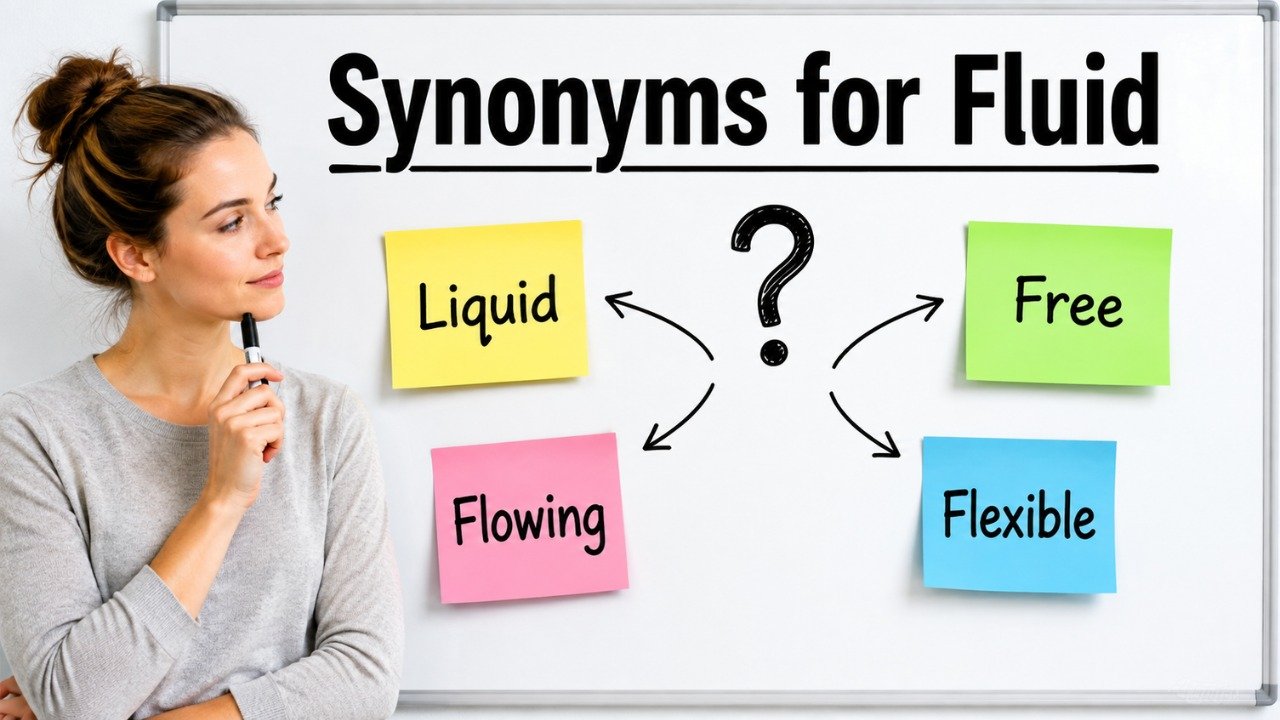
Quick Answer: The best synonyms for fluid are liquid, flowing, smooth, seamless, graceful, fluent, flexible, adaptable, changeable, and shifting. Use liquid for a substance that can flow, flowing or graceful for natural movement, fluent for confident speech or writing, and seamless for a process or transition without interruption. Flexible and adaptable suit plans or systems that can be adjusted, while changeable and shifting describe situations that are not fixed.
Pronunciation and Word Details
Word: Fluid.
Pronunciation: /ˈfluːɪd/.
Part of Speech: Adjective and noun.
Meaning: A substance that flows, or something that moves smoothly and changes easily.
US Pronunciation:
UK Pronunciation:
What Does “Fluid” Mean?
Fluid means able to flow, move smoothly, or change easily.
As a noun, fluid refers to a substance that can flow and take the shape of its container. Water, oil, and juice are common examples of fluids. In scientific contexts, both liquids and gases may be described as fluids because they can move and change shape.
As an adjective, fluid describes movement, language, design, plans, or situations that are smooth, flexible, and not firmly fixed.
A dancer may have fluid movements. A speaker may deliver ideas in a fluid manner. A company may follow a fluid plan that can change when new information appears.
The exact meaning depends on the sentence. It may refer to a physical substance, smooth motion, natural communication, flexible arrangements, or changing conditions.
Meaning, Tone, and Context of “Fluid”
Fluid is generally a neutral and descriptive word. It can be used in everyday conversation, formal writing, academic discussions, scientific explanations, and professional communication.
In scientific or technical writing, fluid usually refers to a substance that flows. In descriptions of movement, it often has a positive tone because it suggests grace, control, and ease.
When used for plans, situations, roles, or boundaries, fluid suggests that something can change. This meaning may be positive when flexibility is useful, but it can sound uncertain when stability is expected.
In writing and speech, fluid describes language that sounds natural and moves easily from one idea to another. However, fluent is usually a more precise choice when discussing someone’s ability to speak a language.
When and How to Use “Fluid”
For a Flowing Substance: Use fluid when referring generally to a liquid or another substance that can flow.
Example: The machine requires a special cooling fluid.
For Smooth Movement: Use fluid to describe motion that appears natural, controlled, and continuous.
Example: Her fluid movements made the routine look effortless.
For Natural Communication: Use fluid when ideas, sentences, or conversations connect smoothly.
Example: The discussion remained fluid and easy to follow.
For Flexible Plans: Use fluid when arrangements can be changed according to new needs.
Example: Our schedule is fluid, so the meeting time can be adjusted.
For Changing Conditions: Use fluid when a situation is developing and has not become fixed.
Example: The political situation remains fluid.
For Seamless Design: Use fluid when parts of a design, process, or experience connect without awkward breaks.
Example: The layout creates a fluid transition between each section.
Best Synonyms for Fluid
Liquid: A substance that flows and takes the shape of its container.
Example: The medicine is available in liquid form.
Flowing: Moving steadily and continuously.
Example: The artist used flowing lines throughout the drawing.
Smooth: Moving or progressing without difficulty or interruption.
Example: The team created a smooth approval process.
Seamless: Continuing without visible breaks, delays, or awkward changes.
Example: The new system allows a seamless transition between tasks.
Graceful: Moving in an attractive, controlled, and elegant way.
Example: The performer made a graceful turn across the stage.
Fluent: Able to speak, write, or express ideas easily and naturally.
Example: She is fluent in three languages.
Flexible: Able to change or adjust according to circumstances.
Example: We need a flexible schedule during the busy season.
Adaptable: Capable of changing successfully when conditions change.
Example: An adaptable strategy can respond to unexpected problems.
Changeable: Likely or able to change frequently.
Example: The weather has been highly changeable this week.
Shifting: Gradually changing in position, direction, condition, or importance.
Example: The organization must respond to shifting customer needs.
50 Synonyms for Fluid with Short Meanings
- Liquid: A substance that flows freely.
- Flowing: Moving continuously and naturally.
- Smooth: Progressing without difficulty or interruption.
- Seamless: Connected without noticeable breaks.
- Graceful: Moving with elegance and control.
- Fluent: Expressing ideas easily and naturally.
- Flexible: Able to change or bend easily.
- Adaptable: Able to adjust to new conditions.
- Changeable: Likely or able to change.
- Shifting: Moving or changing gradually.
- Mobile: Able to move freely.
- Movable: Capable of being moved or changed.
- Free Flowing: Moving without restriction.
- Runny: More liquid than thick or solid.
- Watery: Containing too much water or resembling water.
- Molten: Melted into a flowing state by heat.
- Pourable: Thin enough to be poured.
- Circulating: Moving continuously through a system.
- Streaming: Flowing steadily in a particular direction.
- Rolling: Moving forward in a smooth, continuous way.
- Effortless: Appearing natural and requiring little effort.
- Natural: Unforced, easy, and comfortable.
- Continuous: Continuing without stopping.
- Uninterrupted: Not stopped or broken.
- Unbroken: Remaining complete and continuous.
- Coherent: Clear, connected, and easy to follow.
- Supple: Able to bend or move easily.
- Pliable: Easily bent, shaped, or adjusted.
- Versatile: Able to serve many purposes or situations.
- Adjustable: Able to be changed to suit a need.
- Responsive: Reacting quickly to change.
- Dynamic: Active and continually developing.
- Variable: Capable of changing in amount or condition.
- Mutable: Able or likely to change.
- Unstable: Not firmly fixed or settled.
- Unsettled: Not yet decided or established.
- Evolving: Developing gradually over time.
- Transitional: Related to a period of change.
- Fluctuating: Rising, falling, or changing repeatedly.
- Inconstant: Frequently changing and not dependable.
- Malleable: Easily shaped, influenced, or changed.
- Elastic: Able to stretch, adapt, or return to form.
- Transformable: Capable of being changed into another form.
- Unfixed: Not permanent, settled, or firmly established.
- Volatile: Likely to change suddenly and unpredictably.
- Gliding: Moving smoothly and quietly.
- Sinuous: Moving with smooth curves and turns.
- Streamlined: Designed to move or operate smoothly.
- Limber: Flexible and able to move easily.
- Lithe: Thin, flexible, and graceful in movement.
Read Also:
Synonyms for Inherent

Synonyms for Fluid by Context
When Fluid Means Liquid
Use liquid when referring to a substance that flows. Runny and watery describe a substance with a thin consistency. Molten is appropriate for a solid material that has become liquid through heat.
Liquid Example: The container is designed to hold liquid medicine.
Runny Example: The sauce became too runny after water was added.
Molten Example: Molten metal was poured into the prepared mold.
Pourable Example: Mix the ingredients until the batter becomes pourable.
When Fluid Means Smooth Movement
Flowing, graceful, gliding, sinuous, and seamless describe movement that continues naturally without stiffness or awkward pauses.
Flowing Example: His flowing movements matched the rhythm perfectly.
Graceful Example: The gymnast completed a graceful landing.
Gliding Example: The bird appeared to be gliding across the sky.
Sinuous Example: The river followed a sinuous path through the valley.
When Fluid Means Natural Expression
Fluent, smooth, coherent, natural, and effortless describe speech or writing that is clear and easy to follow.
Fluent Example: She gave a fluent explanation of the process.
Smooth Example: The speaker used smooth transitions between topics.
Coherent Example: His argument was coherent and well organized.
Effortless Example: Their conversation felt relaxed and effortless.
When Fluid Means Flexible
Flexible, adaptable, adjustable, versatile, and responsive describe something that can change according to circumstances.
Flexible Example: The manager introduced a flexible working schedule.
Adaptable Example: The plan is adaptable enough to handle delays.
Adjustable Example: The chair has an adjustable backrest.
Responsive Example: A responsive system reacts quickly to user needs.
When Fluid Means Changeable
Changeable, shifting, variable, evolving, fluctuating, and unsettled describe conditions that are not fixed.
Changeable Example: The region experiences changeable weather.
Shifting Example: The business responded to shifting market conditions.
Evolving Example: The project has an evolving set of requirements.
Unsettled Example: The final schedule remains unsettled.
Another Word for Fluid
The best single replacement for fluid depends on its meaning. Liquid is the clearest alternative for a substance, while smooth is best for movement or progress. Flexible works well for plans and arrangements, and changeable suits developing situations.
Original: The doctor advised her to drink more fluids.
Better Option: The doctor advised her to drink more liquids.
Original: The dancer performed with fluid movements.
Better Option: The dancer performed with graceful movements.
Original: Our travel arrangements are fluid.
Better Option: Our travel arrangements are flexible.
Original: The situation remains fluid.
Better Option: The situation remains changeable.
When Not to Use “Fluid”
Do not use fluid when its meaning could be unclear. Readers may not know whether you mean liquid, smooth, flexible, or changeable.
Weak: The process is fluid.
Better: The process is smooth and can be adjusted when necessary.
Avoid fluid when a more exact technical term is available.
Weak: Add the fluid to the mixture.
Better: Add the water to the mixture.
Do not use fluid as a replacement for fluent when describing language ability.
Weak: She is fluid in English.
Better: She is fluent in English.
Avoid fluid when you need to emphasize sudden danger or instability. Volatile may communicate that meaning more accurately.
Weak: The financial situation is fluid and risky.
Better: The financial situation is volatile and risky.
Do not repeat fluid several times in the same paragraph when different meanings are intended.
Weak: The fluid plan created a fluid process for handling fluid conditions.
Better: The flexible plan created a smooth process for handling changing conditions.
Words Commonly Confused With Fluid
Fluid vs Liquid: Fluid is a broad word for a substance that flows. Liquid is more commonly used for a substance that has a definite volume but takes the shape of its container. In everyday writing, liquid is usually the clearer choice for drinks, oils, and medicines.
Fluid vs Fluent: Fluid describes smooth movement, progress, or expression. Fluent specifically describes the ability to speak, read, or write a language easily and accurately.
Fluid vs Smooth: Fluid suggests continuous, natural movement or development. Smooth means free from difficulty, roughness, or interruption.
Fluid vs Flexible: Fluid may describe something that changes continually. Flexible describes something that can be adjusted when needed.
Fluid vs Volatile: Fluid means changeable or unsettled without necessarily suggesting danger. Volatile describes something likely to change suddenly, sharply, or unpredictably.
Fluid vs Graceful: Fluid focuses on continuous movement. Graceful adds the idea of beauty, elegance, and control.
Which Synonym Should You Choose?
Choose liquid when discussing water, oil, medicine, chemicals, or another substance that flows.
Choose flowing when describing continuous lines, movement, clothing, water, or writing style.
Choose smooth when describing an easy process, journey, operation, or transition.
Choose seamless when separate stages connect without obvious interruptions.
Choose graceful when movement is both smooth and visually elegant.
Choose fluent when discussing confident speaking, writing, or language ability.
Choose flexible when a plan, schedule, rule, or arrangement can be adjusted.
Choose adaptable when a person, system, or strategy can respond successfully to change.
Choose changeable when something frequently moves between different conditions.
Choose shifting when priorities, opinions, positions, or conditions are gradually changing.
Choose volatile when changes are sudden, extreme, and difficult to predict.
Choose coherent when writing or speech is logically connected and easy to understand.
Real Life Examples of “Fluid” in Sentences
Original: The athlete’s movements were fluid and controlled.
Better Option: The athlete’s movements were graceful and controlled.
Original: Our plans for the weekend are still fluid.
Better Option: Our plans for the weekend are still flexible.
Original: The patient was encouraged to increase her fluid intake.
Better Option: The patient was encouraged to increase her liquid intake.
Original: The conversation remained fluid throughout dinner.
Better Option: The conversation remained natural throughout dinner.
Original: The organization operates in a fluid environment.
Better Option: The organization operates in a changing environment.
Original: The website offers a fluid transition between pages.
Better Option: The website offers a seamless transition between pages.
Original: His fluid writing style keeps readers interested.
Better Option: His smooth writing style keeps readers interested.
Original: The schedule is fluid because several guests have not confirmed.
Better Option: The schedule is adjustable because several guests have not confirmed.
Original: She used fluid hand movements during the presentation.
Better Option: She used flowing hand movements during the presentation.
Original: The situation at the border remains fluid.
Better Option: The situation at the border remains unsettled.
Synonym Groups and Usage Differences
Liquid Substance Group
Liquid, watery, runny, molten, and pourable relate to substances that can flow. Liquid is the most general word, while the other choices describe consistency or physical condition.
Example: Heat the material until it becomes molten.
Smooth Movement Group
Flowing, graceful, gliding, sinuous, limber, and lithe describe physical movement. Graceful emphasizes elegance, while limber and lithe focus on bodily flexibility.
Example: The skater used graceful movements to complete the routine.
Fluent Communication Group
Fluent, smooth, coherent, natural, and effortless describe clear communication. Fluent is best for language ability, while coherent focuses on logical organization.
Example: Her explanation was coherent and easy to understand.
Flexible Structure Group
Flexible, adaptable, adjustable, responsive, versatile, and malleable describe something that can change according to need.
Example: A versatile design can be used in several different rooms.
Changing Conditions Group
Changeable, shifting, variable, evolving, fluctuating, unsettled, and volatile describe conditions that do not remain the same.
Example: The company changed its strategy to match evolving customer expectations.
Antonyms of Fluid
The opposite of fluid depends on whether fluid refers to a substance, movement, flexibility, or changing conditions.
Solid: A substance with a fixed shape and structure.
Rigid: Stiff and unable to bend or change easily.
Fixed: Firmly established and not open to change.
Stable: Remaining steady and unlikely to change.
Jerky: Moving with sudden, uneven stops and starts.
Awkward: Lacking smoothness, ease, or grace.
Inflexible: Unwilling or unable to change.
Constant: Remaining the same over time.
Blocked: Prevented from flowing or moving.
Discontinuous: Containing breaks, gaps, or interruptions.
Comparison: Fluid vs Related Words
Fluid vs Liquid
Fluid is broader and may describe liquids, gases, movement, communication, or change. Liquid mainly refers to a physical substance that flows.
Example With Fluid: Check the vehicle’s fluid levels before the journey.
Example With Liquid: A clear liquid filled the glass container.
Fluid vs Smooth
Fluid emphasizes continuous and natural movement. Smooth emphasizes the absence of difficulty, roughness, or interruption.
Example With Fluid: The dancer used fluid arm movements.
Example With Smooth: The project had a smooth approval process.
Fluid vs Fluent
Fluid describes smooth expression in a general sense. Fluent describes a high level of skill in speaking, reading, or writing a language.
Example With Fluid: The conversation had a fluid rhythm.
Example With Fluent: She became fluent in Italian after years of study.
Fluid vs Flexible
Fluid suggests that something is currently changing or not firmly fixed. Flexible means it can be changed when necessary.
Example With Fluid: The situation remains fluid as negotiations continue.
Example With Flexible: The teacher offered a flexible deadline.
Fluid vs Dynamic
Fluid emphasizes ease of movement or change. Dynamic emphasizes energy, activity, and continuous development.
Example With Fluid: The team follows a fluid structure.
Example With Dynamic: The company works in a dynamic industry.
Fluid vs Graceful
Fluid movement is continuous and smooth. Graceful movement is smooth, controlled, and attractive.
Example With Fluid: His fluid gestures made the presentation engaging.
Example With Graceful: Her graceful movements impressed the audience.
Common Phrases and Expressions With Fluid
Fluid Motion: Smooth and continuous physical movement.
Fluid Movement: Movement without stiffness or awkward interruption.
Fluid Situation: A condition that is still changing and developing.
Fluid Design: A design that feels natural, connected, or adaptable.
Fluid Transition: A smooth change from one stage to another.
Fluid Conversation: A discussion that develops naturally without uncomfortable pauses.
Fluid Boundaries: Limits or divisions that are flexible rather than fixed.
Fluid Intake: The amount of liquid a person consumes.
Body Fluids: Liquids naturally produced or contained within the body.
Fluid Dynamics: The study of how liquids and gases move.
Common Mistakes to Avoid
Mistake One: Using fluid when liquid would be clearer.
Use liquid for familiar substances such as water, juice, oil, or medicine unless a technical context requires fluid.
Mistake Two: Confusing fluid with fluent.
A person is fluent in a language. Their speech, writing style, or movements may be fluid.
Mistake Three: Assuming fluid always has a positive meaning.
Fluid movement is usually positive, but a fluid situation may indicate uncertainty or lack of stability.
Mistake Four: Choosing an overly strong synonym.
Do not replace fluid with volatile unless the situation involves sudden and unpredictable change.
Mistake Five: Using fluid without enough context.
Explain what is changing or flowing when the meaning might not be obvious.
Mistake Six: Repeating fluid too often.
Use liquid, smooth, graceful, flexible, changing, or seamless to make the writing more precise and varied.
Mistake Seven: Using unnatural expressions.
Avoid phrases such as fluid in a language when fluent in a language is the accepted expression.
Conclusion
Understanding synonyms for fluid helps you choose a clearer word for substances, movement, communication, flexibility, and changing conditions. Liquid is best for a substance that flows, while smooth, flowing, and graceful describe natural movement. Fluent suits language ability, and seamless works well for transitions or processes. Flexible and adaptable describe adjustable plans, while changeable, shifting, and evolving fit developing situations. Choosing the synonym that matches the intended meaning makes every sentence more accurate, natural, and useful.
FAQs About Synonyms for Fluid
What Is the Best Synonym for Fluid?
Liquid is the best synonym when fluid refers to a substance. Smooth, flexible, or changeable may be better in other contexts.
Is Liquid the Same as Fluid?
Liquid and fluid are similar, but fluid is broader. In scientific contexts, fluids can include both liquids and gases.
What Is a Synonym for Fluid Movement?
Flowing, smooth, graceful, gliding, and effortless are strong synonyms for fluid movement.
Can Fluid Mean Flexible?
Yes. Fluid can describe a plan, schedule, role, or system that can be changed easily.
What Is a Formal Synonym for Fluid?
Adaptable, variable, dynamic, mutable, and transitional are useful formal alternatives, depending on the sentence.
What Is the Opposite of Fluid?
Solid is the opposite for physical substances. Rigid, fixed, stable, jerky, and inflexible are opposites in other contexts.
Can Fluid Describe Speech?
Yes, fluid can describe speech that sounds smooth and natural. However, fluent is more accurate when describing language ability.
