
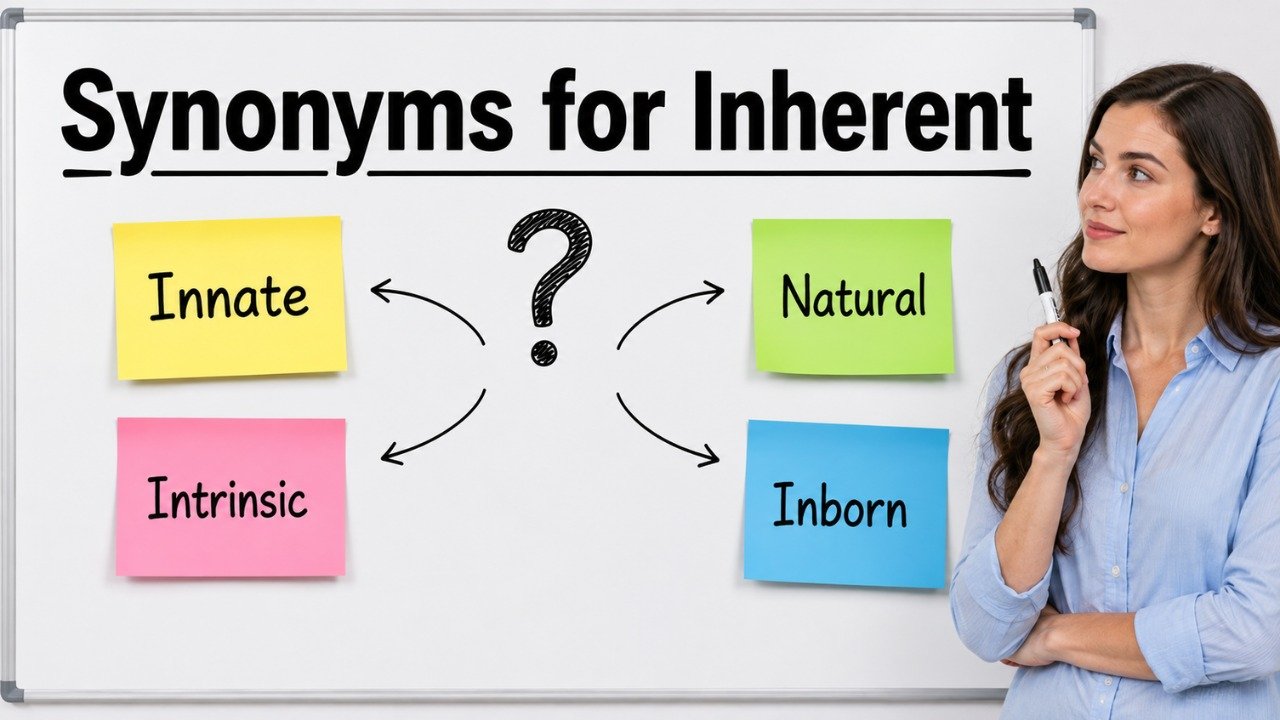
Quick Answer: The best synonyms for inherent are intrinsic, innate, inborn, natural, essential, integral, embedded, ingrained, constitutional, and immanent. Use intrinsic in formal or academic writing when something belongs to the essential nature of a person or thing. Use innate or inborn for qualities present from birth. Use integral when something is necessary to a complete system. Use embedded for features placed deeply within a structure, while ingrained works best for firmly established habits, beliefs, or attitudes.
Pronunciation and Word Details
Word: Inherent.
Pronunciation: /ɪnˈhɪrənt/.
Part of Speech: Adjective.
Meaning: Existing naturally as a permanent, essential, or inseparable quality of someone or something.
US Pronunciation:
UK Pronunciation:
What Does “Inherent” Mean?
Inherent means existing naturally as an essential, permanent, or inseparable part of someone or something. It is an adjective used to describe a quality, feature, risk, ability, weakness, or value that belongs to the basic nature of a person, object, system, or situation.
A quality is inherent when it is not added from the outside. It already exists within the subject being discussed.
Personal Quality: Patience was inherent in her personality.
Natural Feature: Flexibility is inherent in this material.
System Feature: Some uncertainty is inherent in scientific research.
Risk: Financial investment involves inherent risk.
Weakness: The method has an inherent limitation.
Inherent often appears before a noun, as in inherent value, inherent danger, inherent ability, or inherent weakness. It can also appear after a linking verb when followed by the word “in.”
Before a Noun: The plan contains an inherent contradiction.
After a Linking Verb: Uncertainty is inherent in the process.
Meaning, Tone, and Context of “Inherent”
Inherent has a neutral but fairly formal tone. It is common in academic writing, business communication, legal discussion, science, philosophy, psychology, engineering, and analytical reports.
The word is useful when a writer wants to show that a quality belongs naturally to the subject rather than being temporary, learned, added, or caused by outside circumstances.
Formal Use: The system contains inherent weaknesses that require careful management.
Academic Use: Variation is inherent in natural populations.
Technical Use: Heat generation is inherent in the operation of the device.
Business Use: Every investment opportunity carries inherent uncertainty.
Personal Use: Kindness seemed inherent in his character.
In everyday conversation, people may replace inherent with natural, built in, basic, or part of. In formal writing, intrinsic, integral, constitutional, and immanent may provide greater precision.
Inherent is not usually emotional. However, it can strengthen a statement by suggesting that a quality is deeply connected to the nature of something and cannot easily be removed.
When and How to Use “Inherent”
For Natural Qualities
Use inherent when a quality appears to belong naturally to a person, animal, object, or material.
Example: Curiosity is inherent in young children.
For Essential Characteristics
Use inherent when a feature is necessary to the identity or basic nature of something.
Example: Creativity is inherent in the artistic process.
For Risks and Dangers
Use inherent to describe a risk that cannot be completely removed because it is part of an activity or situation.
Example: There is an inherent risk in making decisions with limited information.
For Weaknesses and Limitations
Use inherent when a problem exists because of the basic design or nature of a method, system, or idea.
Example: The model has an inherent limitation because it relies on incomplete data.
For Systems and Structures
Use inherent when a feature is naturally included within a process, system, design, or structure.
Example: Flexibility is inherent in the new organizational structure.
For Personal Traits
Use inherent when describing a characteristic that seems deeply connected to someone’s personality.
Example: Her inherent confidence helped her remain calm.
For Rights and Values
Use inherent when discussing value, dignity, freedom, or rights that belong naturally to a person or thing.
Example: Every individual possesses inherent dignity.
For Academic Analysis
Use inherent when explaining qualities that cannot be separated from a theory, process, subject, or condition.
Example: Some level of interpretation is inherent in historical analysis.
Best Synonyms for Inherent
Intrinsic
Synonym: Belonging naturally to the essential character of something.
Example: The painting has intrinsic artistic value.
Innate
Synonym: Existing naturally from birth rather than being learned.
Example: She has an innate ability to understand music.
Inborn
Synonym: Present in a person or animal from birth.
Example: His inborn curiosity encouraged him to explore new ideas.
Natural
Synonym: Existing normally without being created or added artificially.
Example: Empathy is a natural part of healthy communication.
Essential
Synonym: Completely necessary to the nature or existence of something.
Example: Trust is an essential part of a strong relationship.
Integral
Synonym: Necessary to make something complete or effective.
Example: Regular feedback is integral to the learning process.
Embedded
Synonym: Fixed deeply within a system, structure, culture, or object.
Example: Security controls are embedded within the software.
Ingrained
Synonym: Firmly established in someone’s thoughts, habits, or behavior.
Example: Respect for others was deeply ingrained in her character.
Constitutional
Synonym: Connected to the natural physical or mental character of someone or something.
Example: His constitutional calmness made him a reliable leader.
Immanent
Synonym: Existing naturally within someone or something.
Example: The philosopher described meaning as immanent in human experience.
50 Synonyms for Inherent with Short Meanings
- Intrinsic: Belonging naturally to the essential nature of something.
- Innate: Existing naturally from birth.
- Inborn: Present from the time of birth.
- Natural: Existing normally without outside addition.
- Essential: Necessary to the basic nature of something.
- Integral: Required to make something complete.
- Fundamental: Forming a basic or necessary part.
- Internal: Existing within someone or something.
- Native: Belonging naturally to a particular person, place, or thing.
- Constitutional: Related to someone’s natural character or condition.
- Ingrained: Firmly fixed in habits, beliefs, or behavior.
- Embedded: Placed deeply within a structure or system.
- Built In: Included as a natural or permanent feature.
- Immanent: Existing or operating naturally within something.
- Organic: Developing naturally as part of a whole.
- Instinctive: Arising naturally without conscious thought.
- Congenital: Present from birth, especially as a condition.
- Hereditary: Passed naturally through family or genetic inheritance.
- Characteristic: Typical of a particular person or thing.
- Inseparable: Unable to be divided from something else.
- Underlying: Existing beneath the visible or obvious surface.
- Basic: Forming the simplest and most necessary part.
- Core: Located at the central or most important part.
- Central: Extremely important to the nature of something.
- Defining: Giving something its main identity or character.
- Deep Rooted: Firmly established and difficult to change.
- Fixed: Firmly placed and unlikely to change.
- Permanent: Continuing as a lasting quality or condition.
- Indwelling: Existing permanently within a person or thing.
- Implicit: Naturally contained or understood without being directly stated.
- Constitutive: Helping to form the essential nature of something.
- Structural: Connected to the basic organization of a system.
- Systemic: Existing throughout an entire system.
- Inbuilt: Included naturally as part of the original design.
- Hardwired: Naturally fixed in behavior, biology, or design.
- Naturally Present: Existing without being externally introduced.
- Internally Present: Located or existing within something.
- Rooted In: Originating from or firmly connected to something.
- Woven Into: Closely combined with the nature or structure of something.
- Part Of: Belonging to the complete nature of something.
- Essential To: Necessary for the existence or success of something.
- Native To: Existing naturally within a place, person, or system.
- Embedded Within: Firmly placed inside a larger structure.
- Bound Up With: Closely and inseparably connected with something.
- Inseparably Linked: Connected in a way that cannot easily be divided.
- Part and Parcel Of: A necessary or unavoidable part of something.
- At the Core Of: Located within the most important part.
- Present by Nature: Existing because of natural character or design.
- Endemic: Regularly or naturally present within a particular environment or system.
- Elemental: Connected to the most basic nature of something.
Read Also:
Synonyms for Terrified

Synonyms for Inherent by Context
When Inherent Means Natural or Present From Birth
Innate, inborn, natural, instinctive, congenital, hereditary, constitutional, and hardwired describe qualities that exist naturally or appear from birth.
Innate is usually the strongest general choice for an ability, tendency, or personal quality that was not learned.
Example: She has an innate sense of rhythm.
Inborn is more direct and conversational.
Example: His inborn confidence helped him speak comfortably in public.
Congenital is mainly used for medical or physical conditions that are present at birth.
Example: The child was born with a congenital heart condition.
Hereditary describes something passed from parents to children through genetics.
Example: The condition may be hereditary.
When Inherent Means Essential or Integral
Intrinsic, essential, integral, fundamental, core, central, constitutive, and elemental describe something necessary to the identity, completeness, or function of a subject.
Intrinsic emphasizes that a quality belongs to the true nature of something.
Example: Curiosity has intrinsic value in education.
Integral emphasizes that something is necessary for a complete process or system.
Example: Communication is integral to effective teamwork.
Fundamental describes a basic principle, quality, or requirement.
Example: Fairness is fundamental to a trustworthy system.
When Inherent Means Embedded in a System
Embedded, built in, inbuilt, structural, systemic, internal, woven into, and embedded within describe qualities placed deeply inside a design, process, or organization.
Embedded works well for technology, culture, systems, and procedures.
Example: Privacy controls are embedded in the platform’s design.
Structural describes a quality caused by the basic organization of something.
Example: The industry faces structural challenges.
Systemic describes a condition that exists throughout an entire system.
Example: The investigation revealed systemic weaknesses.
When Inherent Means Firmly Established
Ingrained, deep rooted, fixed, permanent, rooted in, and bound up with describe qualities that are firmly established and difficult to remove.
Ingrained is commonly used for habits, beliefs, attitudes, and customs.
Example: The habit became ingrained after years of repetition.
Deep rooted adds emphasis and often describes beliefs, fears, traditions, or social problems.
Example: The conflict developed from deep rooted mistrust.
When Inherent Means Characteristic
Characteristic, defining, native, organic, and natural describe features that are typical of a person, place, object, or activity.
Characteristic shows that a feature helps identify something.
Example: Clear imagery is characteristic of her writing style.
Defining suggests that the quality strongly shapes identity.
Example: Patience is one of his defining qualities.
Another Word for Inherent
The best single replacement for inherent is often intrinsic. Both words describe a quality that belongs naturally to the essential character of a person, object, idea, or activity.
However, the best alternative depends on context. Use innate for qualities present from birth, integral for necessary parts of a complete system, embedded for features placed deeply within a structure, and ingrained for established habits or beliefs.
Original: The material has inherent strength.
Better Option: The material has intrinsic strength.
Original: She possesses an inherent talent for languages.
Better Option: She possesses an innate talent for languages.
Original: Communication is inherent in effective leadership.
Better Option: Communication is integral to effective leadership.
Original: Bias may be inherent in the procedure.
Better Option: Bias may be embedded in the procedure.
When Not to Use “Inherent”
Do not use inherent when a quality was clearly learned, added, temporary, optional, or caused by external circumstances. In such cases, words such as acquired, developed, added, learned, temporary, or situational are more accurate.
When a Quality Was Learned
Weak: Her inherent writing skill improved through years of training.
Better: Her developed writing skill improved through years of training.
The first sentence is unclear because inherent suggests that the skill existed naturally, while developed shows that training created or strengthened it.
When a Feature Was Added Later
Weak: The device has an inherent camera that was installed last week.
Better: The device has an added camera that was installed last week.
A feature cannot be inherent if it was introduced after the original design.
When a Condition Is Temporary
Weak: The project has an inherent delay caused by today’s weather.
Better: The project has a temporary delay caused by today’s weather.
Weather is an outside cause, so the delay is not part of the project’s essential nature.
When a Simpler Word Is Clearer
Weak: Her inherent friendliness made visitors comfortable.
Better: Her natural friendliness made visitors comfortable.
In casual writing, natural may sound smoother and more direct.
When the Meaning Is Too Vague
Weak: The plan has inherent issues.
Better: The plan has structural cost and scheduling problems.
The second sentence identifies the exact problems instead of using a broad description.
Words Commonly Confused With Inherent
Inherent vs Innate: Inherent describes any quality that naturally belongs to a person, object, idea, process, or system. Innate usually describes an ability, tendency, or trait that exists from birth.
Inherent vs Intrinsic: Both words refer to qualities that belong naturally to something. Intrinsic often emphasizes inner value or essential nature, while inherent frequently describes qualities, risks, limitations, and features that cannot be separated from a subject.
Inherent vs Integral: Inherent means naturally existing within something. Integral means necessary for completeness or successful operation. A feature may be integral without being natural from the beginning.
Inherent vs Ingrained: Inherent describes a natural or essential quality. Ingrained describes a habit, belief, or attitude that has become firmly established, often through repetition or culture.
Inherent vs Hereditary: Inherent is a broad term for qualities naturally belonging to something. Hereditary specifically refers to traits or conditions passed through family genetics.
Inherent vs Congenital: Inherent can describe any natural feature. Congenital is mainly used for physical or medical conditions present at birth, whether inherited or not.
Inherent vs Immanent: Inherent is common in formal and general writing. Immanent is more philosophical and describes something existing or operating within a person, object, experience, or reality.
Inherent vs Internal: Internal only means located inside. Inherent means naturally and essentially connected. An internal feature is not always inherent because it may have been added later.
Which Synonym Should You Choose?
Choose intrinsic when discussing essential nature, inner value, motivation, beauty, worth, or formal academic ideas.
Choose innate when describing talents, tendencies, abilities, or characteristics that appear naturally from birth.
Choose inborn when you want a clear and slightly more conversational alternative to innate.
Choose natural when writing for a general audience and the formal tone of inherent is unnecessary.
Choose essential when something is completely necessary rather than merely naturally present.
Choose integral when something is required to make a system, process, relationship, or plan complete.
Choose embedded when a feature, belief, control, problem, or bias is placed deeply within a system or culture.
Choose ingrained when discussing habits, attitudes, traditions, beliefs, or patterns that are difficult to change.
Choose structural when a problem or feature results from the basic organization of a system.
Choose systemic when a quality or problem exists throughout an entire organization or system.
Choose congenital when discussing a medical or physical condition present at birth.
Choose hereditary when discussing a characteristic or condition passed through genetics.
Choose inherent in reports, essays, and formal emails when a quality is naturally connected to the basic nature of the subject.
Choose built in or part of in casual speech when you want a simpler and more conversational expression.
Real Life Examples of “Inherent” in Sentences
Original: Every business decision involves inherent uncertainty.
Better Option: Every business decision involves intrinsic uncertainty.
Original: She has an inherent ability to recognize patterns.
Better Option: She has an innate ability to recognize patterns.
Original: Cooperation is inherent in successful teamwork.
Better Option: Cooperation is integral to successful teamwork.
Original: The software contains inherent security controls.
Better Option: The software contains embedded security controls.
Original: His inherent politeness made guests feel welcome.
Better Option: His natural politeness made guests feel welcome.
Original: The method has an inherent weakness.
Better Option: The method has a structural weakness.
Original: Curiosity is inherent in childhood development.
Better Option: Curiosity is a fundamental part of childhood development.
Original: The agreement contains an inherent conflict.
Better Option: The agreement contains an intrinsic conflict.
Original: Some level of risk is inherent in outdoor exploration.
Better Option: Some level of risk is inseparable from outdoor exploration.
Original: Respect for tradition was inherent in the community.
Better Option: Respect for tradition was deeply ingrained in the community.
Synonym Groups and Usage Differences
Natural Quality Group
Innate, inborn, natural, instinctive, and constitutional describe qualities that exist naturally rather than being deliberately learned or added.
Innate and inborn are especially useful for talents and personal tendencies. Instinctive describes an automatic reaction or behavior.
Example: Her instinctive response was to protect the child.
Essential Nature Group
Intrinsic, essential, fundamental, elemental, and constitutive describe qualities connected to the deepest or most necessary nature of something.
Intrinsic often refers to inner value, while fundamental describes a basic principle or requirement.
Example: Honesty is fundamental to public trust.
Embedded Feature Group
Embedded, built in, inbuilt, internal, structural, and systemic describe qualities located deeply within a design, organization, process, or system.
Structural refers to basic organization, while systemic suggests that the feature exists throughout the whole system.
Example: The report identified systemic communication problems.
Established Habit Group
Ingrained, deep rooted, fixed, rooted in, and woven into describe habits, beliefs, traditions, or patterns that have become firmly established.
These words do not always mean that the quality existed from birth. They may describe something learned so deeply that it now seems permanent.
Example: The custom is woven into the region’s cultural identity.
Identity Group
Characteristic, defining, native, central, and core describe qualities that help identify a person, object, style, or organization.
Defining is especially strong because it suggests that the quality shapes the subject’s identity.
Example: Simplicity is a defining feature of the design.
Inseparability Group
Inseparable, bound up with, part and parcel of, and inseparably linked describe qualities that cannot easily be separated from a situation or activity.
These expressions are useful for unavoidable consequences, risks, and responsibilities.
Example: Careful judgment is inseparably linked to effective leadership.
Antonyms of Inherent
The opposite of inherent depends on whether the word refers to origin, permanence, necessity, or location.
Acquired: Gained through learning, experience, or exposure.
Learned: Developed through teaching or practice.
Added: Included after the original creation or design.
External: Coming from outside rather than existing within.
Extrinsic: Originating outside the essential nature of something.
Artificial: Created through deliberate human action rather than occurring naturally.
Temporary: Lasting for only a limited period.
Optional: Available by choice rather than being necessary.
Removable: Able to be separated or taken away.
Accidental: Existing by chance rather than as an essential quality.
Incidental: Occurring as a minor or secondary feature.
Situational: Caused by a particular circumstance rather than natural character.
Developed: Formed gradually through experience or effort.
Superficial: Existing only on the surface.
Separate: Not naturally or permanently connected.
Comparison: Inherent vs Related Words
Inherent vs Intrinsic
Inherent describes a quality, feature, danger, limitation, or ability that naturally belongs to something. Intrinsic emphasizes essential character or value that comes from within.
Example With Inherent: The activity carries an inherent risk of injury.
Example With Intrinsic: The activity has intrinsic educational value.
Inherent vs Innate
Inherent applies to people, objects, systems, ideas, and activities. Innate mainly describes qualities or abilities naturally present in a living being from birth.
Example With Inherent: Flexibility is inherent in the design.
Example With Innate: She has an innate ability to solve complex puzzles.
Inherent vs Natural
Inherent is more formal and emphasizes inseparability. Natural is more common in conversation and can describe anything that occurs normally without artificial influence.
Example With Inherent: The process contains inherent uncertainty.
Example With Natural: Some uncertainty is a natural part of the process.
Inherent vs Integral
Inherent means naturally existing within something. Integral means necessary for completeness, success, or proper operation.
Example With Inherent: Variation is inherent in human language.
Example With Integral: Practice is integral to language learning.
Inherent vs Embedded
Inherent suggests that a feature belongs naturally to the subject. Embedded suggests that it has been placed or fixed deeply within a system or structure.
Example With Inherent: Risk is inherent in the activity.
Example With Embedded: Safety checks are embedded in the procedure.
Inherent vs Ingrained
Inherent describes a quality naturally connected to something. Ingrained describes a belief, habit, or behavior that has become deeply established over time.
Example With Inherent: Curiosity is inherent in young children.
Example With Ingrained: Daily reading became an ingrained habit.
Inherent vs Essential
Inherent describes origin or natural connection. Essential describes necessity. Something may be essential without being inherent.
Example With Inherent: Uncertainty is inherent in prediction.
Example With Essential: Reliable information is essential for prediction.
Inherent vs Hereditary
Inherent is a broad description of a natural quality. Hereditary specifically describes a biological trait or condition passed from one generation to another.
Example With Inherent: Adaptability is inherent in living systems.
Example With Hereditary: The disorder may be hereditary.
Common Phrases and Expressions With Inherent
Inherent Quality: A characteristic that belongs naturally to someone or something.
Inherent Risk: A danger that exists as a natural part of an activity or situation.
Inherent Value: Worth that exists independently of outside rewards or opinions.
Inherent Flaw: A weakness caused by the basic nature or design of something.
Inherent Limitation: A restriction that cannot be completely removed because it belongs to the method or system.
Inherent Ability: A natural skill or capacity that does not depend entirely on training.
Inherent Nature: The basic and essential character of someone or something.
Inherent Dignity: Natural worth that belongs to every person.
Inherent Uncertainty: Uncertainty that naturally exists within a process, prediction, or situation.
Inherent Conflict: A disagreement or contradiction built into the nature of a plan, role, or situation.
Common Mistakes to Avoid
Using Inherent for Learned Skills
Do not automatically describe every strong ability as inherent. A skill may have been developed through education, practice, or experience.
Incorrect: His inherent accounting knowledge came from ten years of study.
Better: His extensive accounting knowledge came from ten years of study.
Confusing Inherent With Hereditary
Inherent does not always mean genetically inherited. Use hereditary when a biological trait or condition passes through a family.
Incorrect: The hereditary risks of the project must be reviewed.
Better: The inherent risks of the project must be reviewed.
Confusing Inherent With Integral
A feature can be necessary without being naturally present.
Unclear: Training is inherent in employee development.
Better: Training is integral to employee development.
Overusing Inherent
Repeating inherent can make a paragraph sound formal and monotonous. Replace it with intrinsic, natural, structural, embedded, integral, or another precise alternative.
Repetitive: The system has inherent risks, inherent limitations, and inherent costs.
Better: The system has intrinsic risks, structural limitations, and unavoidable costs.
Using Inherent Without Explaining the Quality
Avoid vague phrases such as inherent issue or inherent problem when you can identify the exact concern.
Vague: The process has inherent problems.
Better: The process contains structural delays and inconsistent approval rules.
Writing Inherent To Incorrectly
Inherent is normally followed by “in,” not “to,” when showing where a quality naturally exists.
Incorrect: Risk is inherent to the activity.
Preferred: Risk is inherent in the activity.
The phrase inherent to is sometimes used, but inherent in is more traditional and widely accepted in careful formal writing.
Adding Unnecessary Words
Do not write naturally inherent because inherent already includes the idea of natural existence.
Wordy: Curiosity is naturally inherent in children.
Better: Curiosity is inherent in children.
Conclusion
Understanding synonyms for inherent helps you choose words that match the exact type of natural or essential connection you want to describe. Intrinsic works well for essential nature and inner value, while innate and inborn suit qualities present from birth. Integral describes necessary parts, embedded suits systems and structures, and ingrained fits established habits or beliefs. Inherent remains a strong formal choice for risks, abilities, limitations, values, and characteristics that cannot easily be separated from their subject.
FAQs About Synonyms for Inherent
What Is the Best Synonym for Inherent?
Intrinsic is usually the best general synonym because it describes a quality that belongs naturally to the essential nature of something.
Are Inherent and Innate the Same?
They are similar, but innate usually describes traits or abilities present from birth. Inherent can describe qualities in people, objects, systems, activities, and ideas.
Can Natural Replace Inherent?
Yes, natural can replace inherent in many everyday sentences. However, inherent is more formal and more strongly suggests that the quality is inseparable from the subject.
What Is Another Word for Inherent Risk?
Intrinsic risk, built in risk, unavoidable risk, and natural risk are useful alternatives. The best choice depends on whether the risk is essential, designed into a system, or simply impossible to remove.
What Is the Difference Between Inherent and Intrinsic?
Inherent often describes unavoidable features, risks, or limitations. Intrinsic more often emphasizes essential character, internal motivation, or value that comes from within.
Is Ingrained a Synonym for Inherent?
Ingrained is a close synonym in certain contexts. It works best for habits, beliefs, attitudes, and traditions that have become firmly established rather than qualities naturally present from the beginning.
What Is the Opposite of Inherent?
Common opposites include acquired, learned, added, external, extrinsic, artificial, temporary, and accidental. The correct antonym depends on the sentence.
