
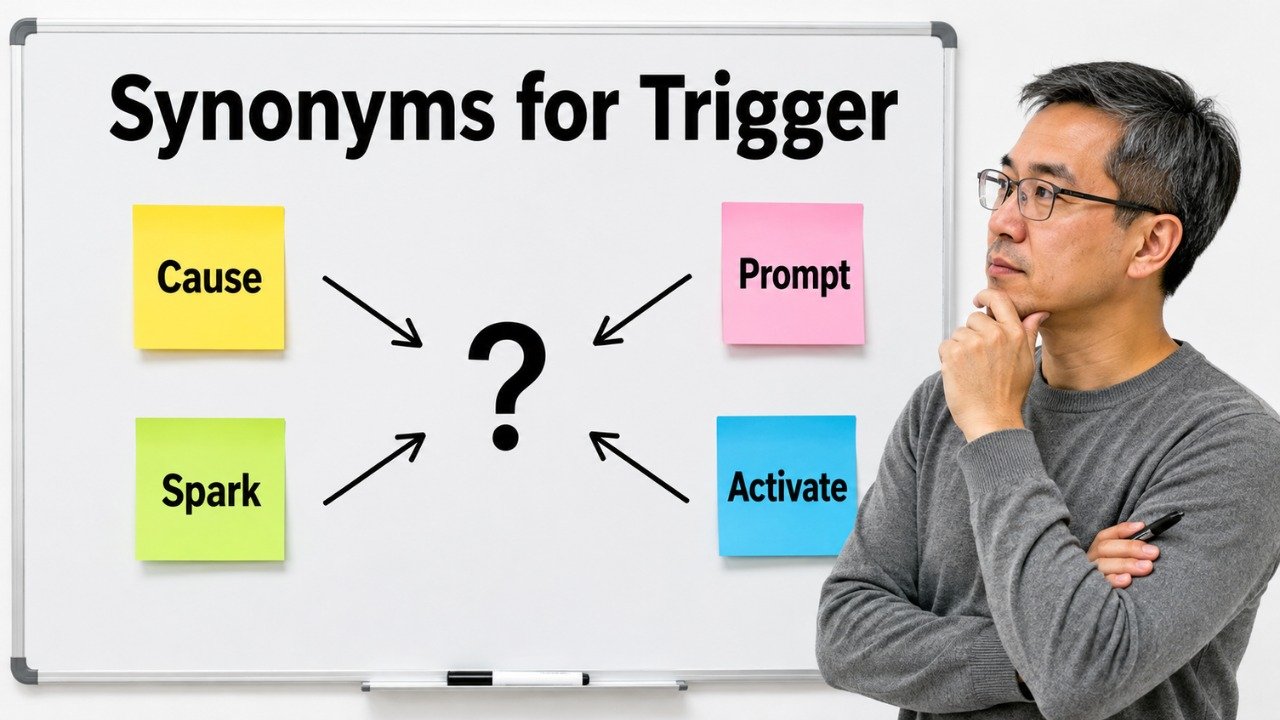
Quick Answer: The best synonyms for trigger include cause, activate, initiate, provoke, prompt, spark, set off, stimulate, catalyst, and cue. Use cause for a general reason behind an event, activate for machines or systems, initiate for formal processes, provoke for strong reactions, prompt for thoughts or actions, and spark for sudden beginnings. Catalyst works best as a noun for something that speeds up change, while cue describes a signal that encourages a response.
Pronunciation and Word Details
Word: Trigger.
Pronunciation: /ˈtrɪɡ.ər/
Part of Speech: Noun and verb.
Meaning: To cause something to begin or happen, or a thing that starts an action, reaction, memory, process, or mechanism.
US Pronunciation:
UK Pronunciation:
What Does “Trigger” Mean?
Trigger means to cause an event, action, feeling, memory, process, or device to begin operating.
As a verb, trigger describes the action of starting or producing something. A loud noise can trigger an alarm, a comment can trigger an argument, and a policy change can trigger an investigation.
As a noun, trigger refers to the thing that causes a response. It can be an event, signal, stimulus, memory, condition, or mechanical part.
Verb Use: The sudden temperature drop triggered the heating system.
Noun Use: Lack of sleep was the main trigger for her headache.
Mechanical Use: Pressing the trigger activated the device.
Emotional Use: The familiar song triggered memories of childhood.
Process Use: The complaint triggered a formal review.
The exact meaning depends on whether trigger refers to a cause, an activating action, an emotional stimulus, a signal, or a physical mechanism.
Meaning, Tone, and Context of “Trigger”
Trigger is generally a neutral word, but its tone changes according to context.
Formal Tone: Trigger appears in reports, research, technical writing, medicine, business, law, and academic discussion when one event causes another.
Technical Tone: In technology and engineering, trigger often means to activate a system, command, sensor, process, or automatic response.
Emotional Tone: Trigger can describe something that produces fear, anger, sadness, stress, or a powerful memory. In this context, it may carry a serious and sensitive tone.
Conversational Tone: In casual speech, trigger can mean to start, cause, annoy, upset, or remind.
Strong Tone: Trigger often suggests a sudden, noticeable, or automatic reaction. It may sound stronger than cause or prompt.
Academic Tone: In essays and reports, cause, initiate, precipitate, stimulate, or provoke may sometimes provide greater precision.
Because trigger has many meanings, writers should identify the exact type of action or reaction being described.
When and How to Use “Trigger”
For Causing an Event
For Causation: Use trigger when one condition directly starts another event.
Example: The heavy rain triggered flooding across the region.
For Activating a System
For Activation: Use trigger when a command, movement, or condition starts a machine or automatic process.
Example: Opening the door triggered the security alarm.
For Beginning a Process
For Initiation: Use trigger when an action starts an investigation, review, discussion, or procedure.
Example: The unexpected results triggered a detailed examination.
For Producing an Emotional Reaction
For Emotion: Use trigger when something creates a strong feeling, memory, or psychological response.
Example: The photograph triggered a powerful feeling of nostalgia.
For Encouraging an Action
For Motivation: Use trigger when an event prompts someone to think, decide, or act.
Example: The warning triggered residents to prepare for the storm.
For Creating a Physical Reaction
For Physical Response: Use trigger when food, weather, stress, or another condition causes a bodily reaction.
Example: Bright light can trigger discomfort in some people.
For Starting Change
For Development: Use trigger when an event begins a wider social, economic, cultural, or organizational change.
Example: The discovery triggered major changes in the project.
For Identifying a Cause
For Explanation: Use trigger as a noun when naming the specific factor behind a reaction.
Example: Stress was the most common trigger for the problem.
Best Synonyms for Trigger
Cause
Synonym: To make something happen or exist.
Example: The damaged pipe caused water to enter the room.
Activate
Synonym: To make a machine, system, or process begin working.
Example: The sensor activated the emergency lights.
Initiate
Synonym: To formally begin a process, action, or event.
Example: The manager initiated a review of the new procedure.
Provoke
Synonym: To cause a strong reaction, emotion, or response.
Example: His careless remark provoked an angry response.
Prompt
Synonym: To encourage or cause someone to think, speak, or act.
Example: The question prompted a thoughtful discussion.
Spark
Synonym: To cause something to begin suddenly.
Example: The announcement sparked widespread interest.
Set Off
Synonym: To cause an alarm, reaction, event, or process to start.
Example: The smoke set off the fire alarm.
Stimulate
Synonym: To encourage activity, growth, thought, or response.
Example: The new program stimulated interest in science.
Catalyst
Synonym: A person, event, or factor that causes or speeds up change.
Example: The meeting became a catalyst for reform.
Cue
Synonym: A signal that prompts a particular action or response.
Example: The flashing light was her cue to begin speaking.
50 Synonyms for Trigger with Short Meanings
The following words include direct synonyms and useful contextual alternatives for the noun and verb meanings of trigger.
- Cause: To make an event or result happen.
- Activate: To make a system or device begin working.
- Initiate: To formally start a process or action.
- Provoke: To cause a strong reaction or emotion.
- Prompt: To encourage an action, thought, or response.
- Spark: To start something suddenly.
- Set Off: To cause an event, alarm, or reaction to begin.
- Start: To make something begin.
- Launch: To begin a planned activity or process.
- Stimulate: To encourage activity, growth, or response.
- Induce: To cause a particular condition or effect.
- Incite: To encourage a strong or disruptive action.
- Elicit: To draw out a response, answer, or emotion.
- Generate: To produce an effect, idea, or reaction.
- Produce: To cause a result or outcome.
- Bring About: To make a change or event happen.
- Give Rise To: To cause something to develop.
- Lead To: To result in a particular outcome.
- Precipitate: To cause an event to happen suddenly or sooner.
- Catalyze: To cause or speed up change.
- Kindle: To begin or strengthen a feeling or interest.
- Arouse: To cause a feeling, interest, or reaction.
- Awaken: To cause awareness, emotion, or activity to begin.
- Stir: To create or awaken an emotion or response.
- Inspire: To encourage an idea, feeling, or action.
- Motivate: To give someone a reason to act.
- Encourage: To increase willingness or confidence.
- Compel: To strongly force or drive an action.
- Drive: To push someone or something toward an action.
- Cue: A signal that prompts a response.
- Signal: A sign that starts or directs an action.
- Stimulus: Something that causes activity or reaction.
- Catalyst: Something that begins or accelerates change.
- Impulse: A sudden force or urge that causes action.
- Incentive: Something that encourages a decision or action.
- Instigator: A person or factor that starts an event.
- Activator: Something that makes a process begin working.
- Initiator: A person or thing that starts an action.
- Switch: A control used to start or stop a system.
- Lever: A handle or control used to operate a mechanism.
- Button: A control pressed to activate a device.
- Release: A control that frees or starts a mechanism.
- Catch: A small part that holds or releases a mechanism.
- Actuator: A component that causes a machine to move or operate.
- Mechanism: A part or system that produces an action.
- Impetus: A force that makes an activity begin or develop.
- Spur: Something that encourages action or progress.
- Provocation: An action that causes a strong response.
- Starting Point: The event or condition where something begins.
- Tipping Point: The moment when an important change begins.
Read Also:
Synonyms for Goddess
Synonyms for Trigger by Context
When Trigger Means Cause an Event
Cause, produce, generate, bring about, give rise to, and lead to are useful when one condition creates a result.
Example With Trigger: The road closure triggered major delays.
Example With Cause: The road closure caused major delays.
Cause is the most direct general alternative. Bring about is useful for planned or gradual change, while give rise to often appears in formal writing.
When Trigger Means Activate a Device
Activate, set off, start, switch on, launch, and operate work when a signal or action makes a device or system begin functioning.
Example With Trigger: The motion sensor triggered the lights.
Example With Activate: The motion sensor activated the lights.
Activate is the clearest choice for machines, systems, alarms, software commands, and automatic processes.
When Trigger Means Provoke a Reaction
Provoke, elicit, arouse, stir, induce, and stimulate are suitable when an action causes an emotional, physical, or intellectual response.
Example With Trigger: The statement triggered public anger.
Example With Provoke: The statement provoked public anger.
Provoke usually suggests a strong or negative reaction. Elicit is more neutral and often describes answers, responses, or emotions.
When Trigger Means Begin a Process
Initiate, start, launch, precipitate, and set in motion can replace trigger when a procedure, investigation, change, or discussion begins.
Example With Trigger: The complaint triggered an official inquiry.
Example With Initiate: The complaint initiated an official inquiry.
Initiate sounds formal and controlled. Precipitate suggests that the process began suddenly or sooner than expected.
When Trigger Means Encourage Action
Prompt, motivate, inspire, encourage, compel, drive, and spur are useful when something influences a person to act.
Example With Trigger: The report triggered the team to reconsider its plan.
Example With Prompt: The report prompted the team to reconsider its plan.
Prompt is neutral and natural. Compel is stronger and suggests pressure or necessity.
When Trigger Means a Cause or Stimulus
Cause, stimulus, catalyst, cue, signal, impetus, and incentive can replace the noun trigger.
Example With Trigger: Noise was the trigger for the reaction.
Example With Stimulus: Noise was the stimulus for the reaction.
Stimulus is common in scientific and psychological contexts. Catalyst is better when the factor creates or accelerates wider change.
When Trigger Means a Mechanical Part
Switch, lever, button, release, catch, actuator, and mechanism may be more precise than trigger when describing equipment.
Example With Trigger: Press the trigger to start the tool.
Example With Switch: Press the switch to start the tool.
The correct word depends on the shape, function, and design of the control.
Another Word for Trigger
The best general replacement for trigger is cause. It works as both a verb and a noun in many situations. However, the most accurate alternative depends on whether trigger means activate, provoke, initiate, prompt, or serve as a stimulus.
Original: The announcement triggered a wave of complaints.
Better Option: The announcement caused a wave of complaints.
Original: The sensor triggered the alarm.
Better Option: The sensor activated the alarm.
Original: Her question triggered a useful discussion.
Better Option: Her question prompted a useful discussion.
Original: The sudden resignation triggered a leadership crisis.
Better Option: The sudden resignation precipitated a leadership crisis.
When Not to Use “Trigger”
Trigger may sound vague, repetitive, too strong, or less accurate than another word.
When the Exact Cause Is Known
Use a more precise verb when you can clearly describe what happened.
Weak: Pressing the control triggered the machine.
Better: Pressing the control activated the machine.
When the Process Is Formal
Initiate, begin, authorize, or launch may sound more professional in reports and official writing.
Weak: The department triggered an investigation.
Better: The department initiated an investigation.
When the Reaction Is Mild
Trigger can suggest a sudden or powerful response. Prompt or encourage may be more suitable for gentle influence.
Weak: The reminder triggered her to check the schedule.
Better: The reminder prompted her to check the schedule.
When Discussing Sensitive Emotional Experiences
Do not use trigger casually when discussing serious emotional distress. Choose clear and respectful language.
Weak: The sad scene totally triggered everyone.
Better: The sad scene caused a strong emotional response.
When the Meaning Is Unclear
Specify whether something caused, activated, provoked, or reminded.
Weak: The message triggered something in the office.
Better: The message prompted a formal review in the office.
When Repetition Weakens the Sentence
Avoid using trigger several times in one paragraph.
Weak: The warning triggered concern, which triggered a meeting that triggered a review.
Better: The warning caused concern, prompted a meeting, and initiated a review.
Words Commonly Confused With Trigger
Trigger vs Cause: Trigger often suggests a specific, sudden, or immediate starting factor. Cause is broader and can describe any reason behind an event.
Trigger vs Activate: Trigger means to cause something to start. Activate specifically means to make a device, system, or process operational.
Trigger vs Provoke: Trigger can produce any type of reaction. Provoke usually suggests a strong emotional, argumentative, or negative response.
Trigger vs Prompt: Trigger often implies an automatic or sudden result. Prompt suggests encouraging a person to think, speak, or act.
Trigger vs Stimulate: Trigger starts a reaction or event. Stimulate encourages activity, growth, interest, or development.
Trigger vs Catalyst: Trigger can be a verb or noun. Catalyst is usually a noun for something that starts or speeds up change.
Trigger vs Cue: A trigger causes a response, while a cue signals that a response should begin.
Trigger vs Stimulus: Trigger often identifies the immediate cause of a reaction. Stimulus is a broader term for anything that produces activity or response.
Which Synonym Should You Choose?
Choose cause when you need a simple and general replacement in everyday writing.
Choose activate when describing alarms, devices, systems, sensors, controls, or software processes.
Choose initiate for formal procedures, investigations, reviews, projects, and official actions.
Choose provoke when describing anger, conflict, criticism, debate, or another strong reaction.
Choose prompt when an event encourages thought, speech, discussion, or action.
Choose spark when something suddenly begins an idea, trend, interest, argument, or movement.
Choose set off in casual speech when an event starts an alarm, reaction, argument, or chain of events.
Choose elicit in essays and reports when something produces an answer, feeling, or observable response.
Choose precipitate in formal writing when an event causes a sudden or earlier than expected result.
Choose stimulate when discussing growth, interest, economic activity, mental activity, or physical response.
Choose catalyst as a noun for a factor that starts or accelerates major change.
Choose cue when describing a signal that tells someone when to act.
Choose stimulus in scientific, medical, psychological, and academic discussion.
Choose cause, prompt, or start in ordinary conversation because they are direct and easy to understand.
Real Life Examples of “Trigger” in Sentences
Original: The smoke triggered the alarm.
Better Option: The smoke activated the alarm.
Original: The announcement triggered excitement among the students.
Better Option: The announcement sparked excitement among the students.
Original: The complaint triggered an internal investigation.
Better Option: The complaint initiated an internal investigation.
Original: His question triggered a long conversation.
Better Option: His question prompted a long conversation.
Original: The sudden price increase triggered public criticism.
Better Option: The sudden price increase provoked public criticism.
Original: The new evidence triggered a change in the decision.
Better Option: The new evidence caused a change in the decision.
Original: The familiar smell triggered memories of her childhood.
Better Option: The familiar smell awakened memories of her childhood.
Original: The policy change triggered rapid growth.
Better Option: The policy change stimulated rapid growth.
Original: The unexpected event triggered a wider crisis.
Better Option: The unexpected event precipitated a wider crisis.
Original: The flashing sign was the trigger for the next action.
Better Option: The flashing sign was the cue for the next action.
Synonym Groups and Usage Differences
Causation Group
Cause, produce, generate, bring about, give rise to, and lead to describe one event creating another.
Cause is the broadest choice. Produce often focuses on the result, while give rise to is more formal.
Example: Poor communication gave rise to several misunderstandings.
Activation Group
Activate, set off, start, launch, switch, and operate describe making a device, system, or process begin functioning.
Activate is most precise for automatic or technical systems.
Example: The temperature sensor activated the cooling system.
Strong Reaction Group
Provoke, incite, arouse, stir, and kindle describe strong emotions, responses, or actions.
Provoke may suggest conflict. Arouse and stir can describe curiosity, concern, interest, or emotion.
Example: The decision provoked an intense public debate.
Response Group
Prompt, elicit, cue, signal, and stimulus describe something that encourages or produces a response.
Prompt is common for human action. Elicit is useful for answers and feelings. Cue is a signal rather than a direct cause.
Example: The interview question elicited an honest response.
Change Group
Catalyze, precipitate, initiate, launch, impetus, and catalyst relate to the beginning or acceleration of change.
Catalyze suggests speeding up a process. Precipitate suggests a sudden result.
Example: The discovery catalyzed further research.
Motivation Group
Motivate, inspire, encourage, compel, drive, spur, and incentive describe influences on human action.
Inspire is positive, compel is forceful, and encourage is supportive.
Example: The successful result motivated the team to continue.
Mechanical Group
Switch, lever, button, release, catch, actuator, and mechanism describe physical or technical controls.
These words should be selected according to the actual design and function of the object.
Example: Pulling the lever released the locking mechanism.
Antonyms of Trigger
Trigger has no single antonym because it can mean cause, activate, provoke, or begin. The correct opposite depends on the context.
Prevent: To stop something from happening.
Stop: To bring an action or process to an end.
Halt: To cause activity or movement to cease.
Suppress: To prevent a reaction, feeling, or activity from developing.
Inhibit: To limit or prevent an action or process.
Deactivate: To make a system or device stop operating.
Disable: To make a device, feature, or process unable to function.
Calm: To reduce strong emotion or activity.
Soothe: To make a feeling, reaction, or discomfort less intense.
Deter: To discourage someone from taking an action.
Delay: To make an event happen later.
Avoid: To keep away from a cause, condition, or event.
Comparison: Trigger vs Related Words
Trigger vs Cause
Trigger often identifies the immediate event that begins a reaction. Cause can refer to a direct, indirect, immediate, or underlying reason.
Example With Trigger: The loud sound triggered the alarm.
Example With Cause: A damaged sensor caused the alarm to malfunction.
Trigger vs Activate
Trigger means to cause something to begin. Activate means to place a system, device, or process into operation.
Example With Trigger: Movement triggered the security system.
Example With Activate: The guard activated the security system.
Trigger vs Provoke
Trigger is neutral and can describe positive or negative reactions. Provoke usually implies a strong, challenging, or unwanted reaction.
Example With Trigger: The article triggered a discussion.
Example With Provoke: The article provoked an angry debate.
Trigger vs Prompt
Trigger suggests that the response may be immediate or automatic. Prompt suggests encouragement or influence.
Example With Trigger: The error triggered an automatic shutdown.
Example With Prompt: The error prompted the team to review the system.
Trigger vs Spark
Trigger can describe technical, physical, emotional, or procedural beginnings. Spark is more vivid and often describes sudden interest, debate, change, or conflict.
Example With Trigger: The report triggered a policy review.
Example With Spark: The report sparked public interest.
Trigger vs Catalyst
Trigger can name an immediate cause or describe the action of starting something. Catalyst is a noun for something that begins or speeds up change.
Example With Trigger: The resignation was the trigger for the crisis.
Example With Catalyst: The resignation became a catalyst for reform.
Trigger vs Cue
A trigger directly causes or activates a response. A cue provides information or a signal that tells someone to respond.
Example With Trigger: The sensor triggered the automatic door.
Example With Cue: The music was the actor’s cue to enter.
Common Phrases and Expressions With “Trigger”
Trigger a Reaction: To cause an emotional, physical, or chemical response.
Trigger an Alarm: To cause an alarm system to activate.
Trigger a Memory: To make someone remember a past experience.
Trigger an Event: To cause a particular event to begin.
Trigger a Response: To produce an answer, action, feeling, or reaction.
Trigger a Process: To start a procedure or series of actions.
Trigger a Debate: To cause people to begin discussing or arguing about an issue.
Pull the Trigger: To activate a trigger or, figuratively, make a final decision.
Trigger Warning: A notice that content may cause a strong emotional response.
Trigger Point: A specific factor, moment, or condition that begins a reaction or change.
Common Mistakes to Avoid
Using Trigger for Every Type of Cause
Trigger is not always the most precise word. Use activate for systems, initiate for formal processes, and prompt for human actions.
Confusing the Noun and Verb Forms
Trigger can function as both a noun and a verb.
Noun: Stress was the main trigger.
Verb: Stress triggered the reaction.
Choosing a Synonym With the Wrong Strength
Provoke and incite are stronger than prompt or encourage. Do not use them for mild or neutral actions unless the meaning supports that intensity.
Using Trigger Without Naming the Result
A sentence may sound vague when it does not explain what was triggered.
Vague: The message triggered several things.
Clear: The message triggered an investigation and a policy review.
Repeating Trigger Too Often
Replace repeated uses with cause, activate, prompt, spark, initiate, or provoke according to meaning.
Using Unnatural Word Combinations
Some synonyms require different sentence structures.
Unnatural: The warning catalyzed him to leave.
Natural: The warning prompted him to leave.
Natural: The warning catalyzed a wider change in behavior.
Confusing Trigger With Catalyst
A trigger may cause an immediate response. A catalyst usually begins or accelerates a broader process of change.
Using Trigger Casually in Sensitive Contexts
When discussing distressing reactions, use clear and respectful language. Avoid turning a serious term into a careless joke or exaggeration.
Conclusion
Understanding synonyms for trigger helps you describe causes, reactions, signals, processes, and activation more precisely. Cause is the best general alternative, while activate suits systems and devices. Use initiate for formal processes, prompt for actions, provoke for strong reactions, and spark for sudden beginnings. Catalyst works well for broader change, while cue and stimulus describe signals or sources of response. Choosing the right word makes sentences clearer, more accurate, and better suited to their context.
FAQs About Synonyms for Trigger
What Is the Best Synonym for Trigger?
Cause is the best general synonym. Activate, prompt, initiate, and provoke may be more precise in specific contexts.
Is Activate a Synonym for Trigger?
Yes. Activate is a strong synonym when trigger means to make a device, system, alarm, or process begin operating.
What Is a Formal Synonym for Trigger?
Initiate, precipitate, induce, elicit, and catalyze are useful formal alternatives. The correct choice depends on the intended meaning.
Can Prompt Replace Trigger?
Prompt can replace trigger when something encourages a person to think, speak, decide, or act. It is less suitable for mechanical activation.
What Is Another Word for an Emotional Trigger?
Stimulus, cue, reminder, cause, or provoking factor may work. The best term depends on the type and strength of the emotional response.
What Is the Difference Between Trigger and Cause?
Trigger usually refers to the immediate event that starts a reaction. Cause is broader and may include underlying or indirect reasons.
What Is the Opposite of Trigger?
Prevent, stop, suppress, inhibit, and deactivate are common opposites. The correct antonym depends on whether trigger means cause, activate, or provoke.
