
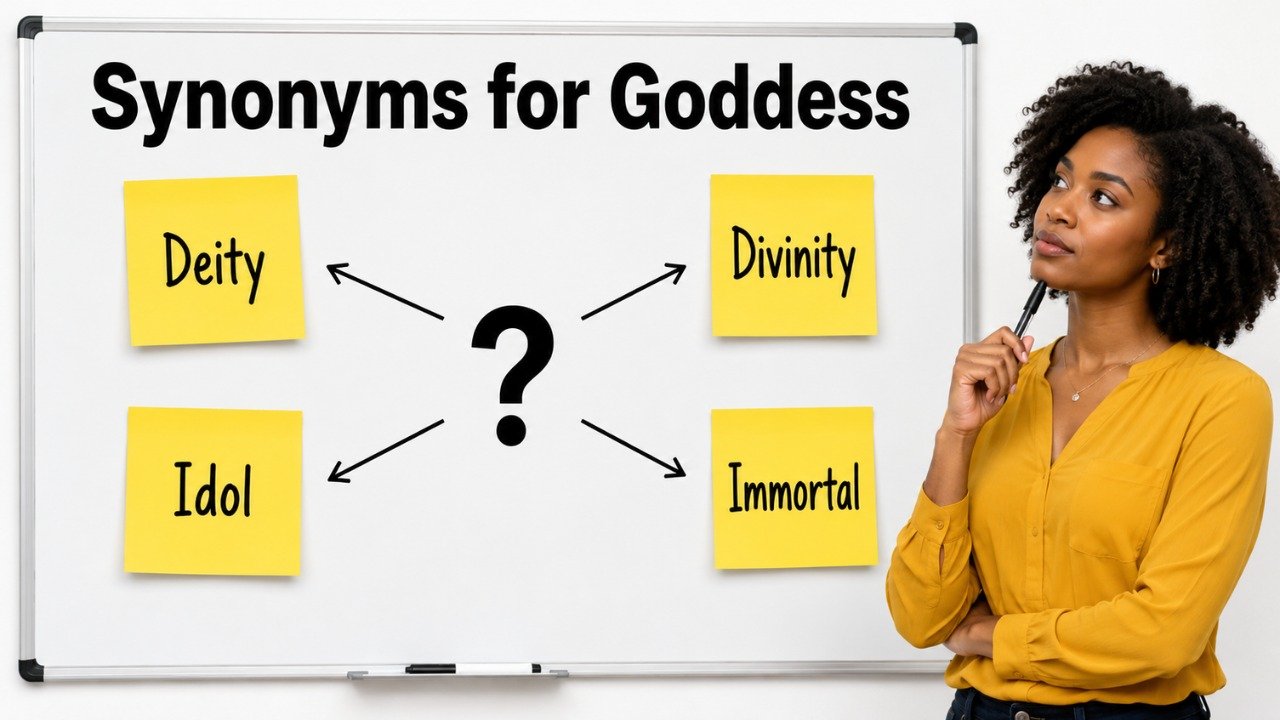
Quick Answer: The best synonyms for goddess include deity, divinity, female deity, divine being, celestial being, immortal, divine queen, patroness, muse, and icon. Use deity or female deity in formal, academic, historical, and mythological writing. Divine being and celestial being work well when describing supernatural status. Patroness suits a protective divine figure. Muse and icon are better in figurative language when praising inspiration, talent, beauty, or cultural influence.
Pronunciation and Word Details
Word: Goddess.
Pronunciation: /ˈɡɒd.ɪs/
Part of Speech: Noun.
Meaning: A female god or a woman who is greatly admired for her beauty, talent, power, or influence.
US Pronunciation:
UK Pronunciation:
What Does “Goddess” Mean?
A goddess is a female divine being who is believed to possess supernatural power, authority, wisdom, or control over part of the natural or human world.
The word goddess is a countable noun. Its plural form is goddesses. It is commonly used in mythology, religion, literature, history, fantasy writing, and figurative conversation.
In mythological contexts, a goddess may represent love, wisdom, nature, war, fertility, the moon, the sea, or another important force. In figurative speech, goddess can describe a woman who is deeply admired for her appearance, personality, talent, confidence, or achievements.
Literal Use: The story describes a goddess who protects the harvest.
Figurative Use: The audience regarded the celebrated performer as a goddess of the stage.
Symbolic Use: The statue presents the goddess as a symbol of justice and wisdom.
The exact meaning depends on whether the writer is discussing a divine being, a symbolic figure, an artistic character, or an admired woman.
Meaning, Tone, and Context of “Goddess”
The word goddess usually has a strong, respectful, elevated, or admiring tone. Its meaning and emotional effect change according to context.
Mythological Tone: In mythology, goddess is a neutral and descriptive term for a female deity.
Religious Tone: In religious discussion, the word may carry sacred, respectful, or ceremonial meaning.
Literary Tone: In poetry, fiction, and fantasy, goddess often creates a majestic, mysterious, powerful, or beautiful image.
Emotional Tone: In personal praise, goddess can sound affectionate, enthusiastic, romantic, or empowering.
Academic Tone: In historical or cultural writing, deity or female deity may sound more precise and objective than goddess.
Conversational Tone: In casual speech, goddess may describe a woman who appears exceptionally beautiful, confident, talented, or impressive.
The term is powerful and expressive, but it may sound exaggerated when used for an ordinary compliment. Writers should choose it carefully according to the relationship, audience, and purpose.
When and How to Use “Goddess”
For Mythology
Use goddess when describing a female divine figure in a traditional story, belief system, legend, or myth.
Example: The villagers honored the goddess of the river during the annual ceremony.
For Divine Power
Use goddess when the female figure has supernatural authority or controls a particular force.
Example: The novel presents her as a goddess with power over storms and oceans.
For Symbolism
Use goddess when a female divine figure represents an idea such as wisdom, justice, love, fertility, or courage.
Example: The sculpture shows the goddess as a symbol of knowledge and protection.
For Literary Description
Use goddess to create an elevated or majestic image in fiction, poetry, and descriptive writing.
Example: She entered the hall like a goddess dressed in silver.
For Admiration
Use goddess figuratively when praising a woman for remarkable beauty, confidence, talent, or presence.
Example: Her supporters described her as a goddess of modern dance.
For Inspiration
Use goddess when describing a woman who inspires creativity, confidence, art, or admiration.
Example: The painter viewed his subject as a goddess of imagination.
For Cultural Discussion
Use goddess when examining the role of female divine figures in art, literature, history, and social traditions.
Example: The essay explores how the goddess represents both creation and destruction.
Best Synonyms for Goddess
Deity
Synonym: A god or goddess with divine or supernatural status.
Example: The temple was dedicated to a powerful female deity.
Divinity
Synonym: A divine being or the state of being sacred and godlike.
Example: The ancient story presents her as a divinity associated with wisdom.
Female Deity
Synonym: A precise and formal term for a female god.
Example: The carving represents a female deity connected with the moon.
Divine Being
Synonym: A supernatural being with sacred or godlike power.
Example: The people believed that a divine being guarded the valley.
Celestial Being
Synonym: A supernatural figure associated with heaven or the sky.
Example: The poem portrays her as a celestial being surrounded by stars.
Immortal
Synonym: A being who does not die and may possess supernatural power.
Example: The legend describes the goddess as an immortal who never aged.
Divine Queen
Synonym: A female supernatural ruler with sacred authority.
Example: She was worshipped as the divine queen of the heavens.
Patroness
Synonym: A female protector or supporter, sometimes used for a goddess connected with a place, activity, or group.
Example: The goddess was regarded as the patroness of artists and musicians.
Muse
Synonym: A woman or figure who inspires artistic or creative work.
Example: The writer called her his muse and goddess of poetry.
Icon
Synonym: A greatly admired person who represents beauty, talent, influence, or achievement.
Example: Her grace and confidence made her a cultural icon.
50 Synonyms for Goddess with Short Meanings
Some words below are direct synonyms, while others are close alternatives used in mythology, symbolism, literature, or figurative praise.
- Deity: A god or goddess with divine power.
- Divinity: A divine being or sacred presence.
- Female Deity: A formal term for a female god.
- Divine Being: A supernatural being with sacred power.
- Divine Figure: A person or character presented as godlike.
- Immortal: A supernatural being who does not die.
- Celestial Being: A heavenly or supernatural figure.
- Heavenly Being: A sacred being associated with heaven.
- Sacred Being: A figure considered holy or divine.
- Supernatural Being: A being whose powers exceed natural limits.
- Divine Female: A female figure with sacred status.
- Divine Woman: A woman represented as holy or godlike.
- Supreme Female Being: A female figure with the highest divine authority.
- Celestial Queen: A heavenly female ruler.
- Divine Queen: A sacred female ruler with supernatural power.
- Divine Ruler: A being who rules through sacred authority.
- Heavenly Ruler: A supernatural ruler associated with the heavens.
- Patron Deity: A divine protector of a place, group, or activity.
- Patroness: A female protector, supporter, or guardian.
- Protectress: A female figure who protects others.
- Guardian Spirit: A supernatural being believed to offer protection.
- Tutelary Deity: A divine protector of a person, place, or community.
- Mother Goddess: A female deity connected with motherhood or creation.
- Mother Deity: A divine maternal figure.
- Earth Mother: A symbolic or divine figure representing the earth.
- Nature Deity: A divine being connected with the natural world.
- Fertility Deity: A divine figure associated with birth and growth.
- Love Deity: A divine being connected with love and attraction.
- Wisdom Deity: A divine figure representing wisdom and knowledge.
- War Deity: A divine being associated with battle and courage.
- Moon Deity: A sacred figure connected with the moon.
- Sun Deity: A divine being associated with the sun.
- Sea Deity: A divine figure connected with oceans or water.
- Household Deity: A divine protector of the home or family.
- Creator Deity: A divine being believed to create life or the world.
- Demigoddess: A female being who is partly divine.
- Numen: A divine presence, spirit, or sacred power.
- Personification: A figure who represents an idea or natural force.
- Embodiment: A person who perfectly represents a quality.
- Archetype: A symbolic figure representing a universal pattern.
- Icon: A greatly admired and influential person.
- Idol: A person or figure who receives intense admiration.
- Muse: A person who inspires creativity or art.
- Heroine: A greatly admired woman known for courage or achievement.
- Queen: A powerful or highly admired female figure.
- Empress: A female ruler with great authority.
- Sovereign: A supreme ruler or authority.
- Enchantress: A captivating woman with magical or mysterious qualities.
- Nymph: A female nature spirit in mythology.
- Divine Feminine Figure: A symbolic female figure representing sacred power.
Read Also:
Synonyms for Marriage

Synonyms for Goddess by Context
When Goddess Means a Female Deity
The best alternatives are deity, female deity, divinity, divine being, and sacred being. These choices work well in mythology, religion, cultural studies, and historical writing.
Example With Goddess: The goddess was believed to control the changing seasons.
Example With Female Deity: The female deity was believed to control the changing seasons.
Deity is usually the best general replacement. Female deity is more precise when the gender of the divine figure matters.
When Goddess Means a Heavenly Being
Use celestial being, heavenly being, immortal, divine figure, or supernatural being when describing a figure from the heavens or a supernatural world.
Example With Goddess: The goddess descended from the clouds in a burst of light.
Example With Celestial Being: The celestial being descended from the clouds in a burst of light.
Celestial being creates a poetic image, while supernatural being is broader and more neutral.
When Goddess Means a Divine Ruler
Use divine queen, celestial queen, divine ruler, heavenly ruler, or sovereign when emphasizing authority and leadership.
Example With Goddess: The people honored her as the goddess who ruled the heavens.
Example With Divine Queen: The people honored her as the divine queen who ruled the heavens.
Divine queen preserves both female identity and sacred authority.
When Goddess Means a Protector
Use patroness, protectress, patron deity, guardian spirit, or tutelary deity when the divine figure protects a person, profession, place, or community.
Example With Goddess: She was the goddess of sailors and coastal villages.
Example With Patron Deity: She was the patron deity of sailors and coastal villages.
Patron deity is especially useful in formal cultural and historical discussion.
When Goddess Means Ideal Beauty
Use beauty, icon, queen, enchantress, or divine woman when goddess is being used as an enthusiastic compliment.
Example With Goddess: Everyone at the ceremony thought she looked like a goddess.
Example With Beauty: Everyone at the ceremony thought she looked like a radiant beauty.
Beauty sounds more natural in everyday conversation. Goddess sounds stronger and more dramatic.
When Goddess Means an Inspiring Woman
Use muse, icon, heroine, idol, or archetype when praising someone for creativity, influence, or achievement.
Example With Goddess: She became a goddess of the artistic movement.
Example With Icon: She became an icon of the artistic movement.
Icon is usually more suitable in formal profiles and cultural commentary.
When Goddess Represents an Idea
Use embodiment, personification, archetype, earth mother, or divine feminine figure when the goddess represents an abstract quality or natural force.
Example With Goddess: The character is a goddess of courage and renewal.
Example With Embodiment: The character is the embodiment of courage and renewal.
Embodiment is more direct when no literal divine being is intended.
Another Word for Goddess
The best general replacement for goddess is deity. It is concise, accurate, and suitable for formal writing. However, deity does not automatically identify the divine figure as female. When gender is important, female deity is the clearest alternative.
In figurative writing, the best replacement may be icon, muse, beauty, queen, or embodiment.
Original: The goddess protected the city from danger.
Better Option: The patron deity protected the city from danger.
Original: The goddess appeared in a vision of golden light.
Better Option: The divine being appeared in a vision of golden light.
Original: She was considered a goddess of classical music.
Better Option: She was considered an icon of classical music.
Original: The artist described her as the goddess behind his greatest paintings.
Better Option: The artist described her as the muse behind his greatest paintings.
When Not to Use “Goddess”
Avoid goddess when it creates an inaccurate, exaggerated, vague, or culturally insensitive meaning.
When Formal Precision Is Needed
Goddess may sound less objective than female deity in academic or historical analysis.
Weak: The report examines a goddess from an early culture.
Better: The report examines a female deity from an early culture.
When the Figure Is Not Divine
Not every supernatural female character is a goddess. A spirit, nymph, enchantress, or legendary woman may have a different identity.
Weak: The forest goddess helped the lost traveler, although the story describes her only as a nature spirit.
Better: The forest spirit helped the lost traveler.
When Praise Sounds Excessive
Calling someone a goddess may sound overly dramatic in professional or neutral communication.
Weak: Our new department manager is an organizational goddess.
Better: Our new department manager is an exceptionally skilled organizer.
When Gender Is Not Relevant
Use deity when the sex or gender of the divine being is unknown or unnecessary.
Weak: The researchers found evidence of a goddess, although the figure could not be identified as female.
Better: The researchers found evidence of a deity.
When the Meaning Is Symbolic
Use embodiment or personification when the figure represents an idea but is not literally divine.
Weak: She was the goddess of patience in the office.
Better: She was the embodiment of patience in the office.
Words Commonly Confused With Goddess
Goddess vs Deity: Goddess specifically refers to a female god. Deity can refer to any god or goddess and is more neutral.
Goddess vs God: Goddess traditionally identifies a female divine being. God may identify a male divine being or serve as a broader term in some contexts.
Goddess vs Divinity: Goddess refers to a particular female divine being. Divinity may refer to a divine being, divine nature, sacred status, or supernatural power.
Goddess vs Muse: A goddess is divine. A muse is a source of creative inspiration and does not need to possess supernatural status.
Goddess vs Nymph: A goddess usually has greater divine authority. A nymph is generally a female nature spirit connected with a location or natural feature.
Goddess vs Queen: A goddess has divine or supernatural status. A queen is normally a human female ruler, although queen can be used figuratively.
Goddess vs Idol: A goddess is a divine female being. An idol may be an object of worship or a person who receives intense admiration.
Goddess vs Enchantress: A goddess is divine, while an enchantress is a woman who uses magic or has a captivating presence.
Which Synonym Should You Choose?
Choose deity for formal, academic, historical, or cultural writing when gender does not need emphasis.
Choose female deity when you need a precise term that clearly identifies the divine figure as female.
Choose divinity when discussing sacred status, divine nature, or a divine presence.
Choose divine being when describing supernatural power without assigning a particular role.
Choose celestial being for poetic, literary, and fantasy descriptions connected with the heavens.
Choose immortal when the most important quality is the figure’s inability to die.
Choose divine queen when emphasizing sacred leadership, rule, and female authority.
Choose patroness or patron deity when the figure protects a profession, community, activity, or location.
Choose mother deity or earth mother when discussing creation, fertility, motherhood, nature, or the earth.
Choose muse when a woman inspires art, writing, music, or another creative activity.
Choose icon for essays, reports, profiles, and cultural discussions about an admired or influential woman.
Choose beauty or queen in casual speech when giving a warm compliment without claiming literal divine status.
Choose embodiment or personification when the figure represents an idea such as justice, wisdom, love, or courage.
Real Life Examples of “Goddess” in Sentences
Original: The ancient people believed the goddess controlled the river.
Better Option: The ancient people believed the river deity controlled the waterway.
Original: The goddess protected every family in the village.
Better Option: The patron deity protected every family in the village.
Original: The story begins when a goddess descends from the sky.
Better Option: The story begins when a celestial being descends from the sky.
Original: The goddess could live forever without growing old.
Better Option: The immortal could live forever without growing old.
Original: The artist called the woman in the portrait his goddess.
Better Option: The artist called the woman in the portrait his muse.
Original: Her fans considered her a goddess of fashion.
Better Option: Her fans considered her an icon of fashion.
Original: She looked like a goddess in the flowing white dress.
Better Option: She looked like a radiant queen in the flowing white dress.
Original: The goddess represented wisdom and fair judgment.
Better Option: The divine figure represented wisdom and fair judgment.
Original: The farmers prayed to the goddess before planting their crops.
Better Option: The farmers prayed to the fertility deity before planting their crops.
Original: The character becomes a goddess of courage for her people.
Better Option: The character becomes the embodiment of courage for her people.
Synonym Groups and Usage Differences
Divine Being Group
Deity, female deity, divinity, divine being, sacred being, and supernatural being belong to the broad divine being group.
Use these terms when the figure possesses sacred or supernatural status. Deity is the most versatile, while female deity is the most precise replacement for goddess.
Example: The manuscript describes a female deity associated with wisdom.
Celestial Group
Celestial being, heavenly being, celestial queen, heavenly ruler, and immortal emphasize a connection with heaven, the sky, eternity, or a supernatural realm.
These alternatives are especially effective in poetry, fantasy, and descriptive fiction.
Example: A celestial queen appeared above the city in a circle of light.
Protective Group
Patroness, protectress, patron deity, guardian spirit, and tutelary deity describe a figure who provides protection or guidance.
Patron deity is formal and precise. Guardian spirit is broader and may not refer to a goddess.
Example: The community honored its patron deity before beginning the journey.
Nature Group
Earth mother, nature deity, fertility deity, moon deity, sun deity, and sea deity identify a divine figure through a natural force or area of influence.
These words provide more information than the general word goddess.
Example: The people believed the sea deity controlled the tides.
Authority Group
Divine queen, divine ruler, heavenly ruler, empress, and sovereign emphasize power, rank, leadership, or control.
Divine queen suggests supernatural authority. Empress and sovereign may describe human rulers unless the context is clearly mythological.
Example: The poem presents her as the divine queen of the stars.
Figurative Praise Group
Icon, idol, beauty, queen, heroine, and enchantress can replace goddess when describing an admired woman.
These words do not normally suggest literal divine status. Their tone ranges from respectful to enthusiastic.
Example: Her fearless performance made her an icon of the theatre.
Inspiration Group
Muse, icon, idol, and heroine describe a woman who inspires art, loyalty, admiration, or positive action.
Muse is best for creative inspiration. Heroine emphasizes courage or achievement.
Example: The poet credited his muse with inspiring the collection.
Symbolic Group
Personification, embodiment, archetype, and divine feminine figure describe symbolic meaning rather than a literal female god.
Use these terms in literary criticism, cultural analysis, and discussions of ideas.
Example: The central character becomes the embodiment of hope and renewal.
Antonyms of Goddess
Goddess has no single exact antonym. The most suitable opposite depends on whether the contrast involves divinity, immortality, sacredness, power, or admiration.
Mortal: A being who can age and die.
Human: A person without divine status.
Mortal Woman: A female human rather than a female deity.
Earthly Being: A being associated with the physical world rather than heaven.
Ordinary Person: Someone without supernatural status or exceptional admiration.
Powerless Figure: A person who lacks the authority associated with a powerful goddess.
Profane Being: A being considered ordinary or not sacred.
Unknown Figure: A person who lacks the fame or admiration suggested by the figurative use of goddess.
God is not a true antonym of goddess. It is traditionally the male counterpart. Demoness is also not a reliable antonym because a demoness may still be a powerful supernatural female being.
Comparison: Goddess vs Related Words
Goddess vs Deity
Goddess identifies a female divine being. Deity is a broader and more gender neutral term for a god or goddess.
Example With Goddess: The goddess was associated with healing and protection.
Example With Deity: The deity was associated with healing and protection.
Use goddess when female identity is relevant. Use deity when you need a formal or neutral term.
Goddess vs Divinity
Goddess refers to an individual female divine being. Divinity can refer to a divine being, sacred power, divine nature, or the quality of being godlike.
Example With Goddess: The goddess appeared beside the sacred spring.
Example With Divinity: The villagers believed a divinity lived near the sacred spring.
Divinity is broader and sometimes more abstract.
Goddess vs Muse
A goddess is a female god, while a muse is someone who inspires creative work.
Example With Goddess: The goddess gave the hero supernatural protection.
Example With Muse: The musician wrote the song for his muse.
Use muse when the main idea is inspiration rather than divinity.
Goddess vs Queen
A goddess possesses divine status. A queen normally holds political, royal, or symbolic authority.
Example With Goddess: The goddess ruled the world of the dead.
Example With Queen: The queen ruled the kingdom for many years.
Queen can replace goddess in casual praise, but not in precise mythological writing.
Goddess vs Nymph
A goddess normally possesses wider authority and greater divine status. A nymph is usually a female spirit associated with nature.
Example With Goddess: The goddess controlled every river in the region.
Example With Nymph: The nymph lived beside a single woodland stream.
The words should not be treated as exact synonyms.
Goddess vs Icon
A goddess is literally or symbolically divine. An icon is a person who is widely admired and represents a particular quality, movement, or achievement.
Example With Goddess: The temple honored the goddess of wisdom.
Example With Icon: The museum honored an icon of modern art.
Icon is usually better when describing a real and influential person.
Common Phrases and Expressions With “Goddess”
Goddess of Love: A female deity associated with love, attraction, or relationships.
Goddess of Wisdom: A female divine figure representing knowledge and intelligent judgment.
Goddess of War: A female deity connected with battle, courage, or military power.
Goddess of the Moon: A female divine figure associated with the moon or night.
Goddess of Nature: A divine female figure connected with plants, animals, seasons, or the natural world.
Mother Goddess: A maternal deity associated with creation, birth, fertility, or protection.
Living Goddess: A woman treated or recognized as possessing sacred status.
Domestic Goddess: A figurative phrase for a woman admired for household skill, cooking, or home management.
Screen Goddess: A highly admired female performer known for beauty, elegance, or presence.
Goddess Figure: A female character or image representing divine power, beauty, or symbolic femininity.
Common Mistakes to Avoid
Treating Every Alternative as an Exact Synonym
Deity and female deity are close replacements for goddess. Muse, icon, queen, nymph, and enchantress are only suitable in particular contexts.
Consider the intended meaning before replacing the word.
Using Goddess for Every Supernatural Woman
A female spirit, nymph, sorceress, enchantress, immortal, and goddess may have different roles. Check how the character is identified in the story or tradition.
Overusing Figurative Praise
Repeatedly calling someone a goddess can make writing sound exaggerated. Use beauty, icon, heroine, queen, or talented woman when a more natural description is needed.
Ignoring Formality
Goddess is appropriate in mythology and literary description. Female deity or deity may sound more objective in academic essays, reports, and historical explanations.
Confusing the Plural Form
The plural of goddess is goddesses, not goddess or goddess’s.
Singular: The goddess guarded the mountain.
Plural: The goddesses guarded different regions.
Confusing Plural and Possessive Forms
Goddesses means more than one goddess. Goddess’s shows that something belongs to one goddess.
Plural: The goddesses gathered in the hall.
Possessive: The goddess’s crown was made of silver.
Capitalizing the Word Unnecessarily
Goddess is normally lowercase when used as a common noun.
Correct: The story describes a goddess of healing.
Capitalize it when it forms part of an official title or begins a sentence.
Removing Important Gender Information
Replacing goddess with deity may remove the information that the divine figure is female. Use female deity when gender matters to the explanation.
Using Vague Descriptions
A more specific term often improves clarity.
Vague: She was a powerful goddess.
Clearer: She was a sea deity believed to control storms and tides.
Conclusion
Understanding synonyms for goddess helps you choose language that matches mythology, formal analysis, symbolism, literature, or everyday praise. Deity and female deity are the strongest choices for accurate writing. Divine being and celestial being emphasize supernatural status, while patroness highlights protection. Muse and icon work better for inspiration or admiration. Queen, beauty, and enchantress suit figurative descriptions. The best synonym always depends on whether goddess refers to a sacred being, a symbolic figure, a powerful ruler, or an admired woman.
FAQs About Synonyms for Goddess
What Is the Best Synonym for Goddess?
Deity is the best general synonym. Use female deity when you need to make the divine figure’s gender clear.
Is Divinity a Synonym for Goddess?
Divinity can be a synonym in some contexts. However, it may also refer to divine nature, sacred power, or the quality of being godlike.
Can Muse Replace Goddess?
Muse can replace goddess when describing a woman who inspires creativity. It cannot replace goddess when referring to a literal female deity.
Is Queen Another Word for Goddess?
Queen can be a figurative alternative when praising a powerful or admired woman. It is not an exact synonym in mythology or religious writing.
What Is a Formal Word for Goddess?
Female deity is the clearest formal term. Deity and divinity are also suitable for academic, historical, and cultural writing.
What Is a Poetic Synonym for Goddess?
Celestial being, divine queen, heavenly being, and immortal are expressive poetic alternatives. The best choice depends on the character’s role.
What Is the Opposite of Goddess?
There is no single exact opposite. Mortal woman, human, earthly being, and ordinary person may work when contrasting divine and nondivine status.
