
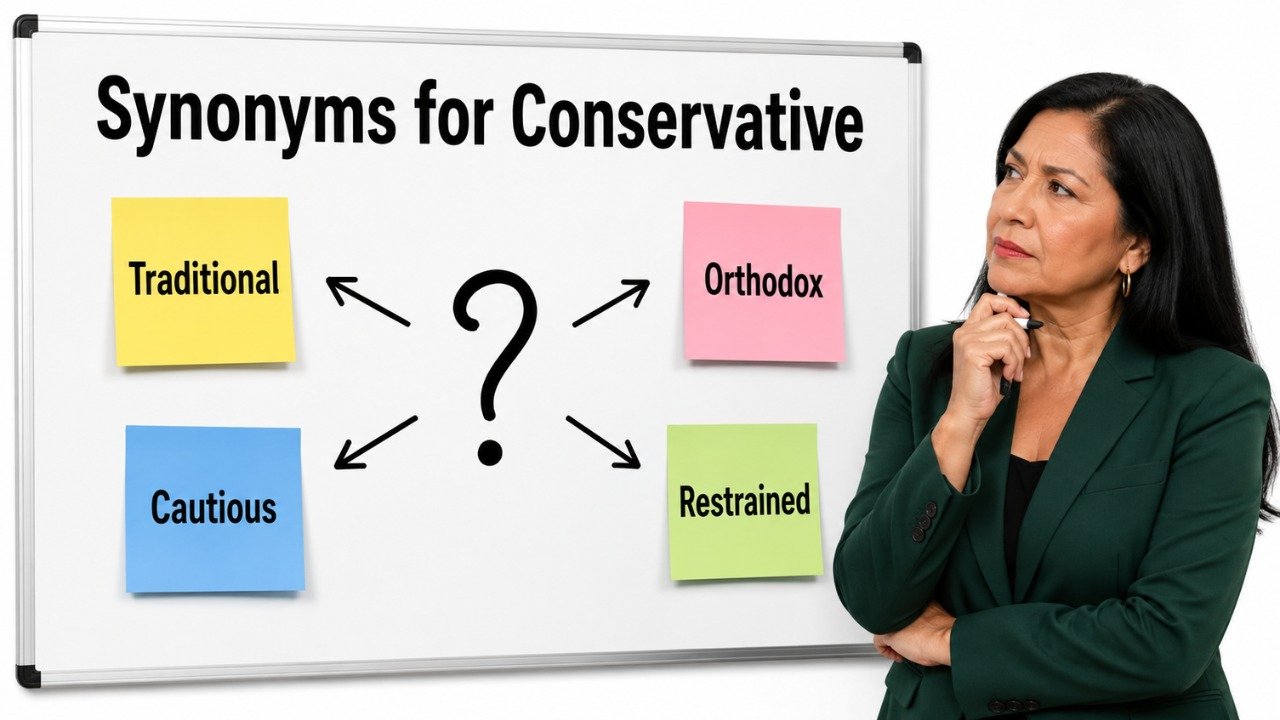
Quick Answer: The best synonyms for conservative include cautious, traditional, conventional, prudent, restrained, moderate, guarded, orthodox, reserved, and modest. The most suitable choice depends on context. Use cautious or prudent for decisions that avoid risk, traditional or orthodox for beliefs and customs, restrained or modest for style and behavior, moderate for balanced opinions, and guarded for careful statements. These synonyms for conservative are related, but they do not express exactly the same meaning in every sentence.
Pronunciation and Word Details
Word: Conservative.
Pronunciation: /kənˈsɜːrvətɪv/.
Part of Speech: Adjective and noun.
Meaning: Describing someone or something that prefers established ideas, avoids unnecessary risk, or remains limited and restrained.
US Pronunciation:
UK Pronunciation:
What Does “Conservative” Mean?
Conservative means cautious about change, risk, spending, estimates, behavior, or style. It can function as both an adjective and a noun.
As an adjective, conservative may describe a person who prefers established traditions, a decision that avoids unnecessary danger, clothing that is modest, or an estimate that is deliberately low.
Traditional Beliefs: Her views on family customs are conservative.
Cautious Decision: The company adopted a conservative approach to expansion.
Restrained Style: He chose a conservative suit for the formal meeting.
Low Estimate: The report gave a conservative estimate of the total cost.
As a noun, conservative refers to a person who supports traditional ideas or prefers gradual change.
Example: He is a conservative who values long established institutions.
The meaning of conservative changes with context. A conservative plan is usually careful, while conservative clothing is modest. A conservative estimate is intentionally cautious rather than exact or generous.
Meaning, Tone, and Context of “Conservative”
Conservative is usually neutral in discussions about risk, spending, forecasting, clothing, and personal behavior. It may sound formal, academic, political, financial, or conversational depending on the sentence.
In everyday speech, conservative often describes someone who is careful, traditional, or unwilling to make sudden changes.
Example: My parents are conservative about major financial decisions.
In formal writing, conservative commonly describes a cautious policy, estimate, strategy, or interpretation.
Example: The researchers used a conservative estimate to avoid overstating the result.
In discussions about culture and values, conservative suggests support for established customs, institutions, or beliefs.
Example: The community maintained a conservative view of social traditions.
When describing appearance, conservative usually means modest, traditional, or restrained rather than fashionable or revealing.
Example: She selected a conservative dress for the ceremony.
In financial language, conservative often describes choices designed to limit risk and protect resources.
Example: They followed a conservative spending plan during the uncertain period.
The word can sometimes carry a critical tone if it suggests excessive resistance to change. It can also carry a positive tone when it suggests responsibility, stability, discipline, or careful judgment.
When and How to Use “Conservative”
For Cautious Decisions
Use conservative when a person or organization avoids unnecessary risk.
Example: The team chose a conservative strategy until more information became available.
For Traditional Beliefs
Use conservative when describing beliefs, customs, or attitudes that favor established practices.
Example: His family holds conservative views about formal ceremonies.
For Limited Spending
Use conservative when discussing careful use of money or resources.
Example: We created a conservative household budget for the next six months.
For Modest Clothing
Use conservative when clothing is traditional, formal, or not revealing.
Example: The invitation requested conservative clothing for the event.
For Restrained Design
Use conservative when a design uses simple shapes, familiar colors, or limited decoration.
Example: The office has a conservative interior with neutral furniture and simple lighting.
For Careful Estimates
Use conservative when an estimate is intentionally kept low or cautious.
Example: A conservative estimate places attendance at approximately five hundred people.
For Gradual Change
Use conservative when a plan favors slow and controlled progress rather than sudden change.
Example: The committee recommended a conservative timetable for introducing the new process.
For Moderate Behavior
Use conservative when behavior is controlled, careful, or reserved.
Example: He gave a conservative response instead of making an emotional promise.
For Protective Planning
Use conservative when a plan prioritizes security, stability, and protection from loss.
Example: Their conservative plan included additional time for unexpected delays.
Best Synonyms for Conservative
Cautious
Synonym: Careful to avoid danger, mistakes, or unnecessary risk.
Example: She remained cautious before accepting the unfamiliar proposal.
Traditional
Synonym: Following established customs, beliefs, or practices.
Example: The family preferred a traditional wedding ceremony.
Conventional
Synonym: Based on commonly accepted standards or familiar methods.
Example: He selected a conventional design for the formal office.
Prudent
Synonym: Showing wise and careful judgment about future consequences.
Example: Saving part of the income was a prudent decision.
Restrained
Synonym: Controlled, limited, and not excessive.
Example: The room featured restrained decoration and simple furniture.
Moderate
Synonym: Balanced and not extreme in opinion, amount, or behavior.
Example: She expressed a moderate position during the discussion.
Guarded
Synonym: Careful about giving information, opinions, or promises.
Example: His response was guarded because the details were not confirmed.
Orthodox
Synonym: Following established beliefs, rules, or accepted traditions.
Example: The group maintained an orthodox interpretation of the custom.
Reserved
Synonym: Quiet, controlled, and unwilling to express strong feelings openly.
Example: She remained reserved during the emotional conversation.
Modest
Synonym: Limited, simple, or not intended to attract excessive attention.
Example: They planned a modest celebration with close family members.
50 Synonyms for Conservative with Short Meanings
- Cautious: Careful to avoid risk or mistakes.
- Careful: Giving close attention to possible problems.
- Prudent: Showing sensible judgment about future consequences.
- Guarded: Unwilling to act or speak without caution.
- Restrained: Controlled and not excessive.
- Moderate: Balanced and not extreme.
- Measured: Calm, controlled, and carefully considered.
- Circumspect: Careful to consider every possible result.
- Wary: Alert to possible danger or difficulty.
- Judicious: Showing sound and thoughtful judgment.
- Sensible: Based on practical and reasonable thinking.
- Risk Conscious: Aware of possible dangers or losses.
- Safety Minded: Focused on avoiding harm or unnecessary risk.
- Reserved: Controlled in behavior or emotional expression.
- Tentative: Cautious because certainty is limited.
- Defensive: Intended to protect against danger or loss.
- Protective: Designed to preserve safety or stability.
- Controlled: Kept within careful limits.
- Temperate: Moderate and not excessive.
- Unadventurous: Unwilling to try unfamiliar or risky options.
- Safe: Unlikely to involve serious danger or uncertainty.
- Low Risk: Involving a limited possibility of loss or harm.
- Economical: Careful about spending money or using resources.
- Frugal: Avoiding unnecessary expense.
- Sparing: Using only a small or necessary amount.
- Modest: Limited, simple, or not excessive.
- Limited: Kept within a narrow amount or range.
- Minimal: Using the smallest practical amount.
- Understated: Quiet, subtle, and not intended to attract attention.
- Subdued: Soft, controlled, and not striking.
- Plain: Simple and lacking elaborate decoration.
- Simple: Uncomplicated and free from excess.
- Traditional: Following established customs or beliefs.
- Conventional: Following widely accepted practices.
- Orthodox: Closely following established ideas or rules.
- Customary: Based on usual or accepted practice.
- Established: Recognized and accepted over time.
- Old Fashioned: Following styles or ideas associated with the past.
- Traditionalist: A person who supports established customs.
- Conventionalist: A person who follows accepted standards.
- Preservationist: A person who seeks to protect existing traditions or resources.
- Conformist: A person who follows accepted behavior or beliefs.
- Change Resistant: Unwilling to accept significant change quickly.
- Reform Resistant: Reluctant to support major alterations.
- Traditional Minded: Inclined toward familiar customs and values.
- Right Leaning: Favoring politically conservative positions.
- Reactionary: Strongly opposed to social or political change.
- Cautious Estimate: A deliberately low or careful calculation.
- Restricted: Limited by careful rules or boundaries.
- Conservative Minded: Inclined toward caution, tradition, or gradual change.
Read Also:
Synonyms for Trigger
Synonyms for Conservative by Context
When Conservative Means Cautious
Use cautious, prudent, careful, guarded, circumspect, wary, measured, or judicious when conservative describes a decision that avoids unnecessary risk.
Example: The manager took a cautious approach to hiring new employees.
Example: It was prudent to review the agreement before signing it.
Cautious is the most natural choice in general conversation. Prudent sounds more formal and emphasizes good judgment.
When Conservative Means Traditional
Use traditional, conventional, orthodox, customary, established, or old fashioned when conservative describes beliefs, customs, or practices.
Example: They followed traditional customs during the family celebration.
Example: The school used a conventional teaching method.
Traditional is usually neutral. Orthodox suggests strict loyalty to accepted beliefs. Old fashioned may sound critical or outdated.
When Conservative Means Moderate
Use moderate, measured, temperate, restrained, or balanced when conservative means avoiding extremes.
Example: She offered a moderate response to the proposed changes.
Example: His measured comments helped calm the discussion.
Moderate is useful for opinions and policies. Measured is better for speech, behavior, or decisions.
When Conservative Means Modest
Use modest, restrained, understated, subdued, plain, or simple when conservative describes clothing, appearance, decoration, or design.
Example: She wore a modest outfit to the formal ceremony.
Example: The room had an understated design with minimal decoration.
Modest is best for clothing and scale. Understated is useful for elegant designs that avoid excessive attention.
When Conservative Means Careful With Money
Use economical, frugal, sparing, careful, restrained, or limited when conservative describes spending.
Example: They adopted a frugal lifestyle while saving for a home.
Example: The department followed an economical spending plan.
Frugal emphasizes avoiding waste. Economical suggests efficient use of money or resources.
When Conservative Describes an Estimate
Use cautious estimate, low estimate, careful projection, restrained forecast, or modest calculation.
Example: A cautious estimate suggests that the repairs will cost at least $2,000.
Example: The report presented a modest projection for future growth.
A conservative estimate usually avoids exaggeration. It may intentionally present the lower end of a reasonable range.
When Conservative Describes Politics
Use traditionalist, right leaning, moderate, preservationist, or reactionary according to the strength and nature of the position.
Example: The writer expressed a traditionalist view of social institutions.
Example: The candidate presented a moderate position on the issue.
Reactionary is much stronger than conservative and often suggests active resistance to change. It should not be used as a neutral replacement.
When Conservative Means Resistant to Change
Use change resistant, reform resistant, traditional minded, conventional, or preservationist.
Example: The organization remained change resistant despite growing pressure to modernize.
Example: Preservationist members wanted to protect the original system.
These alternatives may sound more critical than conservative, so the writer should consider the intended tone.
Another Word for Conservative
Cautious is often the best single replacement for conservative when the sentence describes a decision, plan, strategy, or estimate that avoids risk. However, it does not fit every meaning.
Traditional is better for customs and beliefs. Modest works for clothing or design. Prudent suits formal writing about responsible judgment. Restrained works when something is controlled or limited.
Original: The company followed a conservative expansion plan.
Better Option: The company followed a cautious expansion plan.
Original: She prefers conservative clothing for formal occasions.
Better Option: She prefers modest clothing for formal occasions.
Original: His family has conservative social customs.
Better Option: His family has traditional social customs.
Original: The report offered a conservative prediction.
Better Option: The report offered a cautious prediction.
When Not to Use “Conservative”
Do not use conservative when the sentence requires a more precise description of the behavior, belief, style, or amount.
Weak: She has a conservative personality.
Better: She has a cautious and reserved personality.
Avoid using conservative when you simply mean old or outdated. A traditional idea is not automatically ineffective or obsolete.
Weak: The office uses a conservative computer system.
Better: The office uses an outdated computer system.
Do not use conservative as an automatic synonym for moderate. A person can be conservative without holding a middle position.
Weak: He gave a conservative opinion between both extremes.
Better: He gave a moderate opinion between both extremes.
Avoid using conservative when frugal or economical would describe spending more accurately.
Weak: She is conservative with grocery money.
Better: She is frugal with grocery money.
Do not use conservative estimate when the number is merely inaccurate or guessed without evidence.
Weak: I made a conservative estimate without checking any information.
Better: I made a rough estimate because complete information was unavailable.
Avoid the word in clothing descriptions when modest, formal, plain, or traditional communicates the intended meaning more clearly.
Weak: He wore a conservative shirt.
Better: He wore a plain and formal shirt.
Do not replace conservative with reactionary unless the sentence describes strong opposition to change.
Weak: She prefers traditional ceremonies, so she is reactionary.
Better: She prefers traditional ceremonies, so she is conservative in that area.
Words Commonly Confused With Conservative
Conservative vs Cautious: Conservative can describe beliefs, style, spending, or risk. Cautious mainly describes behavior intended to avoid danger or mistakes.
Conservative vs Traditional: Conservative may suggest resistance to change, while traditional means following established customs or practices.
Conservative vs Moderate: Conservative relates to caution or established ideas. Moderate means balanced and not extreme.
Conservative vs Conventional: Conservative may express values or caution. Conventional means following common or accepted methods.
Conservative vs Reserved: Conservative can describe a broad attitude or approach. Reserved usually describes quiet behavior or limited emotional expression.
Conservative vs Prudent: Conservative may simply mean cautious. Prudent suggests that the caution is wise and based on good judgment.
Conservative vs Frugal: Conservative can describe careful spending, but frugal specifically means avoiding unnecessary expense.
Conservative vs Orthodox: Conservative may prefer established ideas without following them strictly. Orthodox suggests close adherence to accepted beliefs or rules.
Conservative vs Old Fashioned: Conservative can be neutral or positive. Old fashioned often suggests that something belongs to an earlier time.
Conservative vs Reactionary: Conservative generally favors caution or gradual change. Reactionary suggests a much stronger desire to oppose change or restore earlier conditions.
Which Synonym Should You Choose?
Choose cautious when describing decisions, plans, behavior, or actions that avoid risk.
Choose prudent when formal writing needs to emphasize wise judgment and future consequences.
Choose traditional when discussing customs, ceremonies, family values, or established practices.
Choose conventional when referring to familiar methods, accepted standards, or common designs.
Choose orthodox when describing strict adherence to recognized beliefs or rules.
Choose moderate when an opinion, policy, or amount is balanced and not extreme.
Choose restrained when describing controlled behavior, decoration, language, or spending.
Choose modest when discussing clothing, appearance, expectations, or amounts that are limited.
Choose guarded when someone is careful about revealing information or making promises.
Choose reserved when describing a quiet person who does not express emotions openly.
Choose economical when the focus is efficient use of money or resources.
Choose frugal when someone actively avoids unnecessary spending.
Choose understated when describing elegant clothing or design that does not demand attention.
Choose cautious estimate when a number is intentionally placed at the lower end of a reasonable range.
Choose traditionalist when referring to a person who supports established customs or institutions.
Choose change resistant when the sentence needs to emphasize unwillingness to accept new methods.
Choose reactionary only when describing strong and active opposition to change.
Real Life Examples of “Conservative” in Sentences
Original: We used a conservative estimate for the number of visitors.
Better Option: We used a cautious estimate for the number of visitors.
Original: She made a conservative choice because the risks were unclear.
Better Option: She made a prudent choice because the risks were unclear.
Original: His family follows conservative wedding customs.
Better Option: His family follows traditional wedding customs.
Original: The room has a conservative design.
Better Option: The room has an understated design.
Original: She wore a conservative dress to the formal event.
Better Option: She wore a modest dress to the formal event.
Original: The organization took a conservative position on the proposed change.
Better Option: The organization took a cautious position on the proposed change.
Original: He is conservative about spending money.
Better Option: He is frugal about spending money.
Original: The speaker gave a conservative response.
Better Option: The speaker gave a guarded response.
Original: They chose a conservative investment strategy.
Better Option: They chose a low risk investment strategy.
Original: The forecast presents a conservative growth figure.
Better Option: The forecast presents a restrained growth figure.
Synonym Groups and Usage Differences
Caution Group
This group includes cautious, careful, prudent, guarded, circumspect, wary, and judicious. These words describe decisions or behavior intended to avoid mistakes, danger, or loss.
Cautious is the broadest everyday choice. Prudent suggests wisdom. Circumspect suggests careful consideration of every possible result.
Example: A prudent manager reviews the risks before approving a major change.
Tradition Group
This group includes traditional, conventional, orthodox, customary, established, and old fashioned. These words describe ideas or practices connected with accepted customs.
Traditional is usually neutral. Orthodox suggests strict adherence. Old fashioned may express criticism or nostalgia.
Example: The ceremony followed traditional customs passed down through the family.
Moderation Group
This group includes moderate, measured, temperate, restrained, and controlled. These words emphasize avoiding extremes.
Moderate suits views and amounts. Measured often describes speech or decisions. Temperate suggests calm self control.
Example: Her measured response prevented the discussion from becoming hostile.
Modesty Group
This group includes modest, understated, subdued, plain, simple, and restrained. These words describe clothing, decoration, or behavior that avoids excess.
Modest often relates to clothing or scale. Understated suggests subtle elegance. Plain means simple and without decoration.
Example: The hall had an understated appearance with simple furniture and soft lighting.
Financial Caution Group
This group includes economical, frugal, sparing, limited, cautious, and low risk. These alternatives relate to careful spending or resource management.
Frugal describes avoiding waste. Economical means using resources efficiently. Sparing means using only a small amount.
Example: Their frugal habits allowed them to build an emergency fund.
Political and Social Group
This group includes traditionalist, right leaning, moderate, preservationist, and reactionary. These words describe different attitudes toward political or social change.
Traditionalist focuses on established customs. Preservationist emphasizes protection of existing systems. Reactionary is stronger and usually more critical.
Example: The traditionalist speaker argued for preserving established institutions.
Forecast and Estimate Group
This group includes cautious estimate, modest projection, careful forecast, restrained prediction, and low estimate.
These expressions indicate that a number has been deliberately kept within a careful or lower range.
Example: The planners used a modest projection to avoid promising unrealistic results.
Antonyms of Conservative
The opposite of conservative depends on whether the word refers to risk, tradition, spending, style, beliefs, or estimates.
Progressive: Favoring social, political, or institutional change.
Liberal: Open to change, freedom, or less traditional ideas.
Radical: Supporting major or fundamental change.
Innovative: Introducing new ideas, methods, or designs.
Experimental: Willing to test unfamiliar approaches.
Adventurous: Willing to accept risk and try new experiences.
Bold: Confident and willing to take noticeable risks.
Daring: Ready to attempt something difficult or risky.
Unrestrained: Not controlled or limited.
Extravagant: Spending or using more than necessary.
Lavish: Rich, elaborate, or generous in amount.
Excessive: Greater than what is reasonable or necessary.
Optimistic: Expecting a more favorable result, especially in forecasts.
Generous: Larger or more favorable than a conservative amount.
Modern: Based on newer styles, ideas, or methods.
Unconventional: Different from accepted practices or standards.
Reformist: Supporting changes to an existing system.
Flexible: Willing to adjust ideas or methods.
Expressive: Openly showing feelings, personality, or creativity.
Revealing: Showing more of the body than modest clothing does.
Comparison: Conservative vs Related Words
Conservative vs Cautious
Conservative has several meanings, including traditional, modest, and careful. Cautious specifically focuses on avoiding risk or mistakes.
Example With Conservative: The company adopted a conservative growth plan.
Example With Cautious: The company remained cautious while market conditions were uncertain.
Conservative vs Traditional
Conservative may indicate resistance to change or careful decision making. Traditional describes something based on established customs.
Example With Conservative: His views on social change are conservative.
Example With Traditional: The family prepared a traditional meal for the celebration.
Conservative vs Prudent
Conservative suggests caution, while prudent suggests that the caution is wise and appropriate.
Example With Conservative: They selected a conservative budget.
Example With Prudent: Setting aside money for repairs was a prudent decision.
Conservative vs Moderate
Conservative often favors established ideas or limited risk. Moderate means avoiding extreme positions.
Example With Conservative: She supported a conservative approach to reform.
Example With Moderate: She offered a moderate compromise between the two proposals.
Conservative vs Conventional
Conservative can refer to values, risk, style, or spending. Conventional refers to methods or ideas accepted by most people.
Example With Conservative: The organization made a conservative decision.
Example With Conventional: The organization used a conventional interview process.
Conservative vs Restrained
Conservative can describe an overall attitude. Restrained focuses on something controlled or limited.
Example With Conservative: The room has a conservative style.
Example With Restrained: The room uses restrained decoration and neutral furniture.
Conservative vs Reserved
Conservative may describe beliefs or decisions. Reserved usually describes personality or emotional behavior.
Example With Conservative: He takes a conservative approach to spending.
Example With Reserved: He is reserved when meeting unfamiliar people.
Conservative vs Frugal
Conservative can describe many forms of caution. Frugal specifically refers to careful spending and avoiding waste.
Example With Conservative: They created a conservative financial plan.
Example With Frugal: Their frugal habits reduced unnecessary expenses.
Conservative vs Orthodox
Conservative suggests preference for established ideas. Orthodox suggests strict acceptance of recognized beliefs or rules.
Example With Conservative: She has conservative views about education.
Example With Orthodox: The school follows an orthodox interpretation of its traditional principles.
Conservative vs Reactionary
Conservative generally favors caution, tradition, or gradual change. Reactionary suggests strong opposition to change and may carry a negative tone.
Example With Conservative: The group preferred gradual reform.
Example With Reactionary: The reactionary movement rejected nearly every proposed change.
Common Phrases and Expressions With Conservative
Conservative Estimate: A deliberately cautious or low calculation.
Conservative Approach: A careful method that avoids unnecessary risk.
Conservative Strategy: A plan focused on stability and protection.
Conservative Values: Beliefs that support established customs or institutions.
Conservative View: An opinion that favors tradition or limited change.
Conservative Style: A simple, formal, or traditional appearance.
Conservative Clothing: Modest clothing that avoids revealing or striking features.
Conservative Spending: Careful use of money with limited unnecessary expense.
Conservative Budget: A financial plan based on cautious income and expense expectations.
Conservative Forecast: A prediction that avoids overly hopeful assumptions.
Conservative Investment: A financial choice designed to limit risk.
Conservative Treatment: A cautious approach that begins with less aggressive options where appropriate.
Common Mistakes to Avoid
A common mistake is assuming that conservative always has a political meaning. The word can also describe cautious plans, modest clothing, restrained designs, limited spending, or careful estimates.
Incorrect: Every conservative estimate expresses a political opinion.
Correct: A conservative estimate is simply a cautious calculation.
Another mistake is replacing conservative with traditional in every sentence. Traditional does not communicate financial caution or low risk.
Incorrect: They chose a traditional investment plan to avoid major losses.
Correct: They chose a conservative investment plan to avoid major losses.
Do not use cautious as a replacement when the sentence refers to clothing or design.
Incorrect: She wore a cautious dress to the ceremony.
Correct: She wore a modest dress to the ceremony.
Avoid using reactionary as a neutral synonym. It expresses a much stronger resistance to change.
Incorrect: Anyone who values tradition is reactionary.
Correct: Someone who values established customs may be described as traditional or conservative.
Do not confuse conservative with moderate. A conservative opinion is not automatically balanced between two extremes.
Incorrect: His opinion was conservative because it stood exactly in the middle.
Correct: His opinion was moderate because it avoided both extremes.
Avoid vague use when a more exact synonym is available.
Vague: The room looked conservative.
Clear: The room looked understated and traditional.
Writers also sometimes overuse conservative within one paragraph.
Repetitive: The conservative manager created a conservative plan with conservative estimates.
Improved: The cautious manager created a restrained plan with careful estimates.
Remember that conservative can be both an adjective and a noun.
Adjective Example: She supports a conservative approach.
Noun Example: He describes himself as a conservative.
Use lowercase when conservative is a general description. Capitalization depends on whether the word is part of a formal proper name.
Conclusion
The best synonyms for conservative depend on the meaning you want to express. Cautious and prudent suit careful decisions, while traditional and orthodox describe established beliefs. Moderate and measured work for balanced opinions, and modest or understated fits clothing and design. Frugal and economical describe careful spending, while guarded suits careful speech. By considering tone, subject, and sentence context, you can select synonyms for conservative that sound natural, precise, and appropriate in essays, reports, emails, and everyday conversation.
FAQs About Synonyms for Conservative
What Is the Best Synonym for Conservative?
Cautious is the best general synonym when conservative means avoiding risk. Traditional is better when the word refers to customs or beliefs.
What Is a Formal Synonym for Conservative?
Prudent, circumspect, restrained, orthodox, and conventional are useful formal synonyms, depending on the context.
What Is Another Word for a Conservative Person?
Traditionalist, conventionalist, preservationist, or conservative minded person may be suitable. The best choice depends on the person’s beliefs and behavior.
Is Traditional the Same as Conservative?
Not exactly. Traditional means following established customs, while conservative may also mean cautious, modest, restrained, or resistant to change.
What Is a Synonym for Conservative Clothing?
Modest, restrained, traditional, formal, understated, and plain are useful alternatives for conservative clothing.
What Is a Synonym for Conservative Estimate?
Cautious estimate, low estimate, modest projection, careful forecast, and restrained prediction are suitable alternatives.
What Is the Opposite of Conservative?
Possible opposites include progressive, liberal, radical, adventurous, bold, extravagant, experimental, and unconventional. The correct antonym depends on the meaning.
