
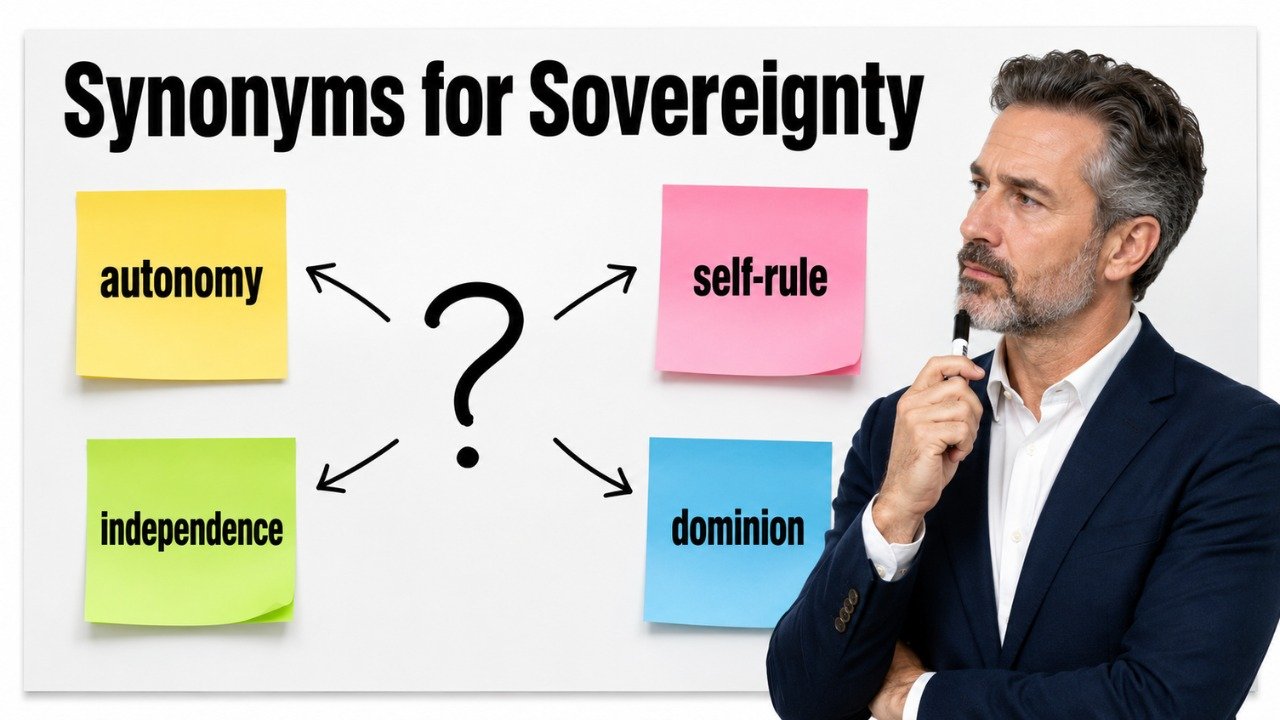
Quick Answer: The best synonyms for sovereignty include independence, autonomy, self rule, authority, supremacy, dominion, jurisdiction, statehood, freedom, and control. Independence works best when discussing a nation free from foreign influence. Autonomy emphasizes the ability to govern independently within a larger system. Authority and supremacy suit formal, political, and legal writing. Jurisdiction refers to legal control, while dominion describes control over land or people. The right choice depends on whether you mean national freedom, governing power, legal authority, or territorial control.
Pronunciation and Word Details
Word: Sovereignty.
Pronunciation: /ˈsɒv.rən.ti/
Part of Speech: Noun.
Meaning: The highest authority of a country, government, ruler, or group to govern itself without outside control.
US Pronunciation:
UK Pronunciation:
What Does “Sovereignty” Mean?
Sovereignty means the supreme authority to govern a country, territory, organization, or community without being controlled by an outside power.
Sovereignty is a noun. It commonly describes the political independence and governing power of a state. A sovereign country has the legal right to create laws, control its territory, manage its institutions, and conduct relations with other countries.
The word can also describe the highest level of authority within a political system. For example, sovereignty may belong to a monarch, a constitution, a parliament, a government, or the people.
In legal writing, sovereignty often concerns jurisdiction, territorial authority, and the power to enforce laws. In political discussion, it may refer to independence, national identity, self determination, or freedom from foreign interference.
National Context: The country protected its sovereignty against foreign control.
Legal Context: The dispute raised questions about sovereignty over the territory.
Political Context: Citizens argued that sovereignty should remain with the people.
Historical Context: The region struggled for sovereignty after years of external rule.
Meaning, Tone, and Context of “Sovereignty”
Sovereignty is a formal, strong, and politically significant word. It is commonly used in government, law, international relations, history, political science, constitutional studies, and academic writing.
The word has a serious and authoritative tone. It is not commonly used in casual conversation unless people are discussing politics, national independence, territorial disputes, or government authority.
Sovereignty may carry an emotional meaning when connected to national identity, freedom, cultural independence, or resistance to outside control. It can also have a technical meaning in legal and constitutional documents.
Formal Tone: Sovereignty is appropriate in essays, reports, laws, speeches, and political analysis.
Legal Tone: It can describe a government’s exclusive legal authority over people and territory.
Political Tone: It often refers to the right of a state or population to govern itself.
Emotional Tone: It may express pride, independence, resistance, or national unity.
Academic Tone: It is frequently examined as a concept involving power, legitimacy, borders, and government.
When and How to Use “Sovereignty”
For National Independence
Use sovereignty when describing a country’s freedom from foreign rule or interference.
Example: The newly independent nation worked to protect its sovereignty.
For Supreme Governing Authority
Use sovereignty when referring to the highest power within a political system.
Example: The constitution places sovereignty in the hands of the people.
For Territorial Control
Use sovereignty when discussing a state’s authority over a particular area of land or water.
Example: Both governments claimed sovereignty over the disputed islands.
For Legal Jurisdiction
Use sovereignty when explaining a government’s right to make and enforce laws within its borders.
Example: The court considered whether the policy violated national sovereignty.
For Self Government
Use sovereignty when a community, region, or nation seeks the right to manage its own affairs.
Example: The movement called for greater sovereignty and local decision making power.
For International Relations
Use sovereignty when explaining how independent states interact while respecting one another’s authority.
Example: The agreement recognized the sovereignty of all participating nations.
For Popular Authority
Use sovereignty when political power is understood to come from the people.
Example: Popular sovereignty gives citizens the final authority to choose their government.
Best Synonyms for Sovereignty
Independence: Freedom from foreign control or external authority.
Example: The country celebrated its independence after decades of foreign rule.
Autonomy: The right or ability to govern oneself, sometimes within a larger political system.
Example: The province was granted greater autonomy over education and taxation.
Self Rule: Government by the people of a country, region, or community themselves.
Example: Citizens demanded self rule instead of administration by an outside power.
Authority: The recognized power to make decisions, create rules, and enforce laws.
Example: The national government has authority over border security.
Supremacy: The position of having the highest power or greatest authority.
Example: The constitution established the supremacy of civilian law.
Dominion: Control or governing power over a territory, population, or area.
Example: The ruler extended his dominion across several neighboring regions.
Jurisdiction: Legal authority over a place, person, issue, or type of case.
Example: The court has jurisdiction over matters arising within the territory.
Statehood: The legal and political condition of being an independent state.
Example: The territory continued its campaign for internationally recognized statehood.
Freedom: The condition of being free from unwanted control or restriction.
Example: The population viewed political freedom as essential to its future.
Control: The power to direct, manage, or govern something.
Example: The government regained control of its national institutions.
50 Synonyms for Sovereignty with Short Meanings
- Independence: Freedom from outside political control.
- Autonomy: The ability or right to govern oneself.
- Self Rule: Government by one’s own people or community.
- Self Government: Independent management of political and public affairs.
- Authority: Recognized power to make and enforce decisions.
- Supreme Authority: The highest level of governing power.
- Supremacy: The state of holding the greatest authority.
- Dominion: Control over a territory or population.
- Jurisdiction: Legal power over a place or matter.
- Statehood: The condition of being a recognized political state.
- Freedom: Release from unwanted control or restriction.
- Liberty: The right to act without unjust control.
- Control: The power to direct or manage affairs.
- Command: Authority to give orders and require obedience.
- Power: The ability to control events, people, or policies.
- Rule: The exercise of political or governing authority.
- Governance: The system or process of governing.
- Governing Authority: Official power to manage public affairs.
- Political Authority: Legitimate power within a political system.
- Legal Authority: Power recognized and supported by law.
- Constitutional Authority: Power granted or limited by a constitution.
- National Authority: The governing power of a nation.
- State Authority: The official power exercised by a state.
- Final Authority: The power to make the last binding decision.
- Ultimate Authority: The highest authority with no superior power.
- Exclusive Authority: Power held without competing control.
- Absolute Authority: Complete and unrestricted governing power.
- Sovereign Power: Independent and supreme political power.
- State Power: The ability of a state to govern and enforce laws.
- National Power: The political strength and authority of a nation.
- Political Power: The ability to influence or control government.
- Governing Power: The ability to direct public institutions and policies.
- Supreme Power: Authority greater than all other powers.
- Ultimate Control: The highest level of control over decisions.
- Territorial Control: Authority over a defined geographical area.
- Political Independence: Freedom from outside political direction.
- National Independence: A nation’s freedom from foreign rule.
- Territorial Independence: Freedom from external control over land.
- Self Determination: The right to choose one’s political future.
- Home Rule: Local control over internal public affairs.
- Independence of Action: Freedom to make decisions without permission.
- Freedom of Action: The ability to act without outside restriction.
- Political Freedom: Freedom to participate in and shape government.
- National Freedom: A nation’s freedom from external domination.
- Governmental Autonomy: Independent control over government functions.
- Territorial Integrity: The protection and unity of a state’s territory.
- National Self Rule: Independent government by a nation’s own people.
- Independent Rule: Government free from outside political control.
- Ruling Power: The authority to direct and govern others.
- Dominion Over Territory: Supreme control over a geographical area.
Read Also:
Synonyms for Pirate

Synonyms for Sovereignty by Context
When Sovereignty Means National Independence
Independence, national freedom, political independence, and national self rule are useful when discussing freedom from foreign control.
Example With Sovereignty: The nation defended its sovereignty after gaining freedom from colonial rule.
Example With Independence: The nation defended its independence after gaining freedom from colonial rule.
Independence is usually the clearest alternative when the main focus is freedom from another country’s control.
When Sovereignty Means Supreme Authority
Supreme authority, supremacy, ultimate authority, final authority, and supreme power fit contexts involving the highest source of political power.
Example With Sovereignty: The constitution recognizes the sovereignty of the people.
Example With Supreme Authority: The constitution recognizes the supreme authority of the people.
Supreme authority is especially effective in constitutional, legal, and academic writing.
When Sovereignty Means Legal Jurisdiction
Jurisdiction, legal authority, constitutional authority, and state authority suit discussions about laws, courts, and official powers.
Example With Sovereignty: The government exercises sovereignty within its borders.
Example With Jurisdiction: The government exercises jurisdiction within its borders.
Jurisdiction is more precise when the sentence concerns legal boundaries or the power of a court.
When Sovereignty Means Self Government
Autonomy, self government, self rule, and home rule emphasize the ability of a group or region to manage its internal affairs.
Example With Sovereignty: The region requested greater sovereignty over local matters.
Example With Autonomy: The region requested greater autonomy over local matters.
Autonomy is usually better when a region remains part of a larger country but controls some of its own affairs.
When Sovereignty Means Territorial Control
Territorial control, dominion, exclusive authority, and ultimate control describe power over land or geographical borders.
Example With Sovereignty: The two states disputed sovereignty over the island.
Example With Territorial Control: The two states disputed territorial control over the island.
Territorial control is clearer when the dispute concerns possession or administration of land.
Another Word for Sovereignty
The best single replacement for sovereignty is often independence. However, the ideal alternative depends on the intended meaning.
Choose independence when referring to freedom from foreign control. Choose autonomy when discussing limited self government. Choose authority when referring to legitimate governing power. Choose jurisdiction when the subject involves legal control.
Original: The nation fought to preserve its sovereignty.
Better Option: The nation fought to preserve its independence.
Original: The province requested greater sovereignty over local education.
Better Option: The province requested greater autonomy over local education.
Original: The court examined the limits of government sovereignty.
Better Option: The court examined the limits of government authority.
Original: The two countries disputed sovereignty over the coastal waters.
Better Option: The two countries disputed jurisdiction over the coastal waters.
When Not to Use “Sovereignty”
Do not use sovereignty when a simpler word communicates the meaning more clearly. The word can sound overly formal in ordinary conversations about personal freedom, workplace control, or everyday decision making.
Avoid using sovereignty when you mean only influence, responsibility, ownership, or personal choice. Sovereignty normally suggests supreme political, legal, or territorial authority.
When Discussing Personal Choices
Weak: She wanted sovereignty over her weekend plans.
Better: She wanted control over her weekend plans.
Sovereignty sounds too political and formal for an ordinary personal decision.
When Describing Limited Local Power
Weak: The local council received complete sovereignty over waste collection.
Better: The local council received authority over waste collection.
A local council may have authority without possessing supreme political power.
When Referring to Court Power
Weak: The court has sovereignty over these cases.
Better: The court has jurisdiction over these cases.
Jurisdiction is more accurate when discussing a court’s legal power.
When Discussing Workplace Responsibility
Weak: The manager has sovereignty over the marketing department.
Better: The manager has control over the marketing department.
Control or authority sounds more natural in a workplace context.
When the Meaning Is Only Freedom
Weak: Students wanted sovereignty to choose their own subjects.
Better: Students wanted freedom to choose their own subjects.
Freedom is the clearer word when no political or governing authority is involved.
Words Commonly Confused With Sovereignty
Sovereignty vs Independence: Sovereignty is the supreme authority to govern, while independence is freedom from outside control. A country may gain independence and then exercise sovereignty through its institutions.
Sovereignty vs Autonomy: Sovereignty usually means complete and supreme governing power. Autonomy often means limited self government within a larger political system.
Sovereignty vs Authority: Sovereignty is the highest political authority. Authority can exist at many levels, including local government, courts, schools, and workplaces.
Sovereignty vs Jurisdiction: Sovereignty describes overall supreme power. Jurisdiction refers specifically to legal authority over an area, person, or issue.
Sovereignty vs Statehood: Sovereignty is a form of governing authority. Statehood is the political and legal status of being recognized as a state.
Sovereignty vs Self Determination: Sovereignty is the power to govern. Self determination is the right of a population to choose its political status and future.
Sovereignty vs Freedom: Sovereignty concerns supreme governing power, while freedom is a broader condition of being free from restriction or control.
Which Synonym Should You Choose?
Choose independence when writing about freedom from colonial rule, foreign control, occupation, or political interference.
Choose autonomy when a region, institution, or community controls some internal affairs but remains part of a larger system.
Choose self rule when emphasizing government by local people rather than an outside authority.
Choose authority when discussing the recognized power to make decisions or enforce rules.
Choose supremacy when emphasizing that one power stands above all competing authorities.
Choose jurisdiction when writing about courts, laws, borders, legal cases, or official areas of responsibility.
Choose dominion when describing extensive control over territory or people, especially in historical or literary writing.
Choose statehood when discussing recognition as an independent political state.
Choose control in general explanations, reports, workplace writing, or less formal conversation.
Choose self determination when discussing a people’s right to choose their own political future.
For formal essays, sovereignty, supreme authority, independence, and autonomy are usually the strongest choices.
For legal writing, jurisdiction, legal authority, constitutional authority, and state authority provide greater precision.
For casual explanations, independence, freedom, control, and self rule are easier to understand.
Real Life Examples of “Sovereignty” in Sentences
Original: The country regained its sovereignty after the occupation ended.
Better Option: The country regained its independence after the occupation ended.
Original: The constitution declares that sovereignty belongs to the people.
Better Option: The constitution declares that supreme authority belongs to the people.
Original: The region requested greater sovereignty over its schools.
Better Option: The region requested greater autonomy over its schools.
Original: The nations agreed to respect one another’s sovereignty.
Better Option: The nations agreed to respect one another’s independence.
Original: The dispute concerned sovereignty over the northern territory.
Better Option: The dispute concerned territorial control over the northern territory.
Original: The court examined the limits of state sovereignty.
Better Option: The court examined the limits of state authority.
Original: Citizens believed that sovereignty should rest with elected representatives.
Better Option: Citizens believed that governing power should rest with elected representatives.
Original: The treaty formally recognized the country’s sovereignty.
Better Option: The treaty formally recognized the country’s statehood and independence.
Original: The community sought sovereignty over its internal affairs.
Better Option: The community sought self government over its internal affairs.
Original: The law was criticized as a threat to national sovereignty.
Better Option: The law was criticized as a threat to national independence.
Synonym Groups and Usage Differences
Independence Group
This group includes independence, national freedom, political independence, national self rule, and territorial independence.
These terms focus on freedom from outside political control.
Example: The population celebrated its national independence after the foreign administration withdrew.
Authority Group
This group includes authority, supreme authority, final authority, ultimate authority, and governing authority.
These words emphasize the recognized power to make binding decisions.
Example: The constitution gives final authority to the elected government.
Power Group
This group includes supreme power, political power, state power, national power, and ruling power.
These terms focus on the ability to direct government, institutions, or public policy.
Example: Political power was transferred peacefully after the election.
Legal Group
This group includes jurisdiction, legal authority, constitutional authority, and state authority.
These expressions are useful when discussing courts, laws, official responsibilities, and legal boundaries.
Example: The court lacked jurisdiction to hear a case from another territory.
Self Government Group
This group includes autonomy, self rule, self government, home rule, and self determination.
These alternatives describe the ability of a population or region to manage its own affairs.
Example: The agreement granted the region greater autonomy over cultural policies.
Territorial Group
This group includes territorial control, territorial integrity, dominion, exclusive authority, and dominion over territory.
These expressions focus on power over land, borders, waters, or geographical areas.
Example: The government promised to defend the territorial integrity of the country.
Antonyms of Sovereignty
The opposite of sovereignty depends on whether the word refers to independence, authority, self government, or territorial control.
Dependence: Reliance on another power for direction or support.
Subordination: A condition of being placed under a higher authority.
Subjection: The state of being controlled by another person or power.
Domination: Control imposed by a stronger outside force.
Occupation: Control of a territory by a foreign military or government.
Colonial Rule: Government of a territory by an external state.
External Control: Direction or authority exercised by an outside power.
Foreign Rule: Government by a country or authority from elsewhere.
Vassalage: Political dependence on a stronger ruler or state.
Powerlessness: A lack of authority or ability to control events.
Submission: Acceptance of another power’s authority.
Annexation: The forced or formal addition of territory to another state.
Loss of Authority: The removal or weakening of governing power.
Political Dependence: Reliance on another state for major political decisions.
Territorial Division: The loss of unified control over a geographical area.
Comparison: Sovereignty vs Related Words
Sovereignty vs Independence
Sovereignty is the supreme right and power to govern. Independence is freedom from external control.
A country may be independent because no foreign state governs it. It exercises sovereignty when its institutions create laws and control national affairs.
Example With Sovereignty: The constitution defines how the state exercises sovereignty.
Example With Independence: The nation gained independence after a long political struggle.
Sovereignty vs Autonomy
Sovereignty is generally complete and supreme. Autonomy may be partial or limited.
A sovereign state has ultimate authority over its affairs. An autonomous region may control education, culture, or local laws while remaining under national authority.
Example With Sovereignty: The country has sovereignty over its entire territory.
Example With Autonomy: The region has autonomy over local education policies.
Sovereignty vs Authority
Sovereignty is the highest form of political authority. Authority is a broader word that can describe power at any level.
A government may possess sovereignty, while a mayor, judge, teacher, or manager may possess authority within a limited area.
Example With Sovereignty: National sovereignty cannot be transferred without constitutional approval.
Example With Authority: The agency has authority to issue safety regulations.
Sovereignty vs Jurisdiction
Sovereignty concerns overall governing power. Jurisdiction concerns legal authority in a defined area or type of case.
A government has sovereignty over its state. A court has jurisdiction over certain disputes.
Example With Sovereignty: The state defended its sovereignty against foreign interference.
Example With Jurisdiction: The court has jurisdiction over criminal cases in the district.
Sovereignty vs Self Determination
Sovereignty is the actual authority to govern. Self determination is the right to choose a political status or system.
A population may demand self determination before establishing an independent state with sovereignty.
Example With Sovereignty: The new government began exercising sovereignty after independence.
Example With Self Determination: The community requested the right to self determination.
Sovereignty vs Statehood
Sovereignty describes governing power, while statehood describes political recognition and status.
A territory may seek statehood because it wants recognition as a state. Once established, it may exercise sovereign authority.
Example With Sovereignty: The government exercised sovereignty through its legal institutions.
Example With Statehood: The territory submitted a formal request for statehood.
Common Phrases and Expressions With Sovereignty
National Sovereignty: The supreme authority of a nation over its own affairs.
State Sovereignty: The independent governing power of a political state.
Territorial Sovereignty: Exclusive authority over a defined geographical territory.
Popular Sovereignty: The principle that political authority comes from the people.
Full Sovereignty: Complete governing power without external limitations.
Limited Sovereignty: Governing power restricted by agreements, institutions, or outside authority.
Internal Sovereignty: Supreme authority over domestic institutions, laws, and citizens.
External Sovereignty: Independence from the control of other states.
Sovereignty Over Territory: The legal right to govern and control a geographical area.
Protect National Sovereignty: To defend a country’s independence and governing authority.
Common Mistakes to Avoid
Using Sovereignty as a General Word for Freedom
Sovereignty usually refers to political or governing power. It should not replace freedom in every sentence.
Incorrect: The employee wanted sovereignty to choose her lunch break.
Correct: The employee wanted freedom to choose her lunch break.
Confusing Sovereignty With Autonomy
Autonomy may be limited, while sovereignty normally suggests supreme authority.
Incorrect: The local council possesses complete national sovereignty.
Correct: The local council possesses limited administrative autonomy.
Using Sovereignty Instead of Jurisdiction
Use jurisdiction when the subject is a court’s legal area of responsibility.
Incorrect: The court has sovereignty over family law cases.
Correct: The court has jurisdiction over family law cases.
Repeating the Word Too Often
Repeated use can make political or academic writing sound heavy.
Repetitive: Sovereignty protects the country’s sovereignty by ensuring that sovereign institutions exercise sovereignty.
Improved: National independence is protected when legitimate institutions exercise supreme authority.
Confusing Sovereign and Sovereignty
Sovereign can function as an adjective or noun. Sovereignty is always a noun.
Correct Adjective: The country is a sovereign state.
Correct Noun: The country protects its sovereignty.
Using an Unclear Alternative
Do not replace sovereignty with power unless the type of power is obvious.
Unclear: The nation defended its power.
Clearer: The nation defended its political independence.
Ignoring the Context
The best synonym changes according to the subject. Independence suits foreign control, autonomy suits regional self government, jurisdiction suits legal authority, and dominion suits territorial control.
Conclusion
Understanding synonyms for sovereignty makes political, legal, historical, and academic writing more precise. Independence is the strongest choice for freedom from foreign control, while autonomy describes limited self government. Authority and supremacy emphasize governing power, jurisdiction suits legal contexts, and territorial control works for disputes involving land or borders. Sovereignty remains the best term when you mean the highest independent authority of a state. Always choose a synonym according to whether the sentence concerns independence, law, government, self rule, or territory.
FAQs About Synonyms for Sovereignty
What Is the Best Synonym for Sovereignty?
Independence is usually the best general synonym when sovereignty refers to freedom from outside political control. Authority is better when the meaning concerns governing power.
Are Sovereignty and Independence the Same?
They are closely related but not identical. Independence means freedom from external control, while sovereignty means possessing the supreme authority to govern.
Can Autonomy Replace Sovereignty?
Autonomy can replace sovereignty when describing self government, but it often suggests limited authority within a larger political system rather than complete independence.
What Is a Legal Synonym for Sovereignty?
Jurisdiction, legal authority, constitutional authority, and state authority are useful legal alternatives. The best choice depends on the exact type of power being discussed.
What Is the Opposite of Sovereignty?
Common opposites include dependence, foreign rule, subordination, occupation, external control, and political powerlessness.
Is Sovereignty a Formal Word?
Yes. Sovereignty is a formal word commonly used in government, law, political science, history, international relations, and academic writing.
What Is the Difference Between Sovereign and Sovereignty?
Sovereign may describe an independent state or supreme ruler. Sovereignty is the noun for the condition or power of having supreme governing authority.
