
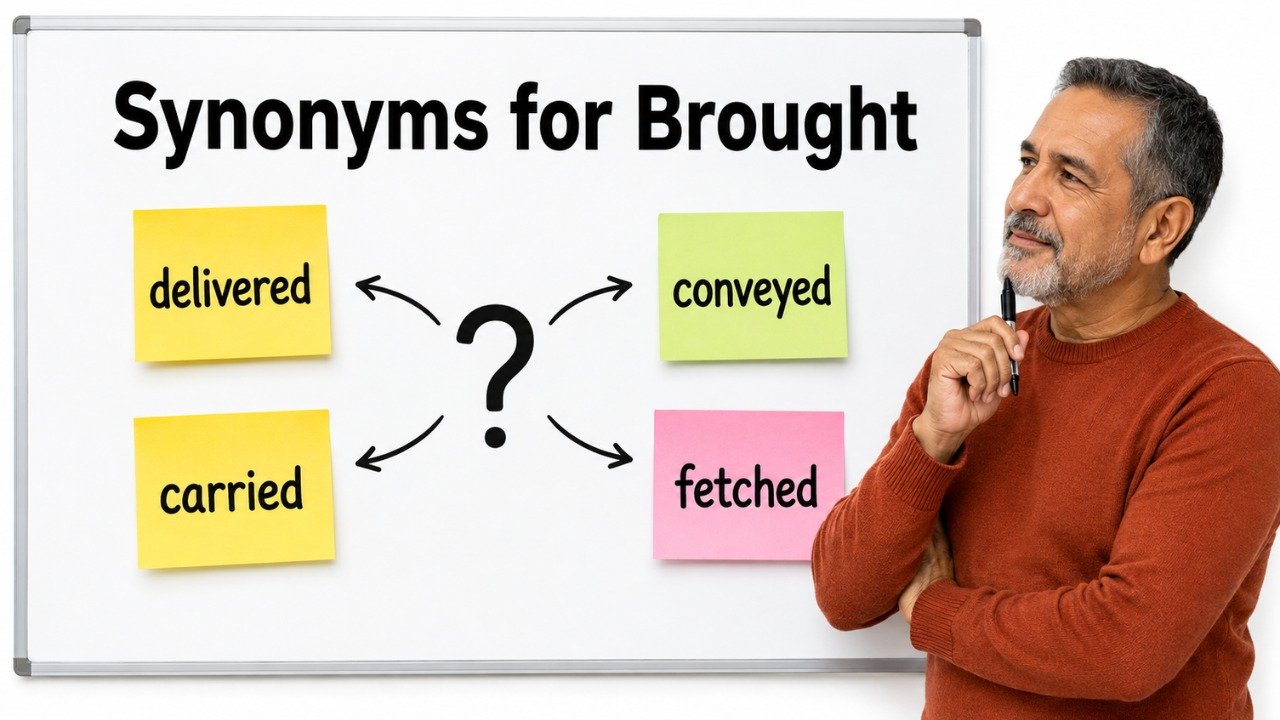
Quick Answer: Common synonyms for brought include carried, delivered, transported, fetched, provided, introduced, escorted, caused, attracted, and produced. Use carried when someone moved a physical object, delivered when something reached a destination, and fetched when someone went to get an item and returned with it. Introduced works for people or ideas, caused and triggered describe results, attracted refers to attention or interest, and produced is useful for outcomes, benefits, or evidence.
Pronunciation and Word Details
Word: Brought.
Pronunciation: /brɔːt/.
Part of Speech: Past tense and past participle of the verb bring.
Meaning: Moved, carried, delivered, caused, or introduced someone or something to a place, person, situation, or result.
US Pronunciation:
UK Pronunciation:
What Does “Brought” Mean?
Brought means carried, moved, delivered, or caused someone or something to arrive at a place, person, condition, or result.
It is the past tense and past participle form of bring. The word is irregular because it does not form its past tense by simply adding ed.
Brought can describe the physical movement of an object.
Example: She brought a glass of water to the table.
It can describe taking a person somewhere.
Example: He brought his cousin to the celebration.
It can also describe causing a situation, feeling, or result.
Example: The announcement brought relief to the community.
Brought may refer to introducing a person, topic, idea, or product.
Example: The teacher brought a new topic into the discussion.
It can also mean attracting attention, customers, visitors, or opportunities.
Example: The new display brought more visitors into the shop.
The correct synonym depends on what was moved, delivered, introduced, attracted, or caused.
Meaning, Tone, and Context of “Brought”
Brought has a neutral tone and appears naturally in both formal and casual English. It is common in conversations, stories, reports, essays, emails, instructions, and professional communication.
In casual speech, brought usually describes carrying an object or taking someone to a place.
Casual Example: I brought my lunch from home.
In formal writing, it may describe causes, effects, changes, evidence, or achievements.
Formal Example: The updated process brought significant improvements in accuracy.
In narrative writing, brought can describe movement, emotion, memory, or change.
Narrative Example: The familiar music brought memories of childhood.
In academic or professional contexts, brought may explain how an action created a particular result.
Academic Example: The discovery brought greater attention to the subject.
Brought is useful because it has several meanings. However, this flexibility can also make it vague. A more specific synonym such as delivered, caused, introduced, or attracted may communicate the intended meaning more clearly.
When and How to Use “Brought”
For Carrying an Object
Use brought when someone carried an item to the speaker, listener, or another stated location.
Example: Mia brought the documents into the office.
For Delivering Something
Use brought when an item, message, package, or supply reached a person or destination.
Example: The driver brought the order before noon.
For Taking a Person Somewhere
Use brought when someone accompanied or transported another person to a place.
Example: Daniel brought his parents to the ceremony.
For Retrieving an Item
Use brought when someone went somewhere, collected something, and returned with it.
Example: She brought the book I had requested.
For Causing a Result
Use brought when an action created a condition, event, or consequence.
Example: The heavy rain brought flooding to several streets.
For Creating an Emotion
Use brought when something caused happiness, sadness, relief, fear, or another feeling.
Example: His kind message brought comfort to the family.
For Introducing a Person or Idea
Use brought when someone introduced a new person, subject, method, or perspective.
Example: The speaker brought a fresh perspective to the discussion.
For Attracting Attention or Interest
Use brought when something attracted visitors, customers, support, or public interest.
Example: The unusual design brought attention to the exhibition.
For Producing a Benefit
Use brought when an action produced progress, success, income, or improvement.
Example: The changes brought better results for the entire team.
For Combining People
Use brought when an event, goal, or experience united people.
Example: The community project brought neighbors together.
Best Synonyms for Brought
Carried
Synonym: Carried means moved something while holding or supporting it.
Example: She carried the basket into the kitchen.
Delivered
Synonym: Delivered means took something to its intended person or destination.
Example: The courier delivered the package safely.
Transported
Synonym: Transported means moved a person or object from one place to another.
Example: The vehicle transported the equipment to the site.
Fetched
Synonym: Fetched means went to get someone or something and returned with them.
Example: He fetched a chair from the next room.
Provided
Synonym: Provided means supplied something that was needed or requested.
Example: The instructor provided additional examples.
Introduced
Synonym: Introduced means presented a person, idea, subject, or method for the first time.
Example: The course introduced several useful concepts.
Escorted
Synonym: Escorted means accompanied and guided someone to a destination.
Example: A staff member escorted the guests to their seats.
Caused
Synonym: Caused means made an event, condition, or result happen.
Example: The error caused a delay in production.
Attracted
Synonym: Attracted means drew attention, interest, people, or support.
Example: The colorful garden attracted many visitors.
Produced
Synonym: Produced means created, generated, or resulted in something.
Example: The new method produced more accurate results.
50 Synonyms for Brought with Short Meanings
- Carried: Moved something while holding or supporting it.
- Delivered: Took something to its intended destination.
- Transported: Moved someone or something between places.
- Conveyed: Carried or communicated something to another place or person.
- Fetched: Went to get something and returned with it.
- Retrieved: Collected something from another location.
- Hauled: Moved something large, heavy, or difficult to carry.
- Moved: Changed the location or position of something.
- Transferred: Moved something from one person, place, or system to another.
- Shipped: Sent goods to a destination.
- Imported: Brought goods or services into a country or region.
- Supplied: Gave something that was needed.
- Provided: Made something available for use.
- Presented: Offered or showed something to others.
- Offered: Made something available for acceptance.
- Handed: Passed something directly to another person.
- Gave: Provided or transferred possession of something.
- Introduced: Presented a person, subject, or idea for the first time.
- Escorted: Accompanied someone to a destination.
- Accompanied: Went somewhere with another person.
- Guided: Directed someone toward a place or result.
- Led: Showed someone the way or influenced an outcome.
- Ushered: Guided someone politely into a place.
- Invited: Asked someone to come to an event or place.
- Attracted: Drew people, interest, or attention.
- Drew: Pulled attention, support, or people toward something.
- Gathered: Collected people or objects in one place.
- Summoned: Called someone to come to a particular place.
- Caused: Made something happen.
- Created: Made a new situation, feeling, or result.
- Produced: Generated a result, effect, or product.
- Generated: Created energy, interest, income, or another result.
- Triggered: Started an event, reaction, or process.
- Prompted: Caused or encouraged an action or response.
- Provoked: Caused a strong reaction or feeling.
- Sparked: Started an idea, discussion, emotion, or event.
- Resulted In: Ended by producing a particular outcome.
- Led To: Caused or contributed to a result.
- Gave Rise To: Caused something to begin or develop.
- Occasioned: Caused a particular event or situation.
- Induced: Caused a condition, action, or response.
- Contributed To: Helped cause a particular result.
- Achieved: Successfully produced a desired result.
- Earned: Gained something through work, effort, or success.
- Secured: Successfully obtained something valuable.
- Obtained: Acquired or gained something.
- Yielded: Produced a result, profit, or benefit.
- Forwarded: Sent a message, document, or item onward.
- Submitted: Presented something for consideration or approval.
- Returned With: Came back carrying or accompanying something.
Synonyms for Brought by Context
When Brought Means Carried an Object
Carried, transported, hauled, moved, and conveyed work when a physical object changed location.
Carried is the most natural option when a person held the object.
Brought Example: She brought the boxes upstairs.
Carried Example: She carried the boxes upstairs.
Transported is more formal and often suggests the use of a vehicle or organized system.
Brought Example: The company brought the equipment to the construction site.
Transported Example: The company transported the equipment to the construction site.
Hauled is suitable for large or heavy objects.
Brought Example: They brought the damaged furniture outside.
Hauled Example: They hauled the damaged furniture outside.
When Brought Means Delivered
Delivered, shipped, forwarded, handed, and supplied describe giving or sending something to a person or destination.
Delivered is best for packages, orders, messages, and formal documents.
Brought Example: The assistant brought the report to the director.
Delivered Example: The assistant delivered the report to the director.
Handed describes passing something directly from one person to another.
Brought Example: She brought me the application form.
Handed Example: She handed me the application form.
Supplied works when the item was needed for a task or purpose.
Brought Example: The organization brought food to the affected families.
Supplied Example: The organization supplied food to the affected families.
When Brought Means Fetched
Fetched and retrieved are useful when someone went to another place to get something.
Fetched is common in everyday communication.
Brought Example: He brought a blanket from the bedroom.
Fetched Example: He fetched a blanket from the bedroom.
Retrieved sounds more formal and often suggests recovering an item from storage or a specific location.
Brought Example: The clerk brought the archived document.
Retrieved Example: The clerk retrieved the archived document.
When Brought Means Accompanied a Person
Escorted, accompanied, guided, led, and ushered describe helping or taking a person to a place.
Escorted suggests responsibility, protection, or formality.
Brought Example: The officer brought the visitor to the meeting room.
Escorted Example: The officer escorted the visitor to the meeting room.
Accompanied simply means that one person went with another.
Brought Example: She brought her younger brother to the event.
Accompanied Example: She accompanied her younger brother to the event.
Ushered usually means politely guiding someone into a room, seat, or event.
Brought Example: The host brought the guests into the hall.
Ushered Example: The host ushered the guests into the hall.
When Brought Means Caused
Caused, triggered, prompted, sparked, produced, and led to describe the creation of an event or result.
Caused is the clearest general alternative.
Brought Example: The power failure brought confusion.
Caused Example: The power failure caused confusion.
Triggered is useful for sudden reactions or processes.
Brought Example: The comment brought an angry response.
Triggered Example: The comment triggered an angry response.
Sparked is often used for discussions, ideas, interest, conflict, or emotions.
Brought Example: The article brought a wider discussion about safety.
Sparked Example: The article sparked a wider discussion about safety.
When Brought Means Introduced
Introduced, presented, submitted, and offered work when a new person, subject, plan, or possibility entered a situation.
Introduced is best for people, ideas, methods, and topics.
Brought Example: The instructor brought a new concept into the lesson.
Introduced Example: The instructor introduced a new concept during the lesson.
Presented works for proposals, evidence, arguments, or information.
Brought Example: The lawyer brought new evidence before the court.
Presented Example: The lawyer presented new evidence to the court.
Submitted is useful when a document or proposal was formally given for review.
Brought Example: The group brought a proposal to the committee.
Submitted Example: The group submitted a proposal to the committee.
When Brought Means Attracted
Attracted, drew, gathered, and generated work when something gained attention, visitors, customers, or interest.
Attracted is the strongest general replacement.
Brought Example: The festival brought thousands of visitors.
Attracted Example: The festival attracted thousands of visitors.
Drew is concise and works well in reports and news style writing.
Brought Example: The performance brought a large audience.
Drew Example: The performance drew a large audience.
Generated is useful for attention, interest, publicity, income, or demand.
Brought Example: The announcement brought considerable interest.
Generated Example: The announcement generated considerable interest.
When Brought Means Produced a Result
Produced, generated, yielded, achieved, earned, and secured describe benefits or successful outcomes.
Produced works for measurable results.
Brought Example: The changes brought better performance.
Produced Example: The changes produced better performance.
Yielded is useful for profits, findings, evidence, crops, and measurable benefits.
Brought Example: The research brought useful findings.
Yielded Example: The research yielded useful findings.
Earned works when effort resulted in money, respect, praise, or recognition.
Brought Example: Her dedication brought the respect of her colleagues.
Earned Example: Her dedication earned the respect of her colleagues.
Another Word for Brought
Carried is often the best single replacement for brought when the sentence describes moving a physical object. However, brought has several meanings, so no single synonym works in every context.
Use delivered for items sent to a destination, fetched for something collected and returned, introduced for new ideas or people, and caused for results or effects.
Original: Lena brought the bags into the house.
Better Option: Lena carried the bags into the house.
Original: The employee brought the parcel to reception.
Better Option: The employee delivered the parcel to reception.
Original: The new rule brought confusion among the staff.
Better Option: The new rule caused confusion among the staff.
Original: The speaker brought an interesting idea into the conversation.
Better Option: The speaker introduced an interesting idea into the conversation.
When Not to Use “Brought”
Avoid brought when it does not clearly explain whether something was carried, delivered, caused, attracted, or introduced. A more precise synonym can make the sentence easier to understand.
Weak: The campaign brought something positive to the area.
Better: The campaign generated new employment opportunities in the area.
Do not use brought when delivered is more accurate for packages, messages, or official documents.
Weak: The courier brought the package at noon.
Better: The courier delivered the package at noon.
Avoid brought when the sentence describes a cause and effect relationship that needs to be explicit.
Weak: The mistake brought a serious delay.
Better: The mistake caused a serious delay.
Do not use brought when fetched better communicates that someone went to get an item.
Weak: He brought a chair from the storage room.
Better: He fetched a chair from the storage room.
Brought can also sound repetitive when several sentences use it for different meanings.
Weak: She brought the files, brought the new employee inside, and brought a change to the schedule.
Better: She delivered the files, escorted the new employee inside, and introduced a change to the schedule.
Avoid brought when took is required by the direction of movement. Bring usually describes movement toward the speaker, listener, or destination under discussion. Take usually describes movement away from the current location.
Weak: Please bring these boxes to the storage room when you leave here.
Better: Please take these boxes to the storage room when you leave here.
Words Commonly Confused With Brought
Brought vs Bought: Brought is the past tense of bring and means carried, delivered, or caused. Bought is the past tense of buy and means purchased something with money.
Brought Example: She brought fresh bread to the picnic.
Bought Example: She bought fresh bread from the bakery.
Brought vs Took: Brought usually describes movement toward a person or destination. Took usually describes movement away from a place or person.
Brought Example: He brought the documents to my office.
Took Example: He took the documents from my office.
Brought vs Carried: Brought focuses on arrival at a destination. Carried focuses on the physical action of holding and moving something.
Brought Example: Nora brought the basket to the table.
Carried Example: Nora carried the heavy basket with both hands.
Brought vs Fetched: Brought means arrived with something. Fetched means went to get something and returned with it.
Brought Example: He brought some extra chairs.
Fetched Example: He fetched some extra chairs from the basement.
Brought vs Delivered: Brought is a broad everyday word. Delivered specifically means that an item reached its intended recipient or destination.
Brought Example: She brought the letter to the office.
Delivered Example: She delivered the letter to the correct department.
Brought vs Caused: Brought can describe an outcome, but caused states the relationship more directly.
Brought Example: The news brought concern.
Caused Example: The news caused concern.
Brought vs Introduced: Brought can refer generally to adding something to a situation. Introduced clearly describes presenting something new.
Brought Example: The update brought several new features.
Introduced Example: The update introduced several new features.
Which Synonym Should You Choose?
Choose carried when someone physically held and moved an object.
Choose delivered when a package, message, document, or order reached its intended destination.
Choose transported when people, goods, or equipment were moved through an organized method or vehicle.
Choose fetched when someone went to get an item or person and returned.
Choose retrieved when something was collected from storage, a system, or a distant location.
Choose supplied when someone gave materials, food, equipment, or other necessary items.
Choose provided when something useful, necessary, or requested was made available.
Choose handed when an object passed directly from one person to another.
Choose escorted when someone accompanied a visitor, guest, child, or official to a destination.
Choose introduced when writing about a new person, idea, rule, feature, topic, or method.
Choose presented when evidence, information, or a proposal was formally shown.
Choose submitted when a document, request, or proposal was given for consideration.
Choose caused when an action clearly created a result or problem.
Choose triggered when something started a sudden reaction, process, or event.
Choose sparked when an event started interest, debate, conflict, or emotion.
Choose led to when explaining a connection between an action and a later result.
Choose attracted when something gained visitors, customers, interest, or attention.
Choose generated when something created demand, income, interest, or discussion.
Choose produced when an action created measurable results.
Choose yielded when research, work, or investment produced useful findings or benefits.
Choose earned when effort brought money, praise, respect, or recognition.
Real Life Examples of “Brought” in Sentences
Original: Sofia brought the groceries into the kitchen.
Better Option: Sofia carried the groceries into the kitchen.
Original: The driver brought our order before noon.
Better Option: The driver delivered our order before noon.
Original: Amir brought another chair from the hallway.
Better Option: Amir fetched another chair from the hallway.
Original: The guide brought the visitors to the main entrance.
Better Option: The guide escorted the visitors to the main entrance.
Original: The teacher brought a new method into the classroom.
Better Option: The teacher introduced a new method in the classroom.
Original: The storm brought widespread damage to the region.
Better Option: The storm caused widespread damage throughout the region.
Original: Her question brought an interesting discussion.
Better Option: Her question sparked an interesting discussion.
Original: The special event brought many families to the park.
Better Option: The special event attracted many families to the park.
Original: The revised plan brought better results.
Better Option: The revised plan produced better results.
Original: His years of service brought him widespread respect.
Better Option: His years of service earned him widespread respect.
Synonym Groups and Usage Differences
Physical Movement Group
Carried, transported, conveyed, hauled, moved, and transferred describe physical movement.
Carried emphasizes holding an object. Transported is more formal and may involve a vehicle. Hauled suggests weight or difficulty. Transferred means moving something between locations, people, or systems.
Example: The workers transported the equipment to the new building.
Delivery and Supply Group
Delivered, shipped, supplied, provided, handed, and forwarded describe sending or giving something.
Delivered focuses on reaching a destination. Supplied and provided focus on meeting a need. Handed describes direct physical transfer. Forwarded is common for messages and documents.
Example: The coordinator forwarded the updated schedule to every participant.
Guidance and Accompaniment Group
Escorted, accompanied, guided, led, and ushered describe taking or directing a person somewhere.
Escorted sounds formal or protective. Accompanied simply means going with someone. Guided emphasizes direction or assistance. Ushered suggests polite movement into a place.
Example: The receptionist escorted the guest to the conference room.
Cause and Effect Group
Caused, triggered, prompted, provoked, sparked, and led to describe how one event created another.
Caused is general and direct. Triggered often suggests a sudden reaction. Prompted usually leads to an action or decision. Sparked commonly refers to discussions, ideas, and emotions.
Example: The unexpected result prompted the researchers to repeat the test.
Introduction and Presentation Group
Introduced, presented, offered, submitted, and provided describe placing a person, idea, or item before others.
Introduced is best for new subjects and people. Presented is useful for information and evidence. Submitted suggests formal consideration. Offered emphasizes availability or choice.
Example: The manager presented a revised proposal to the committee.
Attention and Attraction Group
Attracted, drew, gathered, and generated describe gaining attention, interest, or people.
Attracted is the clearest general term. Drew is concise and natural. Generated works well with attention, interest, publicity, income, and demand.
Example: The announcement generated considerable public interest.
Achievement and Result Group
Produced, achieved, earned, secured, obtained, and yielded describe successful results.
Produced emphasizes creation. Achieved describes reaching a goal. Earned involves effort. Secured suggests gaining something valuable or difficult to obtain. Yielded often describes measurable findings or returns.
Example: The experiment yielded useful information.
Antonyms of Brought
The antonym of brought changes according to its meaning. When brought means carried toward a place, the opposite may be took away or removed. When it means caused, the opposite may be prevented. When it means attracted, the opposite may be repelled.
Took Away: Moved something away from a place or person.
Removed: Took something out of its position or location.
Carried Off: Moved something away from its original place.
Left Behind: Failed to bring someone or something.
Withheld: Refused to give or provide something.
Kept: Continued holding something instead of delivering it.
Prevented: Stopped an event or result from happening.
Stopped: Ended or blocked an action or process.
Discouraged: Reduced interest, confidence, or willingness.
Repelled: Drove people, attention, or interest away.
Dismissed: Sent someone away or rejected an idea.
Excluded: Kept someone or something out of a group or situation.
Exported: Sent goods out of a country rather than bringing them in.
Separated: Moved people or things apart rather than bringing them together.
Comparison: Brought vs Related Words
Brought vs Carried
Brought emphasizes that something arrived at a destination. Carried emphasizes the action of physically holding and moving it.
Example With Brought: She brought the child a warm blanket.
Example With Carried: She carried the warm blanket under her arm.
Brought vs Delivered
Brought is broad and conversational. Delivered is more specific and shows that something reached its intended recipient.
Example With Brought: The assistant brought the documents to the office.
Example With Delivered: The assistant delivered the documents to the department manager.
Brought vs Took
Brought usually describes movement toward the speaker, listener, or stated destination. Took usually describes movement away from a starting point.
Example With Brought: He brought the keys to me.
Example With Took: He took the keys from my desk.
Brought vs Fetched
Brought means arrived with something. Fetched includes the additional idea of going to get it.
Example With Brought: She brought a glass of water.
Example With Fetched: She fetched a glass of water from the kitchen.
Brought vs Caused
Brought can express a result in a natural or emotional way. Caused makes the relationship more direct and precise.
Example With Brought: The unexpected delay brought frustration.
Example With Caused: The unexpected delay caused frustration.
Brought vs Introduced
Brought can mean added something to a situation. Introduced clearly indicates that the subject, person, or method was new.
Example With Brought: The discussion brought a new question into focus.
Example With Introduced: The discussion introduced a new question.
Brought vs Attracted
Brought describes the arrival of people or attention. Attracted explains why they came.
Example With Brought: The event brought many visitors to the town.
Example With Attracted: The event attracted many visitors to the town.
Brought vs Produced
Brought can describe a general result. Produced is more precise for measurable outcomes, products, or evidence.
Example With Brought: The training brought noticeable improvements.
Example With Produced: The training produced noticeable improvements.
Common Phrases and Expressions With Brought
Brought Back: Returned someone or something, or caused a memory or feeling to return.
Example: The photograph brought back happy memories.
Brought About: Caused an event, change, or result.
Example: The new policy brought about several improvements.
Brought Up: Mentioned a topic or raised a child.
Example: She brought up an important concern during the meeting.
Brought In: Introduced, earned, attracted, or moved something inside.
Example: The event brought in additional income.
Brought Out: Revealed a quality or made something available.
Example: The challenge brought out his leadership skills.
Brought Along: Took a person or object to a place.
Example: He brought along a notebook for taking notes.
Brought Forward: Presented an idea, proposal, date, or piece of information for earlier consideration.
Example: The committee brought forward a practical solution.
Brought Together: United people, ideas, or objects.
Example: The community project brought together people of different ages.
Brought Home: Made an idea feel clear, personal, or emotionally powerful.
Example: The story brought home the importance of preparation.
Brought to Light: Revealed information that had previously been hidden or unknown.
Example: The investigation brought several problems to light.
Common Mistakes to Avoid
A common mistake is confusing brought with bought. Brought comes from bring, while bought comes from buy.
Incorrect: She bought her sister to the event.
Correct: She brought her sister to the event.
Another mistake is using bring instead of brought for a completed past action.
Incorrect: He bring the documents yesterday.
Correct: He brought the documents yesterday.
Do not write brang or brung in standard English. Brought is both the simple past form and the past participle form of bring.
Incorrect: She brang the keys this morning.
Correct: She brought the keys this morning.
Incorrect: They have brung enough chairs.
Correct: They have brought enough chairs.
Writers also confuse brought and took. Consider the direction of movement before choosing the verb.
Incorrect: I brought the package away from the office.
Better: I took the package away from the office.
Avoid repeating brought when a precise synonym would make the writing clearer.
Repetitive: The program brought jobs, brought investment, and brought public interest.
Improved: The program created jobs, attracted investment, and generated public interest.
Do not choose carried when the main idea is delivery rather than physical effort.
Less Precise: The courier carried the parcel to the customer.
More Precise: The courier delivered the parcel to the customer.
Avoid using caused for every emotional or creative sentence. Brought can sound more natural when describing memories, comfort, joy, or sadness.
Mechanical: The song caused memories of childhood.
Natural: The song brought back memories of childhood.
Make sure the object of brought is clear. Readers should immediately understand what arrived, changed, or resulted.
Vague: The decision brought many things.
Clear: The decision brought greater stability and clearer responsibilities.
Conclusion
Learning synonyms for brought helps you describe movement, delivery, cause, attraction, introduction, and results with greater precision. Use carried for physical objects, delivered for packages or messages, fetched for retrieved items, and escorted for people. Choose caused, triggered, or sparked for effects, introduced for new ideas, attracted for attention, and produced or yielded for results. The best replacement always depends on what was brought, where it went, and what effect it created.
FAQs About Synonyms for Brought
What Is the Best Synonym for Brought?
Carried is the best general synonym when a physical object was moved. For other contexts, delivered, caused, introduced, or attracted may be more accurate.
What Is a Formal Synonym for Brought?
Transported, conveyed, delivered, introduced, and produced are useful formal alternatives. The correct choice depends on the intended meaning.
What Is Another Word for Brought Something to Someone?
Delivered, handed, carried, or provided may work. Use delivered when the item reached its intended recipient.
What Is a Synonym for Brought Someone Somewhere?
Escorted, accompanied, guided, led, or transported can replace brought when referring to a person.
What Is a Synonym for Brought About?
Caused, created, triggered, produced, generated, and led to are strong alternatives for brought about.
What Is the Difference Between Brought and Bought?
Brought is the past tense of bring. Bought is the past tense of buy. Brought concerns carrying or causing, while bought concerns purchasing.
Is Brought the Past Tense of Bring?
Yes. Brought is both the simple past form and the past participle form of bring.
Simple Past Example: She brought the files yesterday.
Past Participle Example: She has brought all the required files.
