
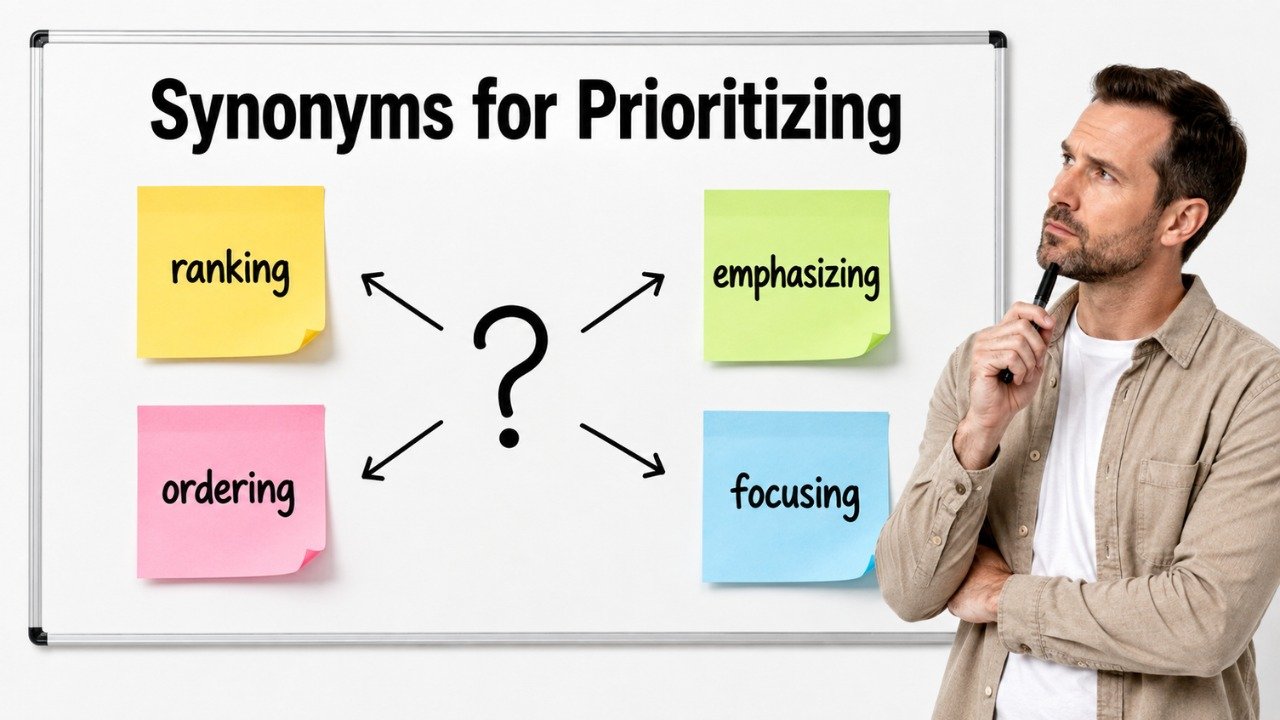
Quick Answer: The best synonyms for prioritizing include ranking, ordering, focusing on, emphasizing, favoring, scheduling, selecting, triaging, putting first, and giving precedence to. Use ranking when placing items in order of importance, focusing on when directing attention, emphasizing when highlighting significance, triaging when handling urgent needs, and scheduling when arranging tasks by time. Putting first works well in casual speech, while assigning priority to and giving precedence to are better choices for formal writing.
Pronunciation and Word Details
Word: Prioritizing.
Pronunciation: /praɪˈɔːrətaɪzɪŋ/.
Part of Speech: Present participle and gerund form of the verb prioritize.
Meaning: Deciding that one task, goal, need, or person is more important and should receive attention before others.
US Pronunciation:
UK Pronunciation:
What Does “Prioritizing” Mean?
Prioritizing means deciding what is most important and dealing with it before less important matters. It is the present participle or gerund form of the verb prioritize.
The word is often used when people arrange tasks, responsibilities, goals, expenses, or needs according to importance. It can describe an action happening now, an ongoing strategy, or the general process of setting priorities.
As an Ongoing Action: She is prioritizing urgent customer requests.
As a General Process: Prioritizing your responsibilities can reduce confusion.
In Planning: The team began prioritizing projects with the greatest value.
In Personal Decisions: He is prioritizing his family this month.
In Resource Management: The department is prioritizing essential services.
Prioritizing does not always mean that unselected tasks are unimportant. It usually means that some matters must receive attention, time, money, or energy before others.
Meaning, Tone, and Context of “Prioritizing”
Prioritizing has a neutral and practical tone. It is common in professional, academic, technical, personal, and conversational contexts.
In formal writing, prioritizing often refers to strategic planning, resource allocation, project management, policy decisions, or organizational goals. In everyday speech, it may describe putting family, health, work, rest, or personal responsibilities first.
Professional Tone: Managers use prioritizing when discussing deadlines, budgets, workloads, and business goals.
Academic Tone: Students may discuss prioritizing research questions, assignments, or evidence.
Technical Tone: Specialists may prioritize system errors, safety risks, or development tasks.
Personal Tone: A person may talk about prioritizing sleep, relationships, exercise, or financial stability.
Strategic Tone: Leaders use the word when deciding which goals deserve immediate investment.
The word usually sounds responsible and intentional. However, it can sound vague when the writer does not explain what is being prioritized or why it matters.
When and How to Use “Prioritizing”
For Ranking Responsibilities
Use prioritizing when deciding which responsibilities are most important.
Example: She is prioritizing the tasks that must be completed before noon.
For Managing Urgent Needs
Use it when urgent issues require attention before routine matters.
Example: The medical team is prioritizing patients with the most serious symptoms.
For Planning Time
Use prioritizing when organizing activities according to deadlines, value, or necessity.
Example: He is prioritizing exam preparation over optional activities.
For Allocating Resources
Use it when deciding where money, employees, equipment, or effort should be directed.
Example: The organization is prioritizing funding for essential repairs.
For Expressing Personal Values
Use prioritizing when someone chooses to give more attention to a person, belief, or life goal.
Example: She is prioritizing her family during a demanding period.
For Improving Productivity
Use it when reducing distractions and concentrating on high value work.
Example: Prioritizing the most meaningful assignments helped him finish earlier.
For Strategic Decisions
Use it when selecting goals that offer the strongest results or greatest benefits.
Example: The committee is prioritizing projects that support long term growth.
For Safety and Risk
Use it when serious dangers must be addressed before minor concerns.
Example: The engineers are prioritizing safety problems before cosmetic improvements.
Best Synonyms for Prioritizing
Ranking
Synonym: Ranking means placing tasks, choices, or goals in an order based on importance.
Example: The director is ranking the proposals according to their potential value.
Ordering
Synonym: Ordering means arranging items in a planned or logical sequence.
Example: She is ordering her responsibilities from most urgent to least urgent.
Focusing On
Synonym: Focusing on means directing attention and effort toward a particular matter.
Example: The team is focusing on the most important customer concerns.
Emphasizing
Synonym: Emphasizing means giving special importance or attention to something.
Example: The lesson is emphasizing clear communication and careful listening.
Favoring
Synonym: Favoring means preferring one choice, plan, or person over another.
Example: The committee is favoring proposals with practical benefits.
Scheduling
Synonym: Scheduling means arranging tasks or events according to time and importance.
Example: She is scheduling urgent meetings before routine discussions.
Triaging
Synonym: Triaging means sorting needs or problems according to urgency.
Example: The support team is triaging requests based on their seriousness.
Selecting
Synonym: Selecting means choosing particular options from a larger group.
Example: The manager is selecting the projects that deserve immediate funding.
Putting First
Synonym: Putting first means treating something as more important than other matters.
Example: He is putting safety first during the renovation.
Giving Precedence To
Synonym: Giving precedence to means allowing one matter to come before another because it is more important.
Example: The policy gives precedence to applications involving urgent needs.
50 Synonyms for Prioritizing with Short Meanings
- Ranking: Placing items in order of importance.
- Ordering: Arranging matters in a planned sequence.
- Sequencing: Deciding the order in which tasks should happen.
- Arranging: Putting tasks or choices into a useful order.
- Organizing: Structuring responsibilities so they can be managed effectively.
- Scheduling: Assigning tasks to suitable times.
- Planning: Deciding what should be done and when.
- Selecting: Choosing certain options from a larger group.
- Choosing: Deciding which task, goal, or option to pursue.
- Preferring: Liking or choosing one option more than another.
- Favoring: Giving greater support or preference to something.
- Emphasizing: Giving special importance to a subject or goal.
- Highlighting: Drawing attention to something significant.
- Focusing On: Directing attention and effort toward one matter.
- Concentrating On: Giving sustained attention to a particular goal.
- Centering: Making something the main subject or concern.
- Foregrounding: Bringing an issue into the most noticeable position.
- Elevating: Raising something to a more important position.
- Advancing: Moving a goal or proposal forward.
- Promoting: Actively supporting the importance or progress of something.
- Putting First: Treating one matter as the most important.
- Giving Precedence To: Allowing something to come before other matters.
- Assigning Priority To: Officially giving something a higher level of importance.
- Treating as Urgent: Handling something as needing immediate attention.
- Addressing First: Dealing with one issue before others.
- Handling First: Managing a task before less important work.
- Tackling First: Beginning with the most important or difficult matter.
- Considering First: Examining one concern before other concerns.
- Placing Importance On: Treating something as especially valuable.
- Making Primary: Turning something into the main concern.
- Making Central: Placing something at the center of attention or planning.
- Putting at the Top: Giving something the highest position on a list.
- Moving to the Front: Bringing a matter forward for earlier attention.
- Giving Preference To: Choosing one option ahead of another.
- Singling Out: Selecting one matter for special attention.
- Designating as Important: Officially identifying something as significant.
- Marking as Urgent: Labeling a matter as requiring quick action.
- Rating: Judging the importance, quality, or value of something.
- Grading: Placing matters into different levels of importance.
- Sorting: Separating tasks or choices into useful groups.
- Classifying: Organizing items according to type, level, or importance.
- Triaging: Sorting problems according to urgency and seriousness.
- Setting Priorities For: Deciding which matters should receive attention first.
- Allocating Resources To: Directing money, people, or materials toward a goal.
- Directing Attention To: Guiding focus toward a particular issue.
- Concentrating Resources On: Using available support mainly for one purpose.
- Establishing an Order of Importance: Creating a clear ranking from most important to least important.
- Determining Importance: Judging how much attention something deserves.
- Making a Top Concern: Treating an issue as one of the most important matters.
- Putting Ahead of Others: Choosing to deal with something before competing concerns.
Read Also:
Synonyms for Peace of Mind
Synonyms for Prioritizing by Context
When Prioritizing Means Ranking Tasks
Use ranking, ordering, sequencing, rating, or establishing an order of importance when tasks must be placed from most important to least important.
Ranking Example: She is ranking the assignments according to their deadlines.
Ordering Example: He is ordering the repairs by urgency.
Sequencing Example: The coordinator is sequencing each stage of the project carefully.
Rating Example: The panel is rating each proposal according to its value.
When Prioritizing Means Focusing Attention
Use focusing on, concentrating on, centering, emphasizing, or highlighting when attention is directed toward a main subject.
Focusing On Example: The discussion is focusing on practical solutions.
Concentrating On Example: She is concentrating on the work that requires careful thought.
Centering Example: The program is centering the needs of local families.
Emphasizing Example: The teacher is emphasizing clear sentence structure.
When Prioritizing Means Handling Urgent Matters
Use triaging, addressing first, tackling first, treating as urgent, or marking as urgent when immediate action is needed.
Triaging Example: The staff is triaging complaints based on seriousness.
Addressing First Example: The council is addressing safety concerns first.
Tackling First Example: He is tackling the most difficult problem first.
Treating as Urgent Example: The company is treating the equipment failure as urgent.
When Prioritizing Means Preferring One Choice
Use preferring, favoring, selecting, choosing, or giving preference to when one option is chosen over another.
Preferring Example: Many readers are preferring the clearer explanation.
Favoring Example: The committee is favoring the less expensive proposal.
Selecting Example: She is selecting courses that support her career goals.
Giving Preference To Example: The program is giving preference to applicants with relevant experience.
When Prioritizing Means Planning Resources
Use allocating resources to, concentrating resources on, scheduling, planning, or advancing when time, money, or effort must be managed.
Allocating Resources To Example: The department is allocating resources to essential services.
Scheduling Example: The supervisor is scheduling urgent repairs before routine maintenance.
Planning Example: The family is planning its expenses around essential needs.
Advancing Example: The group is advancing projects that can deliver immediate benefits.
Another Word for Prioritizing
The best single replacement for prioritizing is often ranking because it clearly communicates the idea of arranging tasks or options by importance. However, the best alternative depends on the context.
Use focusing on when attention is the main idea, scheduling when time is being arranged, triaging when urgency is involved, and favoring when one choice is preferred.
Original: The team is prioritizing the most urgent requests.
Better Option: The team is triaging the requests according to urgency.
Original: She is prioritizing her final assignment.
Better Option: She is focusing on her final assignment.
Original: The manager is prioritizing the afternoon meetings.
Better Option: The manager is scheduling the afternoon meetings according to importance.
Original: The committee is prioritizing practical proposals.
Better Option: The committee is favoring practical proposals.
When Not to Use “Prioritizing”
Do not use prioritizing repeatedly when a more precise verb can explain the action. The word can become vague when the reader does not know whether you mean ranking, scheduling, selecting, emphasizing, or handling an urgent problem.
Avoid using it when all items are receiving equal attention. Prioritizing suggests that one matter is more important or will be handled earlier than another.
It may also sound unnecessarily formal in simple personal statements. Putting first or focusing on may sound more natural in casual conversation.
Weak: I am prioritizing some things this week.
Better: I am focusing on my final exam and project deadline this week.
Weak: The manager is prioritizing the work.
Better: The manager is ranking the tasks according to urgency.
Weak: The team is prioritizing every request equally.
Better: The team is giving every request equal attention.
Weak: She is prioritizing going home early.
Better: She is choosing to go home early.
Weak: The department is prioritizing the budget.
Better: The department is allocating more funding to essential repairs.
A precise synonym helps readers understand the exact action being taken.
Words Commonly Confused With Prioritizing
Prioritizing vs Organizing: Prioritizing means deciding what matters most. Organizing means arranging tasks, materials, or information so they are easier to manage. You can organize a list without deciding which item is most important.
Prioritizing vs Ranking: Prioritizing is the broader process of giving greater importance to something. Ranking specifically means placing several items in a numbered or ordered position.
Prioritizing vs Scheduling: Prioritizing decides what deserves attention first. Scheduling decides when a task will happen. A task can be highly important but scheduled for a later date because of practical limits.
Prioritizing vs Emphasizing: Prioritizing affects order, attention, or resources. Emphasizing draws attention to an idea without necessarily changing the order in which tasks are completed.
Prioritizing vs Preferring: Prioritizing is usually based on importance, urgency, or value. Preferring is often based on personal choice, taste, or comfort.
Prioritizing vs Triaging: Prioritizing can be used in many situations. Triaging is more specific and usually involves sorting urgent problems, requests, or needs according to seriousness.
Prioritizing vs Selecting: Selecting means choosing an option. Prioritizing means deciding that one option deserves earlier or greater attention. A person may select several projects and then prioritize them.
Which Synonym Should You Choose?
Choose ranking when placing several tasks, goals, or choices in order of importance.
Choose ordering when arranging items into a practical sequence.
Choose sequencing when the order of steps affects how a process works.
Choose focusing on when attention and concentration are more important than formal ranking.
Choose emphasizing when you want to highlight the significance of an idea, rule, or value.
Choose triaging when urgent requests, emergencies, or problems must be sorted quickly.
Choose scheduling when deciding when tasks, meetings, or activities should occur.
Choose favoring when one option is receiving more support than another.
Choose selecting when choosing certain options from a larger group.
Choose putting first in casual speech and personal writing.
Choose assigning priority to in formal reports, policies, and professional documents.
Choose giving precedence to in formal writing when one matter must come before another.
Choose allocating resources to when discussing money, staff, equipment, or other limited resources.
Choose concentrating resources on when most available support is being directed toward one goal.
Choose addressing first when explaining which problem will be handled before other problems.
Real Life Examples of “Prioritizing” in Sentences
Original: She is prioritizing the assignments with the closest deadlines.
Better Option: She is ranking the assignments according to their deadlines.
Original: The company is prioritizing customer safety.
Better Option: The company is putting customer safety first.
Original: He is prioritizing his most difficult subject this evening.
Better Option: He is focusing on his most difficult subject this evening.
Original: The clinic is prioritizing patients with serious symptoms.
Better Option: The clinic is triaging patients according to the seriousness of their symptoms.
Original: The manager is prioritizing several important meetings.
Better Option: The manager is scheduling the most important meetings first.
Original: The committee is prioritizing affordable proposals.
Better Option: The committee is favoring affordable proposals.
Original: The department is prioritizing essential repairs.
Better Option: The department is allocating resources to essential repairs.
Original: She is prioritizing family responsibilities this weekend.
Better Option: She is putting family responsibilities first this weekend.
Original: The editor is prioritizing clarity in every article.
Better Option: The editor is emphasizing clarity in every article.
Original: The team is prioritizing the problem that affects the most users.
Better Option: The team is addressing the most widespread problem first.
Synonym Groups and Usage Differences
Ranking Group
Ranking, ordering, rating, grading, and establishing an order of importance describe arranging several matters according to value or urgency.
Ranking is the clearest general choice. Rating focuses on evaluating quality or importance. Ordering and sequencing focus more strongly on position.
Example: The supervisor is ranking the tasks according to urgency.
Focus Group
Focusing on, concentrating on, centering, emphasizing, and highlighting describe giving attention to a particular subject.
Focusing on suggests active attention. Emphasizing shows importance in speech or writing. Centering makes something the main concern of a plan or discussion.
Example: The workshop is focusing on practical communication skills.
Urgency Group
Triaging, addressing first, tackling first, marking as urgent, and treating as urgent describe responding to matters that need quick action.
Triaging is especially useful when several urgent needs must be compared. Tackling first sounds active and conversational.
Example: The maintenance team is triaging repair requests according to risk.
Preference Group
Preferring, favoring, selecting, choosing, and giving preference to describe choosing one option over another.
Preferring may express personal taste. Favoring can express support for an option. Selecting focuses on the act of choosing.
Example: The panel is favoring proposals with clear benefits.
Planning Group
Scheduling, planning, arranging, sequencing, and allocating resources to describe the practical management of time, tasks, or support.
Scheduling focuses on time. Allocating resources to focuses on money, people, or materials. Planning is the broadest choice.
Example: The director is allocating more staff to the busiest department.
Antonyms of Prioritizing
The opposite of prioritizing depends on whether the word refers to attention, order, urgency, preference, or importance.
Neglecting: Failing to give something necessary attention.
Ignoring: Refusing or failing to notice a matter.
Overlooking: Missing or failing to consider something important.
Postponing: Moving a task to a later time.
Delaying: Causing an action to happen later than planned.
Deprioritizing: Reducing the importance or urgency of something.
Downplaying: Making something appear less important than it is.
Dismissing: Treating an idea or concern as unworthy of attention.
Avoiding: Staying away from a task, problem, or responsibility.
Disregarding: Paying no attention to a rule, fact, or concern.
Treating Equally: Giving every option the same level of importance.
Scattering Attention: Dividing focus among too many matters without a clear order.
Comparison: Prioritizing vs Related Words
Prioritizing vs Ranking
Prioritizing means giving greater importance, attention, or resources to something. Ranking means placing several items in a clear order.
Example With Prioritizing: The team is prioritizing urgent safety improvements.
Example With Ranking: The team is ranking the improvements from most urgent to least urgent.
Prioritizing vs Focusing
Prioritizing involves choosing what deserves attention first. Focusing means directing attention toward something, even when no comparison with other tasks is involved.
Example With Prioritizing: She is prioritizing her final project over optional activities.
Example With Focusing: She is focusing on her final project this evening.
Prioritizing vs Scheduling
Prioritizing determines importance. Scheduling determines timing.
Example With Prioritizing: The manager is prioritizing the most valuable projects.
Example With Scheduling: The manager is scheduling the project meetings for Monday.
Prioritizing vs Emphasizing
Prioritizing affects decisions, order, or resources. Emphasizing makes an idea appear especially important in communication.
Example With Prioritizing: The policy is prioritizing public safety.
Example With Emphasizing: The policy is emphasizing the importance of public safety.
Prioritizing vs Preferring
Prioritizing is generally based on importance, urgency, or strategic value. Preferring often reflects personal taste or choice.
Example With Prioritizing: He is prioritizing essential expenses this month.
Example With Preferring: He is preferring the less expensive option.
Prioritizing vs Triaging
Prioritizing is a broad word used in personal and professional contexts. Triaging is more specific and involves sorting needs according to urgency.
Example With Prioritizing: The department is prioritizing serious complaints.
Example With Triaging: The department is triaging complaints according to potential harm.
Common Phrases and Expressions With Prioritizing
Prioritizing Tasks: Deciding which tasks should be completed first.
Prioritizing Goals: Determining which objectives deserve the most attention.
Prioritizing Needs: Identifying which needs are most important or urgent.
Prioritizing Safety: Treating protection from harm as a main concern.
Prioritizing Health: Giving greater attention to physical or emotional wellbeing.
Prioritizing Customers: Making customer needs an important part of decisions.
Prioritizing Quality: Giving greater importance to strong standards and reliable results.
Prioritizing Time: Using available hours for the most meaningful activities.
Prioritizing Resources: Directing money, people, or materials toward important goals.
Prioritizing What Matters: Concentrating on the people, responsibilities, or values considered most important.
Common Mistakes to Avoid
One common mistake is using prioritizing without explaining what receives priority. A clear sentence should identify the task, goal, need, or value being placed first.
Unclear: We are prioritizing this month.
Clear: We are prioritizing urgent repairs this month.
Another mistake is using prioritizing when scheduling is the intended meaning. Prioritizing identifies importance, while scheduling identifies time.
Incorrect Choice: She is prioritizing the meeting for ten in the morning.
Better Choice: She is scheduling the meeting for ten in the morning.
Writers also confuse prioritizing with organizing. Organizing creates structure, but prioritizing establishes importance.
Less Accurate: He is prioritizing his papers into folders.
Better: He is organizing his papers into folders.
Avoid repeating prioritizing in every sentence. Use ranking, focusing on, emphasizing, addressing first, or allocating resources to when those words communicate the action more precisely.
Do not claim that every task is the highest priority. When everything is described as equally urgent, the idea of priority loses its meaning.
Avoid awkward phrases such as prioritizing over something when the sentence does not identify the preferred item clearly.
Awkward: She is prioritizing over social activities.
Natural: She is prioritizing her studies over social activities.
Finally, consider your audience. Putting first may be more natural in conversation, while assigning priority to may be more suitable in formal reports.
Conclusion
Understanding synonyms for prioritizing helps you describe importance, urgency, attention, preference, and planning more precisely. Use ranking for an order of importance, focusing on for concentrated attention, triaging for urgent needs, scheduling for time management, and favoring for preference. Putting first is natural in casual language, while assigning priority to and giving precedence to suit formal writing. The strongest choice depends on whether you are arranging tasks, directing resources, highlighting a goal, or handling an immediate problem.
FAQs About Synonyms for Prioritizing
What Is the Best Synonym for Prioritizing?
Ranking is one of the best general synonyms because it clearly describes placing tasks or choices in order of importance. The best word still depends on the sentence.
What Is a Formal Synonym for Prioritizing?
Assigning priority to and giving precedence to are strong formal alternatives. They work well in reports, policies, essays, and professional communication.
What Is a Casual Way to Say Prioritizing?
Putting first and focusing on are natural choices in everyday conversation.
Example: I am putting my family first this weekend.
Is Focusing On the Same as Prioritizing?
Not exactly. Focusing on means directing attention toward something. Prioritizing means deciding that it deserves more attention or should be handled before other matters.
Can Ranking Replace Prioritizing?
Ranking can replace prioritizing when several tasks, options, or goals are being placed in order. It may not fit when the sentence refers only to attention or resource allocation.
What Synonym Should Be Used for Urgent Problems?
Triaging, addressing first, and treating as urgent are useful choices. Triaging is especially precise when several problems must be sorted according to seriousness.
Is Prioritizing a Formal Word?
Prioritizing is neutral and works in both formal and conversational language. More formal alternatives include assigning priority to, giving precedence to, and allocating resources to.
