
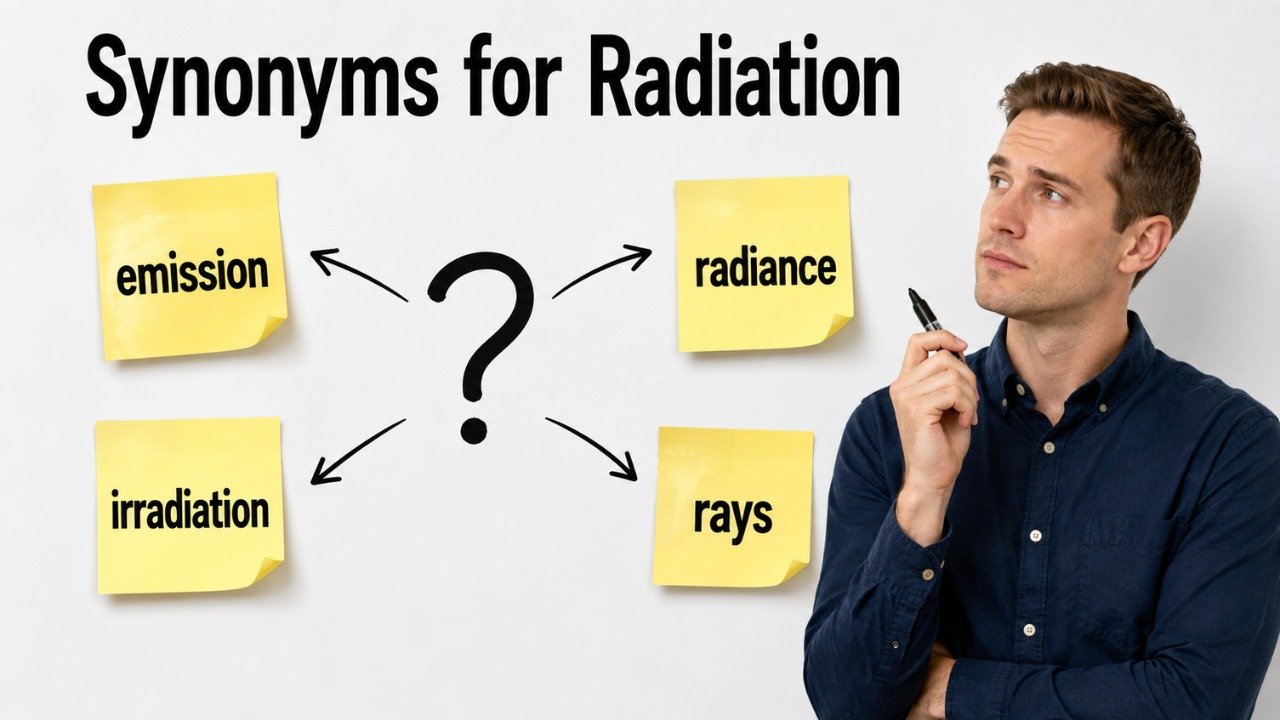
Quick Answer: The best synonyms for radiation include emission, irradiation, rays, energy, exposure, radiance, propagation, transmission, diffusion, and dispersion. Use emission when energy is released from a source, irradiation for exposure to radiation, rays for beams of energy, and radiance for visible light or brightness. Propagation and transmission suit scientific explanations of energy movement, while diffusion and dispersion describe outward spreading. These synonyms for radiation are not always interchangeable, so the correct choice depends on whether the sentence concerns physics, medicine, heat, light, or movement from a central point.
Pronunciation and Word Details
Word: Radiation.
Pronunciation: /ˌreɪ.diˈeɪ.ʃən/.
Part of Speech: Noun.
Meaning: Energy that travels through space or matter as waves or particles, or the process of spreading outward from a source.
US Pronunciation:
UK Pronunciation:
What Does “Radiation” Mean?
Radiation means energy that is emitted from a source and travels through space or matter as waves or particles.
Radiation is a noun used mainly in science, medicine, technology, environmental discussions, and safety communication. It can refer to several forms of energy, including visible light, heat, radio waves, ultraviolet energy, and ionizing radiation.
Example: The instrument measured the amount of radiation near the source.
In medical contexts, radiation may refer to energy used to examine or treat the body.
Example: The patient discussed radiation treatment with the medical team.
Radiation can also describe exposure to emitted energy.
Example: Protective material reduced radiation exposure.
In physics, the word describes the emission, movement, and transfer of energy.
Example: Heat can move through radiation without direct contact.
Radiation may also describe something spreading outward from a central point. This use appears in scientific, geographical, anatomical, and figurative descriptions.
Example: The radiation of roads from the city center created a clear pattern.
The word is broad, so its meaning should be clear from the surrounding sentence. In technical writing, it is often better to identify the exact type, such as thermal radiation, electromagnetic radiation, ultraviolet radiation, or ionizing radiation.
Meaning, Tone, and Context of “Radiation”
Radiation usually has a neutral, scientific, and technical tone. The word itself does not always imply danger. Its meaning depends on the type, strength, source, duration, and context.
In physics, radiation is a standard term for energy transmitted as waves or particles.
Example: The detector records radiation emitted by the material.
In medicine, radiation may refer to diagnostic imaging, controlled treatment, or accidental exposure.
Example: The treatment uses carefully directed radiation.
In environmental and workplace writing, radiation often appears with words such as monitoring, protection, dose, source, level, and exposure.
Example: Workers followed the required radiation safety procedures.
In discussions of light and heat, radiation is often neutral and familiar.
Example: Solar radiation warms the surface.
In everyday conversation, radiation may sound serious or alarming because people often associate it with hazardous exposure. Writers should avoid using the word vaguely when a more specific term would prevent unnecessary confusion.
Vague: The machine produces radiation.
Clearer: The machine produces low energy radio waves during operation.
Radiation can also have a formal figurative meaning related to outward movement from a center.
Example: The radiation of influence from the capital affected nearby regions.
This figurative use is less common in ordinary conversation. Spread, expansion, or outward movement may sound more natural.
When and How to Use “Radiation”
For Energy Emission
Use radiation when energy is released from a source and travels through space or matter.
Example: The star emits radiation across a wide range of wavelengths.
For Scientific Measurement
Use radiation when describing detected, measured, or calculated energy.
Example: The sensor measured background radiation in the area.
For Medical Treatment
Use radiation when discussing controlled energy used as part of a medical treatment.
Example: The medical team created a radiation treatment plan.
For Exposure
Use radiation when a person, object, or environment comes into contact with emitted energy.
Example: The shield helps reduce radiation exposure.
For Heat Transfer
Use radiation when heat moves through electromagnetic waves rather than direct contact or moving fluid.
Example: Heat from the fire reached us through radiation.
For Light and Brightness
Use radiation when describing light or radiant energy emitted from a source.
Example: The surface absorbed part of the incoming radiation.
For Energy Movement
Use radiation when explaining how energy travels outward from a source.
Example: Radiation spreads away from the source in multiple directions.
For Safety Communication
Use radiation with a specific type, level, source, or measurement whenever accuracy is important.
Example: The warning sign identified an area with controlled ionizing radiation.
For Outward Spreading
Use radiation in formal writing to describe lines, branches, or influence extending from a central point.
Example: The radiation of transport routes encouraged development around the city.
For Academic Writing
Use radiation when the technical meaning has already been defined.
Example: The study compares the absorption and reflection of solar radiation.
Best Synonyms for Radiation
Emission
Synonym: The release of energy, particles, light, heat, or another substance from a source.
Example: The instrument detected an unusual energy emission.
Irradiation
Synonym: The process of exposing something to radiation.
Example: The material changed after controlled irradiation.
Rays
Synonym: Narrow paths or beams along which energy travels.
Example: The surface reflected several rays of light.
Energy
Synonym: The capacity to produce change, motion, heat, light, or other effects.
Example: The panel absorbs energy from sunlight.
Exposure
Synonym: Contact with radiation or another environmental influence.
Example: Protective clothing helped limit exposure.
Radiance
Synonym: Light or brightness emitted from a source.
Example: The radiance of the morning sun filled the room.
Propagation
Synonym: The movement or transmission of waves through space or matter.
Example: The study examined wave propagation through the material.
Transmission
Synonym: The passage of energy or signals from one place to another.
Example: The barrier reduced the transmission of energy.
Diffusion
Synonym: The gradual spreading of energy, particles, or matter.
Example: Diffusion caused the heat to spread more evenly.
Dispersion
Synonym: The spreading or separation of energy, waves, or particles.
Example: The prism caused the dispersion of light.
50 Synonyms for Radiation with Short Meanings
- Emission: The release of energy or particles from a source.
- Irradiation: Exposure to radiation under natural or controlled conditions.
- Rays: Lines or beams along which energy travels.
- Energy: The ability to produce heat, light, motion, or change.
- Exposure: Contact with radiation or another influence.
- Radiance: Light or brightness coming from a source.
- Propagation: The movement of waves through space or matter.
- Transmission: The passage of energy from one place to another.
- Diffusion: Gradual spreading through an area or substance.
- Dispersion: The spreading or separation of waves or particles.
- Wave emission: The release of energy in wave form.
- Particle emission: The release of small energetic particles.
- Energy release: The process of sending energy outward.
- Energy transfer: The movement of energy between objects or regions.
- Energy transmission: The carrying of energy through a medium or space.
- Radiant energy: Energy transmitted through electromagnetic waves.
- Electromagnetic energy: Energy carried by electric and magnetic fields.
- Electromagnetic waves: Waves that transport energy through space or matter.
- Ionizing energy: Energy capable of removing electrons from atoms.
- Nonionizing energy: Energy that does not normally remove electrons from atoms.
- Radio waves: Low frequency electromagnetic waves used in communication.
- Microwaves: Electromagnetic waves used in communication, sensing, and heating.
- Infrared energy: Electromagnetic energy commonly associated with heat.
- Visible light: Electromagnetic radiation detectable by human vision.
- Ultraviolet energy: Electromagnetic energy beyond visible violet light.
- X rays: High energy electromagnetic waves used in imaging and analysis.
- Gamma rays: Highly energetic electromagnetic waves from certain processes.
- Thermal radiation: Energy emitted because of an object’s temperature.
- Heat radiation: Heat transferred through electromagnetic waves.
- Solar radiation: Energy that comes from the sun.
- Cosmic radiation: High energy radiation originating beyond Earth.
- Background radiation: Low level radiation naturally present in the environment.
- Nuclear radiation: Radiation associated with changes in atomic nuclei.
- Atomic radiation: Energy or particles released through atomic processes.
- Radiant heat: Heat transferred by electromagnetic radiation.
- Light emission: The release of visible or near visible energy.
- Luminosity: The amount of light or energy emitted by an object.
- Illumination: Light that falls on or brightens an area.
- Glow: A steady or gentle emission of light.
- Brightness: The visible intensity of emitted or reflected light.
- Effulgence: Strong or brilliant radiance.
- Beaming: The sending of rays or energy in a directed path.
- Outflow: Movement outward from a source or central point.
- Outpouring: A strong or continuous flow outward.
- Spread: Movement across a wider area.
- Expansion: Increase outward from an original point or region.
- Divergence: Movement away from a shared point or direction.
- Dissemination: Distribution over a wide area.
- Emanation: Something that flows or proceeds from a source.
- Projection: The sending of energy, influence, or rays outward.
Read Also:
Synonyms for Resentment

Synonyms for Radiation by Context
When Radiation Means Energy Emission
Emission, energy release, radiant energy, electromagnetic energy, wave emission, and particle emission describe energy leaving a source.
Emission is the broadest scientific alternative.
Example: The detector recorded radiation from the sample.
Better Option: The detector recorded an energy emission from the sample.
Wave emission is useful when energy travels in wave form.
Example: The antenna produced a controlled wave emission.
Particle emission is more precise when small energetic particles are released.
Example: The experiment measured particle emission from the material.
Radiant energy refers to energy transmitted by electromagnetic waves.
Example: The surface converted radiant energy into heat.
When Radiation Means Exposure
Irradiation and exposure are the closest alternatives when something is subjected to radiation.
Irradiation describes the process of applying or receiving radiation.
Example: The samples underwent controlled irradiation.
Exposure focuses on contact with radiation and may refer to duration, amount, or circumstances.
Example: The protective barrier reduced exposure.
The two terms are related but not identical. Irradiation is the process, while exposure describes the condition of being subjected to radiation.
When Radiation Means Rays
Rays, beams, wave emission, light emission, and projection suit energy traveling in a visible or directed path.
Rays often appear in ordinary descriptions of sunlight and light.
Example: Rays of sunlight entered through the window.
Beam is more precise for a narrow, directed stream of energy.
Example: The device directed a beam toward the target.
Projection emphasizes energy or light sent outward.
Example: The projection of light created a clear image on the wall.
When Radiation Means Heat Transfer
Thermal radiation, heat radiation, radiant heat, infrared energy, and energy transfer fit descriptions of heat moving without direct contact.
Thermal radiation is the most precise scientific term.
Example: The object lost heat through thermal radiation.
Radiant heat is more natural in everyday descriptions.
Example: We could feel the radiant heat from the fire.
Infrared energy identifies part of the electromagnetic spectrum commonly associated with thermal effects.
Example: The sensor detected infrared energy from the warm surface.
When Radiation Means Light
Radiance, luminosity, illumination, glow, brightness, effulgence, and light emission describe visible energy or brightness.
Radiance emphasizes light coming from a source.
Example: The radiance of the lamp softened the room.
Luminosity refers to the amount of light or energy an object emits.
Example: The researchers compared the luminosity of the two stars.
Illumination describes light falling on an area.
Example: The room received natural illumination through the windows.
Glow suggests a steady, gentle light.
Example: A soft glow appeared on the horizon.
When Radiation Means Wave Movement
Propagation, transmission, dispersion, diffusion, divergence, and energy transfer describe how energy travels or spreads.
Propagation is best for the movement of waves.
Example: The material affected wave propagation.
Transmission refers to energy passing through space, matter, or a system.
Example: The coating reduced light transmission.
Dispersion describes waves separating or spreading according to their properties.
Example: Dispersion separated the light into different colors.
Diffusion describes gradual spreading that reduces concentration or creates a more even distribution.
Example: Diffusion softened the light across the room.
When Radiation Means Outward Spread
Spread, expansion, divergence, outflow, dissemination, emanation, and projection fit formal or figurative descriptions of movement from a center.
Spread is the clearest everyday alternative.
Example: The radiation of influence continued beyond the region.
Better Option: The spread of influence continued beyond the region.
Divergence emphasizes movement in different directions.
Example: The divergence of roads began near the central square.
Emanation describes something that proceeds from a source.
Example: The warmth seemed like an emanation from the stone wall.
Another Word for Radiation
Emission is often the best general alternative to radiation when the sentence describes energy leaving a source. However, no single synonym works in every context.
Use irradiation for the process of exposure, rays for beams of energy, radiance for visible brightness, thermal radiation for heat transfer, and propagation for wave movement.
Original: The device produced radiation during operation.
Better Option: The device produced an energy emission during operation.
Original: The material was changed by radiation.
Better Option: The material was changed by irradiation.
Original: Radiation from the sun entered the room.
Better Option: Rays from the sun entered the room.
Original: The study examined the radiation of waves through the structure.
Better Option: The study examined the propagation of waves through the structure.
When Not to Use “Radiation”
Radiation should not be used when a more specific term would improve accuracy or prevent confusion.
When Referring Only to Visible Light
Use light, illumination, radiance, glow, or rays when visible brightness is the main subject.
Weak: The radiation from the lamp filled the room.
Better: The light from the lamp filled the room.
When Describing Heat in Everyday Language
Thermal radiation is scientifically correct, but heat or radiant heat may sound more natural in ordinary writing.
Weak: We felt the radiation from the fireplace.
Better: We felt the radiant heat from the fireplace.
When Describing Exposure
Radiation and exposure are not interchangeable. Radiation is the energy, while exposure is contact with that energy.
Weak: The workers experienced too much radiation.
Better: The workers experienced excessive radiation exposure.
When the Exact Type Is Important
General use of radiation may be unclear in scientific, medical, or safety writing.
Weak: The material blocks radiation.
Better: The material reduces ultraviolet radiation.
When Discussing Wave Travel
Use propagation or transmission when the movement of waves is the main point.
Weak: The study examined radiation through the cable.
Better: The study examined signal transmission through the cable.
When Describing Outward Growth
Radiation can sound overly technical in figurative writing.
Weak: The radiation of roads changed the town.
Better: The outward spread of roads changed the town.
When the Word Creates Unnecessary Alarm
Radiation may sound dangerous even when the intended meaning is ordinary light, heat, or radio energy. Be specific.
Weak: The remote control sends radiation across the room.
Better: The remote control sends an infrared signal across the room.
When Repetition Reduces Clarity
Use precise related terms instead of repeating radiation in every sentence.
Weak: The radiation source emitted radiation that increased the radiation reading.
Better: The source emitted energy that increased the detector reading.
Words Commonly Confused With Radiation
Radiation vs Irradiation: Radiation is energy traveling as waves or particles. Irradiation is the process of exposing something to that energy.
Radiation vs Exposure: Radiation is the energy itself. Exposure is the condition of coming into contact with it.
Radiation vs Emission: Radiation is energy in transit, while emission is the act or process of releasing it from a source.
Radiation vs Radioactivity: Radiation is emitted energy or particles. Radioactivity is the property or process through which unstable atomic nuclei release radiation.
Radiation vs Contamination: Radiation is energy. Contamination involves unwanted radioactive material being present on or inside something.
Radiation vs Heat: Heat is energy transferred because of a temperature difference. Radiation is one method by which energy, including heat, can travel.
Radiation vs Light: Light is one part of electromagnetic radiation that human eyes can detect. Radiation is a much broader category.
Radiation vs Rays: Radiation is the general energy or process. Rays are lines or directed paths used to represent its travel.
Radiation vs Waves: Waves describe a way energy moves. Radiation may travel as electromagnetic waves or particles.
Radiation vs Transmission: Radiation names the emitted energy, while transmission describes its passage through a material, medium, or system.
Which Synonym Should You Choose?
Choose emission when describing energy or particles released from a source.
Choose irradiation when describing the process of exposing an object, substance, or area to radiation.
Choose rays when writing about sunlight, directed light, or visible beams.
Choose energy when a broad, nontechnical description is sufficient.
Choose exposure when discussing contact with radiation, especially in medical, workplace, or safety contexts.
Choose radiance when describing brightness or visible light in descriptive writing.
Choose propagation when explaining how waves travel.
Choose transmission when explaining energy passing through a material, system, or space.
Choose dispersion when waves or light separate and spread.
Choose diffusion when energy or light gradually spreads and becomes more evenly distributed.
Choose thermal radiation in scientific writing about heat transfer.
Choose radiant heat in everyday descriptions of warmth from a fire, heater, or hot surface.
Choose illumination when the focus is on an area being lit.
Choose glow when describing soft or steady light.
Choose solar radiation in reports about energy from the sun.
Choose ionizing radiation when the distinction is scientifically or medically important.
Choose spread or expansion in conversational or figurative writing about outward movement.
Choose emanation in formal descriptive writing for something that appears to flow from a source.
In essays, use radiation when discussing the broad scientific concept, then introduce more precise terms for individual processes.
In reports, specify the exact type, source, level, or effect whenever possible.
In professional emails, use clear phrases such as radiation exposure, radiation level, or radiation safety rather than relying on the noun alone.
In casual conversation, light, heat, rays, or energy may sound more natural when the technical term is unnecessary.
Real Life Examples of “Radiation” in Sentences
Original: The instrument detected radiation from the source.
Better Option: The instrument detected an emission from the source.
Original: The material changed after radiation.
Better Option: The material changed after irradiation.
Original: Radiation from the morning sun entered the room.
Better Option: Rays from the morning sun entered the room.
Original: The wall reduced radiation from the heater.
Better Option: The wall reduced radiant heat from the heater.
Original: The study examined radiation through the material.
Better Option: The study examined energy transmission through the material.
Original: The room was filled with soft radiation from the lamp.
Better Option: The room was filled with soft illumination from the lamp.
Original: The researchers measured the radiation of waves.
Better Option: The researchers measured the propagation of waves.
Original: The prism changed the radiation passing through it.
Better Option: The prism caused dispersion of the light passing through it.
Original: The workers were protected from radiation.
Better Option: The workers were protected from radiation exposure.
Original: The radiation of roads from the center shaped the city.
Better Option: The outward spread of roads from the center shaped the city.
Synonym Groups and Usage Differences
Emission Group
Emission, energy release, wave emission, particle emission, emanation, and outflow describe something leaving a source.
Emission is the most neutral scientific choice. Emanation is more formal and can also be figurative.
Example: The detector recorded particle emission from the sample.
Exposure Group
Irradiation and exposure describe the relationship between radiation and an object, person, or material.
Irradiation emphasizes the process, while exposure emphasizes contact and amount.
Example: The experiment involved controlled irradiation of the samples.
Wave Movement Group
Propagation, transmission, dispersion, diffusion, and divergence describe different kinds of wave movement.
Propagation is general movement, transmission is passage, dispersion is separation, diffusion is gradual spreading, and divergence is movement away from a common path.
Example: The barrier altered the propagation of the waves.
Light Group
Radiance, luminosity, illumination, brightness, glow, effulgence, and rays relate to visible light.
Radiance and luminosity focus on emitted light, while illumination focuses on an area receiving light.
Example: The soft illumination made the room comfortable.
Heat Group
Thermal radiation, heat radiation, radiant heat, infrared energy, and energy transfer describe heat moving through radiation.
Thermal radiation is best for technical writing. Radiant heat is more natural in everyday descriptions.
Example: The surface released energy through thermal radiation.
Electromagnetic Group
Electromagnetic energy, electromagnetic waves, radio waves, microwaves, infrared energy, visible light, ultraviolet energy, X rays, and gamma rays identify parts or forms of the electromagnetic spectrum.
These terms are not general synonyms in every sentence. They are specific types or forms of radiation.
Example: Visible light is one form of electromagnetic radiation.
Outward Movement Group
Spread, expansion, projection, dissemination, outflow, and divergence describe movement away from a central point.
Spread is the simplest everyday choice, while divergence emphasizes separation into different directions.
Example: The outward spread of development followed the new roads.
Directed Energy Group
Rays, beams, projection, and beaming describe energy traveling along a directed path.
Beam is more precise when the energy is narrow and controlled.
Example: The instrument directed a beam toward the surface.
Antonyms of Radiation
Radiation does not have one perfect opposite because it can refer to energy emission, transmission, exposure, light, heat, or outward spreading. The most suitable opposite depends on the context.
Absorption: The taking in of energy rather than its outward release.
Retention: The keeping of energy instead of emitting it.
Containment: The prevention of energy or material from spreading.
Shielding: Protection that blocks or reduces transmitted radiation.
Isolation: Separation from a source or area of exposure.
Suppression: Reduction or prevention of an emission.
Blocking: Stopping energy from passing through.
Attenuation: Reduction in the strength or intensity of radiation.
Damping: Decrease in the strength of waves or oscillations.
Reflection: The return of energy from a surface rather than absorption or transmission.
Concentration: Gathering into one region rather than spreading outward.
Convergence: Movement toward a common point.
Contraction: Movement inward or reduction in size.
Enclosure: Placement within a boundary that limits outward movement.
Darkness: Absence of visible light.
Shadow: An area where light is blocked.
Cooling: Reduction of heat rather than emission of thermal energy.
Inactivity: Lack of energetic release or movement.
Stillness: Absence of motion or outward movement.
Stability: A condition without significant energetic change or spread.
Comparison: Radiation vs Related Words
Radiation vs Emission
Radiation is energy traveling through space or matter. Emission is the release of that energy from a source.
Example With Radiation: The detector measured radiation near the device.
Example With Emission: The detector recorded an emission from the device.
Radiation vs Irradiation
Radiation is the energy itself. Irradiation is the process of exposing something to it.
Example With Radiation: The shield reduced the radiation reaching the sample.
Example With Irradiation: The sample underwent controlled irradiation.
Radiation vs Exposure
Radiation refers to emitted energy. Exposure refers to contact with that energy.
Example With Radiation: The source produces radiation.
Example With Exposure: The barrier reduces worker exposure.
Radiation vs Radioactivity
Radiation is energy or particles traveling from a source. Radioactivity is the process or property through which unstable nuclei release radiation.
Example With Radiation: The instrument detected radiation.
Example With Radioactivity: The test measured the radioactivity of the sample.
Radiation vs Contamination
Radiation is energy that can travel through space or matter. Contamination involves radioactive material being deposited where it is not wanted.
Example With Radiation: The wall reduced radiation from the source.
Example With Contamination: The surface required testing for contamination.
Radiation vs Rays
Radiation is the broad scientific concept. Rays describe lines or narrow paths of energy.
Example With Radiation: Solar radiation reaches the surface.
Example With Rays: Rays of sunlight passed through the clouds.
Radiation vs Heat
Radiation is a method of energy transfer. Heat refers to energy moving because of a temperature difference.
Example With Radiation: The fire transferred energy through radiation.
Example With Heat: We felt the heat from the fire.
Radiation vs Transmission
Radiation names the energy or process of outward emission. Transmission describes the passage of energy through a substance or system.
Example With Radiation: The source emits radiation.
Example With Transmission: The glass allows light transmission.
Radiation vs Propagation
Radiation refers to emitted energy. Propagation describes how a wave travels.
Example With Radiation: The antenna produces electromagnetic radiation.
Example With Propagation: Buildings can affect wave propagation.
Radiation vs Radiance
Radiation is a technical term for energy traveling as waves or particles. Radiance usually refers to visible brightness or glowing light.
Example With Radiation: The sensor measured incoming radiation.
Example With Radiance: The radiance of the sunset filled the sky.
Common Phrases and Expressions With Radiation
Radiation Exposure: Contact with radiation over a period of time.
Radiation Level: The measured amount or intensity of radiation in an area.
Radiation Source: An object or process that emits radiation.
Radiation Dose: A measured amount of radiation absorbed or received.
Radiation Safety: Practices used to reduce unnecessary exposure and protect people.
Radiation Protection: Materials, procedures, or equipment that reduce exposure.
Radiation Treatment: Controlled use of radiation as part of medical care.
Background Radiation: Low level radiation naturally present in the environment.
Solar Radiation: Electromagnetic energy emitted by the sun.
Thermal Radiation: Energy emitted by matter because of its temperature.
Common Mistakes to Avoid
Treating All Radiation as Identical
Radiation includes many forms with different properties and uses. Identify the type when accuracy matters.
Vague: The device uses radiation.
Better: The device uses infrared radiation.
Confusing Radiation With Radioactivity
Radioactivity is a process that can produce radiation. The two words are related but not interchangeable.
Incorrect: The machine has radiation.
Better: The source emits radiation.
Confusing Exposure With Contamination
A person can be exposed to radiation without radioactive material remaining on them. Contamination specifically involves radioactive material being present where it is not intended.
Unclear: The worker had radiation on the clothing.
Better: The clothing was tested for radioactive contamination.
Using Irradiation as a Complete Replacement
Irradiation describes exposure to radiation, not the radiation itself.
Incorrect: The detector measured irradiation from the source.
Better: The detector measured radiation from the source.
Using Rays for Every Type of Radiation
Rays may sound natural for sunlight or directed energy, but radiation is often not a single narrow beam.
Weak: Rays spread evenly in every direction.
Better: Radiation spread outward from the source.
Using Radiation When Light Is Clearer
Technical language can make simple descriptions harder to understand.
Weak: Radiation from the window brightened the floor.
Better: Sunlight from the window brightened the floor.
Repeating Radiation Unnecessarily
Replace repeated uses with precise related terms.
Repetitive: The radiation source emitted radiation that changed the radiation level.
Improved: The source emitted energy that increased the measured level.
Using the Word Without Context
Readers may assume danger when the writer only means visible light, heat, or radio waves.
Vague: The equipment creates radiation.
Clear: The equipment sends low energy radio waves.
Ignoring Countability
Radiation is usually an uncountable noun when referring to energy in general.
Incorrect: The device produces many radiations.
Correct: The device produces several forms of radiation.
Using Radiance as a Technical Equivalent
Radiance usually refers to brightness or visible light in everyday writing. It does not replace radiation in most scientific contexts.
Incorrect: The shield blocks harmful radiance.
Correct: The shield reduces harmful radiation.
Conclusion
The best synonyms for radiation depend on the intended scientific or descriptive meaning. Emission suits energy released from a source, irradiation describes exposure, and rays fit directed light or energy. Propagation and transmission explain movement, while dispersion and diffusion describe spreading. Radiance, glow, and illumination work for visible light, and thermal radiation or radiant heat fit heat transfer. When using synonyms for radiation, select the term that identifies the exact type, process, or effect rather than replacing the word without considering context.
FAQs About Synonyms for Radiation
What Is the Best Synonym for Radiation?
Emission is the best general alternative when radiation means energy released from a source. Other contexts may require irradiation, rays, energy, radiance, or propagation.
Is Irradiation the Same as Radiation?
No. Radiation is the energy that travels as waves or particles. Irradiation is the process of exposing something to that energy.
Can Rays Replace Radiation?
Rays can replace radiation when the sentence describes sunlight, light beams, or directed energy. It is not suitable for every scientific use.
What Is Another Word for Radiation Exposure?
Irradiation is a related term, but exposure is usually the clearest word when describing contact with radiation.
What Is a Synonym for Heat Radiation?
Thermal radiation, radiant heat, heat radiation, and infrared energy are useful alternatives, depending on the sentence.
Is Radiance a Synonym for Radiation?
Radiance can replace radiation when referring to visible brightness or emitted light. It is not an exact synonym in technical scientific contexts.
What Is the Opposite of Radiation?
Possible opposites include absorption, containment, shielding, blocking, attenuation, and retention. The best choice depends on whether radiation means emission, transmission, or outward spread.
