
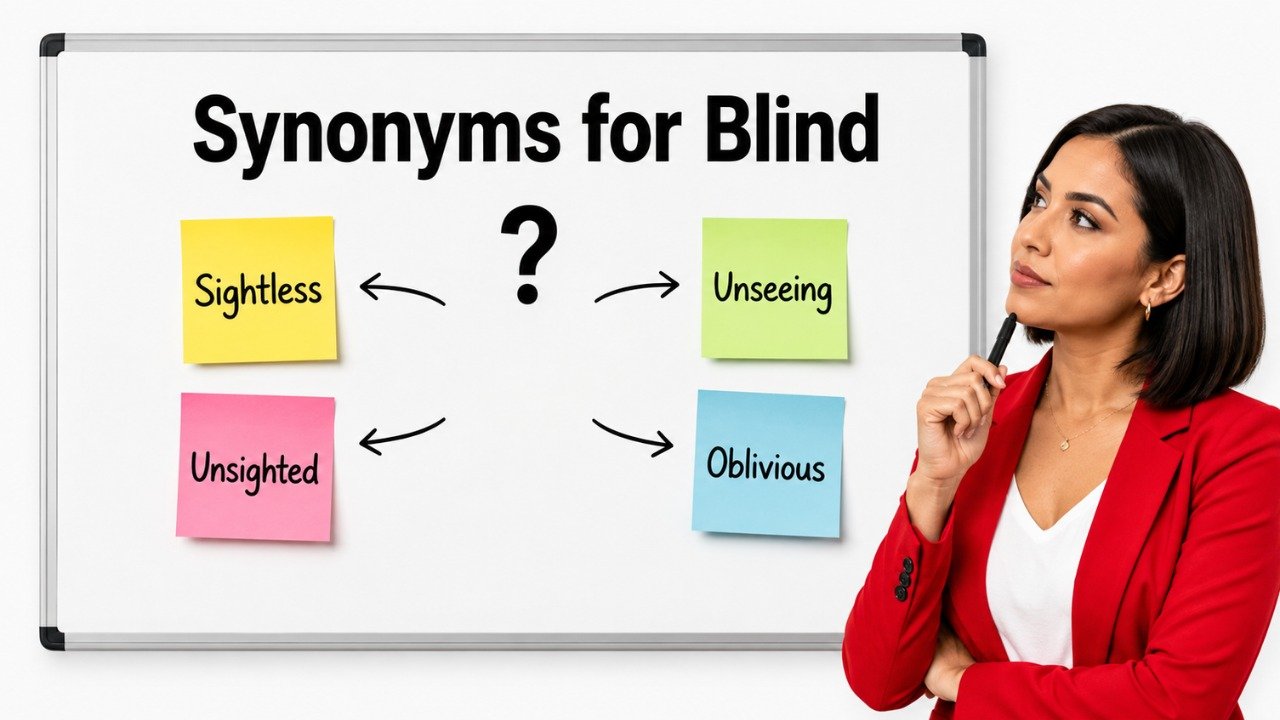
Quick Answer: The best synonyms for blind include sightless, unseeing, visionless, unaware, oblivious, ignorant, heedless, undiscerning, indiscriminate, and concealed. The best choice depends on context. Use sightless or unseeing when referring literally to an inability to see, unaware or oblivious for lack of knowledge, heedless for ignoring risks, indiscriminate for actions made without careful distinction, and concealed when blind describes something hidden from view. Because blind has both literal and figurative meanings, not every synonym works in every sentence.
Pronunciation and Word Details
Word: Blind.
Pronunciation: /blaɪnd/
Part of Speech: Adjective, verb, and noun.
Meaning: Unable to see, lacking awareness, or unable to notice or judge something clearly.
US Pronunciation:
UK Pronunciation:
What Does “Blind” Mean?
Blind most commonly means unable to see, but it can also describe a lack of awareness, judgment, knowledge, or visibility.
As an adjective, blind can refer literally to a person or animal that cannot see. It can also describe someone who does not recognize an obvious fact or problem.
Example: He seemed blind to the warning signs.
In figurative writing, blind can mean uncontrolled, unquestioning, careless, or lacking discrimination.
Example: Blind loyalty prevented him from considering other viewpoints.
Blind can also describe something hidden or performed without seeing the relevant information.
Example: The researchers used a blind evaluation process.
As a verb, blind means to make someone unable to see temporarily or permanently, or figuratively to prevent someone from recognizing the truth.
Example: The bright light blinded her for a moment.
The exact meaning therefore depends strongly on the sentence.
Meaning, Tone, and Context of “Blind”
Blind is a common and generally neutral word when it refers directly and respectfully to blindness. In disability related contexts, it is often used as a straightforward descriptive adjective, although individual people may have different preferences about terminology.
The phrase visually impaired is sometimes used in broader discussions of reduced vision, but it is not an exact synonym for blind. A person may have a visual impairment while still having significant usable vision.
In figurative language, blind can have a stronger emotional tone.
Example: His blind confidence caused him to overlook obvious weaknesses.
Here, blind means uncritical or lacking awareness rather than unable to see.
In formal, academic, scientific, or professional contexts, blind can also describe a process in which certain information is intentionally hidden to reduce bias.
Example: The work was assessed through a blind review process.
In everyday conversation, expressions such as blind to the facts, blind faith, and blind rage are common ways to describe unawareness, unquestioning belief, or uncontrolled emotion.
When and How to Use “Blind”
For Literal Vision: Use blind when referring to a person or animal that cannot see.
Example: The blind musician navigated the stage confidently.
For Lack of Awareness: Use blind when someone fails to recognize a fact, problem, or consequence.
Example: He was blind to the effect his words had on others.
For Unquestioning Belief: Use blind when describing loyalty, faith, trust, or obedience that lacks critical examination.
Example: Blind loyalty can make fair judgment difficult.
For Strong Emotion: Use blind when an emotion overwhelms careful thought.
Example: Blind anger led him to make a poor decision.
For Hidden Information: Use blind when someone completes a task without access to information that could influence judgment.
Example: The entries went through a blind evaluation.
For Lack of Discrimination: Use blind when an action affects people or things without carefully distinguishing between them.
Example: Blind criticism can overlook important differences.
For Physical Obstruction: Use blind when describing a place where sight is limited or blocked.
Example: Drivers should slow down near the blind corner.
For Figurative Ignorance: Use blind when someone does not understand or acknowledge something clearly.
Example: She was blind to the risks of the plan.
Best Synonyms for Blind
Sightless: Unable to see.
Example: The sightless animal relied heavily on sound and touch.
Unseeing: Not seeing or appearing not to notice what is present.
Example: He gave the doorway an unseeing stare.
Visionless: Without the ability to see, or figuratively lacking foresight.
Example: The story describes a visionless creature that moves by sound.
Unaware: Not knowing about something.
Example: She was unaware of the disagreement developing around her.
Oblivious: Completely unaware of something noticeable.
Example: He remained oblivious to the tension in the room.
Ignorant: Lacking knowledge or information about something.
Example: They were ignorant of the new requirements.
Heedless: Failing to pay attention to warnings, risks, or consequences.
Example: His heedless approach created unnecessary problems.
Undiscerning: Unable or unwilling to judge differences carefully.
Example: An undiscerning buyer may overlook important flaws.
Indiscriminate: Done without careful distinction or selection.
Example: Indiscriminate criticism rarely produces useful feedback.
Concealed: Hidden from sight or observation.
Example: The entrance remained concealed behind dense vegetation.
50 Synonyms for Blind with Short Meanings
- Sightless: Unable to see.
- Unseeing: Not seeing or not noticing.
- Visionless: Without sight or visual ability.
- Eyeless: Literally lacking eyes.
- Unaware: Not knowing what is happening.
- Oblivious: Completely unaware of something.
- Ignorant: Lacking knowledge about a matter.
- Uninformed: Not given necessary information.
- Unknowing: Without knowledge or awareness.
- Unconscious: Not aware of something occurring.
- Insensitive: Not noticing or responding to something important.
- Unmindful: Failing to remember or consider something.
- Heedless: Paying no attention to warnings or consequences.
- Unheeding: Not listening to or noticing warnings.
- Inattentive: Not giving enough attention.
- Unobservant: Failing to notice what is present.
- Oblivious: Not conscious of surrounding facts or conditions.
- Unperceptive: Slow or unable to notice important details.
- Undiscerning: Lacking careful judgment.
- Uncritical: Accepting something without careful evaluation.
- Unquestioning: Accepting without doubt or examination.
- Credulous: Too ready to believe something.
- Gullible: Easily persuaded to believe doubtful claims.
- Naive: Lacking experience or practical judgment.
- Unthinking: Acting without careful thought.
- Thoughtless: Showing insufficient consideration.
- Careless: Not giving enough attention or caution.
- Reckless: Acting without proper concern for danger.
- Indiscriminate: Making no careful distinction.
- Random: Done without deliberate selection.
- Arbitrary: Based on uncontrolled or personal choice rather than clear reason.
- Automatic: Done without conscious consideration.
- Instinctive: Done naturally without deliberate thought.
- Uncontrolled: Not restrained or directed.
- Unreasoning: Not guided by rational thought.
- Irrational: Not based on reason.
- Unrestrained: Not controlled or limited.
- Hidden: Kept out of sight.
- Concealed: Deliberately or naturally hidden.
- Obscured: Made difficult or impossible to see.
- Covered: Blocked or hidden by something.
- Masked: Hidden behind another appearance or object.
- Screened: Shielded or hidden from view.
- Blocked: Prevented from being seen or reached.
- Invisible: Unable to be seen.
- Unseen: Not seen or noticed.
- Sightless: Without the power of sight.
- Blinded: Temporarily or permanently unable to see.
- Dazzled: Temporarily unable to see clearly because of intense light.
- Unsighted: Unable to see something or lacking a view of it.
Read Also:
Synonyms for Childish
Synonyms for Blind by Context
When Blind Means Unable to See
The closest alternatives include sightless, unseeing, visionless, and unsighted. These words relate directly to sight, but they can differ in naturalness and usage.
Sightless: A literary or descriptive alternative meaning unable to see.
Example: The sightless animal used vibration to locate movement.
Unseeing: Often describes eyes, a gaze, or someone who appears not to notice what is before them.
Example: She stared ahead with an unseeing expression.
Visionless: Can mean without sight, although it is less common in everyday descriptions of people.
Example: The fictional creature was visionless but highly sensitive to sound.
Unsighted: Often means unable to see a particular object or target rather than permanently unable to see.
Example: The climber remained unsighted from the lower path.
When Blind Means Unaware
Good synonyms include unaware, oblivious, unknowing, uninformed, and unmindful.
Unaware: The broadest neutral choice for lacking knowledge.
Example: He was unaware of the change in schedule.
Oblivious: Stronger than unaware and suggests failure to notice something obvious.
Example: She seemed oblivious to the discomfort around her.
Unknowing: Describes someone who lacks knowledge, often without blame.
Example: He became an unknowing participant in the misunderstanding.
Uninformed: Best when someone lacks information that could have been provided.
Example: The decision left several members uninformed.
When Blind Means Unquestioning
Blind can describe acceptance without examination. Useful alternatives include unquestioning, uncritical, credulous, gullible, and naive.
Unquestioning: Accepting something without challenging it.
Example: Unquestioning obedience can discourage independent judgment.
Uncritical: Failing to evaluate strengths, weaknesses, or evidence.
Example: The proposal received uncritical support from several members.
Credulous: Too willing to believe claims.
Example: Credulous readers may accept an unsupported story too easily.
When Blind Means Careless About Consequences
Heedless, reckless, careless, unthinking, and unmindful can replace blind when it suggests disregard for danger or consequences.
Heedless: Failing to pay attention to a warning.
Example: His heedless behavior created unnecessary risk.
Reckless: Stronger and suggests serious disregard for danger.
Example: The reckless decision endangered the entire group.
Unthinking: Acting without adequate consideration.
Example: It was an unthinking response to a complicated problem.
When Blind Means Without Discrimination
Indiscriminate, arbitrary, random, and unselective can work when blind describes an action performed without careful distinction.
Indiscriminate: The strongest general alternative.
Example: Indiscriminate cutting damaged healthy plants as well as dead growth.
Arbitrary: Appropriate when decisions lack a consistent or reasonable basis.
Example: The arbitrary rule produced uneven results.
Random: Suitable when selection occurs without a deliberate pattern.
Example: Participants were chosen through random selection.
When Blind Means Hidden From View
Hidden, concealed, obscured, covered, screened, and unseen may replace blind in contexts involving visibility.
Concealed: Hidden from observation.
Example: The narrow entrance was concealed by thick vegetation.
Obscured: Difficult to see because something blocks or interferes with the view.
Example: Clouds obscured the mountain peak.
Hidden: A broad everyday alternative.
Example: The mechanism remained hidden inside the wall.
Another Word for Blind
Another word for blind depends strongly on what blind means. Sightless is one of the closest literal alternatives, while unaware is usually the best replacement when blind means not recognizing something. Unquestioning works for blind faith or loyalty, and indiscriminate is better when blind describes action without careful distinction.
Original: He was blind to the problems in the proposal.
Better Option: He was unaware of the problems in the proposal.
Original: Her blind loyalty prevented objective judgment.
Better Option: Her unquestioning loyalty prevented objective judgment.
Original: The campaign relied on blind distribution.
Better Option: The campaign relied on indiscriminate distribution.
Original: Thick trees created a blind area near the road.
Better Option: Thick trees created an obscured area near the road.
When Not to Use “Blind”
Blind should not be used automatically when a more precise word would make the meaning clearer.
When discussing literal vision, avoid replacing blind with visually impaired as though the expressions always mean exactly the same thing. Visual impairment can include many levels of reduced sight, while blind may refer to very limited or absent vision depending on context.
Weak: Everyone with reduced vision is blind.
Better: People can experience different degrees of visual impairment, and not everyone with reduced vision is blind.
Avoid blind when you actually mean uninformed.
Weak: The employees were blind about the policy change.
Better: The employees were uninformed about the policy change.
Avoid blind when careless or reckless is more precise.
Weak: It was a blind decision that ignored every warning.
Better: It was a reckless decision that ignored every warning.
Avoid repeating figurative uses of blind when another word explains the idea more accurately.
Weak: His blind loyalty and blind confidence made him blind to every problem.
Better: His unquestioning loyalty and excessive confidence made him unaware of several serious problems.
Writers should also consider whether figurative expressions involving disability are necessary. In many sentences, unaware, uncritical, careless, hidden, or indiscriminate communicates the intended meaning more precisely.
Words Commonly Confused With Blind
Blind vs Visually Impaired: Blind generally refers to severe or complete loss of sight depending on context. Visually impaired is a broader term that can include people with partial vision. They should not always be treated as exact synonyms.
Blind vs Sightless: Both can mean unable to see, but sightless is more literary and less common in ordinary conversation.
Blind vs Unaware: Blind can figuratively mean failing to recognize something, while unaware directly means not knowing about it.
Blind vs Oblivious: Oblivious usually suggests complete failure to notice something that may be obvious to others. Blind is broader and can describe literal sight or figurative unawareness.
Blind vs Ignorant: Ignorant means lacking knowledge. Blind can mean failing to recognize something even when information is available.
Blind vs Heedless: Heedless specifically means failing to pay attention to warnings or consequences. Blind has many broader meanings.
Blind vs Reckless: Reckless emphasizes disregard for danger. Blind may suggest lack of awareness rather than deliberate risk taking.
Blind vs Indiscriminate: Indiscriminate means making no careful distinction. Blind sometimes has this meaning in expressions describing uncontrolled or untargeted action.
Which Synonym Should You Choose?
Choose sightless when you need a literary or descriptive alternative for literal inability to see.
Choose unseeing when describing a gaze, expression, or moment in which someone does not visually respond to what is present.
Choose unaware for neutral everyday writing about missing information or failing to recognize a situation.
Choose oblivious when the lack of awareness is especially noticeable or complete.
Choose ignorant when someone lacks knowledge about a particular subject.
Choose uncritical when discussing acceptance of an idea without careful evaluation.
Choose unquestioning when describing loyalty, trust, faith, or obedience that is not challenged.
Choose heedless when someone ignores warnings or consequences.
Choose reckless when emphasizing dangerous behavior or serious disregard for risk.
Choose indiscriminate when an action is performed without carefully distinguishing between people, objects, or situations.
Choose concealed or obscured when blind refers to something hidden or blocked from sight.
For formal writing, unaware, uninformed, uncritical, indiscriminate, obscured, and concealed often provide greater precision.
For essays and reports, choose the synonym that describes the exact problem rather than relying on figurative language.
For casual conversation, unaware, oblivious, careless, and hidden are often natural choices.
Real Life Examples of “Blind” in Sentences
Original: He was blind to the weaknesses in his argument.
Better Option: He was unaware of the weaknesses in his argument.
Original: She showed blind loyalty to the group.
Better Option: She showed unquestioning loyalty to the group.
Original: Blind anger influenced his response.
Better Option: Uncontrolled anger influenced his response.
Original: They made a blind choice without reviewing the evidence.
Better Option: They made an uncritical choice without reviewing the evidence.
Original: The driver approached a blind corner carefully.
Better Option: The driver approached an obscured corner carefully.
Original: The organization used blind distribution of the materials.
Better Option: The organization used indiscriminate distribution of the materials.
Original: He remained blind to the consequences of his actions.
Better Option: He remained oblivious to the consequences of his actions.
Original: Bright sunlight temporarily blinded the cyclist.
Better Option: Bright sunlight temporarily dazzled the cyclist.
Original: Her blind trust prevented her from asking questions.
Better Option: Her unquestioning trust prevented her from asking questions.
Original: The reviewers completed a blind assessment.
Better Option: The reviewers completed an anonymous assessment.
Synonym Groups and Usage Differences
Vision Group
Sightless, unseeing, visionless, unsighted, and blinded relate directly to vision. Sightless is a descriptive synonym for inability to see, while blinded often describes a condition caused by something or someone.
Example: The sudden flash left him temporarily blinded.
Awareness Group
Unaware, oblivious, unknowing, uninformed, and unmindful describe different types of missing awareness.
Unaware is neutral. Oblivious is stronger. Uninformed emphasizes missing information.
Example: She was unaware that the meeting had been moved.
Judgment Group
Uncritical, undiscerning, credulous, naive, and gullible describe weak evaluation or judgment.
Uncritical suits formal writing, while gullible implies being easily deceived.
Example: An uncritical reader may accept the claim without examining the evidence.
Attention Group
Heedless, inattentive, unobservant, and unheeding describe failure to notice or respond appropriately.
Example: He was heedless of repeated warnings.
Risk Group
Reckless, careless, unthinking, and irrational describe decisions or behavior that lack sufficient caution or reasoning.
Example: The reckless maneuver placed everyone nearby at risk.
Selection Group
Indiscriminate, random, arbitrary, and unselective relate to actions made without careful distinction.
Example: Indiscriminate criticism can unfairly treat very different mistakes as equal.
Visibility Group
Hidden, concealed, obscured, screened, covered, and unseen relate to something that cannot easily be viewed.
Example: The road sign was obscured by overgrown branches.
Antonyms of Blind
The opposite of blind changes according to the intended meaning.
Sighted: Able to see.
Seeing: Able to perceive visually.
Aware: Knowing or recognizing what is happening.
Conscious: Having awareness of a situation or fact.
Informed: Having relevant knowledge or information.
Knowledgeable: Possessing substantial understanding.
Perceptive: Quick to notice and understand important details.
Observant: Good at noticing what happens.
Attentive: Giving careful attention.
Discerning: Able to judge differences carefully.
Critical: Evaluating something thoughtfully rather than accepting it automatically.
Questioning: Willing to examine or challenge an idea.
Careful: Acting with attention and caution.
Cautious: Avoiding unnecessary risk.
Selective: Choosing carefully rather than indiscriminately.
Visible: Able to be seen.
Exposed: Open to view rather than concealed.
Revealed: Made known or visible.
Comparison: Blind vs Related Words
Blind vs Sightless
Blind is the normal everyday adjective for inability to see and also has several figurative meanings. Sightless is more literary and usually stays closer to the literal meaning of lacking sight.
Example With Blind: The blind traveler used a cane to navigate the unfamiliar path.
Example With Sightless: The story describes a sightless creature living deep underground.
Blind vs Unaware
Blind can figuratively suggest failure to recognize something. Unaware simply states that someone does not know about it.
Example With Blind: He was blind to the growing disagreement.
Example With Unaware: He was unaware of the growing disagreement.
Blind vs Oblivious
Blind to something means failing to see or recognize it figuratively. Oblivious suggests an especially complete lack of awareness.
Example With Blind: She seemed blind to the warning signs.
Example With Oblivious: She seemed oblivious to the warning signs.
Blind vs Ignorant
Blind can describe failure to perceive a truth or problem. Ignorant emphasizes missing knowledge.
Example With Blind: He remained blind to the consequences of the decision.
Example With Ignorant: He was ignorant of the regulations governing the decision.
Blind vs Uncritical
Blind often appears before trust, loyalty, faith, or acceptance to suggest a lack of examination. Uncritical expresses this meaning more directly.
Example With Blind: They gave the proposal blind support.
Example With Uncritical: They gave the proposal uncritical support.
Blind vs Heedless
Blind can suggest lack of awareness, while heedless specifically means not paying attention to warnings or possible consequences.
Example With Blind: He rushed forward with blind confidence.
Example With Heedless: He rushed forward heedless of the danger.
Blind vs Reckless
Blind may imply someone does not recognize a risk. Reckless means the person acts without enough concern for that risk.
Example With Blind: Blind confidence encouraged the mistake.
Example With Reckless: Reckless confidence encouraged the mistake.
Blind vs Indiscriminate
Blind can describe action without careful targeting or distinction. Indiscriminate communicates that meaning more precisely.
Example With Blind: The policy encouraged blind enforcement.
Example With Indiscriminate: The policy encouraged indiscriminate enforcement.
Common Phrases and Expressions With “Blind”
Blind Faith: Complete belief without demanding evidence or proof.
Example: Blind faith in any claim can discourage careful evaluation.
Blind Trust: Trust given without questioning or verification.
Example: Blind trust can make a person overlook warning signs.
Blind Loyalty: Loyalty maintained without critical judgment.
Example: Blind loyalty prevented him from acknowledging the mistake.
Blind Spot: An area that cannot be seen or a weakness someone does not recognize.
Example: Financial planning was a blind spot in the otherwise detailed proposal.
Blind Corner: A corner where the view ahead is blocked.
Example: Drivers slowed as they approached the blind corner.
Blind Rage: Anger so intense that careful judgment is lost.
Example: He regretted the words he had spoken in blind rage.
Blind Ambition: Strong ambition pursued without adequate attention to consequences.
Example: Blind ambition can lead people to ignore important relationships.
Blind Obedience: Following instructions without questioning them.
Example: Good leadership should encourage judgment rather than blind obedience.
Blind Date: A meeting between people who have not previously met, usually arranged by someone else.
Example: Her friend arranged a blind date for the weekend.
Blind Review: An evaluation process in which identifying information is hidden from one or more reviewers.
Example: The entries went through blind review before final selection.
Common Mistakes to Avoid
One common mistake is assuming every use of blind has the same meaning. The word can refer to vision, awareness, judgment, hidden information, uncontrolled emotion, or lack of discrimination.
Do not replace blind with sightless when the meaning is figurative.
Incorrect: He was sightless to the obvious problem.
Better: He was unaware of the obvious problem.
Another mistake is treating visually impaired as an exact synonym in every context. Visual impairment is broader and can include partial sight, so it should not automatically replace blind.
Avoid using ignorant when you mean unaware unless the sentence is specifically about missing knowledge. Ignorant can sound more critical or judgmental.
Less Precise: She was ignorant of the surprise waiting in the next room.
Better: She was unaware of the surprise waiting in the next room.
Do not use reckless when the problem is simply missing information.
Incorrect: He was reckless of the schedule change.
Better: He was unaware of the schedule change.
Figurative phrases such as blind loyalty and blind rage are established expressions, but repeating them frequently can make writing vague. In formal work, more precise alternatives such as unquestioning, uncritical, uncontrolled, unaware, or indiscriminate often communicate the intended idea more clearly.
Writers should also distinguish between blind as an adjective and blind as a verb.
Adjective: The road contains a blind corner.
Verb: The bright flash can blind a driver temporarily.
A synonym that replaces the adjective may not replace the verb grammatically.
Finally, choose respectful and accurate language when discussing disability. The literal word blind should not automatically be replaced with euphemistic wording when blind is the accurate term in the context.
Conclusion
The best synonyms for blind vary according to meaning. Sightless and unseeing relate most closely to literal vision, while unaware, oblivious, and uninformed fit situations involving missing knowledge. Uncritical and unquestioning work well for blind trust or loyalty, heedless and reckless describe disregard for consequences, and indiscriminate fits actions made without careful distinction. Hidden, concealed, and obscured are useful for blocked visibility. Choosing among these synonyms for blind makes writing clearer, more accurate, and better suited to each specific context.
FAQs About Synonyms for Blind
What Is the Best Synonym for Blind?
Sightless is a close literal alternative. If blind means lacking awareness, unaware or oblivious is usually more appropriate.
What Is Another Word for Blind in a Figurative Sense?
Useful figurative alternatives include unaware, oblivious, uncritical, heedless, unquestioning, and indiscriminate. The correct choice depends on the sentence.
Is Visually Impaired a Synonym for Blind?
Not exactly. Visual impairment is a broader concept that can include different levels of reduced vision. Blind and visually impaired should therefore not be treated as interchangeable in every context.
What Is a Synonym for Blind to the Truth?
Unaware, oblivious, unperceptive, or unwilling to recognize can work depending on the intended meaning. Unaware is usually the most neutral choice.
What Is Another Word for Blind Faith?
Unquestioning faith, uncritical belief, or unquestioning belief can express a similar idea. Unquestioning is especially useful when emphasizing lack of examination.
What Is Another Word for Blind Loyalty?
Unquestioning loyalty and uncritical loyalty are strong alternatives. They emphasize loyalty that continues without careful judgment.
What Is the Opposite of Blind?
Sighted is the direct opposite when referring to vision. In figurative contexts, possible antonyms include aware, informed, observant, perceptive, discerning, and attentive.
