
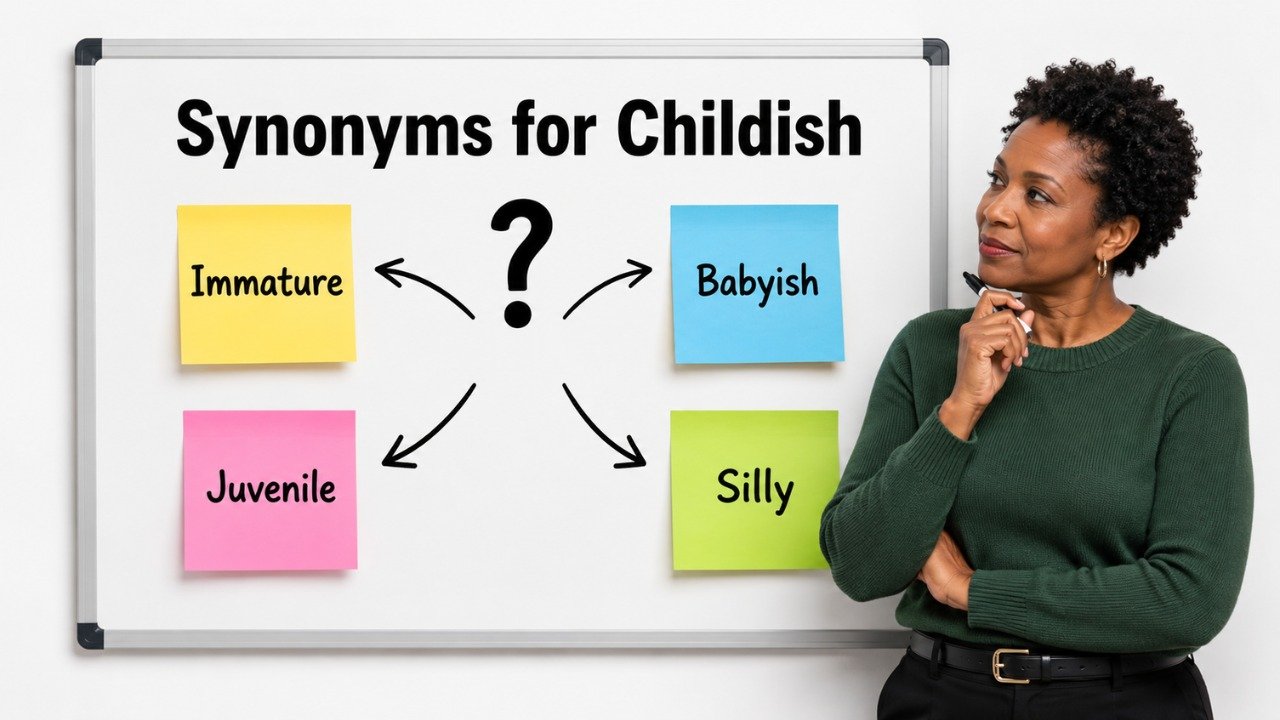
Quick Answer: The best synonyms for childish include immature, juvenile, infantile, silly, foolish, puerile, petty, naive, thoughtless, and immature minded. Use immature for general behavior that lacks emotional maturity, juvenile for conduct associated with younger people, infantile for unusually immature behavior, silly or foolish for poor judgment, puerile for formal criticism, petty for small minded arguments, and naive when childishness comes from limited experience. The best choice depends on whether you are describing behavior, reasoning, emotions, humor, arguments, or social conduct.
Pronunciation and Word Details
Word: Childish.
Pronunciation: /ˈtʃaɪldɪʃ/
Part of Speech: Adjective.
Meaning: Behaving in an immature, silly, or unreasonable way that is more typical of a child than an adult.
US Pronunciation:
UK Pronunciation:
What Does “Childish” Mean?
Childish means immature, silly, or unreasonable in a way that is associated with the behavior of a child. It is an adjective and is most often used to describe behavior, reactions, arguments, habits, jokes, demands, or attitudes.
The word usually has a negative meaning. If someone calls an adult childish, the speaker normally means that the person is not behaving with the maturity expected in that situation.
For example, “His childish reaction surprised everyone” suggests that his response lacked emotional control or mature judgment.
Childish can also describe something simple or unsophisticated in a negative way. A childish argument may be poorly reasoned. A childish joke may seem too simple or immature for the audience.
However, childish should not automatically be confused with childlike. Childlike can describe positive qualities such as innocence, curiosity, openness, or wonder. Childish usually criticizes immaturity.
The meaning therefore depends on context, but the central idea is behavior or thinking that seems less mature than expected.
Meaning, Tone, and Context of “Childish”
Childish is generally negative in tone. It often expresses criticism, disappointment, irritation, or disapproval.
In casual conversation, people commonly use childish to describe arguments, sulking, teasing, selfish behavior, or emotional reactions.
In formal writing, immature, juvenile, puerile, or infantile may be more precise depending on the exact meaning. Puerile is especially formal and often describes ideas, humor, or reasoning that seem foolishly immature.
In professional settings, childish can sound personal or judgmental. A more neutral phrase such as immature behavior, unprofessional conduct, or poor judgment may be more appropriate.
In academic writing, childish is usually less precise than words such as immature, developmentally inappropriate, simplistic, or juvenile.
In literary and descriptive writing, the word can be useful for showing character. A writer may describe a childish grin, childish jealousy, or a childish refusal to cooperate.
The tone of childish is usually stronger than simple descriptions such as young or inexperienced because it suggests that the behavior does not match the expected level of maturity.
When and How to Use “Childish”
For Immature Behavior: Use childish when someone behaves in a way that seems emotionally or socially immature.
Example: Refusing to speak to everyone after losing the game seemed childish.
For Petty Arguments: Childish can describe disputes that seem trivial, unreasonable, or unnecessarily emotional.
Example: Their childish argument over who should sit near the window lasted twenty minutes.
For Emotional Reactions: Use childish when someone responds with sulking, complaining, or exaggerated frustration instead of handling the situation calmly.
Example: His childish reaction to the criticism made the discussion more difficult.
For Silly Humor: Childish can describe jokes or entertainment that seems too immature for a particular audience.
Example: She thought the joke was childish rather than funny.
For Selfish Demands: The word can describe unreasonable demands that ignore other people’s needs.
Example: His childish insistence on getting his own way annoyed the group.
For Poor Judgment: Childish can describe decisions that lack careful thought or mature reasoning.
Example: Leaving the project because of one disagreement would be childish.
For Informal Criticism: Childish is useful in everyday speech when the speaker wants to criticize immature conduct directly.
Example: Stop being childish and explain what is bothering you.
Best Synonyms for Childish
Immature: Lacking the emotional, social, or intellectual maturity expected for a person’s age or situation.
Example: His immature response turned a small disagreement into a larger problem.
Juvenile: Showing behavior or humor associated with young people in an immature way.
Example: The juvenile teasing made the discussion difficult to take seriously.
Infantile: Extremely immature in behavior, thinking, or emotional response.
Example: Her infantile refusal to listen frustrated the entire group.
Silly: Showing poor judgment, lack of seriousness, or foolish behavior.
Example: Their silly argument could have been avoided with a short conversation.
Foolish: Lacking good sense or careful judgment.
Example: It was foolish to end the friendship over such a minor disagreement.
Puerile: Foolishly immature or trivial, especially in ideas, humor, or behavior.
Example: The reviewer criticized the story for its puerile humor.
Petty: Giving too much attention to small or unimportant matters.
Example: Their petty complaints distracted everyone from the real issue.
Naive: Showing limited experience, judgment, or understanding.
Example: His naive belief that every problem would disappear on its own caused difficulties.
Thoughtless: Acting without considering consequences or other people’s feelings.
Example: Her thoughtless remark upset a colleague.
Sulky: Showing bad temper through silence, resentment, or withdrawal.
Example: He became sulky when the others disagreed with his suggestion.
50 Synonyms for Childish with Short Meanings
- Immature: Lacking expected emotional or social maturity.
- Juvenile: Behaving in an immature way associated with youth.
- Infantile: Extremely immature in behavior or thinking.
- Silly: Lacking seriousness or sensible judgment.
- Foolish: Showing poor judgment or little wisdom.
- Puerile: Foolishly immature or trivial.
- Petty: Concerned with small and unimportant matters.
- Naive: Lacking experience or mature understanding.
- Thoughtless: Acting without considering consequences.
- Sulky: Showing resentment through bad tempered silence.
- Immature Minded: Thinking or behaving without expected maturity.
- Babyish: Behaving in a way associated with a very young child.
- Childlike: Resembling a child, sometimes positively rather than critically.
- Simpleminded: Showing overly simple or limited reasoning.
- Frivolous: Lacking proper seriousness.
- Trivial: Concerned with matters of little importance.
- Petulant: Irritable or bad tempered in a childish way.
- Spoiled: Accustomed to getting one’s own way.
- Self Centered: Focused mainly on personal wants and needs.
- Selfish: Concerned excessively with one’s own interests.
- Irresponsible: Failing to behave with proper responsibility.
- Impulsive: Acting quickly without enough thought.
- Rash: Acting without careful judgment.
- Unreasonable: Not guided by fair or sensible thinking.
- Senseless: Lacking sound judgment or purpose.
- Ridiculous: Extremely unreasonable or foolish.
- Absurd: Clearly unreasonable or illogical.
- Nonsensical: Lacking sense or reasonable meaning.
- Inane: Empty, silly, or lacking meaningful thought.
- Fatuous: Foolish and lacking intelligent judgment.
- Gullible: Too willing to believe things without enough evidence.
- Inexperienced: Lacking practical knowledge or maturity from experience.
- Unsophisticated: Lacking worldly experience or complexity.
- Undeveloped: Not fully mature in thought or behavior.
- Unformed: Not yet fully developed in judgment or character.
- Temperamental: Prone to unpredictable emotional reactions.
- Moody: Frequently changing emotional state.
- Whiny: Complaining in an irritating or immature manner.
- Complaining: Frequently expressing dissatisfaction.
- Demanding: Expecting others to satisfy excessive wants.
- Obstinate: Refusing stubbornly to change one’s opinion or behavior.
- Stubborn: Unwilling to change despite good reasons.
- Rebellious: Resisting authority or expectations.
- Mischievous: Playfully causing trouble, sometimes in a youthful way.
- Playful: Lighthearted and sometimes lacking seriousness.
- Unserious: Not treating something with appropriate seriousness.
- Shallow: Lacking depth of thought or understanding.
- Simplistic: Treating a complex issue as though it were very simple.
- Crude: Lacking refinement or maturity.
- Unrefined: Lacking polish, maturity, or sophistication.
Read Also:
Synonyms for Increased

Synonyms for Childish by Context
When Childish Means Immature
Immature, juvenile, infantile, and undeveloped are strong choices when childish refers mainly to a lack of emotional or behavioral maturity.
Immature: The most flexible replacement for general behavior.
Example: His immature reaction made cooperation difficult.
Juvenile: Useful for behavior, jokes, or conduct that seems associated with younger people.
Example: The juvenile comments distracted from the serious discussion.
Infantile: A much stronger criticism suggesting extreme immaturity.
Example: Her infantile refusal to compromise frustrated everyone.
Undeveloped: Useful when referring to judgment, attitudes, or emotional maturity that has not fully developed.
Example: His undeveloped sense of responsibility caused repeated problems.
When Childish Means Silly or Foolish
Silly, foolish, puerile, inane, and fatuous are useful when childish refers to poor reasoning or lack of seriousness.
Silly: Natural in everyday conversation.
Example: It was silly to argue about such a small mistake.
Foolish: Emphasizes poor judgment.
Example: His foolish decision created an unnecessary conflict.
Puerile: A formal synonym for foolishly immature behavior or ideas.
Example: The essay relied on puerile insults rather than logical arguments.
Inane: Suggests that something is both silly and lacking meaningful thought.
Example: The conversation became filled with inane comments.
When Childish Means Petty
Petty, trivial, small minded, and unreasonable are useful when childish describes arguments or behavior focused on insignificant matters.
Petty: Best for unnecessary concern with small issues.
Example: They became involved in a petty dispute over seating.
Trivial: Highlights the unimportance of the issue.
Example: The disagreement seemed trivial compared with the larger problem.
Unreasonable: Best when the behavior lacks fairness or logic.
Example: Her unreasonable demand delayed the decision.
When Childish Means Emotionally Reactive
Petulant, sulky, moody, whiny, and temperamental describe specific forms of immature emotional behavior.
Petulant: Describes irritated or rude behavior caused by disappointment.
Example: He became petulant when his suggestion was rejected.
Sulky: Describes silent resentment or bad temper.
Example: She remained sulky throughout dinner after losing the argument.
Whiny: Describes repeated complaining in an immature tone.
Example: His whiny response made the problem seem less serious.
Temperamental: Describes frequent or unpredictable emotional reactions.
Example: The manager found his temperamental behavior difficult to handle.
When Childish Means Naive or Inexperienced
Naive, inexperienced, unsophisticated, gullible, and unformed are useful when the lack of maturity comes from limited experience rather than deliberate bad behavior.
Naive: Suggests innocence or lack of practical understanding.
Example: Her naive expectations changed after she gained more experience.
Inexperienced: A neutral choice for someone who has not yet developed practical knowledge.
Example: The inexperienced speaker struggled with difficult questions.
Unsophisticated: Suggests limited worldly knowledge or refinement.
Example: His unsophisticated view of the issue ignored several important details.
Another Word for Childish
The best single replacement for childish is usually immature. It has a similar meaning but can sound more precise and less emotionally charged in many contexts.
However, the best alternative depends on what kind of childish behavior you mean. Petty works better for minor arguments, petulant for irritated emotional reactions, puerile for foolishly immature ideas, and naive for limited experience.
Original: His childish behavior annoyed everyone during the meeting.
Better Option: His immature behavior annoyed everyone during the meeting.
Original: Their childish argument lasted all afternoon.
Better Option: Their petty argument lasted all afternoon.
Original: Her childish reaction to losing was obvious.
Better Option: Her petulant reaction to losing was obvious.
Original: The article was filled with childish jokes.
Better Option: The article was filled with puerile jokes.
When Not to Use “Childish”
Childish can sound judgmental, so it may not be the best word in professional, academic, or sensitive situations.
If you are describing a person’s behavior at work, immature, unprofessional, unreasonable, or inappropriate may communicate the problem more clearly.
Weak: His childish behavior made him difficult to work with.
Better: His immature behavior made collaboration difficult.
Do not use childish when you actually mean innocent, curious, imaginative, or full of wonder. Childlike is often better for those positive meanings.
Weak: She had a childish sense of wonder about nature.
Better: She had a childlike sense of wonder about nature.
Avoid childish when you can identify the exact behavior more precisely.
Weak: He gave a childish response.
Better: He gave a petulant response after his proposal was rejected.
The word can also become repetitive if used several times in the same paragraph.
Weak: Their childish conversation led to a childish argument followed by a childish refusal to cooperate.
Better: Their immature conversation led to a petty argument followed by a stubborn refusal to cooperate.
In formal analysis, childish may sound too conversational or emotionally loaded.
Weak: The character’s childish thinking prevents meaningful growth.
Better: The character’s immature reasoning prevents meaningful growth.
Choose a more exact synonym whenever the type of immaturity matters.
Words Commonly Confused With Childish
Childish vs Childlike: Childish usually has a negative meaning and suggests immaturity. Childlike often has a positive meaning and refers to innocence, curiosity, trust, or wonder.
Childish vs Immature: Childish is more conversational and often more critical. Immature is broader and can sound more neutral or analytical.
Childish vs Juvenile: Childish describes behavior that seems immature. Juvenile can refer literally to young people, but it can also criticize immature humor or conduct.
Childish vs Infantile: Infantile is stronger than childish. It suggests behavior that is extremely immature or more appropriate to a very young child.
Childish vs Puerile: Both can criticize immaturity, but puerile is more formal and often describes humor, arguments, ideas, or writing that seems foolishly immature.
Childish vs Naive: Childish criticizes immaturity, while naive usually emphasizes lack of experience or understanding rather than bad behavior.
Childish vs Petty: Childish is broad. Petty specifically describes excessive concern with small matters, minor disputes, or insignificant grievances.
Childish vs Petulant: Childish can describe many forms of immaturity. Petulant specifically describes bad tempered or irritated behavior when someone does not get what they want.
Which Synonym Should You Choose?
Choose immature when you need the most versatile synonym for behavior, decisions, reactions, or emotional development.
Choose juvenile when describing jokes, teasing, comments, or conduct that seems suitable for younger people rather than adults.
Choose infantile when the behavior is extremely immature and deserves stronger criticism.
Choose silly for casual conversation when the behavior lacks seriousness but is not necessarily harmful.
Choose foolish when poor judgment is the main problem.
Choose puerile in formal writing when discussing immature humor, arguments, ideas, or reasoning.
Choose petty when people are arguing over something small or unimportant.
Choose petulant when someone becomes irritated, rude, or resentful because they do not get what they want.
Choose naive when the person’s behavior comes from limited knowledge or experience.
Choose unprofessional when describing immature behavior in the workplace without making the criticism sound unnecessarily personal.
For reports and essays, immature, juvenile, puerile, simplistic, or unreasonable can be more precise than childish.
For emails and professional communication, describe the specific behavior rather than labeling the person. Words such as inappropriate, unprofessional, uncooperative, or unreasonable may be more constructive.
For everyday conversation, childish, silly, petty, and immature are usually natural choices.
Real Life Examples of “Childish” in Sentences
Original: His childish behavior made the meeting uncomfortable.
Better Option: His immature behavior made the meeting uncomfortable.
Original: Their childish argument began over a minor misunderstanding.
Better Option: Their petty argument began over a minor misunderstanding.
Original: She gave a childish response when she heard the decision.
Better Option: She gave a petulant response when she heard the decision.
Original: The jokes sounded childish to the older audience.
Better Option: The jokes sounded juvenile to the older audience.
Original: Refusing to listen was a childish decision.
Better Option: Refusing to listen was a foolish decision.
Original: His childish complaints continued throughout the trip.
Better Option: His whiny complaints continued throughout the trip.
Original: The debate became childish once the personal insults started.
Better Option: The debate became puerile once the personal insults started.
Original: Her childish expectation showed that she had little experience.
Better Option: Her naive expectation showed that she had little experience.
Original: He became childish whenever someone disagreed with him.
Better Option: He became sulky whenever someone disagreed with him.
Original: Their childish refusal to compromise delayed the project.
Better Option: Their unreasonable refusal to compromise delayed the project.
Synonym Groups and Usage Differences
Immaturity Group
Immature, juvenile, infantile, undeveloped, and unformed belong to the general immaturity group.
Immature is the most flexible word. Juvenile often suggests youthful behavior. Infantile is much stronger. Undeveloped and unformed are useful when discussing judgment, personality, or emotional growth.
Example: His immature response showed that he was not ready to handle the disagreement calmly.
Foolishness Group
Silly, foolish, puerile, inane, fatuous, ridiculous, and absurd focus on weak judgment or lack of seriousness.
Silly is common and relatively mild. Foolish emphasizes poor judgment. Puerile sounds more formal. Inane and fatuous suggest a lack of intelligent thought.
Example: It seemed foolish to damage a friendship over such a small issue.
Petty Behavior Group
Petty, trivial, unreasonable, obstinate, and stubborn can describe behavior focused on minor disputes or refusal to cooperate.
Petty emphasizes insignificant matters. Obstinate and stubborn focus more on unwillingness to change.
Example: Their petty disagreement prevented them from solving the real problem.
Emotional Reaction Group
Petulant, sulky, moody, whiny, and temperamental describe different emotional forms of childish behavior.
Petulant is useful for irritated reactions. Sulky suggests withdrawn resentment. Whiny focuses on complaining.
Example: He gave a petulant answer after learning that his request had been denied.
Inexperience Group
Naive, inexperienced, gullible, unsophisticated, and unformed relate to limited knowledge or life experience.
These words are usually less insulting than childish because they may explain why a person lacks mature judgment.
Example: Her naive assumption came from a lack of experience rather than deliberate carelessness.
Self Focused Behavior Group
Selfish, self centered, spoiled, and demanding describe childish behavior driven by personal wants.
These words are useful when someone ignores the needs, rights, or feelings of others.
Example: His demanding behavior made it difficult for the group to reach a fair decision.
Antonyms of Childish
The opposite of childish depends on whether you mean emotional maturity, good judgment, responsibility, or sophistication.
Mature: Showing developed judgment and emotional control.
Adult: Behaving in a responsible and age appropriate way.
Responsible: Willing to accept duties and consequences.
Sensible: Showing practical and reasonable judgment.
Wise: Showing good judgment based on knowledge or experience.
Thoughtful: Considering consequences and other people’s feelings.
Reasonable: Guided by logic, fairness, and good judgment.
Levelheaded: Calm and sensible in difficult situations.
Sophisticated: Showing developed understanding or refinement.
Composed: Calm and emotionally controlled.
Professional: Behaving appropriately and responsibly in a work setting.
Considerate: Showing awareness of other people’s needs and feelings.
Comparison: Childish vs Related Words
Childish vs Immature
Childish and immature are close in meaning, but immature is broader and often sounds more neutral. Childish is commonly used as direct criticism, while immature can describe emotional development, judgment, behavior, or skills.
Example With Childish: His childish refusal to apologize made the disagreement worse.
Example With Immature: His immature response showed poor emotional judgment.
Childish vs Childlike
Childish usually criticizes behavior that lacks maturity. Childlike commonly describes positive qualities associated with children, such as innocence, curiosity, honesty, and wonder.
Example With Childish: Her childish complaint interrupted the discussion.
Example With Childlike: Her childlike curiosity made the museum visit enjoyable.
Childish vs Juvenile
Childish and juvenile can both criticize immature conduct. Juvenile often works especially well for humor, jokes, teasing, or behavior associated with younger people.
Example With Childish: Their childish behavior disrupted the event.
Example With Juvenile: The juvenile jokes distracted from the serious topic.
Childish vs Infantile
Infantile is much stronger than childish and suggests extremely immature behavior.
Example With Childish: His childish protest surprised his friends.
Example With Infantile: His infantile tantrum shocked everyone in the room.
Childish vs Puerile
Puerile is a formal word meaning foolishly immature. It is especially useful for humor, reasoning, writing, or arguments.
Example With Childish: The childish jokes became repetitive.
Example With Puerile: The essay relied on puerile humor rather than thoughtful analysis.
Childish vs Petty
Childish has a broad meaning, while petty focuses on small, unimportant complaints or disputes.
Example With Childish: Their childish behavior wasted everyone’s time.
Example With Petty: Their petty disagreement over seating wasted everyone’s time.
Childish vs Naive
Childish suggests inappropriate immaturity. Naive usually suggests limited experience, innocence, or lack of knowledge.
Example With Childish: His childish demand annoyed the group.
Example With Naive: His naive assumption showed that he did not understand the process.
Childish vs Petulant
Childish can describe almost any immature behavior. Petulant specifically refers to irritated, rude, or bad tempered behavior caused by disappointment.
Example With Childish: She made a childish complaint when the plan changed.
Example With Petulant: She gave a petulant reply when the plan changed.
Common Phrases and Expressions With “Childish”
Childish Behavior: Actions that seem immature or inappropriate for someone’s age.
Childish Argument: A dispute that seems petty, unreasonable, or immature.
Childish Reaction: An emotionally immature response to a situation.
Childish Attitude: A way of thinking that lacks expected maturity.
Childish Joke: Humor considered too immature or simplistic.
Childish Tantrum: An exaggerated emotional outburst resembling the behavior of a young child.
Childish Games: Activities or behavior viewed as immature or unserious.
Childish Excuse: An explanation that seems weak, immature, or poorly reasoned.
Childish Demand: An unreasonable request motivated mainly by personal wants.
Childish Refusal: An immature unwillingness to cooperate, compromise, or accept a decision.
Common Mistakes to Avoid
One common mistake is treating childish and childlike as exact synonyms. They have different tones. Childish is usually negative, while childlike can be positive.
Weak: Her childish enthusiasm made everyone smile.
Better: Her childlike enthusiasm made everyone smile.
Another mistake is using childish repeatedly when more precise words are available.
Weak: His childish comments caused a childish argument followed by a childish reaction.
Better: His juvenile comments caused a petty argument followed by a petulant reaction.
Avoid choosing a synonym simply because it sounds stronger. Infantile is more severe than childish and may be excessive when describing mild immaturity.
Weak: Forgetting to say thank you was an infantile mistake.
Better: Forgetting to say thank you was an immature mistake.
Do not use naive when you mean rude or selfish. Naive suggests lack of experience rather than deliberate disregard for others.
Weak: His naive refusal to share annoyed everyone.
Better: His selfish refusal to share annoyed everyone.
Puerile is useful in formal criticism, but it can sound unnatural in ordinary conversation.
Unnatural: Stop making such puerile complaints about dinner.
Natural: Stop making such childish complaints about dinner.
Be careful when using childish to describe a person rather than a specific behavior. Calling someone childish can sound more personal and insulting than describing what they did.
Less Constructive: You are childish.
More Constructive: Refusing to discuss the issue calmly seems immature.
Avoid vague usage when a specific behavior can be named. If someone is sulking, being petty, behaving selfishly, or making foolish decisions, the more precise synonym often creates stronger writing.
Conclusion
The most useful synonyms for childish include immature, juvenile, infantile, silly, foolish, puerile, petty, naive, petulant, and sulky. The best choice depends on the kind of immaturity being described. Use immature for general behavior, petty for minor disputes, petulant for irritated reactions, puerile for formal criticism, and naive for limited experience. Understanding the differences among synonyms for childish helps you describe behavior, emotions, arguments, humor, and judgment with greater accuracy and a more appropriate tone.
FAQs About Synonyms for Childish
What Is the Best Synonym for Childish?
Immature is usually the best general synonym for childish. It works for behavior, reactions, decisions, attitudes, and emotional development.
What Is a Formal Synonym for Childish?
Puerile is a formal synonym when childish means foolishly immature. Juvenile and immature are also useful in formal contexts depending on the sentence.
What Is a Stronger Word for Childish?
Infantile is stronger than childish and suggests extreme immaturity. Petulant can also be stronger when describing an irritated emotional reaction.
Is Childlike a Synonym for Childish?
Childlike is related but not always interchangeable. Childish usually has a negative meaning, while childlike often describes positive qualities such as innocence, curiosity, or wonder.
What Is Another Word for Childish Behavior?
Immature behavior is the closest general alternative. Juvenile behavior, petty behavior, petulant behavior, and irresponsible behavior may be better in specific situations.
What Is a Synonym for Childish in an Argument?
Petty, immature, puerile, unreasonable, and juvenile can describe a childish argument. Petty is especially useful when the disagreement concerns something unimportant.
What Is the Difference Between Childish and Immature?
Childish usually carries stronger personal criticism and often refers to behavior associated with children. Immature is broader and can describe emotional, social, intellectual, or behavioral development.
