
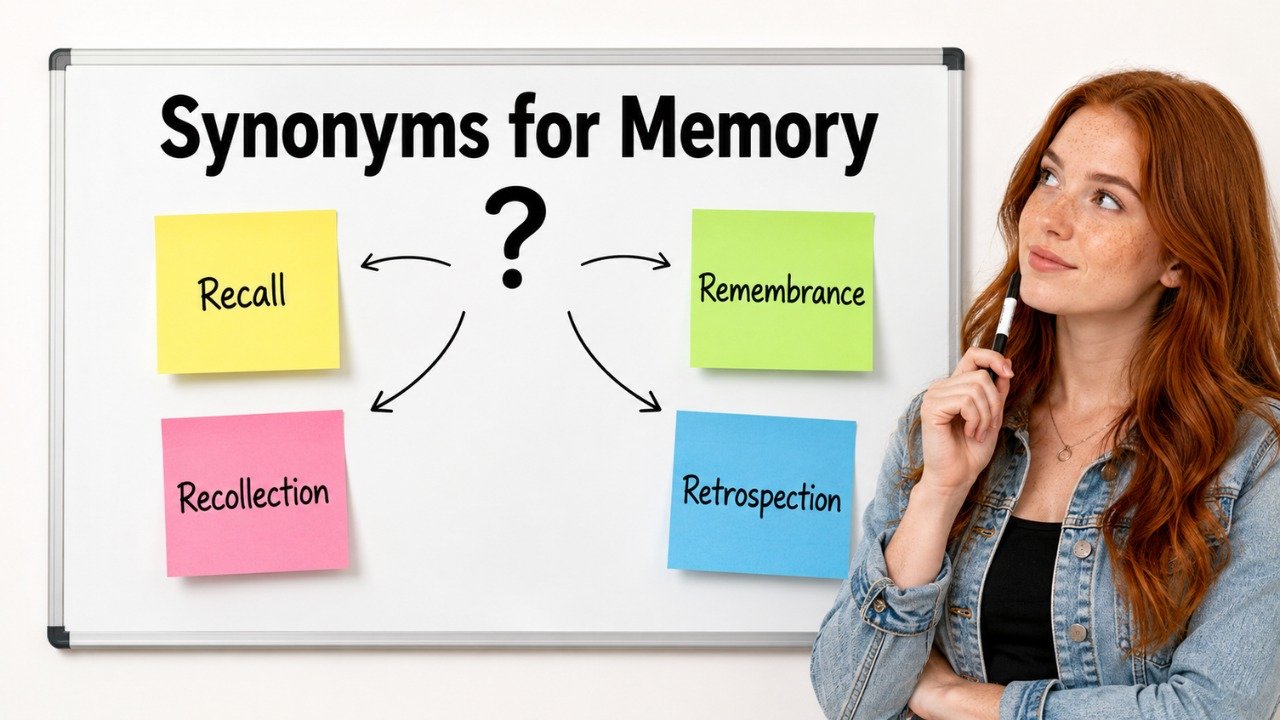
Quick Answer: The best synonyms for memory include recollection, remembrance, recall, retention, reminiscence, recognition, impression, awareness, record, and remembrance. Use recollection for something remembered from the past, remembrance for emotional or respectful memories, recall for the ability to retrieve information, retention for keeping information in the mind, reminiscence for pleasant reflection on past experiences, recognition for identifying something previously known, and record when memory refers to preserved information.
Pronunciation and Word Details
Word: Memory.
Pronunciation: /ˈmeməri/.
Part of Speech: Noun.
Meaning: The ability to remember information, experiences, people, or events, or something that is remembered.
US Pronunciation:
UK Pronunciation:
What Does “Memory” Mean?
Memory means the ability to store, retain, and remember information, experiences, events, people, or feelings. It is primarily used as a noun.
The word can refer to a mental ability, a specific remembered experience, a lasting impression, or stored information.
Example: Her memory of the summer remained vivid for years.
Here, memory means a particular recollection of a past experience.
Example: Regular practice can help improve memory.
In this sentence, memory refers to the mental ability to retain and recall information.
Memory can also describe how someone or something is remembered after time has passed.
Example: They honored the memory of their former teacher.
In this context, memory means the lasting remembrance of a person.
The exact synonym depends on whether memory refers to mental ability, a remembered event, emotional remembrance, information retention, or a preserved record.
Meaning, Tone, and Context of “Memory”
Memory is a neutral and versatile noun used in everyday conversation, education, psychology, literature, formal writing, and technical contexts.
The word can sound personal and emotional when it refers to experiences or people from the past.
Example: That song brought back a precious memory from childhood.
It can sound more academic when discussing learning and mental processes.
Example: Repetition can support memory and information retention.
Memory can also have a respectful or emotional tone when talking about someone who is no longer present.
Example: The garden was created in memory of a beloved community member.
In technical contexts, memory may refer to the capacity of a system or device to hold information, although terms such as storage and capacity may be more precise depending on the situation.
Because memory has several meanings, choosing the correct synonym requires attention to context.
When and How to Use “Memory”
For Recalling Past Events: Use memory when referring to something experienced in the past that a person can still remember.
Example: My strongest memory of the trip is watching the sunrise.
For Mental Ability: Use memory when describing a person’s ability to retain and retrieve information.
Example: She has an excellent memory for names.
For Learning: Memory is useful when discussing how information is retained through study or practice.
Example: Reviewing vocabulary regularly can strengthen memory.
For Emotional Remembrance: Use memory when referring affectionately or respectfully to someone or something from the past.
Example: They shared stories in memory of their grandfather.
For Personal Experiences: Memory works naturally for moments that remain in someone’s mind.
Example: The celebration became one of her happiest memories.
For Preserved Information: Memory may describe stored or retained information in technical or informational contexts.
Example: The system needs additional memory to process the information efficiently.
Best Synonyms for Memory
Recollection: Something remembered from the past or the act of remembering it.
Example: Her recollection of the conversation was surprisingly detailed.
Remembrance: The act of remembering someone or something, often with emotion or respect.
Example: The ceremony was held in remembrance of those who had served the community.
Recall: The ability or act of bringing information back into the mind.
Example: His recall of names and dates was impressive.
Retention: The ability to keep information in the mind for later use.
Example: Regular review improves vocabulary retention.
Reminiscence: The act of thinking or talking about past experiences, often fondly.
Example: Their conversation became a warm reminiscence about childhood.
Recognition: The act of identifying something as familiar from previous experience.
Example: Recognition of the melody came immediately.
Impression: A lasting mental effect or remembered sense of something.
Example: The speech left a strong impression on everyone present.
Awareness: Knowledge or consciousness of something remembered or understood.
Example: She retained a clear awareness of what had happened.
Record: Information preserved so that it can be remembered or consulted later.
Example: The diary provided a valuable record of family life.
Retention Ability: The capacity to keep and remember information.
Example: Practice can improve retention ability during study.
50 Synonyms for Memory with Short Meanings
- Recollection: Something remembered from the past.
- Remembrance: The act or state of remembering.
- Recall: The ability to bring information back to mind.
- Retention: The ability to keep information in the mind.
- Reminiscence: Reflection on past experiences.
- Recognition: Identification of something previously known.
- Impression: A lasting mental effect or remembered feeling.
- Awareness: Conscious knowledge of something.
- Record: Preserved information about past events.
- Retentiveness: The ability to remember information well.
- Recollection Ability: The capacity to remember past information.
- Remembering: The act of bringing something back to mind.
- Mindfulness: Conscious awareness of something in the mind.
- Consciousness: Awareness of experiences or information.
- Knowledge: Information retained through learning or experience.
- Reflection: Thought about past experiences or events.
- Reminding: The act of causing something to be remembered.
- Mind: The mental faculty in which memories are held.
- Thought: An idea or mental impression held in the mind.
- Mental Image: An internal picture of something remembered.
- Image: A remembered representation in the mind.
- Imprint: A lasting effect left on the mind.
- Trace: A small remaining sign of a past experience.
- Echo: A lingering mental reminder of something past.
- Association: A mental connection that helps something be remembered.
- Recognition Ability: The capacity to identify something previously encountered.
- Retention Ability: The capacity to keep learned information.
- Mental Record: Information preserved in the mind.
- Personal Record: A remembered or documented account of experience.
- Account: A description or recollection of an event.
- History: A remembered or recorded account of the past.
- Experience: Something lived through and remembered.
- Flashback: A sudden vivid return of a past experience.
- Nostalgia: Emotional longing connected with memories of the past.
- Remembrance Thought: A thought connected with someone or something remembered.
- Reverie: A dreamy state involving thoughts or memories.
- Reflection on the Past: Thoughtful consideration of earlier experiences.
- Mental Picture: An image held or recreated in the mind.
- Mental Impression: An idea or feeling left by an experience.
- Afterthought: A thought that returns after an event.
- Souvenir: An object that helps preserve a memory.
- Memento: An object kept as a reminder of a person or event.
- Keepsake: An item preserved because of personal memories.
- Reminder: Something that causes a person to remember.
- Memorial: Something created to preserve remembrance.
- Legacy: Something remembered or left behind from the past.
- Tradition: A practice or belief preserved through remembrance.
- Documentation: Information preserved as a record.
- Storage: The keeping of information for later retrieval.
- Capacity: The amount of information that can be retained or stored.
Read Also:
Synonyms for Ruthless
Synonyms for Memory by Context
When Memory Means Recollection
When memory refers to something remembered from the past, useful synonyms include recollection, remembrance, reminiscence, reflection, mental image, and impression.
Example: Her recollection of the first day of school was remarkably clear.
Recollection works especially well when someone deliberately remembers a particular event.
Reminiscence usually suggests reflecting on older experiences, often with affection.
Example: The evening was filled with reminiscence about their college years.
When Memory Means Ability to Remember
When memory describes the mental ability to retain information, recall, retention, retentiveness, and recollection ability are useful alternatives.
Example: His excellent recall helped him remember every instruction.
Recall focuses on retrieving information that has already been learned.
Retention focuses more on keeping information available over time.
Example: Regular practice can improve retention of new vocabulary.
When Memory Means Emotional Remembrance
Remembrance, nostalgia, reflection, tribute, and reminiscence can express the emotional side of memory.
Example: The photograph inspired a feeling of nostalgia for childhood summers.
Remembrance works particularly well when someone or something is being respectfully remembered.
Example: They gathered in remembrance of a respected teacher.
When Memory Means a Mental Impression
Impression, imprint, trace, echo, mental picture, and mental image work when memory refers to something that remains mentally present.
Example: The landscape left a lasting impression in her mind.
A trace suggests only a small remaining memory.
Example: Only a faint trace of the conversation remained in his mind.
When Memory Means Stored Information
Record, documentation, storage, capacity, and mental record may work when memory refers to preserved information.
Example: The archive provides a detailed record of previous events.
Storage is especially useful in technical contexts involving retained information.
Another Word for Memory
The best general replacement for memory is often recollection when referring to something remembered. However, the best alternative depends on the intended meaning.
Use recall for the ability to retrieve information, retention for keeping learned information, remembrance for emotional or respectful remembering, and reminiscence for reflecting on past experiences.
Original: My clearest memory is of our first family vacation.
Better Option: My clearest recollection is of our first family vacation.
Original: Her memory for historical dates is excellent.
Better Option: Her recall of historical dates is excellent.
Original: Repetition improved his memory of the vocabulary.
Better Option: Repetition improved his retention of the vocabulary.
Original: The event was organized in memory of the founder.
Better Option: The event was organized in remembrance of the founder.
When Not to Use “Memory”
Memory can sometimes be too broad when a more specific word would explain the intended meaning better.
If you are describing the ability to retrieve information, recall may be more precise.
Weak: His memory of names is excellent.
Better: His recall of names is excellent.
If you are discussing learning, retention may provide greater precision.
Weak: The exercise improves memory of new words.
Better: The exercise improves retention of new words.
When referring to respectful emotional remembering, remembrance can sound more natural.
Weak: The gathering was held for the memory of their teacher.
Better: The gathering was held in remembrance of their teacher.
Avoid repeating memory several times in nearby sentences.
Weak: Her memory of childhood was clear, and that memory remained one of her happiest memories.
Better: Her recollection of childhood was vivid, and it remained one of her happiest experiences.
Memory may also be unclear if the reader cannot tell whether you mean a mental ability or a specific remembered event. Use context or a more exact synonym to remove ambiguity.
Words Commonly Confused With Memory
Memory vs Recollection: Memory can mean either the ability to remember or something remembered. Recollection usually refers to a particular remembered experience or the act of recalling it.
Memory vs Recall: Memory is the broader concept. Recall specifically refers to retrieving stored information from the mind.
Memory vs Remembrance: Memory is neutral and broad, while remembrance often carries a respectful, emotional, or reflective tone.
Memory vs Retention: Memory covers storing and retrieving information generally. Retention focuses on keeping information over time.
Memory vs Reminiscence: Memory can refer to any remembered experience. Reminiscence usually involves intentionally thinking or talking about past experiences.
Memory vs Recognition: Memory involves retaining information. Recognition is the ability to identify something as already known or previously encountered.
Memory vs Nostalgia: Memory simply involves remembering. Nostalgia includes emotional longing or affection for the past.
Memory vs Impression: Memory can represent a complete remembered event, while impression often refers to a lasting feeling or mental effect.
Which Synonym Should You Choose?
Choose recollection when referring to a specific event or experience remembered from the past.
Choose remembrance when the context is emotional, respectful, or commemorative.
Choose recall when discussing a person’s ability to retrieve names, facts, numbers, instructions, or other information.
Choose retention in academic, educational, and formal writing about keeping learned information.
Choose reminiscence when someone is thinking or talking fondly about previous experiences.
Choose recognition when someone identifies a familiar face, sound, place, word, or object.
Choose impression when an experience leaves a lasting mental effect.
Choose nostalgia when memories create emotional longing for the past.
Choose record in reports, documents, historical discussions, or situations where information is preserved.
Choose storage when discussing retained information in a technical context.
For essays and reports, recollection, retention, remembrance, recognition, and record often provide useful precision.
For casual conversation, memory, recollection, reminder, and nostalgia usually sound natural.
For emotional writing, remembrance, reminiscence, nostalgia, and keepsake can create a warmer tone.
Real Life Examples of “Memory” in Sentences
Original: I have a clear memory of my first day at school.
Better Option: I have a clear recollection of my first day at school.
Original: His memory for names is excellent.
Better Option: His recall of names is excellent.
Original: Daily review improved her memory of new vocabulary.
Better Option: Daily review improved her retention of new vocabulary.
Original: The family gathered in memory of their grandfather.
Better Option: The family gathered in remembrance of their grandfather.
Original: The photograph brought back a memory of summer vacations.
Better Option: The photograph inspired a reminiscence about summer vacations.
Original: I have only a weak memory of that conversation.
Better Option: I have only a faint recollection of that conversation.
Original: The experience remained in his memory for years.
Better Option: The experience left a lasting impression on him for years.
Original: Her memory of the old neighborhood made her emotional.
Better Option: Her nostalgia for the old neighborhood made her emotional.
Original: The document preserves the memory of important events.
Better Option: The document preserves a record of important events.
Original: The smell created an immediate memory of home.
Better Option: The smell created an immediate association with home.
Synonym Groups and Usage Differences
Recollection Group
Recollection, recall, remembering, mental picture, and mental record relate directly to bringing past information or experiences back into the mind.
Recollection is useful for a specific past event, while recall often describes mental ability.
Example: Her recollection of the meeting included several details everyone else had forgotten.
Emotional Remembrance Group
Remembrance, reminiscence, nostalgia, keepsake, memento, and memorial connect memory with emotion or personal significance.
Remembrance often has a respectful tone, while nostalgia involves affectionate longing for the past.
Example: Looking through the photographs filled him with nostalgia.
Learning and Retention Group
Retention, retentiveness, recall, recognition, and association relate to remembering learned information.
Retention focuses on keeping information, while recall focuses on retrieving it.
Example: Frequent review improved her retention of the material.
Mental Impression Group
Impression, imprint, trace, echo, image, and mental picture describe something that remains in the mind after an experience.
An impression may be strong or lasting, while a trace often suggests that only a small part remains.
Example: The conversation left a lasting impression on her.
Preserved Information Group
Record, documentation, history, storage, and account relate to information preserved for later use.
These words are useful when memory refers less to personal remembering and more to keeping information available.
Example: The journal provides a detailed record of the journey.
Antonyms of Memory
The opposite of memory depends on whether memory refers to remembering, retaining information, or preserving a past experience.
Forgetfulness: The tendency or inability to remember.
Forgetting: The process of losing information from memory.
Amnesia: Loss of memory caused by a physical or psychological condition.
Oblivion: A state in which something is completely forgotten.
Unawareness: Lack of knowledge or conscious recognition.
Ignorance: Lack of knowledge about something.
Inattention: Failure to notice or retain information because attention is missing.
Unfamiliarity: Lack of recognition or previous knowledge.
Loss: The disappearance of something once remembered or retained.
Erasure: The removal of information or a record.
Absence: Lack of a remembered idea, image, or awareness.
Disregard: Failure to remember or consider something important.
Comparison: Memory vs Related Words
Memory vs Recollection
Memory is broader because it can describe both mental ability and something remembered. Recollection usually refers to a particular remembered event or detail.
Example With Memory: My strongest memory of childhood is playing in the garden.
Example With Recollection: My strongest recollection of childhood is playing in the garden.
Memory vs Recall
Memory is the overall ability to store and remember information. Recall is the act or ability of retrieving that information.
Example With Memory: She has an excellent memory for faces.
Example With Recall: She has excellent recall of people’s faces.
Memory vs Remembrance
Memory is neutral and can refer to almost any remembered experience. Remembrance often has a reflective, respectful, or emotional tone.
Example With Memory: I still have a vivid memory of my teacher.
Example With Remembrance: The ceremony was held in remembrance of the teacher.
Memory vs Retention
Memory refers broadly to storing and retrieving information. Retention specifically concerns keeping information over time.
Example With Memory: Practice can improve memory.
Example With Retention: Practice can improve information retention.
Memory vs Reminiscence
Memory can simply be something remembered. Reminiscence involves thinking or talking about past experiences, usually with personal feeling.
Example With Memory: She shared a memory from childhood.
Example With Reminiscence: She enjoyed a quiet reminiscence about childhood.
Memory vs Nostalgia
Memory is the mental experience of remembering, while nostalgia is an emotional longing for something from the past.
Example With Memory: The photograph brought back a memory of school.
Example With Nostalgia: The photograph filled her with nostalgia for her school days.
Memory vs Recognition
Memory involves retaining information. Recognition involves identifying something because it has been encountered before.
Example With Memory: His memory of the face remained clear.
Example With Recognition: His recognition of the face was immediate.
Common Phrases and Expressions With Memory
Fond Memory: A pleasant experience remembered with affection.
Vivid Memory: A memory that remains unusually clear and detailed.
Distant Memory: Something remembered from a long time ago or something that has become less clear.
Precious Memory: A remembered experience considered emotionally valuable.
Childhood Memory: An event or experience remembered from childhood.
Long Term Memory: The ability to retain information over an extended period.
Short Term Memory: The ability to hold information briefly for immediate use.
In Memory Of: A phrase used to honor or remember someone.
From Memory: Without looking at written information or another reference.
Jog Your Memory: To help someone remember something that has been forgotten.
Common Mistakes to Avoid
A common mistake is treating every synonym for memory as interchangeable. Recollection, recall, remembrance, retention, and nostalgia describe different aspects of remembering.
Use recollection for a specific remembered event. Use recall for retrieving information. Use retention when discussing how well information is kept over time.
Another mistake is using nostalgia as a direct replacement for every use of memory. Nostalgia includes an emotional longing for the past, so it is unsuitable when the context is purely factual.
Avoid using remembrance when discussing learning ability.
Weak: Her remembrance of vocabulary improved after practice.
Better: Her retention of vocabulary improved after practice.
Do not confuse recognition with recall. Recognition happens when something familiar is identified, while recall requires information to be brought back into the mind without necessarily seeing it first.
Repeated use of memory can also make writing sound monotonous. Replace it with a precise synonym only when the meaning remains accurate.
Be careful with technical contexts as well. Memory, storage, and capacity can have related meanings but are not always interchangeable.
Finally, make sure the surrounding sentence explains whether memory refers to an ability, an experience, a person being remembered, or stored information.
Conclusion
The best synonyms for memory depend on what kind of remembering you want to describe. Use recollection for a specific past experience, recall for retrieving information, retention for keeping learned material, remembrance for respectful or emotional remembering, and reminiscence for reflecting on the past. Nostalgia adds emotional longing, while record suits preserved information. Choosing a context specific alternative makes sentences clearer, more natural, and more precise.
FAQs About Synonyms for Memory
What Is the Best Synonym for Memory?
Recollection is one of the best general synonyms when memory means something remembered from the past. The best choice still depends on context.
What Is Another Word for a Good Memory?
Recall, retentiveness, and retention ability can describe a strong ability to remember information. Recall is especially natural when referring to names, facts, or details.
What Is a Formal Synonym for Memory?
Recollection, remembrance, retention, and record are useful formal alternatives. The correct choice depends on whether you mean remembering, learning, or preserved information.
What Is a Synonym for a Happy Memory?
Fond recollection, reminiscence, and nostalgia can describe pleasant memories. Nostalgia is best when the memory creates affectionate longing for the past.
What Is the Difference Between Memory and Recall?
Memory is the broader ability to store and remember information. Recall specifically means retrieving information that has already been stored in the mind.
What Is the Difference Between Memory and Remembrance?
Memory is a broad and neutral word. Remembrance usually has a more emotional, respectful, or commemorative meaning.
Can Retention Be Used as a Synonym for Memory?
Yes, when memory refers to keeping learned information over time. Retention is especially useful in educational, academic, and formal contexts.
