
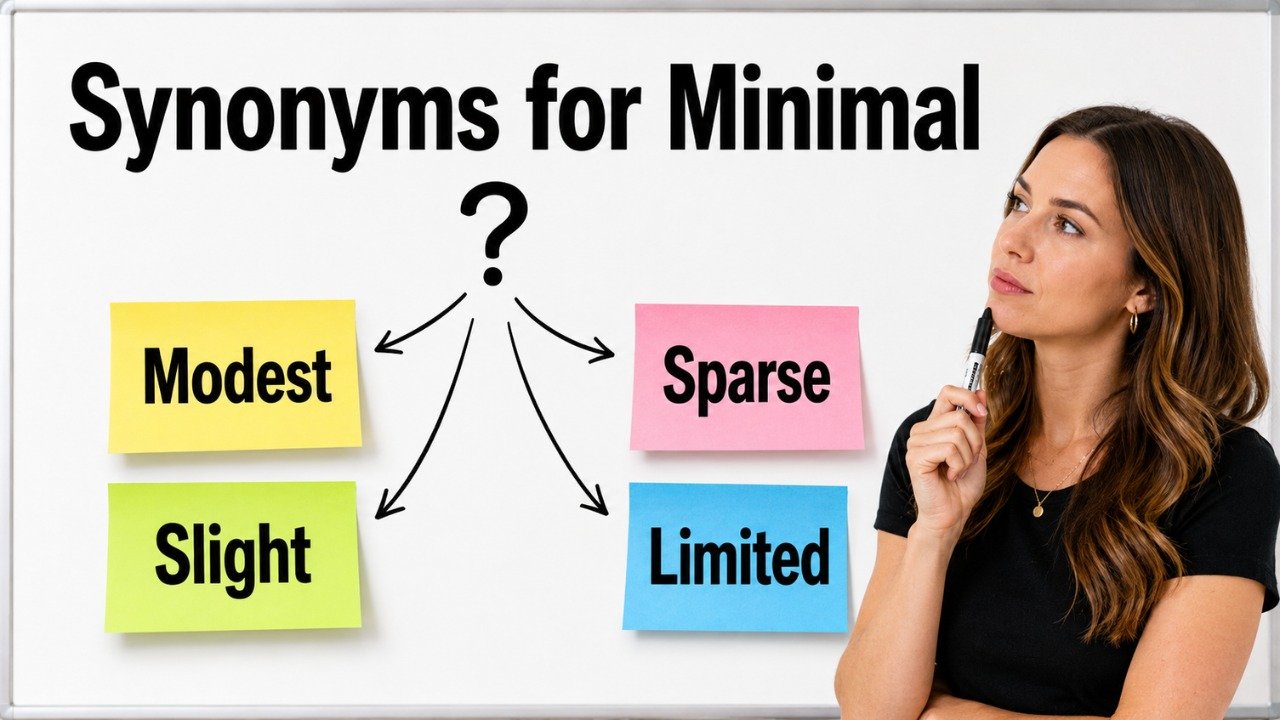
Quick Answer: The best synonyms for minimal include slight, small, limited, modest, negligible, minor, basic, simple, restrained, and sparse. Among these synonyms for minimal, slight works well for a small degree or effect, limited suits quantity or availability, negligible describes something too small to matter much, basic fits essential features, simple works for uncomplicated ideas or designs, and restrained or sparse are useful when describing style, decoration, or presentation.
Pronunciation and Word Details
Word: Minimal.
Pronunciation: /ˈmɪnɪməl/
Part of Speech: Adjective.
Meaning: Very small in amount, degree, size, importance, or complexity.
US Pronunciation:
UK Pronunciation:
What Does “Minimal” Mean?
Minimal means very small in amount, degree, size, importance, or extent.
As an adjective, minimal often describes something that has been reduced to a very low level. A person may experience minimal discomfort, a project may require minimal effort, or a decision may involve minimal risk.
The word can also describe simplicity. A minimal design usually contains only the elements that are necessary, with little decoration or visual complexity.
In practical contexts, minimal can suggest that something exists, but only in a small amount. For example, minimal damage means that some damage occurred, but it was limited.
In design and creative contexts, minimal often refers to simplicity, restraint, clean organization, and the removal of unnecessary details.
The exact meaning depends on what is being described. Minimal effort refers to a small amount of effort, while minimal decoration refers to a simple and restrained visual style.
Meaning, Tone, and Context of “Minimal”
Minimal has a mostly neutral and flexible tone. It appears naturally in everyday conversation, professional communication, academic writing, technical descriptions, reports, instructions, and creative discussions.
In formal writing, minimal often describes measurable amounts, effects, risks, costs, requirements, or changes.
Formal Use: The changes had minimal impact on overall performance.
In casual speech, minimal can describe something that requires very little effort, time, or attention.
Casual Use: The setup takes minimal effort.
In design contexts, minimal suggests simplicity and restraint rather than merely being small.
Design Use: The room has a minimal appearance with simple furniture and little decoration.
In technical contexts, the word can indicate that something has been reduced as much as reasonably possible.
Technical Use: The system requires minimal maintenance.
Minimal is generally less emotional than words such as tiny, paltry, or insignificant. It usually presents a small amount or degree without adding a strong positive or negative judgment.
When and How to Use “Minimal”
For Small Amounts
Use minimal when something exists only in a very small quantity.
Example: The process produces minimal waste.
For Small Effects
Minimal works well when an action or event causes very little change or influence.
Example: The delay had minimal effect on the schedule.
For Low Risk
Use minimal when describing a risk, danger, or possibility that is very small.
Example: The procedure carries minimal risk when performed correctly.
For Limited Effort
Minimal can describe tasks that require little work, energy, or attention.
Example: The application requires minimal preparation.
For Basic Requirements
Use minimal when only a small number of necessary conditions must be satisfied.
Example: The position has minimal experience requirements.
For Simple Design
Minimal is useful for describing clean, simple, and restrained visual choices.
Example: She preferred a minimal design with plenty of open space.
For Small Changes
Use minimal when the difference between two situations is very slight.
Example: There was minimal change in the final results.
For Low Cost
Minimal can describe expenses that remain very small.
Example: The repair was completed at minimal cost.
Best Synonyms for Minimal
Slight: Small in degree, amount, or importance.
Example: There was only a slight improvement in performance.
Limited: Restricted in amount, range, availability, or extent.
Example: The program requires limited resources.
Modest: Small or moderate rather than large or impressive.
Example: The project achieved a modest increase in productivity.
Negligible: So small that it has little practical importance.
Example: The difference between the two results was negligible.
Minor: Small in importance, seriousness, or extent.
Example: The equipment suffered only minor damage.
Basic: Containing only the most necessary features or elements.
Example: The basic package includes the essential tools.
Simple: Easy to understand or containing little complexity.
Example: The instructions follow a simple structure.
Restrained: Controlled, moderate, and free from excessive decoration or expression.
Example: The designer chose a restrained visual style.
Sparse: Present only in small amounts or widely separated.
Example: The office used sparse decoration.
Understated: Simple and attractive without attracting excessive attention.
Example: The room had an understated elegance.
50 Synonyms for Minimal with Short Meanings
- Slight: Small in degree or amount.
- Small: Limited in size, quantity, or extent.
- Tiny: Extremely small.
- Limited: Restricted in quantity, range, or extent.
- Modest: Relatively small or moderate.
- Negligible: Too small to have much importance.
- Minor: Small in importance or seriousness.
- Little: Small in amount or degree.
- Low: Small in level, quantity, or intensity.
- Marginal: Very small or only slightly significant.
- Minute: Extremely small in size or degree.
- Insignificant: Too small or unimportant to have much effect.
- Inconsiderable: Small enough to be relatively unimportant.
- Trifling: Very small in value, amount, or importance.
- Nominal: Very small compared with what might normally be expected.
- Scant: Barely sufficient in amount or quantity.
- Scanty: Small and insufficient in quantity.
- Meager: Very limited in amount or quality.
- Sparse: Thinly distributed or present in small quantities.
- Bare: Containing only what is necessary.
- Basic: Limited to essential elements.
- Simple: Free from unnecessary complexity.
- Plain: Simple and without elaborate decoration.
- Spare: Simple and containing few unnecessary elements.
- Restrained: Controlled and not excessive.
- Understated: Quietly simple rather than showy.
- Subtle: Delicate, slight, or not immediately obvious.
- Muted: Soft, reduced, or restrained in effect.
- Lean: Reduced to necessary elements or resources.
- Compact: Efficiently arranged within a small space.
- Concise: Expressed with few unnecessary words.
- Economical: Using only what is necessary.
- Austere: Very plain and lacking decoration.
- Unadorned: Without decorative additions.
- Unembellished: Presented without unnecessary decoration or detail.
- Uncluttered: Free from unnecessary objects or details.
- Simplified: Made easier or less complicated.
- Reduced: Made smaller in amount, size, or degree.
- Essential: Limited to what is necessary.
- Fundamental: Containing only basic or necessary elements.
- Rudimentary: Basic and not highly developed.
- Elementary: Simple and limited to basic principles.
- Streamlined: Made simpler and more efficient.
- Stripped down: Reduced to the most essential parts.
- Skeletal: Containing only a basic framework.
- Token: Very small in amount and sometimes mainly symbolic.
- Paltry: Disappointingly small or inadequate.
- Faint: Slight in strength, intensity, or visibility.
- Mild: Limited in force, severity, or intensity.
- Moderate: Kept within reasonable or limited bounds.
Read Also:
Synonyms for Memory
Synonyms for Minimal by Context
When Minimal Means Very Small in Amount
When minimal refers to quantity or degree, useful alternatives include slight, small, little, modest, scant, low, and limited.
Example: The project required minimal funding.
Alternative: The project required limited funding.
Slight works especially well for differences, effects, movements, or improvements.
Example: There was only a slight difference between the results.
Modest is useful when the amount is small but still meaningful.
Example: The company reported a modest increase in demand.
When Minimal Means Almost Unimportant
When minimal describes something so small that it has little practical importance, negligible, insignificant, marginal, trifling, and inconsiderable are stronger alternatives.
Example: The error had minimal impact on the final calculation.
Alternative: The error had negligible impact on the final calculation.
Negligible is particularly useful when the amount exists but is too small to affect an outcome significantly.
Example: The difference in cost was negligible.
When Minimal Means Basic
When minimal means containing only necessary features, basic, essential, simple, rudimentary, elementary, and stripped down may work better.
Example: The software has minimal features.
Alternative: The software has only basic features.
Basic emphasizes necessary functions rather than size.
Example: The course provides basic information for beginners.
When Minimal Means Simple in Design
When describing appearance, style, decoration, or presentation, useful alternatives include restrained, understated, sparse, spare, plain, unadorned, uncluttered, and austere.
Example: She chose a minimal interior.
Alternative: She chose an understated interior.
Restrained suggests careful control of decorative elements.
Example: The presentation used a restrained visual style.
Sparse emphasizes the presence of only a few elements.
Example: The room contained sparse furnishings.
When Minimal Means Low in Intensity
For sound, discomfort, damage, force, or intensity, slight, mild, faint, minor, and low can replace minimal.
Example: He experienced minimal discomfort.
Alternative: He experienced mild discomfort.
Minor is especially natural when discussing damage or problems.
Example: The building suffered minor damage.
Another Word for Minimal
The best general replacement for minimal is often slight when referring to degree or amount. However, the most accurate alternative depends on context.
Use limited for restricted quantities, negligible for something too small to matter, basic for necessary features, and restrained for simple design.
Original: The storm caused minimal damage.
Better Option: The storm caused minor damage.
Original: The difference was minimal.
Better Option: The difference was negligible.
Original: The application requires minimal experience.
Better Option: The application requires limited experience.
Original: She prefers minimal decoration.
Better Option: She prefers restrained decoration.
When Not to Use “Minimal”
Minimal is useful, but it can sometimes be less precise than another word.
Avoid using minimal repeatedly when you can identify exactly what is small or limited.
Weak: The project had minimal costs, minimal risks, and minimal delays.
Better: The project had low costs, negligible risks, and only minor delays.
Do not automatically use minimal when you mean simple. Something can be minimal without being easy.
Weak: The instructions were minimal to understand.
Better: The instructions were simple to understand.
Avoid minimal when describing a quantity that is completely absent.
Weak: There was minimal evidence when no evidence was found.
Better: There was no evidence.
Be careful when minimal could make an important issue sound less serious than it actually is.
Weak: The accident caused minimal injuries when several people needed medical care.
Better: The accident caused several injuries that required medical attention.
In creative writing, a more descriptive synonym may produce a clearer image.
Weak: The room contained minimal furniture.
Better: The room contained only a few simple pieces of furniture.
Words Commonly Confused With Minimal
Minimal vs Minimum: Minimal means very small in amount or degree. Minimum refers to the smallest amount that is allowed, possible, or required.
Example With Minimal: The changes had minimal effect.
Example With Minimum: Applicants must have a minimum of two years of experience.
Minimal vs Simple: Minimal emphasizes having very little or only essential elements. Simple emphasizes lack of difficulty or complexity.
Example With Minimal: The room has minimal decoration.
Example With Simple: The instructions are simple to follow.
Minimal vs Minor: Minimal emphasizes a very small amount or degree. Minor usually describes something relatively unimportant or not serious.
Example With Minimal: The treatment caused minimal discomfort.
Example With Minor: The patient experienced a minor reaction.
Minimal vs Negligible: Minimal means very small. Negligible goes further and suggests that something is so small that it can often be ignored.
Example With Minimal: The change produced minimal benefits.
Example With Negligible: The difference in weight was negligible.
Minimal vs Minimalist: Minimal describes something very small, basic, or restrained. Minimalist often describes a style or approach based on simplicity and limited elements.
Example With Minimal: The website uses minimal decoration.
Example With Minimalist: The designer prefers a minimalist approach.
Which Synonym Should You Choose?
Choose slight when describing a small difference, effect, movement, improvement, or change.
Choose limited when something is restricted in amount, availability, range, or opportunity.
Choose negligible when something is so small that it has little practical effect.
Choose minor when describing small problems, damage, errors, injuries, or concerns.
Choose modest when the amount is small but still meaningful or respectable.
Choose basic when something contains only essential features, information, or functions.
Choose simple when you want to emphasize ease, clarity, or lack of complexity.
Choose restrained when describing controlled design, decoration, language, or behavior.
Choose sparse when only a small number of objects, details, or features are present.
Choose understated when something is deliberately simple, subtle, and not designed to attract excessive attention.
For formal reports, limited, negligible, marginal, and minor are often precise choices.
For essays, slight, modest, limited, and insignificant can help express differences in degree.
For professional communication, limited and modest usually sound neutral and clear.
For casual conversation, small, little, slight, simple, and basic often sound more natural.
For design descriptions, restrained, understated, sparse, spare, plain, and uncluttered provide more specific meanings.
Real Life Examples of “Minimal” in Sentences
Original: The renovation caused minimal disruption to daily operations.
Better Option: The renovation caused only slight disruption to daily operations.
Original: The storm caused minimal damage to the building.
Better Option: The storm caused minor damage to the building.
Original: The new system requires minimal maintenance.
Better Option: The new system requires limited maintenance.
Original: There was minimal difference between the two measurements.
Better Option: There was a negligible difference between the two measurements.
Original: The task requires minimal experience.
Better Option: The task requires only basic experience.
Original: She prefers a minimal style in her workspace.
Better Option: She prefers an understated style in her workspace.
Original: The procedure caused minimal discomfort.
Better Option: The procedure caused mild discomfort.
Original: The project achieved minimal improvement during the first month.
Better Option: The project achieved only a slight improvement during the first month.
Original: The room had minimal decoration.
Better Option: The room had sparse decoration.
Original: The change created minimal additional expense.
Better Option: The change created only a modest additional expense.
Synonym Groups and Usage Differences
Small Amount Group
Slight, small, little, modest, scant, and limited describe amounts or degrees that are relatively low.
Slight usually describes degree, while limited emphasizes restriction.
Example: Only a slight adjustment was necessary.
Very Low Importance Group
Negligible, insignificant, marginal, inconsiderable, and trifling describe things with little importance or practical effect.
Negligible is especially useful when an amount is technically present but too small to matter significantly.
Example: The additional expense was negligible.
Basic Structure Group
Basic, essential, fundamental, rudimentary, elementary, and skeletal describe something reduced to necessary or foundational elements.
Basic is the most neutral choice for everyday writing.
Example: The program provides basic editing tools.
Simple Design Group
Restrained, understated, sparse, spare, plain, austere, unadorned, and uncluttered describe simplicity in appearance or presentation.
Understated often has a positive tone, while austere can suggest extreme plainness.
Example: The office has an understated and professional appearance.
Reduced Intensity Group
Mild, faint, slight, low, reduced, and muted describe something with weak or limited strength.
The correct choice depends on the noun being described.
Example: The medication caused only mild discomfort.
Antonyms of Minimal
The opposite of minimal depends on whether the word refers to quantity, degree, complexity, or design.
Maximum: The greatest possible or permitted amount.
Substantial: Large enough to be important or noticeable.
Considerable: Significant in amount, size, or degree.
Significant: Important or large enough to have a noticeable effect.
Major: Large or important in degree or consequence.
Extensive: Covering a large amount, area, or range.
Abundant: Existing in large quantities.
Ample: More than sufficient in amount.
Elaborate: Detailed, complex, and carefully developed.
Ornate: Highly decorated with many details.
Complex: Containing many connected or complicated parts.
Excessive: Greater than what is necessary, reasonable, or desirable.
Comparison: Minimal vs Related Words
Minimal vs Slight
Minimal suggests a very low amount or degree. Slight simply means small and does not always imply that the amount is close to the lowest possible level.
Example With Minimal: The delay had minimal impact on the project.
Example With Slight: The delay caused a slight change in the schedule.
Minimal vs Limited
Minimal focuses on small quantity or degree. Limited emphasizes restriction or a defined boundary.
Example With Minimal: The repair required minimal effort.
Example With Limited: The team had limited time to complete the repair.
Minimal vs Negligible
Minimal means very small. Negligible means so small that it has almost no practical importance.
Example With Minimal: The adjustment produced minimal improvement.
Example With Negligible: The adjustment produced a negligible difference in the final score.
Minimal vs Minor
Minimal focuses on amount or degree. Minor focuses more strongly on importance, seriousness, or consequence.
Example With Minimal: The machine requires minimal maintenance.
Example With Minor: The machine developed a minor fault.
Minimal vs Basic
Minimal describes having very little. Basic describes having only fundamental or necessary features.
Example With Minimal: The page contains minimal decoration.
Example With Basic: The program offers basic editing functions.
Minimal vs Simple
Minimal emphasizes reduction and restraint. Simple emphasizes clarity or lack of complexity.
Example With Minimal: The design contains minimal visual detail.
Example With Simple: The process is simple to understand.
Minimal vs Sparse
Minimal can describe a small amount of almost anything. Sparse is especially useful when items, details, people, plants, or objects are thinly distributed.
Example With Minimal: The office has minimal decoration.
Example With Sparse: The office has sparse furnishings.
Minimal vs Understated
Minimal describes simplicity or limited quantity. Understated describes something intentionally subtle and not attention seeking.
Example With Minimal: The presentation uses minimal graphics.
Example With Understated: The presentation has an understated visual style.
Common Phrases and Expressions With “Minimal”
Minimal Effort: A very small amount of work or energy.
Minimal Risk: A very low level of danger or uncertainty.
Minimal Impact: Very little effect or influence.
Minimal Damage: A very small amount of harm.
Minimal Cost: Very little expense.
Minimal Change: A very small difference from the previous condition.
Minimal Maintenance: Very little regular care or servicing.
Minimal Design: A simple style with few unnecessary elements.
Minimal Requirements: Only a small number of necessary conditions.
Minimal Intervention: Very little direct action or involvement.
Common Mistakes to Avoid
One common mistake is treating minimal and minimum as interchangeable. Minimal describes something very small, while minimum identifies the lowest amount allowed, required, or possible.
Incorrect: The job requires a minimal of three years of experience.
Correct: The job requires a minimum of three years of experience.
Another mistake is using minimal when simple would be more accurate.
Unnatural: The instructions are minimal to follow.
Natural: The instructions are simple to follow.
Avoid choosing a synonym without considering the noun it modifies. Negligible works naturally with differences, effects, costs, and risks, but it may sound strange when describing design.
Unnatural: She wanted a negligible interior design.
Natural: She wanted a restrained interior design.
Repetition can also weaken writing. Using minimal several times in one paragraph makes the language sound mechanical.
Repetitive: The project required minimal effort, minimal funding, and minimal preparation.
Improved: The project required little effort, limited funding, and only basic preparation.
Do not assume every synonym has the same tone. Paltry often expresses criticism, while modest is much more neutral.
Negative: They offered a paltry increase in funding.
Neutral: They offered a modest increase in funding.
Be specific whenever the degree of something matters. Instead of using minimal automatically, choose slight for small changes, minor for small problems, negligible for unimportant differences, or basic for essential features.
Conclusion
The most useful synonyms for minimal depend on what is being described. Slight and modest work well for small amounts or changes, limited emphasizes restriction, negligible suits differences with little practical importance, and minor is useful for problems or damage. For simplicity, basic and simple are natural choices, while restrained, sparse, and understated work especially well for design. Understanding these distinctions helps you choose synonyms for minimal that sound clearer, more precise, and more natural in writing and conversation.
FAQs About Synonyms for Minimal
What Is the Best Synonym for Minimal?
The best general synonym is slight when minimal refers to a small amount or degree. Limited, minor, negligible, basic, and restrained may be better in specific contexts.
What Is Another Word for Minimal Amount?
Useful alternatives include slight, small, modest, scant, limited, negligible, and little. The best choice depends on how small the amount actually is.
Is Minimal the Same as Small?
Not exactly. Small is a broad word for limited size or quantity, while minimal usually emphasizes a very low amount, degree, or level.
What Is a Formal Synonym for Minimal?
Limited, negligible, marginal, modest, insignificant, and minor are useful formal alternatives depending on the context.
What Is a Synonym for Minimal in Design?
Restrained, understated, sparse, spare, plain, uncluttered, and unadorned are useful choices when discussing design or visual style.
What Is the Difference Between Minimal and Minimum?
Minimal means very small in amount or degree. Minimum means the smallest amount that is possible, permitted, or required.
Can Minimal Mean Simple?
Yes. In design, presentation, or structure, minimal can describe something that uses only necessary elements. In these contexts, simple, restrained, spare, basic, or understated may be suitable alternatives.
