
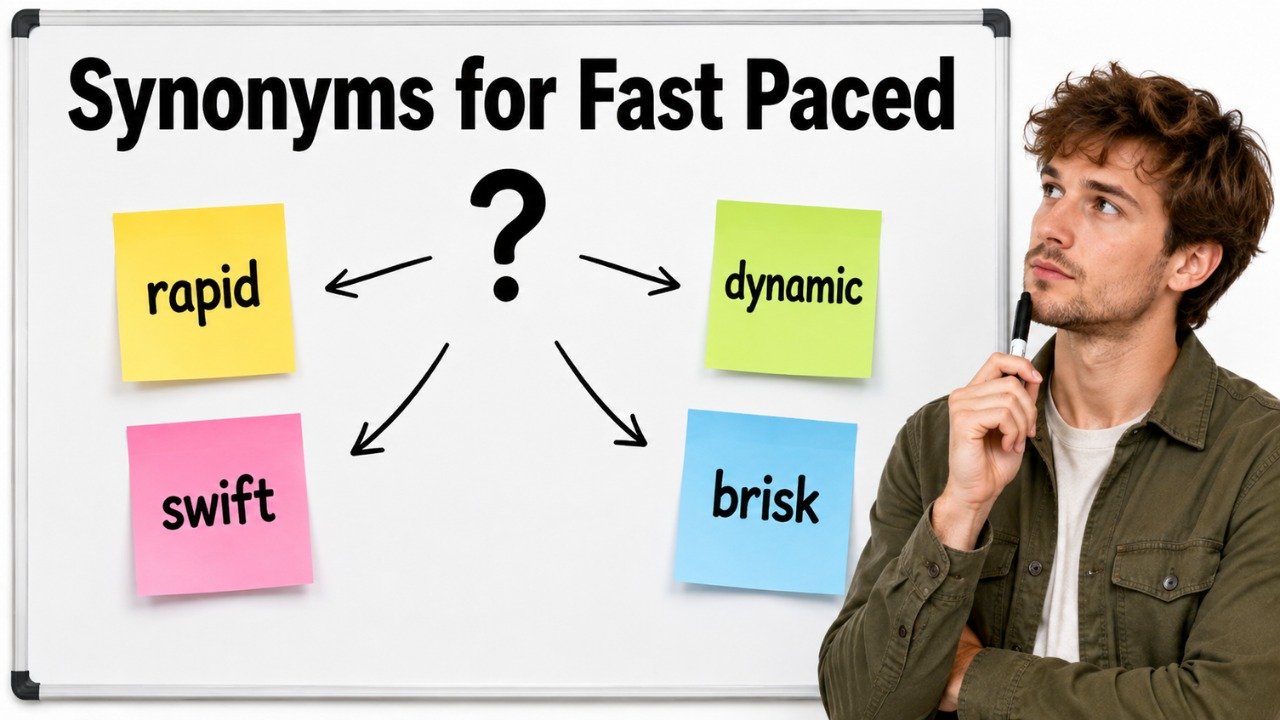
Quick Answer: The best synonyms for fast paced include rapid, brisk, dynamic, energetic, accelerated, hectic, intense, high speed, fast moving, and busy. Use rapid for processes or change, brisk for activity that moves efficiently, dynamic for energetic environments, accelerated for something becoming faster, hectic for stressful activity, intense for demanding situations, and high speed for movement or operations where speed is the main focus.
Pronunciation and Word Details
Word: Fast paced
Pronunciation: /ˌfæst ˈpeɪst/
Part of Speech: Adjective phrase
Meaning: Moving, developing, or happening quickly with frequent activity, change, or action.
US Pronunciation:
UK Pronunciation:
What Does “Fast Paced” Mean?
Fast paced means happening quickly and involving a high level of activity, movement, change, or progress. It is an adjective phrase commonly used to describe environments, jobs, lifestyles, stories, industries, schedules, courses, and situations.
A fast paced workplace may involve frequent tasks, quick decisions, changing priorities, and limited time. A fast paced story usually moves from one event to another quickly. A fast paced lifestyle can involve constant activity and little free time.
The phrase can describe something positively when speed creates excitement, productivity, or energy. It can also have a negative meaning when the speed creates pressure, stress, confusion, or exhaustion.
Work Example: She enjoys working in a fast paced environment where every day brings new challenges.
Lifestyle Example: His fast paced lifestyle leaves little time for relaxation.
Story Example: The novel has a fast paced plot that keeps the reader interested.
Change Example: Employees must adapt to a fast paced industry where methods change frequently.
Meaning, Tone, and Context of “Fast Paced”
Fast paced usually has a neutral or slightly energetic tone, although its exact feeling depends on the situation.
In professional writing, it often describes workplaces, industries, projects, operations, and schedules where tasks happen quickly. In everyday conversation, it can describe a busy life, an exciting event, or any situation that seems to move quickly.
Neutral Tone: Fast paced can simply describe a situation where things happen quickly.
Positive Tone: It can suggest excitement, energy, productivity, progress, and momentum.
Negative Tone: It can suggest stress, pressure, exhaustion, urgency, or lack of rest.
Professional Context: It is commonly used when describing demanding jobs, active workplaces, changing industries, projects, and business environments.
Conversational Context: It can describe a busy day, lifestyle, trip, story, or activity.
Academic Context: More precise alternatives such as rapid, accelerated, dynamic, or rapidly changing may be stronger when describing measurable development or change.
Creative Context: Words such as brisk, energetic, intense, whirlwind, or action packed can make descriptions more vivid.
When and How to Use “Fast Paced”
Use fast paced when speed is connected with activity, frequent change, demanding tasks, or quick movement from one event to another.
For Work Environments: Use fast paced when employees must work quickly, manage several responsibilities, or respond to frequent changes.
Example: She performs well in a fast paced office where priorities change throughout the day.
For Jobs: The phrase works well when describing a position that requires quick thinking and efficient action.
Example: The role is ideal for someone who enjoys a fast paced job.
For Industries: Use it when an industry develops quickly or experiences frequent changes.
Example: Technology related fields often operate in a fast paced environment.
For Stories: Use fast paced when events happen quickly and the plot does not remain focused on one situation for long.
Example: The fast paced story moves rapidly from one conflict to another.
For Lifestyles: The phrase can describe a life filled with work, travel, responsibilities, or frequent activities.
Example: She eventually wanted a break from her fast paced lifestyle.
For Learning: It can describe a course or program that covers substantial material within a short period.
Example: Students need strong concentration to succeed in the fast paced course.
For Change: Use it when developments happen quickly and people must continually adapt.
Example: The company operates in a fast paced market with constantly changing customer expectations.
For Schedules: It can describe a schedule containing many activities within limited time.
Example: Their fast paced schedule included several meetings and presentations.
Best Synonyms for Fast Paced
Rapid
Synonym: Rapid means happening or developing very quickly.
Example: The industry has experienced rapid growth over the past several years.
Rapid is especially useful for change, development, progress, growth, movement, and processes.
Brisk
Synonym: Brisk means quick, energetic, and efficient.
Example: The team maintained a brisk working rhythm throughout the morning.
Brisk often sounds positive and controlled rather than stressful.
Dynamic
Synonym: Dynamic means energetic, active, and constantly changing.
Example: She enjoys the dynamic atmosphere of her workplace.
Dynamic is a strong choice for professional environments, industries, teams, and situations involving change.
Energetic
Synonym: Energetic means full of activity, enthusiasm, and movement.
Example: The event had an energetic atmosphere from beginning to end.
Energetic focuses more on enthusiasm and activity than pure speed.
Accelerated
Synonym: Accelerated means made faster or progressing more quickly than usual.
Example: The project entered an accelerated development stage.
Accelerated is useful for formal, academic, technical, and professional writing.
Hectic
Synonym: Hectic means extremely busy and filled with activity, often in a stressful way.
Example: The office became hectic before the final deadline.
Hectic is best when the speed or activity feels difficult to manage.
Intense
Synonym: Intense means demanding, concentrated, or involving strong activity.
Example: The team completed an intense week of preparation.
Intense emphasizes pressure or effort rather than speed alone.
High Speed
Synonym: High speed means operating, moving, or happening at a very fast rate.
Example: The facility depends on high speed production methods.
High speed works best when actual speed is the main idea.
Fast Moving
Synonym: Fast moving means progressing, changing, or developing quickly.
Example: Employees must adapt quickly in a fast moving industry.
Fast moving is a natural alternative for markets, situations, events, and environments.
Busy
Synonym: Busy means filled with activity, work, or responsibilities.
Example: It was a busy afternoon with several urgent tasks.
Busy is simpler and more conversational than fast paced.
50 Synonyms for Fast Paced with Short Meanings
- Rapid: Happening or developing very quickly.
- Brisk: Quick, active, and energetic.
- Dynamic: Energetic and continually changing.
- Energetic: Full of movement and activity.
- Accelerated: Made faster than normal.
- Speedy: Happening or being completed quickly.
- Swift: Moving or happening rapidly.
- Quick: Taking little time to happen.
- Lively: Full of activity and energy.
- Hectic: Extremely busy and often stressful.
- Intense: Highly demanding or concentrated.
- Busy: Filled with work or activity.
- Active: Involving frequent movement or action.
- Bustling: Full of energetic activity.
- Vigorous: Strong, active, and energetic.
- High Speed: Operating at a very fast rate.
- Quick Moving: Progressing rapidly from one stage to another.
- Fast Moving: Developing, changing, or progressing quickly.
- Rapidly Changing: Experiencing frequent changes in a short time.
- Rapidly Developing: Growing or advancing quickly.
- Rapidly Evolving: Changing continuously at a quick rate.
- Action Packed: Filled with frequent events and activity.
- Demanding: Requiring substantial effort and attention.
- High Pressure: Involving considerable urgency or responsibility.
- Urgent: Requiring quick attention or action.
- Nonstop: Continuing with little or no break.
- Continuous: Happening without significant interruption.
- Relentless: Continuing strongly without slowing.
- Breakneck: Extremely rapid and difficult to maintain.
- Frenzied: Wildly active, hurried, or excited.
- Rushed: Done or experienced with limited time.
- Breathless: So rapid or exciting that there is little opportunity to pause.
- Whirlwind: Involving many activities in a short period.
- Feverish: Extremely active, hurried, or excited.
- Animated: Full of lively energy and activity.
- Spirited: Energetic, enthusiastic, and lively.
- Driving: Creating strong forward movement or momentum.
- Forceful: Strong and energetic in movement or action.
- Momentum Driven: Moving forward through continuing activity and progress.
- Time Sensitive: Requiring action within limited time.
- Deadline Driven: Organized around strict completion times.
- Eventful: Filled with important or frequent events.
- Charged: Filled with strong energy or excitement.
- Intensive: Involving concentrated activity within limited time.
- Compressed: Fitted into a shorter period than usual.
- Rapid Fire: Happening quickly in close succession.
- High Tempo: Maintaining a quick rate of activity.
- Quick Tempo: Moving through activities at a speedy rhythm.
- Swiftly Changing: Changing noticeably within a short time.
- Constantly Moving: Remaining continuously active or progressing.
Read Also:
Synonyms for Object

Synonyms for Fast Paced by Context
When Fast Paced Means Quick or Rapid
When speed itself is the main idea, rapid, swift, quick, speedy, accelerated, and high speed are strong alternatives.
Rapid Example: The organization experienced rapid expansion.
Swift Example: The team made a swift transition to the new process.
Accelerated Example: The program follows an accelerated learning schedule.
These options are useful when something happens within a short period.
When Fast Paced Means Busy and Active
For workplaces, schedules, lifestyles, and environments filled with activity, busy, active, bustling, lively, and energetic work well.
Busy Example: She had a busy schedule throughout the week.
Bustling Example: The bustling office was filled with conversations and activity.
Energetic Example: He enjoys working in an energetic environment.
These words focus more on activity than actual speed.
When Fast Paced Means Stressful
When fast paced describes pressure or difficulty, hectic, intense, demanding, high pressure, rushed, and frenzied are more precise.
Hectic Example: The morning became hectic as several deadlines approached.
Demanding Example: She works in a demanding position that requires constant attention.
High Pressure Example: He remains calm in high pressure situations.
These alternatives communicate the emotional or practical pressure created by speed.
When Fast Paced Means Constantly Changing
For industries, markets, workplaces, and fields that develop quickly, dynamic, rapidly changing, rapidly evolving, fast moving, and rapidly developing are useful.
Dynamic Example: The company operates within a dynamic industry.
Rapidly Changing Example: Employees must understand a rapidly changing market.
Fast Moving Example: Decisions must be made quickly in a fast moving environment.
These choices emphasize change rather than physical speed.
When Fast Paced Means Exciting
For stories, events, activities, and experiences, lively, energetic, action packed, spirited, animated, and whirlwind can sound more expressive.
Action Packed Example: The story is action packed from the opening scene.
Lively Example: The discussion remained lively throughout the evening.
Whirlwind Example: Their weekend became a whirlwind of meetings and activities.
These words help communicate excitement and momentum.
Another Word for Fast Paced
Rapid is one of the best single replacements for fast paced when the main idea is speed. Dynamic is often better when describing an environment involving energy and change, while hectic is more accurate when the activity feels stressful.
The best alternative always depends on what makes the situation fast paced.
Original: The company works in a fast paced industry.
Better Option: The company works in a rapidly changing industry.
Original: She enjoys a fast paced workplace.
Better Option: She enjoys a dynamic workplace.
Original: We had a fast paced morning.
Better Option: We had a hectic morning.
Original: The course has a fast paced structure.
Better Option: The course follows an accelerated structure.
When Not to Use “Fast Paced”
Fast paced is useful, but it can become vague when a more precise word would explain exactly what is happening.
When Speed Can Be Measured More Precisely
If you are describing measurable growth, development, movement, or change, rapid or accelerated may communicate the idea more clearly.
Weak: The region experienced fast paced population growth.
Better: The region experienced rapid population growth.
When You Mean Stressful
Fast paced does not automatically mean stressful. If pressure is the important idea, hectic or demanding may be stronger.
Weak: The morning was extremely fast paced and difficult.
Better: The morning was hectic and difficult.
When You Mean Energetic
If the environment feels lively rather than simply quick, energetic or dynamic may be more descriptive.
Weak: The conference had a fast paced atmosphere.
Better: The conference had an energetic atmosphere.
When You Mean Constant Change
A changing industry is not necessarily moving quickly in every way. Dynamic or rapidly evolving may be clearer.
Weak: She works in a fast paced field that changes constantly.
Better: She works in a rapidly evolving field.
When the Phrase Becomes Repetitive
Repeating fast paced several times can make writing sound generic.
Weak: The fast paced company operates in a fast paced market and maintains a fast paced schedule.
Better: The dynamic company operates in a rapidly changing market and maintains a demanding schedule.
Words Commonly Confused With Fast Paced
Fast Paced vs Fast: Fast describes speed directly, while fast paced usually describes the overall rate of activity, change, or events.
Fast Paced vs Rapid: Rapid emphasizes speed and is often more precise for growth, development, change, movement, and processes.
Fast Paced vs Hectic: Fast paced may be positive or neutral, while hectic usually suggests stress, disorder, or excessive activity.
Fast Paced vs Dynamic: Fast paced emphasizes speed and activity. Dynamic emphasizes energy, change, adaptability, and development.
Fast Paced vs Intense: Fast paced focuses on the speed of events or activity. Intense focuses on difficulty, concentration, pressure, or strength.
Fast Paced vs Busy: Busy simply means filled with activity. Fast paced suggests that those activities also happen quickly.
Fast Paced vs Accelerated: Accelerated normally describes something intentionally or noticeably made faster, such as learning, development, production, or growth.
Which Synonym Should You Choose?
Choose rapid when writing about growth, change, development, progress, or processes that happen quickly.
Choose brisk when the activity is quick but controlled, efficient, and energetic.
Choose dynamic when describing an environment, organization, industry, or situation that combines energy with constant change.
Choose energetic when enthusiasm and activity matter more than actual speed.
Choose accelerated when something has been intentionally made faster or completed within a shorter period.
Choose hectic when the activity feels stressful, crowded, difficult, or overwhelming.
Choose intense when a situation requires substantial concentration, effort, attention, or emotional energy.
Choose high speed when physical or operational speed is the main idea.
Choose busy in casual conversation when you simply mean there is a lot happening.
Choose rapidly changing or rapidly evolving in reports and essays when describing continuous development.
For professional emails, dynamic, busy, demanding, rapid, or rapidly changing may sound clearer depending on the situation.
For casual conversation, busy, hectic, quick, lively, and nonstop are natural choices.
For formal reports, rapid, accelerated, intensive, dynamic, and rapidly evolving usually provide greater precision.
Real Life Examples of “Fast Paced” in Sentences
Original: She enjoys working in a fast paced environment.
Better Option: She enjoys working in a dynamic environment.
Original: The project followed a fast paced schedule.
Better Option: The project followed an accelerated schedule.
Original: It was a fast paced morning at the office.
Better Option: It was a hectic morning at the office.
Original: The industry has become increasingly fast paced.
Better Option: The industry has become increasingly dynamic.
Original: He prefers the excitement of a fast paced lifestyle.
Better Option: He prefers the excitement of an active lifestyle.
Original: The course is extremely fast paced.
Better Option: The course follows an intensive schedule.
Original: The story becomes fast paced near the end.
Better Option: The story becomes action packed near the end.
Original: Their fast paced growth created new challenges.
Better Option: Their rapid growth created new challenges.
Original: She handles fast paced situations confidently.
Better Option: She handles high pressure situations confidently.
Original: The market is fast paced and unpredictable.
Better Option: The market is rapidly changing and unpredictable.
Synonym Groups and Usage Differences
Speed Group
Rapid, swift, quick, speedy, accelerated, and high speed belong to the speed group.
These words work when something happens, moves, develops, or changes within a short time.
Example: The organization experienced rapid expansion during the summer.
Activity Group
Busy, active, bustling, lively, energetic, animated, and spirited emphasize activity.
They are useful when a place or situation contains frequent movement, interaction, or action.
Example: The bustling workspace remained active throughout the afternoon.
Change Group
Dynamic, rapidly changing, rapidly evolving, rapidly developing, and fast moving emphasize continuous development.
These alternatives work especially well for industries, markets, workplaces, technology, and professional environments.
Example: Employees need adaptable skills in a rapidly evolving industry.
Pressure Group
Hectic, intense, demanding, high pressure, rushed, feverish, and frenzied describe situations where speed creates stress or difficulty.
Example: The team remained focused during an intense period of preparation.
Momentum Group
Nonstop, relentless, continuous, high tempo, whirlwind, and constantly moving emphasize uninterrupted progress or activity.
Example: The event followed a high tempo schedule from morning until evening.
Excitement Group
Action packed, lively, animated, charged, and spirited work well when speed creates excitement rather than stress.
Example: The audience enjoyed an action packed performance.
Antonyms of Fast Paced
The opposite of fast paced depends on whether you are describing speed, activity, pressure, or change.
Slow Paced: Moving or developing at a slower rate.
Slow: Taking more time to happen or progress.
Leisurely: Relaxed and without urgency.
Unhurried: Done without rushing.
Relaxed: Calm and free from excessive pressure.
Calm: Peaceful and containing little intense activity.
Steady: Progressing at a consistent and controlled rate.
Gradual: Happening slowly over time.
Measured: Deliberate, controlled, and carefully paced.
Slow Moving: Developing or progressing gradually.
Tranquil: Quiet, peaceful, and free from intense activity.
Deliberate: Done carefully and without unnecessary speed.
Comparison: Fast Paced vs Related Words
Fast Paced vs Rapid
Fast paced describes an overall environment, experience, lifestyle, or situation involving quick activity. Rapid usually describes the speed of a specific process, movement, change, or development.
Example With Fast Paced: She enjoys working in a fast paced environment.
Example With Rapid: The business experienced rapid growth.
Fast Paced vs Brisk
Fast paced can suggest constant speed and activity. Brisk usually suggests quick but controlled and efficient movement.
Example With Fast Paced: The meeting followed a fast paced schedule.
Example With Brisk: The meeting continued at a brisk pace.
Fast Paced vs Dynamic
Fast paced emphasizes speed. Dynamic emphasizes energy, change, development, and adaptability.
Example With Fast Paced: He works in a fast paced office.
Example With Dynamic: He works in a dynamic office where responsibilities continually change.
Fast Paced vs Hectic
Fast paced can be positive, neutral, or negative. Hectic usually has a negative meaning and suggests excessive activity or stress.
Example With Fast Paced: She enjoys her fast paced job.
Example With Hectic: She needed a break after a hectic week.
Fast Paced vs Intense
Fast paced focuses on how quickly activities happen. Intense focuses on the amount of effort, pressure, concentration, or emotion involved.
Example With Fast Paced: The course has a fast paced structure.
Example With Intense: The course requires intense concentration.
Fast Paced vs Busy
Fast paced includes both activity and speed. Busy only tells the reader that there is a lot to do.
Example With Fast Paced: The restaurant has a fast paced working environment.
Example With Busy: Friday evenings are usually busy.
Common Phrases and Expressions With Fast Paced
Fast Paced Environment: A setting where activities and changes happen quickly.
Fast Paced Workplace: A workplace requiring employees to complete tasks and respond quickly.
Fast Paced Job: A position involving frequent tasks, decisions, or changing priorities.
Fast Paced Lifestyle: A way of living that includes constant activity and limited rest.
Fast Paced Industry: A field where developments and changes occur quickly.
Fast Paced Schedule: A timetable containing many activities within limited time.
Fast Paced Story: A story in which events and developments happen quickly.
Fast Paced Course: A course that covers material quickly.
Fast Paced City: A city characterized by frequent activity, movement, and urgency.
Fast Paced Change: Development or transformation occurring within a short period.
Common Mistakes to Avoid
One common mistake is using fast paced whenever something is simply fast. The phrase is usually more useful for an overall rate of activity, events, change, or progress.
Another mistake is treating fast paced and hectic as identical. A fast paced environment can be organized and enjoyable, while a hectic environment usually feels stressful or difficult to control.
Avoid using fast paced repeatedly in professional writing. More specific alternatives can improve clarity.
Repetitive: She works in a fast paced company within a fast paced industry and follows a fast paced schedule.
Improved: She works in a dynamic company within a rapidly evolving industry and follows a demanding schedule.
Do not choose a synonym only because it sounds stronger. Match the word to the intended meaning.
Use rapid for measurable speed or change, dynamic for energy and development, hectic for stressful activity, intense for demanding situations, and busy when you simply mean filled with tasks.
Avoid vague combinations that repeat the same idea.
Awkward: The extremely fast paced rapid development surprised everyone.
Better: The rapid development surprised everyone.
Also consider tone. Breakneck, frenzied, and feverish are much stronger than brisk, dynamic, or rapid. They should be used only when the situation truly feels extreme.
Conclusion
The most useful synonyms for fast paced include rapid, brisk, dynamic, energetic, accelerated, hectic, intense, busy, fast moving, and high speed. The right choice depends on what you want to emphasize. Use rapid for quick development, dynamic for active and changing environments, hectic for stressful activity, accelerated for increased speed, and energetic for lively situations. Choosing a more precise synonym helps your writing sound clearer, more natural, and better suited to the exact context.
FAQs About Synonyms for Fast Paced
What Is the Best Synonym for Fast Paced?
Rapid is one of the strongest general alternatives, especially for change, growth, development, and processes. Dynamic is often better for active environments.
What Is Another Word for a Fast Paced Environment?
Dynamic, busy, energetic, demanding, active, and high pressure can all describe a fast paced environment, depending on whether you want to emphasize energy, workload, or stress.
Is Hectic a Synonym for Fast Paced?
Yes, but hectic has a more negative meaning. It suggests that the quick activity feels stressful, crowded, or difficult to manage.
Is Dynamic the Same as Fast Paced?
Not exactly. Dynamic emphasizes energy and constant change, while fast paced focuses more directly on the speed of activities or events.
What Is a Professional Synonym for Fast Paced?
Dynamic, rapid, accelerated, intensive, demanding, and rapidly evolving are useful professional alternatives. The best choice depends on the sentence.
What Is a Positive Synonym for Fast Paced?
Brisk, dynamic, energetic, lively, and spirited can express the idea positively without suggesting excessive stress.
What Is the Opposite of Fast Paced?
Common opposites include slow paced, leisurely, unhurried, relaxed, gradual, calm, measured, and steady.
